_edited.png)
Best Food Vending Machines for Oklahoma Workplaces

Tuesday afternoon in an Oklahoma City break room tells you more than a product catalog ever will. Half the staff has driven off campus for lunch, the rest is looking at a snack machine filled with stale choices, and the procurement lead is deciding whether to buy equipment, change providers, or give up on vending altogether.
The right setup should keep people on site for quick purchases, reduce complaints to HR, serve second and third shifts, and produce a cost line that makes operational sense. The wrong setup becomes another appliance nobody trusts.
I've placed vending machines in Oklahoma break rooms, healthcare facilities, manufacturing sites, and public spaces. My advice is simple: choose the location first, then choose the machine. Foot traffic, operating hours, customer habits, workforce demographics, available power, and Oklahoma heat matter more than a long feature list.
Location condition | Strong starting point | Main reason |
|---|---|---|
Climate-controlled office with predictable breaks | Dual-zone unit or separate snack and beverage machines | Covers everyday demand without overbuilding |
Hospital or 24-hour facility | Snack machine with frozen capability nearby | Supports overnight staff and visitors |
Hot, dusty manufacturing floor | Beverage machine plus compact refreshment center | Delivers fast purchases during short breaks |
Small alcove or reception area | Compact refreshment center | Uses limited floor space efficiently |
Multi-site workplace program | Managed smart vending | Reduces restocking, service, and reporting burden |
What the Right Food Vending Setup Actually Solves
A break room can have plenty of vending capacity and still fail. If the machine sits away from traffic, misses the night shift, or carries food that does not fit the workforce, people will keep leaving the property. In Oklahoma, heat exposure and long operating hours make placement and service discipline just as important as the cabinet itself.
Start with the site, not the headcount. Spend time near the proposed break room, timeclock, lobby, or employee entrance. Watch who passes through, how long they pause, which shifts overlap, and whether workers already bring meals from home. Nearby restaurants, convenience stores, cafeterias, and delivery access change the sales opportunity.
Practical rule: Put the machine where people already stop, not where the facility has an empty wall.
Then define the operating problem. An office may need quick purchases during scheduled breaks. A hospital, plant, or public facility may need food access through overnight hours, when nearby options are closed. Decide who handles product requests, refunds, cleaning, and service calls before installation. For a managed program, connected equipment can show inventory, sales, machine status, payment performance, temperature, and connectivity health. This overview of vending telemetry explains the operational data these systems can provide.
The service model should match the location. A busy, predictable workplace can justify owned equipment if someone on site will monitor inventory and coordinate repairs. A scattered workforce, long operating day, or temperature-exposed site usually fits managed service better because restocking and maintenance cannot depend on an already-busy employee.
Build the setup around demand
Match the assortment to the people using it. A warehouse crew may favor cold drinks, salty snacks, filling protein items, and quick calories. An office may support bottled water, coffee, fruit, nuts, sandwiches, and baked snacks. A hospital needs choices for clinicians, families, and visitors across different hours.
Healthier vending needs a practical plan, not an empty promise. Research covering campuses, workplaces, and hospitals found that users often view vending as convenient but unhealthy, with water, chocolate, and chips among commonly purchased items. The research also reports that healthier purchases can increase when operators adjust the mix, placement, promotion, and pricing, without a catastrophic sales loss in a hospital setting. Use that evidence before filling every shelf with the same traditional snacks.
The right food vending machine solves a specific access problem. It stays reliable in the site's conditions, fits the traffic pattern, and carries products people will buy repeatedly. In Oklahoma, that location fit determines whether ownership or managed service produces the better return.
The Five Machine Categories Worth Knowing
You need a shared vocabulary before comparing quotes. Oklahoma buyers usually encounter five practical categories, and each one fits a different operating environment.
Standalone snack machines
The standalone snack machine is the familiar baseline. It earns its space in offices, schools, warehouses, and waiting areas where packaged food moves steadily and refrigeration isn't the primary need. Its limitation is obvious: customers still need another machine for cold drinks, and snack-only placement can underperform when beverages drive most visits.
Refrigerated beverage machines
A refrigerated beverage machine is the velocity unit in many workplaces. Bottled water, canned drinks, sports beverages, and energy drinks create frequent repeat purchases, especially near timeclocks and break rooms. The trade-off is power consumption, temperature exposure, and the need to keep the most popular selections available.
Dual-zone combination machines
A dual-zone combination machine puts snacks and chilled drinks in one cabinet. It works well where floor space is limited or demand doesn't justify separate machines. The compromise is depth. Each category has less room than it would in a dedicated cabinet, so fast-moving offices may run out of core drinks or snacks before the next service visit.
Frozen food machines
A frozen unit makes sense when a location needs meals, frozen treats, or extended-hours food access. Hospitals, campuses, residential properties, and large workplaces can justify the format when customers need more than shelf-stable snacks. It requires dependable power, freezer clearance, temperature control, and a service plan for compressor problems.
Compact refreshment centers
A compact refreshment center fits tight hospital alcoves, reception counters, small offices, and controlled-access areas. It provides a smaller, targeted assortment without consuming the footprint of a full lineup. Its limitation is assortment depth. It won't replace a larger snack and beverage program in a busy facility.
Vending technology now reaches beyond the traditional coil machine. Cashless payments, remote monitoring, mobile ordering, product variety, freshness management, and AI-supported inventory tools are reshaping the category, as outlined in this overview of smart market vending machines. The technology matters, but only after the site profile supports it.
Across Oklahoma accounts, Vendmoore most often deploys compact refreshment centers, bottle-and-can vendors, dual-zone chill centers, and frozen food machines. The common thread is not a single favorite cabinet. It's selecting the smallest useful mix that can serve the location without creating dead space or dead inventory.
Comparing Snack, Beverage, Dual-Zone and Frozen Formats
The right cabinet depends on the site, not the sales brochure. In an Oklahoma break room, start with foot traffic, operating hours, customer mix, and temperature exposure. Then choose the format that keeps useful products available without paying to cool or freeze space the location will not use.
Food Vending Machine Formats Compared
Format | Footprint | Capacity | Power | Best-Fit Site | Restock Cadence |
|---|---|---|---|---|---|
Snack | Medium cabinet | Broad packaged-food selection | Standard electrical connection | Offices, schools, warehouses | Can stretch beyond beverage service at moderate demand |
Beverage | Tall refrigerated cabinet | High drink depth | Refrigeration required | Break rooms, timeclocks, public spaces | Often requires frequent attention in busy locations |
Dual-zone combo | Single combined footprint | Snacks and drinks with less depth per category | Refrigeration plus standard operation | Smaller offices and limited-floor-space sites | Balanced service schedule, but fast sellers can empty early |
Frozen | Dedicated freezer cabinet | Frozen meals, treats, or specialty products | Refrigeration and freezer service requirements | Hospitals, campuses, residential sites | Depends heavily on frozen demand and temperature stability |
A snack cabinet suits offices, schools, and warehouses where packaged food sells steadily and cold drinks are available elsewhere. Its broader food assortment can reduce visits when demand stays moderate. A beverage cabinet fits timeclocks, public spaces, and busy break rooms, where repeat drink purchases make empty shelves obvious. Managed service usually fits these high-traffic locations because frequent replenishment and repair coverage protect sales.
A dual-zone unit earns its footprint in a smaller office or a site with limited floor space. It combines snacks and drinks, but each category gets less depth. If both categories sell heavily, separate cabinets can produce more sales per square foot despite occupying more room. For a modest break room, ownership can make sense when an employee can check stock and arrange replenishment. For a larger or multi-shift site, managed service is the safer operating choice.
Frozen equipment belongs in locations with sustained demand for meals, treats, or specialty products. Confirm freezer clearance, circuit availability, drainage or environmental requirements where applicable, and a contingency plan for compressor failure during a hot Tulsa afternoon. Without service coverage, a frozen machine creates food-quality exposure. Buyers evaluating packaged snacks for hospitality settings can also review buying crisps for UK hospitality for ideas on flavor variety, product format, and stocking decisions.
Technical selection matters most where equipment faces heat or long operating hours. Refrigerated beverage equipment should maintain a 36°F ± 1°F next-to-vend temperature under the U.S. Department of Energy test procedure. ENERGY STAR tests that target under outdoor conditions of 90°F ± 2°F and 65% ± 5% relative humidity, while indoor testing uses 75°F ± 2°F and 45% ± 5% relative humidity, according to the DOE refrigerated beverage vending procedure. Review guidance on hot and cold vending machines before approving equipment for mixed-temperature service. In Oklahoma, verified thermal performance matters more than a cabinet's advertised capacity.
Matching Machine Mix to Your Location Profile
A machine that works in an Edmond office can fail on a Tulsa production floor. The difference usually isn't the cabinet. It's the traffic pattern, the users, the hours, and the environment.
Location Profile | Foot Traffic | Recommended Mix | Restock Cadence | Common Mistake |
|---|---|---|---|---|
Corporate office in Oklahoma City | Concentrated during predictable workday breaks | Dual-zone unit plus glass-front beverage machine | Planned around peak workday demand | Stocking for total headcount instead of actual break patterns |
Hospital break area | Continuous across rotating staff and visitors | Frozen unit plus snack machine | Frequent monitoring with overnight coverage | Ignoring visitors and second or third shifts |
Manufacturing floor in Tulsa or Norman | Short, repeated breaks near timeclock areas | Compact refreshment center plus beverage machine | Driven by shift volume and heat exposure | Installing a full snack lineup too far from the workforce |
Corporate office
An Oklahoma City corporate office with 400 employees on one shift has a concentrated demand pattern, with predictable peaks around 10 a.m. and 2 p.m. A dual-zone unit handles routine snack and drink purchases, while a glass-front beverage machine protects cold-drink availability when the combination cabinet doesn't have enough depth. Climate control simplifies refrigeration and product protection.
Don't fill every slot with novelty items. Start with familiar drinks, water, traditional snacks, and a smaller healthy range. Use the first service period to identify what sits, then adjust the planogram through a disciplined assortment planning process.
Hospital break area
A hospital doesn't shut down at five. Rotating clinical teams, visiting families, and overnight staff create demand that a standard office mix misses. Frozen meals and treats can earn their space here, but only if the facility has the power, clearance, and service response needed to protect temperature-sensitive inventory.
The common waste is overstocking fresh or frozen items without checking who buys them. Start with controlled depth, monitor sell-through, and keep dependable packaged snacks available for late shifts.
Manufacturing floor
Tulsa and Norman manufacturing sites create a different challenge. Heat, dust, noise, and short breaks favor quick purchases near the timeclock rather than a polished snack lineup in a distant employee lounge. A compact refreshment center paired with a beverage machine often serves the actual behavior better.
A full cabinet can look impressive and still miss the workforce. Put the machine where employees can reach it without spending their entire break walking across the facility.
Cost Factors and ROI You Can Model
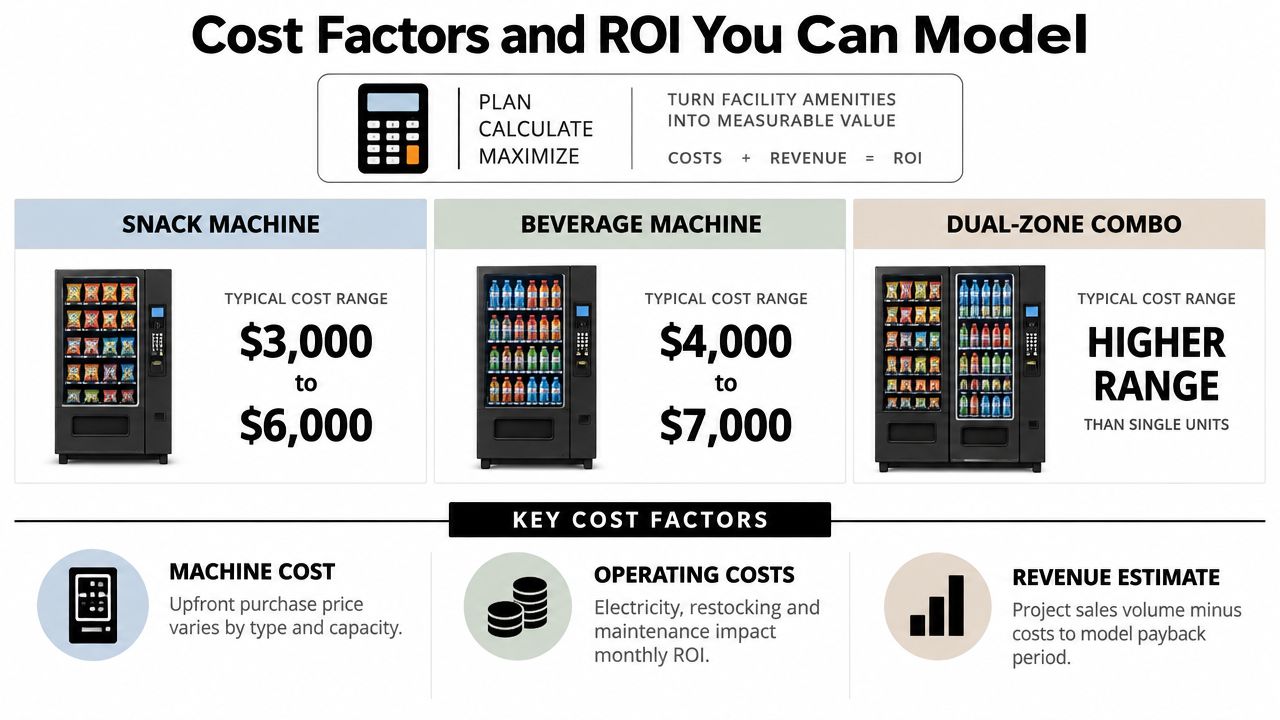
Approve a cabinet only after the location profile supports the math. A busy Oklahoma break room with long operating hours can justify higher equipment and service costs. A low-traffic site with limited access hours usually needs a smaller setup or managed service. Model equipment, installation, electricity, labor, payment costs, maintenance, inventory, and any location revenue share.
Use current vendor quotes for equipment and installation rather than treating broad market ranges as a promise. Record the machine price, electrical requirements, delivery charge, payment hardware, and opening inventory in one worksheet. For energy planning, compare the manufacturer's normalized consumption with the facility's utility rate and the machine's refrigerated volume.
Use a plain calculation
Build the ownership model in this order:
Total startup cost: Add the machine, delivery, installation, payment hardware, and opening inventory.
Monthly operating cost: Add electricity, restock labor, vehicle travel, maintenance, payment processing, insurance, and location fees.
Gross sales estimate: Multiply expected daily transactions by average vend price and operating days.
Gross profit: Apply the expected 35% to 45% gross margin to sales, then subtract operating expenses.
Payback period: Divide the initial investment by the monthly contribution after operating costs.
For a managed program, replace the equipment purchase and internal labor burden with the agreed service structure. The contract may use revenue share, a flat fee, or another arrangement. Compare owned capital and operating responsibility against outsourced service, response time, and accountability. A rural location can make ownership look attractive until travel, replenishment, and downtime are included.
The DOE size-based energy model includes formulas such as MDEC = 0.055 × V + 2.56 kWh/day* for one efficiency class and MDEC = 0.073 × V + 3.16 kWh/day* for another. Technical materials also show Y = 0.0657 × V + 2.844, while EN 50597:2018 provides a measurement method for vending-machine energy consumption. Use those methods to compare machines on a consistent basis instead of judging raw wattage alone.
Product waste often decides whether the model works. Slow items tie up cash, create expiration exposure, and add service visits. Keep the first assortment focused on products the site will buy, then adjust it from sales records. For frozen treats or specialty products, use a separate resource to calculate soft serve profitability.
Use this vending cost comparison analysis to pressure-test ownership against a managed arrangement.
Managed Service Versus Owning Your Machines
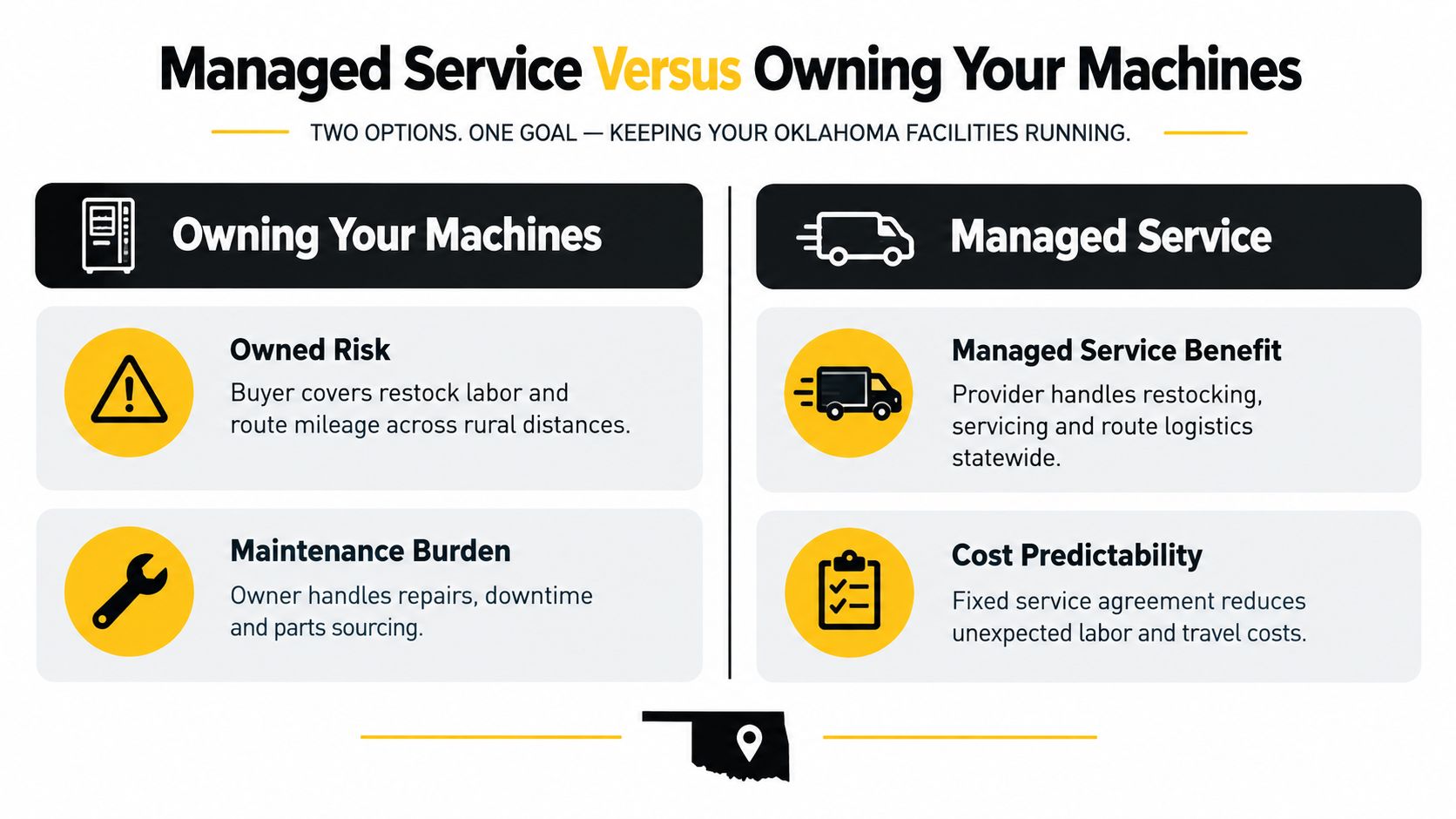
A busy Oklahoma hospital, a weekday office, and a rural shop need different vending arrangements. I recommend managed vending for sites with uneven staffing, long operating hours, temperature-sensitive products, or limited facilities support. Ownership works better when sales are predictable, the machine sits near an established urban route, and someone on staff can handle daily operations.
Ownership puts the full workload on the buyer. Staff must purchase inventory, load vehicles, restock, collect cash, reconcile sales, process refunds, source parts, clean equipment, check temperature, and respond to downtime. A rural placement adds mileage and travel time, especially when the site sits far from an existing route.
A managed operator assigns those tasks to a service route. Route density can make visits more efficient in Oklahoma City and Tulsa. Service economics become less favorable in smaller towns unless the provider already serves nearby accounts. Ask for the operator's actual territory, planned visit frequency, and response process. A statewide service claim means little if your site is an isolated stop.
When ownership makes sense
Ownership fits a site with high, predictable volume, urban access, and internal maintenance or facilities staff. It can also fit a multi-site organization with centralized purchasing, a replenishment team, and one person responsible for reviewing performance across locations.
That setup is uncommon in ordinary workplaces. A facilities lead usually has several competing responsibilities, so restocking and troubleshooting wait until someone reports a problem. Choose ownership only if the buyer can assign those duties before the machine arrives.
Questions to put in the agreement
Response time: What happens when the card reader, refrigeration, or product delivery fails?
Restock commitment: What triggers a visit, and what happens after a stockout?
Reporting frequency: Will the buyer receive sales, inventory, temperature, and payment performance data?
Assortment decisions: Who removes slow products and approves replacements?
Refund handling: Can customers report failed transactions without sending every complaint through HR?
Cashless purchasing now plays a central role in vending. Use a card reader and mobile payment system, but judge the arrangement by its support terms. Payment convenience does not compensate for empty shelves, unresolved refunds, or repeated equipment failures. The agreement must define who monitors transactions, handles complaints, and restores service when the system stops working.
A Procurement Checklist for Oklahoma Buyers
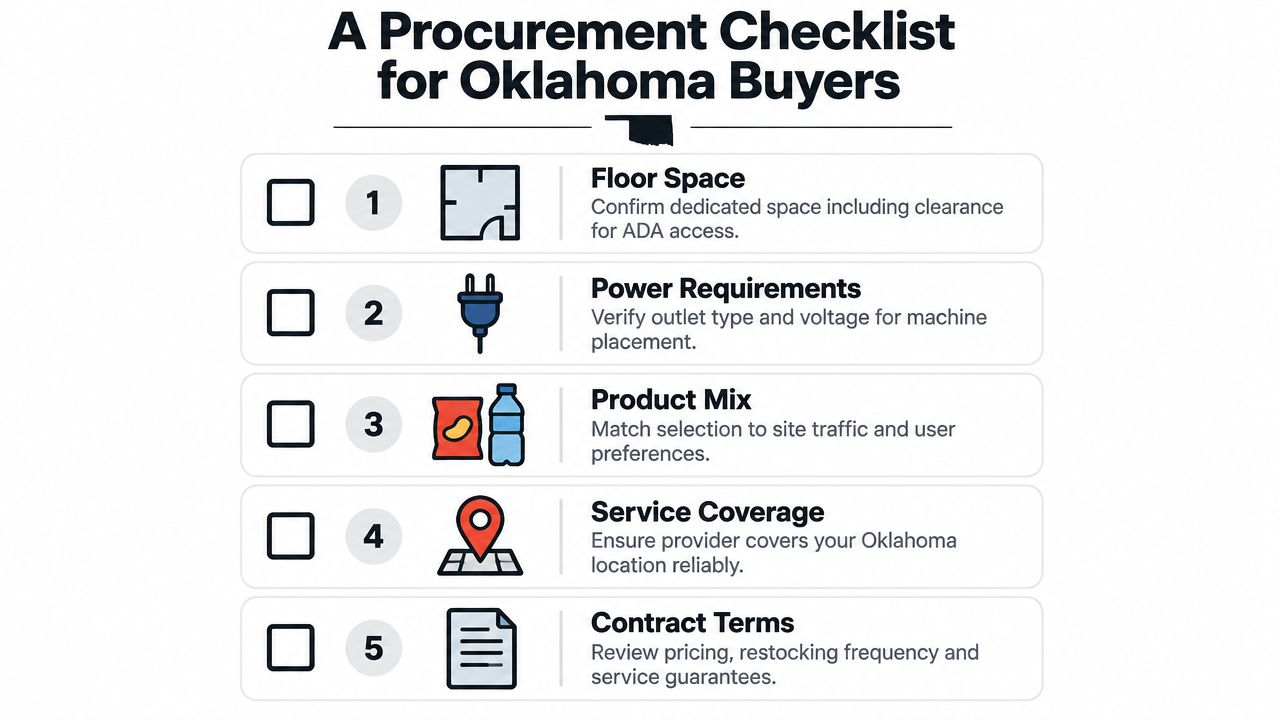
Before requesting quotes, document the site. A provider can't recommend the right machine from employee headcount alone.
Floor space: Measure the dedicated area, confirm ADA access clearance, and identify where customers will stand while making a purchase.
Power requirements: Verify the outlet type, circuit capacity, and whether the proposed machine can share power safely. Oklahoma warehouse sites may rely on shared 120V circuits, which can limit frozen placement.
Demand window: Record shifts, clinic hours, school schedules, after-school activity, visitor patterns, and weekend access. A facility that operates around the clock needs a different replenishment plan than a weekday office.
Comparable references: Ask for Oklahoma references in settings similar to yours, such as Tulsa manufacturing, Norman healthcare, or Edmond schools. Confirm response windows in writing.
Contract terms: Compare revenue share and flat-fee structures, restock frequency, payment processing, refund handling, slow-SKU removal, maintenance responsibility, and service guarantees.
Don't judge proposals by machine price alone. Put the same site information in front of every vendor, request the recommended mix in writing, and ask each provider to explain what they would remove if the first assortment underperforms. That answer reveals whether you're speaking with a route operator or someone selling equipment.
A short site survey should finish the process. Vendmoore Enterprises offers managed vending and ownership options, with equipment, installation, stocking, maintenance, cashless payments, telemetry, and location-specific assortments available for Oklahoma workplaces and public spaces. Visit Vendmoore Enterprises to request a site review and discuss a machine mix built for your traffic, hours, workforce, and facility conditions.
Comments