_edited.png)
Best Smart Vending Machines: A Buyer's Guide

What makes a vending machine “smart” enough to improve an Oklahoma break room, rather than expensive enough to impress visitors? A touchscreen, mobile wallet reader, or polished cabinet may improve the buying experience, but none of those features solves an empty cooler, a failed payment terminal, or a service visit that happens after employees have already stopped using the machine.
For facility managers, the better question is operational: which vending solution delivers reliable availability, useful data, simple payments, and manageable service costs over its full life? That question matters whether you run a corporate office in Oklahoma City, a manufacturing site in Norman, a healthcare facility in Edmond, or a multi-tenant property with several common areas.
The comparison below provides a practical starting point. The best smart vending machines aren't necessarily the ones with the longest feature list. They're the ones that match the site's traffic, product needs, service expectations, and ownership model.
Decision area | Basic vending upgrade | Connected smart vending | Managed vending program |
|---|---|---|---|
Payments | Card and contactless acceptance | Card, mobile wallet, and transaction reporting | Provider supplies and manages payment technology |
Inventory visibility | Manual checks | Remote stock and sales data | Provider uses data to plan replenishment |
Maintenance | Facility or operator schedules service | Alerts can identify issues remotely | Provider owns follow-up and service coordination |
Product changes | Based on occasional feedback | Based on transaction and inventory patterns | Provider can adjust the assortment with location feedback |
Capital responsibility | Buyer pays for equipment | Buyer pays for connected equipment and software | Provider may supply equipment under an agreed commercial model |
Best fit | Small, predictable locations | Teams with internal vending oversight | Workplaces seeking less operational friction |
What Defines a True Smart Vending Machine
Most buyers associate “smart” with the screen facing the customer. That's the visible part, but it isn't the part that determines whether a break room performs well. A true smart vending machine is a networked retail node that sends useful information about sales, inventory, temperature, access events, and mechanical condition to an operator or management platform.
That distinction changes the buying conversation. Instead of asking whether a machine has an attractive interface, an Oklahoma facility manager should ask whether the machine can tell someone that a popular drink is nearly gone, a refrigeration zone is outside its expected range, or a payment component needs attention. Those signals help people act before employees encounter an empty selection or a failed purchase.
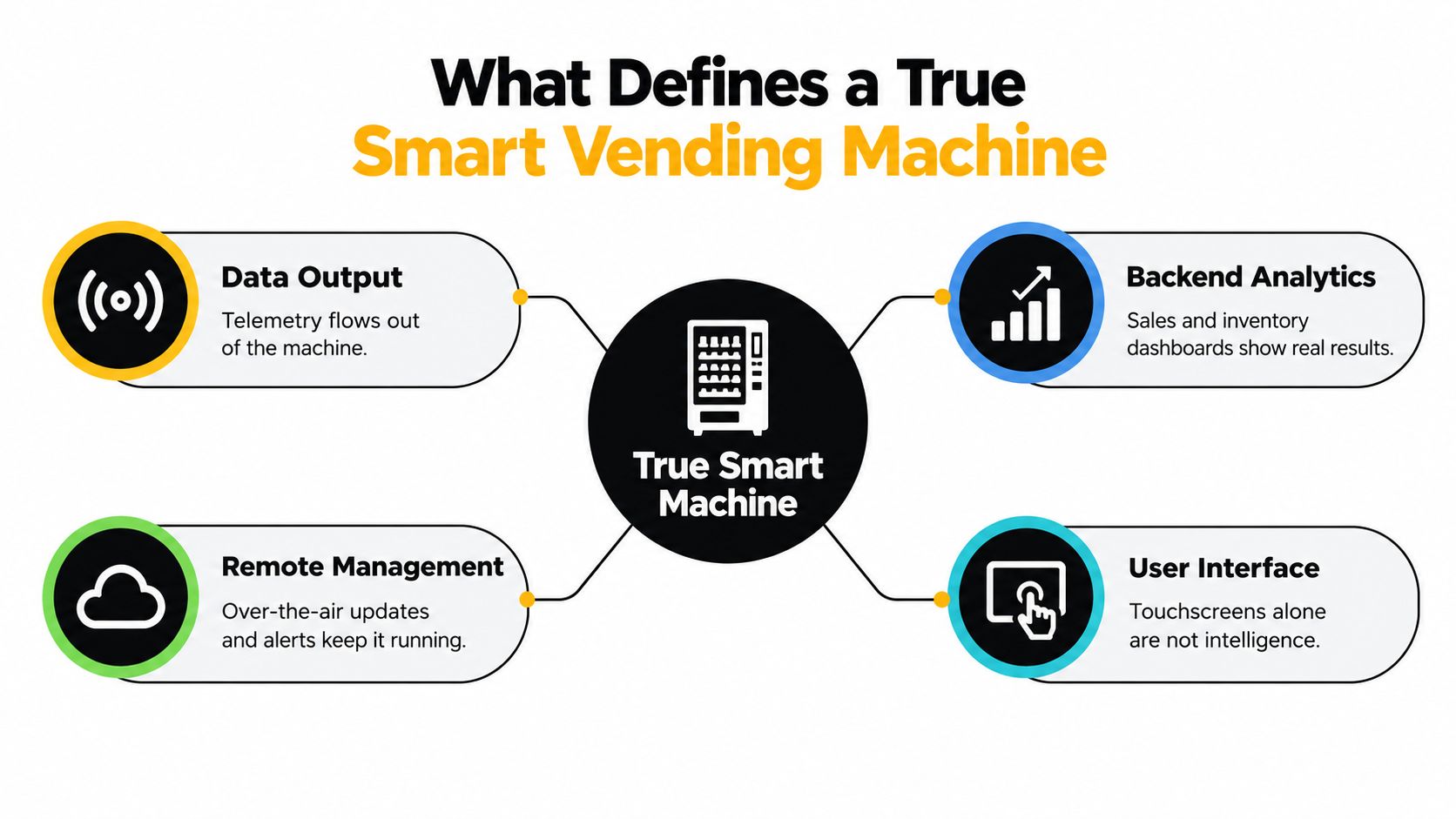
The four layers behind the label
Data output is the foundation. The machine needs to communicate sales, stock movement, and status information consistently. Without that outbound data, a touchscreen remains a user-interface upgrade rather than an operational system.
Backend analytics turns raw events into decisions. Managers need dashboards or reports that help them understand which products move, which selections sit untouched, and where service attention should go. The value isn't the dashboard itself. The value is fewer blind spots.
Remote management connects information to action. Alerts, configuration changes, payment monitoring, and service workflows can reduce dependence on physical inspections. The exact capabilities vary by platform, so buyers should ask which alerts are included, who receives them, and whether the provider responds to them.
The user interface still matters. Employees want clear product information and a quick payment path, but a screen alone doesn't make a machine intelligent. A reliable card reader and mobile-wallet flow may matter more than an elaborate display in a busy workplace.
Berg Insight projects the global installed base of connected vending machines to grow from 8.1 million units in 2025 to 11.7 million by 2030, a 7.6% CAGR, reflecting the industry's movement toward networked telemetry, cashless payments, and remote management. Its breakdown also distinguishes telemetry and software from payment systems, mobile phone and NFC capabilities, and biometric payment options, which helps buyers separate a reporting-only machine from a fuller connected stack. Berg Insight's connected vending machine research provides useful context for that distinction.
Practical rule: Buy the data path before buying the visual polish. If the machine can't produce reliable operational information, the “smart” label won't improve replenishment.
Asset-heavy facilities can apply the same logic beyond refreshments. A resource on the benefits of asset tracking software shows why organizations value visibility into distributed equipment, not just the ability to dispense an item. For a closer explanation of the mechanics behind connected vending, see how smart vending machines work.
Key Features to Compare in Smart Vending Solutions
A feature list doesn't tell you whether a machine will work in your break room. Compare the features by the operational problem each one solves. A facility with frequent stockouts needs a different priority order from a small office that mainly wants contactless payment.
Market research describes smart vending as a combination of IoT connectivity, cashless payments, remote monitoring, digital interfaces, telemetry, and data analytics, with payment data connected to machine telemetry to reveal transaction patterns alongside machine status. This overview of smart vending capabilities supports a useful principle: the machine becomes more valuable when its systems work together.
Payment processing
Start with the checkout path. Look for card acceptance, contactless payments, mobile-wallet compatibility, clear error handling, and a process for resolving incomplete or disputed transactions. Apple Pay and Google Wallet may be especially relevant in workplaces where employees expect to use a phone or watch rather than carry cash.
Ask whether payment reporting is tied to product movement. A reader that accepts payments but doesn't feed usable information into inventory and sales reporting leaves part of the opportunity unused.
Telemetry and monitoring
Telemetry should answer practical questions:
What is selling? Sales data should help identify products that deserve more space or a different placement.
What is running low? Inventory alerts should support planned replenishment rather than routine guesswork.
What needs attention? Mechanical, temperature, door-access, and payment-status signals can help prioritize service.
Who receives the alert? A notification has limited value if nobody owns the response.
Inventory and product zoning
Product zoning is the physical side of assortment strategy. A dual-zone machine may serve chilled drinks and other items differently from a frozen-food unit or a compact refreshment center. The right configuration depends on the workplace schedule, available space, temperature requirements, and the products employees request.
Don't pay for complexity without a clear use case. AI-assisted recognition or advanced analytics may be useful in a large, varied fleet, but a single low-volume office may gain more from dependable stock visibility and fast service.
Software and integration
Review the software experience as carefully as the cabinet. Can users export sales information? Can managers view multiple locations? Does the platform separate operator access from facility access? Are updates and alerts included, or do they require a separate subscription?
A practical review of smart vending machine software can help managers understand why the software layer deserves its own procurement questions. The strongest solution is the one that turns machine activity into a usable routine for replenishment, service, and assortment decisions.
How Telemetry and Payments Transform Break Room Economics
The commercial case for connected vending rests on two linked changes. Cashless payment removes friction at the point of sale, while telemetry helps operators decide when and where to spend labor. Neither feature guarantees profitability by itself, but together they can improve the quality of everyday decisions.
A market report says cashless transactions represented 75.8% of global vending machine revenue in 2025. Another industry source reports that 71% of vending sales in 2024 were cashless, with cashless purchases averaging $2.24 compared with $1.78 for cash, a 37% higher ticket size. These figures are reported in Grand View Research's global vending machine market analysis, and they show why cashless acceptance is now a commercial requirement rather than a decorative upgrade.
For an Oklahoma workplace, the implication is straightforward. Employees may be more willing to buy a drink, snack, coffee, or meal when payment takes a tap instead of a search for cash. A smoother checkout can also make the machine more useful during shift changes, short breaks, and busy building events.
A workplace refreshment program can support more than convenience. Managers evaluating beverage and coffee options may also find practical ideas in this guide to boost office morale with coffee, particularly when deciding whether the break room should serve only packaged snacks or a broader refreshment mix.
Telemetry turns routes into decisions
Traditional servicing often depends on a schedule. The operator visits because the route says it is time, not necessarily because the machine needs every product or because a specific fault has occurred. Telemetry changes that sequence by connecting inventory and status information to replenishment planning.
That distinction matters in a spread-out portfolio across Oklahoma City, Norman, Edmond, and surrounding communities. A provider can use current information to prioritize locations, adjust the product mix, and investigate a problem before the next routine visit. A facility buying its own machine may need to assign someone to review the data and coordinate those actions.
Read the operational detail in telemetry data collection for vending before comparing platforms. The key question isn't whether data exists. It's whether the data changes a decision that would otherwise cost a sale, a service trip, or employee confidence.
Buying vs Managed Programs for Your Facility
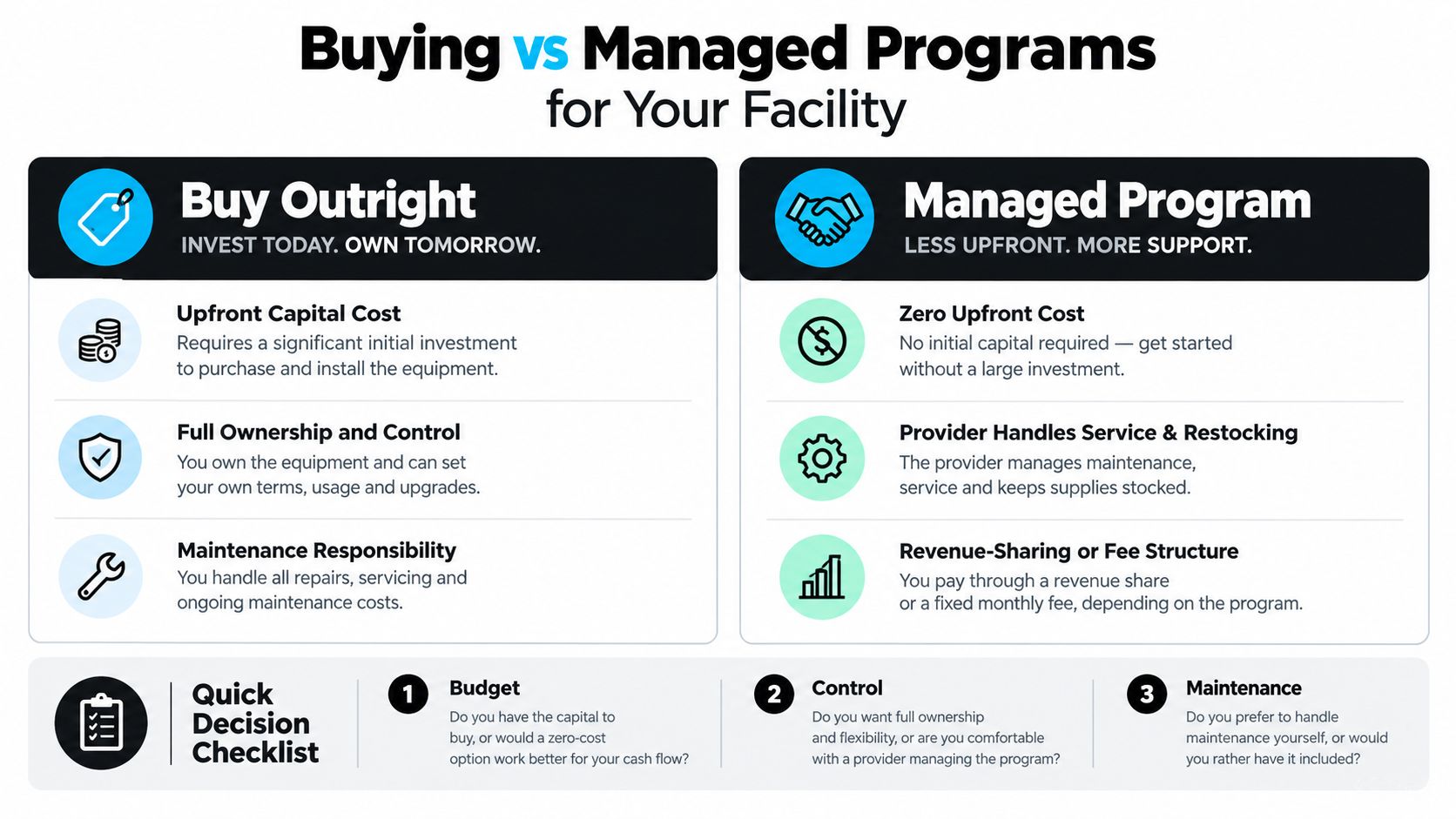
The equipment decision and the service decision are separate. A company can own a connected machine and still outsource replenishment, or it can choose a managed program in which the provider supplies equipment, products, service, and reporting. Treating those paths as interchangeable creates an incomplete cost comparison.
When buying outright makes sense
Ownership can suit an organization that wants direct control over equipment, product sourcing, branding, and data access. It may also fit a location with an internal facilities team that can manage service tickets, payment administration, product ordering, cleaning, and compliance requirements.
The trade-off is responsibility. The buyer carries the equipment cost and must account for software, connectivity, repairs, payment administration, inventory, replenishment labor, and eventual replacement. A low purchase price can become a costly choice if staff rarely review telemetry or if the machine sits empty between service visits.
Before purchasing, build a total-cost worksheet with these categories:
Equipment: Include the machine, payment hardware, installation, and any required modifications.
Technology: Identify software, connectivity, reporting, support, and update costs.
Operations: Assign a real owner for ordering, stocking, cleaning, refunds, and issue resolution.
Compliance: Confirm local requirements, site approvals, accessibility considerations, and food-handling responsibilities.
Downtime: Estimate the practical cost of an unavailable machine, even if you can't express it precisely in advance.
When managed service is the better operating model
A managed program shifts more of the recurring work to a provider. The provider may handle product selection, stocking, payment support, maintenance, telemetry review, and follow-up. The commercial structure can involve revenue sharing, service fees, product margins, or another agreed arrangement, so the contract needs careful review.
The central benefit is not that the machine becomes cheaper. It's that the organization buys less internal coordination. For a workplace manager, that can matter more than owning the cabinet, especially when vending is a supporting amenity rather than a core business function.
Market coverage highlights this overlooked total-cost question. A 2026 outlook estimates the smart vending market at USD 18 billion to USD 28 billion and a 12% to 16% CAGR through 2031, while also noting that hardware, software, network, servicing, and compliance costs shape payback. The same source says fragmented municipal licensing can delay deployments by up to six months, demonstrating why rollout planning belongs in the business case. The smart vending market outlook from Research and Markets provides that context.
Decision test: If your team wants control but doesn't have time to operate the equipment, ownership may create the wrong kind of control. Choose the model that gives someone clear accountability for uptime and replenishment.
For organizations comparing service structures, vendor-managed inventory services offers a useful framework for thinking about who monitors stock, who makes ordering decisions, and who carries the operational burden.
Matching Vending Tech to Workplace Use Cases
A corporate office, hospital, school, manufacturing plant, airport, and residential property may all need vending, but they don't need the same machine. The correct choice depends on who uses it, when they use it, what products they need, and how difficult it is to reach the location for service.
Corporate offices and business centers
Office users often value speed, product variety, and a clean experience. A compact refreshment center may fit a smaller break room, while a larger building may justify separate beverage, snack, chilled-food, or frozen-food capacity. The assortment should reflect employee feedback and actual sales rather than a fixed list chosen during installation.
A smart system is particularly useful when occupancy changes by day, department, or shift. Managers can compare product movement and adjust the range instead of treating the first assortment as permanent.
Healthcare and medical facilities
Hospitals and clinics need dependable access, straightforward payment, and careful product handling. Staff may purchase during short breaks, while visitors may need clear instructions and accessible controls. A facility should ask how the provider handles temperature-sensitive products, cleaning, refunds, and service access in areas with security or infection-control requirements.
Temperature monitoring can be valuable where chilled or frozen products are offered. It can also help distinguish a product problem from a mechanical or environmental problem, provided someone reviews the alerts and responds promptly.
Schools, campuses, and industrial sites
Educational and industrial environments often have varied schedules and distinct user groups. A campus may need several smaller placements across buildings, while a manufacturing site may prioritize equipment, shift coverage, and easy access to drinks and filling snacks.
Telemetry systems can provide real-time inventory monitoring, internal temperature tracking, door-access event logging, and mechanical status indicators. One industry report also says connected machines can reduce out-of-stocks by 40% and truck rolls by 25%, making replenishment more targeted. The telemetry and smart vending analysis from MarketIntelo supports evaluating these capabilities as operational tools rather than marketing extras.
Use the following video as a visual reference for how vending technology can fit into a high-traffic public environment:
Airports, stadiums, and residential properties
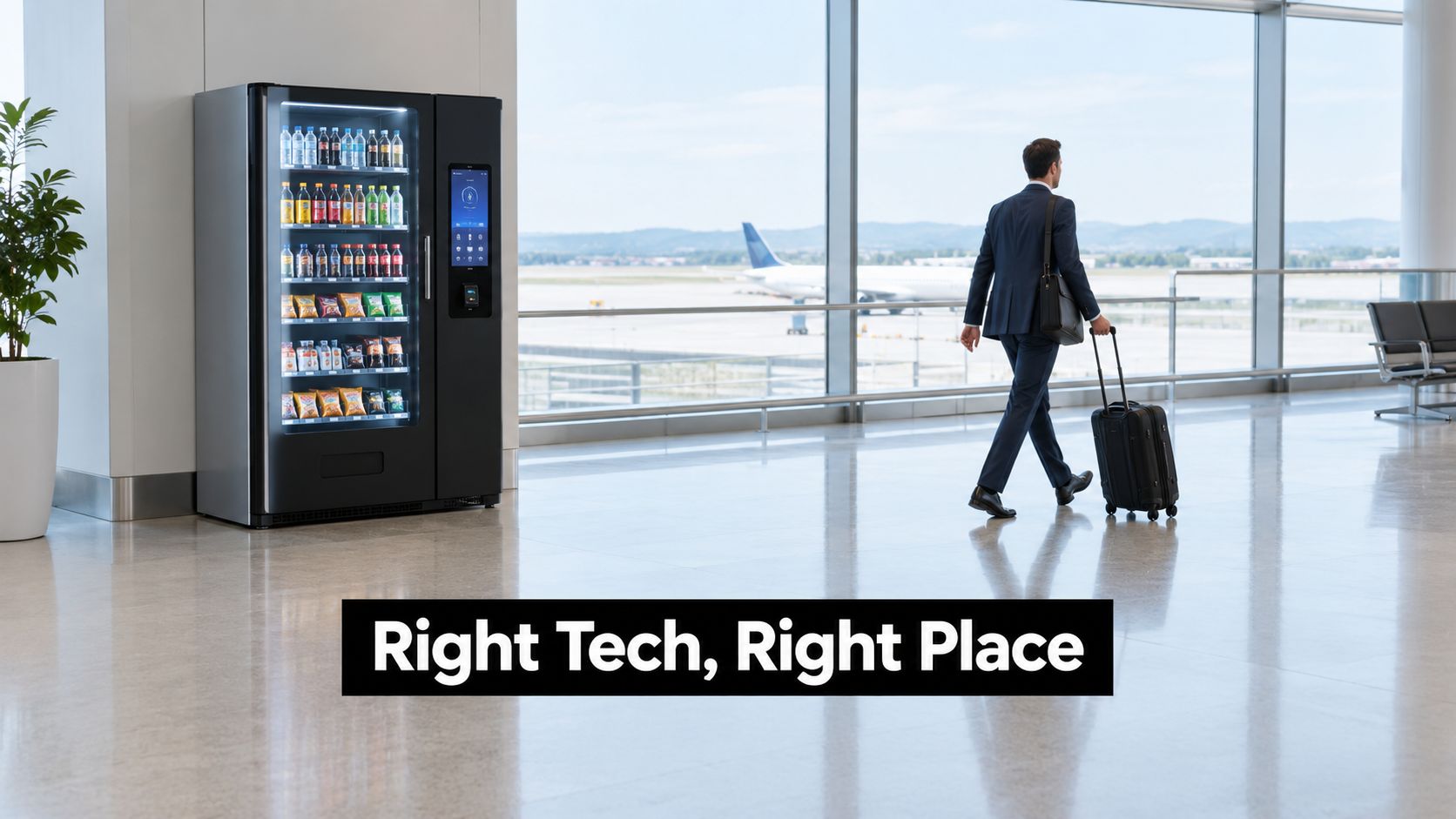
High-traffic venues need fast payment, strong visibility, and service processes that can work around access restrictions. Residential properties may care more about simple replenishment, quiet operation, and a product range that serves residents at different hours.
The hidden cost is not always the machine. It may be a difficult delivery route, restricted loading access, a distant service area, or a product mix that requires frequent manual correction. Match the equipment and provider to those realities before selecting advanced features.
Choosing the Right Partner for Sustainable Operations
A purchased machine can be technically capable and still underperform if nobody owns the operating routine. A managed program can also disappoint if the provider responds slowly, ignores product feedback, or treats telemetry as a reporting ornament. The partner evaluation should therefore focus on behaviors, not only equipment specifications.
Consider a representative Oklahoma workplace with a busy office population, a changing schedule, and employees who want cold drinks, snacks, coffee, and occasional meal options. The facilities manager compares two proposals. The first offers machine ownership and a long feature list. The second offers a managed program with connected payment, replenishment, maintenance, and assortment reviews.
The ownership proposal looks attractive because the company would control the asset. During procurement, however, the manager identifies several unanswered responsibilities: who checks alerts, who orders products, who handles refunds, who visits after a payment failure, and who changes the assortment when employee preferences shift? The capital decision has exposed an operating workload.
The managed proposal costs less in internal coordination, but it requires contract scrutiny. The manager asks how quickly service requests receive a response, how often the provider reviews stock information, how product changes are approved, how revenue or fees are calculated, and what happens if the machine remains unavailable. The better choice depends on the answers, not on the word “managed.”
Questions for every provider
Service ownership: Who receives a fault alert, and who is responsible for closing the issue?
Replenishment logic: Does the provider use sales and inventory information, employee feedback, or only a fixed route?
Assortment changes: Can the product range change when a workplace requests healthier snacks, frozen meals, particular beverages, or coffee options?
Payment support: How are failed transactions, refunds, and wallet issues handled?
Reporting: Can the facility see useful sales, stock, and status information without receiving an unreadable data dump?
Site coverage: Does the provider regularly serve the Oklahoma City metro, Norman, Edmond, and the surrounding area?
Contract clarity: Are equipment, installation, connectivity, maintenance, product pricing, and termination terms clearly separated?
The market is expanding alongside digital payments and automation. The global smart vending machine market was reported at USD 10.68 billion in 2025 and projected to reach USD 26.92 billion by 2035. The same source reports that more than 65% of vending transactions use digital payment technologies, 35% of machines integrate AI-enabled automation, and about 45% of U.S. smart machines include IoT monitoring systems. Global Growth Insights' smart vending market report provides those figures.
Those figures don't prove that the most advanced machine is right for every break room. They show why buyers should expect connected payments and monitoring to be part of the conversation. The final selection should still reflect the facility's actual service burden, product requirements, access conditions, and total cost of ownership.
For Oklahoma organizations comparing providers, local vending services can help frame the importance of proximity, follow-up, and local operating coverage. A sustainable program combines responsive service with assortment decisions based on what people at the site actually use.
Vendmoore Enterprises offers managed smart vending programs and client-owned options for Oklahoma workplaces and public spaces, with cashless payments, connected inventory insights, and product assortments suited to each location. Visit Vendmoore Enterprises to compare break room vending options for your office, school, healthcare facility, industrial site, or property.
Comments