_edited.png)
8 Ways to Improve Break at Work

A break at work can be a productivity issue before it becomes a policy issue. A global workplace survey cited by Slack's workplace research found that 50% of desk workers don't take breaks, while regular break-takers reported 13% higher productivity and 43% higher overall satisfaction. The same survey found that employees who skip breaks are 1.7 times more likely to experience burnout, yet only 38% said they felt comfortable taking breaks.
Those findings point to a practical reality. Employees need more than permission to step away. They need convenient access to appealing snacks, cold drinks, hydration, comfortable spaces, and vending equipment that works when they need it. A well-managed break room can support morale, engagement, and productivity without creating another facilities headache.
For Oklahoma businesses, Vendmoore Enterprises combines smart vending technology with customized assortments and local service across Oklahoma City, Norman, Edmond, and surrounding communities. The right setup can borrow from a thoughtful guide for hospitality buyers, balancing customer preferences, reliable access, presentation, and service. Here are eight practical ways to make a break at work more useful.
1. AI-Powered Smart Vending Machines with Real-Time Telemetry
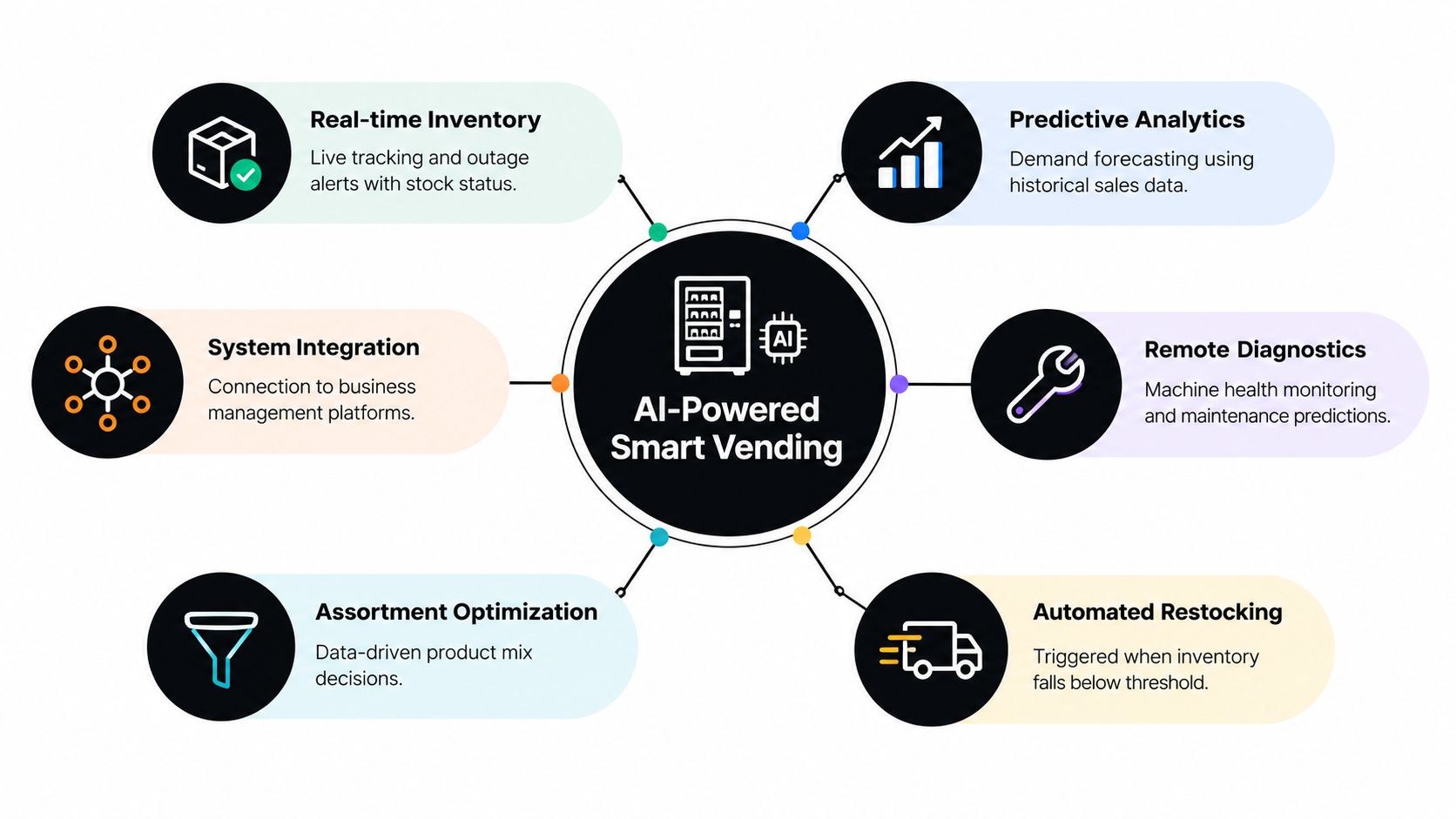
Traditional vending depends heavily on scheduled visits and manual guesses. Smart vending adds a continuous operational layer, giving operators visibility into inventory, sales patterns, payment activity, and machine performance. That information helps a service team identify popular products, spot slow-moving items, and respond to equipment problems before employees encounter an empty selection or failed transaction.
A corporate office in Oklahoma City might use telemetry to understand when its break room receives the most traffic. A multi-tenant business center can compare demand across common areas, while a school or campus refreshment center in Norman or Edmond can align replenishment with class schedules and activity patterns. The point isn't to install technology for its own sake. The point is to make decisions from actual usage rather than assumptions.
Use the data to improve the human experience
A manager should review performance dashboards regularly, then turn the findings into practical changes. If water sells out while a particular snack sits untouched, the assortment needs adjustment. If a machine records failed payments or temperature alerts, the operator should investigate before the problem becomes a complaint.
Businesses considering the technology can also review how smart vending machines work before selecting equipment. Start in a high-traffic area where reliable data will support better decisions. Ask the operator how often assortments are reviewed, how alerts are handled, and whether the service team uses telemetry for proactive restocking instead of just collecting reports.
Practical rule: Telemetry only creates value when someone acts on it. Ask for a clear process covering alerts, assortment reviews, replenishment, and maintenance.
An operator can also use usage data to introduce new products carefully, test employee-requested items, and promote options that fit the location. That turns a vending machine into a managed workplace service rather than a static box of products.
2. Cashless and Mobile Payment Integration
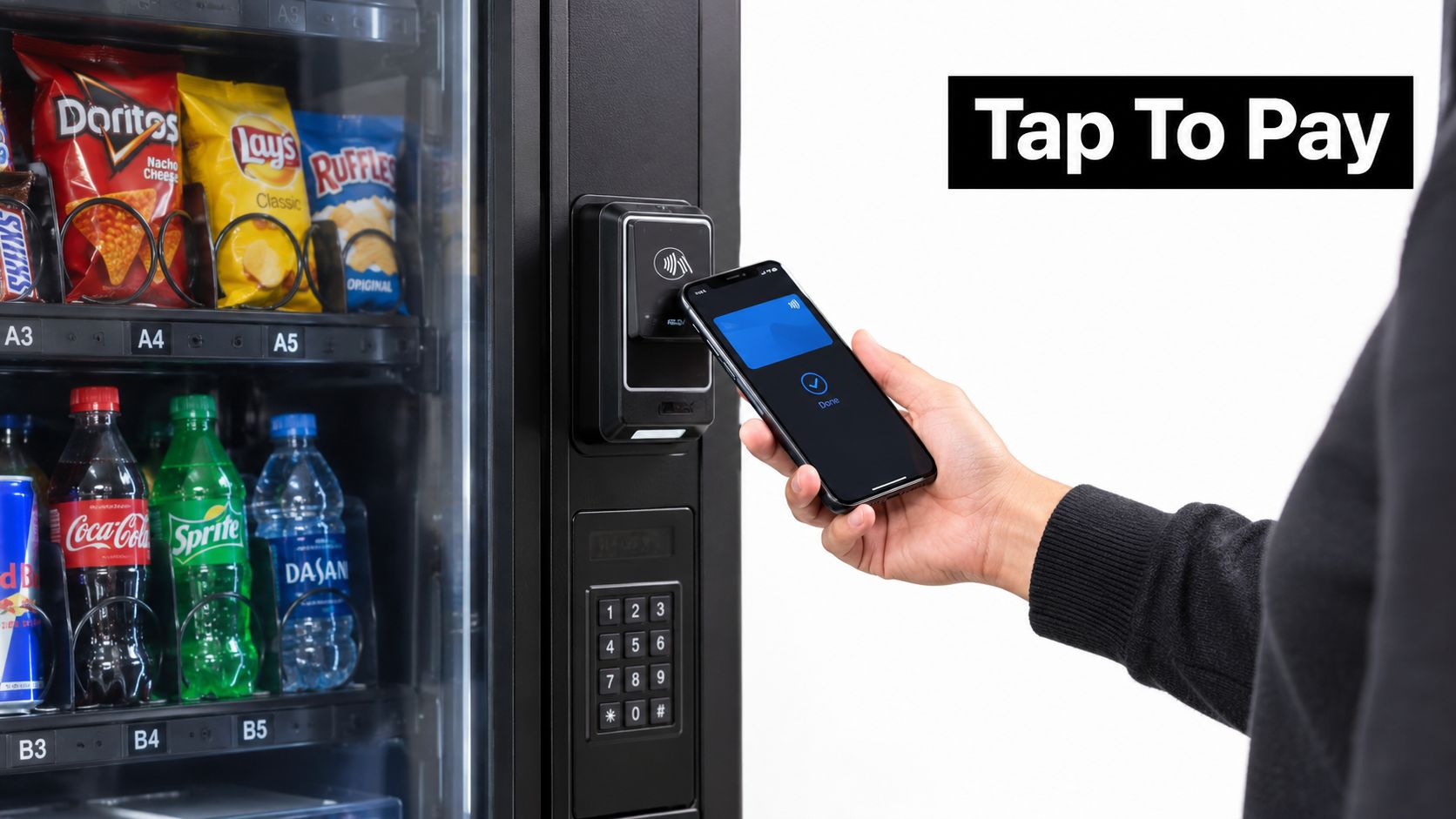
A break becomes less convenient when an employee has to search for coins, find an ATM, or abandon a purchase because a card reader isn't working. Cashless vending supports contactless cards and mobile wallets such as Apple Pay and Google Wallet, helping employees pay with the device or card they already carry.
Cashless payment is also a meaningful operational shift. Cantaloupe reported that cashless payments represented an average of 69% of food and beverage vending sales in 2023 in its micropayment trends report. Another vending industry report states that cashless customers spend 37% more per transaction than cash users. Those figures don't guarantee the same outcome at every workplace, but they show why payment design deserves attention when a business evaluates vending services.
Remove uncertainty at the point of purchase
Employees shouldn't have to guess whether a machine accepts a mobile wallet. Clear signage should identify contactless cards, Apple Pay, Google Wallet, and any other supported methods. The operator should test processors during installation and monitor failed transactions afterward.
Businesses can learn more about cashless payment solutions when comparing vendors. Ask who handles payment errors, how refunds are issued, and whether the machine remains usable if one payment method is temporarily unavailable.
A healthcare facility may value contactless access because it reduces the need to handle cash in a busy environment. An educational institution may prefer mobile payment options that fit student habits, while an office may want faster purchases during short breaks. The best setup reflects the users and the location.
Don't treat payment as an afterthought. A machine with an appealing assortment still fails as a break room amenity if customers can't complete purchases quickly and confidently.
3. Customized Product Assortment Based on Employee Feedback
The most attractive vending machine isn't necessarily the one with the largest selection. It's the one that carries products people at that location actually want. A manufacturing facility may need filling, high-protein snacks for employees working active shifts. A healthcare workplace may favor lighter snacks and convenient beverages. An office in Edmond may request regional Oklahoma products, while a school in Norman may need vegan and allergy-aware choices.
Start by asking employees what the machine lacks. A short survey, suggestion card, QR code, or mobile request form can reveal preferences that sales data alone won't capture. Sales show what people buy. Feedback can explain why they avoid certain products and what they'd purchase instead.
Build a feedback loop, not a one-time survey
Product preferences change with seasons, staffing, health initiatives, and local events. Review requests and sales together, introduce new products in modest quantities, and keep the items that earn repeat demand. An employee-requested label or small sign can also show that facility managers are listening.
Useful practices include:
Ask specific questions: Find out which beverages, dietary options, portion sizes, and local products employees want.
Test before expanding: Place a new item in a limited number of slots before giving it broader space.
Rotate thoughtfully: Use seasonal changes to create discovery without removing dependable favorites.
Close the loop: Tell employees when a requested product has been added or an unpopular item has been replaced.
For a deeper approach, review how to gather customer feedback. The operator should be willing to adjust the assortment rather than defend a fixed catalog.
A good vending service also balances variety with waste control. Too few choices make the machine irrelevant. Too many slow-moving choices consume space and create stale inventory. Feedback-led merchandising gives the service team a practical way to manage that trade-off while making the break room feel designed for the people who use it.
4. Dual-Zone Chill Centers with Temperature-Controlled Compartments
Space often limits what a workplace can offer. A small office, multi-tenant building, or hospital break room may want chilled drinks, snacks, and frozen treats without dedicating an entire wall to separate equipment. A dual-zone chill center addresses that problem by using separate temperature-controlled compartments within one refreshment unit.
The design can help an Oklahoma City office reduce visual clutter while keeping different product categories accessible. A hospital break room may use one zone for cold beverages and another for frozen items that appeal to overnight staff. A campus common area can offer cold drinks during hot weather while maintaining demand for frozen treats throughout the year.
The equipment still needs thoughtful placement. Keep the most frequently chosen products easy to see and reach. Use clear labels so customers understand which compartment serves which type of item. Lighting can distinguish zones, but it shouldn't create glare that makes product labels difficult to read.
Match the machine to the room
Before installation, measure the available floor area, clearance, electrical access, traffic flow, and service access. A compact footprint isn't useful if the doors open into a corridor or technicians can't reach the unit safely. Facility teams should also confirm that the location doesn't block egress or create a congestion point during busy periods.
Learn more about smart cooler vending when evaluating this format. Ask how the operator monitors temperatures, handles product rotation, and schedules preventive maintenance. More mechanical complexity can bring more flexibility, but it also makes service discipline important.
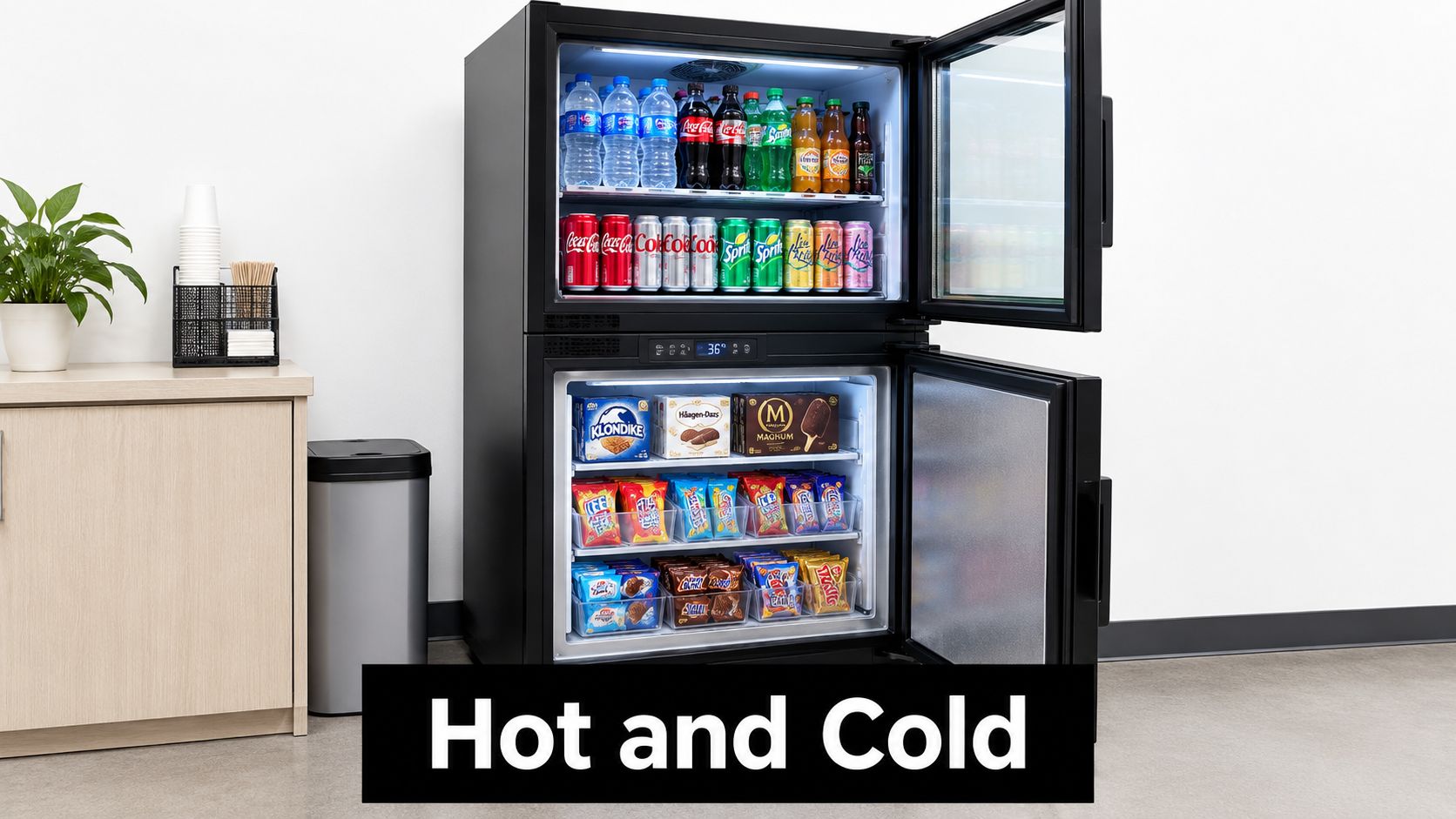
A dual-zone unit works best when its assortment follows actual demand. If the chilled compartment turns quickly but frozen products linger, the operator should adjust the mix. The goal isn't to fill every slot. It's to use limited space for products that make the break at work more convenient.
5. Frozen Food Vending Machines for Expanded Snack Options
Frozen vending expands the break room beyond shelf-stable snacks and bottled drinks. Depending on the location, a dedicated freezer can carry ice cream, frozen novelties, frozen fruit, or convenient frozen meals. That gives employees another way to find a quick treat or meal without leaving the property.
The format can work particularly well at manufacturing sites with extended shifts, corporate campuses with limited nearby food options, and healthcare facilities where staff may not have time to visit an off-site store. Schools and colleges can also use frozen treats to create a more inviting gathering point in a common area.
Treat the freezer as a food service category
A frozen machine needs more than attractive products. Operators must maintain consistent temperatures, follow appropriate handling procedures, monitor defrost cycles, and rotate inventory so products remain appealing. Condensation, freezer burn, damaged packaging, or an unreliable door can quickly undermine trust.
A balanced assortment should include both familiar value choices and premium options. Seasonal changes can help, but the operator should use sales and employee feedback to decide what stays. A summer-heavy range may need to shift toward frozen meals or other practical choices when weather and workplace routines change.
Businesses can explore frozen food dealers when they need a service partner that understands freezer equipment and product handling. Ask who monitors the unit, how often the operator checks it, and what happens when a machine loses temperature.
Placement matters as much as product. Put frozen vending near the main break area or another high-traffic point, but leave enough space for people to open the door and browse without blocking movement. Bright, restrained signage can highlight premium products without making the room feel cluttered.
A frozen machine won't suit every workplace. It may be unnecessary where employees already have a full cafeteria or where power and floor space are limited. In the right setting, though, it can turn a basic snack program into a more useful refreshment service.
6. Proactive Service Model with Rapid Response and Attention to Detail
Employees judge a vending program by what they see and experience. A clean machine with full rows, readable labels, working payment hardware, and fresh-looking products feels dependable. A dirty unit with empty slots and repeated payment failures becomes part of the workplace's daily frustration.
Proactive service requires more than responding to complaints. The operator should schedule predictable visits, clean the machine, rotate products, inspect equipment, and document issues. Facility managers benefit when visits happen at consistent times because they know when to expect restocking and when to raise concerns.
A vending machine is only an amenity while it works, looks clean, and carries products people want.
Define service before installation
A service agreement should explain who stocks the machine, who owns or maintains the equipment, how urgent repairs are escalated, and how customers receive refunds. Managers should also ask whether technicians document visits with notes or photos and whether the operator reviews feedback during service calls.
The U.S. Department of Labor's break guidance explains that federal law doesn't require employers to provide rest breaks or meal periods, but short breaks offered by an employer are generally treated differently from meal periods under federal wage rules. That legal distinction doesn't answer how a company should design a break room, but it reinforces the need for employers to coordinate workplace policies with qualified employment counsel and local requirements.
Service quality also matters more in demanding environments. A hospital may need a rapid response to a failed beverage machine. A school district may require careful cleaning and clear product rotation. A property manager may want visit records that demonstrate the common-area amenity is being maintained.
Don't evaluate operators only by equipment specifications. Compare their response process, communication habits, cleanliness standards, and willingness to adjust service frequency as demand changes. A proactive operator protects the employee experience and gives the facility team fewer problems to manage.
7. Compact Refreshment Centers for Space-Limited Environments
A workplace doesn't need a dedicated break room to provide refreshment access. Compact refreshment centers can fit into small offices, waiting areas, reception spaces, retail locations, and healthcare facilities where a full-size machine would crowd the room.
A medical office in Oklahoma City might place a compact unit near a waiting area for patients and staff. A small law firm in Edmond may use a corner installation rather than redesigning its kitchen. A dental or therapy office can offer drinks and snacks without giving up valuable floor space. Retailers in Norman can position a unit near checkout, provided it doesn't interfere with customer flow.
Design around the available footprint
Start with a site assessment rather than choosing equipment from a catalog. Measure width, depth, height, door clearance, electrical access, visibility, and pedestrian movement. A unit that fits physically can still be a poor choice if it blocks a hallway, creates a trip hazard, or sits where customers can't see it.
Limited space also means limited inventory. Focus on dependable categories such as water, popular soft drinks, a small selection of snacks, and products identified through feedback. Combination snack and beverage equipment can make better use of a constrained footprint, but only if both categories receive enough space to stay useful.
Space-planning principle: The smallest machine isn't automatically the best machine. The right unit preserves safe movement while keeping the most relevant products visible and accessible.
Restocking frequency should follow demand. A compact machine with fast-moving water may need more frequent service than a larger unit in a quiet office. Telemetry can help the operator identify that pattern, while facility managers should report congestion, noise, visibility, or placement problems promptly.
Compact vending works when it solves a specific access problem. It doesn't need to imitate a full break room. It needs to give people a dependable way to make a convenient purchase in the space the business has.
8. Bottle-and-Can Vending Machines with Premium Beverage Selection
Beverages are a practical foundation for many workplace refreshment programs. Employees may skip a snack purchase, but cold water, soda, tea, juice, sports drinks, and energy drinks serve different routines throughout the day. A dedicated bottle-and-can machine can make hydration more visible and easier to manage.
A corporate office may need a balanced selection for different preferences. A manufacturing facility may prioritize cold water and drinks suited to active shifts. A healthcare facility may want hydration options close to staff areas, while a school or college can use beverage vending as part of a broader campus refreshment plan.
Build a beverage mix with purpose
A strong assortment doesn't mean filling every slot with similar products. Use distinct categories and review each one against actual demand:
Hydration staples: Keep cold water easy to find and consistently available.
Everyday choices: Include familiar soft drinks, tea, juice, and sports drinks where the audience wants them.
Energy options: Offer energy drinks only when they fit the location's users and workplace policies.
Premium and local products: Add specialty beverages or Oklahoma-made options when they receive genuine interest.
Wellness selections: Make healthier options visible rather than hiding them among indulgent choices.
Temperature and availability influence the experience. Employees notice an empty cold-drink slot quickly, especially during a busy shift or warm season. The operator should monitor refrigeration, rotate seasonal products, and use sales data to adjust the balance between categories.
A dedicated beverage machine can complement snack, frozen, or dual-zone equipment. It may also be the right starting point for a site that lacks space or wants to test demand before adding more formats. The wrong approach is to install a machine, fill it once, and let the assortment remain unchanged.
A beverage program works best when it supports the wider break room. Clear product labels, reliable cashless payment, responsive replenishment, and visible cleaning standards all contribute to whether employees use the machine regularly.
8-Point Breakroom Refreshment Comparison
Item | Implementation 🔄 (Complexity) | Resources ⚡ (Requirements) | Expected Outcomes 📊 (Impact) | Ideal Use Cases 💡 | Key Advantages ⭐ |
|---|---|---|---|---|---|
AI-Powered Smart Vending Machines with Real-Time Telemetry | 🔄 High, AI, IoT, system integrations and connectivity setup | ⚡ High, smart hardware, cloud analytics, reliable internet, skilled ops | 📊 Strong, fewer OOS, predictive restocking, lower ops costs | 💡 High-traffic offices, multi-tenant sites, campuses needing efficiency | ⭐ Predictive maintenance, assortment optimization, personalized offers |
Cashless and Mobile Payment Integration (Apple Pay, Google Wallet, Contactless) | 🔄 Medium, payment terminal install and PCI/EMV compliance | ⚡ Medium, payment gateways, connectivity, transaction fees, support | 📊 Improved, faster transactions, hygiene, complete sales audit trail | 💡 Offices, healthcare, education prioritizing touchless payments | ⭐ Faster throughput, reduced cash handling, loyalty/billing integration |
Customized Product Assortment Based on Employee Feedback | 🔄 Medium, feedback systems, A/B testing, ongoing curation | ⚡ Low–Medium, survey tools, varied inventory, analytics time | 📊 Positive, higher sales, reduced waste, improved satisfaction | 💡 Locations with diverse tastes or retention-focused employers | ⭐ Higher revenue per machine, stronger employee engagement |
Dual-Zone Chill Centers with Temperature-Controlled Compartments | 🔄 Medium‑High, dual refrigeration controls and calibration | ⚡ Medium, higher equipment cost, electrical capacity, maintenance | 📊 Strong, broader range, space consolidation, increased sales per site | 💡 Space-constrained break rooms needing cold + warm options | ⭐ Consolidates two machines, expands SKU variety, space-efficient |
Frozen Food Vending Machines for Expanded Snack Options | 🔄 High, sub-zero systems, defrost cycles, strict food-safety controls | ⚡ High, heavy energy use, specialized maintenance, dedicated outlet | 📊 High-margin, consistent frozen-item demand, premium pricing | 💡 Shift-work sites, campuses, locations needing grab‑and‑go meals | ⭐ Premium offerings, unique product mix, steady year-round demand |
Proactive Service Model with Rapid Response and Attention to Detail | 🔄 Medium, route planning, SLA enforcement, performance monitoring | ⚡ High, frequent skilled labor, quality control systems, scheduling | 📊 Very high, top uptime, client retention, premium brand perception | 💡 Premium clients, healthcare, high-visibility corporate locations | ⭐ Reliability, strong client relationships, reduced failures |
Compact Refreshment Centers for Space-Limited Environments | 🔄 Low, standard vending functions in smaller form factor | ⚡ Low, lighter install, lower power; may need more frequent restock | 📊 Moderate, enables vending in tight spaces; good revenue per sqft | 💡 Small offices, waiting rooms, lobbies, retail checkouts | ⭐ Fits constrained spaces, flexible placement, preserves aesthetics |
Bottle-and-Can Vending Machines with Premium Beverage Selection | 🔄 Low, conventional refrigerated vending setup | ⚡ Medium, refrigeration capacity, sturdy shelving for heavy items | 📊 Very steady, predictable, often majority share of vending revenue | 💡 Any workplace; foundational for comprehensive vending programs | ⭐ Consistent sales, universal appeal, easy inventory management |
Build a Break Room Employees Actually Use
The best break at work program starts with the people and the space, not with a machine brochure. Ask employees what they want to buy, identify the hours and traffic patterns that shape demand, and assess where equipment can be placed without reducing safe movement. A small office may need a compact combination unit. A large industrial site may benefit from dedicated beverage and frozen machines. A hospital may prioritize rapid service, hydration access, and contactless payment.
Product format should follow the location. Feedback can shape the assortment, while telemetry can show what sells, what sits, and when replenishment is needed. Cashless payments reduce purchase friction, and temperature-controlled equipment expands the choices available in a limited footprint. None of those features replaces basic execution. The machine still needs to be clean, stocked, functional, and easy to use.
Break design also needs realistic expectations. Research reviewed in a 2022 systematic review and meta-analysis found statistically significant improvements in vigor and reductions in fatigue from micro-breaks, while the overall effect on performance wasn't statistically significant in that analysis. A separate meta-analysis reported that supplementary rest breaks reduced daily working time by about 9.3%, increased quantitative task performance by about 5%, and improved work quality by about 9%. The practical lesson is that employers shouldn't frame refreshments as a substitute for sensible scheduling. Vending supports a break culture, but managers still need to make breaks usable and acceptable.
For Oklahoma businesses, Vendmoore Enterprises can discuss managed vending, machine ownership, snack and beverage assortments, frozen options, and equipment suited to workplaces and public spaces. Its service area includes the Oklahoma City metro, Norman, Edmond, and surrounding cities. The portfolio includes smart vending machines, compact refreshment centers, bottle-and-can vendors, dual-zone chill centers, and frozen food machines.
A reliable program should be measured over time. Review employee feedback, product movement, out-of-stocks, payment issues, service records, and equipment performance. Make changes when the evidence points to a better assortment or a different machine format. The same principle applies to office coffee planning, where PureHQ Inc.’s office coffee tips also emphasize matching workplace refreshments to practical employee needs.
The goal isn't to create the most technologically advanced break room. It's to create one employees can actually use during a real workday. Convenient access, relevant choices, comfortable placement, and dependable service turn a vending machine from an isolated purchase point into part of a workplace experience.
Vendmoore Enterprises offers AI-powered vending, cashless payment support, custom snack and beverage assortments, frozen food machines, compact refreshment centers, and proactive service across Oklahoma. Visit Vendmoore Enterprises to discuss a break room setup that fits your space, employees, and service expectations.
Comments