_edited.png)
Cashless Payment Pros and Cons for Vending

A cashless vending machine can sell more, move people through a break room faster, and give a facility manager a clearer view of what employees want. It can also stop selling the moment connectivity fails, while processing costs continue to reduce the operator's margin on every low-value purchase. That tension defines the cashless payment pros and cons for vending.
For offices, schools, hospitals, factories, airports, and residential properties, the decision isn't only whether to install a card reader. The right question is whether the vending program can combine convenient payment, dependable service, useful telemetry, fair pricing, and a practical fallback when digital payments aren't available.
The Rapid Shift to Cashless Vending
Cashless payments have moved from a premium feature to an everyday expectation. Consumers now carry payment cards, phones, and watches that can complete a purchase without coins, bills, or a trip to an ATM. In a break room, that expectation is especially clear. Employees want to tap, collect their drink or snack, and get back to work.
The global payment market is reinforcing that behavior. The total number of cashless transactions worldwide is projected to rise from about 1 trillion in 2020 to almost 1.9 trillion in 2025, with the total expected to nearly triple by 2030, according to PwC's Future of Payments analysis. That expansion helps explain why vending manufacturers, payment providers, and facility managers are building around cards and mobile wallets rather than treating them as optional upgrades.
For unattended retail, the change is more consequential than it is at a staffed register. A cashier can explain a payment problem, make change, or offer another way to pay. A vending machine can't. The machine needs a payment terminal that works quickly, a connection that stays available, and a control system that reports sales and faults to someone who can act.
Why break rooms are feeling the change
A workplace vending machine serves people during short, predictable windows. Employees may visit before a shift, during a scheduled break, or between meetings. A payment process that feels slow or uncertain can discourage a purchase, especially when the customer doesn't have exact change.
Cashless acceptance also changes what facility managers expect from a vending service. They increasingly want a refreshment program that fits a connected workplace, supports mobile wallets, and gives the operator enough information to keep popular products available. A resource such as workplace technology trends helps put vending into that wider facilities conversation, where convenience and connected service matter together.
The operator's new operating reality
Cashless vending reduces dependence on physical cash, but it increases dependence on digital infrastructure. The machine needs compatible hardware, payment authorization, telecommunications service, software support, and a service team that can respond when one of those layers fails.
That makes the decision practical rather than ideological. Cash isn't disappearing from every setting, and cashless isn't automatically better for every customer. For most modern break rooms, however, cashless acceptance should be part of the baseline offer, provided the operator has a plan for fees, downtime, accessibility, and maintenance.
Revenue and Operational Advantages of Going Cashless
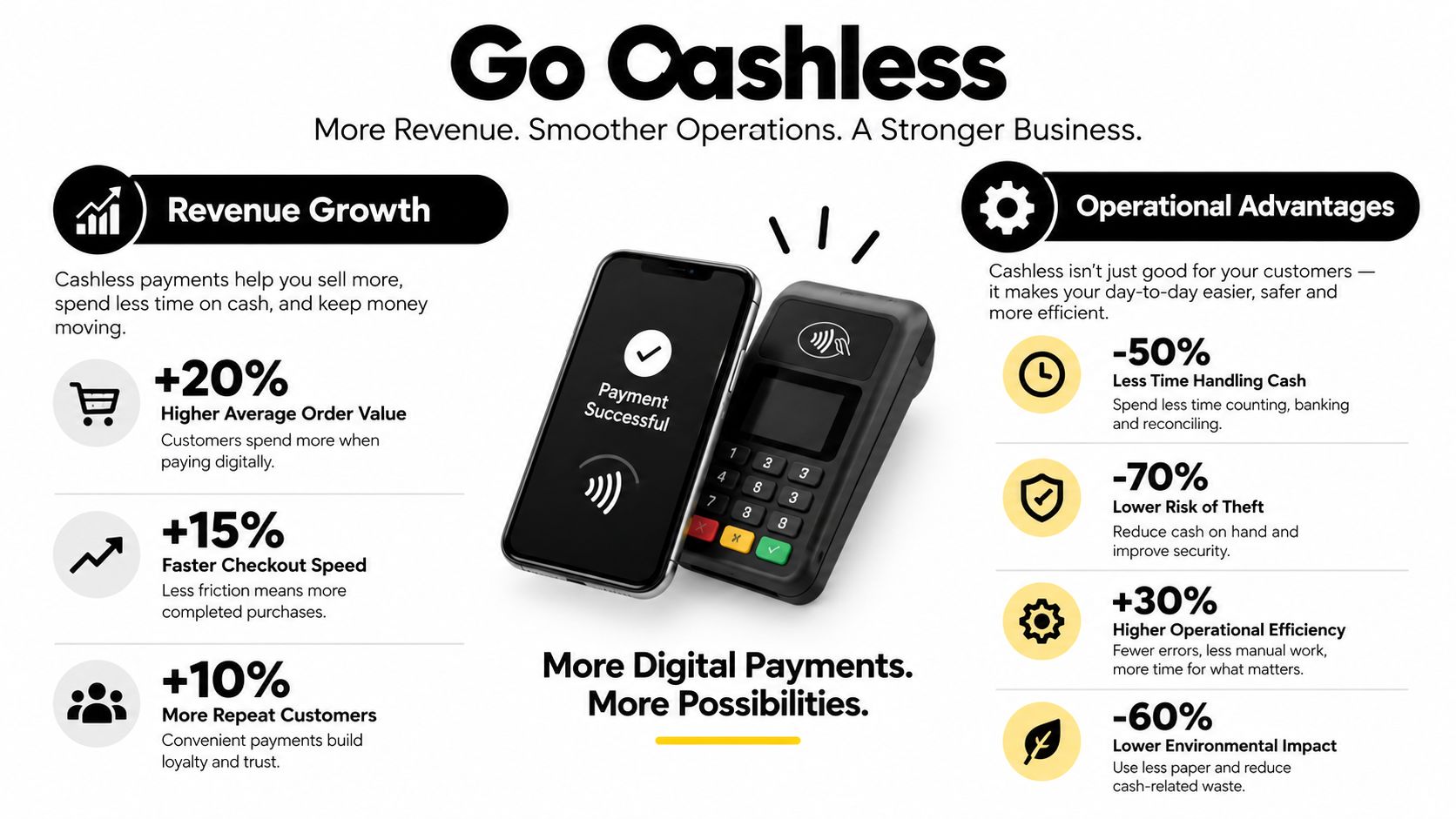
The strongest argument for cashless vending is simple: customers can buy what they want with less friction, and many will spend more when they don't need to count out cash. That matters in break rooms because purchases are often small, time-sensitive, and made while people are already thinking about their next task.
A peer-reviewed point-of-sale timing study found that a contactless card used in offline mode without slip printing was, from the customer's perspective, 12.3 seconds faster than cash. The same source also discusses an industry comparison of 12.5 seconds for ExpressPay versus 33.7 seconds for cash, which indicates a much shorter tender process when the implementation is designed for speed. The findings are detailed in this peer-reviewed POS timing study.
That time saving has a direct operational effect. Shorter transactions reduce the chance that a queue forms around the machine during a shift change or lunch period. A customer doesn't have to search for bills, wait for a validator to accept a worn note, or stand there while the machine calculates change. In an unattended environment, every avoided point of hesitation protects the next potential sale.
The basket-size advantage
The revenue case becomes clearer when you look at the average transaction rather than only transaction speed. Cantaloupe's 2024 micropayment report recorded an average cashless vending ticket of $2.26, compared with $1.46 for cash, a difference of about 55%. The figures appear in the Cantaloupe 2024 Micropayment Trends Report.
That doesn't mean every location will produce the same result. It does show why cashless vending deserves to be evaluated as a revenue tool, not merely as a customer-service feature. Customers who pay with a card or mobile wallet may add a second item, choose a larger drink, or stop worrying about whether they have enough change.
For a facility manager, the benefit can show up in a more useful break room without requiring staff to operate it. For an operator, a stronger average ticket can help support better equipment, regular replenishment, and more responsive service. The key is to track actual location performance instead of assuming that a terminal alone will create growth. Practical tactics for reviewing product mix and purchase behavior are covered in revenue optimization for vending.
What improves for the facility
Cashless vending can improve the daily experience in several ways:
Faster access: Employees spend less time completing a purchase, which is valuable during short breaks.
Better product flexibility: Customers aren't limited to the amount of cash in their pocket.
Clearer purchasing records: Digital transactions make sales activity easier for the operator to review.
Lower cash-handling friction: Route staff don't need to depend on the same level of coin collection and bill handling.
More useful service conversations: Sales data can support decisions about drinks, snacks, frozen items, and seasonal assortment.
The best result comes when payment data and service decisions work together. If a machine accepts contactless payments but stays empty, has poor product selection, or takes too long to repair, the customer experience still fails. Cashless is an accelerator. It isn't a substitute for stocking discipline.
Processing Fees and Network Vulnerabilities
Cashless vending doesn't make every sale more profitable. Processing fees are a major challenge for vending operators, because every card or mobile transaction adds network and processing expense that a cash sale doesn't. Vending Times coverage of card-processing fees describes the pressure those costs create as cashless usage grows.
That pressure is sharper in vending than in many other retail environments. A vending transaction may involve a relatively inexpensive item, while the payment network still applies its own costs. If an operator ignores the fee structure, the machine can generate more gross sales while producing less useful margin.
What facility managers should ask
Facility managers don't need to calculate interchange mechanics themselves, but they should ask how the operator handles the economics. A responsible vending partner should be able to explain whether pricing reflects payment costs, whether the operator absorbs those costs, and whether the program remains sustainable without reducing product quality or service frequency.
Ask for clear answers to these questions:
Who pays the processing cost? Find out whether it sits with the operator, the facility, or the customer.
How is pricing protected? Confirm that cashless adoption won't lead to confusing or inconsistent prices.
What happens with refunds? A failed vend, duplicate authorization, or disputed transaction needs a defined resolution path.
Who monitors payment failures? Someone should review declines and terminal faults rather than waiting for customers to complain.
Does the machine support fallback logic? A connected vending program needs a plan for temporary service interruptions.
You should also review the operator's security practices. Mobile payment security guidance can help facility teams frame questions about tokenized payments, access controls, device protection, and the handling of customer information.
The dead-box problem
A cashless-only machine has a single point of failure that a cash machine can sometimes avoid. A cellular outage, payment gateway problem, terminal fault, or authentication issue can prevent a purchase even when the machine is full and powered on.
That failure is more than a technical inconvenience. It can frustrate employees who have limited break time, disappoint patients or visitors in healthcare settings, and create a poor impression of the facility. In a manufacturing or distribution environment, the nearest refreshment option may be far from the work area, so an outage has a practical cost for the people using the site.
Operators should monitor connectivity, configure sensible offline behavior where the payment system permits it, and maintain a process for diagnosing faults remotely. Facility managers should also ask how quickly the service team responds and whether the operator can identify a payment outage before complaints accumulate.
Practical rule: Don't approve a cashless vending rollout until the operator explains how the machine behaves during a network interruption and who owns the response.
Accessibility and the Cash Fallback Dilemma
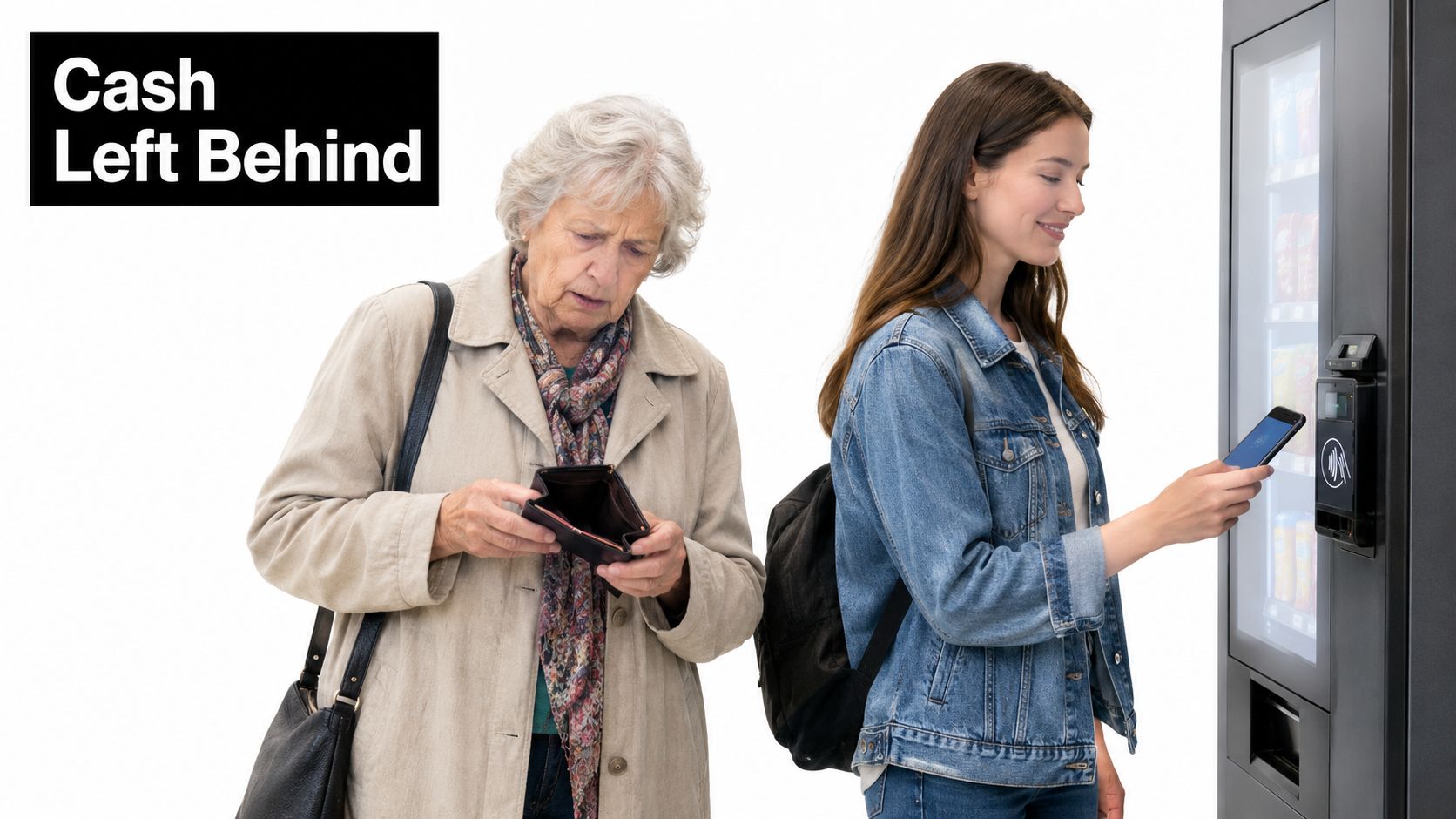
A modern payment experience should be convenient without becoming exclusive. Some customers won't have a smartphone, a mobile wallet, a bank card, or a reliable way to authorize a digital purchase. Others may prefer cash because they want to control spending, protect privacy, or avoid dependence on a network.
That matters in public-facing facilities and mixed workforces. A hospital may serve employees, patients, and visitors with very different payment habits. A school or college may include people with limited access to banking tools. A manufacturing site may have contractors and temporary workers who don't use the same digital payment setup as permanent staff.
Convenience has a boundary
Cashless systems bring real exposure to chargeback fraud, network outages, and cyber threats. They also raise privacy concerns and can exclude people who can't adopt digital payment methods, as discussed in PwC's analysis of a cashless world.
The answer isn't to reject contactless payments. It is to avoid treating one payment method as universally reliable. A vending program should match its payment options to the people who use the facility, the location's connectivity, and the consequences of a failed transaction.
Why hybrid payment still makes sense
A hybrid machine that accepts cash and cashless payments offers a stronger resilience profile where the equipment and economics support it. Cash gives customers an alternative when a phone battery is empty, a wallet app fails, or a network connection is unavailable. Cashless gives the majority of customers a fast option and can support better transaction records.
The broader payment system also supports a measured approach. Recent BIS commentary indicates that cashless payments continue to rise globally while cash in circulation has largely stabilized, which means cash remains a practical fallback rather than an irrelevant legacy method. The BIS Red Book commentary provides the relevant system-level context.
For a facility manager, the right choice depends on the audience and the machine location. A private office with a consistent workforce may prioritize mobile wallet convenience. A hospital lobby, transit-adjacent site, or multi-tenant property should think harder about access and continuity.
The operational question is direct: what happens to sales, satisfaction, and access when the network is down? If the answer is “nothing can be sold,” the program needs either a fallback payment option or a service design that makes outages exceptionally visible and fast to resolve.
Implementing Smart Vending in Modern Facilities
Installing a contactless reader is only the front end of a smart vending program. The stronger setup connects payment acceptance with telemetry, inventory visibility, fault alerts, and a service routine that uses the information. Facility managers should evaluate the complete system, not just the screen or tap symbol on the machine.
Cashless usage is already central to vending. In 2024, 71% of vending machine transactions were cashless, and 77% of those cashless transactions were contactless, according to Vending Market Watch's coverage of Cantaloupe's micropayments report. That makes compatibility and ongoing support more important than a one-time installation decision.
Start with the site, not the machine
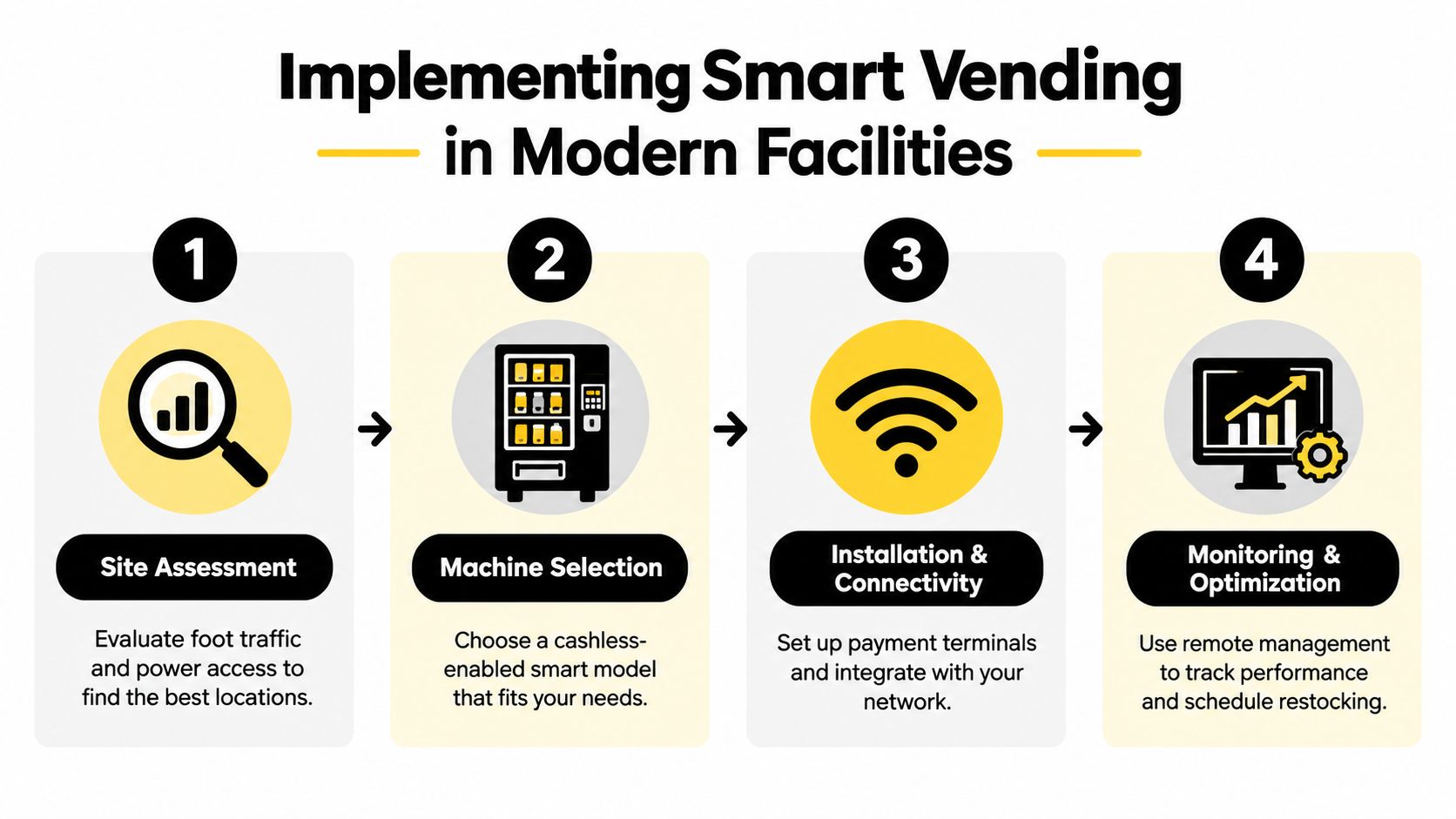
Begin by assessing the location. The operator should review foot traffic, power access, lighting, placement, customer flow, cellular coverage, and the products the audience is likely to buy. A machine placed where people can see it but can't comfortably stop will underperform regardless of its payment features.
Next, select equipment that fits the space and demand. A compact refreshment center may suit a small office, while a dual-zone chill center or frozen food machine may better serve a larger workplace. The decision should account for capacity, temperature needs, product variety, accessibility, and the maintenance requirements of the site.
A useful smart facility solutions guide can help facility teams consider vending as part of a broader connected-building strategy rather than as an isolated appliance.
Build the operating layer
The installation should include a contactless payment terminal, a compatible telemetry module, dependable connectivity, and a dashboard that exposes sales and machine status. The operator needs to know when a machine is low on a popular item, when a payment terminal stops responding, and when a service visit is justified.
Telemetry changes replenishment from a fixed route habit into a demand-led process. The operator can use location data, customer feedback, and product movement to adjust the assortment. That reduces the risk of leaving popular snacks out of stock while continuing to carry items that customers ignore.
Facility managers should clarify ownership at each stage:
Assessment: Who approves the location and identifies power or access issues?
Selection: Who recommends the machine and product categories?
Connectivity: Who installs and tests the payment and telemetry equipment?
Optimization: Who reviews data, gathers feedback, and changes the assortment?
For a plain-language explanation of the connected equipment and workflow, see how smart vending machines work. The practical standard is simple: the technology should help the operator keep the machine useful, stocked, and functioning, not merely make the equipment look modern.
How Vendmoore Supports Cashless Vending in Oklahoma Break Rooms

In the Oklahoma City metro, cashless vending works best when payment convenience is matched by dependable local service. Vendmoore Enterprises provides smart vending for workplaces and public spaces, accepting Apple Pay and Google Wallet while supporting connected telemetry, location-specific assortments, compact refreshment centers, bottle-and-can vendors, dual-zone chill centers, and frozen food machines.
The business case deserves a clear review. Cashless payment can increase basket size by 55%, but processing fees reduce the margin on every sale. Network downtime creates a second risk: a stocked machine still loses sales when the terminal cannot connect. Facility managers should choose an operator that treats payment uptime, replenishment, and follow-up service as one operating responsibility.
A card reader authorizes the transaction; the service team decides whether an office needs more fresh drinks, a school needs different snacks, or a frozen machine is earning its space. Those decisions require performance review, conversations with people at the location, and timely changes to the product plan.
Vendmoore collects employee and customer feedback and uses telemetry to guide replenishment and assortment decisions. That approach suits offices, healthcare facilities, manufacturing sites, educational institutions, multi-tenant properties, stadiums, and airports, where traffic and preferences differ from one site to another.
A managed experience instead of a parked machine
Facility managers should require consistent follow-up, quick responses, attention to detail, and clear pricing from the operator. Those service standards protect the revenue benefit of cashless payment. A machine that accepts a tap but repeatedly runs out of popular products still damages the break room experience.
Vendmoore's equipment formats address different physical needs. A compact machine can serve a small break room. Bottle-and-can equipment, chilled zones, and frozen food machines can expand the offer where a standard snack machine lacks capacity.
The right technology stays in the background. Employees get a stocked, easy-to-use machine, while facility teams receive a dependable amenity without chasing the operator over every refill, fee question, or payment outage.
Choosing the Right Vending Partner for Your Space
The right vending partner should make cashless adoption commercially sensible and operationally dependable. Don't compare providers only by machine appearance or the number of payment logos on the screen. Compare how each operator handles the full experience after installation.
Use this decision matrix when reviewing proposals:
Evaluation area | Strong partner response | Warning sign |
|---|---|---|
Payment economics | Explains processing costs and pricing clearly | Avoids questions about fees |
Connectivity | Monitors terminals and has a downtime procedure | Treats outages as the facility's problem |
Service coverage | Offers local maintenance and responsive follow-up | Gives no clear repair process |
Inventory management | Uses telemetry and feedback to guide replenishment | Restocks on a rigid schedule only |
Product fit | Adjusts selections by location and audience | Installs the same assortment everywhere |
Payment access | Recommends cashless, hybrid, or other options based on the site | Pushes one model without assessing users |
Commercial structure | Provides understandable terms for managed service or ownership | Leaves responsibilities unclear |
For a broader comparison of provider models and service considerations, facility teams can review Accent Food Services as part of their research. The important point is to evaluate the operator's accountability, not just the equipment.
If you're managing a break room, ask for a site assessment before approving a rollout. The operator should identify the right machine type, payment setup, connectivity requirements, product categories, replenishment process, and response plan for your location. That conversation will reveal more than a generic sales brochure.
Vendmoore Enterprises offers cashless smart vending with Apple Pay and Google Wallet support, telemetry-based replenishment, and snack, drink, chilled, and frozen food options for Oklahoma workplaces and public spaces. Visit Vendmoore Enterprises to request a location review and discuss a break room vending program built around reliable service, practical payment choices, and the products your people want.
Comments