_edited.png)
Contactless Payment Benefits for Smarter Vending

A break room queue forms just as employees get a few minutes away from their desks. One person searches for coins, another tries to insert a card into a slow reader, and someone else gives up before reaching the machine. For a facility manager, that small delay can become a recurring source of frustration. For a vending operator, it can mean missed purchases, less engagement, and a machine that doesn't serve the location as well as it could.
Contactless payment benefits extend beyond faster checkout. Tap-to-pay can improve the flow around a vending machine, support cleaner interactions, reduce cash handling, and give operators better payment and inventory information. When those pieces work together, a break room becomes easier to use and easier to manage.
This matters across Oklahoma workplaces, schools, healthcare facilities, manufacturing sites, residential communities, airports, and public venues. A connected vending program can help people get a snack or drink without carrying cash, while telemetry helps the operator understand what needs attention. For a practical overview of cashless options, see cashless payment solutions for vending, and for broader context on merchant acceptance, the Sambapay merchant payments guide offers a useful explanation of tap-to-pay systems.
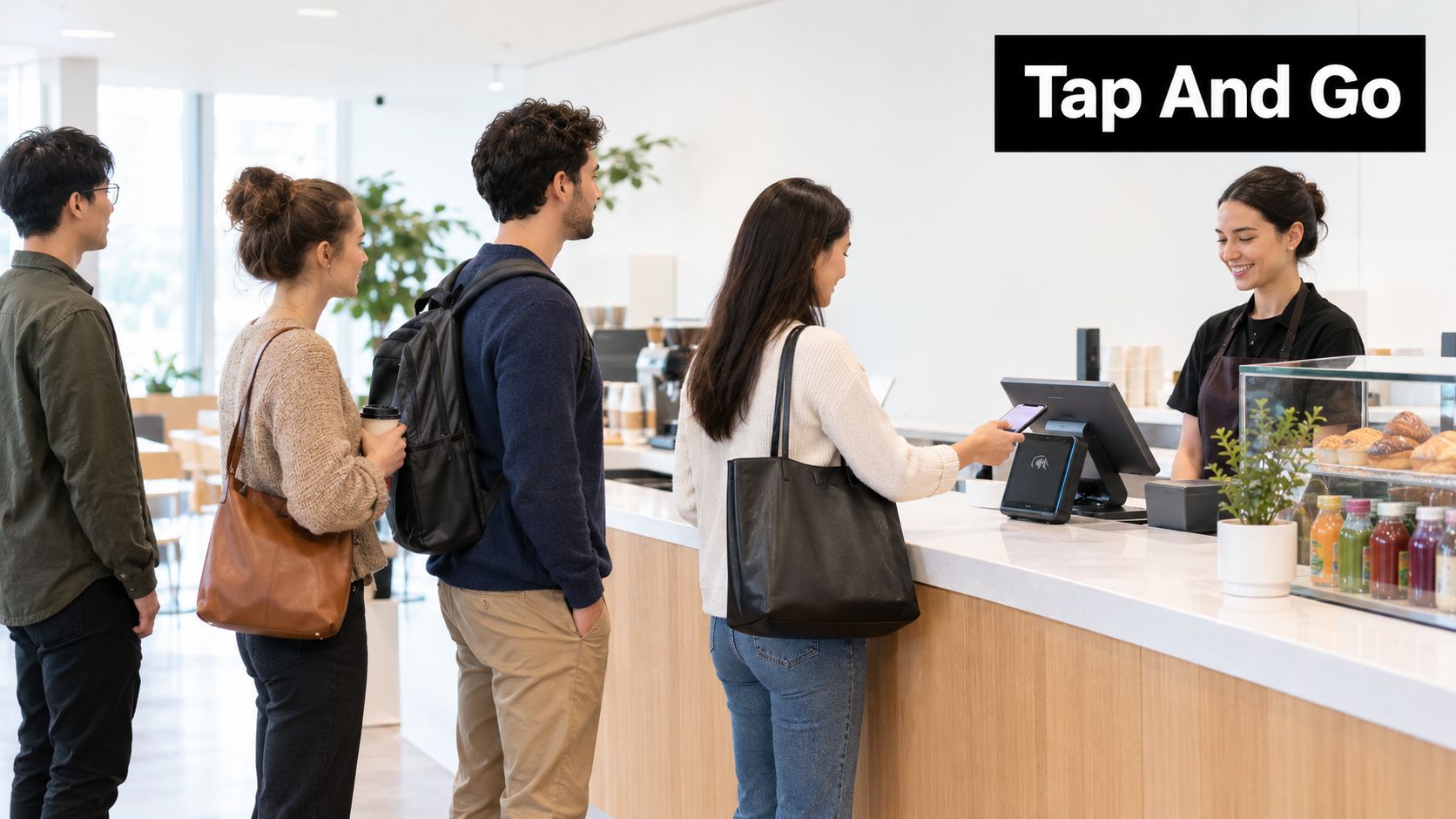
The right question isn't whether a vending machine accepts contactless payments. Facility leaders should ask whether the payment experience removes barriers, whether the machine can keep pace during busy periods, and whether the operator can use transaction information to keep the assortment relevant. Those answers shape employee satisfaction and the long-term value of the vending service.
How Contactless Payments Work in Simple Terms
Think of contactless payment as a short digital handshake between a card or device and a vending terminal. You hold a contactless card, phone, or watch near the reader. The two devices communicate wirelessly, confirm the payment details, and send the transaction for authorization without requiring you to insert or swipe a card.
The first layer is Near Field Communication, or NFC. NFC enables communication over a very short range, which is why the customer usually needs to bring the payment device close to the reader. The limited range helps keep the interaction intentional. The customer chooses a product, taps, and waits for the terminal to approve the purchase.
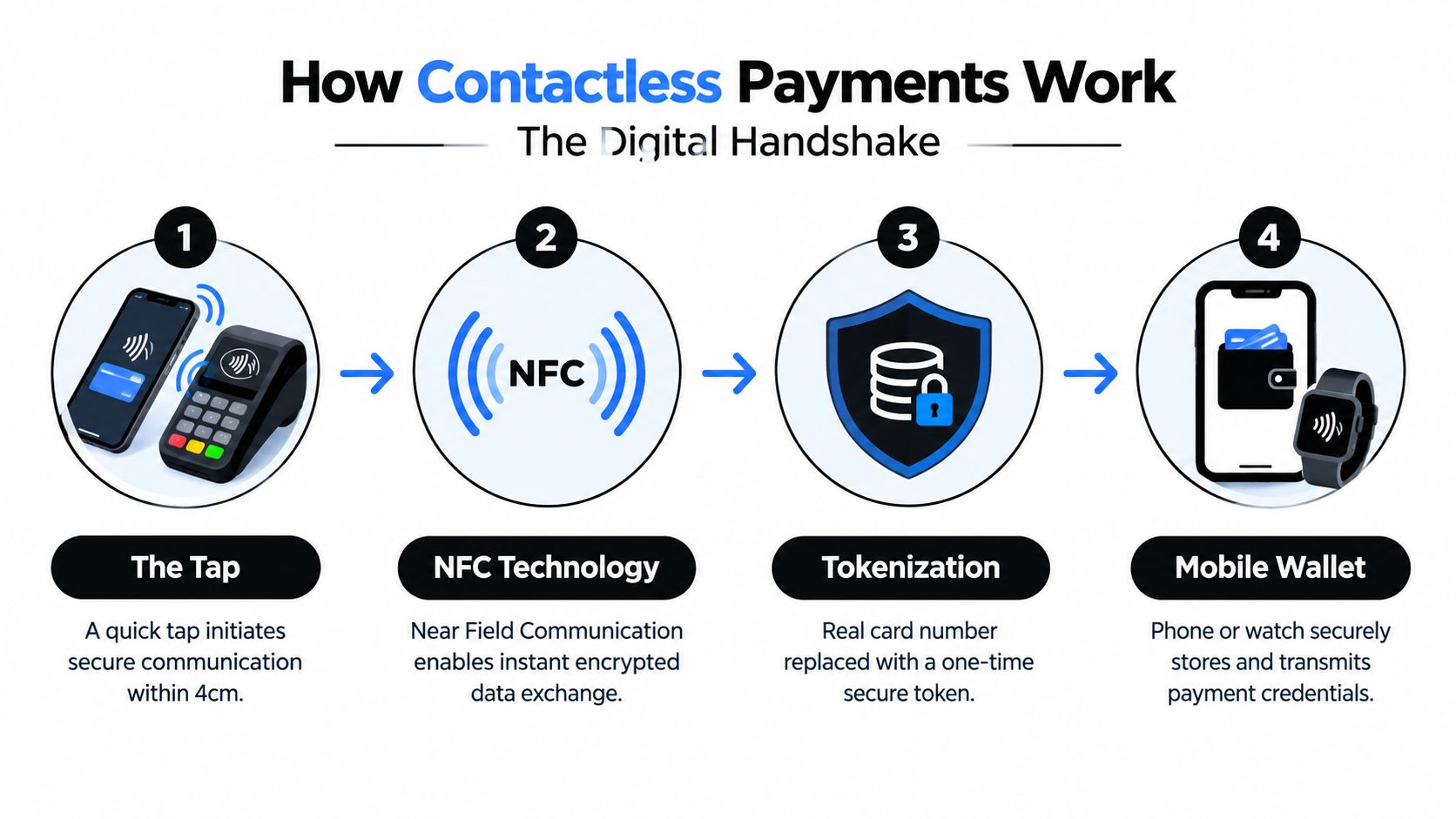
The payment layers
A contactless transaction typically combines several safeguards and devices:
The tap starts the exchange. The customer places a card or mobile device near the terminal. The terminal recognizes the payment method and begins the authorization process.
NFC carries the information. The wireless connection transfers encrypted payment data between the device and reader. The customer doesn't need to hand over a card or leave it on the machine.
Tokenization protects the card number. A token can represent the underlying card details during the transaction. This means the payment system can process the purchase without treating the customer's actual card number as the everyday identifier at the point of sale.
The wallet or card confirms the credentials. Apple Pay and Google Wallet can store payment credentials on a phone or watch. Depending on the device and transaction, the customer may confirm with a fingerprint, face scan, passcode, or the device's existing security process.
EMVCo reported that digital wallets were expected to account for 30% of all in-store payments globally by 2024, and that contactless card usage increased 30% over the prior two years. EMVCo's contactless payment overview connects that shift to the growing role of mobile wallets in retail payment experiences.
For facility managers, the practical takeaway is simple. A vending terminal doesn't need to understand every detail of the customer's bank account. It needs to communicate with an approved payment method, receive authorization, and release the selected product. Resources on how businesses implement modern payment systems can help stakeholders understand the wider infrastructure, while a cashless payment terminal for vending applies the same idea to an unattended machine.
Faster Transactions and Cleaner Experiences
Speed is one of the easiest contactless payment benefits to observe in a break room. A customer doesn't need to count bills, search for coins, insert a card, or wait through extra steps that aren't necessary for a routine purchase. The result is a shorter interaction between the customer and the machine.
An independent benefits report found that contactless transactions were 53% faster than card payments with no signature and 63% faster than cash. In the same report, American Express measured 12.5 seconds for ExpressPay, compared with 33.7 seconds for cash and 26.7 seconds for a credit-card payment with no signature. These figures come from the contactless payment benefits report.
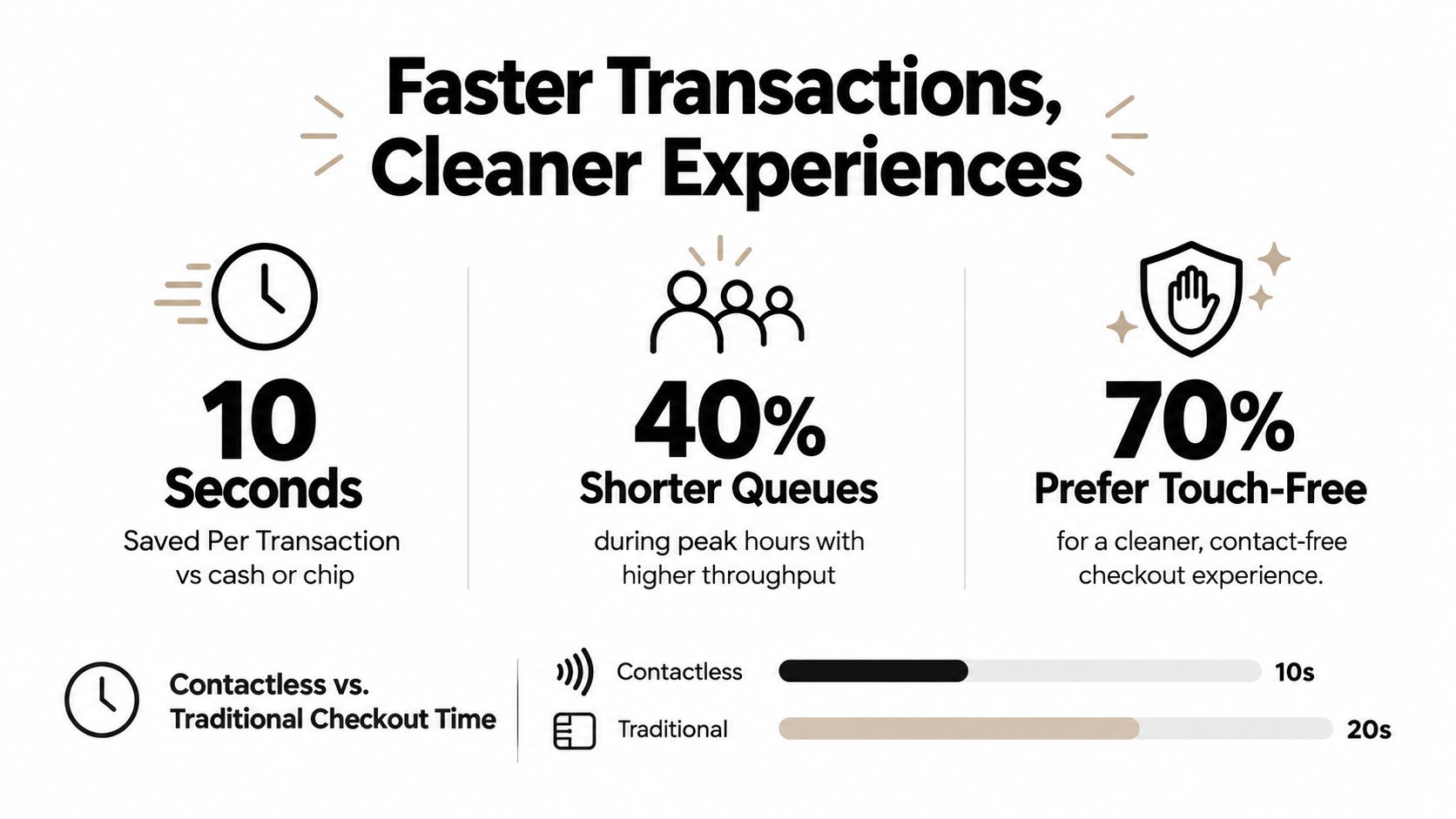
Why seconds matter at a vending machine
A single transaction may only save a short amount of time, but a crowded break room creates a different operational picture. Several employees may arrive during the same break period, and every additional payment step increases the chance that the queue will slow down. Faster individual transactions let the machine serve more people within the same window.
The effect is especially relevant in places with repeated, low-value purchases:
Office break rooms: Employees can make a quick purchase without returning to a desk for cash.
Healthcare facilities: Staff working long or irregular shifts can use a nearby machine without waiting for a staffed café.
Schools and campuses: Students can move through common areas without creating a long payment line.
Manufacturing sites: Workers can use a machine during scheduled breaks when many people arrive together.
Transit and public venues: Travelers and visitors often value a quick purchase when they're moving between destinations.
Contactless also reduces the number of physical payment surfaces a customer handles. That can support workplace expectations around cleaner, touch-free interactions, although operators still need to clean the vending machine, product area, and surrounding surfaces as part of normal service.
Practical rule: Treat payment speed as a capacity issue, not just a convenience feature. A faster terminal helps the same vending location serve customers with less friction during its busiest periods.
The experience still needs a fallback. Some customers prefer cash, use a different card, or feel uncertain about digital payments. A well-designed vending program can offer contactless acceptance without assuming every buyer wants to use the same method. Clear instructions, visible payment symbols, and a reliable alternative make the machine easier for everyone to use.
Security and Fraud Reduction You Can Trust
Some facility managers hesitate to add contactless payment because they assume a tap is less protected than inserting a card. The technology doesn't work that way. Contactless payments can combine encrypted communication, tokenization, dynamic cryptographic authentication, and device authorization to protect the transaction.
A cash transaction has a different risk profile. The machine must hold physical money, the operator must collect it, and staff must reconcile it. Cash can also create counting errors and require more frequent collection. A cashless system changes the operational exposure by moving the payment record into the processing system and reducing the amount of currency stored inside the machine.
What the fraud data means
The European Central Bank reported that, across all payment instruments combined, the annual fraud rate stayed around 0.002% during 2022 through 2024. The most-used exemption for contactless payments had a fraud rate around 0.007%. These figures appear in the European Central Bank payment fraud report.
Those figures should be read carefully. They don't mean every vending transaction carries identical risk, and they aren't a promise that fraud is impossible. They do support a broader technical conclusion: contactless payment systems can maintain low fraud exposure while processing high transaction volume when tokenization, dynamic authentication, and authorization controls work together.
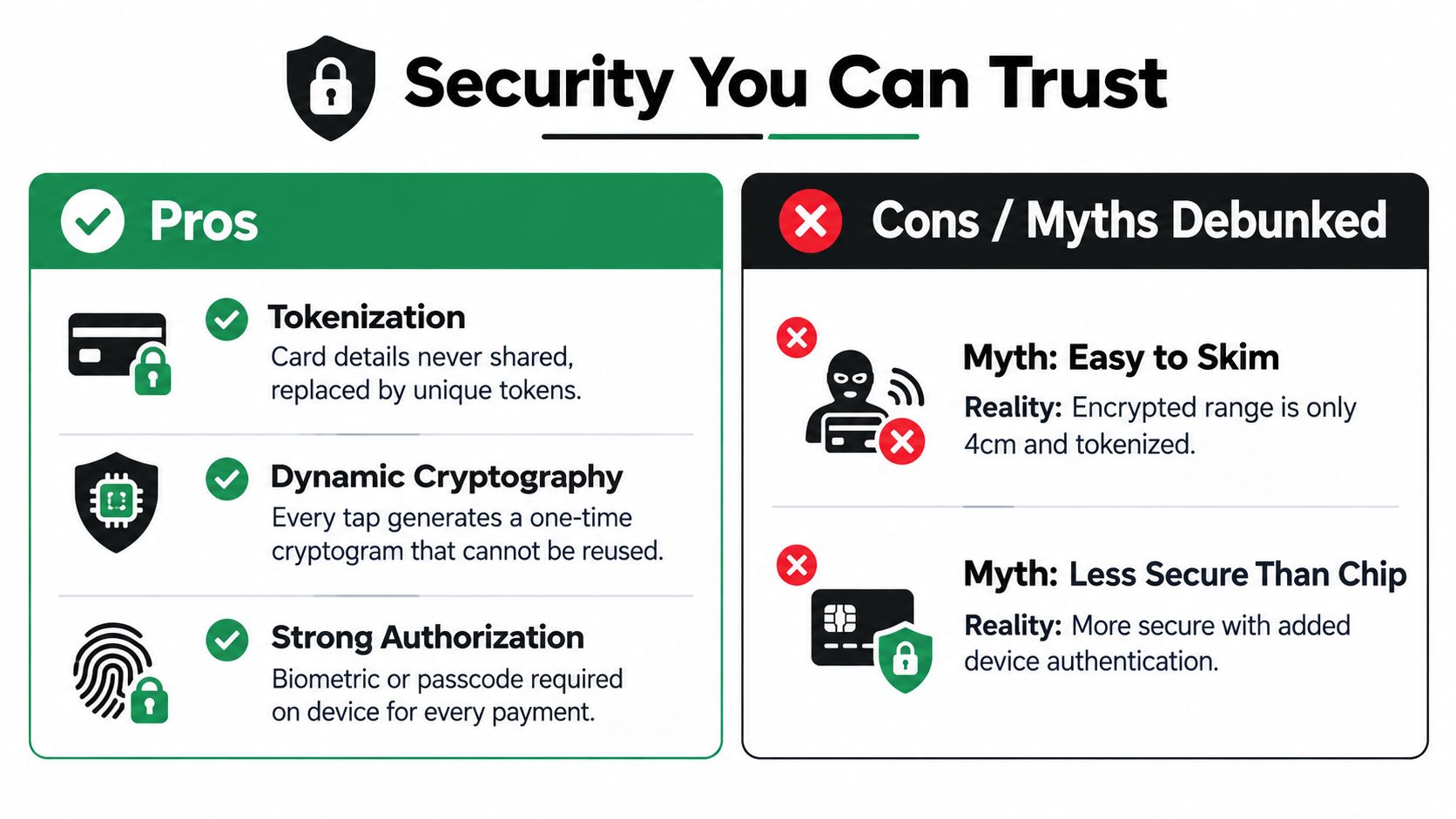
Questions finance and compliance teams ask
Can someone easily skim a contactless card? The short-range NFC interaction requires the device to be close to the reader, and the payment process uses protected transaction data. Customers should still report lost cards and follow their bank's security guidance.
Is a mobile wallet just storing the card number on the phone? A mobile wallet uses payment credentials and security controls designed for digital transactions. Device authentication adds another checkpoint, especially when the phone or watch requires a passcode or biometric confirmation.
Does cashless remove every risk? No. Operators still need dependable terminals, accurate product configuration, secure processing, and clear procedures for disputed transactions. A thoughtful payment processing integration guide can help teams evaluate how the terminal, processor, machine controller, and reporting system fit together.
For a vending program, security includes more than fraud prevention. It also includes dependable authorization, accurate refunds, controlled access to reports, and fewer manual cash-handling tasks. Facility leaders who want a plain-language overview can review mobile payment security for vending before discussing the technology with finance or IT.
How Contactless Drives More Sales and Conversions
A vending machine can carry the right products and still lose sales if payment creates too much work. A customer who doesn't have cash, dislikes inserting a card, or sees a slow queue may walk away. Contactless payment removes one of those barriers by letting customers use the card, phone, or watch they already carry.
The broader market shows why that matters. In 2024, contactless card spending reached US$10.4 trillion across 456.6 billion transactions, representing 42% of all card payments worldwide. Contactless accounted for 23% of all card spending, up from 18% in 2023, according to the global contactless and tap-to-pay usage data.
Those figures don't guarantee a specific vending sales result. They do give operators a useful decision lens: customers increasingly expect payment systems to match the habits they use elsewhere. When the machine accepts Apple Pay, Google Wallet, and contactless cards, the customer can choose a familiar path instead of abandoning the purchase.
Comparing the customer journey
Performance Metric | Without Contactless | With Contactless |
|---|---|---|
Payment preparation | Customer may need cash, coins, or a card insertion | Customer can use a tap-enabled card or mobile wallet |
Checkout flow | More physical steps can slow the interaction | A tap can shorten the payment sequence |
Purchase barrier | A customer without cash may leave without buying | A stored wallet or contactless card creates another route to purchase |
Peak-period capacity | Slower interactions can contribute to queues | Faster interactions can help the machine serve more customers |
Operator visibility | Cash collection and reconciliation provide limited purchase detail | Cashless records can support transaction and performance review |
Assortment decisions | Product changes may rely heavily on informal feedback | Payment and telemetry information can inform replenishment and selection |
The strongest result comes from combining payment access with product relevance. If employees see the drinks, snacks, frozen items, or meal options they want, contactless payment makes the final step easier. If the assortment misses local preferences, a fast terminal can't solve the entire problem.
Operators should compare locations rather than assume every site behaves the same way. An office may respond to coffee and healthier snacks, while a manufacturing facility may need substantial break-time availability and durable equipment. In each case, a contactless terminal can support conversion, but the assortment, pricing, service schedule, and machine placement still determine whether customers engage.
Operational Advantages and Smarter Reporting for Operators
Contactless payment creates a useful record of activity, but the larger opportunity appears when payment data works alongside telemetry. Telemetry is the machine's way of reporting what is happening inside it. Instead of waiting for a customer complaint or a routine visit, an operator can use connected information to identify sales patterns, inventory needs, and service concerns.
Visa's economic analysis across 67 countries found that consumer and merchant time-saving benefits from contactless payments totaled $19.3 billion between 2017 and 2021. During that period, consumer time savings rose from less than $2 billion in 2017 to about $7 billion in 2021, while merchant time savings increased from under $1 billion to roughly $4 billion, as reported in Visa's contactless payment analysis.
The value for vending operators isn't limited to the payment moment. A connected machine can help answer practical questions:
What sells at this location? Transaction patterns can help identify popular products and slow-moving items.
When should the operator replenish? Inventory signals can support more targeted service visits.
Which products deserve more space? Assortment decisions can reflect actual customer behavior and location feedback.
Where is service needed? Alerts and performance information can help the operator investigate equipment or payment issues sooner.
Turning information into a service routine
A facility manager usually doesn't want a spreadsheet full of raw transactions. They want a machine that stays available, products that reflect employee preferences, and a service provider who responds when something goes wrong. Reporting becomes valuable when it leads to an action, such as adjusting the assortment, changing a replenishment schedule, or checking a terminal.
Unattended vending ROI differs from a simple cashbox calculation. A location gains from fewer payment obstacles and a more useful break room. The operator gains information that can reduce unnecessary trips and improve product planning. Employees gain a better chance of finding what they want when they need it.
For decision makers reviewing service proposals, ask how the provider shares results and handles feedback. A vending performance reporting approach should make the information understandable, connect it to service decisions, and avoid treating technology as a substitute for human follow-up.
Vendmoore Enterprises provides smart vending services with cashless payment acceptance, connected telemetry, adaptive assortments, and service follow-up across Oklahoma. That model can include managed vending or equipment ownership options, depending on the location's operating preferences. The technology matters, but the operator's response to the information determines whether the system creates lasting value.
Real World Examples Across Workplaces Healthcare Education and Transit
A corporate office may see contactless vending as a small improvement that removes friction during a busy workday. Employees can use a phone, watch, or tap-enabled card for a drink between meetings, while the operator reviews product activity and adjusts the assortment based on demand and feedback. The facility gains a more convenient amenity without adding a staffed café.
A hospital or clinic has a different pattern. Staff members may work early, late, or overnight shifts, and visitors may need refreshments outside normal food-service hours. A vending machine with contactless acceptance can provide access when the main café isn't open. The operator still needs to maintain cleanliness, stock dependable products, and provide a clear process for payment problems.
Schools, colleges, and universities often manage concentrated traffic around class changes and scheduled breaks. Contactless payment can help students move through a purchase more efficiently, while product selection can reflect the needs of students, faculty, and staff. Manufacturing and industrial sites may prioritize durable machines, practical meal options, and reliable service during fixed break periods.
Different locations need different operating plans
A residential community or property manager may value a compact refreshment center in a shared amenity area. Airports, stadiums, and transit hubs may care more about quick transactions, high availability, and a product mix suited to people in motion. Mastercard says contactless payments account for more than two in every three face-to-face transactions globally, up from one in three before the pandemic, and describes tap-and-go payments as simple, fast, secure, and touch-free in its overview of contactless payment use.
The implementation can also vary. Some organizations want a fully managed service, while others prefer to own the machines and arrange support. Product formats can include compact refreshment centers, bottle-and-can vendors, dual-zone chill centers, and frozen food machines. The right choice depends on available space, traffic patterns, electrical requirements, audience preferences, and the service expectations of the property.
Facility leaders can review vending machine success stories for practical context, then ask prospective operators how they handle assortment feedback, replenishment, payment support, and equipment follow-up. A successful program isn't defined by a terminal alone. It combines accessible payment, relevant products, dependable machines, and reporting that helps the operator keep improving the experience.
Vendmoore Enterprises offers modern, AI-powered vending services across Oklahoma, with machines that accept contactless cards, Apple Pay, and Google Wallet alongside connected telemetry and custom assortments. Visit Vendmoore Enterprises to discuss a managed or client-owned vending program for your office, school, healthcare facility, manufacturing site, residential community, or public venue.
Comments