_edited.png)
Drinks for Vending Machines: A Practical Buyer's Guide

The machine in your break room is full, but employees still complain that there's nothing worth buying. Water disappears before lunch, one energy drink occupies several untouched slots, and the person responsible for restocking keeps ordering by habit instead of evidence. That's not a product problem. It's a drink-mix problem.
The right drinks for vending machines depend on the people using the machine, their schedule, the weather, the equipment, and how they pay. An Oklahoma office needs a different assortment from a hospital, school, warehouse, gym, or airport. Beverage vending has stayed central to the category for decades, from the first beverage vendor recorded in Paris in 1890 to Coca-Cola's rollout of the first soda dispensing machine in 1930, as described in this history of vending machines.
I've stocked machines across offices, schools, and hospitals, and my recommendation is consistent: engineer the assortment around the location first, then use sales data to refine it. Popularity lists are a starting point, not a plan.
Why the Right Drink Mix Changes Everything
A 120-person office can look busy at nine in the morning and still have a badly tuned machine. Suppose energy drinks account for 38% of early sales because a small group buys them before work. By mid-afternoon, two columns of Celsius remain untouched while the water slots are empty. The machine appears stocked, but it's failing the people who want a cold drink during the workday.
That mismatch creates four operational problems:
Dead inventory: Slow products occupy valuable facings and tie up cash.
Stockouts: Fast-moving water, cola, or sports drinks disappear before the next visit.
Customer complaints: Employees contact facilities when the machine repeatedly misses basic needs.
Lost revenue: The operator loses sales, and the site may lose commission income.
Drink mix controls slot velocity, the rate at which each facing sells. Slot velocity determines how often you need to visit, which products require higher par levels, and whether a premium item deserves more space. A machine with the wrong products can require just as much labor as a good machine while producing less revenue.
Practical rule: A full machine isn't necessarily a profitable machine. Measure what sells by slot, time, and location.
The fix starts with a simple review. Separate products into winners, steady sellers, experiments, and dead stock. Look at the time of day and the weather when possible. In hot Oklahoma summers, cold water and electrolyte drinks often deserve more capacity than they receive. In an office with long indoor dwell time, cold brew, sparkling water, and low-sugar options may earn repeat purchases that a generic soda-heavy planogram misses.
Even specialty beverage ideas need the right channel. A syrup resource such as shop dragon fruit syrup mix may suit a staffed coffee or beverage program, but it doesn't automatically belong in a packaged-drink vending machine. The operator's job is to distinguish a good beverage from a good vending SKU.
The Five Core Drink Categories for Vending
Plan the machine in categories before choosing brands. That keeps one popular product from crowding out an entire customer need.
1. Bottled water
Still water is the baseline. Stock it in PET bottles, with sparkling water as a smaller secondary option where the audience supports it. Water usually has lower margin than premium beverages, but it provides dependable velocity and protects customer trust. Keep it cold in a refrigerated machine, especially in warm climates.
2. Carbonated soft drinks
Cans and PET bottles both work for carbonated soft drinks. Cola and diet cola should usually anchor the category because brand recognition creates a reliable purchase decision. Cans chill quickly and pack efficiently, while bottles communicate more volume. Carbonation quality declines when drinks sit in excessive heat, so protect CSDs from poorly controlled ambient storage.
3. Energy and functional drinks
Energy drinks belong in the most visible eye-line positions, not scattered randomly across the machine. Use a mix of regular and sugar-free choices, then watch whether the location favors high-caffeine products, electrolyte beverages, protein drinks, or vitamin-enhanced water. Premium pricing can work here, but only if the audience values convenience and function.
4. Juice, tea, and isotonic drinks
This is the middle ground between soda and water. Bottled tea, 100% juice, flavored water, and sports drinks serve customers who want taste, hydration, or a healthier positioning. Schools, hospitals, gyms, and wellness-focused offices generally need more room for this group than traditional office machines.
5. Specialty beverages
Cold brew coffee, kombucha, plant-based milks, and other premium products differentiate a modern machine. They require tighter inventory control because demand is more location-specific and shelf life can be less forgiving. Ready-to-drink coffee deserves special attention where a bean-to-cup program isn't available. For terminology around ready-to-drink products, see what RTDs are.
Every category also has an equipment implication. Check refrigeration, column width, product diameter, loading access, and temperature recovery before promising a particular package. Food and beverage equipment reliability is a separate discipline, and operators can learn more from Forge Reliability experts when evaluating service and maintenance requirements.
Bottles, Cans, and Pouches Compared
Packaging affects more than appearance. It changes cooling behavior, loading speed, breakage risk, freight handling, and how much product fits in a column.
PET bottles are the default choice for water because customers recognize the format and associate the larger bottle with value. They also work for sports drinks, teas, and some sodas. The trade-off is physical space and vulnerability to splitting when mishandled or frozen.
Aluminum cans fit tightly and give operators more facings per shelf. They're especially practical for cola and energy drinks. Cans can dent during delivery, but a dented can usually doesn't damage neighboring inventory the way a split bottle can. Flexible pouches reduce package weight and freight volume, but vending customers may distrust the format, and the delivery system needs to accommodate a wider, less rigid package.
Dimension | PET Bottles | Aluminum Cans | Flexible Pouches |
|---|---|---|---|
Cooling behavior | Slower recovery than thin metal packaging | Efficient cooling and tight packing | Depends heavily on shape and machine design |
Breakage risk | Can split if frozen or dropped | Usually dents without leaking | Resistant to dents, but punctures remain possible |
Shelf-life fit | Strong for water and many sports drinks | Strong for CSDs and energy drinks | Product-specific and often less familiar |
Slot efficiency | Larger footprint, strong perceived value | Compact, efficient facings | Requires wider chute and careful loading |
Best categories | Water, tea, juice, sports drinks | Soda, energy, some coffee | Niche frozen or specialty beverages |
For a compact location, the small drink vending machine guide is useful when matching package dimensions to available floor space. My default recommendation is simple: PET for water and hydration, cans for soda and energy, and pouches only where the machine and audience clearly support them.
Don't choose packaging by wholesale price alone. A cheaper product that jams, warms slowly, or gets damaged during delivery can cost more through refunds, service calls, and lost confidence.
Chilled, Ambient, and Frozen Storage Zones
Temperature determines whether a drink tastes right when the customer buys it. It also determines which equipment you can safely use.
A chilled zone generally targets 34 to 40°F. Put bottled water, soda, sports drinks, and cold brew there when the machine promises a cold purchase. Leave adequate space around the evaporator and loading area so containers don't block airflow. Overloading a shelf can create warm pockets even when the display shows an acceptable temperature.
Ambient storage generally sits around 60 to 70°F. Shelf-stable juices, certain energy drinks, and bottled teas can occupy this zone when the audience accepts them at room temperature. Ambient equipment usually reduces energy use compared with refrigeration, but it limits the products you can sell convincingly. Customers may accept ambient tea in a corridor, yet reject warm water in a summer warehouse.
Frozen products require a dedicated freezer operating at 0°F or below. Smoothies, frozen lemonade pouches, and novelty ice drinks belong there only after the machine's freezer performance, delivery path, and defrost cycle have been verified. Frozen niches rarely justify the complexity unless the venue supports premium pricing and steady traffic.
Zone | Temperature | Energy Draw | Best Drinks | Trade-Off |
|---|---|---|---|---|
Chilled | 34 to 40°F | Higher than ambient | Water, soda, sports drinks, cold brew | Better customer appeal, higher operating demand |
Ambient | 60 to 70°F | Lower than chilled | Shelf-stable juice, some tea, selected energy drinks | Lower cost, narrower assortment |
Frozen | 0°F or below | Highest and equipment-specific | Smoothies, frozen lemonade, novelty ice drinks | Premium potential, complex maintenance |
Don't freeze PET bottles or carbonated products accidentally. Freezing can split packaging, while poor temperature control can cause carbonation loss, flavor drift, and shorter shelf life. Review hot and cold vending machines before combining temperature zones in one site.
Matching the Mix to Your Location
The best drinks for vending machines are determined by traffic pattern, dwell time, climate, and customer priorities.
Offices need a balanced core: bottled water, cola, diet cola, one energy option, and one or two premium SKUs such as cold brew or flavored seltzer. Employees return to the machine repeatedly, so variety matters, but excessive variety creates slot cannibalization. Put familiar staples in the largest share of facings and reserve visible positions for premium tests.
Hospitals and clinics need hydration and restraint. Stock still water, electrolyte drinks, low-sugar beverages, unsweetened tea, and coffee where appropriate. Avoid making aggressive carbonation the dominant choice near patient areas. Staff may buy at all hours, while visitors often make convenience-driven purchases, so the machine needs dependable basics rather than a novelty-heavy assortment.
Schools and colleges require tighter attention to policy, age, and package size. Smaller cans, flavored water, sports drinks, and 100% juice can serve students and staff without giving the machine an energy-drink identity. Keep caffeine away from the primary school-facing selection unless the institution explicitly permits it.
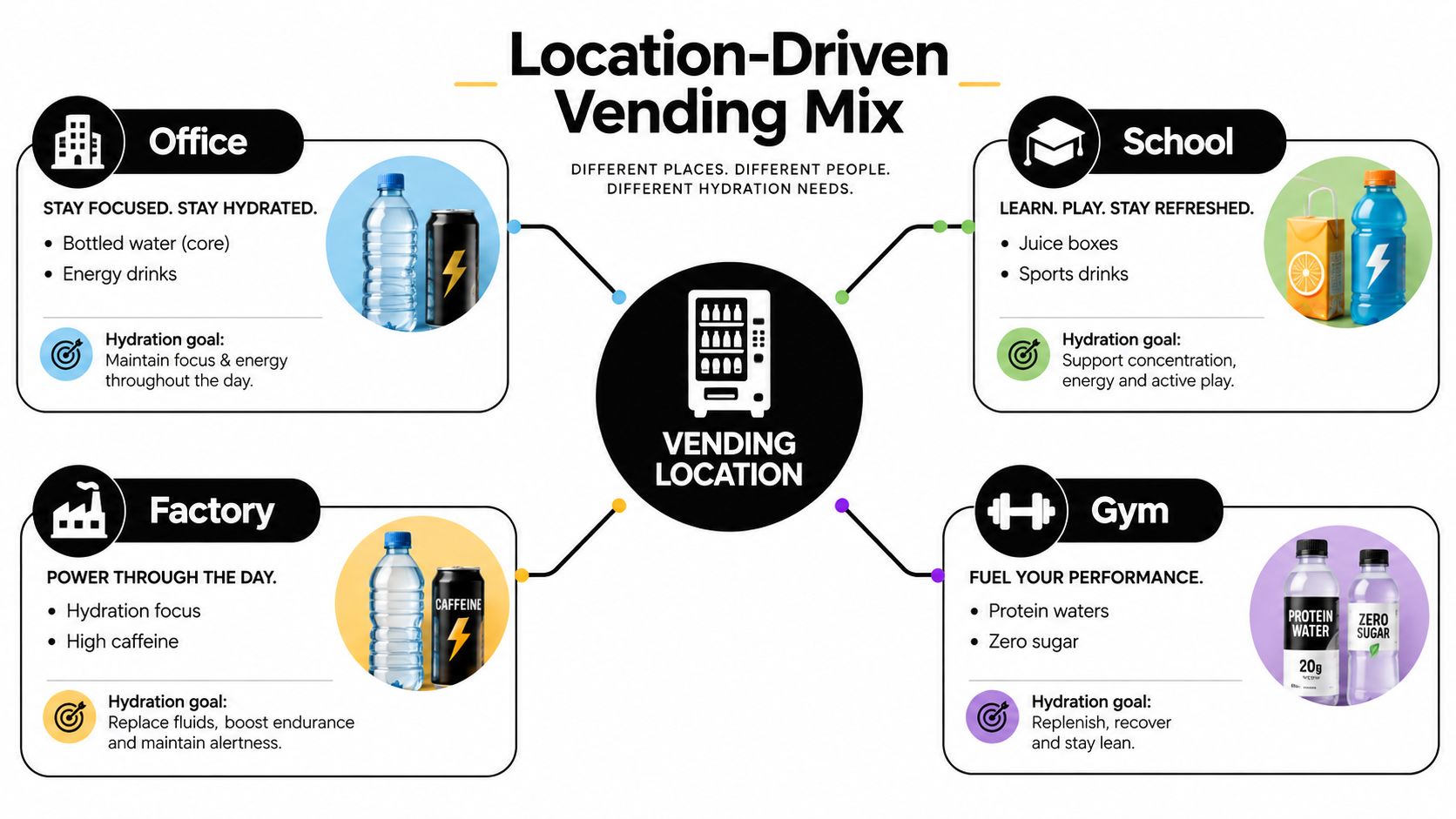
Manufacturing and warehouse sites are hydration sites first. Water, sports drinks, electrolytes, and higher-caffeine energy beverages usually make more sense than premium juice. Heat, physical work, and shift changes create clear demand peaks, so the operator should review delivery timing and summer par levels separately from office routines.
Residential properties need broader household appeal. Combine water, family-sized bottles where the machine supports them, kid-focused juice, teas, and alcohol-adjacent mocktails without selling alcohol unless licensing and site requirements are fully addressed. Apartment residents shop across age groups, so a narrow workplace assortment leaves money on the shelf.
Airports and stadiums tolerate premium convenience pricing better than most workplaces. Cold brew, sparkling water, kombucha, branded energy drinks, and hydration products fit travelers and spectators who have limited alternatives and short decision windows. Visibility and fast payment matter as much as the beverage itself.
Staples, Premium, and Functional Drinks
A strong machine has a dependable core and a controlled premium layer. Don't replace staples with trendy products before the location proves it can support them.
Category | Demand | Price Tolerance | Health Positioning | Slot Priority |
|---|---|---|---|---|
Still water | Broad and dependable | Low to moderate | Strong | Highest |
Soda | Strong brand-led demand | Moderate | Mixed | High |
Energy drinks | Concentrated, impulse-driven | High | Mixed, stronger with sugar-free options | High in suitable sites |
Juice | Selective and audience-dependent | Moderate | Strongest with 100% juice | Medium |
Ready-to-drink coffee | Strong where coffee access is limited | Moderate to high | Depends on sugar and ingredients | Medium to high |
Specialty and functional drinks | Narrower but premium-oriented | Higher | Often strong | Test and measure |
Water provides universal utility but usually carries less price flexibility. Soda remains a dependable choice because customers know exactly what they're buying. Energy drinks can produce stronger margin, particularly when the assortment includes sugar-free variants for offices and gyms.
Juice works best when the venue has families, students, patients, or health-focused buyers. Coffee performs when the machine solves a real access problem, especially in offices without convenient café service. Treat each category as a job to be done, not a label on a spreadsheet.
The premium tier includes cold brew, kombucha, craft soda, sparkling water, and electrolyte waters. The functional tier includes protein drinks, vitamin-enhanced waters, and products marketed around focus or recovery. These items can support a higher ticket, but they need the right placement and enough time for repeat buyers to discover them.
Independent trend coverage says energy drinks dominate search interest, while flavored water stays lower and bottled juice has the weakest interest in that comparison, as reported by vending beverage trend data. That doesn't mean you should remove juice everywhere. It means you should test health positioning against actual site demand rather than assuming a product will sell because it sounds nutritious.
How Cashless and Telemetry Shape the Mix
Cashless payment changes what customers are willing to buy and what operators can learn. In the United States, cashless payments represented 71% of vending sales in 2024, up from 65% in 2023, and 77% of those cashless sales were contactless or mobile-based, according to the 2025 micropayment trends report.
Digital payment also supports premium testing. One vending payment report found that digital customers spent 37% more per transaction, with average spend rising from $1.78 to $2.24, as detailed in this cashless vending payment analysis. That makes cold brew, kombucha, and functional water less risky than they appear in a cash-only environment.
A useful dashboard shows sell-through by slot, time of day, payment type, and stockout events. Pair those signals with short customer feedback, then decide whether a slow kombucha needs better placement or should leave the machine. Mobile wallet and QR vending transactions are projected to grow at a 12.78% CAGR through 2031, according to this North America and Europe vending market report.
Telemetry turns restocking into a forecast instead of a guess. One vending telemetry market report says telemetry-driven operations can reduce inventory-management labor by 40% to 50%, raise uptime above 99% compared with traditional averages near 95%, and increase revenue by 15% to 25% through assortment optimization.
For a deeper look at the data layer, review telemetry data collection. The important point is operational: every sale should help decide the next order.
A Practical Stocking and Replenishment Playbook
Use a repeatable Monday-morning process. Start by photographing the machine before touching it, then record every SKU, facing count, remaining units, expiration date, and visible problem. That image gives a remote reviewer context that a spreadsheet alone can't provide.
Build the order from velocity
Use a 70/30 operating rule. Keep roughly 70% of facings assigned to proven sellers and 30% available for rotation, seasonal products, or site-specific experiments. This isn't a claim about consumer behavior. It's a practical allocation method that protects availability while preventing the planogram from becoming stale.
Count winners first: Water, cola, and sports drinks should set the order priority.
Protect experiments: Give premium juices, kombucha, or functional drinks enough visibility to earn a fair test.
Trim weak facings: If a product repeatedly remains after the next service, reduce its space before removing it.
Use FIFO rotation: Move older stock forward and load newer cases behind it.
Set par levels by machine capacity and traffic rather than applying one universal number. Fast movers need more reserve inventory and closer review. Slow premium items need smaller facings, clear dates, and a firm replacement decision if the audience doesn't respond.
Adjust for weather and schedule
Summer calls for more cold water, electrolyte beverages, and sports drinks in Oklahoma. Winter may justify more ready-to-drink coffee and fewer heat-sensitive impulse products. Seasonal changes should be planned from observed sales, not just the calendar.
Label shelves by velocity so anyone can restock consistently. Track what was pulled from the service vehicle, what was loaded into each slot, and what came back. A spreadsheet works, but a connected system is better when the route includes multiple sites. Use vending machine planogram guidance to keep the layout intentional.
Three Stocking Myths Worth Retiring
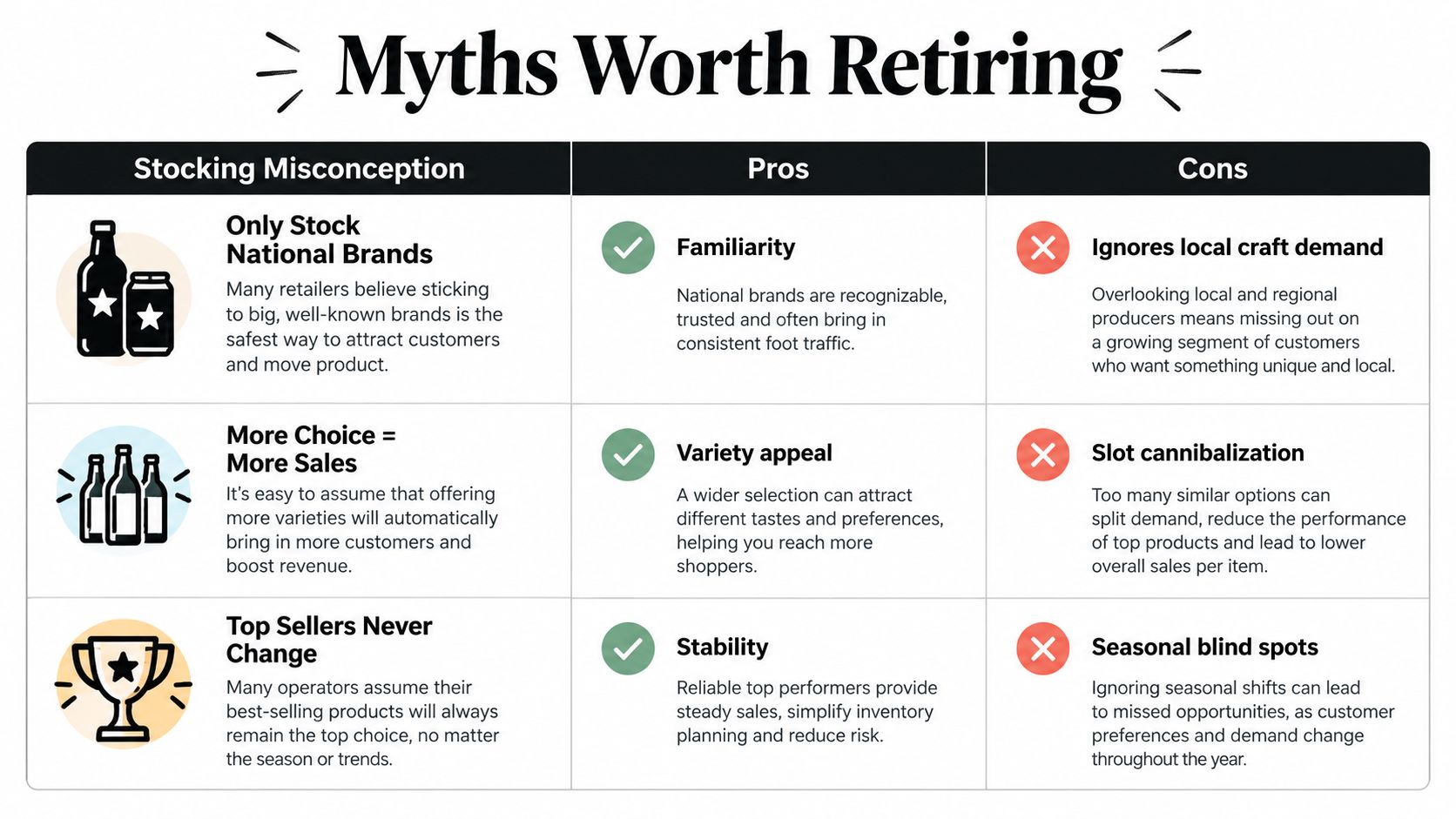
Myth one, only national brands sell. National brands provide recognition, but they don't cover every preference. A hospital employee may want sparkling water, a gym member may want protein water, and an airport traveler may pay for kombucha or premium cold brew. Local or specialty products deserve a measured test when the venue supports them.
Myth two, healthy drinks don't sell. Water, low-sugar sports drinks, sparkling water, and cold brew can perform well in offices, hospitals, and gyms. The mistake is treating “healthy” as a sales strategy by itself. Customers still buy for taste, convenience, caffeine, hydration, and price.
Myth three, a slow product is a failure after two weeks. Premium and functional drinks may need better placement and repeated exposure before customers form a habit. Judge the item alongside shelf position, temperature, price, and audience fit. Remove products that remain weak after a fair, documented test, not products that only need time to be noticed.
The common thread is location discipline. A beverage succeeds when it solves a real need for the people standing in front of that machine.
Quick Reference for Choosing the Right Drinks
Use this table as a starting assortment, then adjust after 30 days of telemetry data. The percentages in the mix column are intentionally practical allocation ranges, not universal sales forecasts.
Venue Type | Top Seller | Healthy Add-On | Premium Pick | Storage Zone |
|---|---|---|---|---|
Office | Still water and cola | Sparkling water or low-sugar tea | Cold brew | Chilled |
Healthcare | Still water | Electrolyte drink or unsweetened tea | Premium coffee | Chilled |
Education | Water and smaller sodas | 100% juice or flavored water | Specialty tea | Chilled |
Manufacturing | Water and sports drinks | Electrolyte beverage | High-caffeine energy drink | Chilled |
Residential | Water and family-size bottles | Kid juice or flavored water | Mocktail-style sparkling drink | Chilled |
Transit or stadium | Water and branded energy | Sparkling water | Cold brew or kombucha | Chilled |
A defensible starting mix usually gives the largest share to water and familiar carbonated drinks, a meaningful portion to hydration or energy, and a smaller test allocation to premium products. Keep ambient and frozen products separate unless the machine and site have proven demand for them.
Vendmoore Enterprises provides customizable drink vending programs, cashless Apple Pay and Google Wallet acceptance, connected telemetry, and replenishment customized for Oklahoma workplaces and public spaces. Visit Vendmoore Enterprises to discuss a managed break room vending setup for your office, school, hospital, manufacturing site, apartment community, airport, or stadium.
Comments