
Espresso Machines Near Me: Buy, Lease or Managed Service
When you search for espresso machines near me, are you comparing the machine's purchase price, or the cost of keeping coffee available when everyone arrives at once? For a shared site, the second question matters more. A good espresso setup needs an ownership model your staff can support, a machine that holds quality through a rush, and a repair arrangement that matches your tolerance for downtime.
For Oklahoma offices, schools, clinics and public spaces, a local vending operator may be part of the answer. But vending service and espresso expertise aren't interchangeable. Evaluate the beverage equipment, maintenance responsibilities and service coverage separately before combining them into a break room program.
Buying, Leasing or Managed Service Compared
Ownership models compared
Model | Upfront cost | Service and repairs | Beans, milk and cups | Best fit |
|---|---|---|---|---|
Buy outright | High, one-time | Owner or service contract | Owner | Sites with facilities staff and steady daily volume |
Lease | Low, fixed monthly payment | Often bundled in the contract | Owner or bundled | Sites that need predictable monthly budgets |
Managed service | None up front under a no-installation-fee agreement | Provider, within agreed scope | Provider | Offices and public spaces with no staff to maintain equipment |
Consider a hypothetical 40-person office serving about 120 cups a day. That's a planning scenario, not an expected consumption rate. Include visitor drinks and repeat users, then check whether the proposed volume resembles your actual demand.
Buying moves the full responsibility onto the office. The owner pays for equipment, filtration, descaling, parts and any service contract, while someone must order supplies and complete routine cleaning. Ownership works when facilities staff have time for those tasks and daily use is steady enough to justify the investment.
A lease converts equipment spending into scheduled payments. It doesn't automatically transfer cleaning or repair responsibility, and a low monthly figure can obscure an expensive end-of-term buyout. Ask whether returning the machine requires freight, removal charges or restoration of the installation area.
Separate ownership from daily work
Managed service leaves the equipment with the provider under the agreed arrangement. The provider handles stocking, cleaning and repairs for a monthly or per-cup charge, but the contract must distinguish service-visit cleaning from tasks left to site staff, especially milk-system sanitation.
The same machine can sit under any of these models. The contract matters more than the ownership label. Facility Management Insights' facility equipment financing choices for 2026 provides additional context for organizing a financing comparison; use the actual proposal to establish your obligations.
Who is responsible when the machine stops during a Monday rush?
That question exposes gaps between equipment supply and operational support. A purchase normally ends with an owned asset; a lease ends through return, renewal or buyout; managed service ends according to removal and termination provisions.
At Vendmoore Enterprises, we offer fully stocked vending, customers can also choose to own their machine, and our full-service vending includes stocking, service and support. Those are vending arrangements, not confirmation of an espresso offering. Our vending machine rental agreement guide can help frame the contract discussion.
Before comparing quotes, pull out service inclusions, repair response time and the buyout figure. Put those terms beside the payment, not in a separate folder.
Machine Formats Matched to Each Site Type
Machine format by site type
Site | Recommended format | Load pattern | What decides the format |
|---|---|---|---|
Small office or break room | Automatic | Steady, low | Staff can run it with one button |
Clinic or medical office | Super-automatic | Steady, moderate | Cleaning cycles and hygiene |
School staff room or college lounge | Automatic or super-automatic | Peaky, around breaks | Rotating users with little training |
Airport lounge or stadium concourse | Super-automatic | Peaky, high | Recovery time between peaks |
Manufacturing site on multiple shifts | Super-automatic | Continuous | Durability and service response |
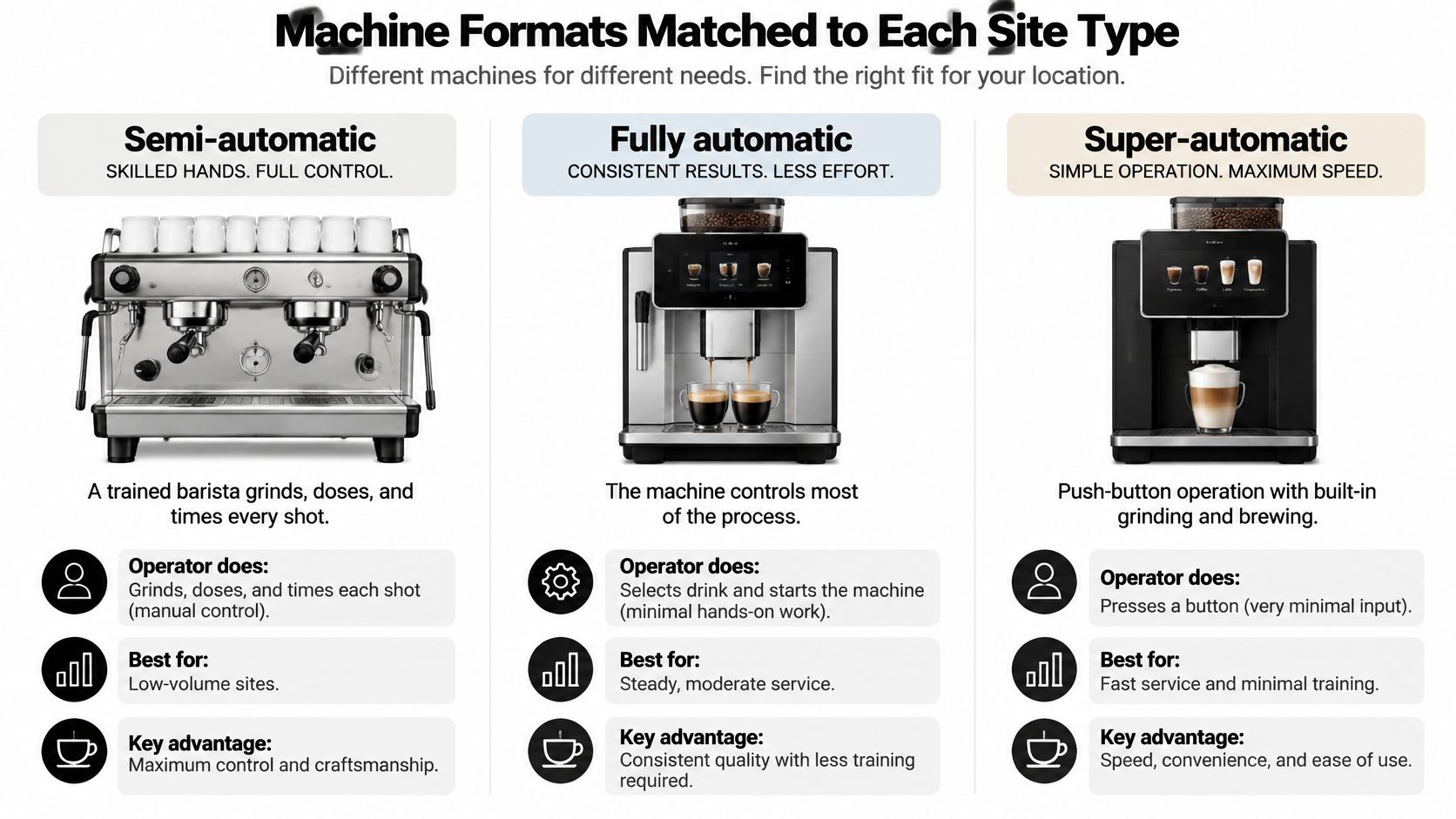
Semi-automatic equipment leaves grinding, dosing, tamping and shot timing to a trained operator. It suits a low-volume hospitality station with a dedicated person, not an unattended corridor.
Automatic machines control programmed extraction, although some still require manual grinding and puck preparation. For a true one-button break room, specify integrated bean-to-cup operation rather than relying on the word automatic. Super-automatic machines integrate grinding, tamping and brewing, with milk preparation automated on appropriately equipped models.
Match the operator to the workload
A small office benefits from simple controls because coffee preparation isn't anyone's main job. A clinic needs an equally clear cleaning process, including responsibility for milk-contact parts and surfaces. A semi-automatic machine in a hospital staff area can produce inconsistent drinks when users have different skills and nobody owns the recipe.
School breaks create concentrated demand. Rotating users need recognizable drink buttons, accessible supplies and a waste drawer they can empty without dismantling the machine. Airport lounges and stadium concourses add a different constraint: the equipment must recover between bursts of espresso brewing and milk steaming.
On a multi-shift manufacturing floor, accessibility for servicing matters as much as the drink menu. Check whether the machine can remain supported across operating shifts rather than assuming daytime technician coverage is enough.
According to Fortune Business Insights' espresso-machine market assessment, fully automatic machines accounted for more than 60% of the market by product category. That supports the appeal of reduced operator intervention, but it doesn't establish whether a particular model can serve your queue.
Our commercial bean-to-cup machine guide helps distinguish integrated preparation from machines that still need manual handling. We provide break room vending for teacher lounges, apartment community areas and office breakrooms; evaluate any espresso addition against each space's staffing.
Before choosing, check counter clearance, payment compatibility and replenishment support. Leave room to remove the grounds drawer, refill beans and access filters. A machine that fits only with its service panels closed doesn't fit.
Test Espresso Consistency Before You Sign
Espresso brewing benchmarks to test
The café setup guidance from Podium Coffee Club identifies approximately 9 bar during extraction, a 7–9 g single or 14–18 g double dose, 90–96°C water and 20–30 seconds as practical starting benchmarks, with approximately 93°C useful for medium roasts.
The Italian Espresso National Institute reference parameters reproduced in Wikipedia's espresso overview specify 9 ± 1 bar inlet pressure, 88 ± 2°C water exiting the unit, 25 ± 5 seconds, 7 ± 0.5 g coffee and 25 ± 2.5 ml beverage volume.
Parameter | Benchmark | Test note |
|---|---|---|
Brew pressure at the group head | About 9 bar | A 15 bar pump rating alone does not show extraction pressure |
Water temperature | 88 ± 2°C reference; 90–96°C café range | Start near 93°C for medium roasts |
Extraction time | 25 ± 5 seconds reference; 20–30 seconds café range | Shots outside the range warrant checking grind or dose |
Single dose | 7 ± 0.5 g reference; 7–9 g café range | Weigh the basket, not the scoop |
Double dose | 14–18 g | Match to the portafilter basket size |
Output volume | 25 ± 2.5 ml | Weigh output separately to calculate the brew ratio |
Don't select a machine because its advertised maximum pump pressure is higher. An over-pressure valve commonly reduces pressure before water reaches the coffee puck, so maximum pump capability doesn't demonstrate controlled extraction.
The temperature references also use different measurement conditions. Water exiting a unit, a boiler display and a measurement at the coffee bed aren't interchangeable. Ask the demonstrator to identify the measurement point before comparing readings.
Establish a repeatable baseline
Bring a coffee scale, timer and recording sheet. Ask the supplier to provide suitable pressure and temperature measurements rather than expecting a display alone to prove performance. For a manual setup, inspect the portafilter basket and confirm that the dose suits it.
Use this proposed acceptance sequence, keeping the recipe fixed:
Pull five consecutive shots. Keep beans, dose, grind and portafilter unchanged. Pass if the machine repeats the agreed recipe without hidden adjustments; fail if the demonstrator must keep correcting it.
Weigh each dry dose and beverage output. Record both separately. Pass when results stay within the recipe tolerance agreed before testing, not a tolerance invented after inconsistent shots appear.
Time every extraction. Use the same starting point each time. If timing shifts, check preparation and grinder delivery before blaming the heating system.
Log pressure and temperature using the agreed measurement method. Pass if the machine maintains its promised operating conditions; fail if it can't recover without pauses your users won't accept.
Volume and beverage mass aren't the same measurement. Crema changes the apparent volume, so don't convert the reference beverage volume directly into an assumed gram target. Establish an output mass for your chosen recipe and use that for repeatability.
For a super-automatic machine, have the technician demonstrate how dose and grinder settings are checked. You may not have access to a conventional portafilter, but you still need recorded drink output, preparation time and a repeatable recipe.
Make the rush test resemble your site
Next, run a proposed stress test of ten or more back-to-back shots. This is an acceptance exercise, not a universal capacity rating. Compare the opening and closing drinks for extraction time, measured conditions and taste.
Include milk drinks if people will order them. Alternating espresso and steaming can expose recovery delays that an espresso-only demonstration misses. Record whether the machine pauses, queues orders or requires the operator to wait before continuing.
A machine that makes an excellent demonstration shot but loses consistency during your busiest queue isn't the better machine.
Lighter roasts often benefit from higher brewing temperatures and darker roasts from lower ones. The practical requirement is adjustable, stable temperature, not a promise that a single preset suits every bean. Once you choose a recipe, don't change beans halfway through the comparison.
Grinder performance deserves its own check. Look for repeatable delivery, accessible adjustment and a clear procedure for changing settings. An expensive brewing system won't compensate for erratic dosing or a grinder that staff can't maintain.
Test the work between drinks
Finish the demonstration by making the intended user perform the routine tasks:
Cleaning cycle: Have a site representative start and finish it, including any tablet, rinse or milk-system steps.
Water treatment: Identify the required filtration, cartridge access and replacement responsibility.
Grounds handling: Empty and reinstall the drawer, then estimate interruptions against your planned daily demand.
Refilling: Check access to beans, water and milk without moving the equipment or blocking users.
Fresh milk adds refrigeration and sanitation duties. An automated rinse isn't permission to ignore the manufacturer's cleaning procedure, and a provider's periodic visit doesn't necessarily cover daily milk handling.
Record pass or fail before the demonstration ends, along with any unresolved condition. Don't accept a verbal promise that a different installation setting will solve a problem without a repeat test or written acceptance requirement.
What Ownership Really Costs Over Three Years
Use a clearly hypothetical office calculation: 120 cups per day × 250 working days = 30,000 cups annually. Over the proposed three-year comparison period, that gives 90,000 cups. These are planning assumptions, not measured consumption.
Use served drinks as the denominator. Include water used for rinsing, coffee discarded during setup and cleaning consumables in the numerator, even though they don't become drinks.
Build a cost sheet from actual quotes
Cost line | How to calculate the annual amount |
|---|---|
Electricity | Quoted or measured annual consumption × local electricity tariff |
Water and drainage | Brewing, rinsing and cleaning consumption × applicable utility charges |
Beans and milk | Recipe cost per served cup × 30,000 |
Cups and lids | Disposable cost per cup × 30,000, adjusted for reusable cups |
Filters and cleaning | Scheduled cartridges, chemicals and descaling costs |
Repairs and parts | Service agreement plus identified exclusions |
Staff time | Assigned cleaning and replenishment time × loaded labor cost |
Waste and recycling | Collection charges and recovery-program costs |
For each variable cost, multiply the per-cup figure by the hypothetical annual volume, then multiply the annual amount by the comparison term. For fixed charges, use the actual scheduled payments rather than pretending they rise with consumption.
Buying adds acquisition and installation costs, with any supportable residual value treated separately. Leasing adds scheduled payments, fees and the buyout if ownership is intended. Managed service adds its quoted charges and anything excluded, including minimum-volume commitments or site cleaning labor.
Cost rule: Divide the complete term cost by the drinks you reasonably expect to serve, not the machine's advertised capacity.
Our cost comparison analysis guide offers a useful starting point for organizing competing proposals. Keep assumptions visible so a cheaper quote can't hide a different drink volume or narrower service scope.
Don't decide sustainability by format alone
Capsules aren't automatically the most expensive or most wasteful option, and ground coffee isn't automatically the opposite. Compare actual consumables, disposal routes, maintenance and useful machine life.
Mordor Intelligence's coffee-machine market coverage describes refurbishment and capsule-recovery initiatives. Ask whether a proposed supplier provides either locally, what materials it accepts and who pays for collection.
Use each proposed machine's own water and energy figures, including standby and cleaning operation. A generic efficiency claim isn't a cost input. Compare the resulting three-year cost per cup, including the lease buyout, rather than choosing the smallest monthly payment.
How to Vet Local Espresso Providers
A nearby seller isn't necessarily a nearby repair team. Use a written vetting routine to distinguish equipment availability from service capability, particularly when you're comparing an espresso specialist with a broader break room vending operator.
Check the operating commitment
Confirm coverage. Get every city and site address in the quote, together with the response commitment for a failed machine. Clarify whether response means a phone call, technician arrival or restored service.
Request downtime history for the proposed equipment and ask whether faults are reported remotely. Monitoring helps identify trouble, but it isn't a repair guarantee.
Verify payment compatibility. Test the payment methods your users need on the proposed installation, including any required network connection.
Read the complete contract for term length, ownership, inclusions, exclusions and end-of-lease buyout. Marketing language doesn't override the signed schedule.
Request comparable references. A clinic reference can explain hygiene support; an airport lounge can describe queue handling. A quiet office isn't a substitute for either.
Confirm installation requirements against a site survey: power, water connection, filtration, drainage where required, ventilation and service clearance.
Check the local business profile. Compare reviews and proximity with actual service coverage. Google's local-ranking guidance identifies relevance, distance and prominence as its main factors and notes that review count and score can influence prominence.
Apply the checks to a vending operator
Vendmoore Enterprises offers vending machines, break room vending and full-service vending across Oklahoma City, Norman, Edmond and surrounding areas. We handle stocking, service and support, but that doesn't establish an espresso-machine specialization or a particular repair deadline.
Our machines feature tap-to-pay and remote monitoring, and accept credit/debit cards, Apple Pay, Google Wallet and cash. Have the written proposal confirm which equipment and payment configuration will serve your location, along with coverage and monitoring scope.
Ask directly whether freshly prepared espresso drinks can be included before treating us as an espresso option. Iced coffee availability and vending telemetry don't prove that a supplier can install, sanitize and repair a bean-to-cup system.
Use our commercial coffee vendor guide to frame that discussion. For a combined refreshment program, require a named responsibility for each component rather than assuming the snack-machine service arrangement also covers coffee equipment.
Confirm the Model Before You Request Quotes
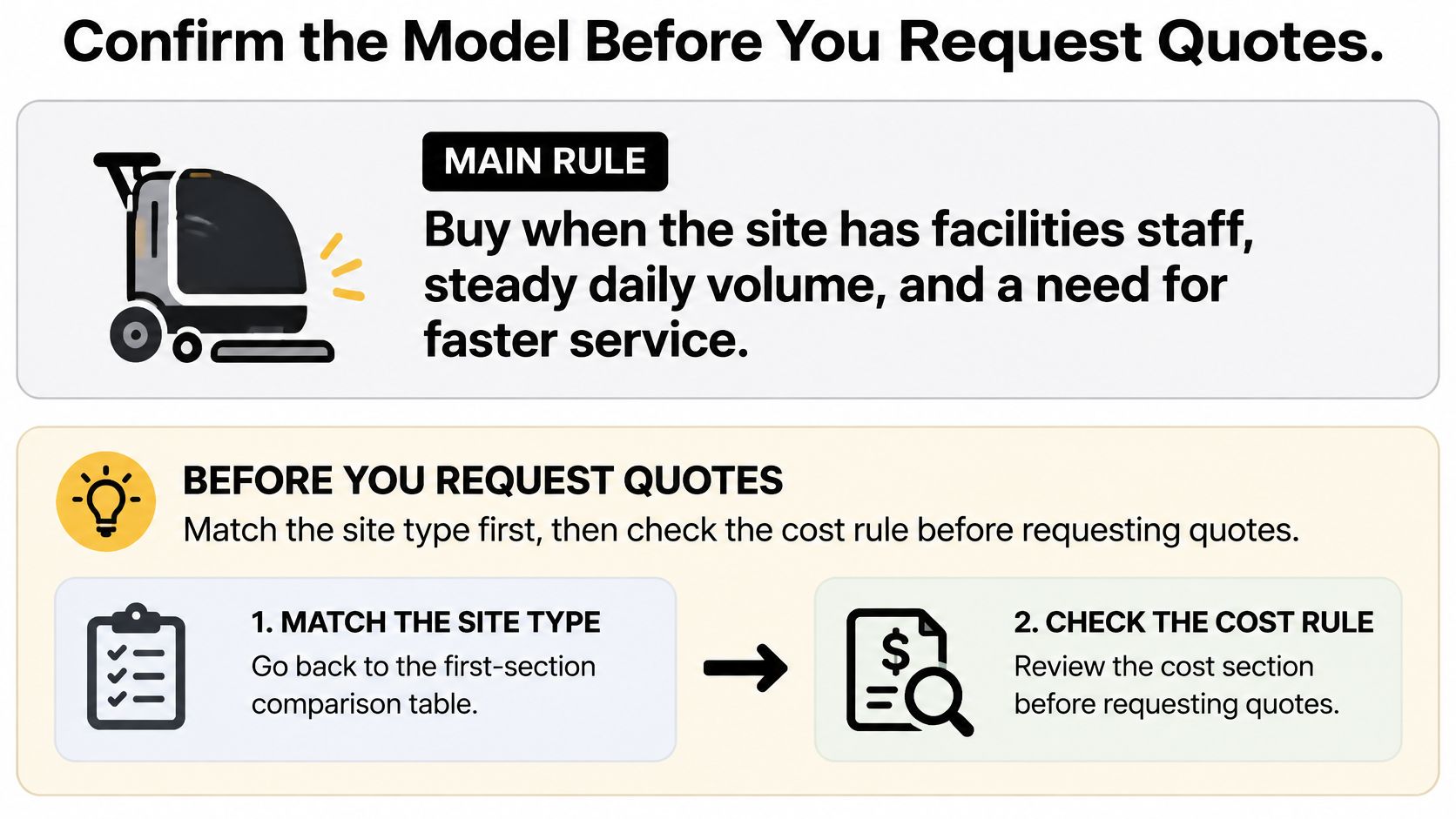
Buy when facilities staff can support the equipment, daily demand is steady, capital is available and the calculated term cost beats the managed alternative. Lease when predictable payments matter and the written buyout makes sense. Choose managed service when the site can't take on maintenance, especially in public or high-traffic spaces.
Use the ownership comparison to identify who will do the work, then apply the cost-per-cup rule before requesting proposals. Don't let a preferred machine force you into an operating arrangement your staff can't sustain.
Send providers the same purchasing specification
Write down demand. Estimate annual cups and people or visitors per day, then describe the busiest service period. Distinguish actual counts from assumptions.
Shortlist three providers within your service area and apply the vetting routine. Include an espresso specialist where technical coffee support is central to the purchase.
Request comparable quotes. Include the brewing acceptance benchmarks, repair response commitment and complete three-year cost-per-cup calculation.
For a smaller workplace, our small-office coffee machine guide can help narrow the equipment discussion. Keep the final specification focused on what users need, not the longest drink menu.
Assign a person to approve the demonstration results and another, if necessary, to approve the service contract. That prevents a good-tasting sample from becoming an equipment order before anyone has accepted the maintenance obligations.
The deciding test is whether the provider's repair response matches your tolerance for downtime. A staff kitchen with an alternative coffee station has different needs from a public lounge selling drinks. If a provider won't state its repair commitment in writing, remove it from the shortlist.
Vendmoore Enterprises offers vending machines, fully stocked break room vending and full-service stocking, service and support for Oklahoma workplaces and shared spaces. Visit Vendmoore Enterprises to discuss your location, refreshment needs and ownership preferences, and confirm whether an espresso setup can be included in your proposed program.
Comments