_edited.png)
Food and Drink Vending Machines Guide for Oklahoma

At 10:15 on a busy Oklahoma workday, an employee walks out of the building for a drink and a quick snack. A few minutes becomes a longer break, another employee joins, and the break room stays empty because it doesn't offer what people want. That small inconvenience can affect focus, morale, and the way employees experience their workplace.
Food and drink vending machines give facilities another way to support people on site. A well-planned setup can provide bottled drinks, snacks, chilled meals, frozen items, and coffee without requiring a staffed counter. The value isn't just convenience. It comes from matching the machine, products, payment options, and service schedule to the people using the space.
The market reflects that shift. The global retail vending machine market was estimated at USD 75.02 billion in 2025 and is projected to reach USD 99.23 billion by 2033, with a 3.6% CAGR from 2026 to 2033, according to Grand View Research's vending machine market analysis. Drinks still lead modern automated retail, with beverage vending machines representing 44.8% of the product mix in 2025.
This guide takes the practical route. You'll learn what different machines do, where fresh and hot food makes sense, how smart features affect daily operations, and how to think about cost and break-even without relying on optimistic sales promises. For a plain-language explanation of the category itself, see what a vending machine means.
The discussion also includes healthier choices for active employees and customers. A resource such as this Gym Snack high-protein guide can help facility teams think beyond candy and soda when building an assortment for gyms, offices, and wellness-focused workplaces.
Introduction to Modern Food and Drink Vending
An Oklahoma office may have employees who need coffee, water, or lunch without leaving the property. A manufacturing plant may run shifts outside restaurant hours. A clinic may need food access for staff and visitors who remain on site. In each case, vending solves an access problem, but the right machine depends on demand, space, staffing, and compliance requirements.
A standard snack-and-drink machine can fit a break room with predictable traffic and limited floor space. Refrigerated or frozen equipment supports more substantial food, while a hot-meal unit adds heating controls, temperature monitoring, replenishment routines, and food-safety responsibilities. Fresh food can improve the offer in a busy workplace, yet it may create waste and service work if sales are too low. The choice should follow the venue's economics, not a preference for newer equipment.
Historical U.S. sales show how vending became an established workplace channel. Sales reached USD 36.6 billion in 1999, rose to USD 38.7 billion in 2000, and reached USD 41.0 billion in 2001, according to historical U.S. vending-machine sales data. The figures help explain vending's presence in workplaces, transit locations, and other high-traffic settings.
Modern buyers also expect practical access. Cashless checkout and mobile wallets reduce payment friction, while product variety helps a machine serve different schedules and dietary needs. Telemetry can justify its cost at a large or dispersed Oklahoma facility by showing inventory levels, sales patterns, and service needs. At a small office, a simpler setup may produce better returns because there are fewer products and fewer problems to monitor.
The practical question isn't “Should we get vending?” It's “What food access problem are we trying to solve, and what machine can solve it reliably?”
For a plain-language definition, review this guide to what a vending machine means. Health-focused venues can also use the Gym Snack high-protein guide when selecting products beyond candy and soda.
How Food and Drink Vending Machines Work
Think of a vending machine as a compact convenience store divided into temperature zones. The cabinet, payment reader, delivery mechanism, refrigeration or heating system, and service controls all work together to move a product from shelf to customer.
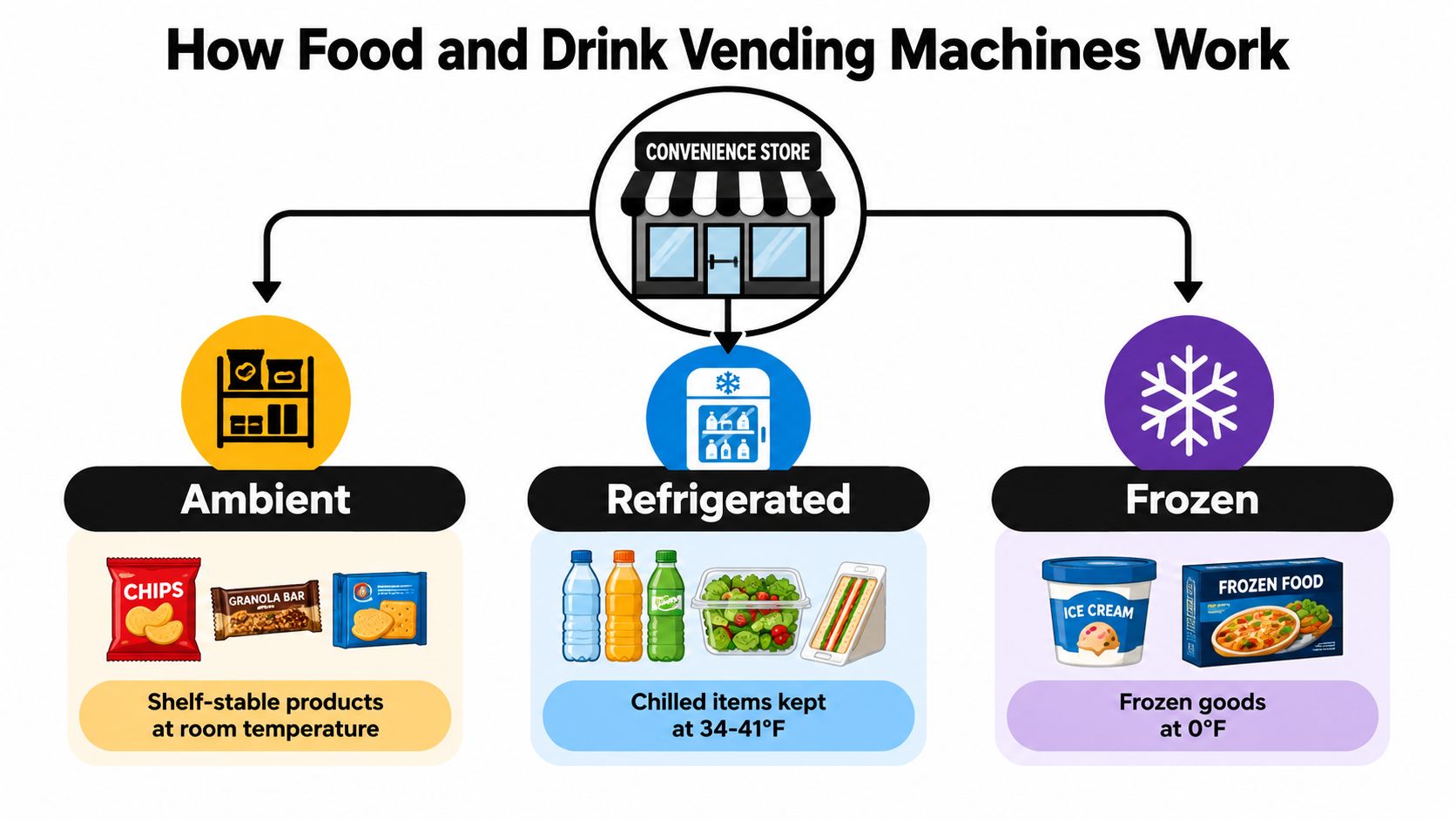
Ambient machines for shelf-stable products
An ambient snack machine keeps products at room temperature. Spiral coils or other delivery mechanisms hold items such as chips, candy, crackers, granola bars, and packaged nuts. These machines are usually simpler because they don't need a refrigerated cabinet, though they still need secure payment equipment, product sensors, lighting, and regular cleaning.
Bottle-and-can vendors focus on drinks. They can carry bottled water, soda, sports drinks, energy drinks, and other packaged beverages. A compact refreshment center combines a smaller footprint with a focused selection, which can suit an office where the available wall or floor space is limited.
Refrigerated and dual-zone machines
A refrigerated machine adds a controlled cold environment for drinks and perishable food. A dual-zone chill center can separate beverage storage from chilled fresh items, allowing an operator to build a broader assortment without treating every product as if it has the same storage needs.
The temperature matters because food safety depends on continuous control, not just the temperature at the time of delivery. Public health guidance commonly places cold products at or below 4°C/41°F, hot products above 57°C/60°F, and frozen products around -12°C to -18°C or below, depending on the jurisdiction, as described in vending-machine temperature guidance.
Frozen and heated food equipment
Frozen food machines are designed for items such as frozen meals, desserts, and ice cream. Hot-food systems add heating elements and controls, which can turn a machine into a small self-service meal station. Coffee equipment may require a different setup altogether, particularly if it needs water and drainage.
A specialty drink can also give a break room more personality. For example, a facility manager planning a coffee station might review options such as Backdraft Decaf Maple Bacon flavored coffee alongside more familiar choices.
Temperature sensors and automatic shutoffs protect the program when equipment moves outside its safe operating range. Telemetry then gives the operator information about inventory, sales, alerts, and machine status, which supports more deliberate replenishment instead of guesswork. For a deeper plain-language overview, read how smart vending machines work.
Smart Features That Power Today's Vending Experience
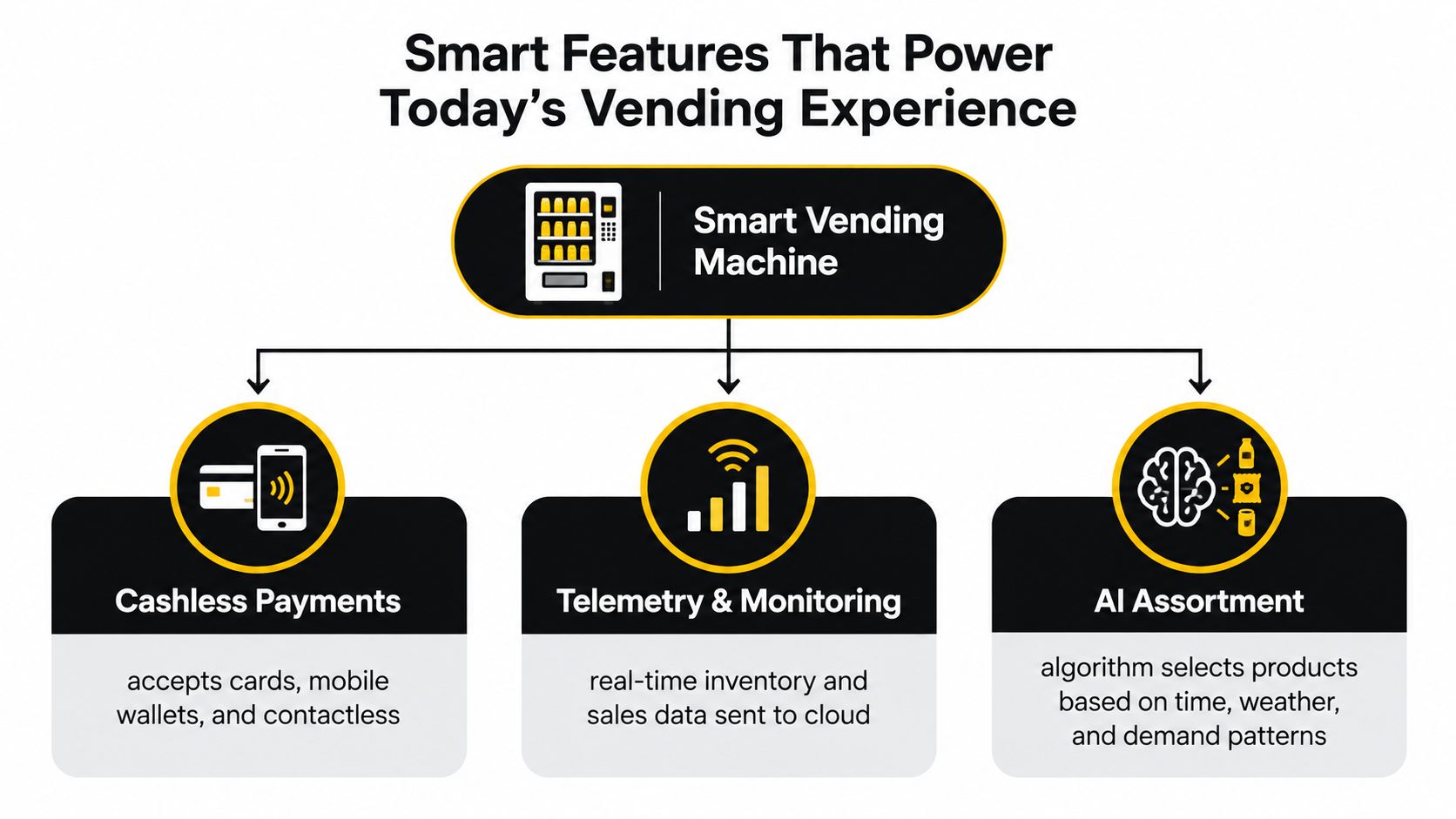
A smart machine earns its name by giving the operator better information and giving the customer fewer obstacles. Three capabilities matter most: cashless payments, telemetry, and assortment intelligence.
Cashless payment means a customer can use a debit or credit card, a phone, or a contactless wallet instead of searching for coins. Apple Pay and Google Wallet are especially useful in workplaces where employees may leave their wallets in a desk or carry only a phone. The payment reader should also handle failed transactions clearly, show the purchase amount before approval, and return the machine to a ready state quickly.
U.S. payment behavior shows why cashless capability deserves serious consideration. Cashless transactions represented 62% of vending purchases in October 2021, while contactless payments increased from 18% of all vending transactions in January 2021 to 43% by October 2021, according to NFC World coverage of U.S. vending payments.
Telemetry turns visits into decisions
Telemetry connects the machine to a remote dashboard. Instead of driving to every location to see whether a row is empty, an operator can review sales, stock levels, temperature alerts, payment status, and possible equipment faults.
That information is most valuable in a busy or dispersed route. If a beverage row sells quickly at an Oklahoma warehouse, the operator can replenish it before the next shift finds it empty. If a fresh-food compartment moves slowly, the operator can reduce the order, change the products, or reconsider whether that machine belongs there.
A guide to business smart tools can help facility teams place vending telemetry in the wider context of connected workplace systems. The useful question remains operational: does the data change a stocking or service decision?
AI assortment needs enough activity
AI assortment tools can identify patterns in product sales and recommend changes. A system may notice that cold drinks sell differently by shift, that a particular snack moves on certain days, or that a product performs better in one building than another.
The feature doesn't replace local judgment. In a low-volume office, there may not be enough activity to justify a complex software layer or recurring subscription. In a larger workplace, hospital, campus, or residential community, the same technology can help manage variety and reduce manual review.
Telemetry and AI also add trade-offs. The operator must account for connectivity, platform fees, data quality, reader compatibility, and staff training. A simple machine that stays full and works every day can outperform a smarter machine that creates technical work without improving the customer experience. Learn more about the connectivity layer through this explanation of IoT device connectivity.
Where Food and Drink Vending Machines Deliver the Most Value
A manufacturing employee has ten minutes between shifts. A visitor at a healthcare facility may not know the building layout. An office worker may already pass the break room several times a day. Each situation creates a different vending opportunity. The right choice depends on traffic, dwell time, access hours, and nearby alternatives, not on machine features alone.
Venue fit changes the product mix
Venue | What usually matters most | Potential mismatch |
|---|---|---|
Corporate office | Coffee, bottled drinks, balanced snacks, compact equipment | Fresh meals may spoil if attendance is inconsistent |
Manufacturing site | Durable drinks, filling snacks, shift-friendly access | A small assortment may empty during shift changes |
School or college | Approved products, affordability, supervision, access rules | Product policies may limit the assortment |
Healthcare facility | Staff meals, visitor convenience, dependable service | Temperature failures create a serious compliance concern |
Residential building | Extended access, varied food, drinks, and essentials | Low resident engagement can leave perishables sitting |
Stadium or airport | Fast checkout and high-capacity beverage service | Existing contracts and intense peak-period demand can complicate placement |
In Oklahoma workplaces, break rooms are often a practical starting point because employees already pause there. A smaller office may need only bottled and canned drinks with snacks. A manufacturing site running multiple shifts may justify greater capacity, more frequent replenishment, or another machine in a second common area.
Fresh food earns its space when demand is steady enough for regular rotation. Hospitals, large workplaces, and facilities with limited nearby food access may support chilled meals or frozen items. An office with irregular attendance can create spoilage and compliance exposure, even when employees express interest in fresh choices. Perishable inventory works like a short clock. If sales do not keep pace, the operator must remove or replace products sooner.
A standard snack-and-drink setup is often the safer financial choice when demand is uncertain. Telemetry and broader fresh-food capacity become worthwhile when they help an operator adjust inventory, protect temperature-sensitive products, or maintain service across shifts. The decision should connect product selection, access, service frequency, and location expectations. A facility manager can use this revenue optimization approach to compare the added cost with the operational improvement.
For a facility manager, the strongest opportunity usually sits where people wait, work long shifts, or cannot easily leave. Compliance requirements also shape the decision. Schools may restrict products, healthcare sites need dependable temperature control, and residential properties may need longer access hours. The machine should fit the venue's routine before it adds complexity.
Choosing and Placing the Right Machine for Your Space
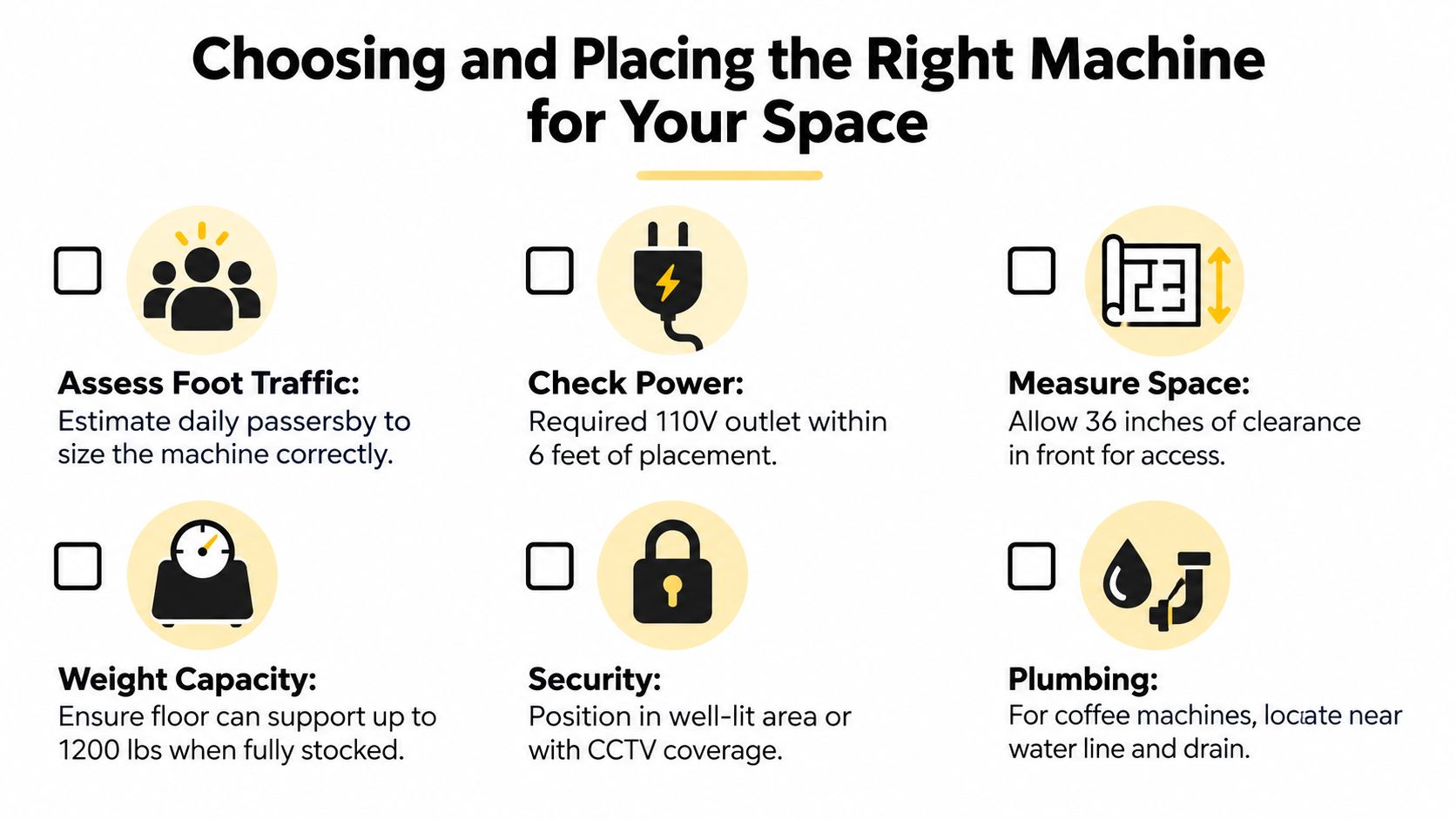
Start with the building, not the equipment catalog. A machine needs a safe, visible position, a reliable power source, enough room for users, and a service path that lets an operator restock without disrupting work.
Use this placement checklist
Observe movement. Identify where employees, students, patients, residents, or visitors naturally pause. A machine hidden behind a door may have less practical value than one positioned near a break room entrance.
Match capacity to demand. A compact refreshment center can suit a smaller office, while a larger workplace may need separate snack and beverage equipment. Don't add fresh or frozen capacity until the audience has a reliable reason to use it.
Confirm utilities. Refrigerated, heated, and coffee equipment may have different electrical or plumbing needs. Ask the operator to inspect the proposed location rather than assuming an existing outlet is sufficient.
Protect access. Keep the front clear, maintain an accessible approach, and avoid placing the machine where pallets, desks, doors, or stored supplies block it.
Plan for security. Good lighting, visible placement, and existing camera coverage can discourage damage and make service issues easier to investigate.
Build feedback into the launch. Product selection should start with audience knowledge, then change according to what people buy, request, and ignore.
Treat compliance as a design requirement
For machines dispensing time and temperature control for safety foods, automatic controls and thermostatic systems must prevent vending when a refrigerated unit exceeds 5°C (41°F) for more than 30 minutes after servicing, or when a hot-holding unit falls below 57°C (135°F) for more than 120 minutes after servicing, according to FDA vending-machine guidance. These controls are intended to stop bacterial growth during the higher-risk period after restocking or maintenance.
That means the facility should ask how the machine records temperature, what happens after an alarm, who receives the alert, and how quickly affected products are removed. A vendor that can't explain those steps clearly hasn't completed the operational plan.
Placement rule: Leave enough room for a customer to approach, choose, pay, and collect a product without standing in a doorway or blocking a working area.
Before signing, walk the route from the delivery entrance to the final position. Check floor transitions, elevator access, outlet location, drainage needs for coffee, and whether the operator can service the machine during normal business activity.
Managing Costs Maintenance and ROI for Your Vending Program
A vending program can be managed by an outside operator or by the organization that owns the equipment. The right choice depends less on enthusiasm for vending and more on who can reliably handle purchasing, stocking, payment support, cleaning, repairs, food rotation, and compliance follow-up.
The food and beverage vending machine market was estimated at US$21.5 billion in 2025 and is projected to reach US$29.1 billion by 2032, implying roughly 4.4% CAGR over that forecast period, according to Persistence Market Research. Market growth doesn't guarantee that a specific Oklahoma location will work. The facility still needs to test demand and account for its own operating burden.
Compare the management models
Decision Factor | Fully Managed Program | Owner Operated |
|---|---|---|
Equipment | Operator may install and provide machines | Facility purchases or leases equipment |
Stocking | Operator orders, rotates, and replenishes products | Facility staff manage inventory and visits |
Maintenance | Operator handles service coordination | Facility pays for repairs or maintains a service relationship |
Assortment | Operator can adjust products using sales and feedback | Facility controls selection but must review performance |
Cashless system | Usually configured as part of the service | Facility selects and supports payment equipment |
Staff time | Lower internal workload | Requires an assigned owner and repeatable process |
Financial structure | May include product pricing, commissions, or service terms | Facility carries equipment and operating expenses |
A simple ROI model starts with the customer problem. Estimate expected sales qualitatively from attendance, access, dwell time, and nearby alternatives. Then list every cost that applies: inventory, payment processing, location payments, electricity, service visits, software, spoilage, equipment financing, and staff time.
Know when fresh food earns its place
Fresh and hot meals add value when people need substantial food and alternatives are inconvenient. They also add energy use, stricter temperature control, more frequent rotation, and a greater chance of waste. For a low-volume office, standard snacks and drinks may produce a healthier operating result because the machine is simpler and the inventory lasts longer.
Telemetry can support ROI by showing what sold, when the machine needs attention, and whether a service visit is necessary. Its value is higher in dense or geographically dispersed routes, where unnecessary trips consume time. In a small, nearby site, a manual check may be adequate if the operator already visits for another reason.
Ask for a written explanation of pricing, refill frequency, response expectations, product rotation, refund handling, and temperature alerts. Then compare the total program cost with the value of keeping employees on site and giving them dependable access to food and drinks. A guide to vending machine installation cost can help frame that conversation before equipment arrives.
Next Steps to Upgrade Your Oklahoma Break Room
The practical path starts with a short site review. Walk through the break room, lobby, clinic waiting area, production floor, or residential common space at different parts of the day. Note who uses the area, when demand appears, what people bring from outside, and how far they must travel for food and drinks.
Ask employees or regular users direct questions. Which beverages do they want? Do they need breakfast, lunch, protein-focused snacks, frozen meals, or coffee? Would they use a machine during every shift, or only during special events? The answers won't replace sales data, but they can prevent an assortment from being built around a manager's personal preferences.
Build a controlled pilot
A pilot gives the facility a safer way to test venue fit before adding more equipment. Start with a machine type that matches the clearest need, then agree on what will be reviewed:
Product movement: Which drinks and snacks sell, and which sit?
Availability: Does the machine run empty during particular shifts?
User feedback: Are employees requesting healthier, larger, colder, hotter, or more varied options?
Service quality: Are refills, cleaning, refunds, and repairs handled promptly?
Food safety: Are temperature checks, shutoffs, and product rotation documented where needed?
For Oklahoma City, Norman, Edmond, and surrounding communities, local service coverage matters because a machine's value falls quickly when users can't get help. A provider should explain who stocks the equipment, how cashless payments are supported, how telemetry alerts are reviewed, and how products are changed after feedback.
Vendmoore Enterprises offers managed and owner-supported options, with compact refreshment centers, bottle-and-can vendors, dual-zone chill centers, and frozen food machines. Its Oklahoma service model includes cashless payments, real-time inventory and performance insights, assortments, follow-ups, replenishment, and maintenance for workplaces and public spaces.
Turn the break room into an operating asset
The strongest program treats the break room as part of the employee experience, not as a machine delivery. The equipment should fit the space, the products should fit the audience, and the service plan should fit the building's schedule. Start with a clear need, measure actual use, and expand only when the data and feedback support the next step.
If your Oklahoma workplace needs dependable snacks, drinks, chilled food, frozen items, or cashless break room vending, visit Vendmoore Enterprises to discuss a machine mix and service approach for your location. Share your site type, employee schedule, and current food-access gaps so the right vending program can be evaluated with you.
Comments