_edited.png)
Google Wallet Vending Machine Setup Guide

An employee reaches for a drink during a busy shift, finds the break room vending machine, and taps an Android phone against the reader. The payment fails. Someone else tries a card, the machine pauses, and the line grows. For a facility manager, that small interruption points to a larger problem: a vending machine can accept modern payments on paper and still deliver a poor experience if the reader, network, firmware, and inventory process aren't working together.
A reliable Google Wallet vending machine setup starts on the machine side. Google Wallet uses the same contactless infrastructure as other mobile wallets, so the commercial question isn't only whether users can tap. It's whether the equipment can authorize purchases consistently, dispense the selected product, transmit useful telemetry, and stay stocked with items people genuinely want.
How Google Wallet Vending Machine Payments Work
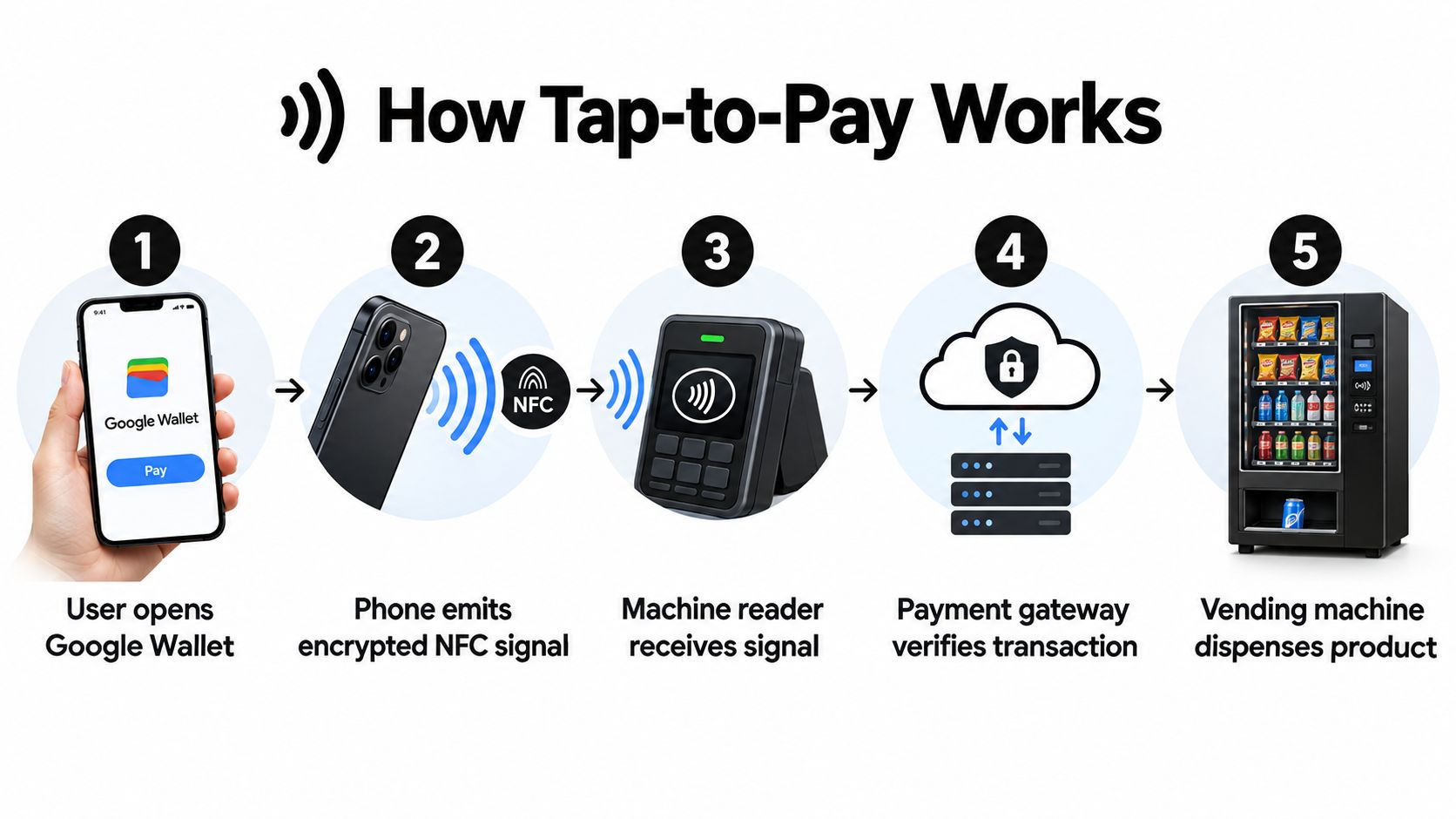
The customer sees a simple action. They select a snack, open a phone, hold it near the contactless symbol, and wait for confirmation. Behind that tap, the vending machine's unattended payment reader establishes a short-range near-field communication, or NFC, session with the device.
Google Wallet entered vending-machine payments during the modern NFC era in 2011, when Google announced support for tapping compatible Android phones at point-of-sale terminals, including NFC-equipped vending machines. The early model also supported coupons or loyalty interactions during the purchase flow, helping establish vending as an important real-world use case for phone-based contactless payment. Vending Market Watch's coverage of Google Wallet in vending documents that early connection between mobile wallets and unattended retail.
What the reader actually does
The reader doesn't receive the customer's underlying card number as a plain credential. Google Wallet supplies a one-time payment token, which the payment gateway sends to the card issuer for authorization. The machine receives the approval, then its controller triggers the vend command. If authorization fails, the machine should withhold the product and show a clear retry or alternate-payment message.
That sequence matters in a break room, hospital, campus, or manufacturing site because the machine is unattended. The reader needs to make a secure decision without a cashier checking the card, confirming the product, or correcting a failed vend. Tokenization also limits card-data exposure at the machine, supporting a narrower payment-security burden and helping operators manage disputes more effectively. This explanation of contactless vending infrastructure outlines the relationship between NFC, tokenized credentials, gateway authorization, and dispensing.
The rollout moved beyond trials when Cantaloupe Systems and First Data enabled Google Wallet purchases across thousands of vending machines in major U.S. cities, including New York, Washington, and Chicago. The machines already had compatible NFC readers, which meant operators could extend acceptance without replacing the entire vending cabinet. Google's mobile payment branding later changed from Google Wallet to Android Pay in 2015, while NFC tap-to-pay acceptance remained the central pathway. Retail Dive's account of that vending deployment provides the historical context.
For a facility manager, the practical takeaway is straightforward:
The wallet is only one part of the transaction. The reader, payment processor, cellular connection, vending controller, and product-delivery system all have to cooperate before the snack comes out.
Operators can also point users to this guide to contactless vending payments when employees need help understanding the tap experience. The guide should complement, not replace, machine-side testing.
The Commercial Impact of Mobile Wallet Adoption
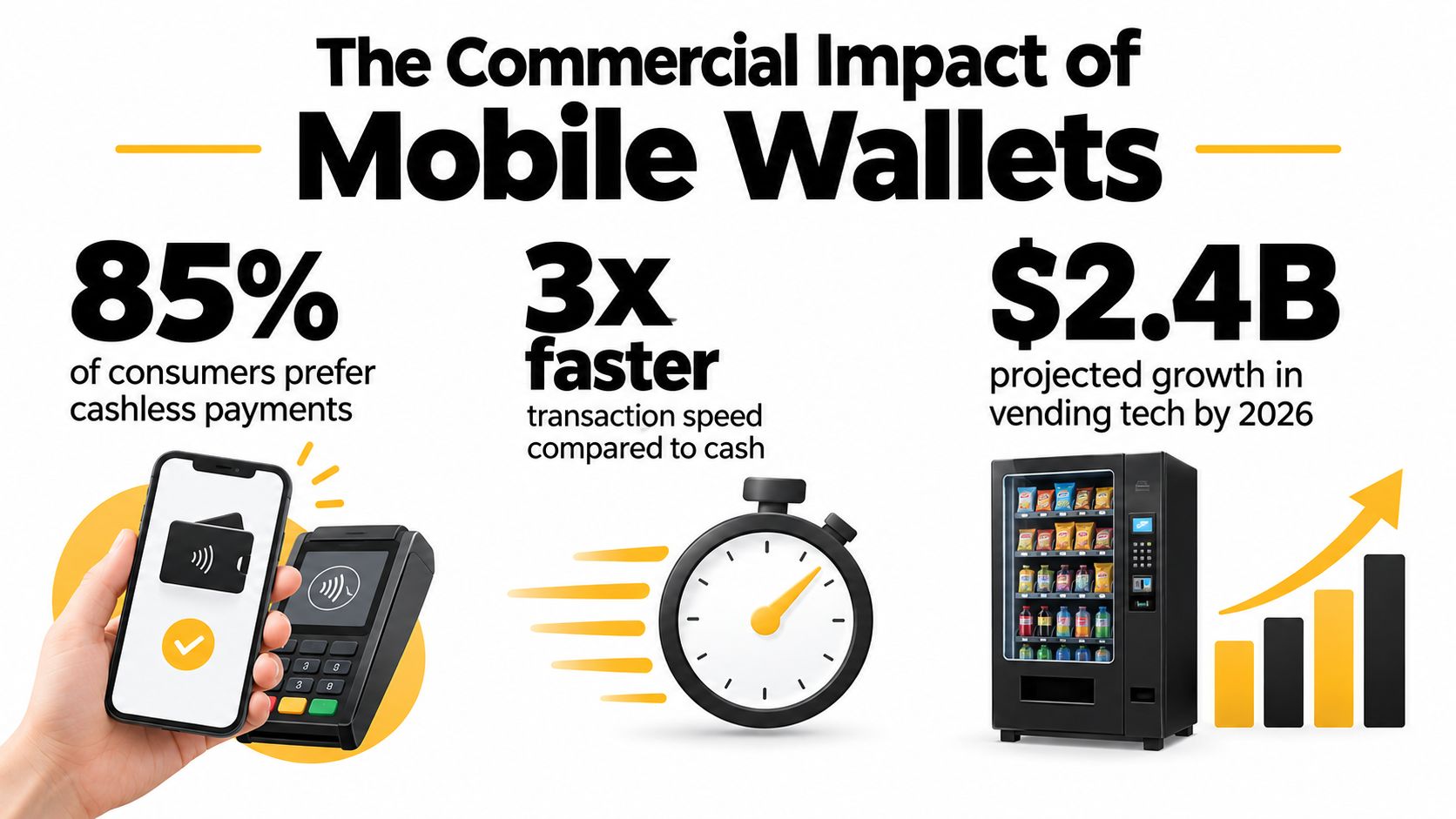
Cashless acceptance has become a core part of unattended retail rather than a decorative feature on a payment panel. Industry data from Cantaloupe reports that contactless methods represented 85% of cashless vending sales in 2025, while mobile payments reached nearly 38% of total cashless vending sales by year-end 2025. Those figures come from the Cantaloupe Micropayment Trends Report, and they show why a facility should evaluate mobile-wallet readiness as part of the vending program, not as an optional add-on.
Friction affects the break room experience
Cash creates several points of resistance. People need the right bills or coins, the machine must accept them, and the customer may need to wait for change. A chip card adds insertion and removal steps. A phone tap can remove much of that friction when the reader is responsive and the customer's wallet is ready.
That doesn't guarantee a sales increase by itself. A failed reader, poor cellular coverage, confusing product selection, or an empty spiral can erase the convenience benefit. The value of Google Wallet is therefore conditional: it can make payment easier, but only a functioning vending system converts that ease into a completed purchase.
Facility managers should also separate transaction speed from business value. A faster tap may reduce crowding during a shift change, but the operator still needs to measure product availability, failed transactions, refunds, and sales by machine. A cashless program becomes commercially useful when payment records connect with telemetry and service decisions.
Mobile payment data creates an operating signal
A connected reader can send transaction and equipment information through the payment gateway and cellular network. Operators can use that flow to identify products selling quickly, machines needing attention, and locations where the assortment doesn't match demand. A facility manager evaluating cashless vending should ask for visibility into those decisions rather than accepting “smart” as a label.
This overview of cashless payment in vending can help stakeholders distinguish payment acceptance from the broader operating system around it. The useful questions are practical:
What sells by location? A corporate office, hospital, school, and factory may need different beverages, meal items, and snack formats.
What goes out of stock first? Fast-moving products deserve replenishment priority, especially during predictable shift or class periods.
What fails at the point of sale? Declines, timeouts, and refund requests can reveal connectivity or reader problems.
What does the customer choose after a substitution? A replacement product may indicate a demand opportunity, not just an inventory inconvenience.
A facility manager shouldn't approve a Google Wallet vending machine solely because it supports a popular phone payment method. The stronger business case combines frictionless checkout, accurate telemetry, responsive replenishment, and assortment decisions based on actual purchases. That combination can turn an overlooked break room amenity into a more dependable service for employees and visitors.
Technical Requirements and Implementation Checklist
A Google Wallet vending machine doesn't require proprietary Google hardware. The machine needs an NFC-capable, EMV-compliant unattended reader connected to a compatible payment processor and vending controller. Once the reader supports the standard contactless pathway, Google Wallet can generally use the same acceptance environment as Apple Pay and contactless cards.
Start with the reader, not the phone. Confirm that the installed device supports NFC contactless payments, unattended EMV transactions, tokenized wallet credentials, and the card brands your merchant account accepts. Ask the equipment supplier for the reader model, certification status, processor compatibility, and supported vending-controller interface.
A deployment checklist that catches field problems
Use this sequence before putting the machine into a high-traffic location:
Verify the payment hardware. Check for the contactless symbol and confirm the reader is designed for unattended vending, not only attended retail. A reader that works at a counter may still need vending-specific integration to authorize and release products correctly.
Confirm the merchant and processor connection. The reader must connect to the operator's payment gateway and merchant account. Test authorization, declines, refunds, and a successful vend using the same configuration planned for production.
Review firmware and controller settings. Firmware should be current and compatible with the reader, gateway, and machine logic board. The controller must trigger dispensing only after approval and must record the correct product, price, and outcome. Don't rely on a reader update alone if the vending controller uses older integration settings.
Test the network at the actual site. Cellular signal quality affects how quickly the gateway can authorize a transaction. A machine in a basement, hospital corridor, warehouse corner, or metal-heavy industrial area may behave differently from a test unit in an office. This resource on IoT device connectivity is useful when assessing connected vending equipment and remote monitoring requirements.
Place the reader where people naturally tap. Mount it at a comfortable height, keep the contactless symbol visible, and avoid placing it behind a protruding trim piece or near a location that forces awkward wrist movement. Check that both phones and watches can reach the reader without touching the product window.
Add simple instructions. Google says users need NFC enabled, a supported payment method, and an active phone for contactless payments. Google Wallet's contactless requirements explain the customer-side prerequisites. Signage should also show accepted alternatives, such as a contactless card or chip card, if the machine supports them.
Test failure modes, not just successful taps
A proper commissioning test includes a declined card, a weak-signal condition, a canceled selection, a sold-out product, and a failed delivery. Confirm that the customer isn't charged without receiving the item and that the operator can identify the event remotely.
Google's store instructions say users should turn on the screen, wake the phone, hold the back of the device near the reader, and remove it after the blue check mark appears. Google's tap-to-pay instructions give facility teams a simple reference for user-facing signage, but the operator remains responsible for making the machine's response clear.
Managed Vending Services Versus Owned Equipment
Buying equipment gives a business direct control. A managed vending program transfers much of the operational responsibility to a service provider. Neither model is automatically right for every site, and the choice should follow the facility's staffing, technical capacity, refreshment goals, and tolerance for service work.
Owned equipment | Managed vending service |
|---|---|
The facility purchases or finances the machine. | The provider supplies and operates the equipment. |
The facility coordinates repairs, payment support, and replenishment. | The provider handles routine service and product stocking. |
The facility owns the data and operating decisions, subject to system access. | The provider uses telemetry and service workflows to manage performance. |
The facility carries more responsibility for equipment uptime. | The facility has a direct service relationship and defined response expectations. |
What ownership really requires
Ownership can make sense for a company with facilities staff, procurement capacity, and a clear plan for inventory. It also gives the buyer control over product standards, pricing, machine placement, and replacement timing. The trade-off is that the machine becomes another operating asset to maintain.
That responsibility includes more than filling empty slots. Someone must monitor payment-reader health, manage processor relationships, investigate refunds, coordinate repairs, review sales, rotate dated products, and decide which items deserve space. If the reader loses connectivity or the machine stops dispensing, the facility needs a process for finding the problem and getting it corrected.
Budget for the operating workload, not just the cabinet. A low purchase price doesn't make a vending program low-effort.
Payment gateway costs, maintenance, connectivity, inventory carrying costs, and staff time can be easy to overlook during equipment selection. Owned equipment offers control, but control only creates value when someone actively uses it.
Where managed service earns its place
A managed provider can take responsibility for installation, replenishment, payment support, and repairs. Connected telemetry helps the provider see inventory movement and machine status without waiting for a complaint from an employee or property manager. The provider can then adjust delivery schedules and assortment decisions according to the location's actual behavior.
Vendmoore Enterprises is one example of a provider offering both fully managed vending and options for clients who want to own machines. Its Oklahoma service includes cashless acceptance such as Google Wallet, connected inventory and performance insights, location-specific assortments, compact refreshment centers, bottle-and-can vendors, dual-zone chill centers, and frozen food machines.
The right comparison isn't “owned versus free.” It's internal responsibility versus outsourced responsibility. A facility manager considering ownership should review the cost comparison analysis for vending programs and list every recurring task, not only the equipment purchase.
Choose managed service when uptime, stocking, and responsiveness matter more than owning the hardware. Choose ownership when the organization has the people and processes to operate the system properly.
Optimizing Break Room Assortments with Telemetry Data
A tap payment can tell an operator that a purchase happened. Telemetry makes the purchase useful. It connects sales activity with inventory levels, machine status, replenishment needs, and product performance. The operator can then replace assumptions with a more precise view of what a workplace uses.
Workplace food demand is meaningful even when employees have other options. A population-based U.S. study found that 23.4% of employed adults obtained foods from work over a 7-day period, and those consumers averaged 1,292 kcal per week from work-related food acquisitions. The study published through the National Library of Medicine supports a practical point for facility managers: on-site food access can generate repeat traffic when the selection fits the workforce.
Match the machine to the location
A corporate office may need premium coffee accompaniments, sparkling water, fresh snacks, and convenient breakfast items. A manufacturing site may place more value on substantial drinks, portable meals, and products that remain available through multiple shifts. A hospital or clinic may need balanced options for staff, visitors, and patients with different schedules.
The machine format matters too. A bottle-and-can vendor serves a different purpose from a dual-zone chill center or frozen food machine. Telemetry can show whether the facility needs more cold storage, a different meal mix, or a smaller refreshment center near a secondary entrance.
This explanation of telemetry data collection is relevant for managers who want to understand how connected vending supports replenishment and assortment review. The useful workflow is continuous: observe sales, check availability, gather feedback, adjust the mix, and watch what happens next.
Wellness standards can change purchasing
Healthier vending isn't only a labeling exercise. A workplace intervention study reported that adding healthier vending standards increased sales of healthier snack and beverage items while lowering sales of less healthy items. The intervention research demonstrates that assortment rules can influence buying behavior when operators apply them consistently.
Facility managers can use that finding without treating wellness as a one-size-fits-all menu. Set clear standards, preserve enough variety for different preferences, and use purchase data to identify gaps. If employees repeatedly choose a healthier alternative when it's visible, available, and easy to buy, the operator can give that category more reliable space.
Google Wallet supports the convenience layer. Telemetry supports the decision layer. Together, they help a break room become more responsive, with fewer empty selections and a product mix shaped by the people who use the facility.
Elevating Workplace Amenities in Oklahoma Markets
Oklahoma businesses have a practical reason to modernize vending. Employees in the Oklahoma City metro, Norman, Edmond, and surrounding communities still need convenient food and drinks during work, school, medical, industrial, and travel schedules. A machine that accepts Google Wallet and stays stocked can remove a small but recurring source of friction from the workplace.
The technology also supports a more deliberate property experience. Property managers can offer a compact refreshment center in a multi-tenant building, frozen food access in a long-shift workplace, or a dual-zone chill center where employees need more than bottled drinks. The right choice depends on traffic, available space, operating hours, and the mix of people using the site.
Local service matters as much as the payment panel
A modern reader won't compensate for slow responses, empty spirals, or unclear ownership when something fails. Oklahoma facility managers should ask prospective operators how they handle follow-ups, product feedback, service calls, connectivity issues, and assortment changes. Monthly prize promotions and customized product variety can support engagement, but only when the basic machine experience remains dependable.
For property teams planning broader modernization, Faberwork LLC's example of digital transformation in smart buildings offers useful context on how connected technology can fit into a larger building strategy. Vending doesn't need to operate as an isolated amenity. Its payment and telemetry data can sit alongside a facility's broader interest in responsive, technology-enabled services.
The strongest Oklahoma vending programs combine local accountability with modern infrastructure. That means contactless readers, usable network connections, remote visibility, product decisions based on demand, and a service partner who responds when the machine doesn't perform as expected. Facility managers should audit current machines for payment failures, stockouts, outdated product formats, and unclear support before deciding whether an upgrade is justified.
Vendmoore Enterprises offers managed vending and flexible equipment options across the Oklahoma City metro, Norman, Edmond, and surrounding areas, with Google Wallet acceptance on compatible machines, connected telemetry, custom assortments, and proactive stocking and service. Visit Vendmoore Enterprises to discuss a break room vending setup that matches your facility, workforce, and operating needs.
Comments