_edited.png)
Healthy Vending Machine Snacks in Schools: A 2026 Guide

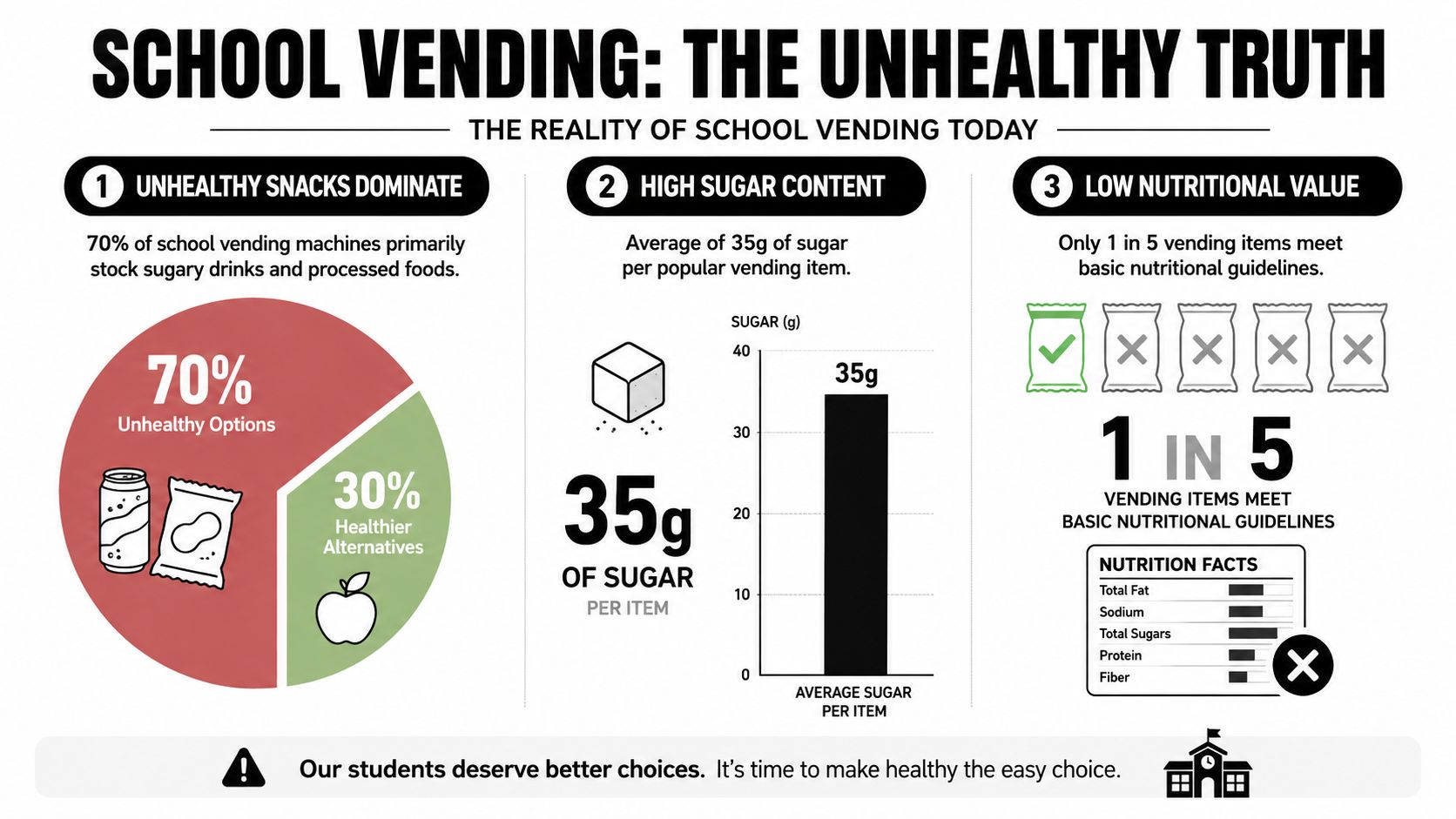
The old school vending machine is easy to recognize, and hard to defend. In a widely cited U.S. school-vending survey, 75% of beverage options and 85% of snack options in middle and high school machines were of poor nutritional quality, and only 26 of 9,723 snack slots held fruits or vegetables CABI Digital Library. That's the starting point for healthy vending machine snacks in schools, because the opportunity isn't just to swap a few products, it's to fix an assortment problem that has been baked into school vending for years.
Schools that treat vending as a compliance checkbox usually end up with machines that look different but still sell the same tired mix. Schools that treat it like a managed retail program can build a healthier snack line that students purchase, the machine stays profitable, and the school doesn't fight constant spoilage or empty facings. If you're looking for a practical way to support students and families with limited access to affordable snacks, the helpsnackz for families resource from Homeless Engagement Lift Partnership (HELP Now AZ) is worth knowing about.
The Reality of School Vending Today
School vending usually starts from a weak baseline. Machines in middle and high schools have long leaned on candy, chips, and sweet baked goods, and that pattern pushes healthier choices out of the places where students make fast decisions. In the survey cited earlier, candy accounted for 42% of snack options, chips accounted for 25%, and sweet baked goods accounted for 13%, so those three categories made up 80% of snack choices. That is an inventory habit, not a nutrition plan.
Product assortment matters more than machine count
A school can have vending access and still offer very little that is meaningfully healthy. The same survey showed how limited the fruit and vegetable presence was, with only 26 of 9,723 snack slots containing those items. The machine is not the main problem. The planogram is.
Practical rule: If the shelf still looks like a convenience store aisle, students will shop it like one.
Healthy vending programs work better when the school and operator stop thinking only about “having a machine” and start thinking about what gets facings, what gets visibility, and what gets restocked fast enough to stay relevant. A machine full of technically available but unpopular items turns into dead inventory. A tighter, curated mix can serve students without creating a spoilage problem or constant empty slots.
For schools that want a cleaner reference point, the article on healthy grab and go snacks shows the same issue outside the machine. Healthy products still need to be convenient, familiar, and easy to choose in a hurry. That is true in a cafeteria line, a hallway, or a vending bank.
The opportunity for operators
For vending operators, the business case is still real. Schools that want to change their snack mix usually need help with product selection, machine set-up, and ongoing compliance. That gives operators room to bring discipline to assortment instead of dropping in a generic “better for you” bundle and hoping the school community accepts it.
There is also a practical family-support angle. If a school wants a healthier snack program and also needs a community resource for access concerns, the helpsnackz for families resource from Homeless Engagement Lift Partnership (HELP Now AZ) is worth knowing about.
The programs that hold up over time do not just trade one candy bar for one granola bar. They reshape the mix so the machine still feels useful to students, the school keeps moving toward its nutrition goals, and the operator is not stuck with a product line that looks good on paper but fails in real use.
Understanding USDA Smart Snacks Standards
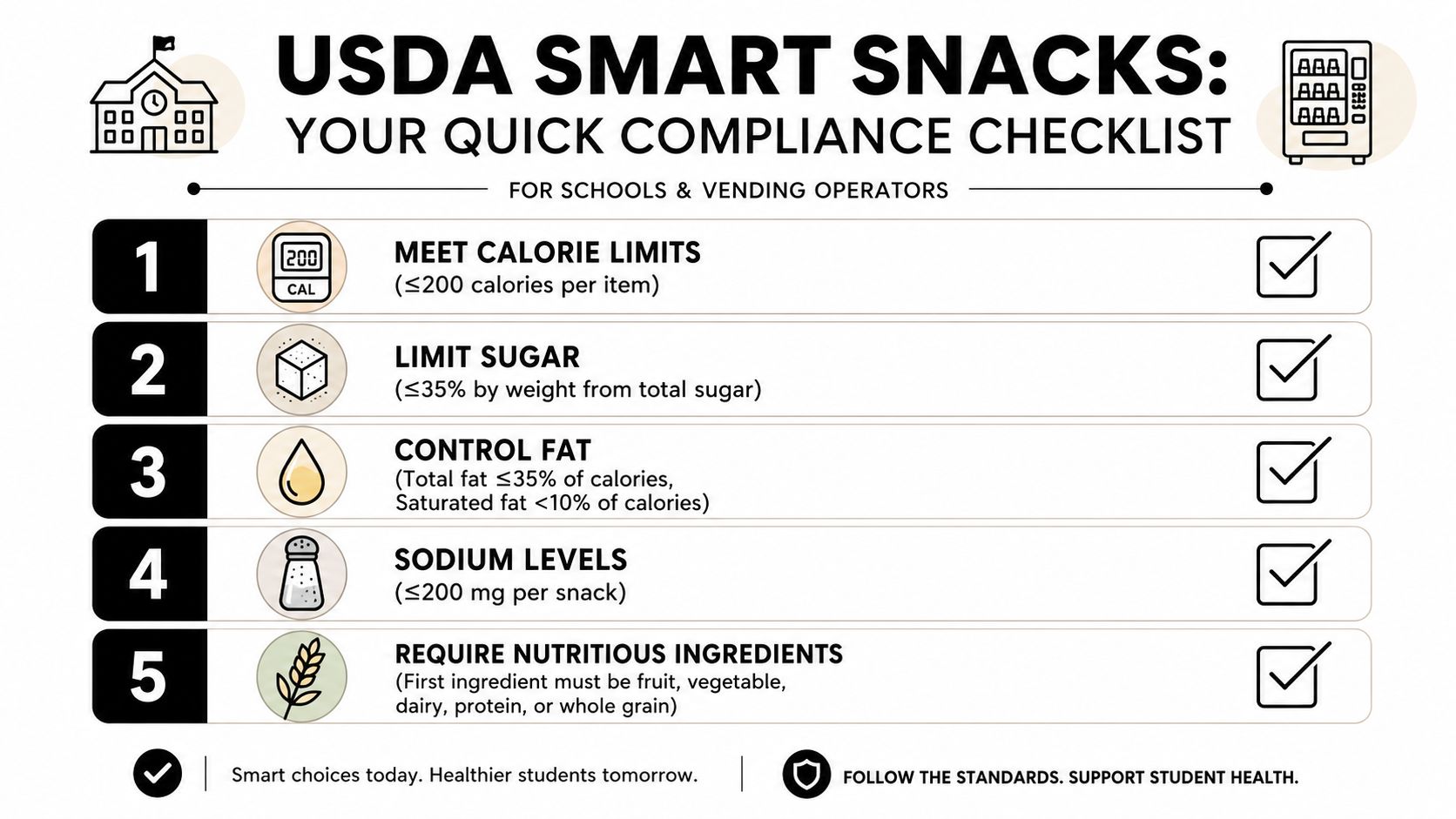
School vending rules leave little room for guesswork. CDC Smart Snacks standards require that school-day competitive foods and beverages meet nutrition limits on fat, sugar, sodium, and calories CDC Smart Snacks. If a product falls outside those rules, it does not belong in a school-day machine, even if it sells well in a corner store.
What to verify before a product goes in the machine
The compliance mindset has to stay practical. In the HEALTHY study, intervention schools set vending targets of 0% 100% fruit juice, no added-sugar beverages, and snacks of 200 kcal or less per single-serving package, and those goals were achieved in 100% of intervention schools compared with only 11% of control schools meeting beverage goals and 25% meeting snack goals CDC Smart Snacks. Clear product rules, backed by enforcement, can hold up in real school settings.
Before a product goes in the machine, check the nutrition label and the ingredient list. The item needs to fit the calorie cap, stay within sugar and sodium limits, and have an ingredient profile that makes sense for a school account. If the first ingredient reads like dessert language, the product usually will not pass school review.
A useful internal reference is the article on product quality standards, which gives a fast operational filter for what qualifies and what does not. In school vending, product quality is not about branding. It is the line between a compliant location and a problem account.
How operators keep compliance from slipping
The healthiest school programs do not rely on memory. They use a written approved-product list, periodic label checks, and simple restock rules that keep noncompliant items from creeping back in after an emergency substitution. That matters because schools, vendors, and students all change what they need over time.
A useful operating habit is to treat every new item as a test, not a permanent slot. If it passes the school rules and moves through the machine without constant markdowns, it earns a place. If it does not, it gets replaced quickly. That discipline keeps the program aligned with the standard that made it viable in the first place.
Building a Compliant Snack Assortment Students Will Buy
A healthy vending machine can meet school rules and still fail at the most basic level, students ignore it. That usually happens when operators stock for compliance first and buying behavior second. Students buy what looks familiar, tastes worth the price, and fits the moment they are in. Schools need real healthy snacks that can move, not polished packaging that sits until it gets pulled for waste.
Stock for usefulness, not moral points
The strongest assortment usually includes items students already recognize as food, not just products that look healthy on a shelf. Low-fat dairy, fruits, vegetables, and other straightforward options are easier to defend with staff and parents, and they are easier for students to trust. The practical point is simple, schools do better when they stock items that are compliant and still feel like normal snack choices.
A pilot study on implementation found that schools need “real” healthy snacks rather than pseudo-healthy substitutes, and that warning still holds up on the route Healthy vending implementation research. I have seen the same pattern in school accounts, if the item looks like a compromise, students treat it like one. A better assortment starts with products that match the school's rules and the student's appetite at the same time.
Shelf life is the trade-off that decides whether the program works. Fresh and lightly processed items can spoil faster than candy, so the mix has to fit the traffic pattern at that building. A high-volume middle school can support a different lineup than a quieter rural campus, and that difference matters more than many operators admit. The primary question is not only what passes the standard, it is what can stay in rotation without turning into markdowns and waste.
A machine that looks healthy but constantly empties out is not a healthy program. It's a logistics failure.
Merchandising and placement change outcomes
Healthier items need better placement if they are going to sell. Prominent rows, routine rotation, and clear signage help students notice the better choice before they default to the same two snack categories they already know. School programs also need disciplined assortment management, because once the machine starts filling up with easy substitutions, the healthy promise fades fast.
Operators who want better sell-through should apply behavioral economics for growth instead of assuming students will sort through every option evenly. Put the items you want chosen where eyes land first, and keep the display simple enough that a student can make a decision in a few seconds. That approach matters more in schools than in many other vending locations because attention is split and purchase decisions are quick.
The internal guide on healthy grab-and-go snack options is useful here because the same merchandising logic applies in cafeterias, lockerside kiosks, and vending machines. If healthy items are buried, students act like they are not there. If they are visible and easy to grab, they start acting like a real option instead of a token one.
Respect the school level and the local context
Elementary, middle, and high school campuses do not buy the same way. Teenagers usually want faster access and more convenient packaging, while younger students need clearer cues and simpler choices. Rural or lower-resource schools may also need more support to keep a healthier program alive, because compliance without dependable replenishment just becomes frustration for staff and students alike.
The operational takeaway is direct. Build the mix around products that are compliant, recognizable, and quick enough to sell through before freshness becomes an issue. That is what keeps a healthy vending program credible in the building and workable on the route.
Choosing the Right Vendor Partnership Model
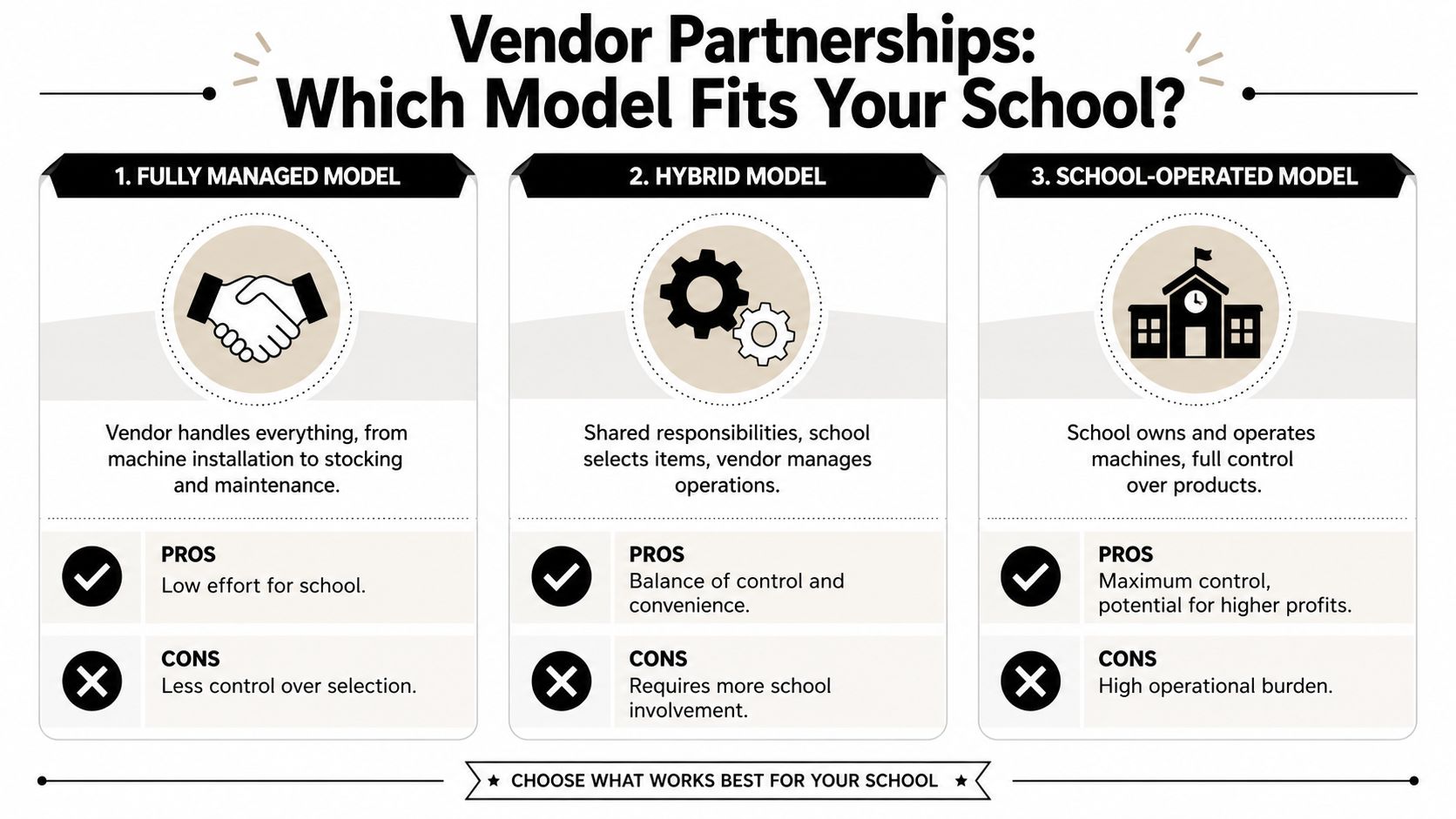
The partnership model determines how much control the school keeps and how much burden it takes on. A fully managed setup works when the school wants minimal day-to-day responsibility. A hybrid model works when the school wants a voice in assortment but doesn't want to handle service calls and machine maintenance. A school-operated model gives the most control, but it also creates the most work.
What schools give up and gain
A fully managed vendor usually handles installation, stocking, repairs, and routine monitoring. That's the easiest route for school staff, but it can be too rigid if the operator doesn't listen to feedback about what students are buying. A hybrid arrangement gives the school more input on product mix while still leaving the logistics to the operator, which is often the sweet spot for schools that care about nutrition but don't want another side job.
A school-operated model gives maximum control over products and pricing, but it also makes the school responsible for inventory planning, maintenance, and service consistency. That model can work, but only if someone on staff is prepared to manage the route discipline that vending requires.
For a practical lens on how payments and commissions affect the relationship, the internal article on revenue sharing models is worth reviewing. The core question isn't who gets the machine, it's who owns the operational mistakes when the machine goes empty or the mix goes stale.
The technology stack matters
Modern operators use telemetry to see inventory and performance patterns before a machine fails at the worst possible time. Cashless payment systems, including Apple Pay and Google Wallet, also matter because students and staff expect fast transactions, not coin hunts. When a school is comparing vendors, it should ask how often the operator checks the machines, how substitutions are approved, and what happens when the top-selling item runs out.
Vendmoore Enterprises is one example of a vendor that combines smart vending with connected telemetry, cashless payments, and location-specific product assortment. That kind of setup works because the operator can see what sells, adjust quickly, and keep a healthier machine from turning into a stale one.
Contract terms should reflect service, not slogans
A strong contract spells out stocking cadence, response time, product approval rights, and what happens if the machine repeatedly misses its service expectations. Schools should also ask for product variety commitments, not just a promise to “keep it healthy.” If the vendor can't explain how it rotates items and responds to feedback, the school is probably looking at a machine, not a program.
Implementation Strategies That Drive Student Adoption
A compliant machine that nobody uses is just expensive furniture. The schools that get adoption right make the healthy option easy to see, easy to pay for, and easy to talk about. That's where placement, payment, and student engagement do the essential work.
Put the machine where students already move
High-traffic visibility matters. A machine tucked into a low-traffic corner collects dust, while one placed near cafeterias, main hallways, or staff break areas gets noticed without requiring a sales pitch. The point is convenience, not novelty.
Payment also matters more than people think. Students and staff are used to frictionless checkout in other parts of life, so machines that accept cashless payments feel current instead of clunky. That doesn't mean cash should disappear everywhere, but it does mean the experience has to be fast enough that people don't abandon the purchase.
Practical rule: If a student has to think too hard at the machine, the healthier snack usually loses to habit.
The internal article on how to gather customer feedback is useful for schools and operators trying to make the assortment more student-friendly. Feedback doesn't need to be formal to be useful, it just has to be consistent.
Make healthy choices visible and social
Labeling should be clear enough that students can find the better option without reading every panel. Good placement, simple nutrition callouts, and visible product facings do more than polished messaging ever will. Promotions help too, especially when schools use low-pressure engagement like prize drawings or rotating feature items that create a reason to try something new.
The embedded video below is a useful example of how visual presentation can support healthier snack choices in a school setting.
Keep the service rhythm tight
Restocking schedules should follow actual sell-through, not a generic calendar. If a machine moves quickly, it needs more frequent service. If it's overstocked with slow movers, that product mix needs a reset before waste piles up.
Schools also need a pricing structure that keeps healthy items affordable without making the route unsustainable. That usually means a tighter feedback loop between what students choose, what the operator can source reliably, and what the school wants to encourage. The goal is repeat purchase, not one-time curiosity.
From Pilot to Scale Using Data and Feedback
Healthy vending in schools usually works better when it starts small. One machine, one location, and one clear test let the school and operator see what sells, what sits, and what needs to change before the whole campus is committed.
A pilot should test assumptions, not just products
A pilot should answer practical questions about assortment, placement, and replenishment speed. If students pass over the healthier slots, the issue may be the product mix. If the machine sells out too fast, the problem may be service frequency. If the same items keep coming back, the operator may have picked products that look strong on paper but do not fit the campus.
The evidence shows healthy vending can shift buying behavior when it is executed well. In one pilot study, the share of sales from “healthier choice” items ranged from 14% to 17%, and revenue declines across schools ranged from 0.7% to 66%, which shows performance depends heavily on implementation and context HEALTHY intervention study.
Use feedback to refine the mix
Telemetry gives the operator the hard numbers. Student feedback explains the reason behind them. Used together, they show whether a product is underperforming because it is unpopular, poorly placed, or not stocked well enough to keep up with demand. The operators who do this well adjust the mix instead of defending the first ordering decision.
A larger middle-school intervention found that 100% of intervention schools met both beverage and snack goals, compared with only 11% of control schools meeting beverage goals and 25% meeting snack goals HEALTHY intervention study. That result points to a simple operating truth. Policy plus monitoring works better than hoping the right products stay in the machine by accident.
Scale only after the pilot proves itself
Once one machine works, copy the same operating rules across additional locations. Keep the same feedback cadence, the same approved-product list, and the same service expectations. Scaling too early usually spreads the same problems to more buildings.
For operators who want a more technical approach to machine reporting and product tracking, the internal article on telemetry data collection is a practical companion. The data does not replace judgment, but it keeps guesswork from becoming expensive.
Vendmoore Enterprises designs and operates modern vending programs with connected telemetry, cashless payment systems, and location-specific product selection for schools and other campuses. If you want a healthier school vending setup that is built around real service, consistent follow-up, and products students will buy, visit Vendmoore Enterprises and see how a managed program can fit your location.
Comments