_edited.png)
PPE Vending Machine for Sale: A Buyer's Guide

Your maintenance lead needs the right gloves before the shift starts, but the cabinet has only the wrong size. A nurse needs a replacement mask between rounds. Meanwhile, someone in purchasing is trying to explain why PPE orders keep rising when nobody can say who took what.
If you're searching for a PPE vending machine for sale, don't start with cabinet capacity or the cheapest listing. Start with the distribution problem you need to fix. The right purchase gives employees dependable access to approved equipment and gives your facility manager a record they can actually use.
What a PPE Vending Machine Actually Solves
Walk past an empty PPE cabinet and the problem is obvious: somebody has to stop working to find protection. Walk up to a stocked, badge-controlled dispenser and the process is different. The employee identifies themselves, selects an authorized item, and gets back to the task while the system records the withdrawal.
That's the operating model to evaluate. A PPE vending machine is a controlled workplace-safety distribution point, not a snack machine with gloves substituted for chips. Its value depends on the equipment being appropriate, accessible, and replenished.
Availability with accountability
For a factory, that might mean separating cut-resistant gloves by size instead of putting every pair in a communal box. In a healthcare setting, it might mean locating approved replacement supplies where staff can retrieve them without crossing the building. In a warehouse, it means assigning somebody responsibility for refilling safety glasses before the next shift needs them.
The diagram captures these access problems, but treat dependable availability as an operating goal, not a promise that automation eliminates stockouts.
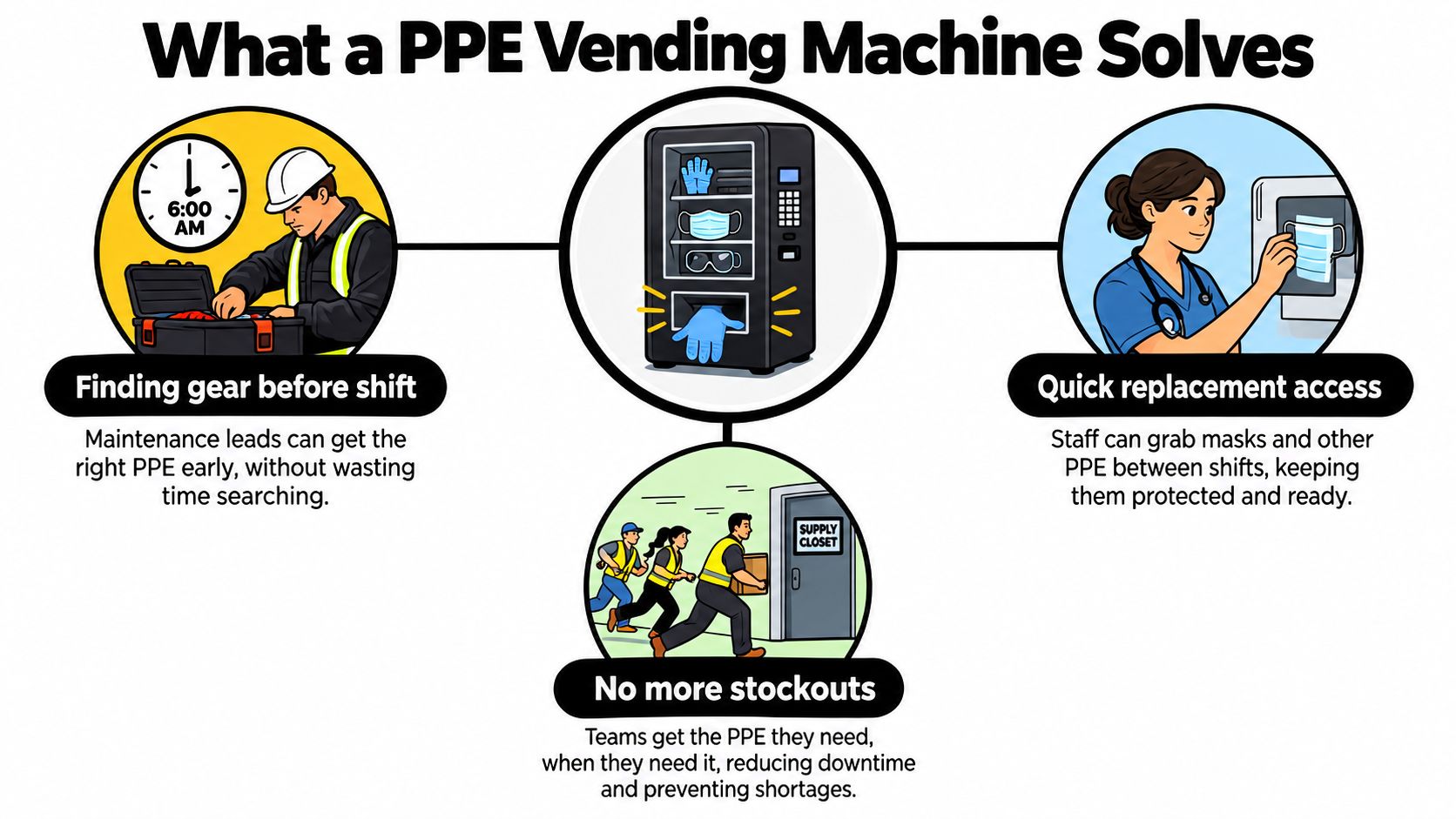
PPE is central to industrial vending: it accounted for 40.8% of industry revenue in 2025, while manufacturing represented 39.0% of end-use demand, according to Grand View Research's industrial vending market analysis. That's useful context, but your purchasing decision still needs a site-specific business case.
Operator's rule: Buy a replenishment process with a machine attached, not a cabinet you hope somebody remembers to fill.
For facilities that also operate kitchens or catering services, Monopack ltd.’s safety gear guide for caterers is a useful discussion resource when identifying department-specific needs. Don't treat a general equipment list as approval for your own workplace.
Review point-of-use industrial vending solutions with your safety and operations teams together. Success means employees can get the approved item, purchasing can trace consumption, and replenishment has a named owner.
Hardware and Software Specs That Matter
Ask suppliers to demonstrate the machine with your actual packaged products. A dispenser that handles a snack bag neatly hasn't proved it can deliver safety glasses, glove pouches, or respirator packaging without damage.
Write the specification around product handling, access, and reporting. Don't let a glossy touchscreen distract you from failed deliveries or software that combines every glove size into an unusable inventory total.
Match storage and access to the application
Request ambient, refrigerated, dual-zone, or frozen equipment only when the intended assortment requires it. For PPE, use each manufacturer's storage instructions to determine acceptable conditions. Don't assume gloves and respirators share the same requirements, and don't buy refrigeration merely because you're also considering break-room vending.
Separate employee authorization from retail payment. Ask vendors to confirm Apple Pay and Google Wallet compatibility for paid purchases, and demonstrate badge access or employee-ID deduction if those features are proposed. Your safety team should approve any charging arrangement before it becomes part of workplace PPE distribution.
Spec tiers at a glance
These are suggested purchasing categories, not standardized industry classifications.
Spec area | Basic tier | Mid tier | Industrial tier |
|---|---|---|---|
Product handling | Demonstrated delivery of selected packs | Adjustable dispensing configurations | Validated handling for varied PPE packaging |
Access | Simple authorization | Department permissions | Role and product-specific controls |
Inventory | On-site counts | SKU visibility and alerts | Size-level tracking and exception reporting |
Reporting | Transaction review | Downloadable usage records | Buyer-defined audit exports |
Resilience | Documented recovery procedure | Remote diagnostics | Tested offline access and manual contingency |
Require usable data and durable equipment
Use a telemetry and data collection checklist to specify what the buyer receives, rather than accepting “smart vending” as a complete answer.
Inventory visibility: Request current quantities by SKU, low-stock alerts, and a clear distinction between attempted and completed dispenses.
Environmental records: Where temperature-controlled storage is justified, require remote logs and an escalation process for excursions.
Export access: Ask for a sample file your safety officer can open without proprietary software.
Physical readiness: Confirm locks, mounting requirements, service clearance, electrical specifications, and suitability for the proposed environment.
Finally, test a jam, a lost network connection, and a power restart during acceptance. A showroom demonstration proves normal operation. You also need to know what happens when normal operation stops.
Procurement Steps from Hazard Assessment to Installation
The disciplined buyer starts with a hazard-and-task matrix. The impatient buyer starts with machine capacity, gets a quote, and discovers later that approved products don't fit or employees can't access their assigned sizes.
NIOSH describes PPE selection within a broader program covering hazard assessment, fit, inspection, replacement, training, and effectiveness monitoring in its protective clothing and PPE guidance. Use that foundation to define the assortment before requesting equipment proposals.
Build the purchasing specification
For each work area, document the hazard, required protection, employee group, size variants, replacement trigger, and authorization rule. Then map each requirement to a distinct machine SKU and dispensing configuration. If suppliers can't explain that mapping, their proposal isn't ready.
The procurement sequence should keep equipment selection downstream of the safety requirements.
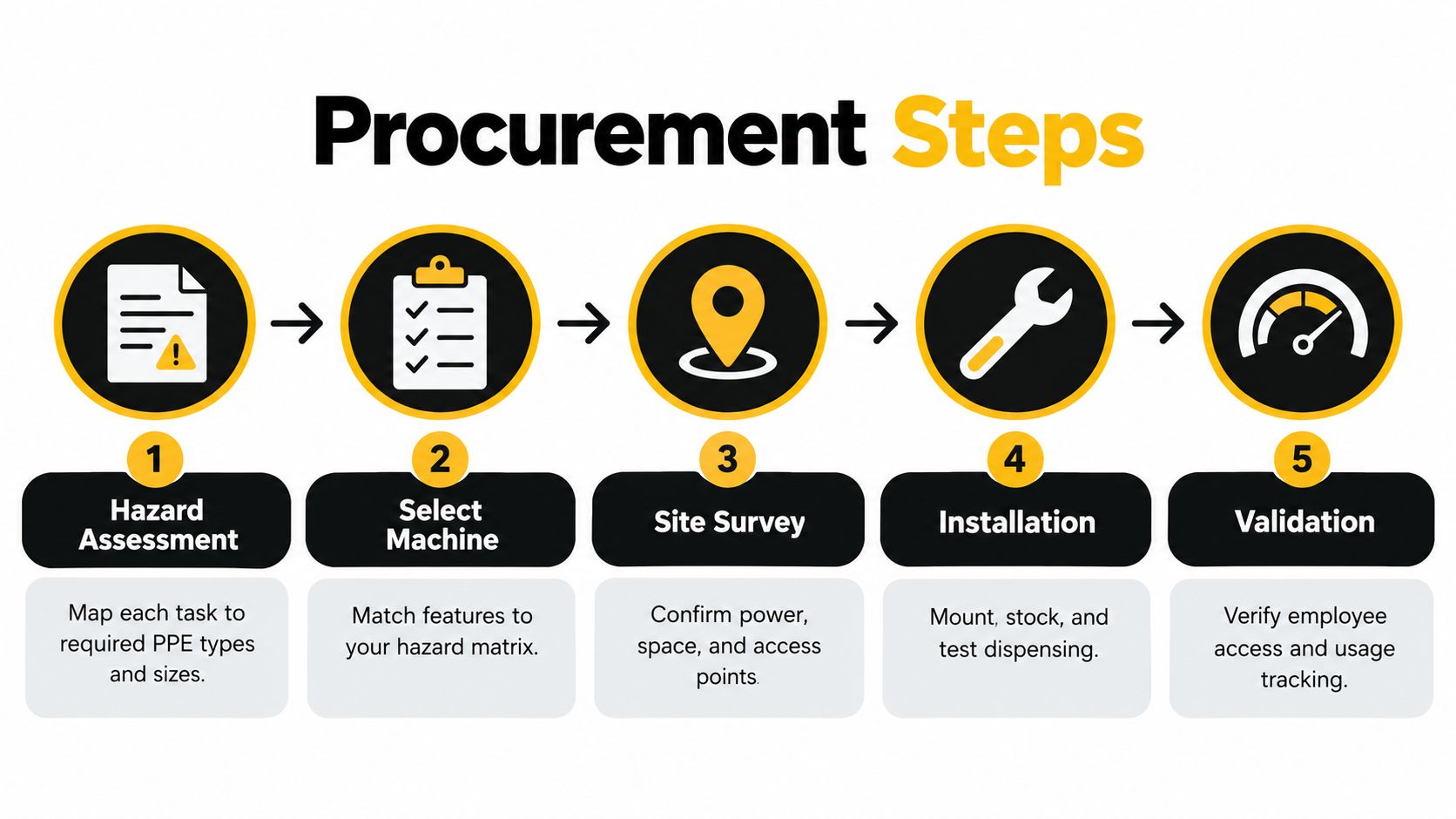
Use a site survey to settle the practical details before delivery.
Placement: Choose a point of use that employees can reach without obstructing circulation or emergency access.
Site readiness: Have the appropriate personnel verify the floor, power supply, delivery route, and required clearances.
Connectivity: Test the intended network at the actual machine location, not in the purchasing office.
Acceptance: Assign somebody to validate employee permissions, product delivery, counts, and recovery procedures.
Review the machine installation process with facilities, IT, safety, and the supplier before scheduling the work. Make each team's responsibility explicit.
Prove the business case before expanding
Controlled consumption can produce meaningful savings, but don't borrow another facility's result as your forecast. In Grainger's GD Copper USA case study, badge-linked dispensing and weekly on-site service accompanied reported annual PPE savings of approximately $80,000–$100,000; for your pilot, establish a 90-day baseline covering SKU issues, unit costs, emergency purchases, stockouts, and issuing labor.
Compare that baseline with pilot results for critical-item availability, retrieval time, failed dispenses, access failures, inventory corrections, refill frequency, and administrative effort. Include software, connectivity, service, and consumable costs when assessing the outcome.
Approve expansion when the pilot demonstrates reliable access and accountable consumption, not merely a busy transaction log.
Managed Service, Lease, or Buy the Machine
Choose the operating model before negotiating the equipment price. A low purchase quote isn't attractive if your maintenance team inherits unfamiliar repairs and nobody has time to manage inventory.
For an Oklahoma facility, the decision comes down to who will do the work, who will carry the costs, and what happens when the arrangement ends. Don't assume every supplier uses the same definition of managed service or lease-to-own.
Compare responsibility, not just invoices
Model | Cost structure to request | Accountability to establish | Appropriate buyer |
|---|---|---|---|
Fully managed service | Equipment, service, and product charges | Operator ownership, stocking, repairs, and downtime obligations | Facility seeking less internal workload |
Lease-to-own | Payments, financing terms, and ownership transfer | Maintenance during the lease and end-of-term conditions | Organization phasing capital commitments |
Direct purchase | Equipment plus ongoing operating costs | Buyer ownership with defined service support | Facility with inventory and maintenance resources |
For fully managed service, require the contract to state that the operator owns, stocks, and services the machine. Specify the remedy for downtime rather than assuming the operator absorbs every consequence. Your facility still needs an internal contact for access changes, product approvals, and service escalation.
Lease-to-own can spread the equipment commitment over time, but have finance review the accounting treatment. Read cancellation terms, ownership-transfer conditions, and repair obligations before signing. UI Lib's UI Lib rent comparison offers an additional ownership-versus-rental perspective, but your vending decision should rest on the actual equipment contract.
Match the model to the workplace
A corporate break room may suit managed vending when nobody wants an additional stocking assignment. A hospital loading dock needs a service plan that addresses delivery access and operating schedules. A university considering campus-wide ownership should first decide who will maintain equipment and reconcile inventory across departments.
Direct purchase makes sense when your team wants control and has the resources to exercise it. It doesn't make sense merely because purchasing prefers a single invoice.
Use a vending cost comparison analysis to compare complete proposals. Include installation, subscriptions, product handling, repairs, and removal obligations, then ask who owns each task after the supplier leaves.
Compliance and the Respirator Question
A dispensing record is not proof of PPE compliance. It shows that somebody received an item. It doesn't establish that the item matched the hazard, fitted correctly, or was used properly.
Under OSHA's PPE standards framework, employers must assess hazards, select appropriate protection, and ensure its use; OSHA also identifies ANSI-related requirements for many PPE categories. Those responsibilities remain with the employer after installation.
Keep the safety program in charge
Training must address when protection is necessary, how to wear it, its limitations, care, useful life, and disposal. OSHA's personal protective equipment program guidance also addresses evaluating program effectiveness over time.
Use the machine to enforce approved distribution rules, not to create an unrestricted catalog. A broader assortment isn't automatically safer if employees can choose equipment unsuitable for their tasks.
This checklist is a reminder of the program behind the dispenser.
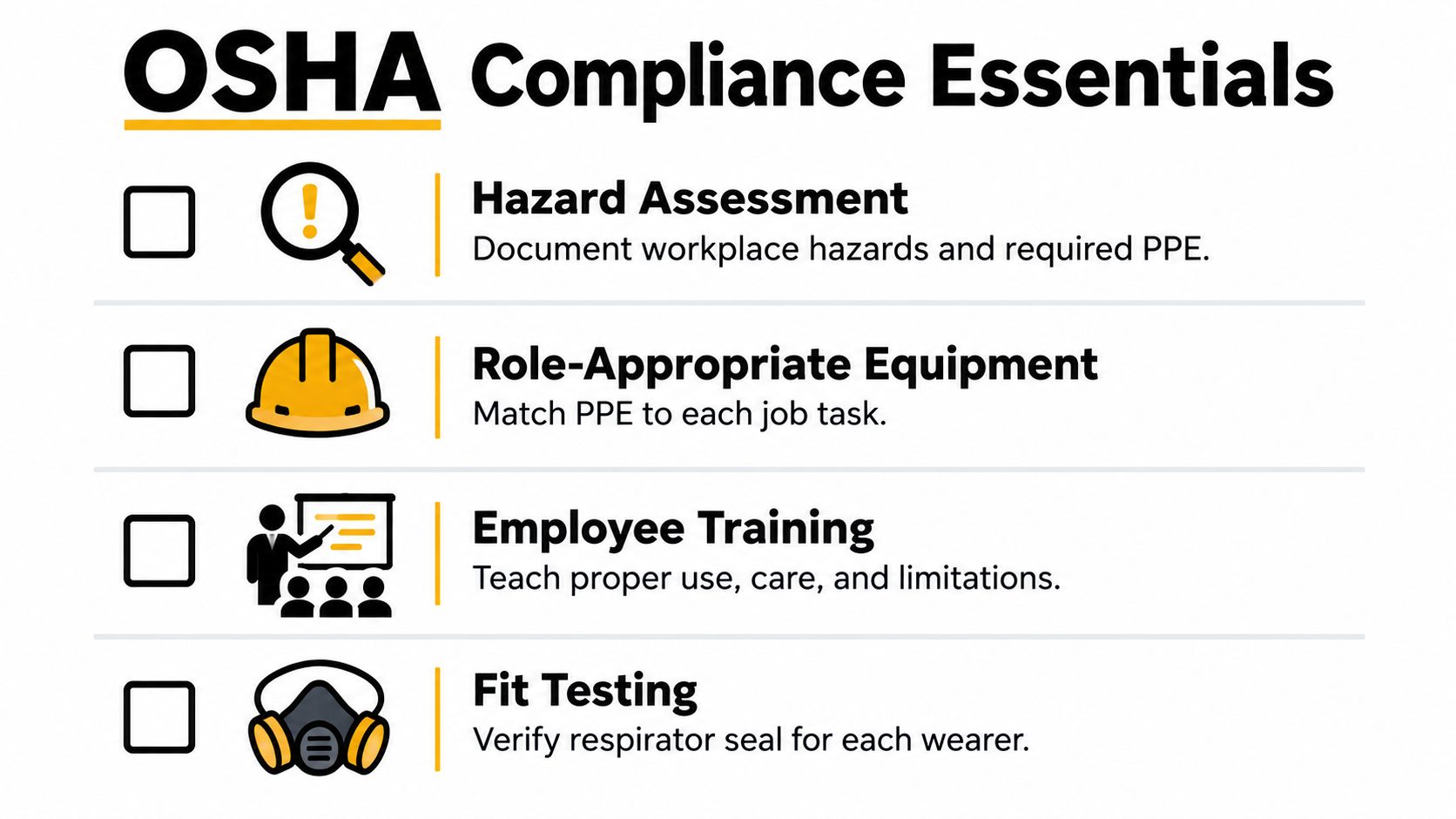
Role restrictions: Make approved products available to the appropriate employee groups.
Size-level control: Preserve the distinction between variants instead of allowing casual substitutions.
Quarantine procedures: Define how damaged, expired, or questionable inventory is removed from availability.
Audit boundaries: Give safety staff the distribution records they need without exposing unrelated personal information.
Control respirator access deliberately
Respirators deserve a separate purchasing review. OSHA requires fit testing for tight-fitting respirators before first use, whenever a different facepiece is used, and at least annually, with a seal check every time the respirator is donned, as described in its respiratory protection technical guidance. Dispensing cannot replace the associated medical evaluation, training, or program documentation.
Configure access around employer-approved models and sizes matched to each worker's fit-test record. Store the authorization result needed for dispensing rather than unnecessary medical details. Provide a supervised replacement path when a respirator is damaged or the authorized item is unavailable.
For background reading on a particular shape, the BacteriaFAQ.com N95 duckbill analysis can inform questions for your respiratory-program administrator. It isn't a substitute for hazard-based selection or fit testing.
Safety boundary: Never let an inventory substitution become an unreviewed respirator substitution.
How to Evaluate Vendmoore and Competing Suppliers
Make every supplier answer the same RFP questions. Compare Vendmoore with equipment dealers, industrial distributors, and other vending operators on documented capability, not presentation quality.
A site walk should produce written observations and commitments.
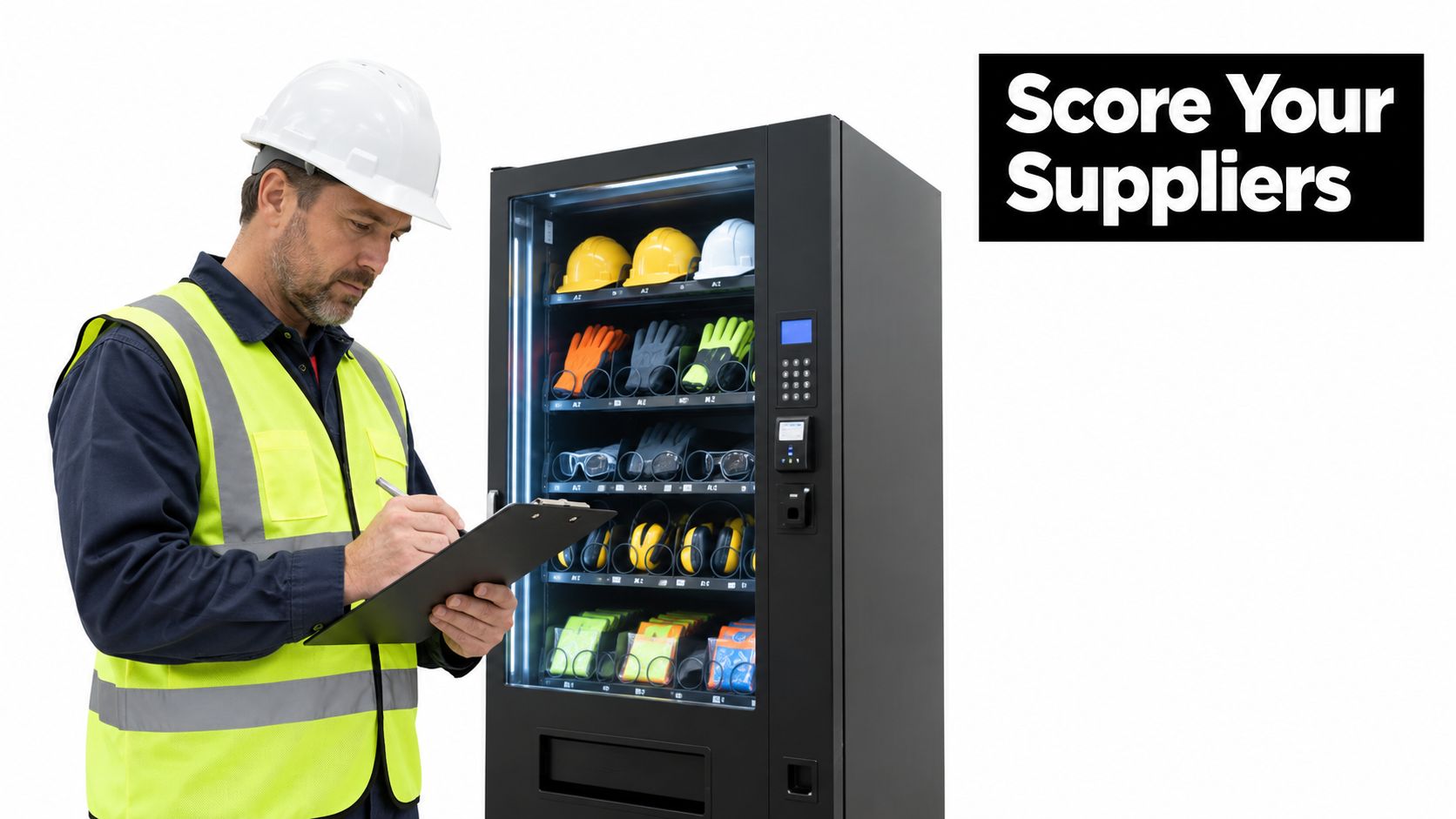
Score evidence rather than promises
Use meets requirement, needs clarification, and fails requirement for each proposal. Weight safety-critical access and service continuity above cosmetic features.
Ownership and stocking: Identify the equipment owner, inventory owner, refill responsibility, and removal terms.
Buyer data: Require sample telemetry exports and a demonstration of reporting permissions.
Service measurement: Ask how calls are logged, escalated, closed, and reviewed with the customer.
Response commitments: Distinguish initial acknowledgment from an on-site visit and restored operation.
Assortment changes: Require an approval process informed by consumption records and employee feedback.
The vendor management and service-level agreement guide is a useful starting point for turning those questions into contract terms. Don't accept “regular refills” without explaining how the supplier handles unexpected demand.
Test the Oklahoma service claim
Local proximity can help, but a nearby address isn't a service guarantee. For Oklahoma City, Norman, Edmond, and surrounding communities, ask where technicians start their routes, whether replacement inventory is held locally, and how your site fits the replenishment schedule.
For a mixed workplace, ask suppliers to separate PPE controls from break-room vending requirements. Refreshment assortments can respond to preferences; safety-product changes need the appropriate approval.
Use the video as a conversation starter, then request a demonstration of the exact equipment and configuration being quoted.
Reject proposals with unexplained data exports, unavailable service metrics, or long commitments attached to vague refill promises. A supplier should also explain parts availability and what support remains if you change operators.
The practical local advantage is a route and support plan that fits your facility. Make the vendor prove it.
Putting It All Together and Planning the Rollout
Finish procurement with an operating file, not just a purchase order. It should contain the approved hazard matrix, written hardware and software specification, ownership agreement, respirator controls, acceptance results, and supplier scorecard.
Assign an internal owner for that file and for decisions that follow installation. Facilities should know whom to call about equipment; safety should control approved substitutions; purchasing should understand the invoice and inventory records.
Questions to settle before signing
How long does installation take?
Don't accept a generic timeline. Request milestones for equipment availability, configuration, delivery, site preparation, commissioning, and employee access testing, with dependencies identified.
What data will the buyer receive?
Specify the fields, export format, delivery method, retention terms, and post-contract access. Ask whether you can retrieve historical records without maintaining the supplier's subscription.
Will the machine work offline?
Require a demonstration. Establish which permissions remain active, how transactions are stored and reconciled, and what employees should do if access fails.
How does pricing scale across locations?
Request separate equipment, software, inventory, and service charges. Ask how route coverage, site access restrictions, and differences in assortment affect each location's quote.
Connect safety distribution with workplace vending
For facilities also seeking break-room vending services, evaluate the overall service relationship without treating refreshments and PPE as interchangeable. A shared operator may simplify coordination, but the safety program still governs protective equipment.
Connected telemetry, cashless payment, and managed replenishment give buyers concrete capabilities to evaluate across corporate offices, campuses, stadiums, and airports. Choose them because they solve an operational need, not because the proposal labels them modern.
Keep approvals clear: Name who authorizes products, access rules, and substitutions.
Review exceptions: Investigate recurring failed deliveries, discrepancies, and emergency withdrawals.
Expand deliberately: Roll out additional machines only after the pilot meets your documented acceptance criteria.
For Oklahoma vending businesses seeking visibility, accurate service descriptions and useful local information matter: Google identifies relevance, distance, and prominence as the main local search ranking factors. For the facility manager, those pages should make it easier to identify a suitable operator and ask informed questions, not substitute for due diligence.
Vendmoore Enterprises offers managed and client-owned vending options for Oklahoma workplaces, with cashless payments, connected inventory insights, and location-specific assortments. Visit to discuss break-room vending or industrial PPE dispensing, and bring your product list, site requirements, and service expectations so the conversation starts with the operating plan.
Comments