_edited.png)
Product Assortment Optimization for Vending Success

A lot of break rooms have the same problem. The machine is full, but the right items still aren't there.
You see it in the sales pattern fast. A few rows empty out early, the same slow movers sit for days, and employees start saying the machine “never has anything good” even when it's technically stocked. In offices, plants, clinics, campuses, and apartment common areas, that mismatch costs more than snack sales. It hurts satisfaction, lowers repeat use, and sends people off-site.
That's why product assortment optimization matters so much in vending. It isn't just deciding which chips and drinks to put in a machine. It's deciding what should earn a slot, what should lose one, what needs more facings, and what only works in one kind of location. For operators trying to grow, it also shapes how people talk about your service online, what reviews they leave, and whether facility managers searching for break room vending or vending operators find a business that looks current, reliable, and tuned to real demand.
Why Product Assortment Optimization Matters for Vending Performance
A machine can be full at 9:00 a.m. and still miss the room by lunch.
Walk into two break rooms with the same equipment, the same planogram size, and the same service schedule, and one will outsell the other because the product mix fits how people buy at that site. In the weaker machine, the problem usually is not stocking effort. It is slot allocation. Too many lookalike items, too many safe catalog choices, or too much space handed to products that sound reasonable in a spreadsheet but stall in the coil.
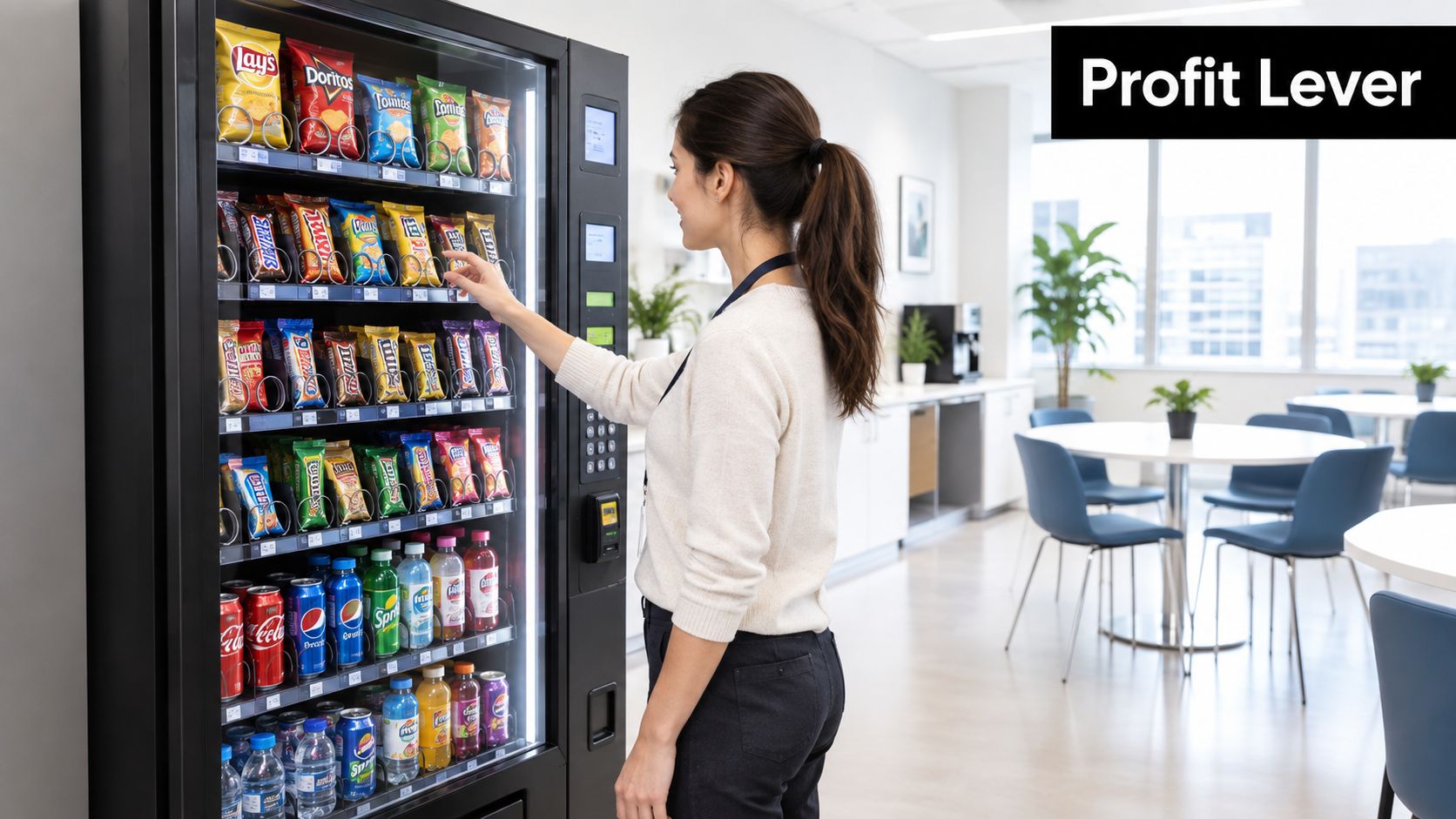
That is why product assortment optimization matters in vending performance. Retail assortment theory asks which products deserve limited shelf space. Vending adds a harder layer. The recommendation only works if it fits real machine constraints, survives the service cycle, and gets reordered before the item that wins its slot goes empty.
Vending makes assortment mistakes visible fast
In a store, weak items can hide on a long shelf. In a vending machine, every bad choice is exposed.
One slow seller can block a better use of space for days. One underallocated top seller can create a false read on demand because it sells out before the refill. One product that looks good in a category review can flop in the field because the package hangs up, the price point feels off for that building, or the location has a different daypart pattern than the model assumed.
The trade-off is simple. Variety helps only when each added SKU brings distinct demand. If two products pull from the same buyer and one sells twice as fast, the weaker item is not adding breadth. It is wasting a slot.
Recommended assortment and executable assortment are not the same thing
This is the gap operators deal with every week.
A category review might say a location needs more better-for-you snacks, more zero-sugar drinks, or fewer duplicate pastry items. That can be right. But the machine still has to carry products with the right dimensions, stable packaging, acceptable margins, and enough local demand to justify repeat replenishment. I have seen good recommendations fail because the item fit the strategy but not the column, the par level, or the service rhythm.
Strong vending assortment work connects three things:
Demand by location: What people at this site buy repeatedly, not what sells somewhere else
Machine reality: Coil size, tray mix, cold capacity, and whether the product dispenses cleanly
Replenishment discipline: Whether the item can stay in stock without crowding out faster winners
That is the practical side many assortment discussions miss. The best mix on paper does not help if execution turns it into repeated outs, dead slots, or leftovers riding around on the truck.
Better assortment improves both sales and account stability
Facility managers notice when a machine feels tuned to the room. So do employees.
A tighter, better-chosen mix usually leads to faster turns, fewer stale rows, and fewer complaints that the machine has "nothing good" even when it is stocked. It also gives operators a stronger story during reviews with clients. Real examples matter here. A page of vending machine success stories shows what good execution looks like after the initial setup, not just at installation.
The same location-specific logic shows up outside vending. Teams working on hospitality fan engagement strategies tailor the experience to a venue instead of forcing one standard plan everywhere. Break rooms respond the same way. The locations that perform best are the ones where assortment decisions match the audience, the machine, and the refill process.
Gathering the Right Inputs Before You Change Anything
Monday morning, the office manager says the machine has “nothing good,” but last week's report shows decent sales. By Friday, two better-selling rows were empty for half the week, a slow granola bar stayed full, and the driver swapped in extra pastries because that was what was on the truck. If you change the planogram from that messy history, you are optimizing noise.
Good assortment work starts with one question: what did people try to buy here, and what was available when they tried?
Start with what the room is asking for
Sales history misses demand when people stop checking a machine that keeps disappointing them. Break room comments fill in that gap fast, especially in locations with uneven schedules, tight meal windows, or a strong preference for a few specific formats.
Keep the feedback process simple enough that route teams and account contacts will use it.
Ask one direct question: “What do you want in this machine that is not here now?”
Tag the request to the site type: Hospital, plant, office, school, and apartment amenity room produce different patterns.
Look for repeat requests: One comment can be random. The same request across shifts usually is not.
Separate item requests from need-state requests: “Need more protein” points to a category gap. “Need Fairlife chocolate” points to a specific SKU test.
That distinction matters in vending more than in shelf retail. A retailer can add width. A vending operator has to earn every slot.
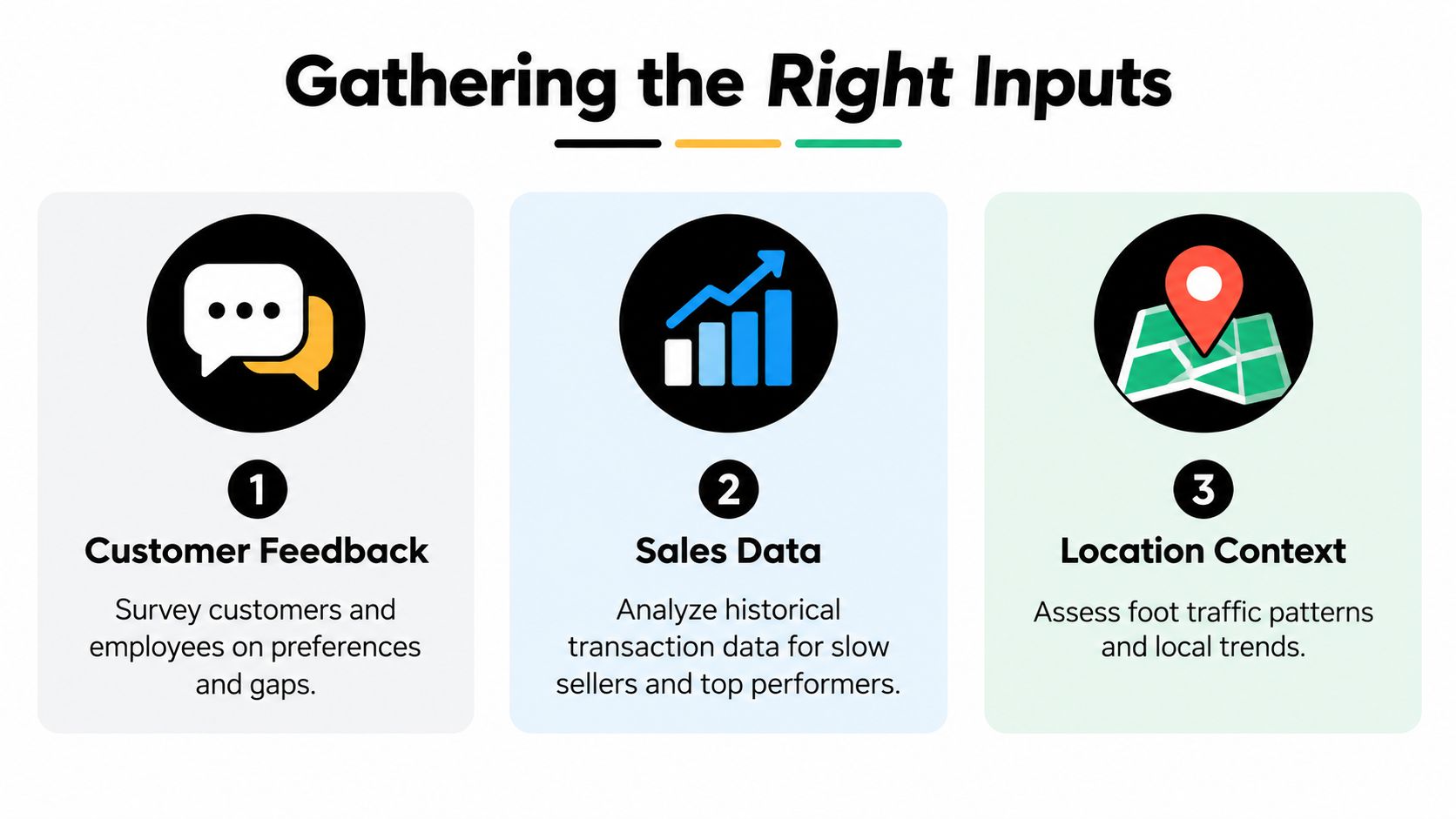
Pull telemetry before you trust the sales rank
Machine-level telemetry is the closest thing to a ground truth, but only if you read it with execution in mind. Pull vend counts by SKU, stockout timing, daypart patterns, cashless versus cash mix, and service intervals. A practical starting point is this guide to telemetry data collection.
One rule saves a lot of bad decisions.
A low sales number from an empty or half-empty slot is an availability problem until proven otherwise.
I look for three kinds of distortion first. Long stockouts that make winners look average. Duplicate product names that split one SKU into two fake histories. Route substitutions that leave the machine “full” while changing what customers could buy.
An industry overview from Harmonya makes the same point from the retail side. Feasible assortment analysis depends on clean transaction data, consistent product hierarchy, on-shelf availability, promo history, and enough time to catch seasonality, as explained in this assortment optimization tools overview. In vending, the constraint is tighter because one bad label or one undocumented substitution can distort a large share of the machine.
Audit physical reality, not just reports
Operators know this, but many assortment reviews still skip it. Machines lie by omission.
A row can show inventory in the system and still fail to vend cleanly. A coil can be set too loose for one bag size and too tight for another. A card reader can lag. A freezer can hold product safely but recover temperature too slowly after a busy lunch rush. None of those problems mean demand is weak. They mean the machine did not execute the assortment you thought you were testing.
Use a short site audit before you remove anything:
Check empty columns, low facings, and chronic near-outs before labeling an item a poor performer.
Match machine reports to physical count so phantom inventory does not pollute the read.
Log payment, refrigeration, and dispense issues that can suppress trial and repeat purchase.
Record route-level substitutions because they can break the link between the planned assortment and the actual assortment.
Build one decision file per machine
Chainwide averages hide the exact problems that matter in vending. Two accounts can buy from the same catalog and need different mixes because one serves office staff from 9 to 5 and the other serves second shift crews at 2 a.m.
Keep one working file for each machine or micro-location.
Input | What to capture | Why it matters |
|---|---|---|
Feedback | Requests, complaints, repeat asks | Shows unmet demand and format gaps |
Telemetry | Vend counts, stockout timing, daypart behavior | Separates true demand from availability issues |
Location context | Shift structure, traffic pattern, site type | Explains why similar products behave differently |
Execution notes | Substitutions, misvends, payment issues, service timing | Shows whether the machine actually ran the planned mix |
That file closes the gap between retail assortment logic and vending reality. The recommendation only matters if the machine can hold it, vend it, stay in stock, and get reordered with discipline.
Deciding What to Keep Remove and Localize by Location
A machine can look good on paper and still fail in the field. I've seen recommended assortments loaded with the right brands, price bands, and category mix, then stall because the machine had the wrong slot widths, too many close substitutes, or no room for the items people buy twice a week.
That gap matters in vending. Retail assortment logic helps you choose the right products. Vending execution decides whether those products stay in stock, vend cleanly, and earn their space.
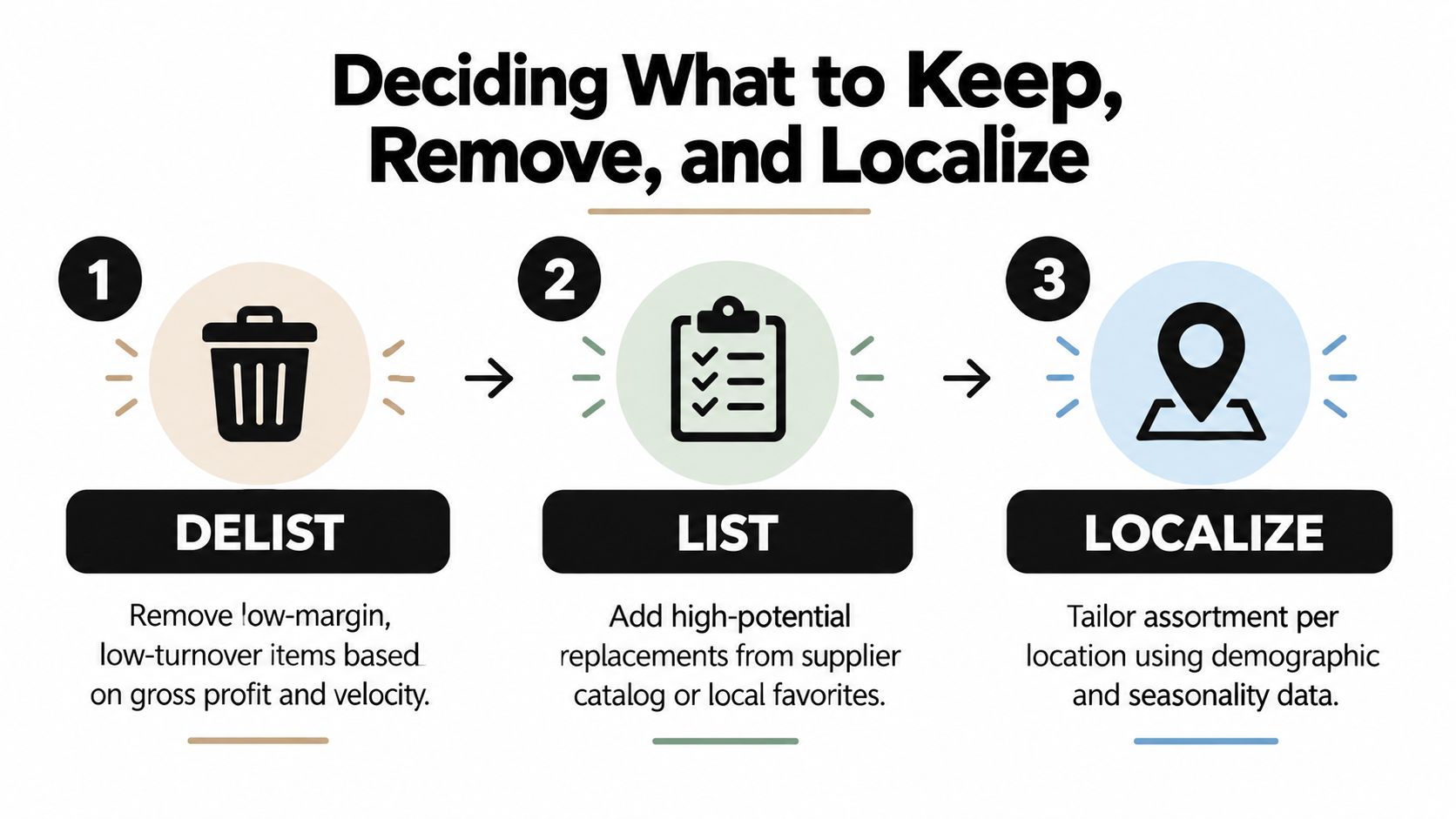
A practical sequence is delist, list, then localize. In that order.
Delist with substitution and slot value in mind
Low sales alone are a weak reason to cut an item. In vending, one slow SKU can still earn its keep if it serves a specific buyer, protects variety in a small machine, or catches demand that would otherwise leave the account. Another slow SKU is just wasting a slot that could hold a faster, cleaner seller.
Before removing anything, check three things:
Margin after service reality, not just product cost. A bulky item with decent dollars per vend can still be a bad use of space if it creates more refill pressure than the return justifies.
What buyers do when it is missing. If customers switch to a nearby substitute, the SKU may be removable. If sales disappear altogether, that item may be carrying unique demand.
Whether the weakness is local or broad. A product that drags in one hospital lounge and turns well in two similar lounges usually points to placement, pricing, or audience fit.
Cannibalization is real in tight machines. Two similar protein bars, three energy drinks in nearly the same flavor profile, or multiple sweet baked snacks at the same price can split demand without growing the category. In those cases, the weaker slot should have to justify itself.
List new items to solve a specific gap
New SKUs should have a job. “Something new” is not a job.
The best adds usually solve one of four problems: a missing need state, a missing price point, a missing pack format, or a missing daypart use. A second shift plant may need a heavier snack or meal replacement. A corporate office may need more zero-sugar drinks and fewer novelty chips. A student housing site may respond to lower entry price and stronger flavor rotation.
Price belongs in the decision from the start. An item can be right for the location and still fail if it lands a quarter too high beside a close substitute. Researchers in this assortment and pricing study found that assortment and price decisions work better together than in isolation. That tracks with what operators see in the field. A new SKU needs the right neighboring products, the right slot, and a price that makes the trade-up feel fair.
One warning here. Adding choice can hurt conversion if the machine gets crowded with lookalikes. Operators trying to simplify the set can borrow a few ideas that reduce choice overload with Quikly, especially in high-traffic break rooms where people make fast decisions.
Localize by site behavior, not operator habit
“Standard machine” assortments save planning time, but they usually leave money behind.
The same 40 selections do not serve a law office, a fabrication shop, and a rehab hospital equally well. Daypart demand changes. Shift structure changes. Appetite changes. So does tolerance for premium pricing. That is why localization has to happen at the machine or micro-location level, not at the catalog level.
In practice, the pattern often looks like this:
Site type | What usually matters most | Typical mix shift |
|---|---|---|
Corporate office | Midday snacking, variety, lighter options | More bars, sparkling water, lower-sugar drinks, light meals |
Manufacturing floor | Fast energy, filling snacks, easy grab-and-go | More savory snacks, energy drinks, larger packs |
Healthcare facility | All-hours coverage, meal replacement, practical choices | More coffee, frozen meals, dependable staples |
Campus or student housing | Price sensitivity, novelty, late-night demand | More impulse drinks, fun flavors, compact meals |
The machine still needs a stable core. Keep proven staples in the majority of slots, then reserve a smaller set of flex positions for local demand and controlled swaps. That prevents over-customizing every account while still giving each location room to perform like its own market.
Execution matters here as much as selection. If the machine cannot support facings for the products that turn fastest, the assortment is incomplete no matter how smart the recommendation looked in a spreadsheet. A practical vending machine planogram guide helps tie the assortment decision to slot size, product adjacency, and backup substitutes that route drivers can follow.
The goal is not variety for its own sake. The goal is a machine that carries the right core, keeps local winners in stock, and stops wasting slots on products that look good in review meetings but sit untouched behind the glass.
Testing Seasonal Rotations Pricing and Promotions in Real Machines
The cleanest assortment logic still needs proof in the field. Real machines introduce noise that spreadsheets can't fully capture. Shift changes, refill timing, weather, and even where a machine sits in the room can affect what moves.
That's why testing should stay small, controlled, and easy to reverse.
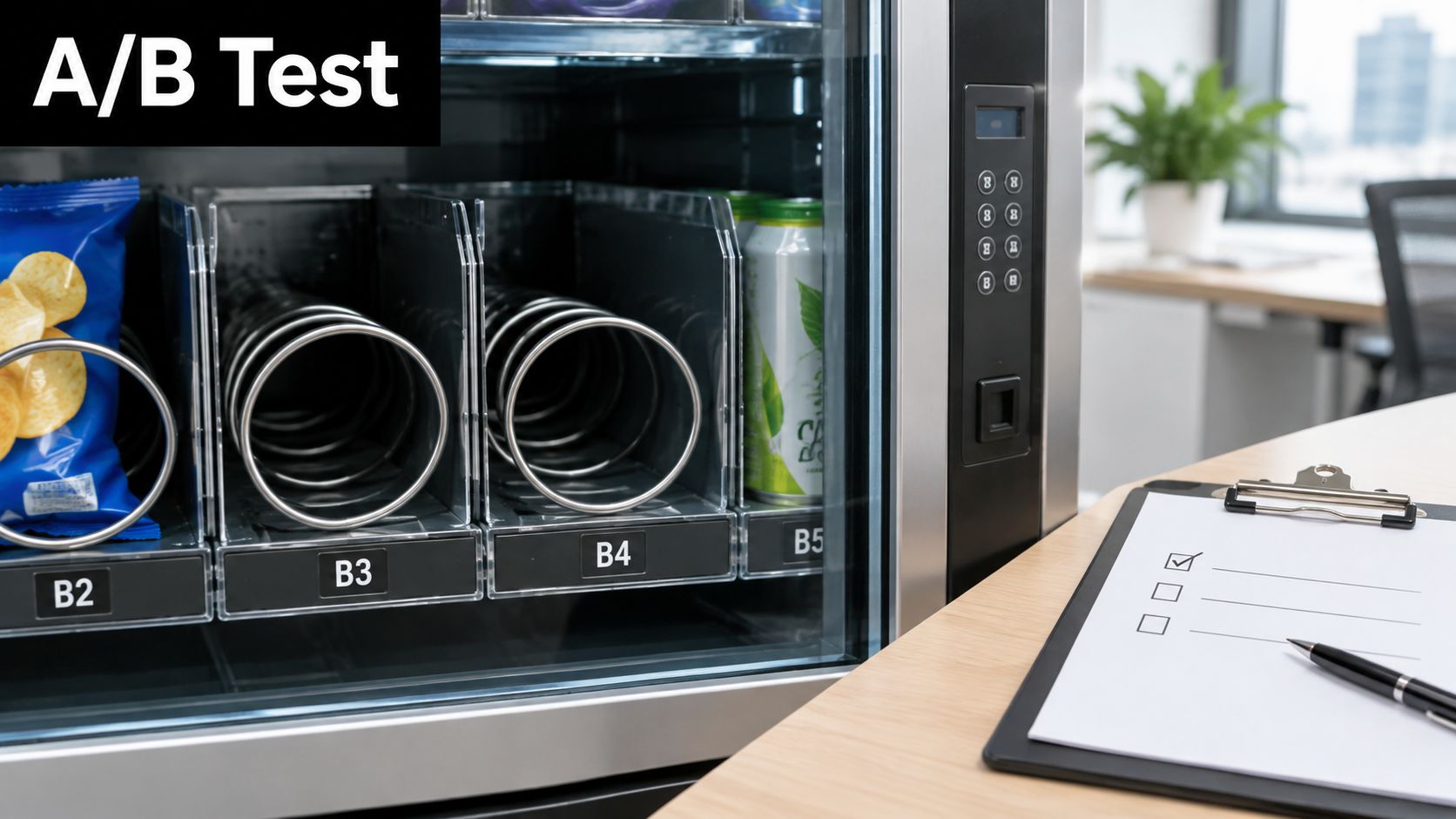
Keep the test narrow
Don't rebuild the whole machine at once. Change one or two slots, one product family, or one price point. That makes the result readable.
A practical field test usually follows this pattern:
Pick a stable machine with enough traffic to give you a read.
Leave the core assortment alone so the rest of the machine stays comparable.
Swap a small number of slots with the new SKU, flavor, or format.
Hold service timing steady so a route-day difference doesn't distort the result.
Log what changed and when because memory isn't a measurement system.
A seasonal rotation is a good example. Pumpkin spice drinks, holiday bakery snacks, or summer hydration items can work well, but only if they fit the audience and return to baseline cleanly after the season. Operators testing fall flavors can use ideas like those in this pumpkin spice season guide to think about timing and placement without overcommitting machine space.
Test promotions without wrecking the read
Promotions in vending are easy to overdo. If you cut prices and rotate products at the same time, you won't know what caused the result. Keep the variable isolated.
Try one of these instead:
Single-SKU price test: Hold assortment steady and test a price change on one item family.
Bundle-style adjacency test: Place complementary items near each other and watch whether both improve.
Light incentive test: Use a simple prize or monthly giveaway mechanic tied to cashless use, then compare behavior against similar sites.
Small tests beat dramatic resets. If a product flops, you can pull it without confusing the whole machine history.
Watch replenishment and availability during the test
A good test fails in practice. A new item gets dropped in, sells through faster than expected, sits empty, and the operator concludes demand was modest because the weekly total looks ordinary. The machine proved the opposite.
Academic work in vending has already treated assortment and replenishment as linked operational problems. One paper models vending decisions with consumer choice behavior, and another frames the problem as determining the optimal assortment of items and the optimal replenishment cycle time in this vending operations research paper. That's exactly right for field testing. A product test isn't valid if the refill cycle can't support it.
Use control locations when you can
If you operate multiple comparable sites, run the test in one and hold another steady. An office with a similar employee count or a second clinic with a similar schedule can give you a cleaner read than before-and-after alone.
What matters most is discipline. Change less, document more, and roll back quickly when the machine tells you the answer.
KPIs That Reveal True Demand and Execution Gaps
A machine at a hospital break room shows weak sales on a protein bar. On paper, it looks like an easy cut. Then you check the audit trail and see the slot sat empty for two afternoons each week, and the item was loaded in a bottom spiral next to three cheaper candy bars. That is not weak demand. That is a bad field setup creating bad assortment data.
That gap matters in vending more than it does in full-shelf retail. Retail assortment models can recommend the right SKU mix, but a vending operator still has to fit that mix into fixed spirals, uneven traffic patterns, and refill schedules that are rarely perfect. The KPI set has to measure both demand and execution, or you end up delisting items that never got a fair test.
Read the machine at slot level
Machine averages hide too much. Slot-level tracking shows whether the problem is the product, the price, the position, or the refill routine.
Start with a short KPI set you can review every cycle.
Sales per slot: Shows whether each facing is earning space.
Gross margin per machine: Keeps high-volume, low-contribution items from looking better than they are.
Walk rate: Estimates how often a shopper leaves instead of switching to another item.
On-shelf availability: Confirms whether the item could be bought at all.
Stockout-adjusted velocity: Measures movement only during the time the slot was live.
Replenishment cycle time: Shows whether service frequency matches the speed of demand.
Retail assortment teams often use a similar objective set, covering sales, margin, substitution, and localization. In vending, the same logic works only if you pair it with refill reality and machine-level execution. That is why regular review of machine-level transaction data analysis matters. It connects assortment decisions to what the machine had available to sell.
Vending Assortment KPI Decision Matrix
KPI Signal | What It Suggests | Recommended Action |
|---|---|---|
Low sales per slot, low margin, weak substitution | The SKU is probably wasting space | Remove it and test a replacement |
Low sales, but strong movement when in stock | Availability issue | Improve refill cadence or add facings |
Weak results in one machine, solid results in similar sites | Poor localization or uneven distribution | Move the SKU, narrow distribution, or keep it only where it fits |
High sales, but weaker margin than nearby alternatives | Volume is hiding weaker contribution | Review price, facings, and substitutes |
Frequent stockouts on a fast mover | Reported demand is understated | Add capacity or shorten the service interval |
Sales drop after a nearby SKU change | Demand shifted or the set lost balance | Rework the surrounding assortment |
Don't confuse low movement with low demand
I see this mistake all the time. An item sells slowly for three weeks, gets labeled a loser, and disappears before anyone checks whether it was in stock, visible, or priced in line with the rest of the row.
In constrained machines, weak movement usually comes from one of five causes:
The item was out of stock too often
Too many close substitutes crowded the same row
The slot location got poor visibility
The price broke the set
The site needed a different category mix
A lot of assortment work falls apart at execution. A model may recommend the right mix, but the field result changes when the item lands in the wrong machine, gets one facing instead of two, or misses the next refill. A recent CPG assortment execution article gets at the same issue from the shelf side. Vending has the same problem, just in a smaller box with less margin for error.
Fix execution before you cut the SKU. Empty slots and bad placement can make a good item look dead.
Judge performance by location, not by chain-wide averages
One-rule assortments usually drift toward mediocrity. A courthouse, a light industrial break room, and a Class A office tower can all reject the same SKU for different reasons. The courthouse may need faster grab-and-go snacks. The office may support premium bars and cold brew. The industrial site may over-index on larger sizes and value pricing.
The practical test is simple. Ask three questions for every weak or borderline SKU: Did it sell when it was available? Did it fit the price ladder in that machine? Did similar locations perform differently? Those answers do more for assortment quality than a chain-wide average ever will.
Strong operators track demand, then check whether the machine made that demand easy to capture. That is how retail assortment science turns into vending results that stay stocked, sell through, and justify the next reorder.
Putting Your Optimized Assortment Into Action
A workable assortment process isn't fancy. It's repeatable.
Each review cycle should start with three questions. What did people ask for? What sold when it was available? Where did execution break down? If you answer those at the machine level, the next actions usually become obvious. Keep the winners, cut the drags, test a few targeted additions, and fix any stocking problems before calling an item a failure.
A practical operating cadence
Most locations do better with a light monthly review and a deeper quarterly reset.
Monthly check-ins: Review stockouts, stale inventory, repeated requests, and obvious slot waste.
Quarterly resets: Rebalance category mix, rotate seasonals, review price architecture, and revisit frozen or meal items where relevant.
Site visits: Take fresh photos, note traffic flow, and verify that the machine on the floor still matches the intended planogram.
One modern option is a managed operator that combines telemetry, cashless payments, location-level assortment updates, and replenishment support. Vendmoore Enterprises fits that model by operating smart vending programs with real-time machine insights and assortments for workplaces and public spaces across Oklahoma.
What strong operators do differently
They don't treat assortment as a one-time setup. They run it as an operating loop.
They also understand that better machine performance supports better business growth. When a site stays stocked with the right products, people notice. Facility managers talk about it. Reviews improve. Prospects searching online for break room vending or vending services see a business that looks active, specific, and trustworthy.
BrightLocal summarizes local pack factors with Google Business Profile signals at 32%, reviews at 20%, and on-page signals at 15% in this local ranking factors summary. For operators, that means the digital side matters too. Accurate service categories, clear location pages, and strong customer feedback help the right prospects find you.
Local review depth matters as well. A large local SEO dataset reported that profiles with 1–5 reviews had a 39.3% top-three rate, while profiles with 201–500 reviews reached 73.0%, and it also reported a +25.8 percentage point lift from business descriptions once profiles passed 200+ reviews, as covered in this local SEO ranking factors analysis. If your assortment process leads to better service, ask for the review. That's how operational discipline starts feeding search visibility.
The operators who grow don't separate machine performance from market presence. They connect them.
If you want a vending program that uses telemetry, cashless technology, and location-specific product decisions instead of a one-size-fits-all fill, Vendmoore Enterprises handles that work across offices, healthcare sites, schools, and other high-use environments in Oklahoma. To see how that approach can support better assortment decisions, stronger service, and more consistent break room performance, visit Vendmoore Enterprises.
Comments