_edited.png)
Vending Machine Ice Cream Guide for Oklahoma Workplaces

At about 2:30 in the afternoon, a lot of Oklahoma break rooms look the same. Coffee has gone lukewarm, the snack machine has the usual chips and candy, and people want something that feels a little more rewarding before they head back to work. That's where vending machine ice cream starts to matter. It isn't just a treat. In the right setting, it becomes a small part of workplace culture.
Facilities leads usually aren't shopping for novelty. They're trying to solve practical problems. Keep employees on site a little longer during breaks. Improve the break room without adding labor. Offer something visitors, staff, students, or patients will notice and use. If you're comparing break room vending, talking with vending services, or trying to sort through operator options in Oklahoma, frozen vending deserves a serious look.
Why Vending Machine Ice Cream Belongs in Your Break Room
A simple frozen option changes the mood of a room faster than most amenities do. A cup of coffee is routine. Ice cream feels like a small win.
In offices, that often shows up in familiar ways. A project team wraps a long meeting and grabs a frozen bar before heading back upstairs. A manufacturing crew on a hot shift break wants something cold, fast, and easy to carry. In a medical office or business center, visitors remember the waiting area that felt considered instead of bare.
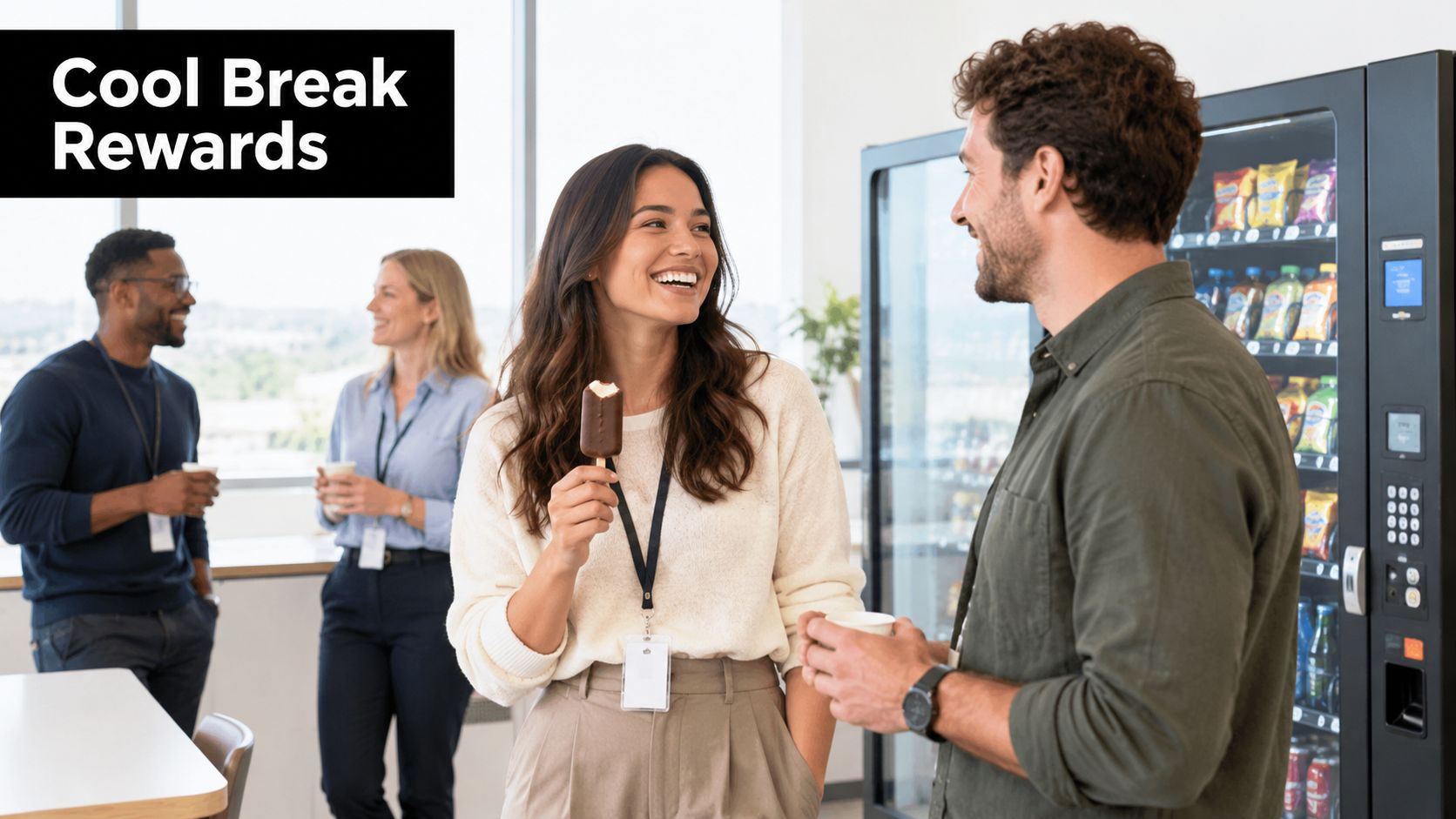
Why frozen treats get attention
Snack vending solves hunger. Vending machine ice cream solves something slightly different. It adds comfort, variety, and a reason for people to use the break area.
That matters if you're trying to improve:
Employee experience: People notice when the break room offers more than the basics.
Visitor perception: A better refreshment setup makes offices, clinics, and shared properties feel more complete.
On-site convenience: Staff don't need to leave the building for a quick cold treat.
Break room engagement: The space becomes a place people want to use, not just pass through.
Some facilities teams first arrive at frozen vending after looking at broader unattended retail options like smart cooler vending for workplace refreshment. That's a good starting point, especially if you're balancing snacks, drinks, and grab-and-go food. But ice cream has its own appeal because it feels more like a reward than a refill.
A break room upgrade works best when employees talk about it without being asked.
It's not a new gimmick
Frozen vending may feel modern because today's machines have screens, cashless payment, and remote monitoring. But the category itself has real history. A historical industry review shows U.S. ice cream vending sales volume rising from 25,555 thousand U.S. dollars in 1960 to 470,000 in 1999, while machine count increased from 36,500 to 75,000 over the same period, showing that ice cream has long been a measurable, if niche, vending category in the United States (historical vending review).
That long track record matters for buyers. You're not evaluating a fad. You're looking at a mature vending idea that now has better equipment, better controls, and more flexible service models than it used to.
How Frozen Vending Keeps Ice Cream Safe and Scoopable
It is 3:10 p.m. in an Oklahoma office, the afternoon slump hits, and an employee buys an ice cream bar expecting a small reward, not a science project. If it comes out rock hard, messy, or half-soft, the machine has not done its job. In a break room, that moment matters more than it may seem. A frozen vending machine is not only storing dessert. It is protecting trust in the space and giving employees a break option they will use again.
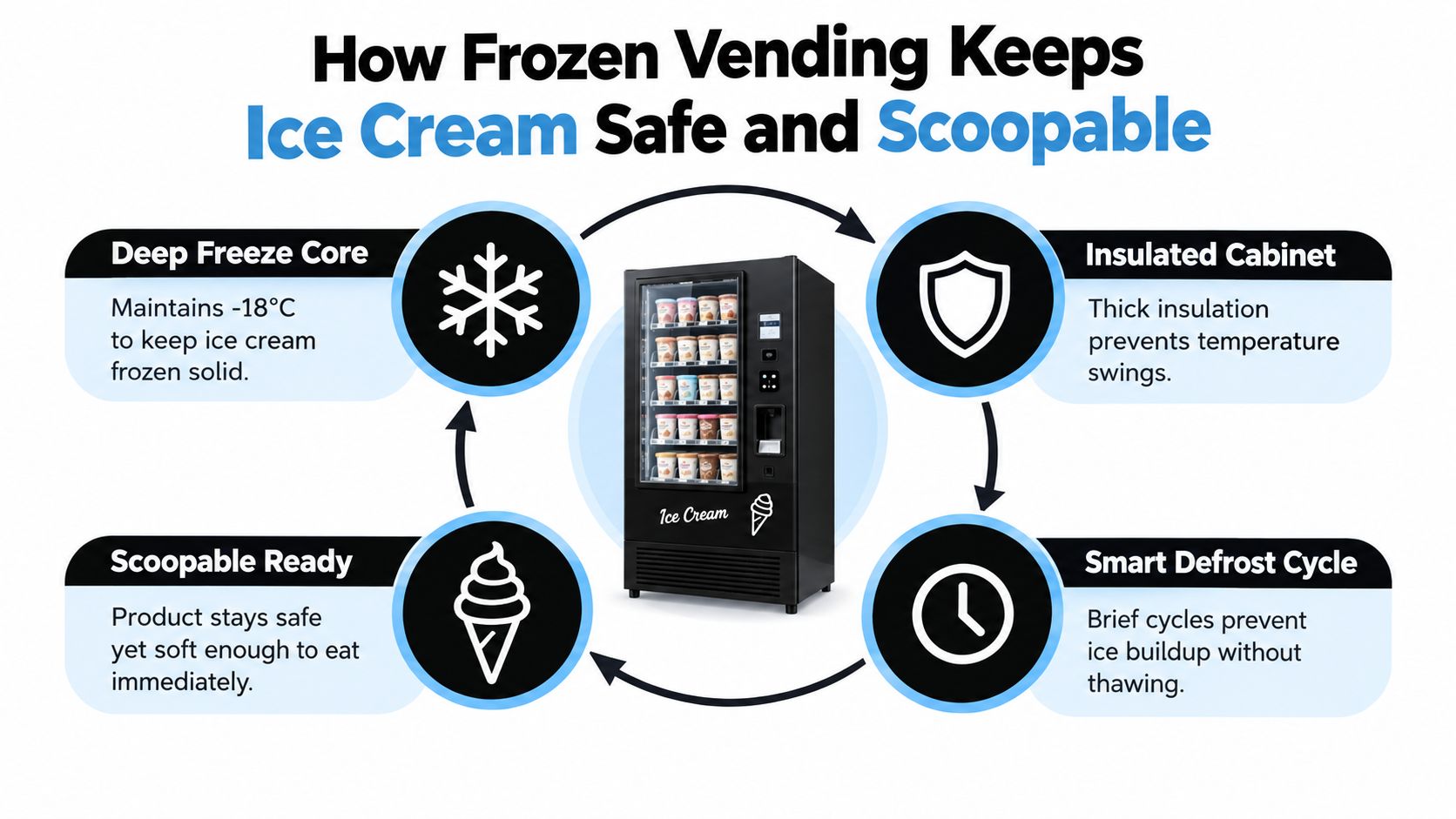
The difference between hardening and holding
Frozen vending works like a small warehouse freezer paired with a careful handoff system. The first job is temperature control. The second is product protection during dispense. Ice cream needs both.
A common point of confusion is the difference between making ice cream firm enough for storage and keeping it cold afterward. Industry guidance explains that ice cream is hardened at very cold temperatures, often around -25°C to -30°C, with frozen storage commonly discussed near -5°F to 0°F for holding quality over time (ice cream production guide). The practical takeaway is clear. Stable cold temperatures help limit ice crystal growth, which is what keeps texture pleasant instead of grainy.
That texture piece matters in employee settings because people judge the whole break-room experience in a few seconds. If the product is too warm for too long, it may still look frozen but eat poorly. If it thaws and refreezes, quality drops again. Facilities teams do not need to memorize freezer science. They do need to know that cold enough to survive is different from cold enough to stay appealing.
Practical rule: A machine can keep ice cream frozen enough to sell and still miss the texture employees expect.
Temperature discipline starts before the machine is ever stocked. If your team or vendor is moving product from distributor to site, proper frozen food transport practices protect quality before the first item reaches the spiral or delivery bin.
What modern safety controls actually do
Good frozen vending equipment is built to prevent quiet failures. It monitors internal conditions, checks for drift, and can stop sales if storage moves outside safe limits.
Hong Kong food-safety guidance describes ice-cream vending controls that hold fillings at 4 to 5°C, suspend sales, and alert operators if temperature rises above 7°C. The same guidance recommends cold foods in vending machines be kept at 4°C or below (food vending safety guidance). While that example covers a different vending format, the operating logic is useful for any facilities buyer reviewing frozen or chilled automation. Machines should monitor conditions, log exceptions, and stop dispensing questionable product.
In plain terms, the control process usually works like this:
Sensors track cabinet temperature on an ongoing basis.
The control system flags readings that fall outside the set range.
The machine can pause sales instead of releasing product during a problem.
The operator receives an alert and checks the cause before service resumes.
That is where telemetry starts to matter for ROI, not only for maintenance. A freezer problem caught early can protect product, avoid employee complaints, and keep the break room from becoming a source of frustration. In a workplace setting, reliability is part of engagement. If staff trust the machine, they use it. If they get one bad experience, usage can fall fast.
A short visual walkthrough helps if you want to see the basic mechanics in motion.
Safety controls and freshness claims are not the same thing
Facilities buyers hear a lot of marketing language in frozen vending. The better questions are more operational. How is sanitation handled? How are allergens managed? What happens if temperatures drift? Who gets the alert, and how fast?
Those questions are especially important in Oklahoma workplaces where the break room often does more than feed people. It helps shape whether employees feel the site is thoughtful, current, and easy to use. Cold-chain discipline and remote monitoring support that outcome. They help protect product quality, but they also protect the employee experience that drives repeat purchases and stronger break-room participation.
The result is straightforward. Safe, scoopable ice cream does not come from one cold box. It comes from consistent storage, careful transport, active monitoring, and controls that stop a bad sale before it reaches an employee.
Choosing the Right Frozen Machine for Your Location
Not every frozen machine is an ice cream machine, and that's where selection gets easier once you stop shopping by appearance alone. Start with the site, not the spec sheet.
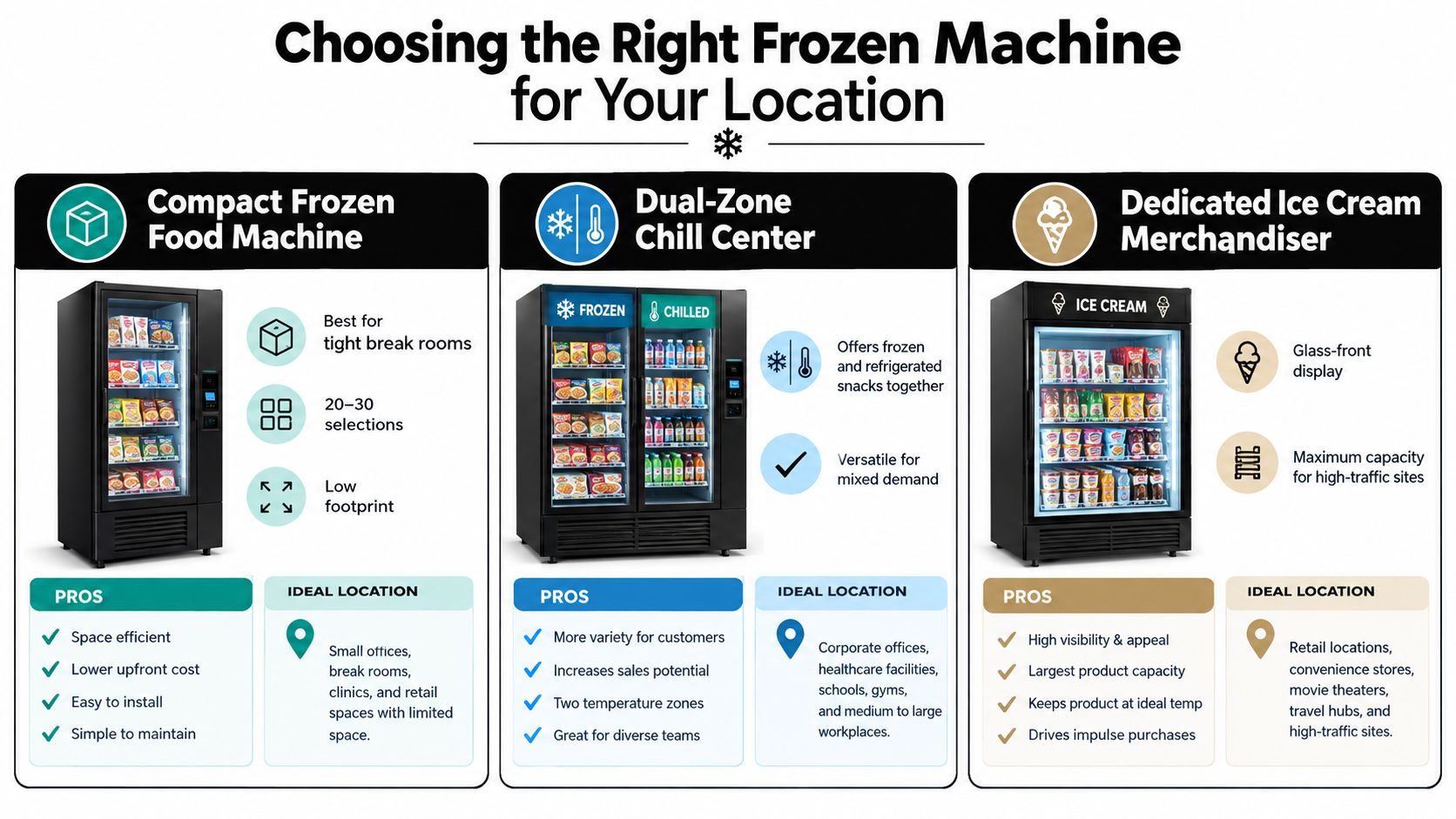
Three common machine formats
Some locations need a dedicated frozen dessert destination. Others need one machine that balances several food types. Most decisions fall into one of these formats:
Machine type | Best fit | Main strength | Watch for |
|---|---|---|---|
Compact frozen food machine | Tight break rooms, smaller offices, back-of-house spaces | Saves floor space while adding frozen options | Limited assortment depth |
Dual-zone chill center | Offices or campuses with mixed demand | Combines frozen and refrigerated items in one footprint | Product planning matters more |
Dedicated ice cream merchandiser | High-traffic shared areas, stadium-adjacent spaces, busy lobbies | Strong visual appeal and larger frozen focus | Works best where demand is steady |
Match the machine to the audience
A corporate office usually needs convenience first. Employees want quick access, easy payment, and a product mix that doesn't overwhelm the machine with too many niche choices.
A school or university often needs tighter oversight. Product mix, sanitation routines, service windows, and placement all matter more because the environment is more regulated and usage patterns can be bursty.
Healthcare is different again. In a clinic or hospital-adjacent building, the machine has to feel orderly and dependable. The product selection may need to be simpler, clearly labeled, and easy for visitors to understand.
For manufacturing sites, durability and speed matter most. People may be buying during short breaks, often with gloves off for only a minute or two. Machines with straightforward selection flow and reliable dispensing make the most sense there.
Elevator delivery and remote monitoring
Modern frozen vending systems increasingly use IoT integration, elevator dispensing, and remote monitoring, and they're being positioned for offices, malls, hostels, and public spaces because those features support safer product handling and easier operation (smart frozen vending overview). Elevator dispensing matters because frozen products can be brittle. A controlled handoff helps reduce damage compared with a hard drop.
Choose the machine that fits the behavior in the room, not the one with the longest feature list.
If you're comparing broader categories, frozen food vending machines for different site types can help narrow down whether you need a dedicated ice cream setup or a mixed frozen program.
Managed service or owner-operated
This choice often matters more than cabinet style.
Managed vending: The operator handles stocking, service, and assortment changes. This fits offices and property managers who don't want another operational task.
Owner-operated: The business keeps more direct control over products and restocking. This can work for organizations with in-house facilities support.
Hybrid arrangements: Some sites want a machine partner for maintenance and telemetry but more input on brands and pricing.
For most workplace environments, the right answer comes down to who's going to own the daily friction. If nobody on your team wants to monitor product rotation, service calls, and assortment resets, a managed model is usually the cleaner fit.
Product Mix Payments and Smart Telemetry That Drive Sales
A break room machine earns attention the same way a good cafeteria cooler does. It offers the right items, makes purchase easy, and stays dependable enough that people trust it will have their favorite treat after a long shift.
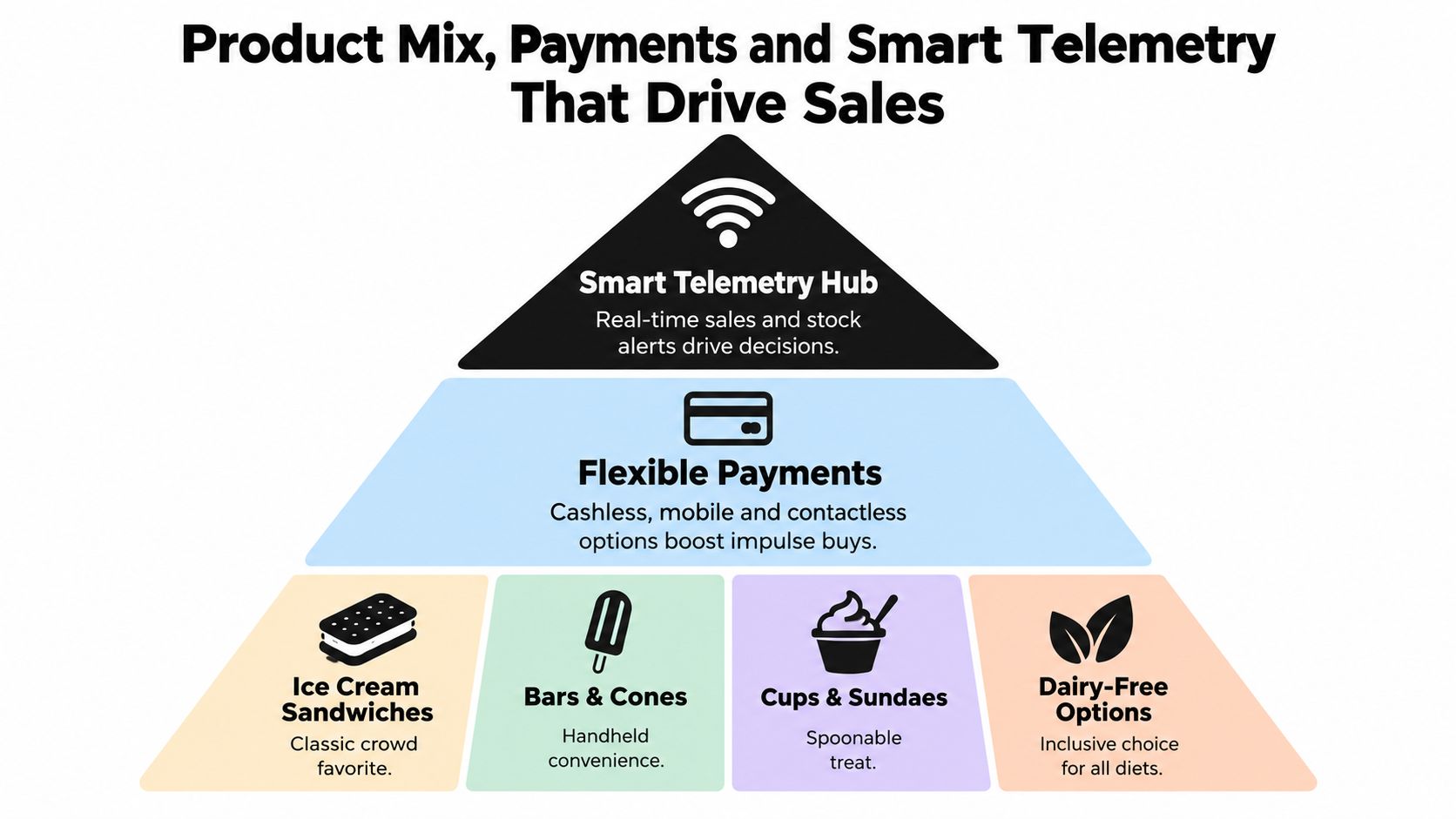
For Oklahoma workplaces, that matters more than it may seem at first. Ice cream in the break room is not only a frozen snack program. It can become a small engagement tool that gives employees a quick reward without leaving the building. The machine gets used more often when the menu feels familiar, the checkout feels easy, and the popular items stay in stock.
Start with products people already want
A strong frozen mix usually begins with recognition. Employees are more likely to buy a known sandwich or bar on impulse than pause to study a lineup full of novelty items.
A practical assortment often includes:
Core favorites: Ice cream sandwiches and familiar bars that support repeat purchases
Quick handheld items: Cones and stick bars for short breaks
Sit-down options: Cups and sundaes for offices, waiting areas, and lunch spaces
Inclusive picks: A small number of dairy-free items where the audience supports them
The mix should match the pace of the building. A warehouse or production site often sells more wrapped handheld items because they are fast and tidy. An office with longer breaks may support more cup-based desserts. A hospital staff area may need a narrower, dependable set that turns over consistently.
Easy payment helps impulse sales happen
Frozen vending gets many of its sales in small moments. Someone heads into the break room for coffee, notices a favorite ice cream bar, and decides to add it. That sale can disappear if checkout takes too long or requires exact cash.
Card and mobile wallet payments remove that friction. A quick tap works better for employee break periods, especially in offices and industrial sites where people do not carry bills or coins. For a facilities lead, that is not just a convenience feature. It affects whether the machine becomes part of daily break room behavior or fades into the background.
One Oklahoma-focused option in this category is Vendmoore Enterprises, which operates AI-powered vending programs with cashless payments including Apple Pay and Google Wallet, along with assortments and telemetry-driven replenishment for workplaces and public spaces. That setup can reduce the amount of hands-on oversight required from an internal facilities or office team.
Telemetry helps the machine stay relevant
Telemetry is remote visibility for the machine. Instead of waiting for a complaint or making a service trip based on a guess, the operator can see what sold, what is running low, and whether a product is sitting too long.
That matters because product mix should change based on buying patterns, not assumptions. In an Oklahoma workplace, telemetry might show that a chocolate bar is stalling while an ice cream sandwich sells through first. Vendmoore can use that signal to swap the slow mover for another sandwich or a similar top seller in the next service cycle. The result is simple. Fewer empty spirals for high-demand items, fewer wasted facings for weak ones, and a break room that feels better tuned to the people using it.
If you want a clearer picture of how that works day to day, telemetry data collection for vending programs explains how operators track inventory, service needs, and usage patterns remotely.
The first sale usually comes from recognition. Repeat sales come from keeping the right frozen items available week after week.
A simple way to improve the menu over time
Start with a balanced lineup, then make small changes based on real usage.
Load proven bestsellers first.
Include a few format differences, such as bars, sandwiches, and cups.
Watch for items that sell slowly across multiple service visits.
Replace weak movers with similar products, not random experiments.
Review the mix during seasonal traffic changes or staffing shifts.
That approach keeps the machine familiar for employees and useful for management. You are not chasing novelty. You are building a break room amenity that stays stocked, stays easy to use, and keeps earning its place.
Placement Permitting and Daily Operations Made Simple
The machine can be excellent and still underperform if it sits in the wrong corner. Placement is the first daily operations decision.
Where frozen vending works best
For most workplaces, the strongest locations are visible without being disruptive. Near the break room entrance works well. So does a shared amenity area, a cafeteria edge, or a high-use employee corridor with enough room for people to stop without blocking traffic.
A poor placement usually has one of three problems:
Hidden location: Staff forget the machine exists.
Tight circulation: People avoid stopping because they feel in the way.
Bad support conditions: Power access, flooring, or ventilation aren't right for steady operation.
In healthcare and education settings, placement often needs an extra layer of review. Facilities, food service, compliance, or administration may all want approval before install. That isn't a drawback. It's just part of doing frozen vending responsibly.
What to confirm before install
A frozen machine should never arrive before the site answers a few basic operational questions.
Power readiness: Confirm the machine has the right nearby electrical service and that the circuit can support the unit.
Floor condition: Heavy equipment needs a stable, level surface.
Access path: Measure doorways, elevators, and turns from delivery point to final position.
Approval chain: Check whether property management, risk, food service, or administration needs signoff.
Cleaning zone: Make sure nearby housekeeping routines won't create avoidable obstruction or water exposure.
The easiest install is the one that's fully mapped before the truck arrives.
The daily routine is simpler than many buyers expect
Frozen vending doesn't mean constant babysitting. It does mean disciplined routines.
A reliable daily or scheduled operating plan usually includes visual inspection, temperature review, stock rotation, exterior wipe-down, and quick checks for damaged packaging or empty spirals. In regulated sites, allergen labeling and sanitation records may need closer attention as part of broader facility policy.
For managed service programs, the goal is to keep this off your internal team's plate. For owner-operated programs, the goal is to make the routine so clear that it doesn't turn into a forgotten side task.
Sanitation and allergen control need plain rules
This is one area where buyers sometimes want reassurance but need specifics instead. If the machine carries multiple frozen dessert types, someone should define how labels are presented, how products are rotated, and how service staff handle stock cleanly.
Keep the rules simple:
Separate products clearly by slot and label.
Remove damaged items immediately.
Rotate by date and delivery sequence.
Record temperature exceptions and service actions.
Treat the machine like food equipment, not just furniture.
That kind of discipline is what keeps frozen vending convenient without making it sloppy.
Costs Margins and ROI for Oklahoma Businesses
Frozen vending usually gets approved or rejected on one question. Will people use it enough to justify the equipment and service?
The answer starts with honest math. A break room frozen program has several cost layers: machine lease or purchase, installation, product cost, electricity, stocking labor or service, and occasional maintenance. None of that is unusual. What makes ice cream interesting is the revenue per item.
Why frozen treats can change the math
One industry source on frozen vending states that ice cream and frozen dessert items can produce materially higher unit margins than standard snacks, citing roughly $3 to $5 per ice cream sandwich versus about $0.75 for a candy bar (frozen vending margin example). The exact mix at your site will vary, but the operational point is clear. A smaller number of frozen purchases can matter more than many low-ticket snack sales.
That doesn't mean ice cream replaces snacks. It means the frozen category can strengthen the economics of a break room vending setup when the audience and placement are right.
A simple ROI snapshot
Metric | Ice Cream Vending | Traditional Snack Vending |
|---|---|---|
Typical item role | Treat, reward, convenience dessert | Everyday grab-and-go snack |
Unit selling price example | Higher, with examples in the frozen category around $3 to $5 for an ice cream sandwich in one industry source | Lower, with a candy bar example at about $0.75 in the same source |
Temperature demands | Strict frozen storage and monitoring | Less complex than frozen holding |
Product impact | Often supports engagement and amenity value | Strong for routine replenishment |
Best use case | Break rooms wanting a stronger premium option | Broad baseline vending demand |
The category is growing, but it's still specialized
Frozen vending shouldn't be framed as a mass-market replacement for every snack machine. It's better understood as a durable specialty category that has expanded into a modern equipment niche.
One market estimate places the global ice cream vending machine market at USD 1.20 billion in 2024 and projects USD 2.40 billion by 2032, a doubling over eight years at a reported 8.5% CAGR (global market projection). A separate report estimates the market at $1.2 billion in 2023 and projects $2.3 billion by 2032 at a 7.2% CAGR (separate market estimate). Those projections don't guarantee results at any one site, but they do support the idea that frozen vending is a real commercial category with long-run momentum.
If your organization is comparing acquisition models, vending machine installation cost factors can help separate equipment expense from the longer-term operating picture.
A practical decision framework
For facilities teams, ROI usually comes from three questions:
Will the machine be used regularly by a stable audience?
Does the higher per-item revenue justify frozen storage complexity?
Will your team manage it internally, or is service support part of the plan?
If capital budgeting is part of the conversation, a financing primer like Business Loan Warrior eco financing can be useful for thinking through equipment funding options in a broader facility-improvement context.
A realistic view works best. Frozen vending tends to succeed when the machine is visible, the assortment is familiar, and the service model is disciplined.
Bringing It All Together for Your Oklahoma Location
By the time most facilities leads finish evaluating vending machine ice cream, their questions are less about novelty and more about fit. Does it belong in this building. Will it stay reliable. Will employees use it. Those are the right questions.
The strongest Oklahoma setups usually share the same pattern. The machine sits where people naturally pause. The product mix is simple and recognizable. Payment is quick. Restocking is based on actual usage, not guesswork. And the cold-chain side is treated seriously enough that quality doesn't slip over time.
A short decision checklist
Before you move forward, sanity-check the location against these points:
Audience fit: Are the main users employees, students, visitors, patients, or mixed traffic?
Break behavior: Do people take quick breaks on site, or leave the property?
Space fit: Is there a visible, practical spot with proper power and access?
Service model: Do you want managed vending or more direct ownership control?
Product plan: Will familiar frozen items serve the site better than a complicated menu?
Operational discipline: Who will watch temperature exceptions, stock rotation, and service response?
For Oklahoma workplaces, campuses, clinics, and mixed-use properties, that checklist usually matters more than any one machine feature. A frozen machine can strengthen a break room, but only when the operational details are settled up front.
Local support also matters. If your sites are in Oklahoma City, Norman, Edmond, or nearby communities, response time, restocking discipline, and machine monitoring tend to shape the day-to-day experience more than showroom features do. That's especially true when frozen products are involved, because reliability and product condition are part of the employee experience.
The upside is straightforward. Done well, vending machine ice cream gives people a reason to notice the break room again. It supports comfort, convenience, and a more thoughtful workplace without asking your team to run a mini café.
Vendmoore Enterprises provides modern vending programs for Oklahoma workplaces and public spaces, including cashless machines, telemetry-based monitoring, product assortments, and frozen vending options that fit break rooms and shared areas. If you're evaluating whether vending machine ice cream makes sense for your office, campus, clinic, or facility, visit Vendmoore Enterprises to explore service options and request a site-specific conversation.
Comments