_edited.png)
Vending Machine Snack Prices: The Complete Oklahoma Guide

You're standing in an Oklahoma break room, waiting for coffee, when someone buys a bag of chips and asks why it costs more than the grocery-store multipack down the road. The facility manager hears the complaint, checks the machine's sales report, and still has no clear answer. Is the price too high, or is the machine providing a service the supermarket can't?
That question sits at the center of vending machine snack prices. A fair price has to account for convenience, product cost, equipment, payment processing, stocking, spoilage, location access, and dependable service. It also has to fit the people using the machine, from office employees in Oklahoma City to night-shift staff in Norman, students, patients, warehouse teams, and residents in an apartment community.
Understanding What Oklahoma Offices Pay for Break Room Snacks
At a manufacturing facility outside Oklahoma City, a vending machine might be the only food option available during a short break. An employee can walk to the machine, tap a phone, and get a snack without leaving the property. At a downtown office, the same purchase may compete with a nearby convenience store, café, or grocery market.
The product looks similar, but the service is different. A supermarket sells products in volume and expects customers to transport them home. A workplace machine keeps individual portions available on-site, often outside normal meal hours, and an operator must deliver, rotate, stock, monitor, and repair the equipment.
What employees are really paying for
The price on the selection label includes more than the snack itself. It supports:
Immediate access: Employees don't need to drive, wait in line, or leave the building.
Equipment availability: Refrigerated machines, compact refreshment centers, frozen-food equipment, and payment readers require installation and maintenance.
Route service: Someone has to inspect inventory, remove damaged products, rotate dates, and replenish the machine.
Location economics: A machine in a busy workplace may sell more, while a smaller facility may need more careful assortment and visit planning.
Payment convenience: Cashless acceptance makes purchases easier, but every transaction still has processing costs.
The right question for a facility manager isn't just, “Can I buy this item cheaper somewhere else?” It's, “Does this program provide reliable access, sensible choices, transparent pricing, and service that employees genuinely use?”
A useful break-room pricing guide can help employers compare product tiers, service expectations, and the difference between a low sticker price and a sustainable refreshment program. In Oklahoma workplaces, fair pricing usually means keeping an accessible option available while allowing premium drinks, healthier items, and meal products to carry prices that reflect their operating requirements.
Typical Price Ranges for Common Vending Snacks and Drinks
A 2025 cost report compiling nationwide U.S. vending-price data lists average consumer prices of $1.26 for snacks and candy and $1.71 for beverages. The same report gives a reported range of $0.85 to $1.67 for snacks and $0.92 to $2.50 for beverages. These figures come from nationwide vending price data, so they're useful as a reference point rather than a fixed Oklahoma price list.
For an office break room, the snack range generally creates room for several tiers. Standard chips, crackers, cookies, and candy can sit near the lower or middle portion of the range. Larger packages, specialty products, protein snacks, and better-for-you choices may sit higher when their wholesale cost and demand justify the difference.
A practical way to read the ranges
Think about the machine by category rather than assuming every selection should cost the same:
Chips and salty snacks: Familiar single-serve bags often work as dependable value or standard selections. Brands such as Doritos, Lay's, Cheetos, and Fritos are easy for customers to recognize, but the appropriate price still depends on package size and acquisition cost.
Candy bars: Snickers, Reese's, Kit Kat, Twix, and M&M's can draw customers to the machine. Chocolate also needs special attention in warm Oklahoma locations because heat can damage the product and create waste.
Cookies and crackers: Cheez-It, peanut butter crackers, and sandwich cookies give customers alternatives to chips and candy. They're often useful for maintaining variety when demand is steady but not concentrated in one product.
Bottled water and soda: Beverage prices can vary more widely because package size, refrigeration, delivery weight, and equipment requirements affect the operator's cost.
Energy drinks and premium beverages: These products may fit toward the higher end of the beverage range, particularly in industrial, athletic, or overnight-shift settings where customers value function and immediate availability.
Oklahoma context matters
An Oklahoma City corporate office near retail may need tighter pricing than a rural industrial site where the machine is the most convenient nearby option. A hospital, airport, school, or residential property also has different hours, traffic patterns, and customer expectations.
The reported averages won't tell you whether a machine is fair by themselves. Compare equivalent package sizes, identify whether prices differ by tier, and check whether the machine offers recognizable value options alongside premium products. A machine with one price level for every item can look simple, but it often ignores the different costs and roles that products play.
Why Vending Prices Vary Across Locations and Products
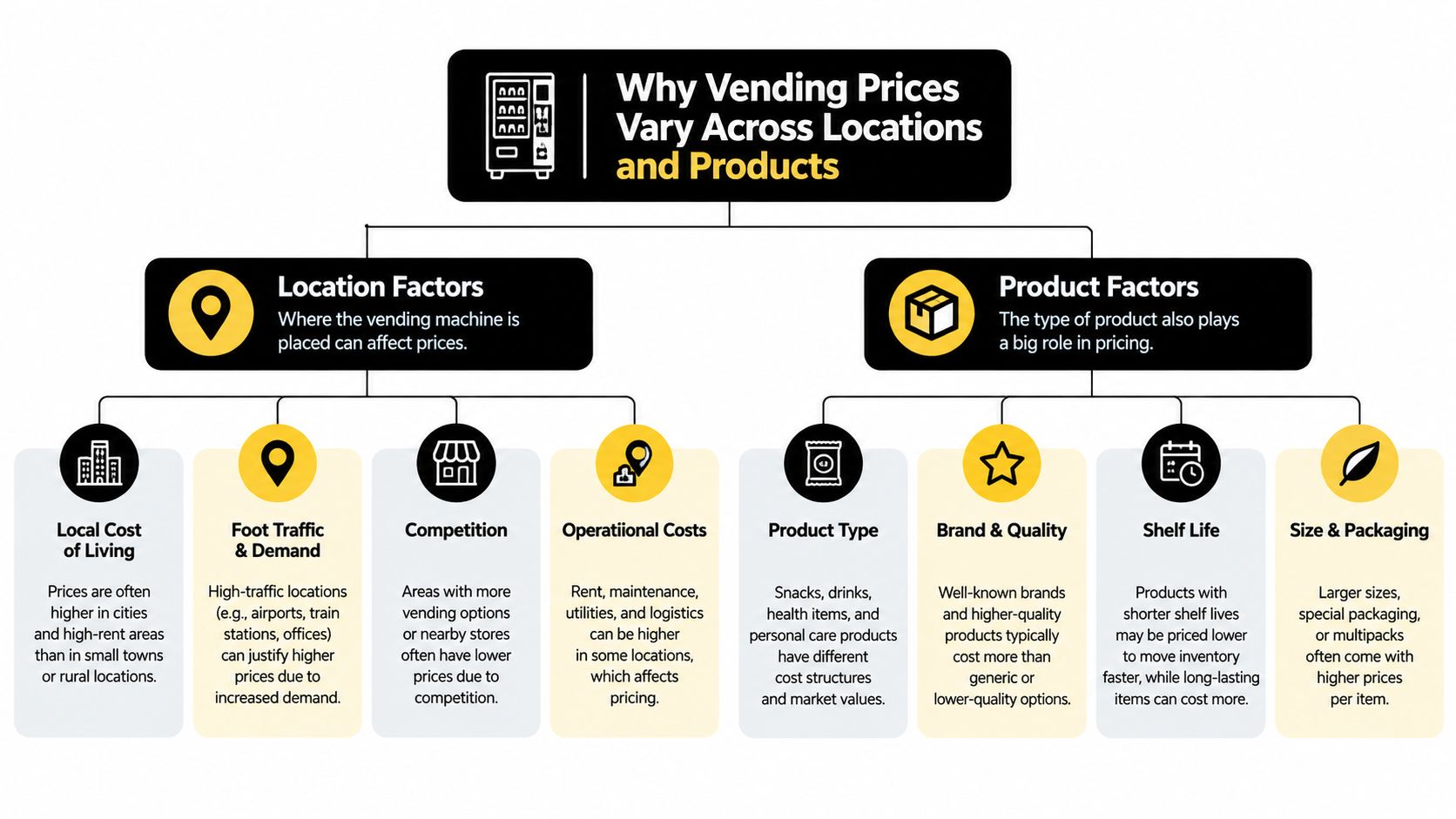
A vending machine in an Oklahoma City business center doesn't face the same economics as one in an Edmond warehouse or a Norman hospital. Traffic, operating hours, nearby alternatives, equipment, product mix, and payment behavior all shape the price a sustainable operator needs.
In 2024, the average vending-machine purchase in the United States was $2.11. Cashless transactions averaged $2.24, compared with $1.78 for cash purchases, a 26% higher average ticket for cashless payments, according to the 2024 vending transaction report. That difference doesn't mean every cashless item should cost more. It shows that customers often build a larger purchase when tapping a card, phone, or wallet.
Location changes the operating equation
A high-traffic office can support frequent replenishment and a broader assortment because products move consistently. A small facility may need a narrower lineup, more deliberate route planning, and a price structure that prevents slow inventory from sitting too long.
Oklahoma weather also affects product decisions. Chocolate in an unconditioned industrial area may be a poor choice during hot months, while cold drinks and shelf-stable salty snacks may perform more reliably. A hospital with overnight activity needs different availability from an office that empties after the workday.
Equipment matters as well. A compact refreshment center may have different capacity and service requirements from a dual-zone chill center or frozen-food machine. Refrigeration, power consumption, product handling, and repair access all influence the economics behind the selection price.
Telemetry makes pricing less dependent on guesswork
Connected telemetry can show which slots sell, which products sit, when inventory runs low, and whether a machine needs attention. That data lets an operator replace slow-moving items, protect popular selections from stockouts, and reduce spoilage instead of treating every location as if it behaves the same way.
Practical rule: Price by the economics of the location, then refine the assortment using actual sales and inventory data.
Telemetry doesn't automatically make prices fair. An operator can still use data poorly by pushing expensive products without considering accessibility or employee feedback. The useful approach combines machine performance with product cost, service requirements, and a clear value tier. Operators and employers can also use assortment planning for vending to connect product selection with space, demand, and replenishment decisions.
Comparing Vending Prices to Grocery Stores and Convenience Stores
A grocery store usually wins on unit cost because customers buy larger quantities and accept the work of traveling, shopping, storing, and portioning the food. A convenience store may be closer to the workplace, but it still requires a trip. A vending machine wins on time, proximity, and availability.
A neutral 2025 Illinois farm policy analysis found that U.S. food-away-from-home prices, including vending-machine purchases, rose 31.9% from December 2019 to April 2025, compared with 28.2% for food bought at home, as summarized in this Bureau of Labor Statistics analysis. The comparison matters because vending prices aren't operating in isolation from broader food costs, but it doesn't erase the need to evaluate the individual machine.
Compare equivalent value, not just shelf labels
A fair comparison asks what the customer receives:
Alternative | Main advantage | Cost question to ask |
|---|---|---|
Grocery store | Lower unit cost for multipacks | Will the customer use the whole package, and how much time does the trip require? |
Convenience store | Broader selection and immediate retail access | Is the store close enough to reach during a short break? |
Workplace vending | On-site access and individual portions | Are prices transparent, products fresh, and the machine reliably stocked? |
Café or prepared-food counter | Fresh meals and service | Does the portion and availability justify the higher operating cost? |
A $1.50 snack from a machine isn't automatically unfair if it saves an employee a drive during a short break. The same price may feel unreasonable if the machine is frequently empty, accepts a payment but fails to vend, or offers only premium items.
Oklahoma locations create different value tests
An airport, hospital, and industrial plant may all support a convenience premium, but for different reasons. Travelers and visitors may value immediate access. Night-shift healthcare workers may need food when nearby options are closed. A manufacturing employee may have no practical way to leave the site during a scheduled break.
Employers should evaluate more than the product price. Review the assortment, cashless and cash options, uptime, replenishment schedule, refund process, and response time when the machine has a problem. A structured cost comparison analysis helps separate the product's retail price from the value of access and the cost of keeping the service available.
The strongest program also shows its pricing logic. Entry-level items should remain visible, premium choices should be identified by their product type, and employees shouldn't have to discover unexpected fees at checkout.
Smart Strategies to Manage Vending Costs and Maximize Value
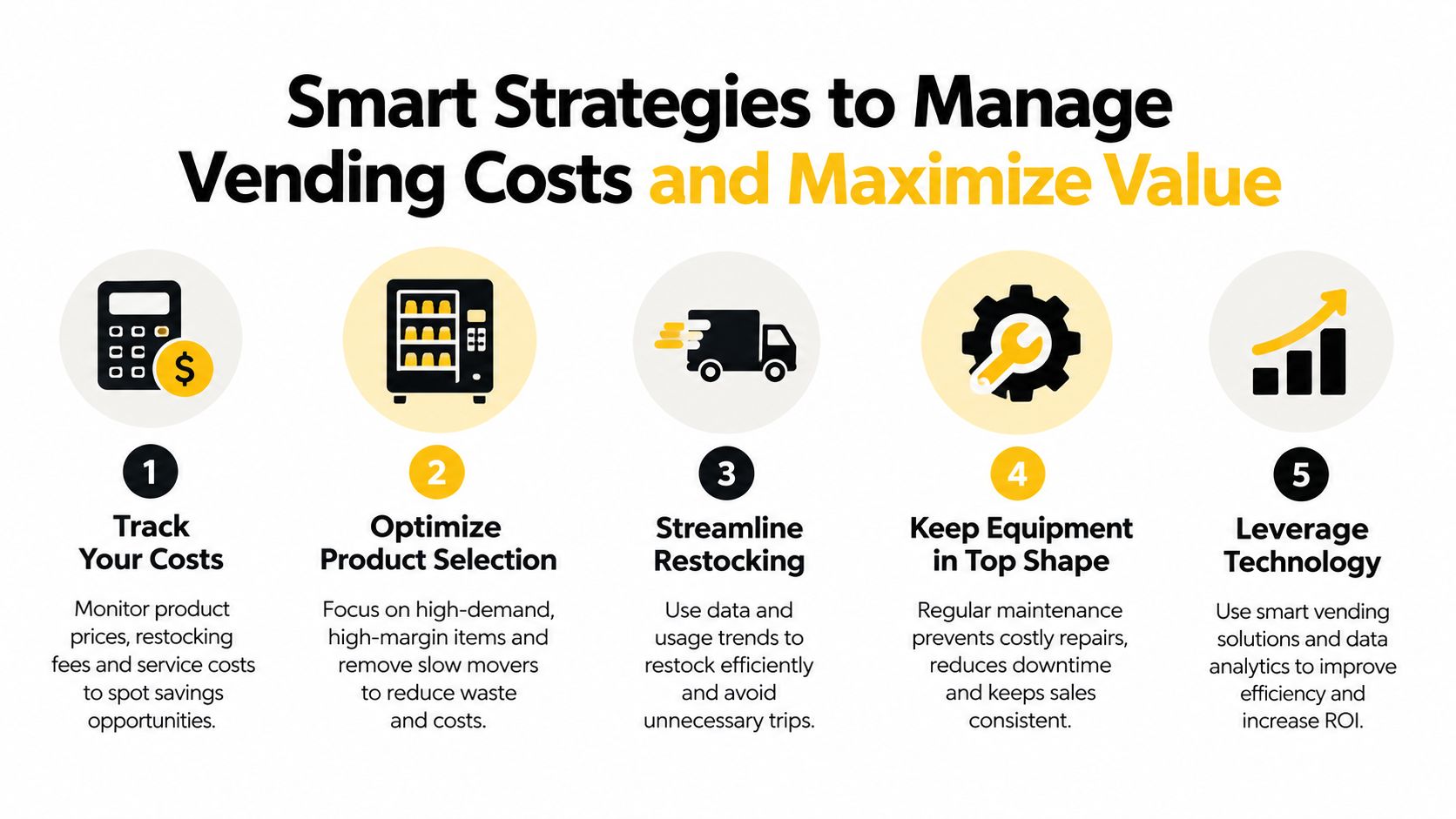
Good vending pricing starts with architecture, not a blanket increase. Keep a value tier, maintain standard favorites, and reserve premium pricing for products that offer a clear reason to cost more. That structure gives employees choice while helping the operator cover route, equipment, inventory, and payment expenses.
An 18-month intervention involving 33 vending machines at metropolitan bus garages increased healthy-item availability to 50% and reduced prices by an average of 31%. The targeted healthy products recorded 10% to 42% higher sales, and during the largest price-reduction period, healthy snacks represented 48% of all snack purchases, according to the published vending intervention study.
Five decisions that improve value
Protect an accessible entry point. Keep several familiar snacks and drinks at the lower end of your approved pricing structure. This matters most in schools, hourly workplaces, healthcare facilities, and locations where customers have limited alternatives.
Use relative pricing to influence choice. A healthier item doesn't need to be the cheapest product in the machine, but pricing selected options below comparable indulgent products can encourage substitution. Availability matters too. A healthy product hidden in one corner won't perform if customers can't see it.
Test small changes. Change a limited group of selections, then watch units sold, contribution margin, repeat purchases, and inventory turns. Uniform increases can protect the sticker price while weakening demand across the whole machine.
Let slow movers earn their space. Telemetry can identify products that occupy a slot without producing enough sales. Replace them with a test item, then compare performance against neighboring selections. A product that sells slowly may still deserve a place if it serves an important dietary or customer need, but that decision should be deliberate.
Review the machine by profit per facing. A lower-margin product can contribute more when it sells reliably and reduces dead inventory. Revenue optimization for vending should consider volume, margin, spoilage, and service effort together.
Employees can apply the same logic from the other side. Learn which items are value selections, compare package sizes, use cashless convenience when it helps you avoid a trip, and choose a nearby store when the machine's premium doesn't match the access it provides.
Building a Fair and Sustainable Vending Program for Oklahoma Workplaces
Fair vending doesn't mean keeping every item artificially cheap. It means matching the price structure to the service, showing customers what they're paying, and adjusting the program when real demand contradicts the original plan.
A workplace manager in Norman may need a different assortment from a property manager in Edmond. An Oklahoma City office may prioritize coffee, bottled water, and lighter snacks, while a manufacturing site may need filling products for long shifts. A hospital can require dependable overnight availability, and a school must consider its own purchasing policies and audience.
Listen to the people using the machine
A 2013 survey of 2,035 U.S. workers found that only 25% said they worked in an optimal environment for productivity. The same workplace research report says that giving employees choices and a voice in workplace decisions can improve happiness, motivation, and performance.
That principle applies directly to break-room vending. Ask employees which products they want, which price points feel reasonable, and what disappears first. Then compare those responses with sales, stockouts, refunds, and replenishment records.
A vending program feels fair when customers can see that the operator responds to demand instead of guessing from a static product list.
Balance access with operating sustainability
Operators can't maintain reliable service if every price is forced below the cost of stocking and servicing the machine. Employers also shouldn't accept vague pricing, poor communication, or a machine that stays empty because the operator has no useful performance process.
A workable program should define:
Product expectations: Include value items, standard favorites, healthier choices, beverages, and location-specific products.
Service expectations: Set a clear schedule for stocking, cleaning, repairs, refunds, and communication.
Data review: Use telemetry and sales information to adjust the planogram, not just to report revenue.
Feedback loops: Give employees a practical way to request products and report problems.
Pricing transparency: Display the final price clearly and avoid surprises at the point of payment.
Employers building a broader wellness program may also find useful ideas in this resource on compact hydration for employee wellness by HYDAWAY, especially when hydration access needs to complement snack and beverage availability.
A documented vendor management service-level agreement can turn these expectations into measurable responsibilities. It should address communication, machine uptime, inventory standards, refund handling, and how both parties review performance.
Vendmoore Enterprises operates smart vending programs across the Oklahoma City metro, Norman, Edmond, and surrounding communities, using cashless payments, connected telemetry, location-specific assortments, and feedback to manage workplace and public-space refreshment services. The company offers managed programs and machine options for organizations that want more control over products and pricing, including offices, schools, healthcare sites, industrial facilities, residential properties, stadiums, and airports.
Visit Vendmoore Enterprises to discuss a vending program built around transparent snack pricing, cashless convenience, telemetry-driven stocking, and Oklahoma-specific service. Ask for a location review so your assortment, price tiers, and replenishment plan fit the people who use your break room.
Comments