
Vendor vs Service Provider: Who Owns What After the Sale

A vendor supplies a defined product judged on delivery, while a service provider performs ongoing work judged on sustained outcomes. Buyers are already spending that way: Deloitte's global outsourcing survey reports that 76% of executives said their IT services were delivered through third-party models, and 67% reported increasing budgets for operate services.
Procurement teams still compare the quote, the warranty, and the badge on the machine. That reflex fails the afternoon a cashless terminal dies and nobody owns the ticket. The invoice label does not restock shelves, answer a stockout, or absorb lost sales. Accountability after the sale does, and the contract should price who carries it.
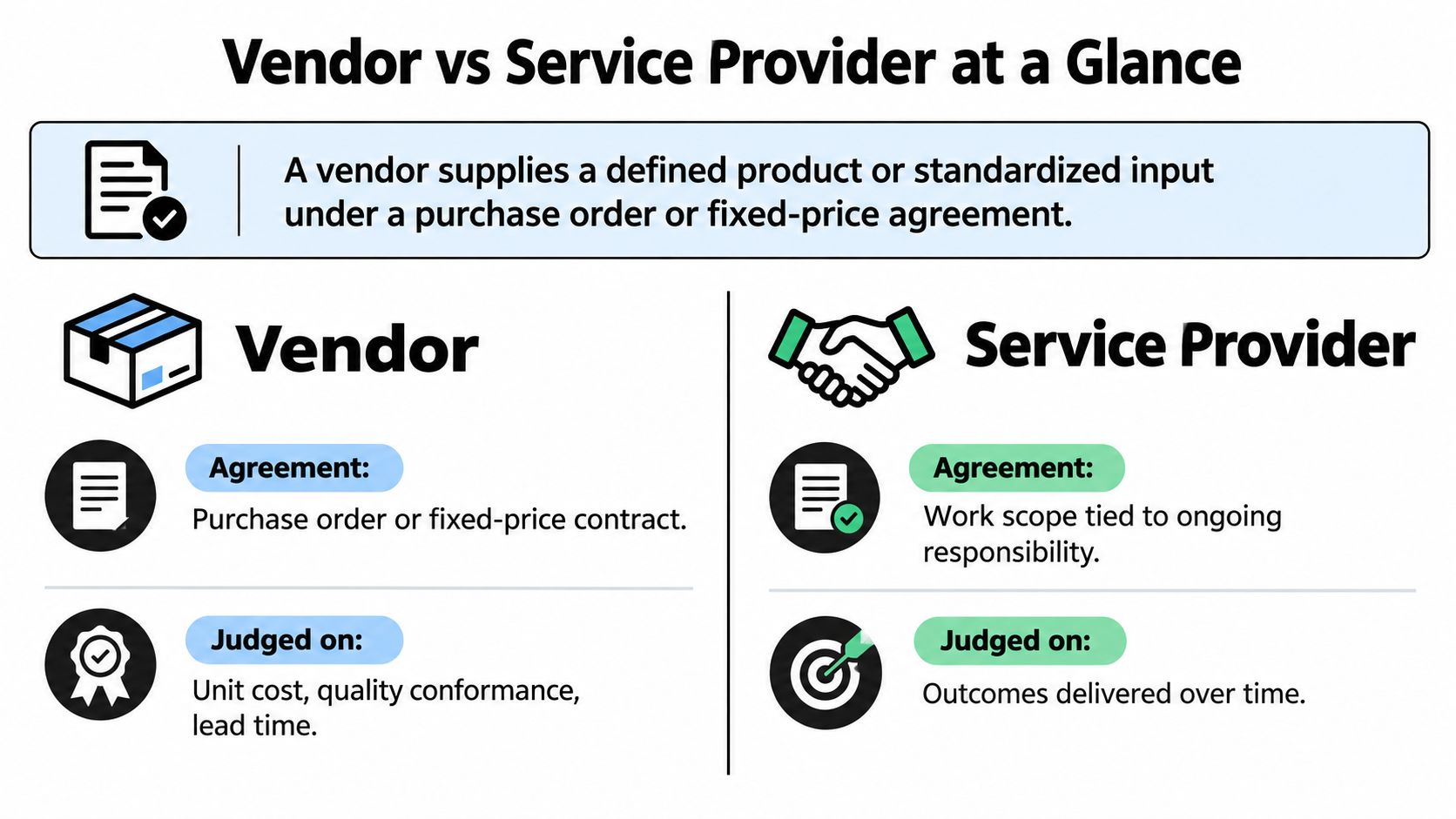
Vendor vs Service Provider at a Glance
A vendor supplies a defined product, piece of equipment, or standardized input, usually under a purchase order or fixed-price contract, and is judged on unit cost, quality conformance, lead time, and defect rate. A service provider performs continuing work and is judged on service levels, responsiveness, consumption, and outcomes.
Deloitte's global outsourcing survey describes traditional outsourcing as simple, discrete tasks and cost reduction under a transactional vendor relationship, and contrasts that with managed services that run complex processes or whole functions under longer agreements tied to service levels, outcomes, and volume. The same survey is where those third-party and operate-budget figures come from. Organizations are buying continuing operational accountability, not only a box.
Criterion | Vendor | Service Provider |
|---|---|---|
Core deliverable | Defined product or standardized input | Ongoing activity or managed function |
Typical contract | Purchase order or fixed-price agreement | Master services agreement with service levels |
Pricing basis | Unit price or equipment cost | Monthly, per-location or revenue-share fee |
Term length | One transaction or short supply cycle | Multi-year, renewable term |
Success is judged by | Delivery against specification | Sustained outcomes against service levels |
Vending example | Sells a snack machine with a hardware warranty | Installs, restocks, repairs and reports on the machine |
A product vendor can sell a snack machine and a hardware warranty, then be finished at delivery. A workplace service provider installs the machine, restocks it, maintains the payment terminal, dispatches repairs, and reports uptime every month. Obligations such as stocking frequency, response time, payment reliability, and satisfaction do not end when the pallet leaves the dock.
When the same company is both
Three blur cases show up constantly in break room vending.
Operator who also sells machines: The company invoices equipment like a vendor and still runs routes, telemetry, and repairs like a provider.
Hardware reseller that adds monitoring: The purchase order covers the terminal. A second agreement covers alerts and remote checks.
Janitorial firm that sells supplies and the schedule: Cases of product are a vendor sale. The cleaning calendar is a managed function.
The test: Does the buyer receive an item, or a function that must keep running after installation?
For regulated buyers, a subservice organization is the sharper version of that test. It is a provider whose own controls the buyer relies on for reporting, not a supplier whose staff the buyer directs day to day. Hospitals and schools should ask whether a payment processor, hosting platform, or route partner sits inside the control environment that auditors will read.
The label is a starting point, not a verdict. Read the deliverable, the term, and who is still on the hook after the sale.
Who Owns Which Responsibilities After the Sale
Outsourcing transfers execution, not the customer's accountability. Employees, patients, students, and tenants still hold the buying organization responsible for the break room, even when an outside party stocks the machine.
Use the matrix as a responsibility schedule. Each row is one task in a break room program. Read across for what a typical vendor model covers, what a typical service provider model covers, and what the customer must still do.
Responsibility | Typical Vendor Model | Typical Service Provider Model | Customer Action |
|---|---|---|---|
Delivery and installation | Vendor delivers; buyer arranges the site | Provider delivers, installs and commissions | Confirm site access and power |
Product assortment | Buyer chooses from the catalogue | Provider proposes and adjusts from feedback | Approve changes |
Restocking and freshness | Buyer or staff restock | Provider restocks on a set schedule | Report stockout patterns |
Payment terminal upkeep | Vendor covers warranty only | Provider maintains and tests transactions | Escalate payment failures |
Repairs and fault response | Buyer calls vendor under warranty | Provider dispatches within contracted response time | Log faults promptly |
Complaint handling | Buyer absorbs complaints | Provider logs and resolves complaints | Forward feedback |
Usage data and reporting | Rarely provided | Telemetry reports and monthly reviews | Review data and set goals |
Invoices and reconciliation | Single purchase invoice | Recurring statements per location | Approve statements |
How to read two rows
Take repairs and fault response. Under a vendor model the buyer calls in under warranty, often during business hours, and waits on parts lead time. Under a service model the provider must dispatch inside a contracted response time. The customer action does not disappear: someone on site still logs the fault the same day, with the machine ID and what failed.
Payment terminal upkeep splits the same way. Warranty coverage replaces a dead reader if the failure fits the warranty. It does not test Apple Pay or Google Wallet every week, and it does not own a failed settlement. A provider maintains and tests transactions. The site still escalates payment failures instead of taping a “cash only” note to the glass.
For every row, answer two questions. Who performs the task? Who is accountable if it fails? Those are different people more often than the quote admits.
Blank rows become disputes. If the quote is silent on stockouts, complaints, or telemetry, write the row in before you sign.
Turn the finished matrix into the contract's responsibility schedule. Teams that treat operations as a living schedule, the way operational insights from MR2 Solutions frame managed work, spend less time arguing about whose job a missed visit was. If replenishment is the function you are handing off, spell out how vendor managed inventory services use machine data, visit cadence, and location-level assortments so “restock” is not a vague promise.
Contract Terms That Separate the Two Models
A purchase order or set of sales terms defines a product and its warranty. A master services agreement, plus statements of work, defines a recurring service: scope, levels, measurement, and exit. Mixing those documents is how buyers think they bought uptime and end up with only a machine.
Clauses in the order they bite
Governing document. If the PO wins a conflict with the services schedule, service levels are marketing copy. Name one controlling document and attach the responsibility schedule to it.
Performance standard. A vendor sale states a specification: model, capacity, payment hardware, warranty months. A managed agreement states levels: availability, restock interval, response, and transaction success, plus how each is measured.
Remedy for failure. A warranty replacement ends a hardware defect. A service credit pays something back when a level is missed. It does not put the lost afternoon sales back in the till. Say whether credits, a cure, or termination is the remedy, and in what order.
Liability and insurance. Product sales often cap liability at the equipment price. That cap is thin once a down machine sits in a hospital lobby for a week. Negotiate caps, indemnities, and insurance against the work being performed, not only the asset value.
Data and reporting. Vendor invoices are often the only data you get. A managed deal should grant access to usage and sales records, set a reporting cadence, and say who owns telemetry.
Subcontracting. Route techs and payment processors are often not the company on the letterhead. Require consent before a new subcontractor works on site.
Term and exit. A one-time sale ends at acceptance. A multi-year term needs termination rights, data return, and transition help so the next operator is not guessing fill levels.
The clauses buyers skip
Spend negotiation time here, not on the logo page.
A cure period gives the provider days to fix a miss before credits or termination apply. Too long, and a chronic stockout never quite becomes a breach. Too short, and a parts delay becomes a default. Match the cure to the fault: hours for a payment outage at a high-volume site, days for an assortment miss.
Consent over subcontractors matters because those people have keys, after-hours access, and sometimes card data paths. Consent is useless if you cannot see who is actually on the route.
Ownership of telemetry and sales records decides whether you can rebid. If the provider owns the history, your next quote is a guess. Keep a right to export location-level sales, faults, and visit logs at exit.
Transition assistance is the unglamorous clause. Require a handover window, machine keys, planograms, and open-ticket lists. Without it, exit is a weekend of empty spirals.
For hospitals, clinics, and schools, add audit rights and a right to independent reports on the provider's controls, especially where a subservice partner touches payments or hosting. A practical companion is a written service level agreement that names the level, the measure, and the remedy in one place.
Terms and enforceability vary by jurisdiction. Have counsel review any agreement before you sign.
Measuring Performance in Each Model
You cannot score both models with the same checklist. A vendor is checked at delivery against specification: uptime at commissioning, warranty compliance, payment-terminal compatibility, and replacement lead time. A service provider is managed continuously against an operating outcome.
Services-procurement research names three measurement problems that make the split real. Service quality is often hard to observe directly. Results can show up after a lag. Performance is hard to pin on one party. A stockout might be a bad forecast, a missed route, or a payment fault that stopped sales before the spiral went empty.
A low equipment price does not offset repeated stockouts, failed cashless transactions, or slow corrective service. Compare vendors on deliverables and providers on sustained, location-specific outcomes. Telemetry and service logs are the evidence.
Trailing results and leading signals
Trailing metrics tell you what already happened. Leading metrics tell you whether next month will look like this one. Quality, timeliness, inventory, and satisfaction are the usual service dimensions. Schedule adherence is an early warning, not a trophy.
Metric | Type | What It Shows | Who Controls It |
|---|---|---|---|
Machine availability | Trailing | Share of time the machine can sell | Provider |
Stockout rate | Trailing | Frequency of empty selections at inspection | Provider, using buyer forecasts |
Transaction success rate | Trailing | Share of cashless payments that complete | Provider and payment processor |
Mean time to resolution | Trailing | Average time from fault report to closure | Provider |
Revenue per operating hour | Trailing | Sales productivity by location | Shared |
Complaint rate | Trailing | Feedback volume per location | Shared |
Scheduled visit completion | Leading | Whether planned servicing happens | Provider |
Telemetry alert response | Leading | Speed of action on machine alerts | Provider |
Site access and forecast accuracy | Leading | Whether the buyer enables service | Customer |
Assortment review completion | Leading | Whether feedback changes the product mix | Shared |
Every metric needs an owner, including the rows the customer controls. If site access is late or the headcount forecast is wrong, do not score that miss as a provider failure. Shared rows, revenue and complaints, need a note on what each side contributed.
Make a metric enforceable
For each row, the contract should name the measurement method, sampling interval, data owner, exclusions, escalation path, and remedy. “Uptime” without a clock, a data source, and a list of excluded hours is a slogan.
Normalize multi-site programs by machine count, operating hours, and foot traffic. An airport concourse and a 40-person office are not the same job. A useful pattern is a short monthly pack of performance reporting that shows trailing results beside the leading signals, so a review meeting argues about causes instead of anecdotes.
Do not judge an airport gate with the same raw stockout count you use for a small office.
Comparing Total Cost Beyond the Quote
The cheapest vendor can cost more than a managed program once your own people become the service desk. KPMG's outsourcing analysis describes organizations that want providers to share accountability for outcomes, not only to hit a predefined level. The public-sector figures in that work show the measurement gap: 93% of surveyed agencies review supplier performance and 80% monitor contract or supplier performance, yet only 32% track and report supplier-performance metrics, and 28% track contract-performance metrics. Plenty of buyers watch the relationship and still cannot prove what it costs.
Add these categories to any quote before you rank it.
Contract price: The equipment invoice, or the monthly, per-location, or revenue-share fee.
Installation: Power, placement, and commissioning time.
Restocking labour: Staff hours if your people fill the machine.
Repair coordination: Calls, tickets, and waiting on site for a tech.
Invoice reconciliation: Matching statements to locations and credits.
Product changes: Time spent swapping a dead SKU.
Lost sales: Hours the machine is down or a popular selection is empty, plus any emergency repair bill.
A workable frame is: total annual cost equals the contract price, plus internal staff hours times a loaded hourly rate, plus estimated lost sales from downtime and stockouts, plus emergency repair cost.
Say one office machine looks $80 a month cheaper on a vendor purchase. A coordinator spends three hours a month restocking, resetting the reader, and chasing a warranty part. At a loaded rate of $40 an hour, that is $120 in hidden labour, already more than the fee gap, before a single lost afternoon of drink sales. The numbers are an illustration, not a benchmark. Run them with your wage and your fault log.
When the vendor model is the cheaper honest choice
A vendor purchase wins when you already have facilities staff, product needs are stable, faults are rare, and you want full control of price and assortment. Owning the asset then avoids a management fee you would not use. It loses when those hours are borrowed from a receptionist who was not hired to be a route driver.
Ask every bidder to price the same responsibility matrix. A low number that leaves restocking and complaints on you is not comparable to a higher number that includes them. A structured cost comparison analysis keeps that math in one place so the spreadsheet matches the work.
Choose the Right Model Before Requesting Quotes
Choose the model that matches who will carry the work after installation, not the one with the lowest first-year price. Price is the last filter, after ownership is clear.
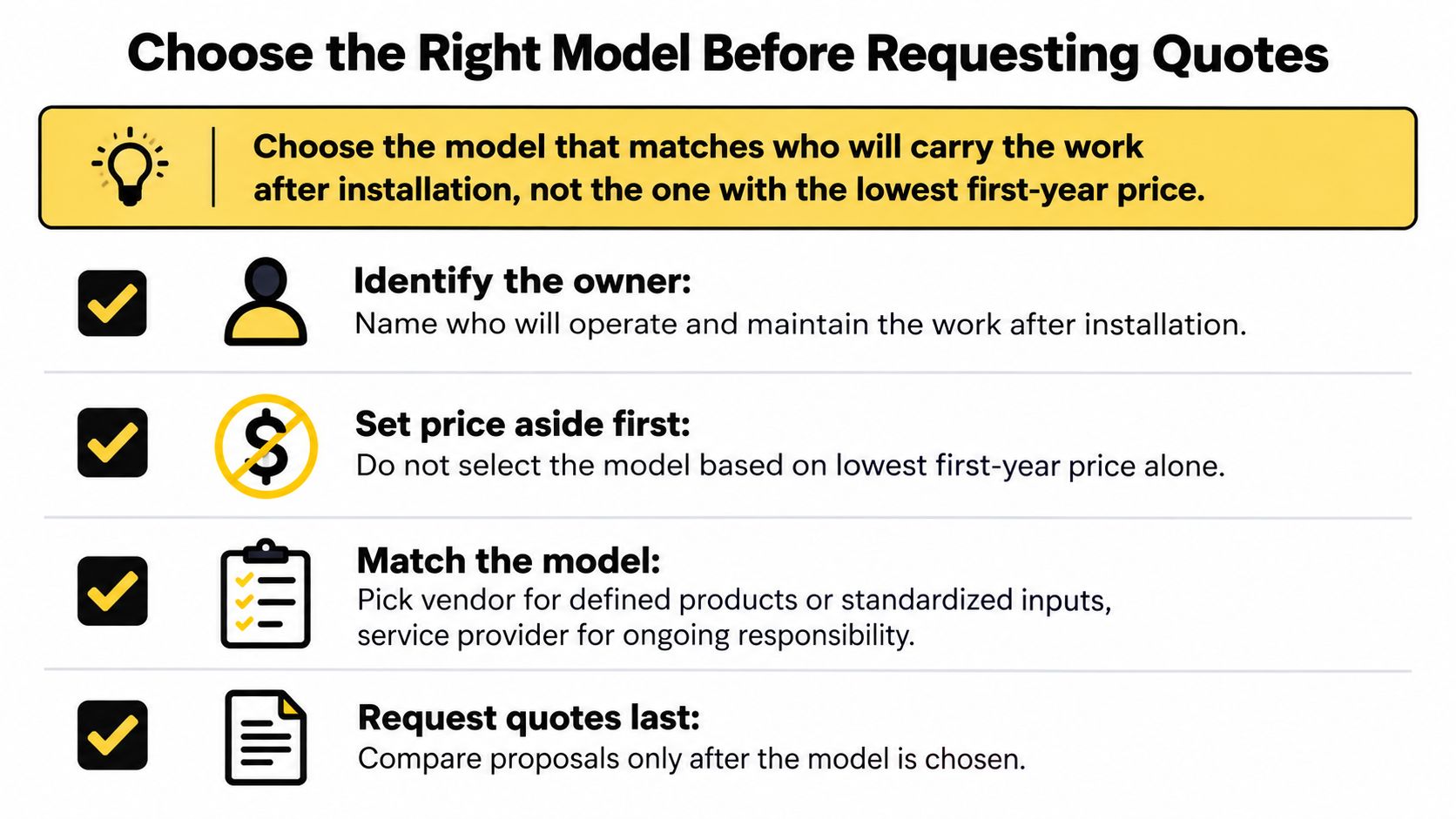
The short version of that sequence is also worth watching before you open a bid form.
Situation | Lean Toward | Why | Confirm Before Signing |
|---|---|---|---|
One office machine, staff willing to restock | Vendor purchase | Low coordination needs; buyer controls restocking | Warranty length and parts availability |
Multi-site break rooms with no facilities team | Service provider | Restocking, repairs and reporting need a named owner | Response times and reporting cadence |
Hospital, clinic or medical office | Service provider | Uptime, documentation and controlled access matter | Audit rights and data handling |
School or university under procurement rules | Service provider or hybrid | Competitive bids and multi-year terms need defined service levels | Procurement cycle and termination rights |
Stadium, airport or high-volume site | Service provider | Peak demand requires fast restocking and normalized KPIs | Peak-event staffing and stockout remedies |
Company that wants to own its machines | Vendor purchase plus service agreement | Ownership with outsourced upkeep | Who pays for repairs and parts |
A single office with someone glad to refill on Fridays can live with a purchase and a warranty. A clinic cannot. Controlled access, documented uptime, and a named responder matter more than saving the management fee. Schools and universities often land on a service provider or a hybrid because competitive bidding and multi-year terms need levels you can defend in a procurement file. Stadiums and airports need peak staffing written down, not assumed. If you want the asset on your books, buy it, then add a service agreement that states who pays for parts.
What to do before the first quote goes out
Name the outcomes. Availability, stock, payment success, and response time, in words a site manager would recognize.
Finish the matrix. Every blank row is a future argument.
Bid the same matrix. Vendors and providers price identical rows.
Score the metric table. Trailing and leading, with an owner on each.
Lock the clauses. Remedy, data, subcontractors, cure, and exit, then counsel.
For Oklahoma offices, schools, clinics, plants, and venues, Vendmoore Enterprises installs and operates cashless machines with telemetry, and also offers owned-machine options, across Oklahoma City, Norman, and Edmond. Request both a managed quote and an owned-machine quote against one matrix. If you are still mapping who serves a campus or a property portfolio, start with how food service companies near me differ from a vending operator before you mix those scopes in one bid.
Vendmoore Enterprises runs fully managed vending for workplaces and public spaces, and it also supports buyers who want to own the machines and outsource the upkeep. That is the same choice this comparison turns on: who carries stocking, repairs, payments, and reporting after installation. If you are ready to price both models on one responsibility matrix, visit Vendmoore Enterprises and ask for quotes against your sites.
Comments