_edited.png)
What Is Product Assortment and Why It Matters in Vending

You walk into the break room and see a vending machine that looks well stocked. The lights work, the shelves are full, and nobody has reported a mechanical problem. Yet employees keep leaving without buying anything. The issue may not be the machine. It may be the product assortment, the deliberate mix of snacks, drinks, brands, sizes, and prices inside it.
For a facility manager, understanding what is product assortment means learning to connect customer preferences with practical operations. In a connected vending program, the assortment isn't a fixed list loaded on every route. It's a location-level decision that changes as people buy, request, reject, and replace products.
The Break Room Moment That Starts This Conversation
It's Tuesday at 10:14 a.m. in a 60-person office. Three coworkers arrive at the break room within seconds of one another.
The first reaches past three energy drinks and searches for a cold brew. The machine has bottled water and soda, but nothing that fits the coffee habit he has developed during his morning shift. The second studies a sad row of chips, looking for something low-sodium. The available choices are familiar, but none match what she wants. The third checks the selection, sighs, and walks to the lobby café.
The machine is full. The snack break still failed.
That moment captures the difference between inventory and assortment. Inventory describes what is physically present. Assortment describes whether the available products make sense for the people, schedule, space, and purpose of that location. A machine can have every slot occupied and still miss the demand that matters most.
A vending operator decides which items earn a slot, how much space each category receives, which package sizes fit the equipment, and how prices are balanced. Those decisions affect whether employees find a quick breakfast, a refreshing drink, a better-for-you snack, or an affordable afternoon treat. They also affect replenishment work, expiration risk, and whether a product is available when someone wants it.
Practical rule: A full machine isn't automatically a useful machine. The mix has to fit the people using it.
A facility manager who wants to improve the break room experience should look beyond equipment appearance and ask whether the selection reflects actual habits. Resources such as this guide to the break room experience can help connect vending choices with the broader employee environment.
The rest of this guide defines product assortment in plain language, explains the decisions behind it, and shows how telemetry and feedback help operators keep the mix relevant. The goal is simple: fewer empty-handed walks to the café and a vending program that feels designed for your building.
What Product Assortment Actually Means
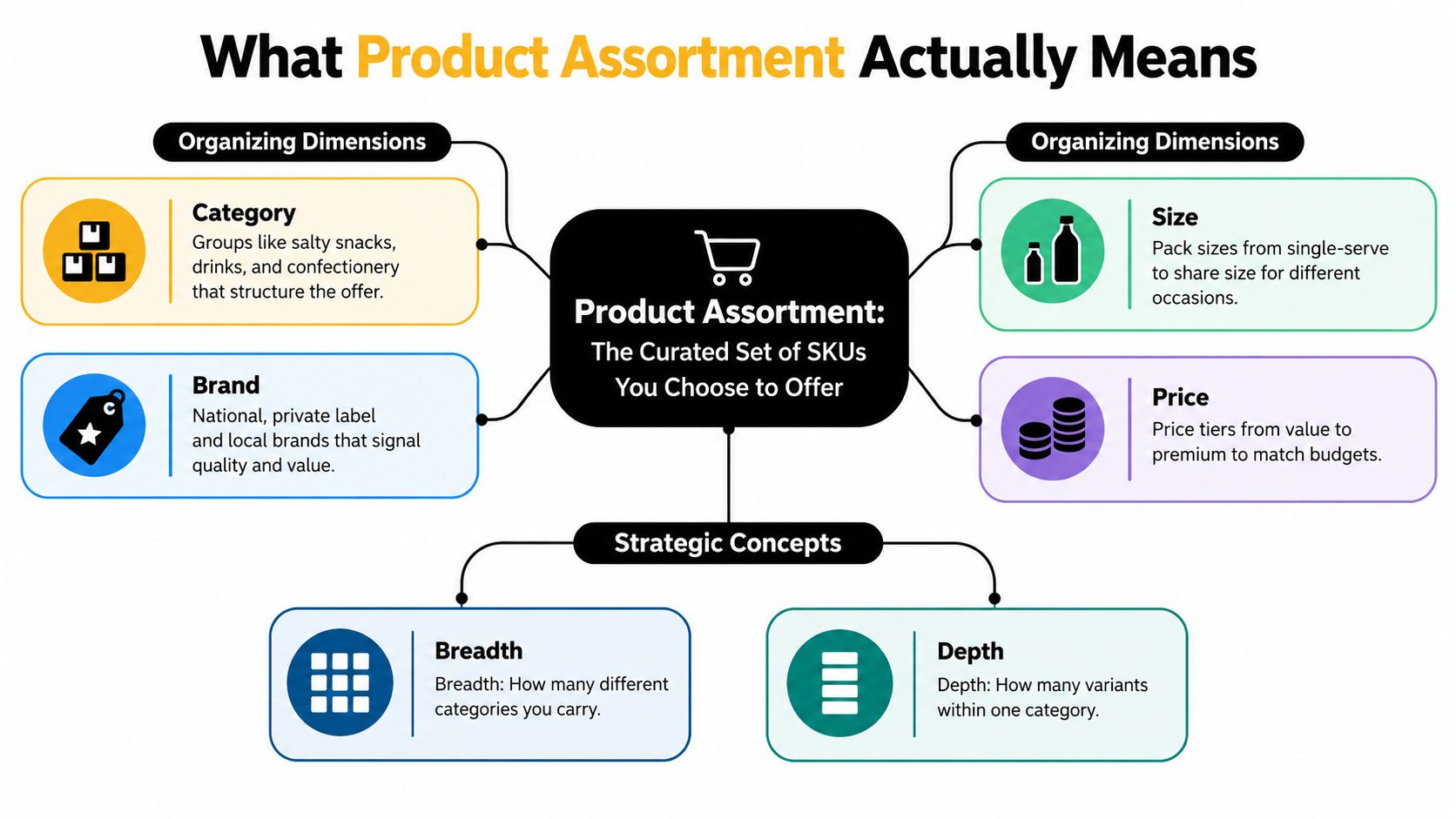
Product assortment is the curated set of stock-keeping units, or SKUs, that a retailer or vending operator chooses to offer. In a machine, each SKU might be a specific flavor, package size, brand, or price point. A lemon sparkling water and a berry sparkling water may belong to the same category, but they're separate choices within the assortment.
The easiest way to understand an assortment is through two dimensions, breadth and depth. Breadth means how many different categories the operator carries. Depth means how many variations appear within each category. Retail references describe this framework as a way to balance variety and specialization while matching the offer to customer demand and available space. The meaning and strategy of product assortment provides useful background on this distinction.
Breadth determines the range of needs
A machine with broad assortment might include bottled water, soft drinks, energy drinks, coffee, salty snacks, candy, pastries, protein bars, nuts, and frozen meals. It gives customers more types of products, but it may offer only a few choices in each category.
A narrower machine might focus on beverages and snacks, with several chip flavors, multiple soda options, and a deeper coffee selection. It offers fewer categories but more alternatives within those categories.
Consider a 30-slot machine. One plan could use six categories with five options each. That arrangement gives the machine meaningful depth. Customers who want a snack or drink may find several familiar choices. Another plan could use twelve categories with two or three options each. That setup signals broader variety. It may appeal to a mixed audience, but each category has less room for popular products and backup choices.
Neither plan is automatically correct. A small office with strong coffee demand may benefit from depth in cold brew, bottled coffee, water, and protein-forward snacks. A public venue with varied visitors may need broader categories, premium choices, and fast-moving impulse products.
Depth helps customers find a preferred version
Depth answers the question, “How many ways can someone get what they came for?” In salty snacks, depth might mean classic potato chips, baked chips, tortilla chips, pretzels, popcorn, and nuts. In beverages, it might mean still water, sparkling water, low-sugar drinks, regular soda, energy drinks, and coffee.
Assortment also includes brand, size, and price. A single-serve package suits a quick break. A larger package may work for someone buying food for later. A familiar national brand can reduce purchase hesitation, while a local or emerging product can add interest.
A break room assortment plan should therefore answer four practical questions:
What categories belong here? Select products that match the location's daily routines.
Which versions deserve space? Choose flavors, brands, and sizes based on observed demand.
Who is the machine serving? Consider employees, students, patients, residents, or visitors.
What can the equipment support? Match the assortment to slot configuration, cooling, storage, and replenishment limits.
A machine shouldn't contain whatever a driver happened to load during the previous visit. It should reflect an intentional plan, as explained in this resource on assortment planning.
Why Assortment Drives Satisfaction, Sales, and Turnover
Assortment controls three connected outcomes in a vending program: whether customers find something suitable, whether the machine generates worthwhile sales, and whether inventory moves before it becomes a problem.
Customer satisfaction starts with relevance. A product can be physically available and still fail because it doesn't suit a dietary preference, taste, occasion, or budget. In the break room, that includes the employee who wants low-sugar hydration, the person looking for a filling snack, and the night-shift worker who needs a convenient meal.
Retail research also shows why operators shouldn't treat assortment as a simple shelf-count exercise. One influential study of U.S. supermarkets found that corporate structure and store size explained 25% to 48% of differences in assortment composition across cereals, coffee, colas, and toothpaste, while clientele variables explained 3% to 4% and competition variables explained 1% to 4%. The findings are summarized in this product assortment guide. The operational lesson is that format, capacity, and operating model can shape the right mix as strongly as customer demographics.
Sales depend on substitution and space
When a preferred item is unavailable, a customer may choose another product in the machine, switch categories, or leave. Technical retail models account for both substitution and shelf-space effects. Changing the number of facings can influence demand, and customers may move to an in-assortment alternative or an out-of-assortment option when their first choice is missing. This integrated assortment and shelf-space model explains why product selection and slot allocation should be planned together.
Store-level optimization research also demonstrates the potential impact of assortment decisions. One implementation-oriented study found that optimized assortments could increase expected retailer profit by 37.3%, rising to 43.7% when SKU pricing was optimized at the same time. Those figures come from the retail assortment optimization study. Vending results will vary by location and execution, but the principle is directly relevant: product mix and pricing deserve operational attention.
Turnover protects the margin
A demand-matched assortment generally gives each slot a clearer job. Fast-moving products receive reliable replenishment. Slow movers don't occupy space indefinitely. Perishable drinks, dated snacks, and frozen products get a better chance of selling within their useful window.
Outcome | Generic Assortment | Tailored Assortment |
|---|---|---|
Customer satisfaction | Products are available, but key preferences may be missing | Choices reflect local tastes, routines, and dietary needs |
Sales | Space may go to familiar but weakly matched items | Slots support products customers actively seek |
Inventory turnover | Slow movers can remain while popular items sell out | Replenishment and space follow product movement |
The three outcomes reinforce one another. When customers find relevant products, the machine earns more purchase opportunities. When operators identify movement accurately, they can protect availability without filling the machine with unnecessary SKUs. A thoughtful assortment protects the snack break and the operator's margin at the same time.
For a practical way to evaluate whether users are satisfied, facility teams can review this resource on measuring customer satisfaction.
The Building Blocks of a Smart Vending Assortment
A smart vending assortment starts with structure. Without a clear structure, the machine can become a random collection of popular products, even when those products compete with one another or overlook important customer needs.
Categories create the framework
Categories determine the broad reasons people approach the machine. A break room may need salty snacks, candy, pastries, gum and mints, bottled water, soft drinks, energy drinks, juice, coffee, specialty beverages, and frozen food.
The exact category list depends on the equipment and location. A compact refreshment center may focus on drinks and packaged snacks. A dual-zone chill center can support different temperature requirements. A frozen food machine creates room for meal-oriented choices that a standard snack vendor can't handle.
Brands build familiarity and discovery
Brands help customers judge quality quickly. Familiar names can make a purchase feel safer, especially when someone is in a hurry. Local favorites and emerging brands can add variety and give the assortment a more distinctive feel.
The right balance isn't about filling every category with similar labels. It's about giving customers recognizable choices while leaving room to test products that match local requests.
Sizes serve different occasions
Package size changes the role of a product. Single-serve bars, cans, and bottles suit a quick break. Share bags, larger bottles, and meal-size items serve people who are stocking up for a longer shift or avoiding a separate store trip.
Operators should also check whether the machine can vend each size reliably. A product that looks attractive on a list isn't useful if its shape, weight, or packaging creates delivery problems.
Price tiers make the offer accessible
A practical assortment includes value, core, and premium options. The price examples requested by many facility teams might include a dollar bill, $1.50, $2, and $2.50, depending on product cost and machine configuration. Price architecture should be reviewed alongside product demand, because a machine that carries only premium items can exclude customers even when the products are appealing.
Healthier options deserve deliberate space rather than token placement. Protein bars, nuts, sparkling water, and low-sugar drinks can serve employees who want alternatives to traditional candy, chips, and sugary beverages.
Seasonal slots keep the mix responsive. Cold-only drinks may earn more space during summer, while warm drinks and heartier products may matter more during winter. A clear vending machine planogram helps the operator decide where each category belongs and how the layout should change.
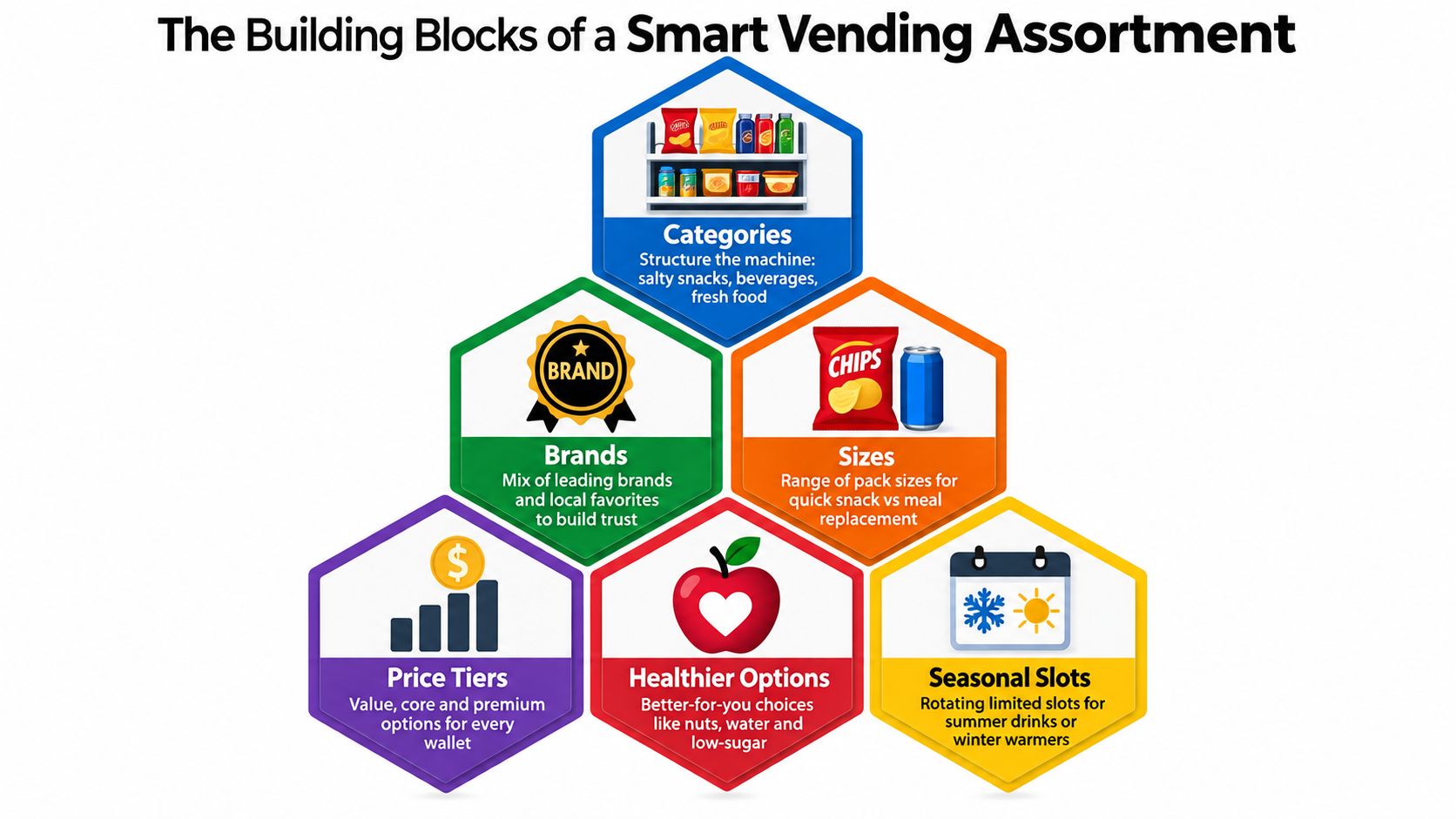
Together, these building blocks turn a machine from a collection of products into a clear customer offer. The categories create coverage, brands create trust, sizes support occasions, prices open access, healthier items respond to preferences, and seasonal slots keep the lineup from becoming stale.
How Telemetry and Feedback Reshape the Mix
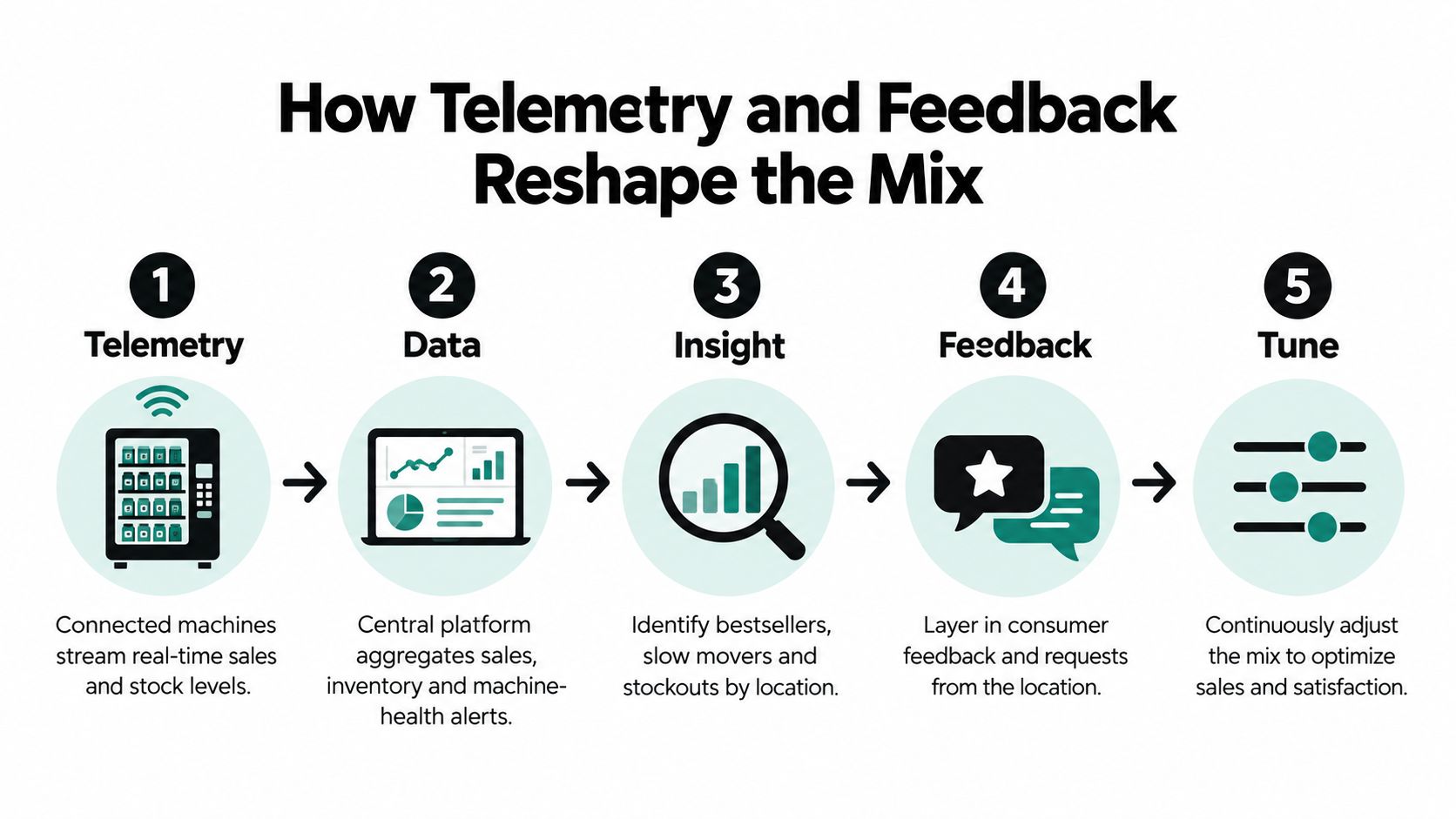
Connected vending changes assortment from a decision made occasionally into a process that can be tuned continuously. Instead of relying only on a driver's visual impression during a service visit, operators can review sales, stock levels, and machine alerts through a central dashboard.
Telemetry can show refrigeration temperature, door-lock engagement, payment responsiveness, and the stock level in each inventory slot. That detail helps an operator distinguish between a machine that looks full and a machine that has the right products available at the right time. The technology category itself is significant, with telemetry representing 31.8% of the smart vending technology segment share, according to this smart vending machines market report.
Cashless payments add behavioral signals
Cashless transactions provide another useful layer. An industry study reported that cashless transactions rose from 51% of vending sales in January 2020 to 62% by October 2021, while contactless payments increased from 18% to 43% and cash transactions declined from 49% to 38% over that period, as detailed by NFC World's vending payment coverage.
A later industry summary reported that about three-quarters of U.S. vending machines accept cashless payments, compared with 69% in 2018, according to Vending Times. For a workplace program, tap-to-pay and mobile wallet support can make purchases easier to complete while creating cleaner records of what sold, when, and at which location.
Feedback explains what sales can't
Sales data tells an operator that a product moved or didn't move. It doesn't always explain why. A QR code on the machine, a short survey, a service email, or a conversation with a facilities team can reveal that customers want a particular flavor, a missing dietary option, or more cold beverages during a specific shift.
Operators can combine those signals in a simple cycle:
Observe movement: Identify sellouts, steady sellers, slow movers, and stockouts.
Collect requests: Use customer feedback collection methods that fit the site and its users.
Test selectively: Place new SKUs in a small group of comparable locations.
Reallocate space: Give stronger products more dependable availability without removing useful variety.
Review the result: Compare the new mix with the prior arrangement before expanding the change.
Connected vending is expanding as cashless upgrades and remote management become more common. One 2026 industry report said connected vending machines had passed 8 million units globally, as reported by IoT Business News. For operators, the important point isn't the global total. It's the practical connection between machine data and better location-level decisions.
A short visual explanation can also help facility teams understand how connected equipment supports replenishment and assortment decisions.
For operators evaluating data collection practices, telemetry data collection offers a useful operational reference.
Matching the Assortment to Each Location Type
No single vending lineup works equally well in every building. The same machine that performs well in a corporate office may miss the needs of a warehouse, school, hospital, apartment community, or transit hub.
A corporate office often benefits from premium coffee, cold brew, sparkling water, protein-forward snacks, salads where equipment supports them, and a visible healthier tier. Employees may use the machine during morning arrivals, mid-morning breaks, and afternoon work gaps, so the assortment should cover both quick refreshment and light meal occasions.
Schools require a more careful balance. Single-serve snacks, juice, and bottled water may be central, while portion sizes, pricing, and applicable nutrition requirements influence what can be offered. The operator and facility should confirm local and institutional rules before finalizing the plan.
Healthcare facilities serve staff, visitors, and patients with different routines. Hydration, healthier choices, convenient packaging, and products with practical shelf life can matter more than indulgent variety. A clinic may need a compact selection, while a hospital with extended operating hours may justify broader coverage.
Industrial warehouses often serve shift workers who want filling, energizing options. Sports drinks, electrolyte beverages, hearty sandwiches, substantial snacks, and reliable coffee can be important, particularly where employees have limited time to leave the site.
Residential buildings need a different rhythm. Family-friendly snacks, mixers, bottled drinks, frozen food, and evening impulse products may perform better than an office-focused assortment. High-traffic venues such as airports and stadiums need bold variety, premium options, and enough replenishment capacity to handle rapid movement.
Location Type | Core Categories | Priority Mix |
|---|---|---|
Corporate office | Coffee, water, snacks, soft drinks, healthier items | Cold brew, sparkling water, protein bars, salads, familiar favorites |
School or campus | Water, juice, single-serve snacks, packaged meals | Smaller portions, lower-priced choices, compliant products |
Healthcare facility | Hydration, healthier snacks, coffee, convenient meals | Water, low-sugar drinks, nuts, protein items, longer-shelf-life products |
Industrial site | Coffee, energy drinks, sports drinks, hearty snacks, meals | Electrolytes, filling sandwiches, substantial snacks, shift-friendly choices |
Residential building | Snacks, drinks, frozen food, family items | Mixers, family-friendly products, evening and weekend options |
Airport, stadium, or transit hub | Drinks, snacks, meals, premium items | High variety, premium choices, quick-purchase formats, rapid replenishment |
These are starting points, not rigid templates. The facility's audience, equipment, operating hours, and feedback should determine the final mix.
A Practical Playbook for Tailoring Your Assortment
A facility manager doesn't need a complicated retail system to begin improving assortment. Start with what the machine sells, what users request, and what repeatedly sits untouched.
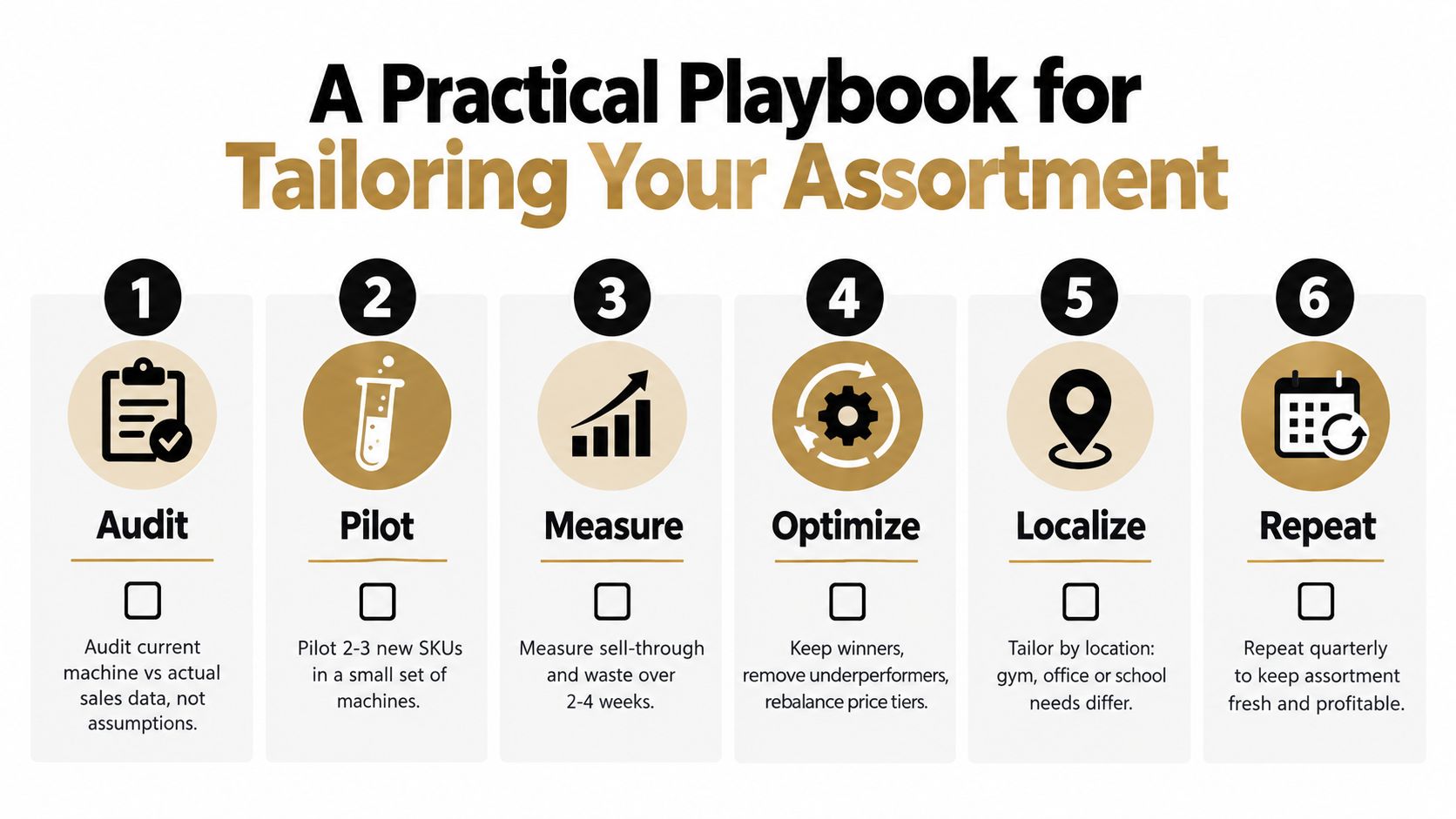
Audit the current mix. Compare the physical lineup with sales and stockout records. Don't assume the most visible products are the most useful.
Run a small pilot. Test a tightened assortment of 25 to 35 SKUs where the machine's capacity allows it, rather than changing every location at once.
Classify movement. Mark each product as fast, steady, or slow, then review telemetry reports weekly during the pilot.
Replace weak slots. Remove the bottom 10% of SKUs and test an alternative from another category or price tier.
Schedule seasonal changes. Adjust cold drinks, warm beverages, meal options, and snack choices around weather, holidays, and shift patterns.
Repeat the review. Revisit the mix quarterly, using actual movement and user feedback instead of habit.
The pilot guidance above is a practical testing framework. It isn't a universal threshold. Machine capacity, location traffic, product shelf life, and replenishment schedules should shape the final number of active items.
Use this checklist before approving a change:
Machine capacity: Confirm slot count, temperature zones, package compatibility, and storage limits.
Audience profile: Identify who buys, including employees, students, visitors, residents, or shift workers.
Time-of-day peaks: Separate morning coffee demand from afternoon snacks, evening purchases, or overnight needs.
Price access: Include choices across the price tiers your users can reasonably support.
Local compliance: Check school, healthcare, workplace, and municipal requirements before loading products.
Service capability: Make sure the operator can replenish winners and rotate seasonal items consistently.
Why Less Is Often More and What to Do Next
More SKUs don't automatically create more sales. A crowded machine can dilute attention, give too much space to slow movers, and make it harder to keep popular products available.
Every weak item also consumes a slot, a replenishment decision, and sometimes working capital. If dated snacks or perishable drinks sit too long, waste reduces the value of the entire program. A focused assortment can offer enough choice while giving proven products the space and service they need.
Start with a one-month assortment review. Ask front-line users what they want, compare their requests with sales and stockout records, and identify products that repeatedly fail to move. If possible, work with an operator that can share telemetry dashboards and explain how changes will be measured.
The right mindset is to treat assortment as a living system. Vendmoore Enterprises provides location-specific vending programs with cashless payment options, connected inventory and performance visibility, product feedback, and replenishment adjusted to each site's demand. Visit Vendmoore Enterprises to discuss a managed vending program or machine option for your Oklahoma workplace, school, healthcare facility, industrial site, residential community, stadium, or airport.
Comments