_edited.png)
Best Cashless Payment System for Smart Vending

Cashless payments made up 78% of all vending sales in 2025, up from 73% the year before, and contactless methods represented 85% of cashless vending sales, according to Cantaloupe's micropayment trends report. For a workplace break room, that isn't a minor convenience trend. It's a clear operating signal: if your machine still treats cash as the primary checkout method, you're building around yesterday's customer behavior.
The best cashless payment system for smart vending is not just the reader with the most recognizable logo. It's an integrated setup that approves small purchases quickly, keeps working through connectivity problems, shares useful telemetry, and gives the operator enough data to stock the right products. That standard matters in corporate offices, schools, hospitals, manufacturing sites, stadiums, airports, and apartment communities where a missed transaction is often an abandoned purchase.
The Rapid Shift to Cashless Vending Environments
Cashless vending has moved from an upgrade option to the baseline expectation for a modern refreshment program. Employees and visitors increasingly arrive with a contactless card or phone, not a pocketful of coins. A machine that accepts only cash forces a customer to solve a payment problem before they can solve a snack or drink need. Most just walk away.
The broader payment market supports that shift. The Bank for International Settlements payment statistics reported that annual cashless payments per capita in emerging market and developing economies increased by 21% to 242 in 2024. Advanced economies reached 468 cashless payments per capita in 2022 and continued growing afterward. The same data shows that credit transfers represented 86% of cashless payment value in advanced economies and 94% in emerging market and developing economies, confirming that account-based digital rails remain central even as tap-to-pay becomes the visible checkout experience.
The historical direction is just as clear. The World Bank's global payment systems review found that annual cashless transactions per person worldwide rose from 91 in 2017 to 135 in 2020, with low- and middle-income economies roughly doubling during that period. In the United States, the Federal Reserve reported that cash's share of consumer payments fell from 31% in 2016 to 16% in 2023. Those figures describe different markets and measures, but they point to the same operational conclusion: cashless acceptance is becoming the normal path to purchase.
Why break rooms feel the change first
Vending depends on speed and impulse. A worker has a short break, a visitor wants a drink before a meeting, or a student needs food between classes. Cash handling adds friction through exact-change problems, bill validators, coin jams, and empty cash boxes. Contactless payment removes many of those interruptions with one tap.
For facility managers, the decision also affects perceived workplace quality. A stocked break room with a reliable tap-to-pay terminal feels current and useful. A machine that displays a payment error after a customer has already selected a product creates the opposite impression.
Operator's rule: Treat cashless payment as core vending infrastructure, not a decorative feature added after the machine is installed.
Operators should still preserve a practical fallback where the audience or location requires it. Cash remains relevant in many economies, and the BIS notes that cash in circulation has largely stabilized even as cashless usage rises. The right setup therefore supports the payment habits of the site instead of assuming every user has the same card, phone, network access, or willingness to use a wallet app.
For businesses reviewing their break room program, these contactless payment benefits for vending provide a useful starting point. The bigger question is what sits behind the reader. A reliable system must connect the payment event to inventory, machine status, settlements, and service decisions.
Core Components of a Modern Cashless Setup
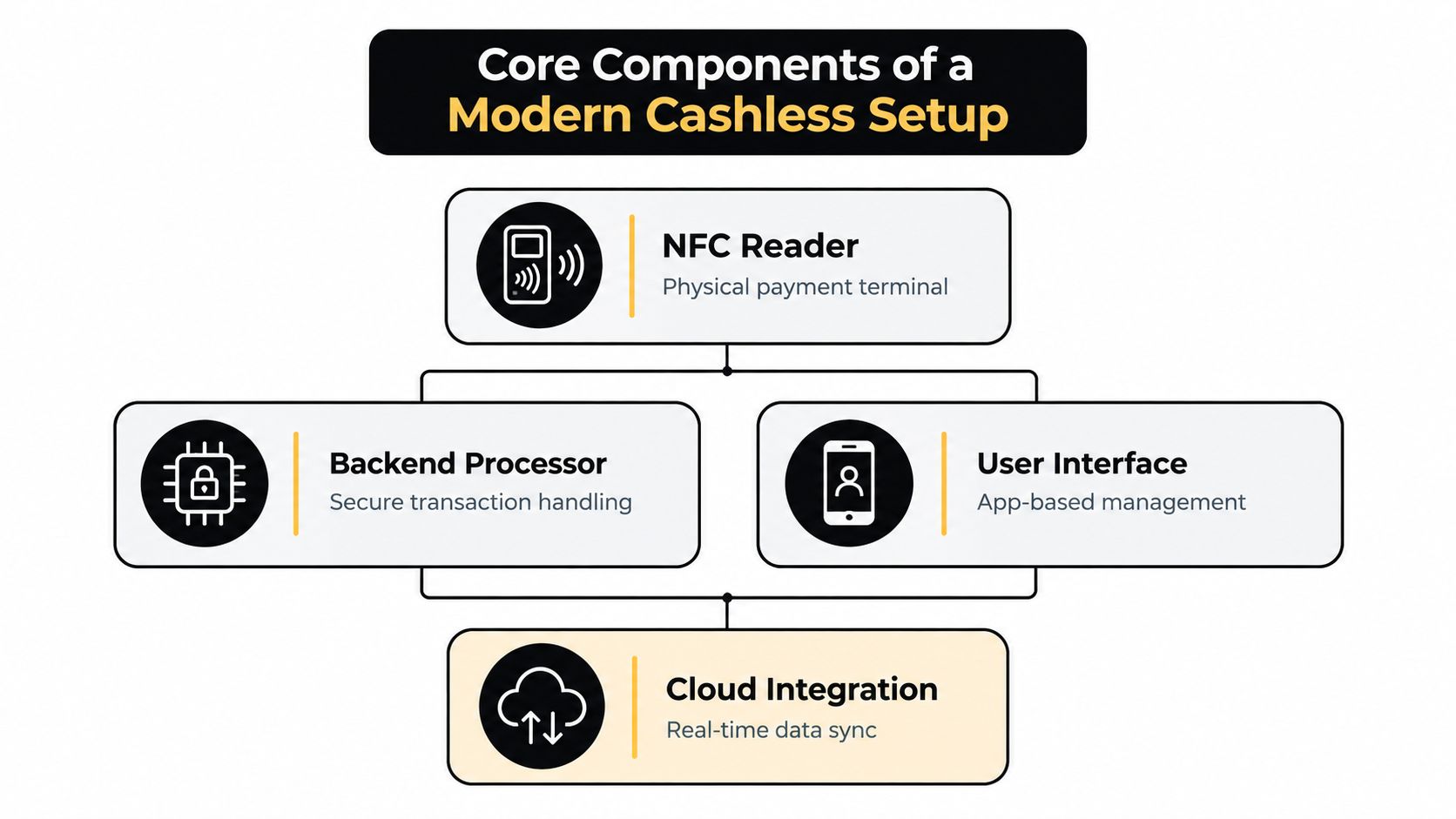
A smart cashless machine has four connected layers. The reader handles the customer's tap, but the operator gets value only when the payment layer communicates correctly with the vending controller, processor, and cloud platform.
Start with the physical reader
The NFC reader is the customer-facing component. It should accept contactless EMV cards and mobile wallets such as Apple Pay and Google Wallet. Look for a clear display, visible payment prompts, a durable enclosure, and a design that works in the actual machine location. A terminal placed behind reflective glass, exposed to weather, or mounted in a busy hallway needs different physical protection than a countertop device in a staffed café.
The reader also needs to communicate with the vending machine through the MDB interface, or Multi-Drop Bus. MDB is the machine's internal communication path for payment equipment. It allows the reader to send an approved transaction to the controller, receive the vend result, and support the machine's pricing and product-selection logic.
A terminal that accepts a tap but doesn't reliably trigger the correct vend isn't a successful payment system. Buyers should ask vendors to demonstrate the complete flow, from selection and authorization through product delivery and refund handling.
Connect payment to telemetry
The telemetry modem connects the machine to the cloud. That link supports transaction visibility, inventory reporting, machine alerts, remote configuration, and route planning. Without it, an operator may accept digital payments while still managing the fleet as if every machine were offline.
A connected setup can expose product movement by machine and location, support remote price changes, flag equipment problems, and give service teams a clearer view of what needs attention before they visit. It also creates a single operational record rather than forcing staff to reconcile a payment processor, a machine controller, and separate inventory notes.
Vendmoore's overview of smart vending machine software illustrates why software integration matters. The payment reader should be part of the operating system, not an isolated accessory attached to the front of a machine.
Verify the backend before signing
Ask who processes transactions, how settlements are reported, how refunds are initiated, and which party supports the full hardware and connectivity stack. Also confirm whether the platform supports remote firmware updates, machine-level reporting, inventory data, and role-based access for facility teams.
The best cashless payment system gives the customer a short tap and gives the operator a complete operational record. That connection is what turns a card reader into smart vending infrastructure.
Comparing Payment Rails for Unattended Retail
A payment rail earns its place in a vending fleet through tap-to-vend speed, authorization reliability, device coverage, offline resilience, and telemetry compatibility. Brand recognition matters less than whether the rail completes high-frequency, low-ticket purchases and reports each event clearly to the operator.
Contactless EMV cards should be the default for mixed audiences. Customers do not need a charged phone, wallet app, or specific operating system. NFC mobile wallets deliver a similarly quick checkout and suit customers who store cards in Apple Pay or Google Wallet. Device authentication can add protection, depending on the phone and wallet settings.
Account-to-account fast payments deserve consideration where local banks and instant-transfer systems are widely used. The World Payments Report 2025 reports that these rails reached 49% of total cashless payments on average in emerging markets. Their advantages are direct account connectivity and quick confirmation. Their weaknesses are practical: bank participation, customer familiarity, dispute handling, QR or terminal support, and integration with the vending controller vary by market.
Choose the mix around the site. A corporate office can support cards and mobile wallets as its primary options. A campus may require credentials or account-based payment. A public venue should start with broadly accepted rails, then add regional methods only when usage justifies the hardware and support burden.
Payment Rail Performance in Vending
Payment Method | Transaction Speed | User Adoption | Offline Fallback |
|---|---|---|---|
Contactless EMV card | Fast tap-to-pay checkout when the reader and network respond correctly | Broad coverage across mixed customer groups | Depends on the processor, reader configuration, and risk controls |
NFC mobile wallet | Fast checkout with Apple Pay or Google Wallet | Strong among smartphone users, but dependent on device access and battery | Usually controlled by the payment platform and wallet rules |
Account-to-account fast payment | Potentially immediate account-based transfer | Varies by country, bank, and customer habit | Requires a documented retry, queue, or alternative payment path |
Contactless methods accounted for 77% of cashless transactions in North America, while cashless transactions produced a 26% higher average ticket value than cash, according to Kiosk Industry's unattended retail payment analysis. That makes contactless acceptance the operating baseline, not merely a customer convenience.
Keep another payment path available where coverage or network conditions demand it. The reader must also pass transaction status, device identity, and failure details into the operator's telemetry system. A fast tap that creates unclear settlement or inventory records still creates route work.
Use this vending machine payment systems comparison to check controller compatibility, settlement reporting, offline behavior, and fleet-management support. In a break room or public-space machine, select the rail combination that completes the largest practical share of small purchases with minimal hesitation and minimal service intervention.
Measuring ROI and Operational Efficiency Gains
Cashless vending improves ROI through larger digital purchases and tighter route control. Facility managers should measure both outcomes. A reader that raises checkout completion but adds little operational visibility has a limited return.
Vending Times reports that consumers spend 37% more per transaction when paying digitally, with an average digital ticket of $2.24 versus $1.78 for cash purchases. Digital checkout removes coin counting and reduces hesitation over whether a customer has enough cash. That can encourage a larger drink, an additional snack, or an impulse purchase.
Another industry analysis found that cashless vending transactions average 26% more than cash transactions, as noted earlier. Do not combine the figures as if they measured the same thing. They support the same operating conclusion: low-ticket customers tend to spend more when payment takes one quick tap.
Build the ROI case around the whole route
Calculate the upgrade against the complete route, not just the cost of the reader:
Revenue per machine: Compare sales before and after installation, while separating payment effects from pricing, assortment, and location changes.
Average basket behavior: Check whether customers add items or select higher-value products after cashless checkout becomes available.
Service efficiency: Use telemetry to identify machines needing replenishment, payment attention, or maintenance before sending a driver.
Stock availability: Match product outages with sales records and refill timing to find lost sales.
Administrative effort: Record time spent on cash collection, reconciliation, refunds, and manual reporting.
The strongest gain is operational visibility. Live sales and inventory data lets route managers prioritize stops instead of visiting every machine on a fixed schedule. It also supports location-specific assortment decisions. A manufacturing site may sell more filling snacks and cold drinks, while a hospital may need different meal and beverage choices.
Telemetry must connect payment events with inventory, pricing, and service records. Otherwise, the operator sees a completed transaction but cannot explain a failed vend, an unexplained stockout, or a machine that needs attention. For workplace and public-space vending, high-frequency small purchases make accurate event data as important as fast authorization.
Track each machine as a small retail location. Review sales, product availability, payment success, service events, and customer feedback together. That scorecard shows whether cashless payment is increasing engagement and reducing route work, rather than merely adding another payment device.
Navigating Connectivity and Resilience Challenges
A cashless machine is not reliable just because it has an NFC symbol. It needs dependable connectivity, sensible failure handling, secure hardware, and a fallback plan for the moments when the network or device doesn't cooperate.
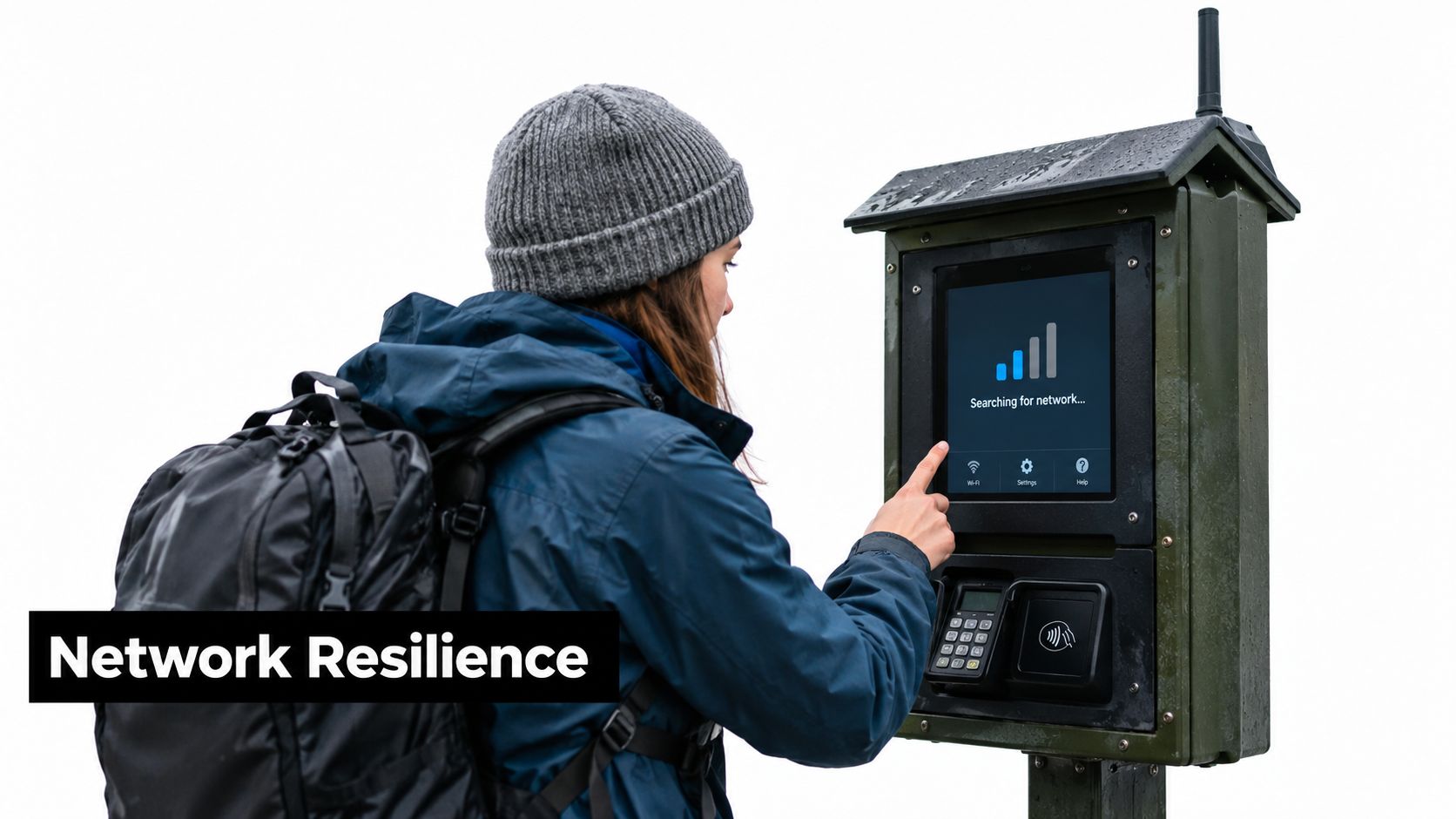
Connectivity gaps are common in the vending estate. Only 44% of vending machines were connected to the internet in 2023, while industry projections expect that rate to reach 71% by 2028, according to Mordor Intelligence's vending market analysis. Basements, hospitals, industrial buildings, parking areas, stadium concourses, and large campuses can all create difficult signal conditions.
Test the location, not the brochure
Before installation, test signal at the proposed machine position and during the busiest operating periods. A strong connection near the building entrance doesn't prove that a machine will work in a concrete basement or behind industrial equipment.
Ask the payment provider whether the reader supports offline authorization, store-and-forward processing, intelligent retries, and clear decline reasons. These features need strict risk controls. Offline processing can help preserve sales during a temporary connection loss, but it must protect the operator from duplicate charges, excessive exposure, and uncertain settlement.
Security deserves the same attention. Payment tokenization, encrypted communication, PCI DSS compliance, tamper resistance, and controlled administrative access should be part of the vendor review. Biometric authentication and fraud monitoring are becoming more prominent across payment ecosystems, but the vending operator still needs a system that works for a quick, low-value transaction without creating an awkward customer experience.
Protect continuity with practical infrastructure
Facility managers should coordinate with their IT team before a machine goes live. Confirm power availability, network permissions, physical mounting, service access, and the escalation path when a terminal stops responding. For organizations comparing connectivity options, this guide to best business internet providers 2025 can help frame the broader network discussion, although the vending vendor must still validate signal at the machine.
The operator should also receive device-health alerts and a clear service commitment. IoT device connectivity for vending is valuable only when the data leads to an action, such as a technician visit, a modem reset, or a route change.
A resilient deployment keeps a backup path available where appropriate. That may mean retaining cash acceptance, offering another approved payment rail, or placing machines where users can still reach support. The goal isn't to pretend outages won't happen. It's to prevent one failed network session from turning a productive break room into a dead sales point.
Vendor Evaluation Checklist for Oklahoma Operators
Oklahoma facility managers should evaluate a vending partner as an operating service, not just as a hardware supplier. A reader can be installed quickly. Reliable replenishment, responsive support, accurate reporting, and product decisions that fit the location determine whether the program stays useful.
This matters across the Oklahoma City metro, Norman, Edmond, and surrounding communities. A corporate office needs dependable break room availability. A healthcare facility needs service that respects staff schedules and public access. A school, campus, plant, apartment community, stadium, or airport needs product selection and support that match very different traffic patterns.
Questions to put in the proposal
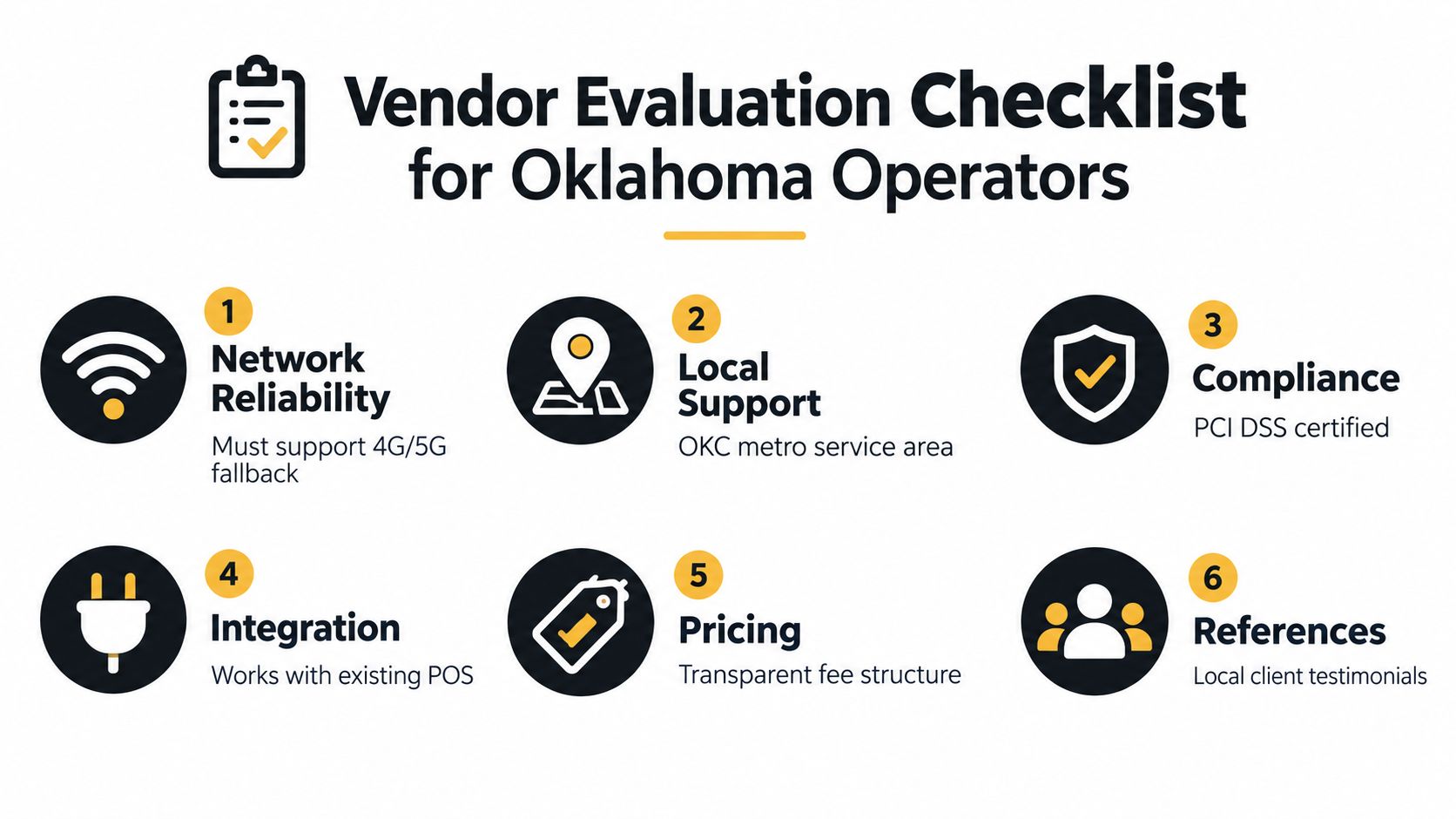
Ownership model: Will the vendor own and operate the machines, or does the client want to purchase equipment? Ask how installation, upgrades, repairs, and replacement decisions change under each model.
Payment coverage: Confirm support for contactless cards, Apple Pay, Google Wallet, and any employee badge, campus ID, or closed-loop program the site already uses.
Telemetry access: Request a clear explanation of machine-level sales, inventory, payment status, alerts, remote pricing, and reporting.
Local service: Define the service territory and escalation process for Oklahoma City, Norman, Edmond, and nearby locations. Ask who responds when a machine is empty, offline, or rejecting valid payments.
Product customization: Confirm how the vendor gathers feedback and changes the assortment. A break room should reflect the people using it, not a generic route plan.
Commercial terms: Review commissions, service charges, payment processing costs, equipment responsibility, contract renewal terms, and refund procedures.
Facility teams comparing payment processors can use a practical comparison of Stripe, Adyen, and PayPal to understand how processor capabilities differ, but vending buyers must go further. The processor is only one part of the system. Machine compatibility, telemetry, connectivity, and local accountability matter just as much.
Look for evidence of follow-through
Ask for references from similar Oklahoma locations and request examples of how the vendor handled a stockout, failed reader, product complaint, or machine relocation. Pay attention to response quality during the sales process. A vendor that answers technical questions clearly is easier to manage after installation.
Vendmoore Enterprises operates smart vending services with cashless payments, connected telemetry, location-specific product assortments, and flexible options for managed programs or clients who want to own machines. For service-level expectations, review the vendor management service level agreement and make sure the final contract states who owns each responsibility.
Ask for the operating dashboard, not just the machine brochure. You're buying availability, service response, product fit, and payment continuity.
Frequently Asked Questions About Vending Payments
What is the best cashless payment system for vending?
For most workplace and public-space machines, choose an integrated setup built around contactless EMV plus NFC mobile wallets, with telemetry tied to the payment and vending controllers. This combination covers broad card usage, supports phone-based checkout, and gives operators useful visibility into sales and machine status.
Account-to-account fast payments can be valuable in markets where customers already use them regularly. They shouldn't replace broad card and wallet acceptance unless the location's users, processor, and hardware all support that decision.
What happens when a payment is declined?
The customer should receive a clear message and the machine should avoid charging for a failed vend. The platform should record the decline reason, support a remote refund workflow when needed, and alert the operator when failures cluster on one machine.
Ask vendors to explain how they handle duplicate authorizations, cancelled selections, product delivery failures, and transactions that time out during a weak connection. A polished customer experience depends on the recovery process, not only on the successful tap.
Can cashless vending work with employee badges or campus IDs?
It can, provided the badge or ID program has a compatible payment or account system and the vending hardware supports the required integration. Treat this as a separate project from ordinary contactless card acceptance. Confirm authentication, account funding, reporting, refunds, privacy, and who supports the connection when an employee or student can't complete a purchase.
How long do NFC readers last?
Reader life depends on installation conditions, usage, weather exposure, tampering, cleaning practices, power quality, and the vendor's hardware program. Ask about warranty coverage, replacement procedures, firmware updates, and whether a failed reader can be swapped without replacing the vending controller.
A high-use location should also have a documented spare-part and service plan. A reader that works well in a lightly used office may need stronger protection and faster support in a hospital, stadium, airport, or public transit environment.
Should a machine still accept cash?
Usually, yes, if the audience includes users who lack a suitable card or phone, prefer cash, or need an alternative during a network problem. Cashless should be the primary operating capability in a modern break room, but resilience and inclusion argue against assuming one payment method fits everyone.
Vendmoore Enterprises provides smart vending for Oklahoma workplaces and public spaces, with cashless acceptance, connected telemetry, customized product assortments, and managed or client-owned machine options. Visit Vendmoore Enterprises to discuss a break room vending program for your office, school, healthcare site, manufacturing facility, apartment community, stadium, or airport.
Comments