_edited.png)
7 Best Practices for Customer Satisfaction

A person steps into the break room between meetings and finds the snack they wanted in stock. They tap a phone at the terminal, collect the product, and get back to work without handling cash or searching for change. Later, when a payment fails or a product gets stuck, they can report the problem and receive a prompt response instead of wondering whether anyone manages the machine.
That experience comes from more than a vending cabinet. Customer satisfaction depends on availability, payment access, product relevance, service recovery, engagement, flexibility, and trust. Those same operating details also shape whether a facility manager recommends a provider or whether a prospect searching Google for break room vending and vending services finds a business worth contacting.
The following best practices for customer satisfaction translate those principles into an operating playbook for offices, schools, healthcare sites, manufacturing facilities, airports, stadiums, and multi-tenant properties. They also show how a vending operator can turn reliable service into stronger local visibility and more qualified website traffic.
1. Real-Time Inventory Management and Proactive Restocking
Empty spirals and unavailable cold drinks damage confidence quickly. Connected telemetry gives operators a clearer view of inventory, sales patterns, machine health, and product movement, allowing the route team to restock before a popular item disappears.
A practical program starts with product-level thresholds. Bottled water, energy drinks, fresh food, and everyday snacks shouldn't all use the same reorder point. Review historical sales by location, account for shift changes and seasonal demand, and schedule replenishment during quieter periods so the service visit doesn't disrupt a busy lobby or production floor.
Operators should also check whether the data is accurate. Product names, prices, planograms, and delivery quantities need regular review. A machine can transmit information in real time, but poor product setup still produces poor decisions.
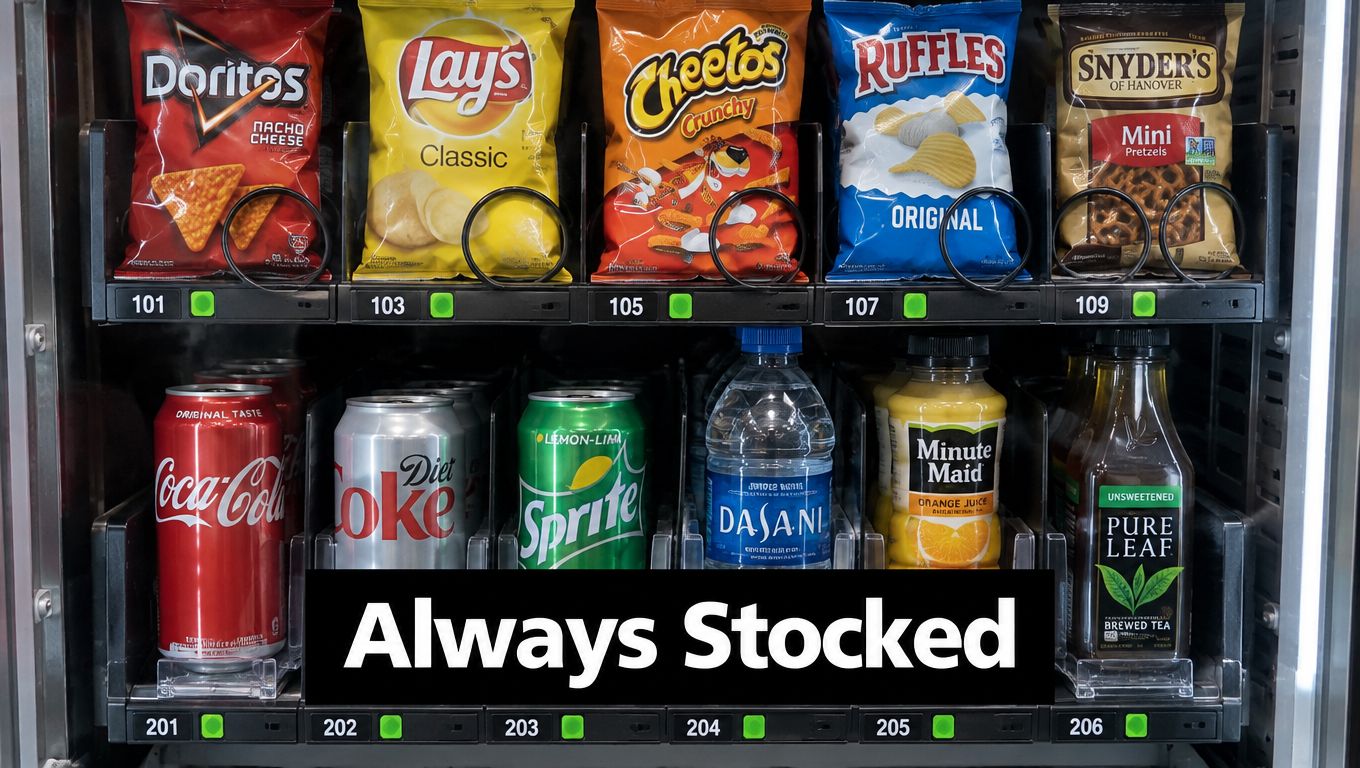
Practical rule: Track stockouts, replenishment visits, product-level sales, expired products, and machine downtime together. Availability is a service outcome, not only a warehouse task.
A workplace with a large morning rush may need earlier beverage replenishment, while a school may need assortment changes around lunch and after-school activity. An Oklahoma operator using connected equipment can apply the same principle across Oklahoma City, Norman, and Edmond, while keeping each site's inventory profile distinct. Telemetry data collection can help teams understand what the machine is reporting and how that information supports route decisions.
For smaller operations, a QR-based count and restock process can supplement telemetry when a full connected system isn't practical. Scanely's QR inventory tips offer another way to make product checks more consistent.
The performance question is simple: are customers finding the products they came to buy? Use stockout frequency, fill accuracy, repeat purchases, and complaint volume to answer it, then adjust thresholds instead of relying on a fixed route calendar.
The video below shows how vending technology can support a more connected operating model.
2. Seamless Cashless Payment Integration and Multiple Payment Options
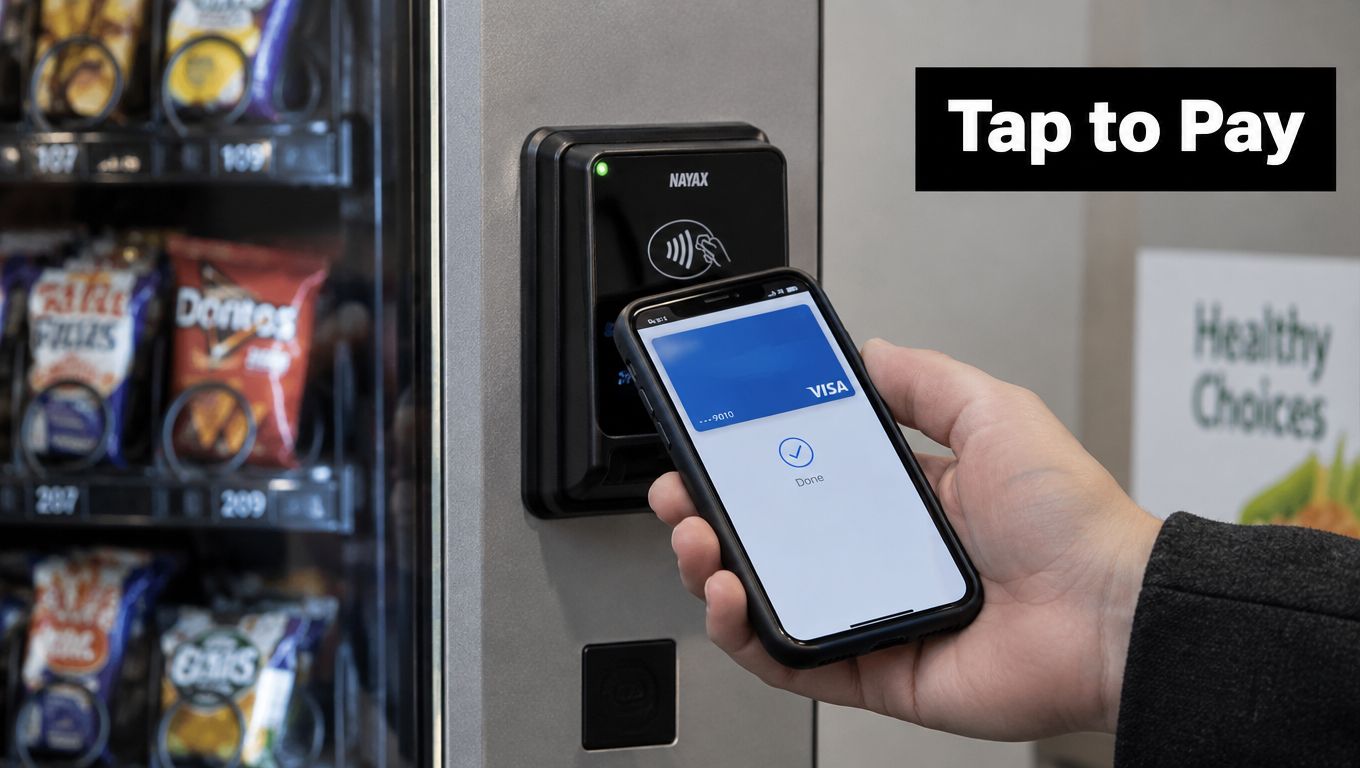
A customer shouldn't abandon a purchase because the machine accepts only coins or because a card reader is unreliable. Payment convenience is part of the product experience. Mobile wallets such as Apple Pay and Google Wallet, contactless cards, standard card readers, and QR payments give customers practical choices across offices, universities, healthcare facilities, and public venues.
Reliability matters more than having a long list of logos on the machine. Test every payment method before deployment, confirm that the product vends after authorization, and monitor failed transactions by machine and payment type. A network outage plan should include a clear status message, a support route, and a backup process where the equipment allows it.
Signage should be visible before the customer reaches the payment screen. If a terminal supports tap-to-pay, display that option. If QR payment requires a particular app, explain the steps in plain language. Confusing instructions create friction even when the technology works.
Healthcare sites may prioritize contactless transactions because they reduce shared-touch interactions. A university may need mobile payments because students often carry a phone instead of cash. A corporate campus might benefit from a broader cashless setup across several buildings, but only if the operator can support consistent connectivity and troubleshooting.
Operators should track:
Authorization failures: Separate declined payments from network errors and machine faults.
Refund requests: Review whether customers are being charged without receiving a product.
Time to resolution: Measure how quickly staff handle payment complaints.
Terminal uptime: Compare payment availability across locations and devices.
Payment security also requires disciplined system maintenance and staff training. Mobile payment security guidance can help operators explain safeguards and build a response process for transaction concerns.
A convenient payment experience can still feel poor if a customer has to repeat a failed transaction or wait without updates. Make payment support easy to find, document each incident, and use recurring failures to identify equipment or connectivity problems rather than treating every complaint as an isolated event.
3. Personalized Product Assortment Based on Customer Feedback and Location Analysis
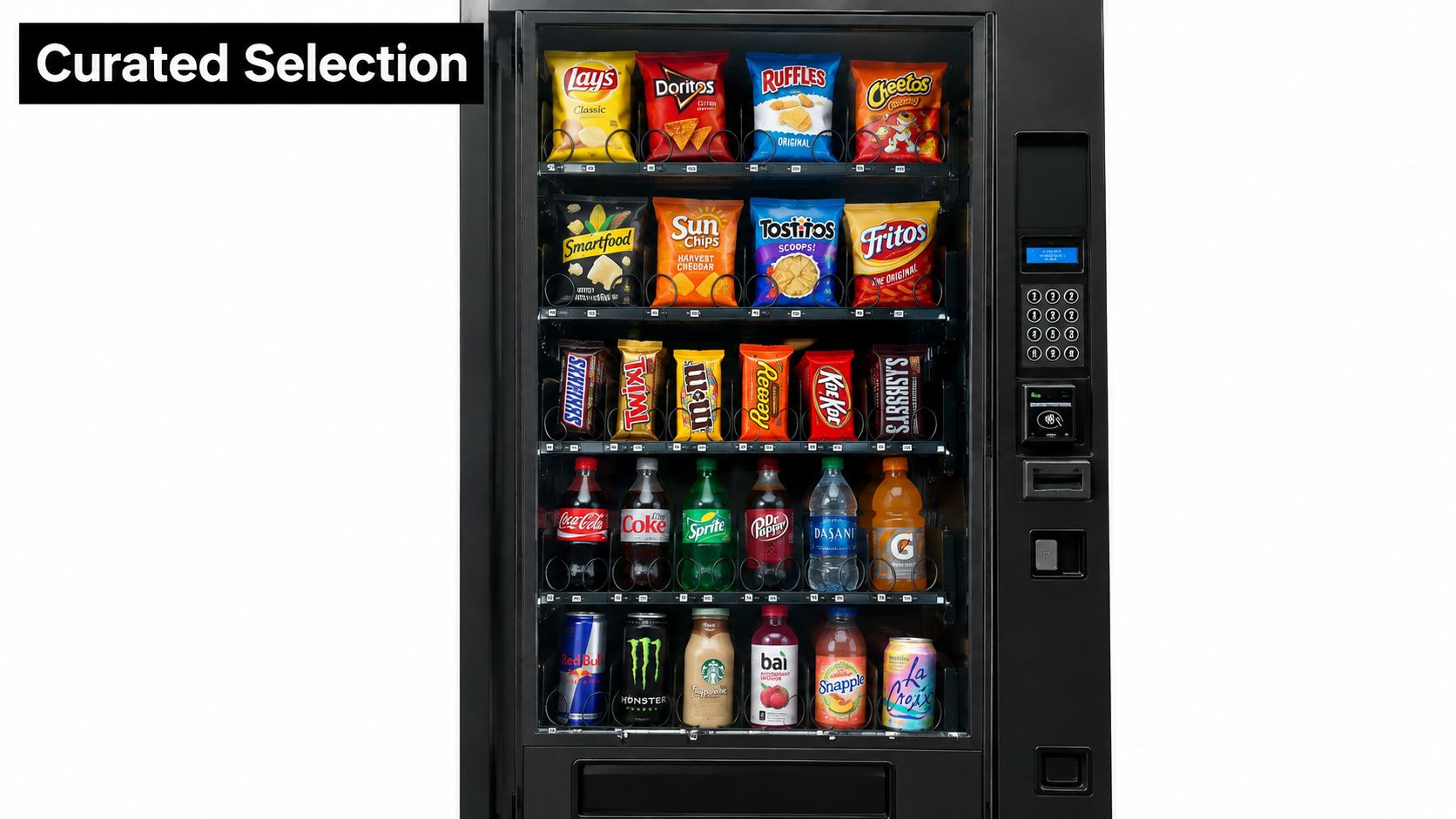
A product mix that works on an executive floor can miss the needs of a factory, school, hospital, or apartment community. Operators should match each machine to local preferences, schedules, dietary expectations, and the reason customers use that site.
Begin with purchase data, then verify the pattern with direct feedback. A QR-linked survey can ask which items customers want added, removed, or kept in stock. Record requests by machine or location rather than folding them into a regional average. A beverage that sells in Norman may perform differently in Edmond, while a night-shift production facility needs a different mix from a daytime office.
Use controlled trials for uncertain products. Add a limited selection to one machine, monitor sales and waste, and ask customers for reactions. Replace weak performers without treating the result as a failure. Testing reduces guesswork, but operators must account for shelf life, delivery space, price, and replenishment requirements.
Customers notice when a suggestion appears on the shelf. Tell the location which feedback led to an assortment change, even when the requested item cannot be added.
Build a location profile covering:
Audience: Employees, students, patients, visitors, tenants, or travelers.
Operating pattern: Day shifts, night shifts, class changes, clinic appointments, or 24-hour access.
Dietary expectations: Healthy, sugar-free, allergen-conscious, culturally diverse, or premium options.
Purchase context: Quick meal replacement, afternoon snack, coffee break, or emergency refreshment.
A corporate executive floor may support premium coffee and higher-end snacks, while a general break room may need familiar products at accessible price points. A medical facility may request more wellness-oriented choices. A university may respond better to a broader range of culturally familiar snacks. Each decision carries a trade-off: a wider assortment can improve choice while increasing inventory complexity and waste.
The product assortment optimization framework connects preference data with inventory decisions. Track more than the number of products offered. Useful KPIs include sell-through, waste, substitution requests, repeat purchases, recurring feedback themes, and the share of assortment changes prompted by customer input.
Clear service-area pages for offices, schools, hospitals, and industrial sites can also support search visibility. Prospects seeking managed break room vending want evidence that the provider understands their environment, including its schedules, dietary needs, and purchasing occasions.
4. Rapid Response and Proactive Service Model with Consistent Follow-Up
A jammed snack or failed payment becomes a service test as soon as a customer reports it. If nobody responds, the fault reflects on the entire vending program. Operators should treat recovery speed and follow-through as part of daily site management across offices, schools, healthcare facilities, manufacturing plants, and multi-tenant properties.
Create one service path for product jams, payment failures, spoiled items, temperature concerns, refunds, and machine outages. A ticketing system should capture the site, machine, issue type, first response, resolution, field visit, refund status, and customer follow-up. Managers can then identify recurring faults, compare locations, and assign corrective work instead of sorting through informal messages.
Set service response expectations by channel and site, using the customer service response time standards as a reference point. A manufacturing facility may need a defined escalation route for shift changes, while a healthcare location may require faster attention because staff and visitors depend on on-site refreshments. Publish the standard, train the service team, and measure actual performance against it.
First-contact resolution deserves separate tracking. Research on inbound contact centers has found that resolving an issue without another contact or callback supports higher caller satisfaction. For vending, that means giving the first responder enough information and authority to arrange a refund, dispatch a technician, or explain the next step without making the customer repeat the complaint.
Service standard: A response is not the same as a resolution. State what happens next, assign ownership, and confirm closure with the customer or facility contact.
PwC's 2025 Customer Experience Survey found that 52% of consumers stopped using or buying from a brand because of a bad product or service experience, and 29% stopped specifically because of poor customer experience, online or in person. For vending operators, rapid recovery supports retention. Follow up after service completion, connect repeated complaints to preventive maintenance, and document the root cause before the same machine fault affects an entire workplace.
Track first response time, resolution time, repeat-contact rate, refund completion, preventive-maintenance compliance, and post-service CSAT. Review the results with facility managers and include response practices in local service pages that target vending searches.
5. Engaging Promotional Programs and Gamification to Boost Engagement
A vending machine can meet an immediate need, while a well-designed promotion can bring customers back. Monthly prize drawings, limited-time products, wellness themes, and surprise rewards make a break room feel active and maintained rather than purely transactional.
Match the offer to the site and keep participation simple. Automatic entry with a purchase is easier to explain than a separate registration process. The machine's display should show the offer, closing date, eligibility rules, and prize details. A school might promote finals-week coffee, a healthcare facility may prefer a wellness theme, and a manufacturing site may respond better to practical prizes than merchandise.
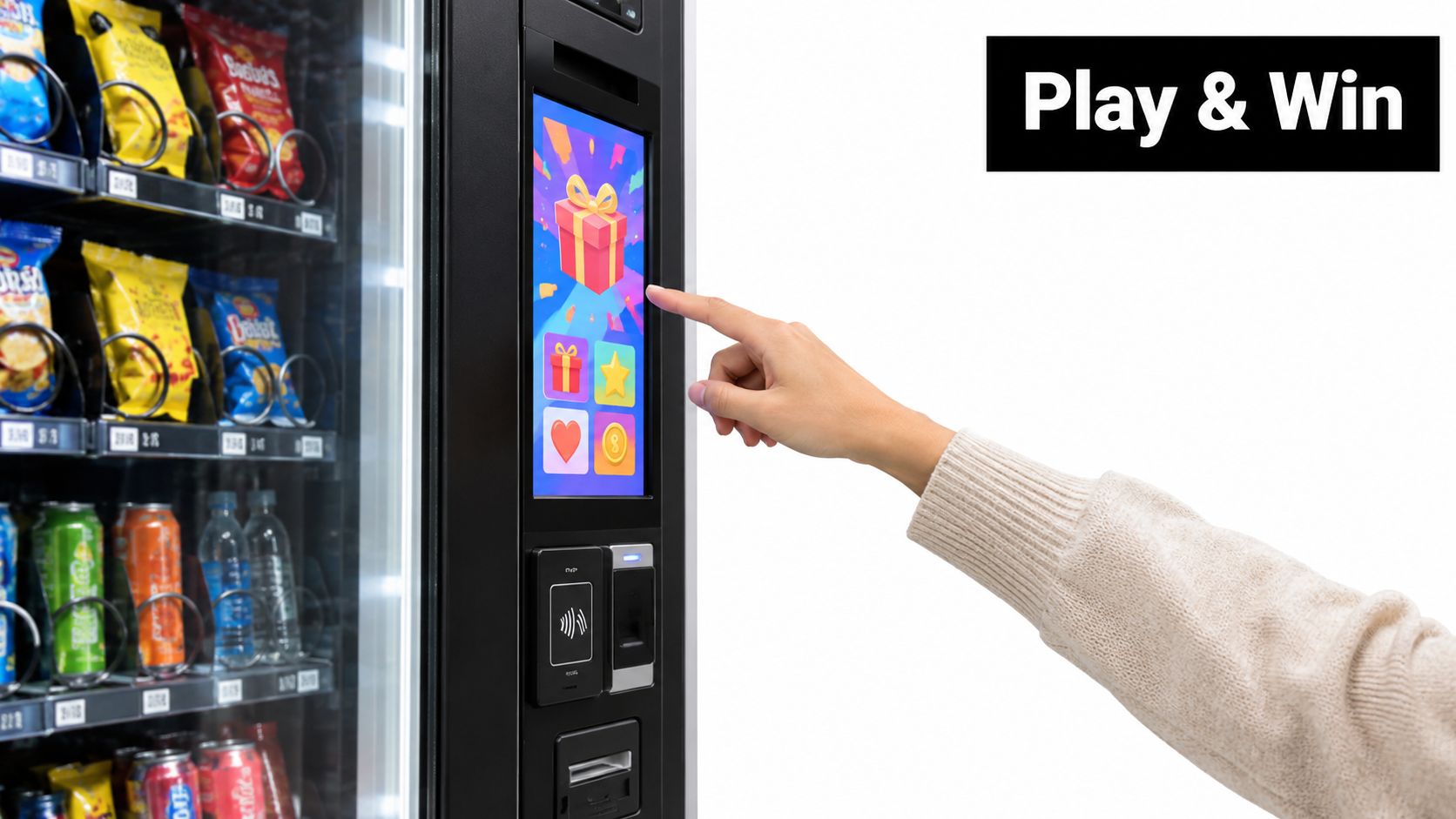
Use each campaign to test demand. Compare participation, product movement, repeat visits, and customer comments before and during the promotion. Revenue alone can give the wrong signal. If interest rises but popular items sell out, adjust par levels and route timing before running the campaign again.
Set clear terms, use lawful contest mechanics, and fulfill prizes accurately. If the promotion collects email addresses, obtain appropriate consent and explain how the information will be used. A drawing can support future communication, but unclear data practices can damage trust with employees, students, patients, or visitors.
Rotate themes around seasonal events, sustainability, health, community, or workplace milestones. Facility communications and approved social channels can extend reach, while the machine remains the main point of contact. On-site signage should match the digital offer so customers do not encounter conflicting instructions.
Operational simplicity determines whether a program lasts. Special pricing, manual prize records, and frequent screen changes can burden route staff. Choose mechanics that field teams can execute consistently, then track participation rate, redemption or fulfillment accuracy, incremental product demand, and customer comments.
Promotions also create useful content for local marketing. Photos of a clean break room and a clearly explained offer show prospective office, school, healthcare, manufacturing, and property-management clients how the operator supports engagement in a real facility.
6. Flexible Vending Solutions and Customizable Service Models
Service design should match the site's staffing, traffic, space, and accountability requirements. A corporate office may want a fully managed program with no internal stocking work. A property manager may own the equipment but outsource replenishment and repairs. A manufacturing plant may handle basic tasks internally while relying on an operator for assortment planning, route support, payments, and technical service.
State these choices in plain language. A proposal or service page should identify who owns the equipment, sources products, fills machines, maintains hardware, processes payments, prepares reports, supports promotions, and handles escalations. Clear ownership prevents missed tasks and helps facility managers compare offers before a sales conversation.
Equipment selection also affects satisfaction. Compact refreshment centers can fit smaller offices or school staff areas. Bottle-and-can vendors suit high-volume locations, while dual-zone chill centers accommodate products with different temperature requirements. Frozen-food machines can add meal options at manufacturing sites, hospitals, or other facilities where employees and visitors remain on site for extended periods.
Use a short comparison:
Fully managed: The operator coordinates equipment, products, replenishment, maintenance, payment support, and reporting.
Client-owned with operator support: The client owns the equipment, while the operator performs the services listed in the agreement.
Custom service levels: The contract sets visit frequency, response targets, product scope, reporting, and task ownership.
Flexibility creates value only when the operating plan remains measurable. Excessive exceptions can increase route complexity, slow issue resolution, and make results harder to compare between locations. Define service-level terms, document equipment and inventory ownership, and specify how changes will be approved. Track uptime, stockout frequency, response time, refill completion, refund handling, and customer complaints by site.
A multi-tenant property may prioritize lobby appearance, access hours, tenant expectations, and whether the machine should serve as a visible amenity. Healthcare sites may place greater weight on inventory controls, cleaning routines, and equipment suitability. Airports and stadiums require planning around traffic flows, event schedules, and peak demand.
Create separate operating and marketing guidance for offices, schools, hospitals, manufacturing sites, residential properties, stadiums, and airports. Pages targeting office vending services, school vending machines, and break room vending in Oklahoma should show how the setting changes stocking, service coverage, payment support, and reporting, not merely describe different equipment.
7. Data-Driven Insights and Transparent Reporting for Partnership Success
A facility manager reviewing a vending program needs answers beyond whether a machine is installed. The useful questions are practical: Are customers using it? Which products move? Are complaints resolved? What should the operator change next?
Build each report around transactions, revenue, product movement, stockouts, service tickets, response performance, refunds, promotions, and assortment changes where relevant. Pair the figures with a decision. A beverage category may be gaining traction, a manufacturing site may need more night-shift replenishment, or a product may require a limited test before taking more shelf space.
A concise dashboard or monthly performance report should make the next action clear. Use consistent comparison periods, labeled charts, and brief notes on unusual changes. Operators evaluating reporting tools can review a Raven Tools alternative to see how lean, decision-focused dashboards can keep stakeholder reviews practical.
Reporting principle: Every metric should answer a management question. If a number does not support a decision, keep it out of the main summary.
Schedule reviews with the account contact and the people who can approve changes. Facilities may focus on uptime and complaints, procurement on service terms and value, and property management on tenant usage. Record the agreed action, owner, and due date so different stakeholders do not receive conflicting updates.
Net Promoter Score provides a standardized loyalty measure. It uses a 0-to-10 recommendation scale and subtracts the percentage of detractors from the percentage of promoters. Use it with CSAT, response time, first-contact resolution, repeat contacts, stockouts, and product feedback. A single loyalty score cannot explain whether dissatisfaction came from payment failures, empty shelves, or slow service.
A strong CSAT result is often treated as 75% to 85% across sectors, while the American Customer Satisfaction Index was reported at 76.9 in 2025, according to The CSAT benchmark context. Use those figures as context, then prioritize high-volume friction such as payment failures, replenishment gaps, and service handoffs.
AI-assisted reporting also needs outcome checks. Twilio's 2025 research found a 31-point gap between business leaders' view of conversational AI satisfaction and consumers' actual satisfaction. 90% of leaders believed customers were satisfied, compared with 59% of consumers reporting satisfaction, as shown in Twilio's research. Track customer outcomes and human escalation, not automation efficiency alone.
For local growth, reporting should inform content and profile updates. Google identifies relevance, distance, and prominence as primary local ranking factors, with reviews and links contributing to prominence, according to Google's local ranking guidance. Keep the website and business profile aligned with actual service areas, customer types, and vending offerings.
7-Point Comparison: Customer Satisfaction Best Practices
Practice | Implementation Complexity 🔄 | Resource Requirements ⚡ | Expected Outcomes ⭐📊 | Ideal Use Cases | Key Advantages 💡 |
|---|---|---|---|---|---|
Real-Time Inventory Management and Proactive Restocking | High 🔄🔄🔄 (IoT + analytics) | Significant ⚡⚡⚡ (sensors, connectivity, platform, training) | Fewer stockouts; higher uptime; increased revenue ⭐⭐⭐⭐📊 | Multi-site operators, campuses, high-traffic locations | Predictive restocking; efficient routing; data-driven assortment |
Seamless Cashless Payment Integration and Multiple Payment Options | Medium 🔄🔄 (hardware + compliance) | Moderate ⚡⚡ (NFC/EMV terminals, gateway fees, network) | Faster transactions; higher conversion; less cash handling ⭐⭐⭐⭐📊 | Corporate offices, healthcare, education, public venues | Convenience; reduced theft risk; payment analytics |
Personalized Product Assortment Based on Feedback & Location Analysis | Medium 🔄🔄 (feedback systems + analytics) | Moderate ⚡⚡ (surveys, SKU management, frequent restocking) | Better relevance; higher satisfaction; reduced waste ⭐⭐⭐⭐📊 | Offices, universities, healthcare, niche locations | Higher per-transaction spend; stronger customer loyalty |
Rapid Response and Proactive Service Model with Consistent Follow-Up | Medium-High 🔄🔄🔄 (24/7 ops, ticketing) | High ⚡⚡⚡ (service teams, dispatch, spare parts) | Minimized downtime; improved trust and retention ⭐⭐⭐⭐📊 | Healthcare, manufacturing, mission-critical sites | Fast resolution; preventive maintenance; reputation boost |
Engaging Promotional Programs and Gamification to Boost Engagement | Medium 🔄🔄 (digital content + rewards tracking) | Moderate ⚡⚡ (digital displays, prize costs, CMS) | Increased visit frequency; higher AOV; social engagement ⭐⭐⭐⭐📊 | Workplaces, campuses, retail partnerships | Drives repeat purchases; marketing buzz; loyalty building |
Flexible Vending Solutions and Customizable Service Models | Medium 🔄🔄 (multiple contract types) | Moderate-High ⚡⚡⚡ (training, diverse inventory, admin) | Broader market fit; higher adoption across client types ⭐⭐⭐⭐📊 | Property managers, mixed-size clients, enterprises | Scalability; tailored terms; reduced adoption barriers |
Data-Driven Insights and Transparent Reporting for Partnership Success | Medium 🔄🔄 (dashboards + reporting) | Moderate ⚡⚡ (analytics tools, data security, staff time) | Clear ROI; informed decisions; stronger partnerships ⭐⭐⭐⭐📊 | Facility managers, procurement teams, multi-site operators | Transparency; optimization opportunities; budget justification |
Make Satisfaction a Measurable Vending Advantage
Customer satisfaction improves when the operating sequence is clear. Start by establishing a baseline for availability, payment success, service response, repeat contacts, CSAT, and customer feedback. Without that baseline, teams can make changes but can't tell whether the customer experience improved.
Improve the fundamentals first. Keep high-demand products available, make payment access dependable, and create a visible route for reporting problems. Then use feedback and location data to refine assortments instead of forcing every site into the same planogram. A school, hospital, office, factory, apartment community, airport, and stadium each has a different customer rhythm.
Formalize service recovery next. Set response expectations by channel, assign ownership, aim to resolve issues on the first visit or contact where possible, and follow up after completion. PwC's 2025 research links poor experiences with customers stopping their relationship with a brand, while Zendesk benchmark data says 73% of consumers switch to a competitor after multiple bad experiences and more than 50% switch after one bad experience. Zendesk's customer service statistics make repeated vending failures a retention risk, not a minor inconvenience.
Once reliability is stable, add engagement programs that fit the site. Promotions should be easy to participate in, lawful, properly fulfilled, and supported by enough inventory. Match the commercial model and equipment to each location, then explain responsibilities in the agreement. Finally, review performance with customers regularly and turn the findings into specific changes.
Facility managers should assess potential vending partners on reliability, responsiveness, customization, payment access, reporting, and service ownership, not only on whether a machine can be placed in a corner. A useful SaaS customer satisfaction framework reinforces the broader principle that feedback becomes valuable only when teams connect it to action.
For Oklahoma organizations, Vendmoore Enterprises offers modern vending services for workplaces and public spaces across the Oklahoma City metro, Norman, Edmond, and surrounding cities. Its model includes cashless payment options, connected telemetry, location-specific assortments, proactive service, flexible ownership arrangements, and data-informed replenishment. Prospects searching for managed break room vending services can evaluate those capabilities against the practical needs of their own site.
Vendmoore Enterprises offers managed and client-owned vending options, cashless payment support, customized product assortments, connected inventory insights, and proactive service for Oklahoma workplaces and public spaces. Visit Vendmoore Enterprises to explore a vending program built around reliable availability, responsive support, and transparent performance reviews.
Comments