_edited.png)
Hospital Vending Machine Strategy That Actually Works

At 2 a.m., a hospital corridor tells you more about vending than a sales presentation ever will. A nurse leaving a long shift needs something substantial, a visitor wants water without crossing the campus, and a facilities manager is wondering whether the machine is clean, accessible, connected, and defensible in a procurement meeting. A hospital vending machine has to serve all of them without pretending that a bag of snacks can replace clinical nutrition or a staffed food outlet.
That's why hospital vending works best as a managed food-environment program. The machine, product mix, placement, hygiene controls, cashless payments, telemetry, and service response all affect whether people use it and whether the hospital trusts the operator. A useful primer on the broader role of vending is what a vending machine means for modern facilities, but healthcare requires a more exacting operating model.
What a Hospital Vending Machine Really Has to Do
The procurement lead walks past an empty waiting area and finds a vending machine glowing beside the elevators. It accepts cards, but the healthiest option is sold out. The snack display is full, yet most choices are unsuitable for someone avoiding high sugar or certain allergens. A visitor has no idea whether the products are general refreshments or appropriate for a patient with a medical diet.
That scene captures the assignment. A hospital vending machine must provide dependable access during overnight shifts, visitor hours, weekend coverage, and breaks that don't align with cafeteria schedules. It serves staff, visitors, patients where appropriate, contractors, and support teams, each with a different purchase mission. It also operates inside a facility where food policy, infection control, accessibility, and clinical boundaries matter.
A healthcare-food-environment study audited 28 hospitals and 36 long-term-care facilities, with interviews from staff representing 11 hospitals and 26 long-term-care facilities. Vending appeared more often in hospitals, and 67.9% of hospitals had the dominant configuration of combined soft drinks and snacks. At the same time, 42.9% of hospitals reported vending machines selling only healthy items, while 89.3% had kiosks or small gift shops selling food. Those findings show that vending sits inside a competitive on-site food environment, rather than operating as the hospital's only convenience option. The healthcare-food-environment study provides useful context for evaluating the whole site.
Practical rule: Judge the program by access, safe assortment, uptime, purchase data, stock availability, and audit records. A machine that looks attractive but fails one of those tests is only equipment, not a food service solution.
The operator also needs a clear boundary around clinical nutrition. General vending can support staff and visitors, but it shouldn't imply that a low-sugar, high-protein, allergen-free, or “healthy” product is suitable for every patient. People with diabetes, kidney disease, dysphagia, food allergies, and other dietary needs may require clinician-directed meals or dietitian-approved options. That distinction should appear in the product policy, signage, and service agreement.
Choosing Machine Types and Locations Inside the Facility
Hardware decisions become easier when the floor plan is treated as a set of purchase missions. A bottle-and-can vendor suits high-volume hydration near an emergency entrance or transport corridor. A snack machine fits a waiting room where visitors want a quick bite. A dual-zone chill center makes more sense near a cafeteria or staff break room when the program needs both chilled drinks and fresh food.
Frozen food units can serve staff-only areas with longer dwell times, but they require tighter temperature monitoring and a dependable refill routine. Compact refreshment centers can work in narrow hospital alcoves, reception counters, small offices, and controlled-access spaces where a full-size machine would obstruct movement. The right choice depends on traffic, available power, floor loading, service access, and the type of food the hospital has approved.
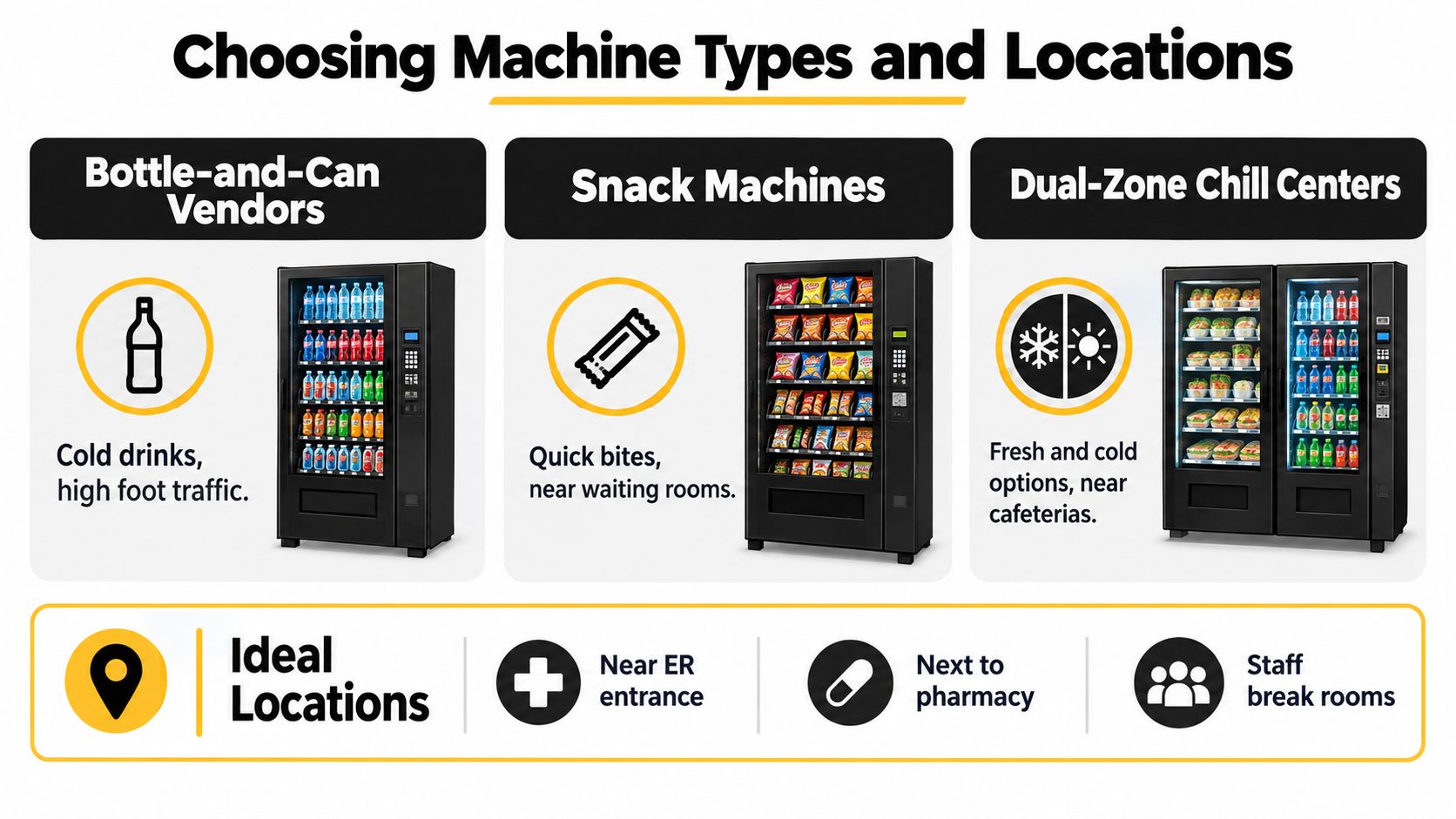
Use this quick placement rule before requesting equipment:
Site condition | Practical starting point |
|---|---|
Emergency or outpatient entrance | Bottle-and-can vendor for visible hydration and fast transactions |
Waiting room near pharmacy or registration | Snack machine with clear allergen and nutrition information |
Staff break room | Dual-zone chill center or frozen food unit, subject to facilities approval |
Narrow alcove or controlled-access area | Compact refreshment center |
Near clinical treatment areas | Keep noise, spills, waste, and customer congestion away from patient-care circulation |
Accessibility needs to be checked on the actual site, not assumed from a brochure. Confirm that users can approach the machine, reach controls and payment hardware from an appropriate position, and turn or pass without blocking a corridor. Facilities teams should review floor loading, electrical capacity, door clearance, cleaning access, and the path used for replenishment.
Placement also affects wayfinding. A machine hidden behind a lift lobby may technically be available but practically invisible. Hospitals planning navigation can draw on Waymap's approach to hospital wayfinding, especially when deciding whether signage, landmarks, and machine locations support visitors who are already stressed or unfamiliar with the building.
Touch surfaces deserve a specific decision. A sealed keypad or protected payment interface may simplify cleaning compared with exposed controls, but every surface still needs a documented cleaning method. Don't place a machine where spills run toward clinical areas, where delivery carts obstruct care routes, or where refrigeration noise disrupts a quiet waiting zone. A practical venue setup process should include a walk-through with facilities, infection control, security, and the department that owns the space.
Building a Product Mix That Balances Nutrition and Demand
A hospital machine gets judged in two ways at once. Staff and visitors decide in seconds whether the products are worth buying. Procurement, nutrition, and site leadership judge whether the machine supports the hospital food environment, holds up under audit, and avoids becoming a box full of high-sugar defaults in a clinical setting. The product mix has to satisfy both.
The mistake I see most often is a sudden reset. Operators strip out familiar sellers, load the spirals with worthy products that look right on paper, and then act surprised when velocity drops and expiry climbs. A better approach is a phased assortment test. Keep the proven anchors, add healthier options with clear nutrition rules, and review performance slot by slot rather than arguing from gut feel.
That approach has support in practice. A 2019 Auckland study looked at healthier-vending guidelines across 14 snack vending machines at two hospital sites. The rules set thresholds for energy, saturated fat, sugar, and sodium, then rolled in over two months. After implementation, energy declined 24% per 100 grams, total fat 32%, saturated fat 41%, and total sugars 30%. Sales volumes were unchanged, and staff satisfaction increased. The Auckland healthier-vending study shows why gradual change usually works better than a hard switch.
Other studies show the trade-off more bluntly.
Study setting | Health change | Sales or revenue change | Takeaway |
|---|---|---|---|
Hospital intervention with healthier availability and placement | Healthy purchases rose from 22% to 39% | Total unit sales fell 18.81% during a one-month pilot, with 604 items sold | Placement can shift choice, but volume and revenue still need their own review. Hospital intervention study |
Controlled healthy-vending experiment | Calories purchased fell 61%, from approximately 2.354 million to 923,000 | Sales reached about 73% of the unhealthy-condition level, and reported profit averaged about 70% | Lower calorie purchasing can come with weaker commercial performance. Controlled experiment |
Public health site stocking standard | Healthier drinks and foods are required to dominate the mix | Red drinks are restricted by serving size and healthier choices must be labeled | Clear machine rules make nutrition policy auditable at shelf level. The New South Wales stocking rules |
Build the mix like an operator, not a slogan writer. Use water and lower-sugar drinks in the strongest facings. Keep a controlled number of familiar sellers if they are what hold the machine up financially. Watch units sold, revenue, calories, sugar, sodium, fat, margin, stockouts, and expiry risk by SKU. If telemetry shows a healthy line never turns, replace it fast. If a better-for-you item sells only in day shift traffic, stock it where that pattern exists.
Product ideas are easy. Fit is harder. A list such as 10 powerhouse nutrient dense choices can help a team discuss candidates, but every SKU still has to pass allergen, labeling, storage, pack-size, and demand checks. Put the reason for each add, keep, move, or delete into a documented hospital vending assortment planning process, then review the pilot weekly. That is how nutrition boundaries, replenishment reality, and sales discipline start working as one program instead of three separate checklists.
Meeting Compliance, Hygiene, and Safety Standards
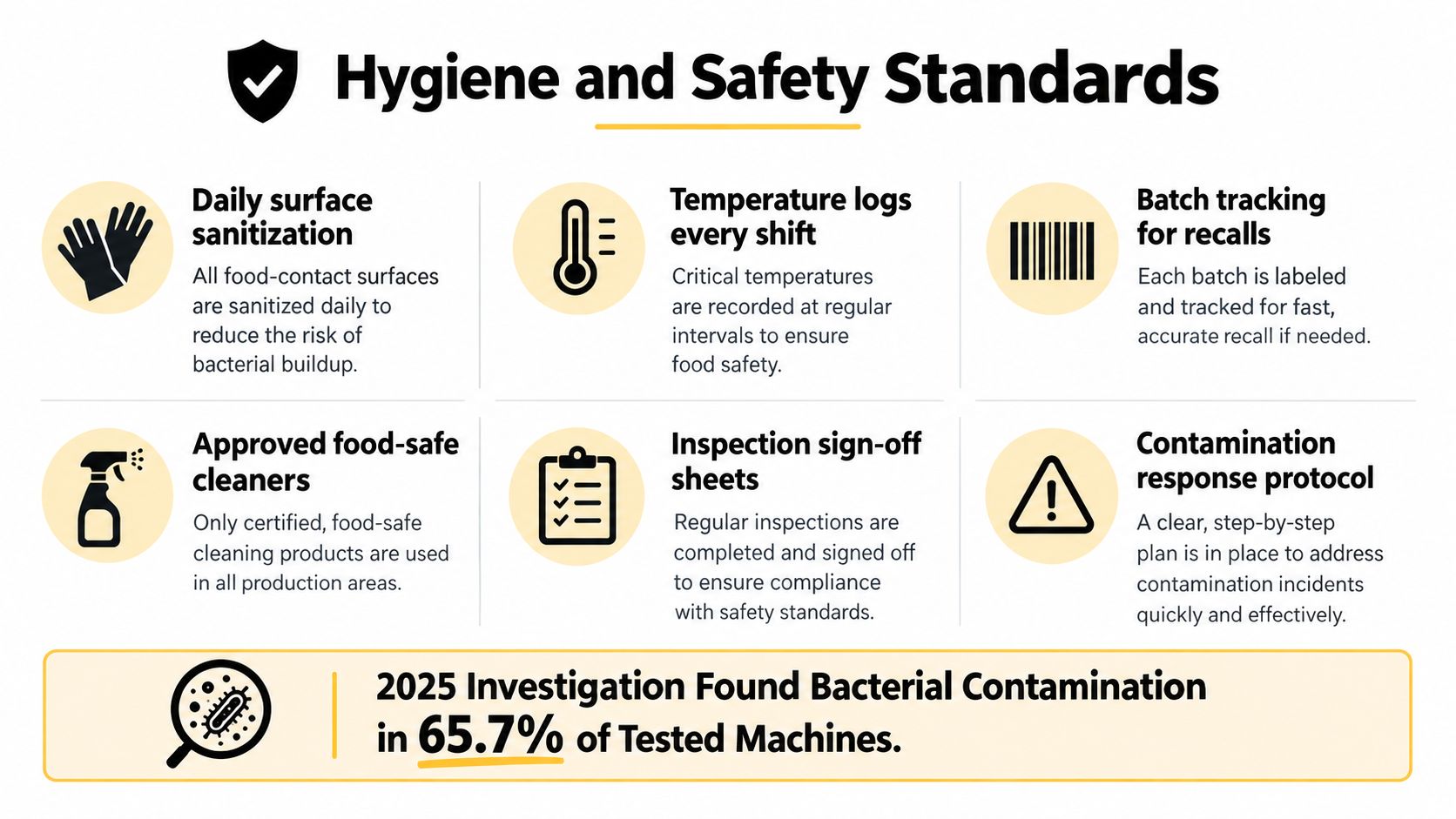
Wiping the front of a machine isn't a hygiene program. A preliminary 2025 investigation reported contamination in 74.3% of samples, including bacterial contamination in 65.7% and fungal contamination in 32.9%. The findings don't prove that every hospital vending machine is unsafe, and the sampling context may not generalize globally, but they do show why hygiene has to cover product handling, temperature, touchpoints, cleaning records, and response procedures. The preliminary vending-machine investigation is a reason to demand evidence, not a reason to make an unsupported claim about every machine.
Build controls around actual failure points
A practical program starts with HACCP-style thinking. Identify where contamination, spoilage, allergen exposure, recall failure, or customer contact can create risk, then assign an owner and a record.
Temperature control: Log chilled and frozen units at a defined cadence, set acceptable thresholds, and document who receives alerts and who decides whether stock is quarantined.
Surface cleaning: Specify approved food-safe cleaners and separate procedures for buttons, card readers, touchscreens, handles, product shelves, and spill areas.
Traceability: Record supplier, batch, lot, expiry, and machine location so recalled products can be found quickly.
Allergen visibility: Display relevant allergen information at the point of purchase and review claims such as “low sugar,” “high protein,” and “gluten-free.”
Clinical separation: State that general refreshments aren't substitutes for therapeutic meals, and provide an escalation path to a dietitian for borderline products.
Incident response: Define what happens after a temperature excursion, damaged package, pest observation, spill, payment-area contamination, or recall notice.
A machine near an oncology waiting area deserves the same operational discipline as other high-touch food equipment. Users may be immunocompromised, handling payment controls during stressful visits, or carrying food toward a clinical space. That doesn't mean the machine must be removed. It means the hospital should require documented cleaning, temperature records, product traceability, and a response time for faults.
Audit question: Can the service team show the record, identify the responsible person, and explain what happens when the record fails?
Hospitals can also compare their vending controls with broader commercial kitchen cleaning services practices, while adapting them to vending-specific touchpoints and refill routines. Put the requirements into the RFP, then verify them during site reviews. The nutrition-labeling process should be equally explicit, including vending machine nutrition labeling, allergen presentation, product claims, and the distinction between general food and clinical nutrition.
Running Cashless Payments and Telemetry-Driven Replenishment
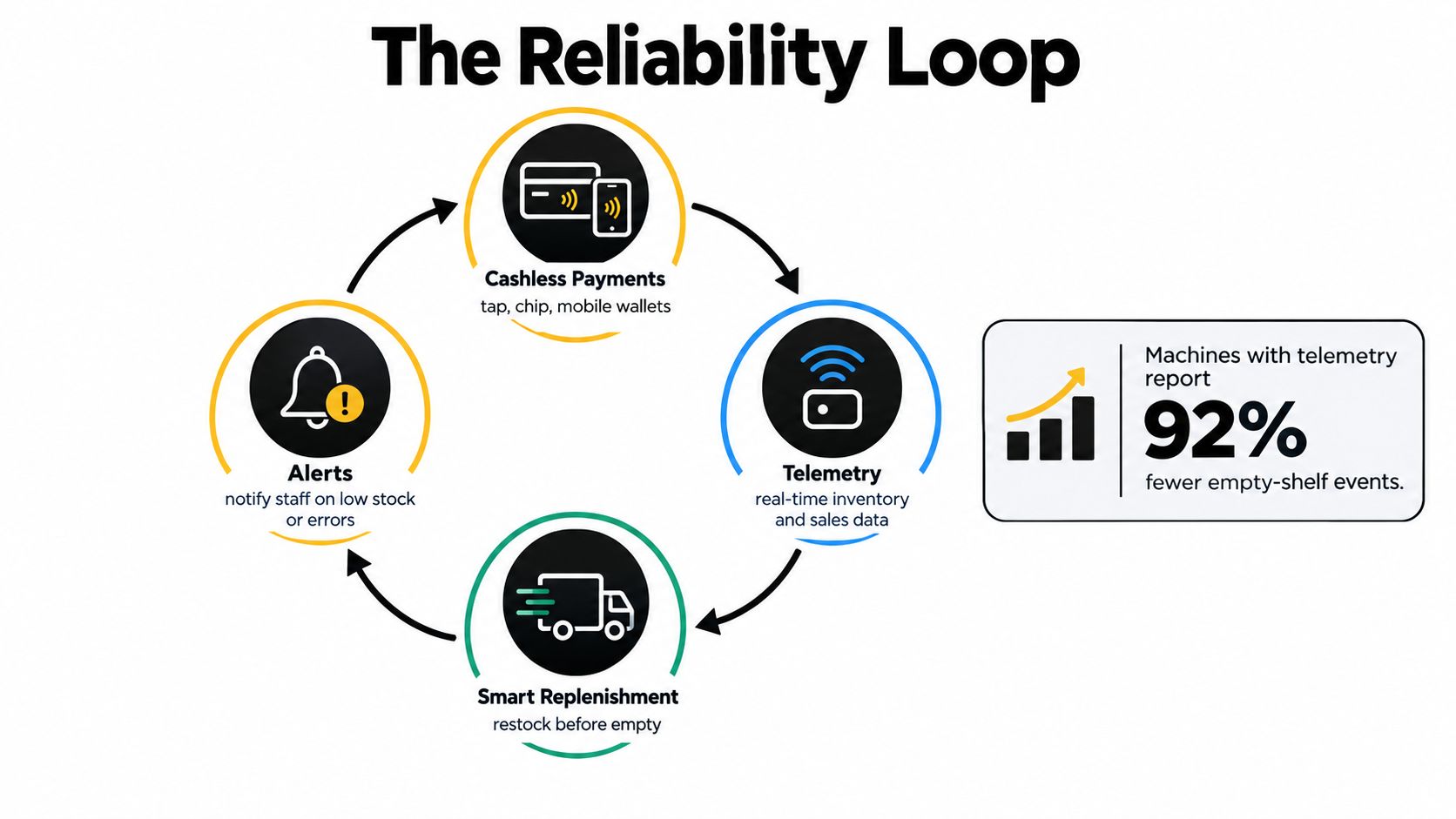
A hospital machine that rejects a card at midnight has failed, even if the product inside is perfect. Cashless payment should support tap, chip, and mobile wallets such as Apple Pay and Google Wallet, while the site plan should account for corridors where cellular or network coverage is unreliable. Ask how the system handles a weak signal, a failed transaction, refunds, and reconciliation before signing the equipment order.
Telemetry closes the operating loop. The system should report sales and stock movement by slot, then generate useful alerts for low inventory, temperature excursions, door events, and payment failures. The operator can refill the products most likely to sell before the next shift change, move slow items to another location, or retire a perishable SKU before expiry.
The practical questions are operational:
What triggers a refill? Define a stock threshold by SKU and location, not just a fixed calendar visit.
Who receives alerts? Route errors to a named service team, with escalation when the first response fails.
What gets changed? Keep fast movers, test replacements for slow sellers, and remove products with repeated expiry or damage issues.
How is performance reviewed? Compare sales, stockouts, refunds, service calls, and payment failures by machine.
A managed operator such as Vendmoore Enterprises uses connected machines, cashless payments, location-specific assortments, replenishment, and maintenance as one operating service. Its approach also includes monthly engagement promotions and assortment adjustments based on site data. The procurement standard should focus on documented response, usable reporting, and reliable service rather than the lowest equipment price.
Phased Rollout, KPIs, and Continuous Improvement
Hospitals shouldn't launch every machine, every product, and every policy at the same time. Begin with one clearly defined zone, record a baseline, run a controlled intervention, and only then expand. The baseline should include item-level units sold, product category, calories, sugar, sodium, fat, price, machine position, and stockouts.
A practical rollout looks like this:
Select one zone: Choose a staff break room, outpatient lobby, or another location with a clear customer group and accountable facilities contact.
Record the baseline: Preserve payment and service conditions while measuring sales, stockouts, product characteristics, and machine performance.
Test the assortment: Retain proven best sellers, add healthier products in measurable proportions, and improve visibility without changing every variable at once.
Review the intervention: Examine healthy-purchase share, units, gross margin, service calls, uptime, refunds, stockouts, and compliance records.
Expand carefully: Add machines only after the first zone shows that replenishment, cleaning, reporting, and escalation work in practice.
The controlled hospital intervention found that healthier purchases rose from 22% to 39%, while total unit sales fell 18.81% during the one-month pilot. That result is why a facilities director should distinguish a nutrition win from a revenue win. Review confidence intervals or pre/post comparisons instead of changing the assortment because one department disliked a product.
Decision rule: Change the assortment when repeated telemetry shows weak velocity, expiry exposure, poor margin, or a sustained mismatch with the approved nutrition standard. Leave it alone when a short-lived complaint conflicts with stable purchase data and acceptable compliance.
Track uptime, cashless success, healthy-purchase share, stockout events per week, service response time, audit completion, temperature exceptions, and refund rates. Keep a machine map, approved product standards, cleaning and temperature logs, recall procedure, intervention results, and one named contact at the vending partner. A clear performance reporting process makes the program easier to defend and improve.
Answering the Hard Questions Procurement Always Asks
Will healthier vending make money? It can still serve a commercial purpose, but procurement shouldn't approve the program on optimism. One controlled experiment reported sales at about 73% of the unhealthy-condition level and average reported profit at about 70%. Another hospital pilot recorded an 18.81% fall in total unit sales during its one-month intervention. Those figures aren't universal forecasts, but they establish the trade-off clearly. Protect margin by keeping proven anchors, testing healthier products in stages, and measuring contribution by SKU instead of judging the machine by its healthy-product percentage alone.
Are hospital vending machines hygienic? They can be operated safely, but “the exterior gets wiped” isn't enough evidence. The 2025 preliminary investigation reported bacterial contamination in 65.7% of samples and fungal contamination in 32.9%, so the vendor should provide cleaning logs, temperature records, product traceability, recall procedures, and a documented response to spills, damaged packaging, alerts, and expired stock. Require those controls in writing and audit them.
What happens when a product is recalled? The operator should be able to identify the affected batch, locate every machine carrying it, remove the product, document the action, and notify the hospital contact. A barcode or batch-tracking process is more defensible than relying on memory during a busy service round.
How are accessibility and dietary needs handled? Confirm approach space, control reach, payment usability, readable labeling, allergen visibility, and a clear distinction between general refreshments and clinician-directed meals. Ask the vendor to explain how staff escalate a product question to the hospital's dietitian or procurement lead.
My recommendation is straightforward. Approve a hospital vending machine only when the proposal combines a measurable assortment policy, documented hygiene controls, cashless reliability, telemetry, responsive replenishment, and a phased test. For an Oklahoma facility evaluating a managed program, compare those operating commitments alongside equipment specifications and price.
Vendmoore Enterprises offers healthcare vending programs with customizable snacks and beverages, cashless payments including Apple Pay and Google Wallet, connected telemetry, replenishment, installation, stocking, and maintenance. Visit Vendmoore Enterprises to discuss a hospital vending machine program built around your facility's locations, nutrition boundaries, hygiene requirements, and service expectations.
Comments