_edited.png)
Office Snack Dispenser: A Guide for Oklahoma Businesses

71% of vending transactions are now cashless, and a smart office snack dispenser gives employees faster access to food while supporting a more satisfying, productive break-room experience. The right machine works best when it serves every shift, accepts the payment methods people already use, and produces measurable operating data.
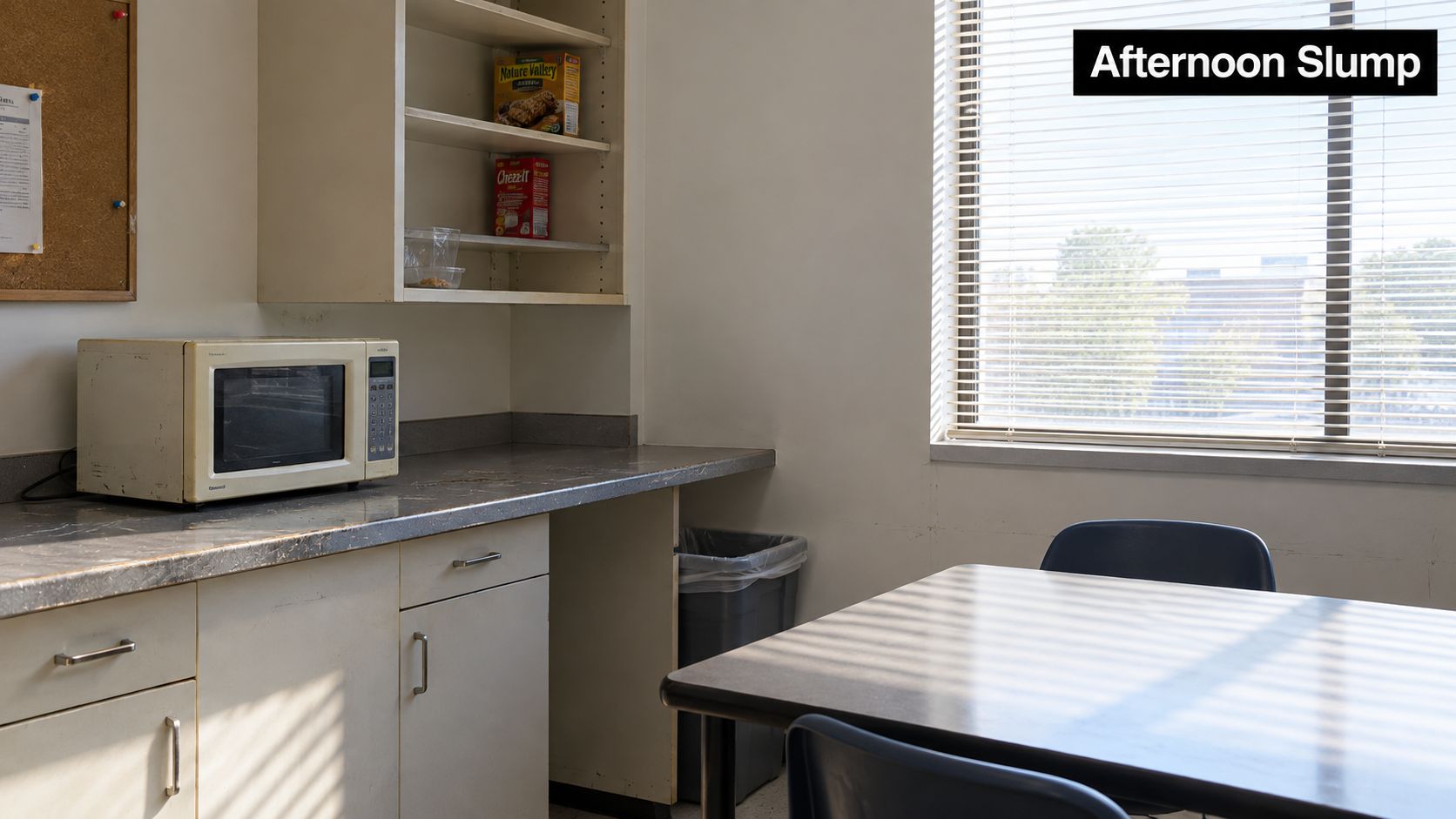
At 2:30 PM in an Edmond technology office, deadlines are stacking up. The microwave is unreliable, the cabinet contains stale crackers, and the nearest café requires a drive. Employees either skip the break they need or leave the building for a snack that takes longer than the purchase itself.
That scene plays out across Oklahoma. An office snack dispenser won't fix poor workplace planning, but a professionally managed one can turn an ignored break room into a dependable service point. The important question isn't whether a machine looks modern. It's whether the program stays stocked, works for night-shift employees, accepts inclusive payment options, and earns its footprint through actual use.
The Oklahoma Office Break-Room Reality
The office manager in this situation usually hears the same complaints first: there isn't enough variety, the machine is empty when people need it, or nobody knows whom to contact when a payment fails. A neglected dispenser becomes another piece of office equipment employees walk past. A responsive one becomes part of the workday.
Workplace food also influences attendance decisions. 33% of surveyed professionals said free lunch and snacks motivate them to come into the workplace, according to workplace attendance and amenity research from Envoy. That doesn't mean every employer should provide free food, and it doesn't prove that paid vending produces the same result. It does show that refreshments have moved beyond a minor perk.
The real test is equitable access
A daytime office with salaried staff may appear well served while a manufacturing site leaves second-shift workers with no fresh options. A school may offer popular snacks but exclude students or staff who need allergen-conscious choices. A hospital break room may have strong daytime traffic and almost no suitable food overnight.
Before installation, ask who uses the break room, when they use it, and what prevents access today. Check shift schedules, nearby food options, accessibility, refrigeration, and whether employees can pay without a smartphone or bank card.
Practical rule: A machine that serves only the easiest customer to reach isn't a successful workplace program. It is an amenity with a blind spot.
Facilities teams should also treat cleanliness and surrounding conditions as part of the refreshment experience. A well-stocked dispenser won't compensate for an unpleasant break room, so companies may find value in reviewing broader workplace upkeep, including resources such as Toronto office cleaning by Arelli for ideas on maintaining a consistently usable employee area.
Placement matters financially too. Review the practical considerations around vending machine placement fees before approving a location. A visible, convenient position usually supports stronger adoption than a technically available machine hidden beside a supply closet.
How Modern Office Snack Dispensers Work
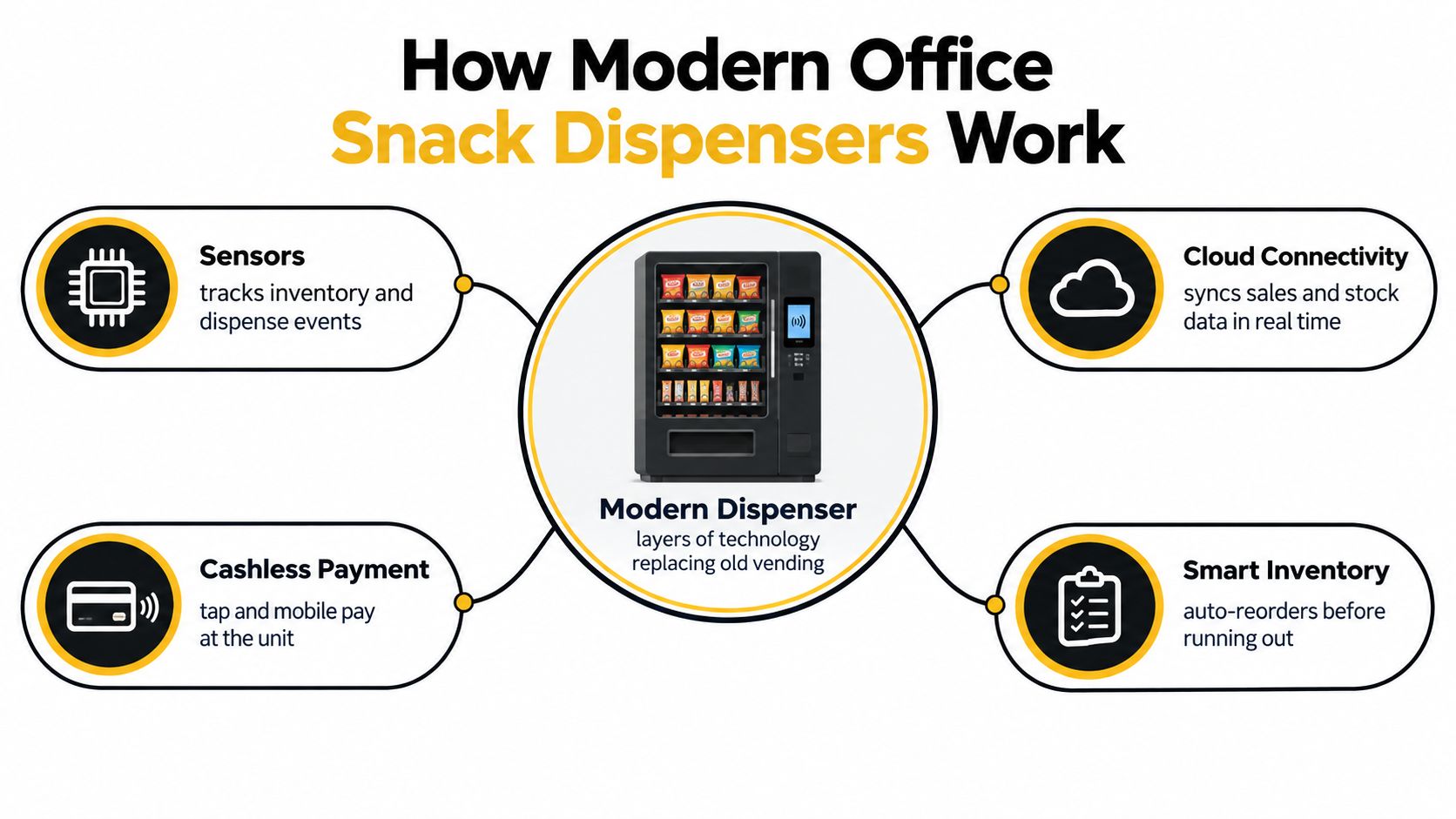
An old vending machine waits for a customer to insert money and select a product. A modern office snack dispenser adds a connected operating system around that basic transaction. The hardware still stores and releases products, but payment data, inventory signals, machine status, and service decisions can now work together.
The first layer is the dispensing hardware. Snack spirals handle packaged products such as chips, bars, nuts, and candy. Refrigerated sections support drinks, fresh items, and other temperature-sensitive choices. Frozen equipment can serve meals and treats in workplaces where employees need more than an afternoon snack.
The second layer is payment. Employees should be able to tap a card or use a mobile wallet such as Apple Pay or Google Wallet. Cashless convenience matters because people don't always carry cash, and a payment failure at the machine creates an immediate service complaint.
The third layer is telemetry. Sensors and connected software can report sales, stock levels, temperature conditions, and equipment alerts. That gives the operator a reason to restock based on actual movement instead of guessing from a fixed route.
Follow the data loop
A useful dispenser creates a simple loop:
The employee buys an item. The system records the product, payment method, time, and location.
The operator sees movement. Fast sellers, slow sellers, stockouts, and failed transactions become visible.
The assortment changes. Products that consistently underperform make room for items employees request.
The service route improves. The operator replenishes where demand justifies attention and investigates unusual machine conditions.
Automatic vending has been evolving for a long time. A stamp-dispensing patent in England dates to 1867, practical coin-operated machines appeared in London during the early 1880s, and the technology reached the United States in 1888 through chewing-gum machines installed by the Thomas Adams Gum Company on New York City elevated-railway platforms, as described in the history of automatic vending. The workplace connection strengthened during the industrial expansion of the twentieth century, when factories needed on-site refreshments for long shifts.
Today's advantage isn't the novelty of unattended retail. It's the information layer. Read how smart vending machines work before comparing vendors, and ask each operator what data the customer receives, how alerts trigger service, and what happens when connectivity or payment processing fails.
Choosing the Right Dispenser Type for Your Space
A two-person professional office doesn't need the same equipment as an Oklahoma City plant with workers arriving at different hours. The right choice depends on the break room's footprint, electrical access, expected product mix, and whether employees need snacks, drinks, or substantial food.
Machine Type | Best For | Capacity Range | Key Feature |
|---|---|---|---|
Compact refreshment center | Small offices, law firms, and compact break rooms | Compact assortment | Small footprint with targeted product selection |
Dual-zone chill center | Offices that want snacks and beverages together | Moderate mixed capacity | Separate temperature zones for varied products |
Frozen food machine | Healthcare, manufacturing, campuses, and shift-based workplaces | Larger meal-focused capacity | Access to frozen meals and substantial food |
Bottle-and-can vendor | Lobbies, common areas, and high-traffic facilities | Beverage-focused capacity | Fast selection and strong drink visibility |
Match the machine to the customer
A Norman law office with a small kitchenette should start with a compact refreshment center. It needs popular snacks, bottled drinks, and a carefully chosen selection, not a large machine that consumes valuable floor space and takes too long to turn over.
A dual-zone chill center suits a corporate office or business center where employees want a single place for cold drinks and packaged snacks. It keeps the purchase simple and allows the operator to compare beverage demand with snack demand rather than treating the break room as one undifferentiated category.
Frozen equipment earns consideration at hospitals, manufacturing plants, schools, and universities. When workers can't easily leave the property during a shift, a frozen meal option can address a more serious access problem than chips and candy alone. The operator must manage temperature, replenishment, product rotation, and clear preparation information.
For an airport, stadium, residential complex, or public-facing lobby, a bottle-and-can vendor may be the cleanest fit. High visibility and quick transactions matter more there than an extensive meal assortment.
A larger machine isn't automatically a better machine. A well-managed unit with the right products beats unused capacity every time.
Check the best smart vending machines with your actual floor plan in hand. Then ask for installation requirements, power needs, service access, product dimensions, and a plan for changing the mix when the first sales data arrives.
Features That Actually Move the Needle
A vendor can fill a brochure with screens, sensors, analytics terms, and artificial intelligence language. Buyers should ignore the noise and rank features by their effect on access, uptime, product relevance, and financial control.
Payment belongs at the top of the list. Federal Reserve research found that credit cards accounted for 32% of monthly payments and debit cards for 30%, meaning cards together represented more than 60% of consumer payments, as reported in the 2024 Diary of Consumer Payment Choice. An office dispenser should support cards and mobile wallets while retaining a practical backup for employees who don't use a smartphone or bank card.
Rank the capabilities by operational value
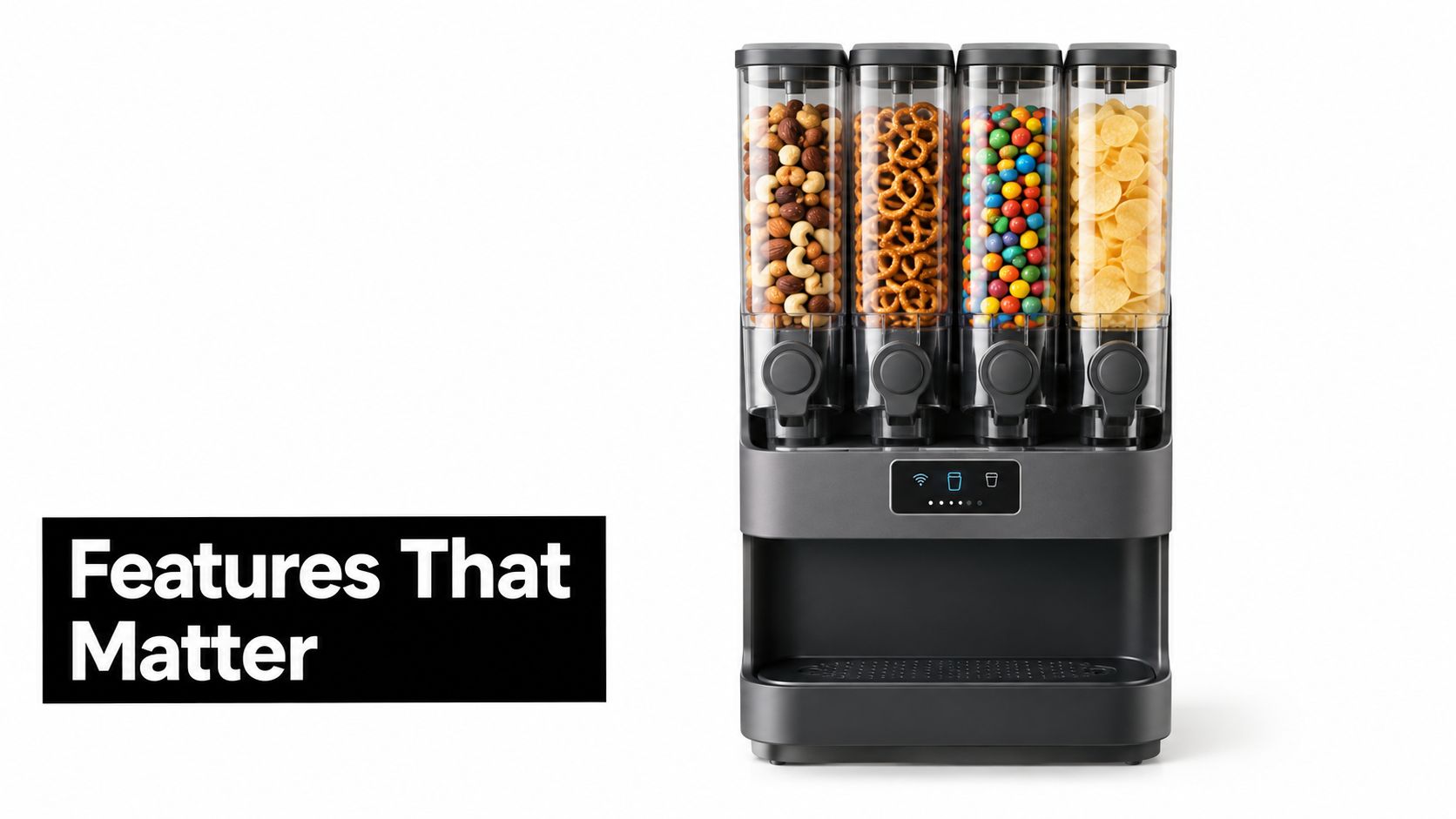
Telemetry is more valuable than decorative technology. It should tell the operator what sold, what is approaching a stockout, whether a refrigeration issue needs attention, and which products fail to move. If the customer can't access meaningful reporting, the machine isn't as smart as the sales presentation suggests.
Cashless checkout must include recovery procedures. Ask what happens after a declined transaction, a duplicate charge, a product jam, or a network interruption. Employees need a visible support path and a reasonable refund process. A payment terminal with poor issue resolution still creates a frustrating experience.
Assortment controls should support local decisions. A downtown Oklahoma City office, a Norman campus, and an industrial site near Edmond won't have identical buying patterns. The operator should be willing to test products, gather direct feedback, and remove items that consume space without earning repeat purchases.
Service responsiveness protects utilization. A machine that stays empty for days loses trust. Ask how alerts become work orders, who responds, and how the operator handles emergency visits outside a normal route.
The U.S. vending sector offers useful context. The National Automatic Merchandising Association census estimated approximately 2.9 million vending machines in operation in 2023, with $18.2 billion in estimated annual revenue and average annual sales of $6,284 per machine. The market had fewer machines than in earlier census years while average productivity was higher, which supports investing in assortment quality, uptime, telemetry, and location-specific replenishment instead of adding equipment.
Pricing can also change behavior, but tiny discounts shouldn't be treated as a strategy. Evidence summarized in a workplace and school vending intervention found that a 10% discount on lower-fat snacks didn't significantly increase purchases, while 25% and 50% discounts did. Test promotions against baseline sales and review contribution margin, substitution, and repeat purchases rather than celebrating unit volume alone.
Stocking Strategies Beyond the Vending Brochure
Healthy stocking isn't a matter of removing every indulgent product and replacing it with items employees don't want. That approach narrows choice and often creates a machine that looks responsible but sells poorly. The better operating model combines familiar favorites with products that offer protein, fiber, lower sugar, allergen clarity, and varied dietary fit.
A controlled intervention involving 14 hospital snack machines applied thresholds for energy, saturated fat, total sugar, and sodium. Products sold contained 24% less energy, 32% less total fat, 41% less saturated fat, and 30% less total sugar per 100 grams, while overall sales volume remained unchanged and employee satisfaction increased, according to the published vending intervention.
That evidence supports standards, not vague “healthy” labels. Track nutrient density per unit sold, because the number of better-for-you products displayed doesn't tell you whether customers choose them.
Build the mix around actual needs
Start with a balanced core. Include salty snacks, sweet items, nuts or seeds, protein-oriented bars, lower-sugar beverages, water, and products with clear ingredient information. Add refrigerated or frozen choices where employees use snacks as meal substitutes.
That last point deserves attention. In a survey of 1,005 on-site workers, 65% of employees without employer-provided meals reported eating snacks as meals, 48% skipped meals, and 18% relied on vending machines or convenience stores, according to the workplace nutrition review. A workplace dispenser may therefore serve a real food-access function for late workers, shift employees, and people without nearby options.
Use telemetry and feedback together:
Review sales regularly: Identify fast sellers, slow movers, stockouts, and products that sell only after a promotion.
Audit the assortment: Check allergens, dietary categories, package sizes, expiration dates, and representation of employee requests.
Measure the outcome: Compare units sold with revenue, waste, repeat purchases, and nutrient density per unit sold.
Invite direct feedback: Provide a QR code, short form, or visible contact route so employees can request products and report problems.
Do not assume a vegetarian, halal, gluten-free, low-sugar, or allergen-conscious option will sell just because it occupies a slot. Label it clearly, price it fairly, and watch actual movement. Employees deserve choice without the operator making unsupported medical or wellness promises.
Use assortment planning for vending as an operating discipline, not a one-time installation task. A good mix changes as seasons, shifts, employee demographics, and workplace schedules change.
Why Oklahoma Businesses Gain a Real Edge
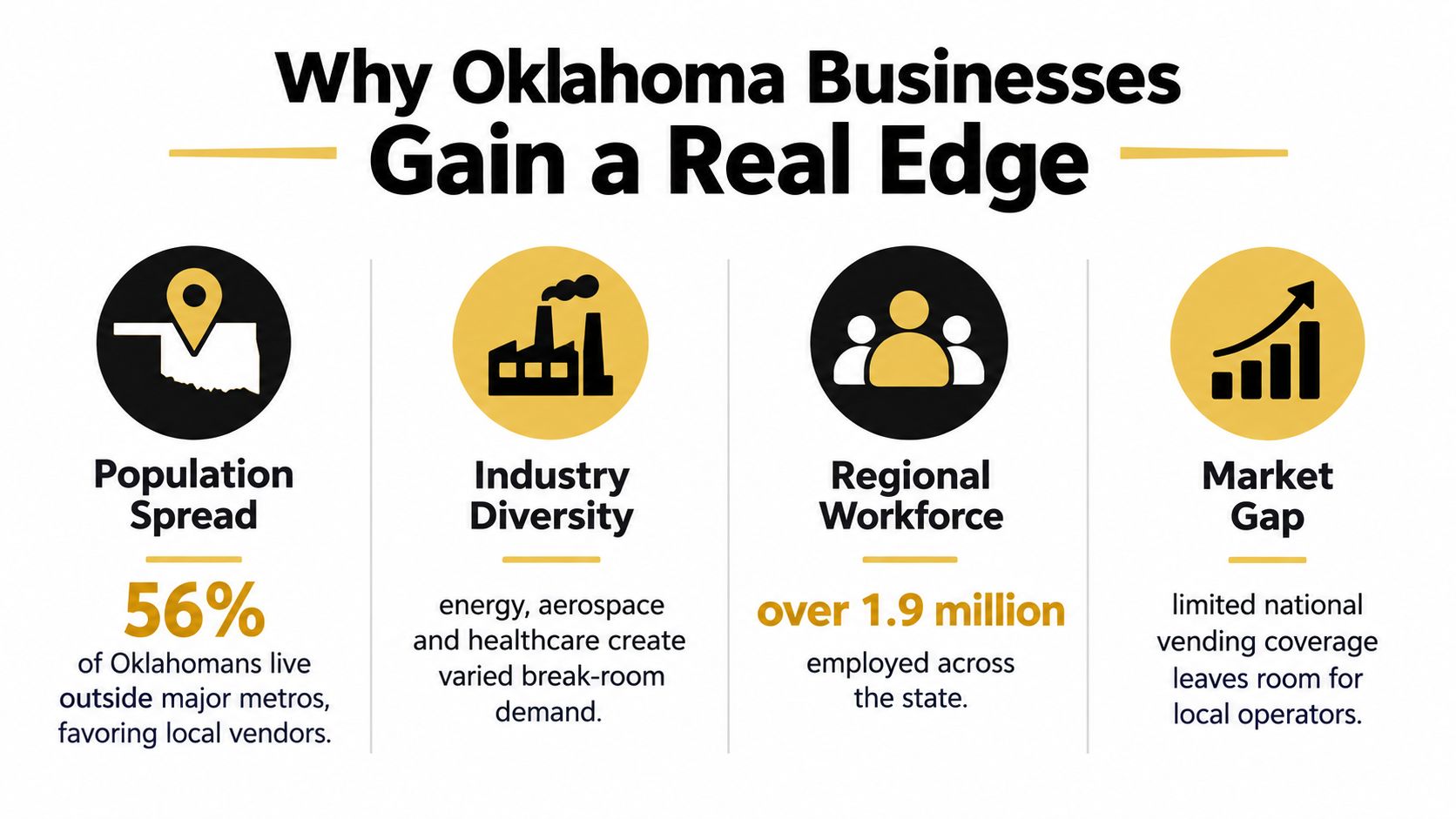
Oklahoma gives local vending operators a practical advantage because the customer base is spread across distinct communities and workplace types. A medical office in Edmond, a university facility in Norman, a manufacturing site near Oklahoma City, and a residential property in a surrounding community need different service patterns.
The local market is substantial. Oklahoma City had an estimated population of 712,919 on July 1, 2024, and Edmond had an estimated population of 99,040 in the Census estimate series, supporting separate local service pages and targeted sales coverage, according to the U.S. Census Bureau population table. Those figures provide market context. They don't prove vending demand by themselves, so operators still need to show access, service quality, and a credible product plan.
Local search should reflect local service
A vending business shouldn't rely on one generic Oklahoma page. Build useful pages for Oklahoma City, Edmond, Norman, and nearby service areas, with specific information about offices, schools, healthcare facilities, industrial break rooms, residential amenities, airports, and event venues.
Google recommends LocalBusiness structured data to communicate details such as hours, departments, reviews, geographic coordinates, and opening-hours specifications. Use the most specific applicable subtype, validate the markup with the Rich Results Test, inspect important pages with URL Inspection, and submit a sitemap so search engines can discover updates. Google specifies that latitude should use at least five decimal places when coordinates are provided.
Organization information also needs consistency. Google's Organization structured-data guidance supports providing applicable address, multiple addresses, email, and telephone information, including country and area codes. Structured data won't replace useful page content or guarantee enhanced search results, but accurate service-area information helps search engines distinguish the company from each location it serves.
Reliability is the local differentiator
National vending coverage can look convenient until a machine needs attention and the route is too broad for a quick response. A local operator should answer direct questions about refill frequency, emergency service, payment failures, product substitutions, and who owns the customer relationship.
Ask whether the operator can support every shift, whether prices remain visible and consistent, and whether employees without smartphones have a usable payment alternative. Local coverage only creates an advantage when it produces dependable service.
Implementing Your Office Vending Program Successfully
Start with a short needs assessment before speaking with vendors. Walk the building during different shifts, note where employees already gather, list nearby food options, and ask staff what they buy outside the workplace. Record current complaints about price, choice, access, and payment so you have a baseline rather than relying on general satisfaction.
Set the program up deliberately
Choose stakeholders. Include facilities, human resources, finance, security, and representatives from different shifts. A break-room program affects more people than the person who signs the installation form.
Select the location. Favor natural movement paths, visible common areas, and accessible surfaces. Confirm power, clearance, temperature requirements, and service access before approving the footprint.
Define the assortment. Begin with a balanced mix that reflects employee requests, dietary needs, portion preferences, and the difference between snack demand and meal demand.
Confirm payment inclusion. Require card and mobile-wallet acceptance, but also document the fallback process for people who don't use those methods.
Agree on service standards. Put replenishment responsibilities, machine monitoring, refund handling, cleaning, repair escalation, and communication channels in writing.
A managed program can reduce the workload on office staff because the operator handles replenishment, maintenance, and product adjustments. Review vendor-managed inventory services when comparing a fully supported program with a client-owned machine.
Measure what matters after launch
Don't judge success by installation day excitement. Track transaction frequency, repeat purchases, stockouts, waste, average basket value, product mix, payment failures, and feedback by shift or location. Compare those results with your baseline and investigate whether the machine serves only daytime office staff while night workers or lower-wage employees use it less.
Set a review cadence that produces action. A weekly operational check should catch empty slots, failed payments, and temperature or hardware alerts. A monthly business review should examine sales, assortment, pricing, and service response. A recurring employee feedback check should identify products and access problems that transaction data can't explain.
A successful office snack dispenser is not measured by how advanced it looks. It is measured by whether employees can use it, whether the operator keeps it working, and whether the business can prove the program earns its space.
Vendmoore Enterprises provides managed vending programs for Oklahoma workplaces and public spaces, including cashless office machines, customized snack and beverage assortments, frozen food equipment, inventory monitoring, stocking, and maintenance. Visit Vendmoore Enterprises to discuss a break-room vending program for your Oklahoma City, Norman, Edmond, or surrounding-area location.
Comments