_edited.png)
Smart Food Vending Machines: A Complete Buyer Guide

At 7:15 a.m., a facility manager shouldn't be troubleshooting a vending machine before the first shift starts. Yet that's exactly what happens when a break room has an old refrigerated unit that's gone warm, a coin-only snack machine, and no reliable way to tell whether yesterday's popular items sold out or never moved.
That setup creates more than an ugly employee experience. It creates wasted service visits, missed sales, uncertain food safety, and a product mix based on guesswork. Smart food vending machines address those problems with connected inventory data, cashless payments, machine-health monitoring, and an operating model built around uptime.
The important buying decision isn't whether a screen or phone reader looks modern. It's whether you want a managed vending service to own the daily work, or whether your organization is prepared to purchase, stock, monitor, clean, and repair its own equipment for the next twelve months.
Why the Break Room Feels Outdated
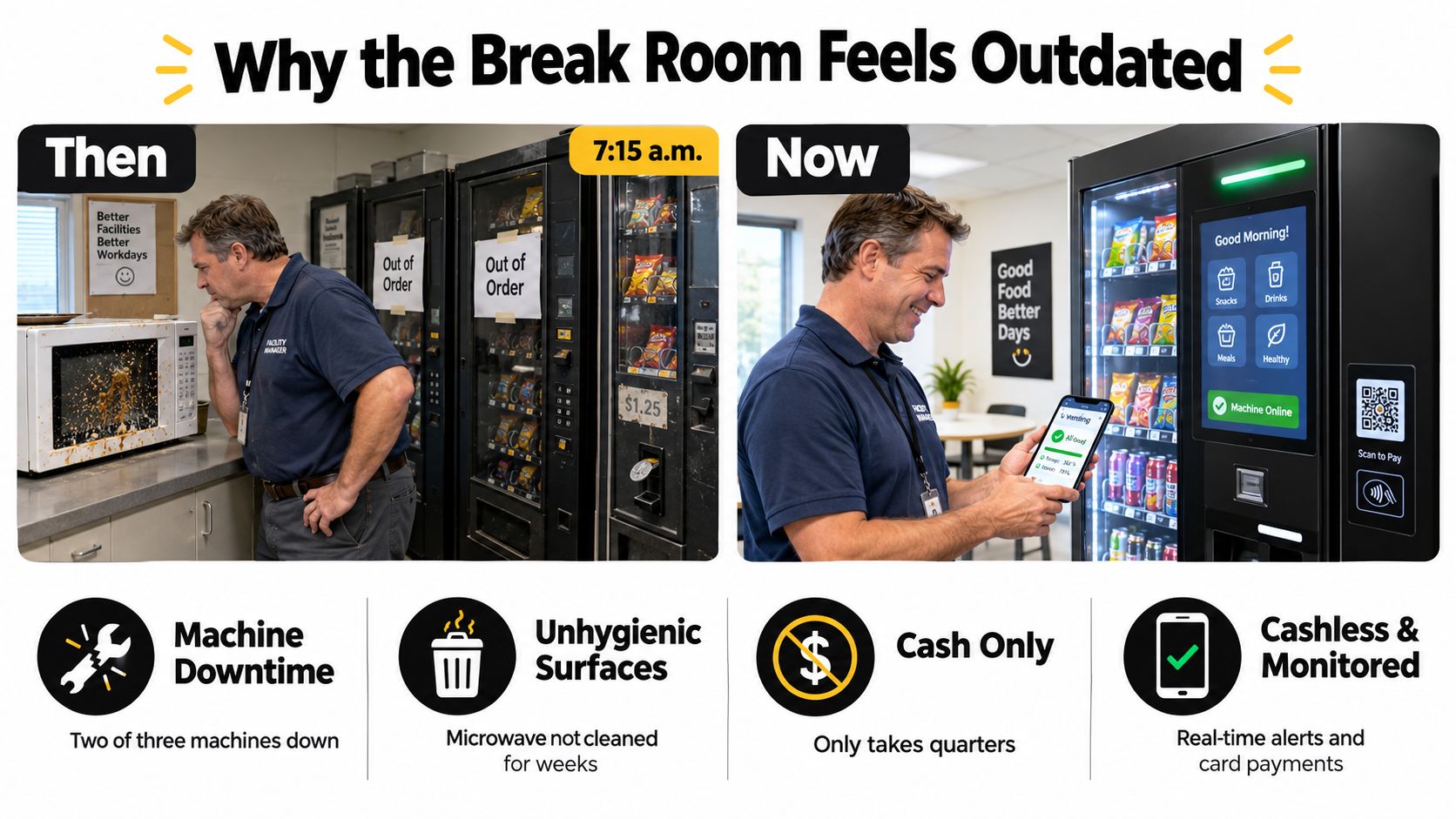
A manager walks into the break room and sees three vending machines. Two have handwritten “Out of Order” signs. The third accepts quarters, but most employees pay with a phone and don't carry change anymore. Nearby, the microwave has dried food on the door, and nobody knows who's responsible for cleaning it.
That scene is common because traditional vending hides the information an operator needs. A machine can be empty for days without sending an alert. A cooler can lose temperature without anyone noticing until a customer complains. A popular item can disappear during the busiest part of the workday, while slow products occupy the same space because nobody has reviewed the sales pattern.
The practical test: If the operator learns about a stockout or temperature issue from an employee, the system is already behind.
Smart vending changes the daily experience in concrete ways. A connected machine can report stock movement and faults remotely. Cashless hardware lets an employee tap a card or phone at 6:45 a.m. without searching for coins. An operator can review cold brew demand from Tuesday before deciding what to load for Wednesday.
The category has grown beyond a niche automation idea. One industry report valued the global smart vending machine market at USD 20.5 billion in 2022 and projected USD 55.5 billion by 2030, with a projected 14.0% compound annual growth rate. The same report put food, candy, ice cream, and frozen items at USD 7.2 billion in 2022, and identified North America as the largest revenue-generating region that year. Global Growth Insights reports on the smart vending machine market provide that market context.
For an Oklahoma office, hospital, school, or warehouse, the question is no longer whether vending can dispense food. The question is whether the equipment and service model can keep the right products cold, available, and easy to buy throughout the day. A useful overview of how workplace technology is changing is available in this workplace technology trends guide.
How Telemetry and Cashless Payments Actually Work
Smart food vending machines rely on two connected systems. Telemetry is the machine's reporting layer, while cashless payment is the transaction layer. Together, they turn a vending box into a remotely managed retail endpoint.
Telemetry turns a machine into a reporting device
Think of telemetry as a modem inside the machine, similar in purpose to a connected thermostat. It sends information to an operator dashboard, including sales, inventory, faults, service needs, and, where supported, temperature conditions.
That information changes routing. Instead of visiting every machine on a fixed schedule, the operator can prioritize the unit with an empty drink column, a refrigeration warning, or an unusual fault. Academic research describes telemetry as a wireless connection that transmits sales, inventory, and service data to back-office systems. It connects that visibility with better route scheduling, procurement, lower spoilage, and remote service resolution, and reports an operator-facing labor reduction of about 25% when visits happen only as needed. The Eindhoven University of Technology research on vending telemetry documents that relationship.
A machine that reports stock levels also reduces the familiar “the machine ate my money” complaint. The operator can verify whether a vend completed, whether a selection failed, and whether a refund or credit needs attention.
For a deeper look at what operators collect and use, see this guide to telemetry data collection.
Cashless payments remove the change problem
Cashless systems support contactless cards, chip cards, mobile wallets, and, depending on the hardware, QR payments. NFC handles tap-to-pay, while payment gateways use security controls such as EMV processing and tokenization so the operator doesn't handle a raw card number.
Cashless adoption is no longer a minor convenience. A 2026 industry payment analysis reported that 71% of U.S. vending sales are cashless, and that digitally paying customers spend 37% more per transaction, with average spend increasing from USD 1.78 to USD 2.24. It also reported that contactless payments represent 77% of cashless vending sales. DataIntelo's smart vending machine payment analysis provides those figures.
The useful connection is between payment data and inventory data. The operator can see which product sold, when it sold, and how the customer paid. That makes it easier to identify a genuine demand pattern, such as mobile-wallet purchases of cold drinks during a shift change, rather than relying on an occasional visual check.
Where Smart Food Vending Fits in Oklahoma Locations
Oklahoma locations need different machines and assortments. A downtown office, a hospital, and an industrial site may all want vending services, but their traffic, staffing patterns, and food requirements have little in common.
Corporate offices in Oklahoma City and Tulsa usually benefit from chilled drinks, cold brew, sparkling water, protein snacks, and fresh wraps. Lunch demand often concentrates around the middle of the workday, but early arrivals and late meetings create additional demand for breakfast items and convenient snacks.
Schools and universities need stronger controls around product eligibility, labeling, and supervision. Campuses may support combo meals, frozen entrées, bottled drinks, and grab-and-go items for students studying outside cafeteria hours. K-12 locations need assortments that comply with applicable school nutrition standards, not merely whatever sells fastest.
Hospitals and clinics operate around the clock. Night-shift staff, visitors, and patients' families need dependable access when the cafeteria is closed. Healthier options, clear dietary tags, chilled meals, and filling snacks matter more than novelty products.
Manufacturing plants and warehouses along the I-35 and I-40 corridors require a different mix. Staff working physically demanding shifts may choose substantial handheld meals, calorie-dense snacks, energy drinks, and hydration products. A machine exposed to intense summer heat also needs careful placement, ventilation, refrigeration monitoring, and a service plan that treats temperature alerts seriously.
Multifamily properties and amenity spaces work best with small grocery staples, breakfast items, meal kits, frozen foods, and single-serve beverages. Residents aren't necessarily looking for a traditional snack machine. They're paying for convenience when a store trip feels unnecessary.
Oklahoma's weather makes a universal assortment especially unreliable. A product that moves during a cold winter morning may sit during a hot afternoon, while refrigerated and frozen equipment has to operate in very different ambient conditions.
Location | Top Product Mix | Peak Hours | Oklahoma Climate Note |
|---|---|---|---|
Corporate office | Cold brew, sparkling water, protein snacks, fresh wraps | Morning arrival and lunch | Keep chilled equipment shaded and ventilated |
School or university | Combo meals, frozen entrées, compliant snacks, bottled drinks | Class breaks, lunch, evening study | Use age-appropriate and standards-compliant assortments |
Hospital or clinic | Healthier meals, dietary-tagged items, hydration, substantial snacks | Shift changes and overnight | Temperature visibility matters during continuous operation |
Industrial or warehouse site | Handheld meals, energy drinks, hydration, calorie-dense snacks | Shift start, breaks, shift change | Protect refrigeration from hot corridors and direct sun |
Multifamily property | Breakfast items, groceries, meal kits, frozen foods | Morning and evening | Match stock to resident routines and seasonal demand |
Managed Service vs Owning Your Own Machines
The ownership question matters more than the touchscreen. You're choosing between a vending operator that handles the route and a client-owned program where your organization becomes responsible for the route.
With a managed service, the operator typically supplies or installs the equipment, loads products, monitors telemetry, handles merchandising, manages refrigeration service, processes payment issues, and responds to faults. A good agreement should also address ADA access, applicable health requirements, cleaning, restock cadence, and the response standard for breakdowns.
With client-owned equipment, you control the hardware, retail prices, product selection, data access, and replacement schedule. You also inherit the work. Someone must review sales, pre-kit products, drive the route, rotate fresh inventory, inspect temperature, process refunds, coordinate repairs, and reconcile cashless fees.
The economics can look attractive on paper. A 24-select combination machine may cost roughly $6,000 to $12,000 to purchase, with another $800 to $1,500 per year for cash processing, telemetry subscriptions, and preventive service. Those figures are planning inputs, not a complete operating budget. Labor, fuel, emergency repairs, spoilage, and management time can change the result.
Managed routes commonly exchange gross revenue for service, often using a 70/30 or 80/20 split in the operator's favor. In return, the client avoids the capital purchase and gets an accountable party for replenishment and repairs. Before comparing proposals, review this vending cost comparison analysis.
Responsibility | Managed Service | Client-Owned |
|---|---|---|
Equipment purchase | Usually handled by operator | Client purchases hardware |
Product stocking | Operator route team | Client staff or contracted route |
Telemetry monitoring | Operator reviews alerts | Client must assign ownership |
Merchandising | Operator adjusts the display | Client manages assortment and presentation |
Refrigeration repair | Operator coordinates service | Client pays and coordinates service |
Payment issues | Operator handles refunds and processor support | Client handles processor relationship |
Product waste | Operator carries or shares the operating risk | Client absorbs the loss |
Pricing control | Set by agreement | Client controls prices |
Service response | Contractual SLA should apply | Client must create an SLA with vendors |
Capital exposure | Low at launch | Higher at launch |
My recommendation is direct: managed service wins for most workplaces under 500 employees. Client ownership makes sense when volume is consistently high and a specific employee or facilities team can commit to weekly route work, inventory controls, and service coordination. If nobody owns those tasks, the machine becomes another neglected asset in the break room.
What the ROI Really Looks Like
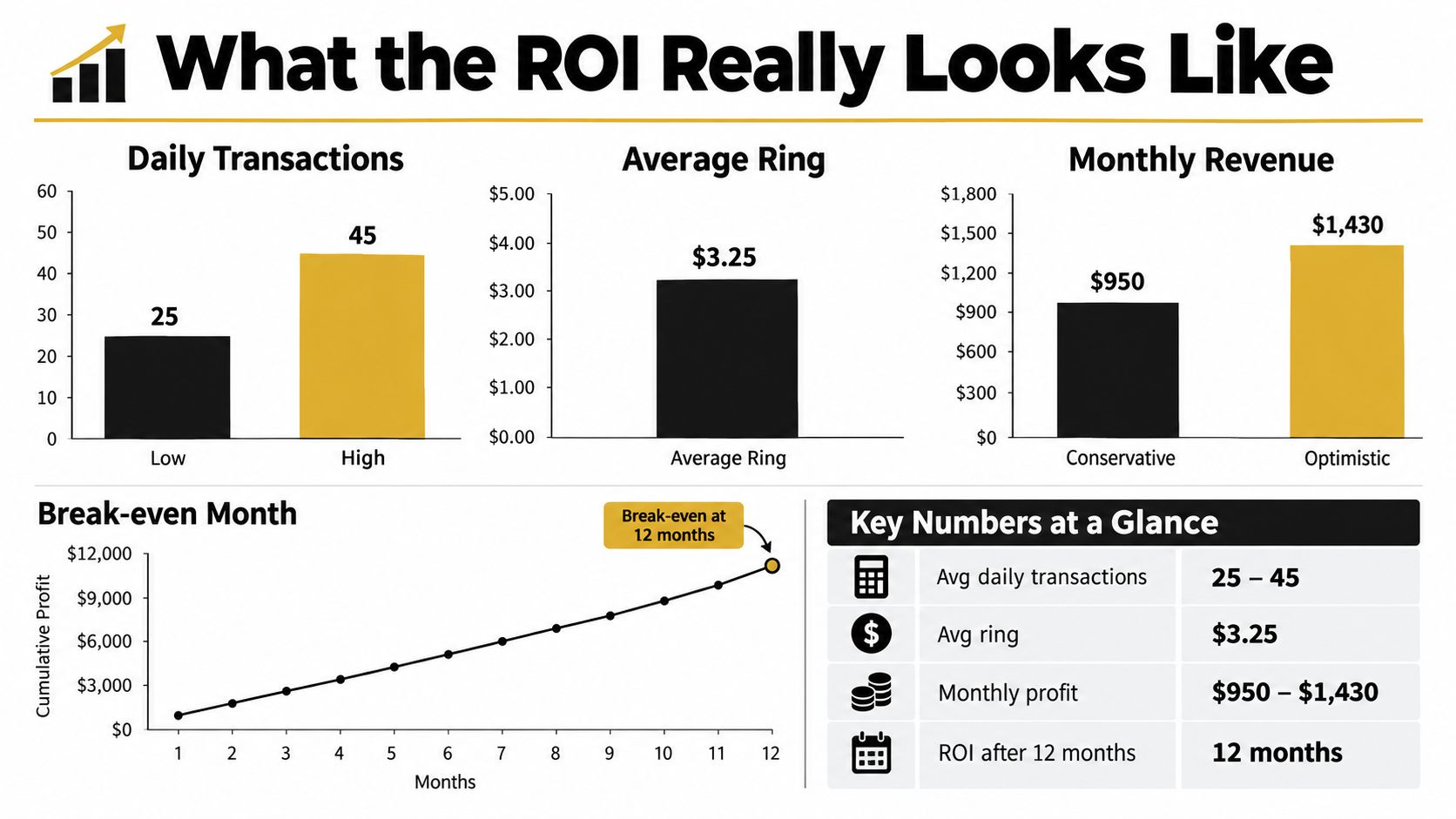
Vending ROI starts with utilization, not equipment features. A typical Oklahoma workplace combination machine may sell 25 to 45 transactions per day at an average $3.25 ring, producing roughly $950 to $1,430 in weekly gross sales under the planning assumptions in this guide. Those figures should be tested against the actual headcount, operating hours, nearby food options, and service frequency at the proposed site.
Product cost may consume 45% to 55% of sales, with fresh items usually carrying more spoilage exposure than packaged snacks and drinks. Expiration and spoilage may take another 3% to 6%, while cashless processing may take 2.5% to 3.5%. Those are the variables a proposal should expose instead of hiding behind a projected revenue figure.
For an owned unit, a $9,000 machine can reach payback in roughly 14 to 22 months at mid-volume, according to the planning model supplied for this guide. That estimate only works if the machine stays available, the route is efficient, and the owner manages the mix instead of treating installation as the finish line.
Telemetry can improve the economics by exposing sold-out rows and late-night stockouts before they become recurring problems. Industry descriptions of smart vending combine cashless payments, real-time inventory, machine-health monitoring, and AI or IoT analytics to support predictive maintenance and location-specific assortment decisions. Persistence Market Research's smart vending market overview describes that integrated operating model.
ROI warning: A machine that sits down during a hot July afternoon isn't just a repair ticket. It's lost availability, spoiled product risk, and a customer who may choose another food option next time.
The most useful review is monthly. Track sales by SKU, gross margin, stockouts, refunds, spoilage, service calls, and time spent on the route. If a managed operator won't share enough reporting to answer those questions, don't sign a long contract.
Building a Product Mix That People Actually Buy
A profitable assortment starts with the location, not the operator's warehouse. For a 60-select machine, a sensible starting allocation is roughly 35% snacks, 30% cold drinks, 20% fresh or frozen entrées, 10% better-for-you options, and 5% local favorites. Treat that as a launch hypothesis, not a permanent formula.
A night-shift manufacturing site in Pryor may need handheld hot meals, energy drinks, water, and filling snacks. A Tulsa law office may respond better to yogurt, salads, sparkling water, premium coffee drinks, and lighter snacks. An Oklahoma City elementary school requires a much tighter selection built around applicable Smart Snack standards.
Use the machine as a test kitchen
Load a balanced opening assortment, then review actual sales by item and time period. Remove slow movers after a meaningful test period, expand the strongest products, and protect space for new trials. The operator should be able to explain why an item remains in the machine.
Fresh and frozen products require more discipline than shelf-stable snacks. Refrigerated units need shade and airflow during July and August, while frozen equipment must maintain stable conditions even when the surrounding space is hot. Ask how the service team checks temperature, rotates dates, and handles products after a temperature exception.
Local products can also make the machine feel specific to the community. Test Oklahoma-made snacks and drinks where supply, shelf life, and pricing support the idea. A familiar local item can earn attention that another generic packaged product won't.
Build a feedback loop
Put a QR code on the machine for product requests, refund reporting, and quick satisfaction feedback. Review the results with the operator each month, then make a broader assortment decision each quarter.
For ideas that connect assortment, offers, and customer behavior, review these proven tactics to increase restaurant sales. The principles around testing offers and listening to customers translate well to break room vending, even though the sales environment is different.
The operator should also provide a simple report covering top sellers, items with weak movement, stockouts, refunds, and waste. Product assortment optimization for vending is most effective when it produces a specific action, such as adding more hydration products for a summer shift or replacing a slow premium snack with a lower-priced option.
Implementation Checklist Before You Sign Anything
A vending installation can fail before the machine arrives. The site may lack a suitable outlet, the signal may be weak, the equipment may block an access path, or the contract may leave response time undefined.
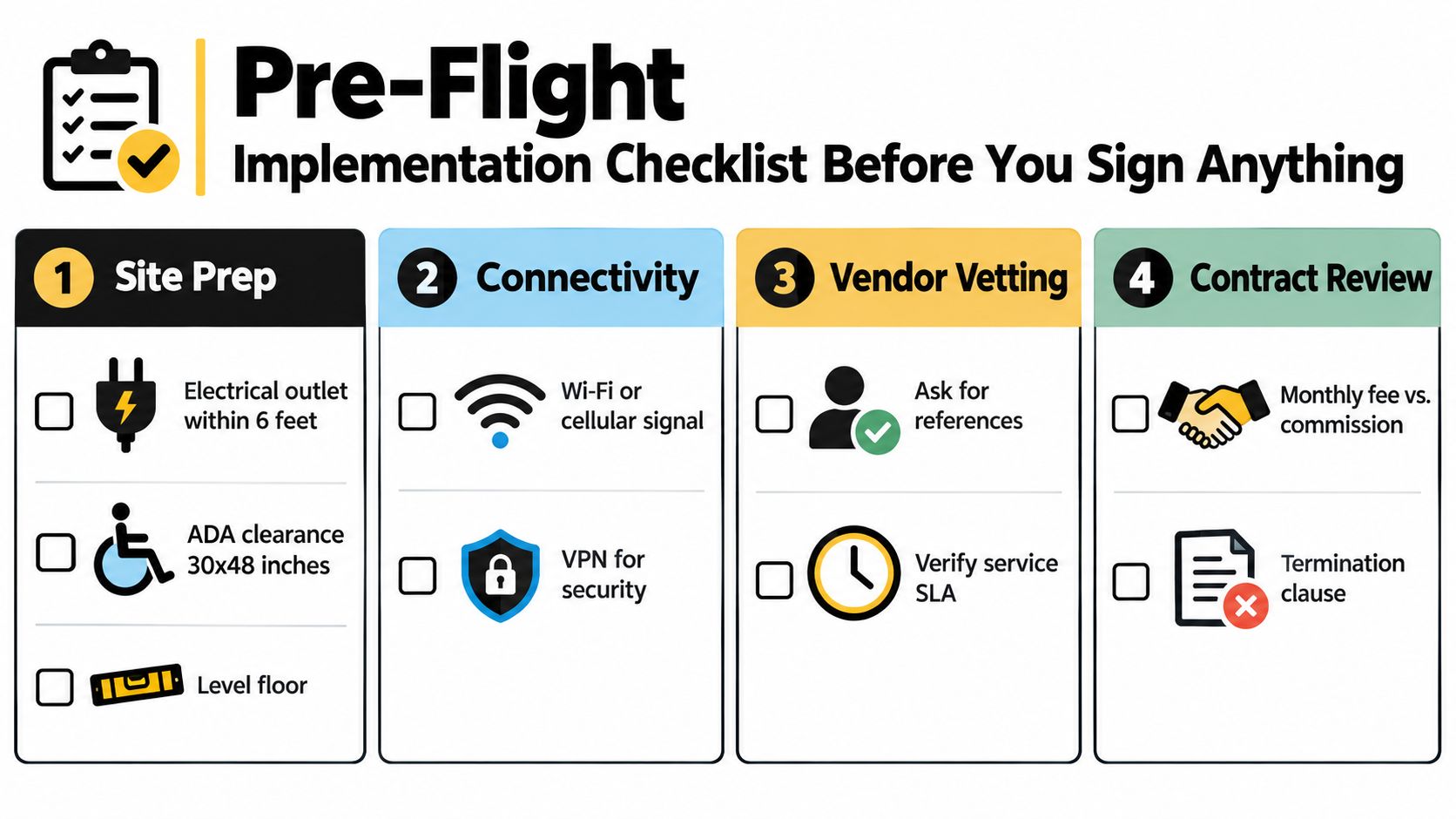
Start with the physical space. Confirm a dedicated 120V outlet within 6 feet of the planned position, ADA clearance of 30 by 48 inches in front of the machine, and a floor rated for 600 pounds or more. The operator should confirm the equipment dimensions, door swing, service clearance, and delivery route before scheduling installation.
Check the site before approving equipment
Walk the proposed location at different times of day. A visible position near the main corridor usually performs better than a machine hidden behind a door, but direct afternoon sun can create unnecessary heat in west-facing Oklahoma lobbies. Verify cellular or wired connectivity at the exact placement point, because a dead zone can interrupt telemetry and payment communication.
Use this pre-sign checklist:
Electrical access: Confirm the outlet location, circuit suitability, and cable path.
Clearance: Protect the required access area and keep the machine away from doors or emergency routes.
Floor condition: Check that the surface is level, stable, and rated for the equipment weight.
Signal quality: Test cellular or wired connectivity where the machine will sit.
Visibility: Choose a position employees, students, staff, residents, or visitors naturally pass.
Temperature exposure: Avoid direct sun, hot mechanical rooms, and poorly ventilated corners.
Cleaning access: Make sure staff can reach the surrounding floor and machine surfaces.
Food handling needs: Confirm which products require refrigeration, freezing, date rotation, or special labeling.
Put the operating promises in writing
The launch plan should name the delivery window, first stocking date, payment processor activation, promotional signage, and first 30-day review meeting. Don't accept “we'll take care of it” as a service standard.
The contract should state the response time for machine faults, normal restock cadence, refund process, temperature-exception procedure, reporting access, ownership of equipment, termination rights, and what happens if sales underperform. Ask whether the operator provides a four-hour response target, next-day service, or another defined commitment.
Contract rule: If uptime, refunds, and restocking matter to your employees, they belong in the agreement, not in a sales conversation.
Use this machine installation process guide to compare the steps your proposed operator expects to complete. A professional installation should feel planned, not improvised around an extension cord and a last-minute delivery.
Common Misconceptions and Smart Next Steps
Refrigerated machines don't automatically fail in Oklahoma heat. They need correct placement, ventilation, cleaning, temperature monitoring, and timely service. A poorly placed cooler can struggle, but blaming refrigeration technology avoids the core question: does the operator have a plan for temperature exceptions and summer conditions?
Cashless payment doesn't automatically mean higher retail prices. It introduces processing costs, but an operator can account for those costs through transaction volume, product selection, and route efficiency. More important, cashless acceptance captures people who would otherwise abandon a purchase because they don't have change.
Payment reliability deserves more attention than the presence of an Apple Pay logo. Current industry coverage reports that more than 63% of newly installed vending systems globally support digital wallets, QR payments, and NFC transactions, while another report puts cashless execution at 67.8% of vending transactions by May 2026. DataIntelo's fresh food vending market coverage highlights the practical gap between accepting payment and handling failed vends, connectivity interruptions, and out-of-stock selections.
Refunds should have a clear owner
A failed vend shouldn't become a customer-service mystery. Telemetered systems can log the transaction and machine event, but the contract still needs to state how customers report the problem, who reviews it, and when the credit is issued. Put the refund channel on the machine itself.
Smart doesn't mean low-risk. Fresh meals, multi-zone refrigeration, and frozen products create more food-safety and energy-management responsibilities than a shelf-stable snack machine. Temperature monitoring helps, but it doesn't replace date rotation, cleaning, documented response, or a service team that can act on alerts.
The installed base also matters. One 2025 North America and Europe market view reported that non-smart units still represented 60.94% of installations, which indicates that conversion from legacy equipment remains a major part of the opportunity rather than every placement being a brand-new smart deployment. Accio's market coverage of smart vending provides that perspective.
Request a site walk from a reputable Oklahoma operator, ask for a 90-day sales projection, and compare the proposal with a second quote. Review product assumptions, service response, payment handling, temperature controls, and reporting side by side. A facility manager who runs that comparison early is far more likely to choose a partner that can keep the machine useful after installation.
Vendmoore Enterprises offers fully managed and client-owned smart vending options for Oklahoma workplaces, schools, healthcare facilities, industrial sites, and residential communities, with cashless payments, connected inventory monitoring, and location-specific product selection. Visit Vendmoore Enterprises to request a site walk, discuss your break room or common-area needs, and build a vending service plan around uptime and the products your people buy.
Comments