
What Is Unattended Retail? a Practical Guide for 2026

When an unattended machine gets a transaction wrong, who answers to the person standing in front of it, and how would anyone even find out?
Unattended retail covers vending machines, open-shelf stores and similar formats where the equipment handles payment and stock tracking on its own. The U.S. convenience-services industry behind those formats returned to its pre-pandemic revenue level in 2023, so more shared spaces now rely on systems where nobody watches the sale happen.
A card reader that charges twice. A coil that jams after the payment clears. A row that stays empty for nine days because nobody was watching. All three are accountability problems, and accountability decides whether people trust the setup or drift back to the convenience store on their break.
That is the lens worth using for any site, whether it is a hospital staff room, a school corridor, a factory floor or an apartment lobby. The useful question is which parts of the system leave a record, and who reads that record when something goes wrong.
What Unattended Retail Means in Plain Terms
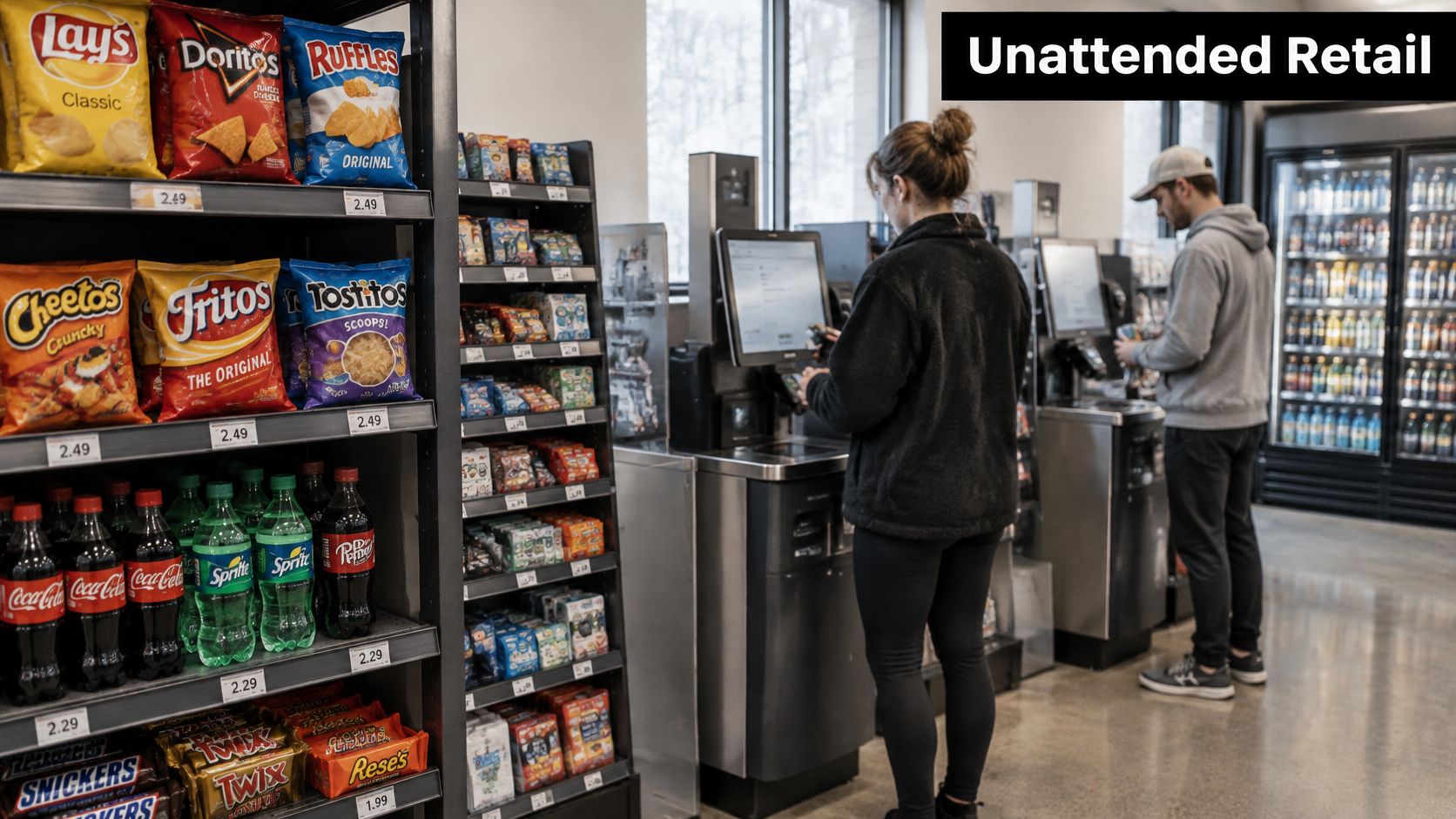
Unattended retail is any sale where no member of staff stands at the point of purchase and the equipment does the verifying. Picture a supermarket self-checkout lane shrunk to fit a break room: the scanner becomes a coil sensor or a shelf camera, the bagging scale becomes a weight pad, and the card reader stays exactly where it was.
A cashier used to do three jobs at once. They took the money, they watched what left the store, and they noticed when a shelf ran dry. Every unattended format rebuilds those three jobs out of hardware, software and a restocking schedule, and the quality of that rebuild separates a system that works from a cabinet full of complaints.
The three parts every setup needs
A place to buy. A coil cabinet, an open shelf, a glass-front cooler, a locker bank. The format decides how wide the assortment can be and how much floor space the site gives up.
A way to pay without a person. A card reader or tap-to-pay terminal, usually with a coin or note option behind it for the minority who still carry cash.
A system that records and reacts. Every sale, failed vend, temperature reading and door event lands in software that tells someone what to restock and what to repair.
Compare that with the two things people confuse it for. A staffed shop verifies every transaction through a person, which is expensive but self-correcting. An honor box verifies nothing: it relies on the customer to pay and leaves no record either way.
The practical distinction: a traditional honor box asks people to be honest. An unattended system doesn't have to, because it writes down what happened and can show the buyer the same record.
Timing explains why this matters now. A hospital needs food at 3 a.m., a university needs it between lectures, a plant needs it at shift change, and an apartment block needs it on a Sunday. A staffed cafeteria can't cover those hours at any sensible cost. A machine or a small market can.
Everything else follows from those three parts: which formats exist, how one sale travels through the system, which sensors prove what, what breaks, and how to choose for a specific building.
Why Sites Adopt Unattended Retail
Five benefits show up in almost every site survey, and each one comes with a condition attached.
Round-the-clock access. A nurse finishing a night shift, a stadium crowd at half time, a tenant collecting a late snack. None of them can wait for a cafeteria that opens at seven.
Lower staffing burden. No counter, no cashier and no rota to fill. The operator carries stocking and service, provided the route is planned from real demand rather than a fixed fortnightly visit.
Faster checkout. A tap with a card or phone takes seconds, and buyers increasingly arrive without coins in a pocket.
Better assortment over time. Telemetry shows which slots earn their space, so the mix sharpens at each restock instead of staying whatever was loaded on day one.
Shared-space value. Employees, students, patients and tenants get food access in buildings where a staffed cafeteria would never cover its own labor.
Each benefit leans on something. The payment reader needs a working network connection. The assortment only improves if somebody reads the sales data. Access only stays reliable if there's a named support route for a jammed coil or a double charge at 9 p.m. on a Friday.
That's the trade a site makes. Speed and access in exchange for holding the operator to account for errors and for the data the system collects.
The Main Formats From Vending Machines to Micro Markets
Six formats cover most of what a site will be offered, and the differences that matter are what they hold, how the customer shops and how much room they need.
Format | What It Sells | Payment | Typical Placement |
|---|---|---|---|
Snack and beverage vending machine | Packaged snacks, cans and bottles | Card or phone wallet, sometimes cash | Break rooms, lobbies, gyms |
Bottle and can vendor | Cold beverages only | Card or phone wallet | Warehouses, schools, stadiums |
Compact refreshment center | Snacks, drinks and small grab-and-go items | Card or phone wallet | Small offices, clinics, residential lobbies |
Dual-zone chill center | Ambient and chilled items in separate zones | Card or phone wallet | Offices and manufacturing floors |
Frozen food machine | Frozen meals and desserts | Card or phone wallet | Break rooms and shift-based sites |
Micro market | Open-shelf fresh food, drinks and meals with a self-checkout kiosk | Card or phone wallet | Corporate campuses and large workplaces |
Why the mix tilted toward open shelves
Vending still carries the industry: 68% of U.S. convenience-services revenue in 2023, against 69% in 2019, according to NAMA's convenience-services revenue report. Micro markets did the growing, rising from 2% of industry revenue in 2014 to 20% by 2023, with revenue climbing at an average annual rate of 41% since 2020.
The reason isn't that coils stopped working. A coil limits a site to packaged, shelf-stable items bought one at a time, while an open shelf with a kiosk lets someone pick up a sandwich, a coffee and a bag of chips in a single transaction. That difference decides which sites can move beyond snacks. The mechanics of the open-shelf model, including how self-checkout handles a basket of items, are set out in how a self-serve market works.
A rule that saves arguments: match the format to the need, not to the budget. A snack machine where people want lunch will be empty by Tuesday; a micro market in a 20-person office will struggle to keep fresh food moving.
Before anyone signs, answer three questions. How many people use the space on a normal day? A few dozen supports a refreshment center; several hundred across shifts supports a market. When do they want food, really? If demand peaks mid-afternoon, a chill unit earns more than a wider snack range. Does anything need temperature control? Fresh and frozen items rule out a coil cabinet for that part of the range.
How a Single Unattended Sale Works
A purchase looks like nothing from the outside: a tap, a thud, a walk away. Seven things happen underneath, and each one answers a question a cashier used to answer by standing there.
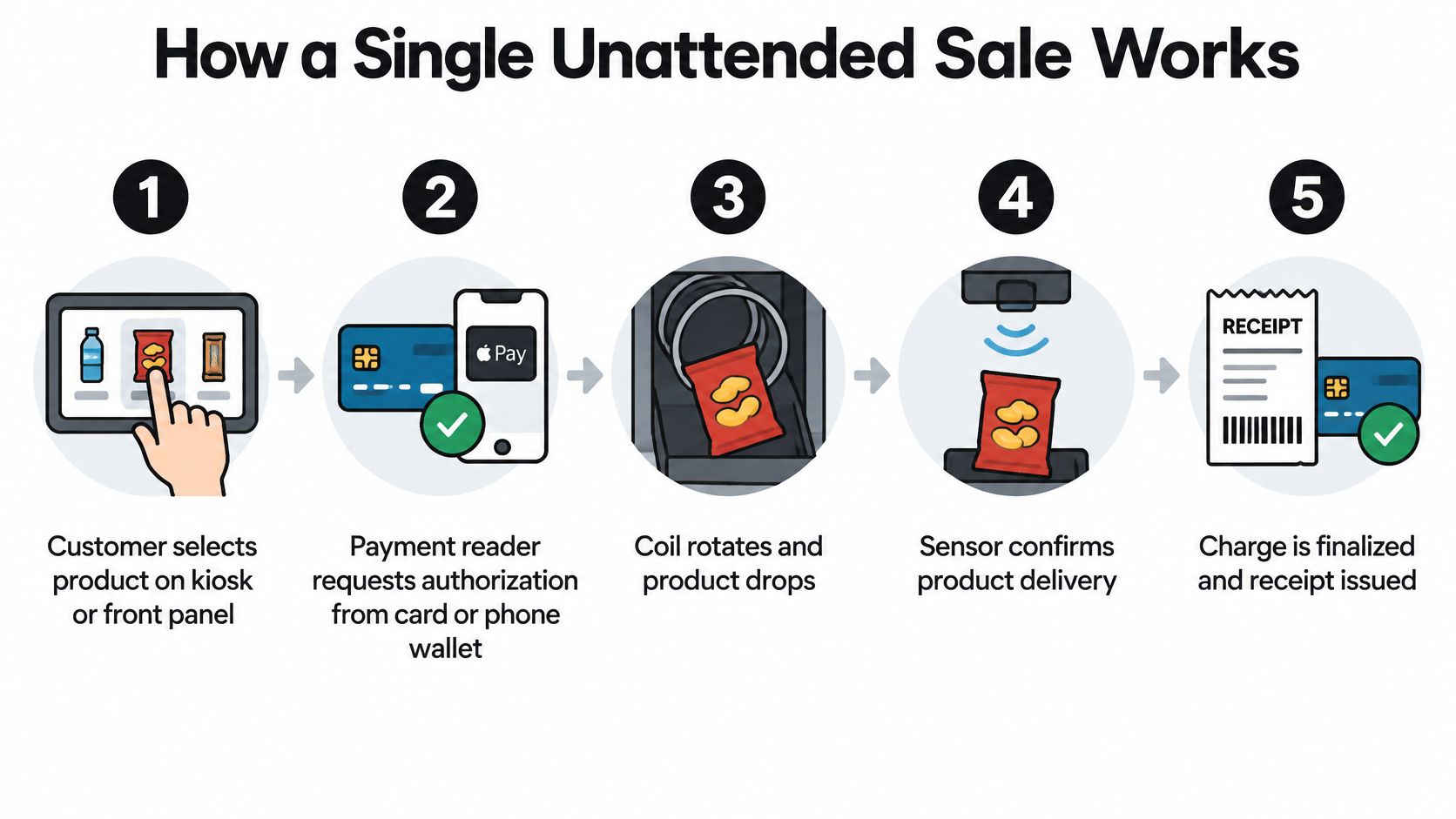
The customer selects. They press a slot code or tap a product on the kiosk. That choice is the first data point, and it names the exact item before any money moves.
The reader requests authorization. The terminal asks the card issuer or wallet for approval and holds the amount rather than capturing it. That hold is why a failed vend usually doesn't turn into a refund chase.
The mechanism releases the product. A coil turns, a gate opens or a locker door pops. The machine then looks for proof of delivery through a drop sensor, a light beam or a weight change, because payment approval alone proves nothing about what left the cabinet.
Sensors update the expected count. The slot-level record changes at the moment of confirmation, not at the next restock. That single design choice is what makes remote stock visibility possible.
The controller reports the event. Sale amount, vend result and any error code travel to the operator's dashboard. This is the step that turns a cabinet into a managed service with a service history.
The dashboard flags exceptions. Low stock, failed vends, door events, temperature drift and repeated reversals surface here, sorted by what needs attention first rather than by machine number.
Someone acts. A route driver restocks, a technician replaces a coil, a support agent issues a refund. Response time at this step is the part customers feel.
Cashless is the default now, not a premium. Industry reporting citing the National Automatic Merchandising Association estimated that approximately three-quarters of U.S. vending machines accepted cashless payments by 2024, up from 69% in 2018, Vending Times reported. The same article notes the Federal Reserve put cash at 14% of consumer payments in 2024, with consumers averaging seven cash payments a month.
Read those two figures together and the design brief writes itself. Build for the tap, keep a cash option for the minority, and make the receipt and refund path obvious to someone who never speaks to a person. A machine that charges a card and then offers no route to a refund undoes every convenience it promised.
The test of a working loop: every approved payment has a matching vend, and the physical count at each restock reconciles with the sales record. When those two numbers agree, the system is doing its job.
When they don't, that gap is the signal worth chasing.
Sensors and Payment Tech Behind the Scenes
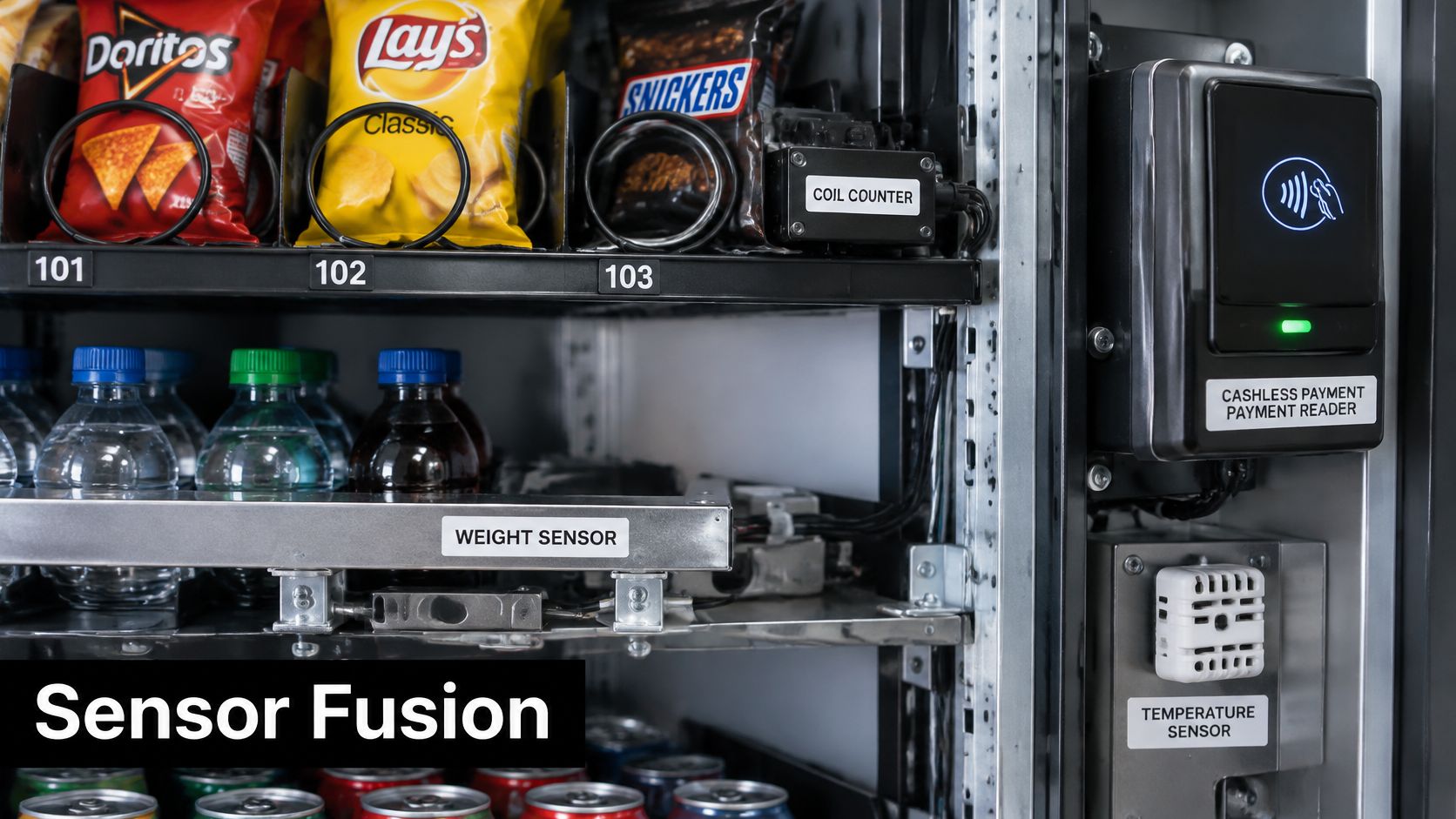
No single sensor proves a sale went right. A coil counter says a product dropped, not that anyone took it. A weight pad notices something left the shelf but can't separate two items of similar mass. The workable design is redundancy: several weak signals read together, each covering another's blind spot.
Technology | What It Tells the Operator | Main Limit |
|---|---|---|
Cashless payment reader | Whether a sale was approved, declined or reversed | Does not show what physically left the machine |
Vend or coil counter | Whether a product was dispensed | Cannot confirm the buyer took it |
Door and lid sensors | Access events and how long a door stayed open | Records access, not what was removed |
Temperature sensor | Cold-chain status for chilled and frozen zones | Reads the zone, not each item |
Weight sensor | Change in shelf weight | Confuses products of similar weight and needs calibration |
RFID tag reader | Item-level presence without line of sight | Not suitable for every product and adds tagging cost |
Computer vision camera | Items handled versus items scanned | Raises privacy and data-protection duties |
Connected telemetry | Uptime, stock levels and error codes, remotely | Depends on a working network connection |
Payment is the row to inspect hardest, because it's the only one the customer sees directly. What a cashless payment terminal has to get right, from authorization through refunds and connectivity, is where most complaints originate.
Sensor fusion is the discipline that makes the table useful. Industry research cited in a Zensar study on shrinkage and retail profitability reports that RFID adoption can reduce shrinkage by up to 20%, a benchmark drawn from broader retail deployments rather than vending specifically. Treat it as a direction of travel, not a promised result.
The pattern that holds up is reconciling three things: the expected balance from sales and replenishment, the physical signals from coils, shelves and doors, and a periodic count or image check. Then an alert can carry a likely cause instead of just a number.
The short walkthrough below shows how the sensors and controller on a modern machine talk to each other.
Five numbers tell you whether any of it is working: inventory-record accuracy, stockout rate, vend-success rate, mean time to replenish, and unexplained variance per 100 transactions. The last one is the most honest, because it isolates the losses nobody can attribute to a jam or a bad forecast.
Ask any provider three questions. Which sensors are fitted? What does each one report? And how often is a physical count reconciled against the sales record? A vague answer to the third is the one to worry about.
How Telemetry Catches Shrinkage and Stock Gaps
Adding a camera doesn't solve shrinkage. It produces footage. What solves it is a comparison: what the customer handled against what the customer paid for, checked automatically at the point of transaction.
A UK Research and Innovation project set out exactly that architecture. Computer vision counts the items physically handled or scanned and cross-checks the count against the customer's digital basket, designed to catch unscanned products and scan omissions that conventional CCTV misses when nobody is watching the monitor (UK Research and Innovation project record). The same work notes that RFID and electronic article-surveillance labels aren't suitable for every product and haven't been deployed universally, which is why vision-based checks matter for mixed assortments of packaged snacks, drinks and frozen items.
Signal | Likely Cause | First Response |
|---|---|---|
Payment approved, no vend confirmation | Mechanical jam or coil fault | Dispatch a technician and refund the buyer |
Stock short with no matching sales | Miscounting or shrinkage | Run a physical count and check camera or RFID records |
Frequent door-open events | Late restocking or tampering | Check route logs and access records |
Repeated payment reversals | Card reader fault or a dispute pattern | Test the reader and review transaction history |
Temperature above set range | Cooling fault or door left open | Pull affected stock and service the unit |
Sales falling with full stock | Weak assortment or poor placement | Gather user feedback and adjust the product mix |
Every one of those signals is cheap to capture and expensive to ignore. The operating rule is to rank inspections by expected loss instead of servicing every machine on the same schedule, which is how a driver ends up visiting a healthy machine in Edmond while a problem unit across town goes another week without attention.
A 40-slot machine in one office that comes up two units short every weekend doesn't need a price increase or a second camera. It needs one targeted count on a Saturday morning to establish whether the loss is a restocking miscount, a door event, or removal without a scan. The pattern is the evidence. The response should be narrow.
A design constraint, not an afterthought: vision checks belong on the edge, with short retention and no biometric identification, so the system can prove a discrepancy without building a video archive of everyone who walked past the machine.
What to request from any operator is an exception log and a stated response time for each signal type. How shrinkage prevention works in a vending program is a fair test of whether the provider treats this as engineering or as an after-sales excuse.
Privacy, Accessibility and Trust in Shared Spaces
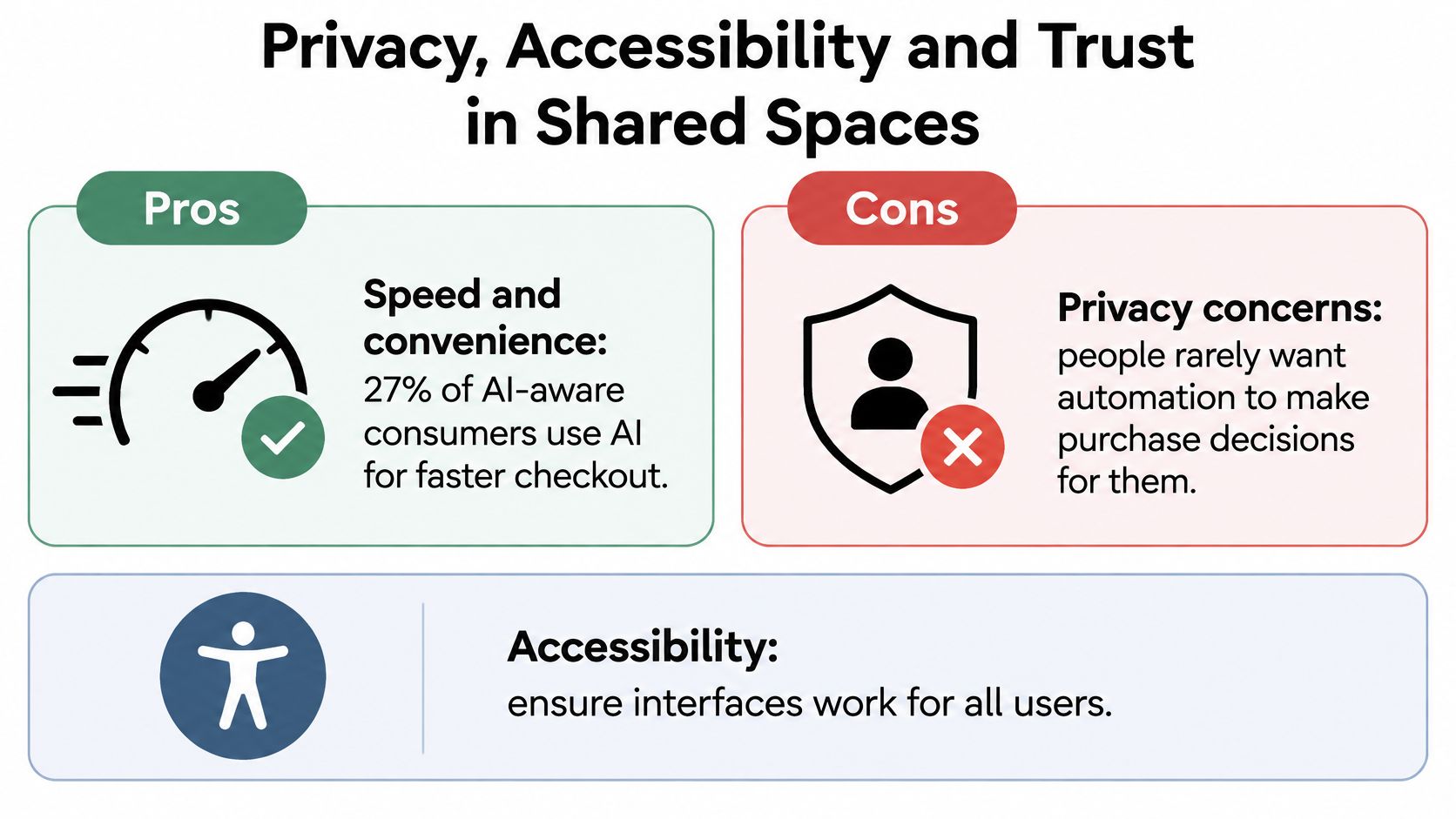
People want automation to go faster. They rarely want it to decide for them, and the gap between those two things is where trust gets built or lost.
Research across 15 global markets found that 27% of AI-aware consumers use AI for product research, but only 9% currently allow autonomous purchases, and 71% believe AI should be approached cautiously (Ipsos). Within that same body of work, just 13% had let AI complete a purchase, even though 70% said they felt at least somewhat comfortable with the idea.
Cashless payment and inventory telemetry don't require facial recognition, and they don't require letting software buy on someone's behalf. Keeping those features out keeps accountability legible: a person taps, a person chooses, a named support channel fixes errors.
The line to draw separates operational telemetry, meaning product sales, stock levels, temperature and uptime, from identity or behavioral surveillance. Retail systems can collect traffic, dwell time and potentially demographic data, and obligations may apply under laws such as GDPR, CCPA and PIPEDA, as Intel's analysis of retail technology trends sets out. In schools, clinics and apartment buildings, where users may be minors, patients or tenants, profiling and differential treatment are the risks worth designing out rather than managing later.
Feature | Benefit | Trust Risk |
|---|---|---|
Cashless payment | Fast checkout without coins | Unclear refund ownership when a vend fails |
Inventory telemetry | Stock levels and route planning | Over-collected data if sensors record identity |
Computer vision checks | Catches unscanned items | Privacy and data-protection duties apply |
AI product recommendations | Helps users find products faster | Can steer purchases and shape fairness between users |
Autonomous purchase | Hands-free buying | Only 9% of consumers currently allow it |
Accessibility belongs in the same conversation. A machine has to work for someone with limited reach, low vision, a language other than English, no bank card, or a phone with no signal in a basement break room. Screen design carries much of that weight, and what a vending machine touch screen should get right covers display contrast, language options and confirmation screens. Redundant payment options and a support number a human answers buy more trust than personalization does.
Where Unattended Retail Fits and How to Decide
Six site types, each with a different center of gravity.
Corporate offices and business centers. Demand spreads across the day and spikes mid-afternoon; after-hours access is what staff notice when they work late.
Schools and universities. Product rules and allergen clarity matter more than range, and part of the audience can't sign a contract or hold a card.
Hospitals and clinics. Rotating shifts plus visitors arriving at unpredictable hours, where reliability outranks novelty.
Manufacturing and industrial sites. Shift change drives demand, so frozen meals and a dual-zone chill unit often earn space a snack machine wouldn't.
Multi-tenant residential buildings. A compact refreshment center in a lobby serves people who never meet a staff member.
Airports and stadiums. Short, intense peaks where the whole value is speed and the queue behind you.
The decision itself comes down to five checks.
Count daily users. Not the headcount on the lease, the number who walk past the space on a normal day.
Confirm when demand peaks. A 6 a.m. shift site and a 2 p.m. office need different stocking rhythms.
Check whether anything needs chilling or freezing. That single answer decides between a coil cabinet and a chill or frozen unit.
List the payment methods available on site. Include one option that doesn't need a smartphone or a bank card.
Require a written escalation route. Who refunds a failed vend, within what time, and who answers the phone on a Saturday.
A fully managed service suits a site with no staff to spare for stocking and repairs, while ownership suits a site that wants control over assortment and pricing and can carry the servicing itself. The cost side of that choice, including what vending machine installation actually costs, usually settles the argument faster than a feature comparison. Vendmoore Enterprises runs full-service vending across Oklahoma City, Norman and Edmond, with tap-to-pay and remote monitoring on its machines, so the checklist above can be pointed at a real set of answers rather than a brochure.
One more test costs nothing. Search for the service the way your staff would, for example break room vending in your own city, and look at what comes back. Google says local results are decided mainly by relevance, distance and prominence, where prominence reflects reviews, links, directories and overall standing in web results (Google Business Profile help). A provider with a claimed, verified profile and specific pages for office, school, healthcare and industrial vending is easier for Google to match to that search than one with a single generic page (Google Search Central guidance on business details).
Shortlist two providers, ask each for a sample exception report and a written repair response time, then score the answers against the five checks.
Vendmoore Enterprises installs and operates smart vending machines for workplaces and shared spaces across Oklahoma City, Norman, Edmond and the surrounding cities, with tap-to-pay, remote monitoring and full-service stocking handled by our team. If you're weighing a break room machine, a refreshment center or a frozen food unit, we'll help you match the format to your building and show you how the reporting works before you commit. Visit Vendmoore Enterprises to start the conversation.
Comments