
United Vending Food Service vs Modern Smart Vending

What if the name you're searching for doesn't tell you who will stock your break room, fix a jammed machine, or choose snacks your team will buy? Many facility managers start with United Vending Food Service because it sounds established and complete. That's understandable. The more useful question isn't whether the name sounds right, it's what kind of vending service stands behind it and how that service will work day after day in your Oklahoma workplace.
What Does United Vending Food Service Mean
You're setting up a new office in Oklahoma City. Employees keep asking for drinks nearby, the nearest convenience store isn't walkable, and you type United Vending Food Service into Google hoping to find one clear company to call. Instead, you see similar names, national directories, and local operators that don't seem connected.
That confusion is normal. The phrase is best read as a generic description, not a single well known national brand. It could refer to a local operator using a broad name, a division name inside a larger firm, or the combination of vending machines plus food service. Different companies can use similar words because the words themselves describe what they do.
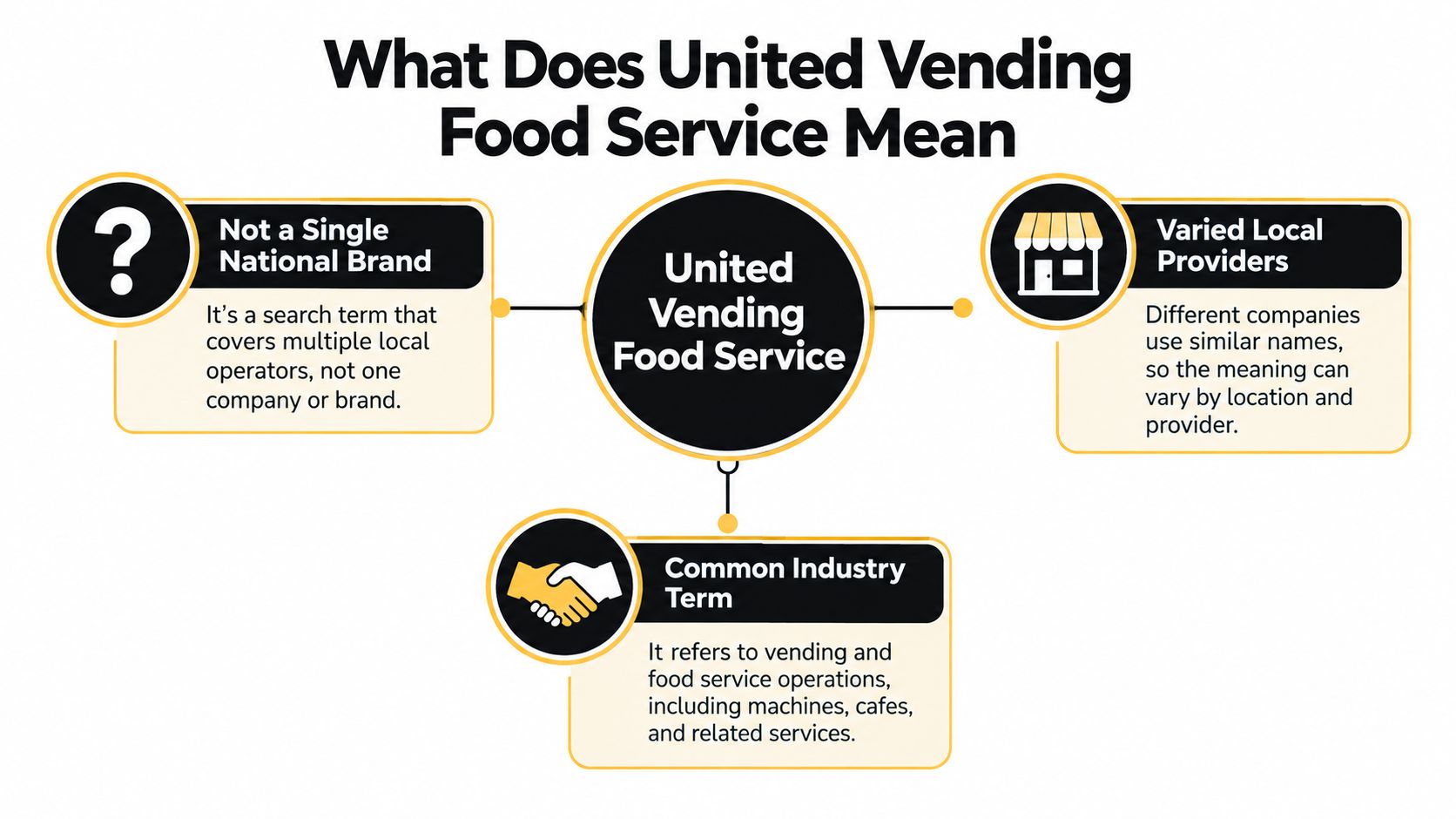
Why vending has so many local names
Vending isn't organized like a handful of fast food chains. The U.S. vending machine operator industry recorded 3,740 establishments and 41,069 employees in the 2017 Economic Census data for vending machine operators, showing a distributed business made up of thousands of operating locations rather than a small number of national companies.
It works like plumbing. You'll find many independent firms with similar names because each one serves nearby routes. A driver has to physically visit your machine, carry products, clean equipment, and respond when something breaks. Distance still matters, so local and regional operators dominate daily service.
How to interpret the name when you see it
Don't chase the name. Evaluate the operation behind it.
Check the service area: Does the operator serve your building in Oklahoma City, Norman, or Edmond, or are you reading a directory listing?
Check the equipment: Can they place snack, beverage, chilled, or frozen machines, or only one basic type?
Check the service model: Who stocks, cleans, repairs, and decides what products stay or go?
A vending name is a label. Your contract, service visits, and stocking choices are the real product.
That distinction sets up a better comparison. Instead of asking which name is biggest, ask how a traditional operator model differs from a modern, AI powered local service like Vendmoore, and which one fits your site.
The Traditional Vending Business Model Explained
A traditional vending business works like a small convenience store split into many tiny locations and visited by truck. The operator places machines, fills them, collects money, and repeats the route. When that system works, you barely notice it. When it doesn't, you notice empty coils, outdated snacks, and a machine that won't take a card.
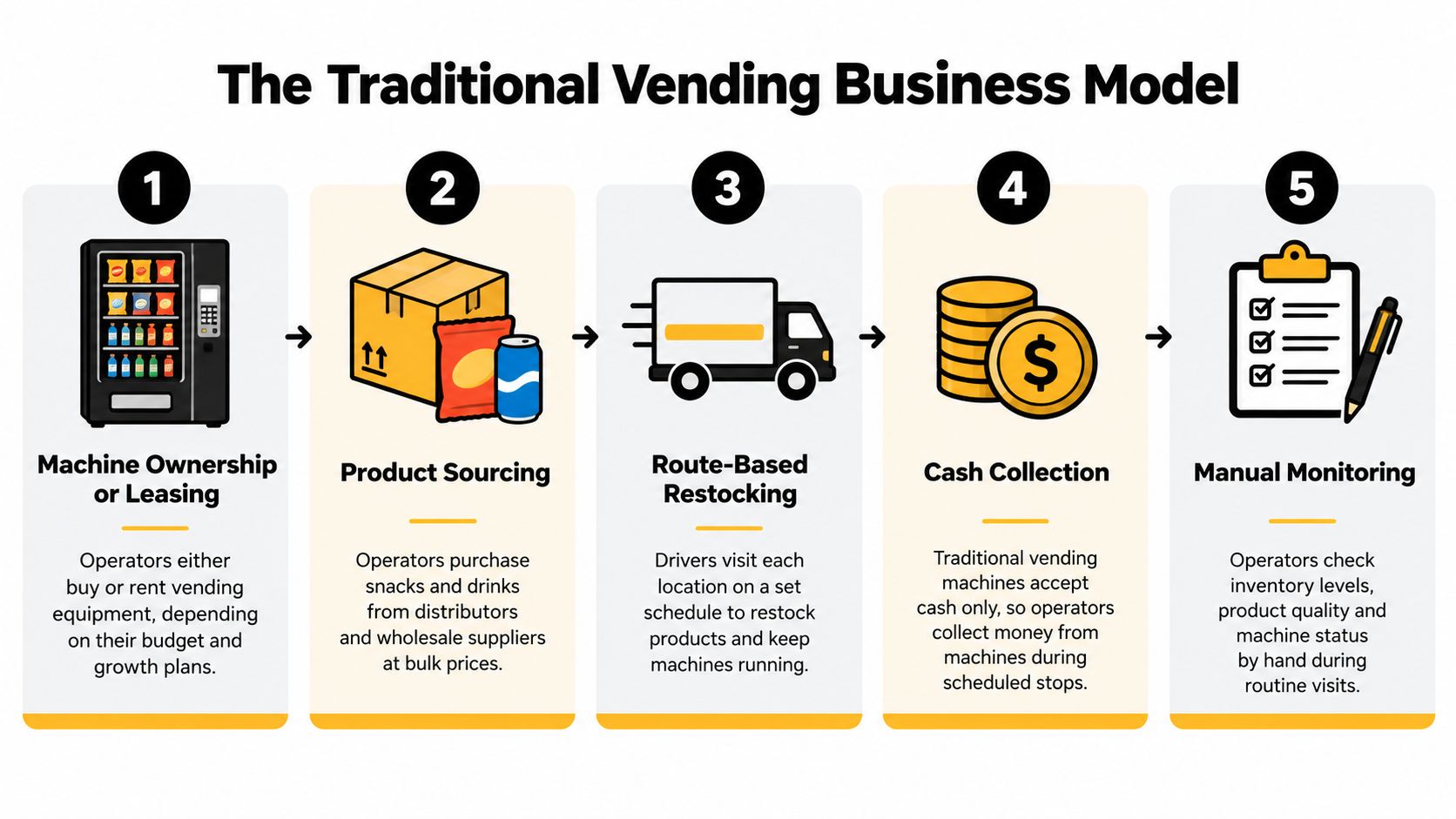
The five moving parts
First, the operator buys or leases machines and agrees placement with a workplace, school, hospital, or factory. If you're comparing proposals, it helps to understand how vending machine placement fees work in managed programs before you sign anything.
Second, the operator buys snacks and drinks from wholesalers or distributors. Third, a route driver visits on a schedule, often the same day each week, and refills what looks low. Fourth, the driver collects cash and coins. Fifth, the operator handles cleaning and repairs, usually after someone reports a problem.
That model built a large industry. The NAMA Foundation's 2015 census reported $24.6 billion in total refreshment services revenue, with vending accounting for 81%, or approximately $19.9 billion, across 15,250 operators and 1.9 million customer locations, according to the NAMA industry census results reported by Vending MarketWatch.
Where the old model strains
The weakness isn't effort, it's information. If a driver visits on Tuesday and your top drink sells out Wednesday, the machine sits partly empty until the next visit unless someone calls. Stocking decisions often rely on habit and memory, so slow sellers stay while popular items run out.
Payment can be uneven too. Older machines may accept cash only, which frustrates employees who don't carry bills. Sustainability questions add another layer in offices with coffee service, and Nothing's compostable cup guide is a useful starting point if your break room is reviewing disposable cups alongside vending.
In short, traditional vending is a route and guesswork system. It's proven and familiar, but visibility between visits is limited.
How Vendmoore Modernizes Vending in Oklahoma
Vendmoore follows the same basic promise as any operator, which is convenient food and drinks on site. The difference is how it gets information and acts on it. Instead of waiting for the next route to discover a problem, the machine reports what's happening between visits.
The screenshot below shows how Vendmoore presents its modern vending offer to Oklahoma workplaces.

Start with payment and telemetry
Step one is removing friction at the machine. Vendmoore's smart machines accept cashless payments, including Apple Pay and Google Wallet, so employees and visitors don't need exact change. That matters in hospitals at night, factories between shifts, and offices where people tap a phone.
Step two is connected telemetry. The system provides real time inventory and performance insights, which means the operator can see what's selling, what's low, and whether a machine needs attention before complaints pile up. You're replacing the driver's clipboard guess with location level sales data.
Step three is tailoring. Vendmoore gathers employee and customer feedback and adjusts selections accordingly. A warehouse crew may want filling frozen items and large drinks, while an office may rotate snacks and lighter options. The point isn't that an algorithm guesses perfectly. The point is that actual purchases and direct feedback guide the next stocking plan.
Equipment matched to the space
Vendmoore's portfolio includes compact refreshment centers for smaller break rooms, bottle and can vendors for drinks, dual zone chill centers for chilled items, and frozen food machines for more substantial options. You don't have to force one large machine into every setting.
The short video below gives a visual sense of this modern approach in a real setting.
Based in the Oklahoma City metro and serving Norman, Edmond, and surrounding cities, Vendmoore pairs that technology with consistent follow ups and rapid responsiveness. Data helps, but a local team still has to load the right products and show up quickly.
Traditional vs AI-Powered Vending Compared
Comparing these models isn't about old being useless and new being automatic. It's about which trade offs you can live with. A quiet office with steady demand may tolerate scheduled visits. A busy plant or hospital usually can't.
Traditional vs AI-Powered Vending at a Glance
Feature | Traditional Vending | Vendmoore AI-Powered |
|---|---|---|
Payment | Often cash focused, card options vary | Cashless, including Apple Pay and Google Wallet |
Inventory | Checked manually during visits | Monitored through connected telemetry |
Product selection | Based on habit and route experience | Adjusted using sales data and site feedback |
Service response | Usually after a complaint or next visit | Proactive follow up with faster local response |
Data visibility | Limited between visits | Real time inventory and performance insights |
Accountability | Depends heavily on the route driver | Local team backed by machine reporting |
If you want the mechanics behind the right hand column, Vendmoore explains how smart vending machines work from sensor to restocking in plain terms.
Why stockouts matter more than they look
A vending machine isn't always an impulse treat. A 2024 survey of 1,005 on site workers found that employees without employer provided meals were more likely to eat snacks as meals at 65%, skip meals at 48%, or rely on vending machines and convenience stores at 18%, according to the ezCater Food for Work Report 2024.
That changes the stakes. If vending is a meal substitute for someone on a short break, an empty machine isn't a minor annoyance. It's a missed meal or a trip off site. Telemetry earns its value when it triggers earlier restocking and better choices, not when it only produces a dashboard.
Workplace leaders thinking about staffing and service coverage alongside amenities can also find AI workforce management insights useful for the broader operations picture.
Decision rule: Choose the model that reduces empty slots and complaints at your busiest hours, not the model that looks simplest on a proposal.
Local accountability is the final divider. When the operator is nearby and the machine reports problems early, you get both a person to call and evidence of what needs fixing.
Vending Solutions for Different Oklahoma Workplaces
The right assortment in a downtown office will fail in a manufacturing plant, and both will fail in a hospital corridor. People differ, break lengths differ, and hours differ. Good vending starts with the site, not a fixed product list.
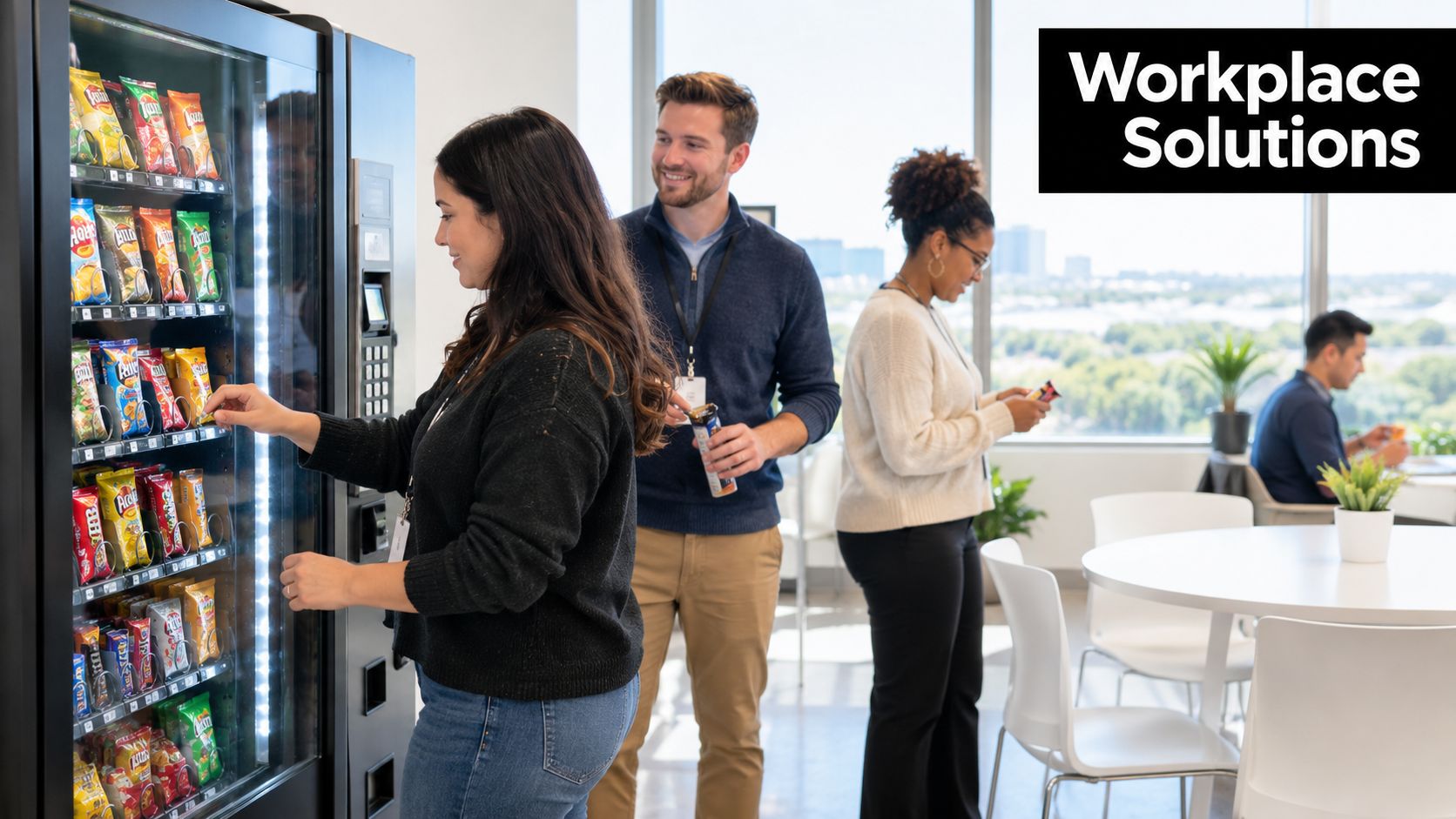
Offices, schools, and healthcare sites
Corporate offices and business centers usually need a compact footprint, quick payment, and variety that rotates before employees get bored. A compact refreshment center paired with a bottle and can vendor often fits better than one oversized unit.
Educational institutions need predictable stocking around class schedules and products appropriate for students, staff, and visitors. Healthcare facilities are different again. Nurses, technicians, patients' families, and night staff may need chilled or frozen food when cafeterias are closed, so availability and food safety matter as much as choice.
Federal and public sector guidance requires effective time and temperature controls for perishable vending products, plus temperature monitoring, date stamping, sanitation, and corrective action when controls fail, as set out in the federal food safety and sanitation guidelines for vending operations. Ask any operator how they meet that standard for chilled and frozen machines.
Industrial, residential, and public venues
Manufacturing and industrial sites often need heartier options and high capacity drinks because breaks are short and physical work drives appetite. Multi tenant residential complexes need convenience outside office hours, while stadiums and airports face surges tied to events and travel patterns.
Manufacturing: Frozen items, substantial snacks, and fast restocking around shift changes.
Residential: Reliable everyday drinks and snacks for evenings and weekends.
Stadiums and airports: Capacity, speed, and monitoring during peak surges.
Healthy vending fits into this site by site thinking. Removing every indulgent item can push people to skip food or leave the property, so balance matters. For a broader view of formats, Vendmoore's overview of food and drink vending machines for different locations shows how equipment and assortment change together.
Track healthy item share of sales, repeat purchases, stockouts, and employee satisfaction. Those measures tell you whether healthier choices are available and chosen, not just advertised.
Why Local Visibility Matters for Vending Services
You can't evaluate a vending partner you can't find, and you can't hold one accountable if you don't know where they're based. Local visibility isn't vanity marketing. It's a practical signal that an operator serves your area, answers to nearby customers, and can reach your site quickly.
Google states that local search visibility is primarily influenced by relevance, distance, and prominence, and that more reviews and positive ratings can help local ranking, according to Google's guidance on improving local ranking. Each factor maps to a real buying question.
What those three factors mean for you
Relevance asks whether the business clearly offers what you searched for, such as break room vending, office beverage service, smart vending, or frozen food vending. Distance asks whether the operator is close enough to service you well. Prominence asks whether other people know and review the business.
That's why dedicated pages for Oklahoma City, Norman, Edmond, and nearby service areas help. A single generic page can't tell a Norman school and an Edmond office whether routes, response times, and equipment options fit them. Vendmoore's page on local vending services across the Oklahoma City area is an example of making that service area explicit.
Reviews as an accountability loop
Reviews do two jobs. They help future customers find the business, and they give the operator public feedback it has to respond to. A workplace manager describing a smooth installation or a property manager noting fast restocking tells you more than a slogan does.
For a growing operator, this visibility also drives the business goal behind searches like United Vending Food Service. People looking for break room vending need to discover a real local provider, understand its services, and convert into inquiries. Clear service pages, accurate profiles, and authentic reviews turn that search traffic into customers while supporting Google ranking over time.
A local operator with visible reviews has a reputation to protect on your route, not just a machine to place.
Choose the provider you can verify, reach, and review. That combination usually predicts responsiveness better than size alone.
What to Look for in a Vending Partner
Interview a vending operator the way you'd interview any service contractor. Ask direct questions, request evidence, and notice whether answers describe a system or just a promise. You'll avoid most disappointments before the machine arrives.
Payments, products, and restocking
Start with the user experience. Which payment methods work at the machine, and what happens if a payment fails or a product doesn't vend? Ask how refunds are handled and who employees contact.
Then ask how products get chosen. Does the operator use sales data and site feedback, or does every location get the same planogram? Who can request changes, and how quickly do slow sellers rotate out?
Finally, pin down restocking. Is it on a fixed route, triggered by telemetry, or both? What happens during holidays, special events, or a sudden surge in headcount?
Food safety and service evidence
For chilled and frozen food, ask for specifics, not reassurance.
Temperature monitoring: Are logs kept, and who receives an alarm when temperatures drift?
Date rotation: How are products date checked, quarantined, and removed when limits approach?
Sanitation: What's cleaned during each visit, and what's on a deeper schedule?
Corrective action: If power fails, does the machine stop dispensing and how is affected food handled?
Traceability: Can the operator show what was stocked, when, and by whom?
Telemetry only counts when it triggers a documented response. A sensor that nobody acts on is just a record of a problem.
Put expectations in writing. Vendmoore's guide to a vendor management service level agreement for vending programs helps you frame response times, stocking standards, and reporting before problems occur.
Also clarify the commercial model. Some businesses prefer a fully managed program where the operator owns, stocks, and maintains everything. Others want to own machines and buy service separately. Either can work, but responsibilities for repairs, product waste, and upgrades must be explicit.
End by asking for local references in settings like yours. A hospital reference won't fully predict factory performance, and a small office won't predict airport surges. Match the evidence to your environment.
Choosing the Right Vending Approach for Your Business
Return to the search that likely brought you here. United Vending Food Service sounds like a destination, but it's really a category label. The operator behind the label, their distance from you, their equipment, and their restocking system will determine whether employees trust the machine or walk past it.
Traditional vending offers familiarity. Machines get placed, a driver follows a route, and cash gets collected. That can be enough for a stable, low volume site. Its limits appear between visits, when nobody knows a best seller is gone, a card reader is missing, or a chilled product needs attention.
AI powered vending adds visibility and speed. Cashless payment removes a daily barrier, telemetry replaces guessing with inventory and performance data, and feedback driven assortments keep the selection tied to your people rather than a warehouse habit. Vendmoore combines those tools with a local Oklahoma City metro presence, serving Norman, Edmond, and surrounding communities.
A simple way to decide
Walk your own site at the busiest break time. Count how far people travel for food, how long they have, and whether they'd use frozen or chilled options outside normal hours. Then test each operator against that reality, not against a brochure.
Reputation can support that decision if you read it correctly. A 2025 BrightLocal survey of 1,026 U.S. adults found that 96% of consumers are open to writing a review for a local business, while 27% use only one website to read reviews and 40% use at least two review sources on average, according to the BrightLocal Local Consumer Review Survey 2025. Check more than one source, and look for comments about stocking and responsiveness, not just price.
For operators, the same lesson runs in reverse. Businesses grow when searchers for break room vending and vending services can find clear local pages, understand modern smart vending, and see credible customer feedback. Visibility brings inquiries, but reliable service turns inquiries into long term locations.
You don't need the biggest name. You need the right fit for your people, hours, space, and appetite, backed by evidence you can check.
Vendmoore Enterprises installs and manages AI powered smart vending for Oklahoma workplaces and public spaces, with cashless payment, telemetry based restocking, and assortments suited to each location. If you're comparing a traditional United Vending Food Service style operator with a modern local alternative, visit Vendmoore Enterprises to explore equipment options and discuss vending for your break room or common area.
Comments