
Vegan Snack Boxes: Labels, Allergens and Vending Choices

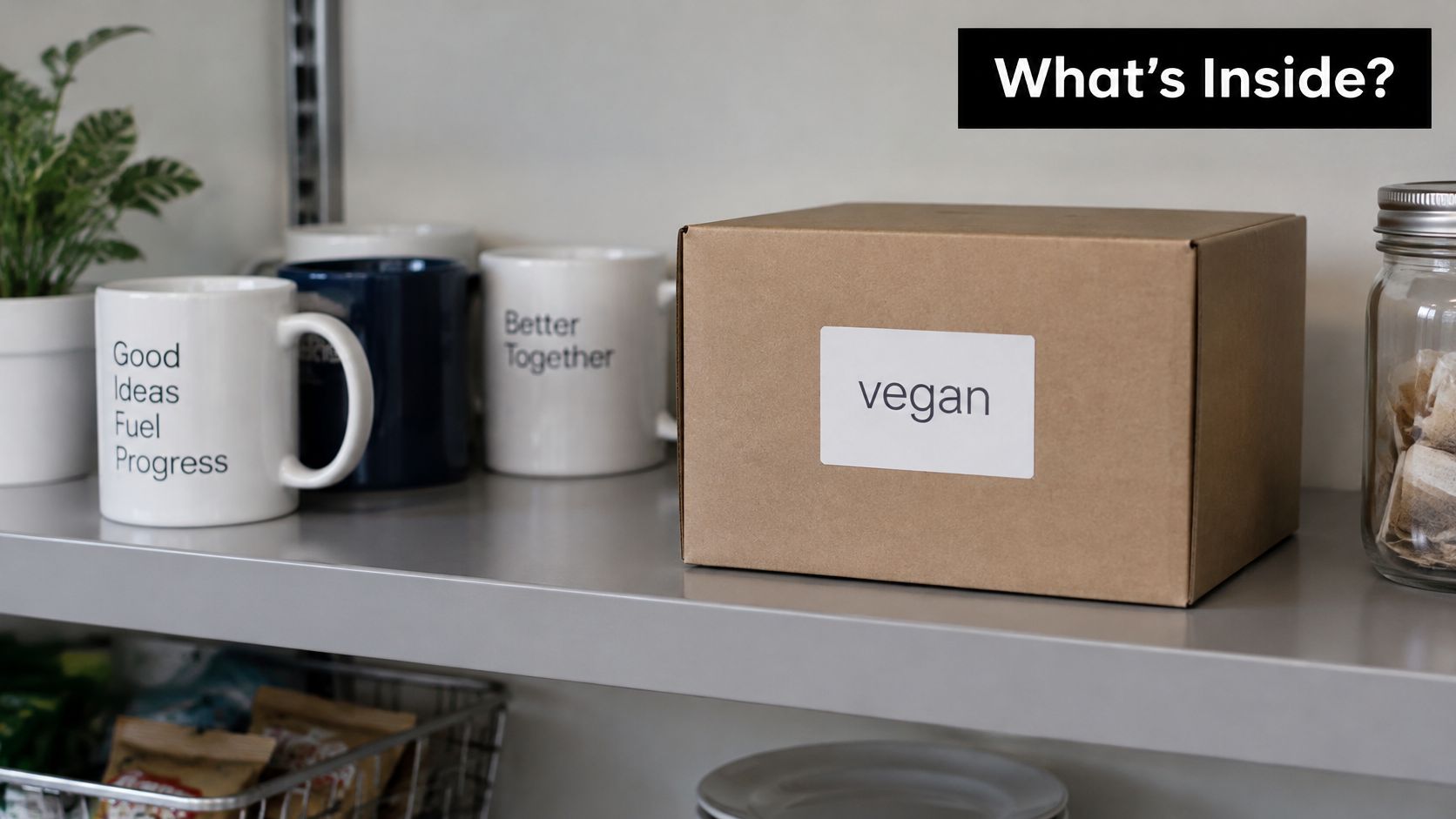
A box labeled vegan has appeared beside the break room mugs. Someone wants a filling snack before a meeting, someone avoids milk, and someone else has a peanut allergy. The label sounds helpful, but nobody knows whether the contents suit all three people.
Vegan snack boxes work best when animal-free ingredients are only the first filter. Buyers also need to check allergens, nutrition, packaging and shelf life. For an office manager, school administrator or hospital facilities team, those checks turn a vague dietary promise into a practical vending assortment.
What Vegan Snack Boxes Contain and Who Buys Them
A break room selection might pair fruit bars and roasted seeds with whole-grain crackers, dried fruit, chips or chocolate. A vegan snack box groups snacks made without animal-derived ingredients. Items may come individually wrapped for easy distribution, or in larger packs intended for sharing.
Different formats serve different jobs
Consumer subscriptions often focus on discovery, combining single portions and larger packs.
Bulk office boxes replenish shared shelves, reception areas or staff kitchens.
Vending assortments offer products one at a time, so packages need to fit the machine and display useful product information.
Box size and price vary widely by format and selection. A subscription box designed for discovery is not a direct price comparison for a vending item, which is sold as an individual snack.
A selection can include treats as well as everyday snacks. Buyers exploring confectionery can browse plant-based chocolate truffles, then check the product's own details before adding it to a box.
The audience extends beyond strict vegans
Flexitarians and curious eaters may choose familiar snacks made without animal-derived ingredients, even if they do not follow a fully vegan diet. In offices, schools and hospitals, that can make a small selection useful to people with different eating preferences.
The word “vegan” answers one question: whether a product contains animal-derived ingredients. It does not, by itself, describe allergen safety, nutritional value or how long the snack will keep. Each of those needs a separate check.
Dietary Labels Decoded Before You Buy
Use this comparison to separate an ingredient claim from an allergy warning before approving a product.
Vegan and allergen claims compared
Claim | What it means | What to verify |
|---|---|---|
Vegan | No animal-derived ingredients | Full ingredient list for honey, whey, casein, gelatin and carmine |
Dairy-free | No milk-derived ingredients | Milk in the Contains statement; eggs and peanuts are not ruled out |
Gluten-free | Under 20 ppm gluten under the FDA definition | Labeled gluten-free status and supplier documentation |
Nut-free | No tree nuts or peanuts as ingredients | Ingredient list, Contains statement and facility line |
May contain | Voluntary cross-contact warning | Treat as a risk flag and keep the warning on the record |
Certified vegan logo | Third-party audit of ingredients | Certifier name and logo on the current pack |
These claims answer different questions. Dairy-free doesn't establish that a product is vegan, because it may contain eggs or another animal ingredient. Nut-free doesn't establish gluten-free status, and a vegan certification isn't an allergen certification.
A certified vegan logo should lead you to a named certifier, not end the review. Confirm what that certification covers, because ingredient review and manufacturing requirements aren't necessarily identical across certification programs.
A repeatable purchasing routine
Read the full ingredient list. Check the actual formulation rather than relying on a leaf symbol or plant-themed packaging. Ingredients such as whey and casein can be less familiar than milk but still matter to the decision.
Check the Contains statement. Compare it with the ingredients and retain any precautionary wording. If the front panel and detailed label appear inconsistent, hold the product for clarification.
Confirm supporting documents. Use the current manufacturer specification, allergen statement or certification record. A distributor's shortened description isn't a substitute for the package information.
Record the verified status. Attach the document to the SKU, meaning the specific inventory item, and record who checked it. Keep the package size and flavor in the record so a similar-looking replacement doesn't inherit an approval.
A Contains statement may not appear as a separate line when the required allergen information is declared through the ingredient list. Its absence therefore isn't proof that allergens are absent.
For machine-facing information, our guide to vending machine nutrition labeling helps buyers consider what customers can see before purchasing.
Purchasing rule: Put any unsupported claim into an unverified group. Don't convert uncertainty into a dietary promise.
This approach also prevents purchasing staff from copying claims between flavors. A plain cracker and its seasoned version should have separate records, even when their packages look nearly identical.
Allergens a Vegan Label Does Not Cover
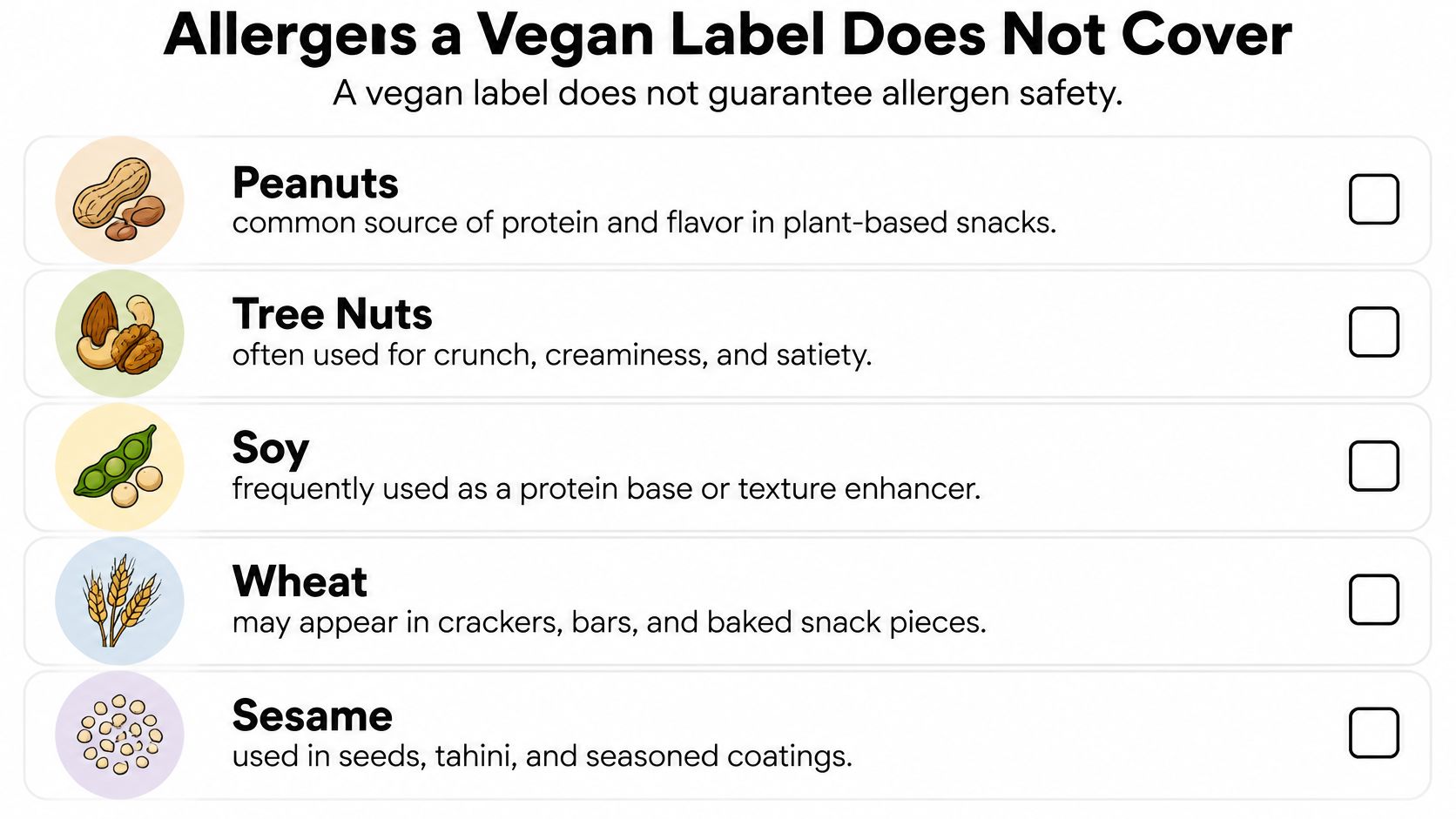
A school staff lounge receives a mixed vegan box containing a peanut bar, sesame crackers and soy-based crisps. Every product may meet the animal-free requirement, yet the collection introduces several allergen sources. In a hospital, the same box also needs clear boundaries between general staff refreshments and food approved for individual patient diets.
The distinction is visible in this checklist.
Ingredients and cross-contact need separate checks
The FDA's food allergen labeling guidance identifies nine major food allergens for U.S. packaged-food labeling: milk, eggs, fish, Crustacean shellfish, tree nuts, peanuts, wheat, soybeans and sesame. The requirements cover ingredients containing allergen-derived proteins, not just recognizable whole-food ingredients.
Peanuts and soy can supply protein; tree nuts can provide crunch or creaminess. Wheat appears in crackers and baked pieces, while sesame may appear as seeds, tahini or seasoning. None becomes suitable for an allergic consumer just because the product is vegan.
Mandatory allergen declarations and voluntary precautionary statements serve different purposes. A may contain warning flags possible cross-contact; it doesn't replace good manufacturing practices, and removing the warning from an inventory description doesn't remove the risk.
For product discovery, NZ Supps offers a bar guide for dairy-avoiding shoppers. Use such guides to identify candidates, then make approval decisions from current manufacturer information.
Sort products by documented suitability
Maintain separate inventory groups for nut-containing, nut-free, gluten-containing and top-nine-allergen-free products, using free-from categories only when supplier documentation supports them. These groups can overlap; they aren't interchangeable safety levels.
For wheat-related selection questions, our guide to gluten-free snack packs provides additional purchasing context.
Use this onboarding checklist:
Obtain current records. Request the manufacturer label or allergen statement for the exact product.
Record allergen categories. Preserve ingredients, warnings and relevant supplier qualifications.
Keep original information accessible. Don't cover package declarations with a homemade dietary sticker.
Reverify changes. Review a new recipe, supplier or substitute before stocking it.
A shared box is an assortment, not a blanket assurance of suitability for someone with a severe allergy.
Nutrition Targets for a Better-for-You Box
Vegan doesn't automatically mean nutritious or filling. A collection dominated by chips, sweets and refined crackers can offer plenty of energy without much protein or fiber.
Use each package's Nutrition Facts panel and its displayed Daily Value information as reference points, rather than treating a snack as a full day's nutrition.
Nutrient reference points for a snack box
Nutrient | Why it matters in a box |
|---|---|
Protein | Pair legume, soy or seed items to contribute meaningfully to the snack |
Dietary fiber | Whole-grain, pulse and fruit components add fiber |
Sodium | Compare savory products and flag higher-sodium choices |
Added sugars | Check confectionery and sweetened bars rather than judging by plant-based branding |
Calories | Compare the amount in the whole single-serve pack |
Read the serving size before comparing products. A small bag may contain more than one labeled serving, and a sharing-size item doesn't become a single serving because it arrived in a snack box.
A per-package comparison is usually more useful for vending than a comparison by weight alone. Customers buy the package in the slot, so the scorecard should reflect what they're likely to eat.
Build around complementary foods
A stronger combination includes a legume-, soy- or seed-based item for protein, a whole-grain or pulse-based item for fiber, and a portion-controlled fruit or vegetable component for variety. Each candidate still needs to meet the location's dietary restrictions.
For example, compare a sweet bar and chips with roasted chickpeas, whole-grain crackers and an unsweetened fruit pouch. Don't assume the second combination wins automatically. Read the labels, check portion sizes and confirm whether the pouch fits the intended vending equipment.
Consumer preferences support looking beyond the vegan claim: Baking Business's functional-snacking reporting cites a 2024 survey in which protein and low sugar were tied as leading snack attributes, each rated very important by 34% of consumers, and reports 12% year-over-year growth in low-sodium and organic snack sales.
Set targets from the actual assortment
Track calories, protein, fiber, sodium and added sugars per package in a spreadsheet. Compare similar roles, such as a filling savory snack against another filling savory snack, rather than ranking chocolate against roasted pulses.
Set written per-box selection goals after reviewing the available products and the audience. A school staff snack, an office treat collection and food intended to bridge a long industrial shift don't need identical mixes.
More vegan variety can still produce a weak assortment if buyers never check whether the food satisfies hunger.
Keep indulgent choices clearly identified. The aim isn't to disguise confectionery as functional food, but to offer both with transparent information and test substitutions when the balance drifts.
Packaging and Shelf Life for Vending Machines
A snack can meet every dietary requirement and still fail at the vending spiral. A carton may catch on the coil, a soft pouch may fold, and a sharing tray may not release cleanly. Test the actual package in the intended machine, including the drop into the collection area.
Packaging formats and their vending fit
Packaging format | Vending fit | Shelf or rotation risk |
|---|---|---|
Sealed single-serve bag | High when sized for standard spiral slots | Check seal integrity and date code at delivery |
Rigid bar wrapper | High when matched to narrow slots | Low-moisture products are straightforward to rotate; protect the wrapper |
Cardboard or paper carton | Medium; can jam spirals | Crush damage and moisture exposure |
Multi-pack tray | Low; generally needs large-format equipment | Harder to rotate and trace per unit |
Low-moisture products are generally easier to manage in ambient machines than fresh or high-water foods. That doesn't make them indefinitely stable: nuts, seeds and whole-grain products need rotation because their unsaturated fats can develop rancid flavors.
Follow the manufacturer's storage conditions. A shelf-stable claim doesn't justify placing a product beside a heat source, and a vegan claim says nothing about refrigeration requirements.
Rotate by date, not arrival order
Log dates at receiving. Record the manufacturer's date code and its meaning, keeping different batches distinguishable.
Stock first-expiring-first-out. Put the earliest-expiring approved stock in the next selling position, even if a newer delivery arrived first.
Set a withdrawal point. Choose a documented remaining-shelf-life threshold that allows for service intervals and the product's storage instructions.
Review sell-through weekly. Use sales and inventory information to reduce orders for slow products before excess stock accumulates.
Inspect tamper evidence and seals during replenishment. Remove leaking, split or damaged packs rather than relying on an intact outer carton.
Packaging sustainability also needs verification. Keep the supplier's recycling instructions and check local collection acceptance; paper-looking material isn't necessarily accepted with ordinary paper recycling.
Adding Vegan Boxes to a Break Room Vending Program
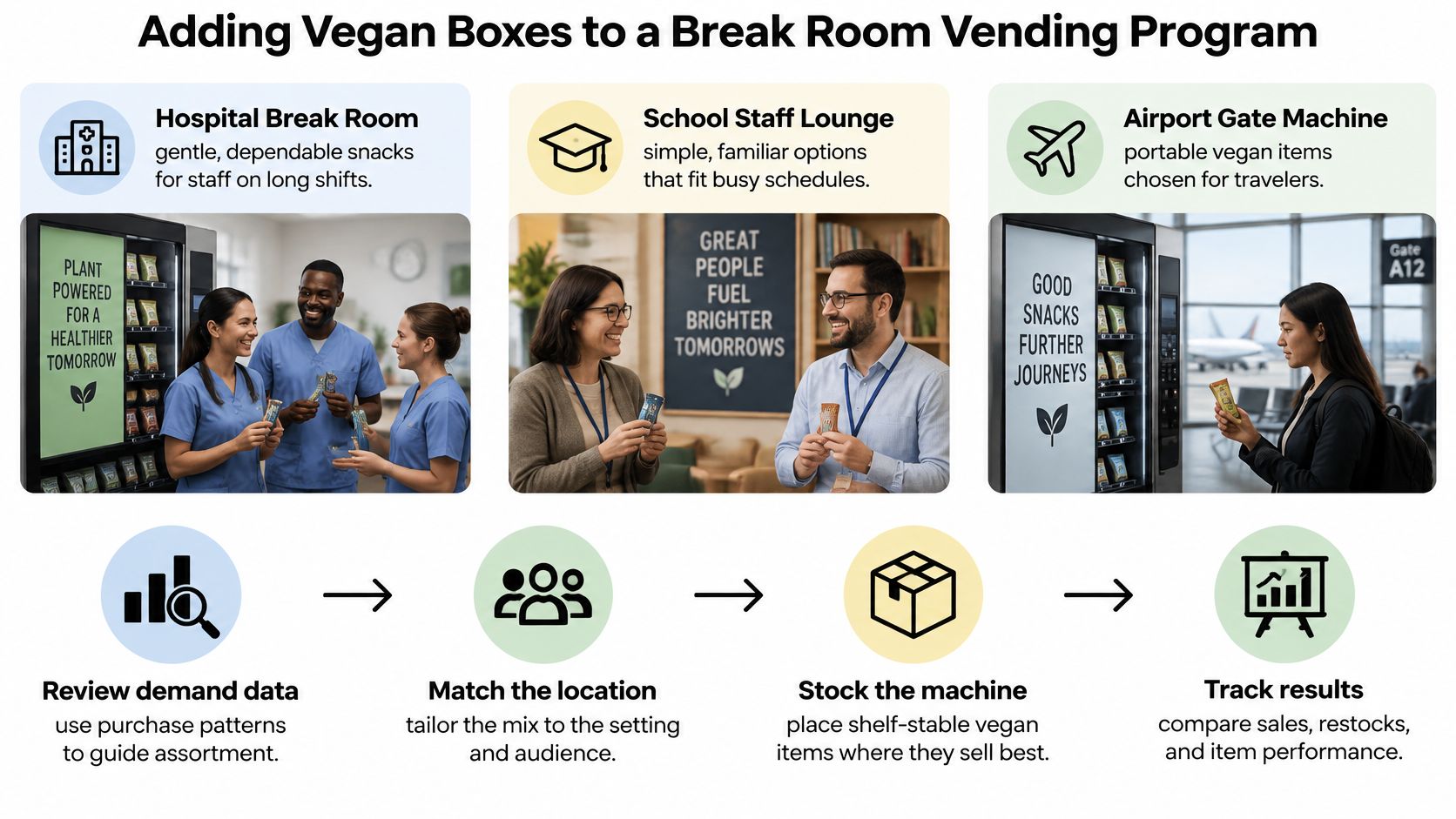
A hospital break room needs dependable choices for staff working long shifts. A school staff lounge needs familiar snacks that fit institutional rules, while an airport gate machine serves travelers who want portable food. The same assortment shouldn't be copied into all these settings.
Use the location and its customers to shape the selection.
Modern vending can support that work with payment and machine information. Vending Times reported that approximately three-quarters of U.S. vending machines accepted cashless payments, compared with 69% in 2018, and described telemetry systems that provide immediate visibility into sales and machine status.
Build an assortment around the setting
Treat the following quantities and review intervals as an example operating plan, not a universal requirement.
Survey the people using the space. Ask about preferred formats, filling options, dietary needs and acceptable prices. Separate food preferences from restrictions that require documented controls.
Start with a manageable selection. A hypothetical launch might include 8 to 12 vegan SKUs across bars, nuts where permitted, crackers, dried fruit and confectionery. Replace restricted categories with documented alternatives.
Retain familiar conventional choices. Introduce vegan products within the broader assortment rather than assuming everyone wants a complete replacement.
Review each location separately. Compare sales, unavailable slots and comments. A product that sells slowly may need a different position, clearer information or replacement.
Schedule considered substitutions. In this example, review slower products for replacement every six to eight weeks, while responding immediately to safety concerns.
Display dietary groups clearly. Make vegan and relevant allergen information visible without implying that a machine label overrides the original package.
Offices and manufacturing sites can test protein-oriented and whole-grain products. Schools and healthcare locations should prioritize their institutional allergen requirements, while residential communities and stadiums may support a more indulgent mix. These are starting hypotheses to test, not fixed assumptions about customers.
Support the whole break room
Food access also includes the surrounding space. If employees need napkins, cups or utensils, Material Handling USA food service disposables provides a useful category reference for planning those supplies alongside the vending area.
Use a documented method for product assortment optimization so purchasing changes reflect location-level results rather than guesswork.
For another look at vending in a workplace setting, the following video provides visual context.
Every machine should show its vegan and applicable allergen tags clearly. Customers shouldn't have to guess which row contains the option they came to buy.
Pilot a Vegan Snack Box and Measure the Results
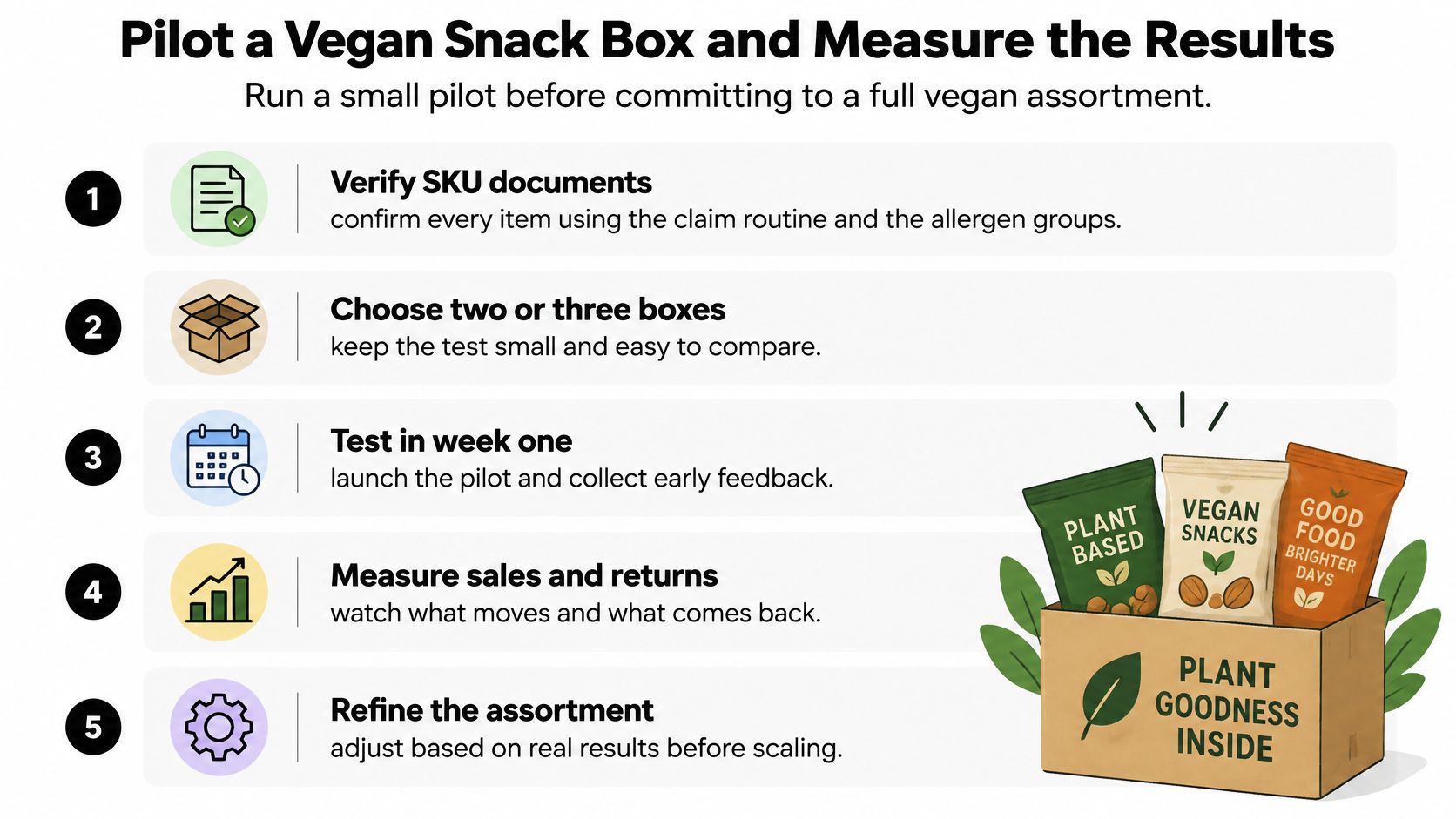
Run a limited pilot before committing a whole location to a new assortment. The following eight-week example gives a facilities team a defined decision point without treating trial quantities or timing as industry standards.
Keep the launch small enough to investigate every substitution and every complaint.
Launch with a controlled record
In week one of this example, complete the claim checks and select two or three locations with different needs. An office break room, school staff lounge and airport staff area could provide useful contrasts, provided each site approves the test.
Keep one defined assortment per site. The sites don't need identical products, but each needs a stable baseline and a dated change log so you can explain differences in results.
We customize each vending menu with classic favorites, healthier options or a mix, and plan around the customer's breakroom, lounge or community space. Our break room vending serves teacher lounges, apartment community areas and office breakrooms; our machines accept credit/debit cards, Apple Pay, Google Wallet and cash.
Measure more than purchases
Use these decision measures:
Sell-through by SKU. Compare units sold with units stocked and time available for sale. Record stockouts so an empty slot doesn't look like weak demand.
Repeat purchases. Use voluntary customer feedback or available privacy-respecting reporting. Don't assume anonymous transactions identify returning individuals.
Staff feedback. Ask about taste, portion size, value and label clarity through a consistent customer feedback method.
Nutrition scorecard results. Check whether popular replacements preserve the intended balance rather than gradually turning the assortment into sweets alone.
During weeks two through seven of the example, review each site weekly. Record damaged packages, returns and complaints alongside sales, and avoid changing several variables at once unless safety requires it.
In week eight, decide which products stay, which need replacement and which locations justify expansion. Strong sales aren't enough if users can't interpret the labels or the product repeatedly creates waste.
Stop condition: Pause the affected pilot if an expired item or a product conflicting with the site's approved allergen restrictions reaches a machine.
Quarantine the affected stock and document the item, batch, location and corrective action. Resume only after resolving the cause and updating the approved record.
Choosing a Vending Operator for Vegan Options
Choose a vending operator based on documented practice, not just a website promise of healthy snacks. The useful question isn't whether the operator can obtain vegan products, but whether it can maintain the right selection for your location.
A local search may produce a convenient shortlist. A SeoProfy compilation of local-search findings reports that 91% of consumers search online before choosing a local business and 73% of U.S. consumers began their most recent local-business search on a mobile device. Neither figure establishes an operator's food-handling practices.
Questions to resolve before signing
Product records: Can the operator supply current manufacturer labels or allergen statements for every proposed vegan SKU?
Sales visibility: Does it track sell-through by SKU and location through telemetry, and what reporting will the customer receive?
Dietary display: Can machines distinguish documented nut-free, gluten-containing and top-nine-free groups without overstating safety?
Stock rotation: How are date codes recorded, and what remaining shelf life triggers withdrawal?
Assortment flexibility: Can the selection reflect each site's balance of dietary needs and familiar favorites?
Payment access: Which payment methods are supported on the actual equipment proposed for the location?
Request a sample inventory record and a sample location report. Those documents reveal more than a broad statement about customization.
Our Oklahoma City metro service area includes Norman, Edmond and surrounding communities. For Oklahoma workplaces, educational institutions, healthcare facilities, airports, stadiums and residential communities, the evaluation should account for who uses the space and who approves dietary restrictions.
If you're comparing providers, our discussion of Accent Food Services offers additional context for evaluating vending options. Confirm service coverage, documentation access and replenishment responsibilities before signing; don't assume every location receives the same arrangement.
Vendmoore Enterprises offers customized break room vending with stocking, service and support for Oklahoma workplaces and community spaces. Visit Vendmoore Enterprises to discuss vegan snack choices for your location, bringing your allergen requirements, preferred snack formats and pilot goals so the conversation starts with what your customers need.
Comments