_edited.png)
Vending Machine Features That Actually Move the Needle

An office manager in Oklahoma City usually doesn't notice a vending program when it's working. They notice it when a card reader declines, a favorite drink is missing, or the cabinet feels warm when it should be cold. Those small failures turn a convenient break-room amenity into another service complaint.
The right vending machine features should change measurable day-to-day outcomes: shorter stockout duration, fewer payment failures, fewer unnecessary service trips, and more accurate reorders. This guide evaluates payment systems, telemetry, refrigeration, shelving, accessibility, security, and service models from the perspective of the people who refill, maintain, and rely on the machines.
What Today's Break-Room Vending Is Asked to Do
A break-room machine has a simple job, but the operating conditions aren't simple. It needs to accept the payment method a person carries, show accurate availability, keep chilled products at the right temperature, survive frequent use, and make replenishment practical for the operator. A cabinet that looks modern but fails at any of those points creates friction for employees and extra work for whoever services it.
The best way to evaluate a feature is to ask what changes after installation. Does cashless payment prevent a lost purchase? Does telemetry tell a route manager which slot needs attention before an employee sees an empty spiral? Does refrigeration control maintain product quality without leaving the compressor running harder than necessary? Does a flexible shelf let the operator respond when one product sells through faster than another?
Operator rule: A feature earns its place when it improves availability, transaction completion, service efficiency, or customer confidence.
The vending concept itself is much older than touchscreens and remote dashboards. The earliest known example is attributed to Hero of Alexandria in first-century Roman Egypt, where a coin-operated mechanism reportedly dispensed measured quantities of holy water. A historical overview of vending machines traces the broader development from early coin mechanisms to modern unattended retail.
That history matters because the underlying promise hasn't changed. Customers want convenient access in places where a staffed shop isn't practical, while operators need compact merchandising, controlled payment, and repeatable service. Modern equipment adds digital tools to that original model.
A buyer should therefore judge every feature against the complete operating cycle:
The customer experience: Can someone find, pay for, and receive the selected item without confusion?
The service route: Can a team identify what needs attention before making a trip?
The product environment: Does the cabinet protect temperature, cleanliness, and physical stock?
The business relationship: Can a property manager or employer see whether the program is meeting expectations?
The sections that follow keep that standard in view. A feature list is useful only when it helps a break-room vending program stay stocked, accessible, secure, and responsive.
How Vending Got Smart
Vending's development follows a practical pattern. Early machines placed products in high-traffic locations and used payment-controlled access to make unattended selling possible. In London, Percival Everitt introduced practical modern vending machines in 1883, dispensing postcards, envelopes, and notepaper in railway stations and post offices. In the United States, the Thomas Adams Gum Company placed gum machines on New York City train platforms in 1888.
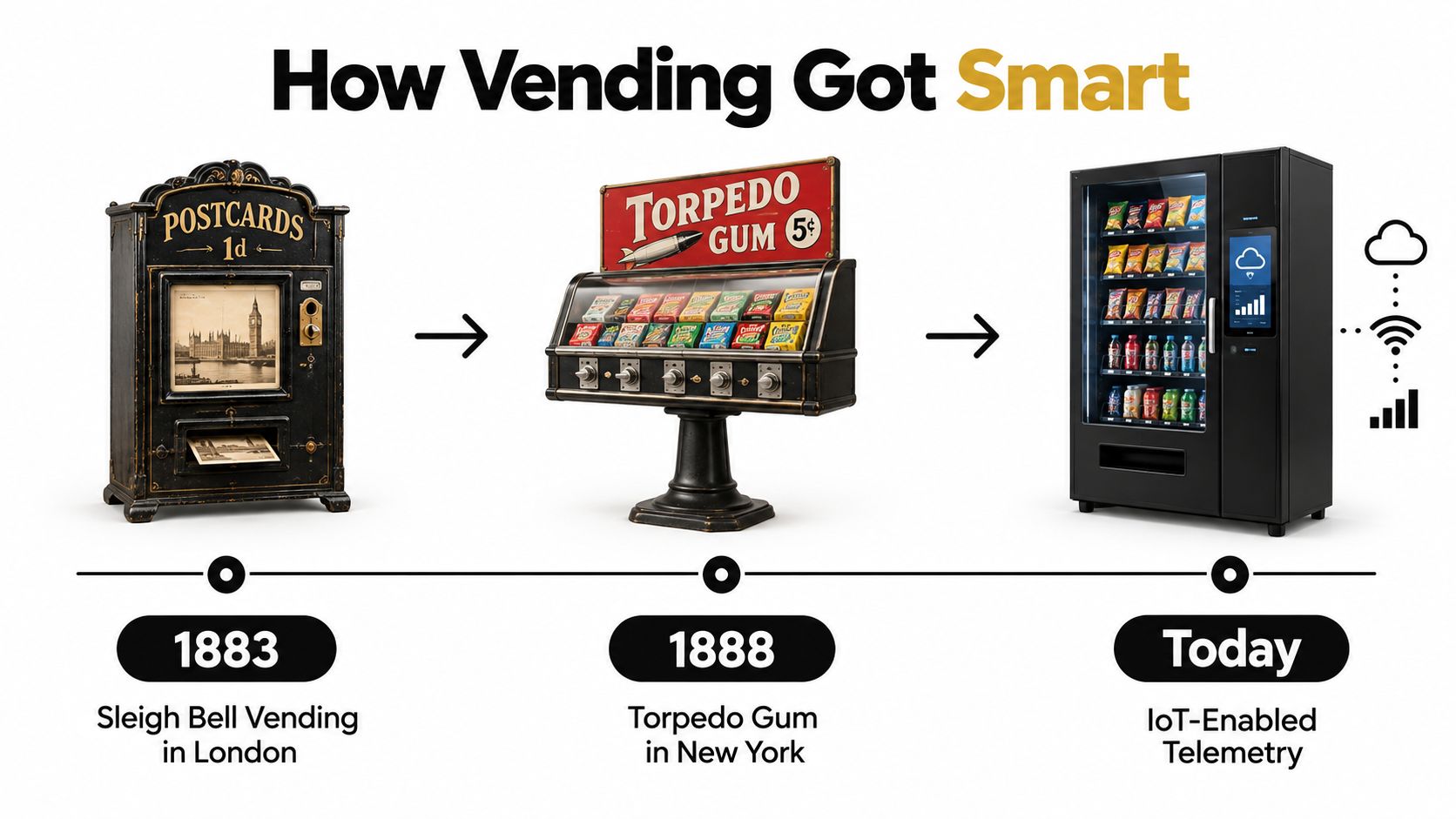
The products changed over time. Penny-candy vending remained important until cigarette machines helped establish the modern automatic-selling industry in 1926, followed by the first soft-drink machines in 1937. These milestones are less important as dates than as evidence of the model's adaptability. Vending expanded wherever compact merchandising and immediate access solved a real placement problem.
Today, the same roles have digital equivalents:
Original vending role | Current feature equivalent |
|---|---|
Coin-controlled access | Card readers, NFC, mobile wallets, QR payments, and electronic receipts |
Compact product display | Flexible spirals, shelves, trays, and configurable slot mapping |
High-traffic unattended placement | Telemetry, remote diagnostics, and route-based replenishment |
Product protection | Refrigeration controls, insulated cabinets, and temperature monitoring |
Basic sales exchange | Transaction records, SKU velocity, and customer feedback loops |
Modern features such as cashless payment, remote monitoring, refrigeration, and data-driven inventory management represent technological extensions of the original unattended-retail model rather than a separate concept. The focus has shifted from merely enabling a sale to managing the complete retail system around that sale.
For a practical explanation of how the connected layer fits together, see how smart vending machines work. The important buyer question is not whether a cabinet has a screen or an internet connection. It's whether those additions make payment more dependable, replenishment more accurate, and service more deliberate.
The Four Backbone Features and Why They Matter
Some specifications affect the whole program. Payment, telemetry, refrigeration, and merchandising determine whether the machine can sell reliably and whether an operator can keep it useful after installation.
Cashless payment removes avoidable friction
Cash still has a role, but a machine that accepts only coins or bills excludes customers who expect to tap a card or phone. A 2025 industry micropayment report estimated that cashless transactions represented 71% of vending-machine sales in 2024, while contactless and mobile payments made up an average of 77% of cashless sales. The micropayment trends report provides the relevant context.
Install a reader that supports contactless cards and mobile wallets such as Apple Pay and Google Pay, while retaining cash acceptance where the location requires broad payment access. Then test declined transactions, interrupted connections, refunds, and receipts, not just successful taps.
Rule of thumb: Treat cashless acceptance as a core sales function, not an optional screen upgrade.
Telemetry turns restocking into a controlled process
Remote inventory works only when the system connects each product slot to a sensor state, transaction event, and timestamp. That mapping lets an operator distinguish a normal sale from a failed vend, stockout, or sensor fault.
Set minimum and reorder thresholds by location. A hospital, office, school, and industrial site won't have the same daypart demand or product velocity. Network monitoring should also buffer transactions locally during a connection loss and alert the service team when data becomes stale.
Operators who want the technical background can review telemetry data collection for vending. The useful outcome isn't a dashboard full of charts. It's a route decision that says which machine needs which products and why.
Rule of thumb: Reorder thresholds should reflect measured sell-through by location, not a universal par level.
Refrigeration controls operating cost and trust
A cold-drink machine creates a continuing electrical load through refrigeration, lighting, and compressor operation. An NREL field study measured an illuminated machine dispensing approximately 500 12-ounce cans at 7–11 kWh per day in an office environment. The same study found that a load manager reduced consumption by an average of 33%.
That makes programmable low-power modes valuable, particularly in offices and facilities with predictable occupancy. A useful setup can dim or disable lighting during unoccupied periods, reduce cooling demand when product requirements allow it, and restore normal settings before peak traffic. Telemetry should confirm that the programmed behavior is taking place.
Dual-zone refrigeration can also support a wider assortment, such as chilled drinks in one area and products with different temperature requirements in another. It costs more and adds configuration complexity, so it earns its place when the location needs that variety.
Rule of thumb: Choose energy controls you can verify remotely, not just an efficiency label on a specification sheet.
Shelving determines how quickly products move
Spiral vending works well for standardized packaged items and gives the operator a familiar way to control individual facings. Shelf-based systems provide more flexibility for irregular packages, meal-oriented products, and varied product dimensions. Smart shelves can add sensing, but sensing doesn't fix a poorly chosen assortment.
Configure slots around actual velocity. Give high-demand items enough facings to avoid repeated empty selections, while using slower slots to test new products or respond to requests. Avoid filling every space with the same package size just because the cabinet makes it easy.
Feature Area | What It Controls | Operator Behavior It Enables | Measured Outcome |
|---|---|---|---|
Payment system | Checkout access | Test cards, wallets, cash, refunds, and connectivity | Fewer failed transactions |
Telemetry | Stock and machine status | Set thresholds and prioritize service routes | Shorter stockout duration |
Refrigeration | Temperature and energy behavior | Schedule low-power operation and monitor conditions | Better product protection and energy control |
Shelving | Product fit and facing count | Adjust slots to package size and velocity | More accurate replenishment and sell-through |
Rule of thumb: Configure the cabinet around what people buy, not around what the manufacturer makes easiest to load.
User Experience, Accessibility, Security, and Data
A technically capable machine can still feel difficult to use. The customer sees the menu, payment prompt, product window, delivery area, and accessibility controls. The operator sees tamper risk, cash variance, service alerts, and reporting quality. Both views matter.
The interface should shorten the purchase
A clean screen should make the next action obvious. Product categories, prices, dietary information, availability, and payment instructions need to appear in a sequence that doesn't force the customer to guess. A large promotional display may attract attention, but it isn't useful if the customer has to click through unnecessary screens to complete a purchase.
Compare a simple product-first interface with a heavily animated menu. The first usually works better for routine break-room purchases, while richer visuals may help in a public venue where the machine is part of the environment. Test the interface with people who haven't seen the cabinet before.
Accessibility cannot be treated as a compliance checkbox. Reach height, clear operating space, large text, audio guidance, readable contrast, and mobile-wallet access should work for people using the machine from different positions. The payment reader should remain usable at an accessible height, and the delivery area should not require awkward reaching.
Security protects both product and reporting
Anti-theft construction includes cabinet strength, lock design, payment-reader protection, delivery-door design, and tamper alerts. Cash machines create another control issue because physical collection and reconciliation can introduce variance. Cashless transactions reduce reliance on that physical process, but they don't remove the need to monitor refunds, reversals, and failed vends.
Remote lock-down can help after repeated tampering or suspicious activity, provided the operator has a clear escalation process. Review the practical controls in vending machine security features, then ask how alerts reach the service team and who can authorize a machine to return to operation.
Data should answer operational questions
Telemetry-enabled systems represented 35.10% of the connected vending installed base in 2025, while AI-powered vending was projected to grow at a 14.18% compound annual rate through 2031, according to connected vending market research. Those figures indicate growing interest, but adoption alone doesn't prove that a particular dashboard improves service.
At minimum, reporting should show:
Sales by slot: Identify products and positions that consistently move.
Sales by daypart: Match replenishment and service timing to demand.
Payment type: Find failed or underused payment paths.
SKU velocity: Separate fast sellers from products occupying valuable space.
Machine status: Track connectivity, temperature, and vend exceptions.
If an operator won't share meaningful reporting, ask for a recurring service summary with stockout issues, assortment changes, and unresolved faults. You don't need every raw transaction, but you do need enough visibility to judge whether the program is meeting its obligations.
Matching Features to the Location Behind the Machine
The right feature package depends on who uses the machine, when they use it, and what happens when service is delayed. A compact office cabinet and a rugged airport unit shouldn't be configured from the same template.
Corporate offices and business centers
Office users generally value fast checkout, dependable availability, and a break-room assortment that feels relevant rather than generic. Mobile-wallet acceptance helps employees who don't carry cash, while dual-zone chilling can support a wider mix of drinks, snacks, and meal-oriented items.
A business center may have several tenants with different schedules. Telemetry can identify whether demand peaks during morning arrivals, lunch, or afternoon breaks, while feedback gives the operator context that sales data can't provide. A flexible shelf configuration is useful when tenants request larger food items or different package formats.
For a deeper approach to adapting the mix, use assortment planning for vending. The feature that earns its cost is the one that keeps the cabinet relevant across multiple audiences.
Schools and universities
Colleges serve a mobile-first audience. Federal Reserve payment research found that mobile phones were used for 45% of all payments among adults ages 18–24 in 2024. The Federal Reserve payment study supports treating Apple Pay and Google Wallet acceptance as a practical requirement in many campus settings.
Schools may also need nutrition filters, clearer product labeling, durable cabinets, and accessible controls. A machine near a residence hall can require a different assortment from one near a library or athletics facility. The operator should review requests and sell-through separately by placement rather than applying one campus-wide product list.
Healthcare facilities and clinics
Healthcare locations need availability across shifts, quiet operation, easy cleaning, and strong physical security. A clinic may benefit from compact refreshment options for visitors, while a hospital staff area may need more substantial food and drink choices during long shifts.
Accessibility has particular importance in public-facing care environments. The machine should be easy to approach, read, and operate, with payment and delivery areas positioned for different users. Remote monitoring reduces the chance that staff discover an empty or malfunctioning cabinet during a busy period.
Manufacturing and industrial sites
Shift work changes demand. A machine that is adequately stocked during daytime office hours may fail during overnight production, when service visits are less frequent and employees have fewer alternatives nearby.
Industrial programs should prioritize rugged hardware, large-capacity slots, reliable payment, and replenishment rules based on shift patterns. On-site food access can also support retention of employees during breaks. The operator should track which products disappear during each shift and schedule service around production access rather than convenience alone.
Multifamily residential properties
For apartments and mixed-use residential buildings, vending can function as an amenity as much as a retail point. Residents may want drinks, snacks, frozen items, personal-care basics, or products suited to late-night access.
The best setup creates a feedback loop. Residents can request items, the operator can compare those requests with sales and stock data, and property managers can review recurring service issues. A compact footprint, cashless payment, and strong tamper protection matter when the machine sits in a shared lobby or amenity area.
Stadiums and airports
Event venues and airports need fast throughput, clear wayfinding, rugged hardware, and an interface that works for travelers from different backgrounds. Door and delivery design should support rapid purchases without creating a queue around the machine.
Multilingual UX can reduce confusion in high-turnover public settings. Inventory planning should also account for event schedules, travel needs, and sudden demand changes. Here, service responsiveness and refill timing may matter more than adding elaborate promotional effects.
Why Telemetry and AI Only Help If You Use the Data
A connected machine can still be empty. Sensors may report inventory, artificial intelligence may identify patterns, and a dashboard may display every alert, but none of that changes the customer experience until someone acts on the information.
Telemetry should connect to written service rules. Define how long a stockout may remain during an operating day, what triggers a priority visit, how failed vends are investigated, and who approves an assortment change. Set vend-accuracy and uptime expectations that fit the location, then review exceptions rather than relying on a general “smart” label.
Practical rule: If a data point doesn't change a route, a reorder, a repair, or an assortment decision, it may be reporting rather than operational control.
The useful measurement framework pairs machine data with human feedback:
Availability: Track how long high-demand items remain unavailable.
Vend accuracy: Compare the selected SKU, payment event, and delivered product.
Uptime: Record connectivity, temperature, and mechanical interruptions.
Assortment response: Test whether requested products earn repeat purchases.
Service follow-through: Confirm that alerts result in documented action.
Market analysis cited in this overview of retail analytics software can help buyers compare reporting approaches, but the software is only part of the decision. Ask who reviews the data, how often thresholds change, and whether the operator can explain a recommendation in operational terms.
Privacy needs the same discipline. Collect only the information required for inventory and service, limit access to transaction-level records, and state clearly whether the system makes demographic or behavioral inferences. A transparent feedback loop is more valuable than an opaque AI feature that produces recommendations nobody can challenge.
A Buyer's Checklist and the Questions Worth Asking
Start with the features that affect the operating result:
Payment coverage: Does the machine accept contactless cards, Apple Pay, Google Wallet, cash, and the payment types your audience expects?
Reporting access: Can you see stockouts, sales by slot, payment exceptions, temperature status, and service history?
Refrigeration behavior: Are cooling zones appropriate for the assortment, and can low-power settings be verified?
Shelf flexibility: Can the operator change facings and accommodate different package sizes?
Accessibility: Are reach height, text, audio, payment, and delivery areas usable for customers with different needs?
Security controls: How are the cabinet, payment hardware, cash compartment, and remote alerts protected?
Service response: What happens after a failed vend, connectivity loss, empty slot, or temperature alert?
Then ask the vendor for direct answers:
Which payment methods are included, and how are refunds handled?
What inventory and performance data will the site receive?
How does the system distinguish a sale, failed vend, stockout, and sensor fault?
How do you set reorder thresholds for this specific location?
What refrigeration and energy controls are available?
How do you handle accessibility and tampering?
Who responds to service alerts, and what response process applies?
How can employees, residents, students, or visitors request products?
What information is retained, and who can access transaction-level data?
The answers should name a process, not just a feature. “It has AI” isn't a service commitment. “We review stock exceptions, adjust thresholds by location, and document replenishment changes” is the kind of answer a buyer can evaluate.
For a broader comparison of equipment options, see smart vending machine choices. The strongest program combines practical hardware with an operator who will keep adjusting the assortment and service plan.
A workplace food-access study found that only 19.6% of surveyed employees said their employer provided opportunities to eat a healthy diet, while food vending machines were available in 45.3% of workplaces and beverage vending machines in 53.6%. The peer-reviewed workplace health study supports treating better-for-you choices as part of the break-room service, not as a decorative add-on.
Watch the supporting video for a practical overview of how connected vending can fit into a workplace refreshment program.
A separate workplace break-room survey reported that 78% of employees feel more valued when they have access to food at work, 56% have stayed longer at a company because of strong break-room perks, and 60% say break-room food options influence how often they take breaks. The workplace food survey points to the underlying business case: a stocked, responsive break room affects how people experience the workplace.
Vendmoore Enterprises provides managed and client-owned vending options across Oklahoma, with cashless payments, connected inventory visibility, customized assortments, and responsive replenishment for workplaces and public spaces. Visit Vendmoore Enterprises to discuss a vending program built around the features that improve availability, payment reliability, and day-to-day service.
Comments