_edited.png)
Why Inventory Management Is Important for Vending Programs

Poor inventory management contributes to $1.7 trillion in global retail losses each year through overstock, stockouts, and shrinkage, making disciplined stock control one of the most powerful levers for vending profitability. Carrying inventory also commonly costs 20% to 30% of its average value annually, so every slow-moving case of drinks or snacks consumes cash that could support the business elsewhere.
A familiar break room tells the story. Employees walk up expecting a cold drink, find an empty slot, and leave without buying. A facility manager sees expired products, inconsistent service, and complaints that seem minor individually but keep returning. Behind those frustrations sit lost sales, unnecessary labor, wasted product, and a vending program that gradually loses credibility.
For operators serving offices, schools, healthcare facilities, manufacturing sites, apartments, stadiums, or airports across Oklahoma, inventory management isn't just counting stock. It determines whether machines earn revenue, whether customers trust the program, whether routes run efficiently, and whether a vending service can be found by the next business searching for break room solutions.
The Hidden Costs of Unmanaged Vending Inventory
The machine usually gives plenty of warning before a vending program fails. A popular bottled drink disappears first. Then the snack spiral empties during a busy afternoon. A few products sit untouched until their packaging looks tired or their dates become a problem. Employees start bringing food from home, walking to a nearby store, or ignoring the machine altogether.
That pattern creates more damage than a single missed transaction. A stockout interrupts the customer experience at the precise moment someone is ready to buy. A stale product creates the opposite problem, because the machine looks full but signals that the operator doesn't understand what people want.
The revenue leak inside a full route
Unmanaged inventory produces several losses at once:
Missed sales: The machine can't sell a product that isn't available, even when demand is predictable.
Wasted route time: Drivers spend stops checking machines without reliable information about what needs attention.
Product waste: Slow movers occupy slots while dated or damaged goods become unsellable.
Lower engagement: Employees stop checking the machine after repeated disappointments.
Poor account retention: Facility managers associate the vending program with complaints rather than convenience.
Shrinkage adds another layer. Products can disappear through theft, loading errors, dispensing problems, or inaccurate counts. Practical controls such as documented deliveries, exception reviews, and consistent machine checks can help operators address these issues, as outlined in this guide to shrinkage prevention.
Practical rule: A machine that looks stocked isn't necessarily a healthy machine. Measure what sells, what expires, what disappears, and what customers repeatedly request.
The financial impact also extends beyond the machine. When employees leave a workplace to find refreshments, the organization loses convenience and may lose time. When a hospital, campus, or manufacturing site provides unreliable access to drinks and snacks, managers face avoidable dissatisfaction. Inventory neglect compounds because every poor visit teaches customers to choose another option next time.
The right response isn't to fill every slot with more product. It's to match the assortment and replenishment rhythm to each location. An Oklahoma City office, a Norman school, and an Edmond medical facility can have different traffic patterns, dietary preferences, peak periods, and best sellers. Inventory control turns those differences into operating decisions instead of recurring complaints.
Understanding Inventory Carrying Costs in Vending Operations
A route can look profitable while cash sits idle in cases, storerooms, and service vehicles. The purchase price is only the starting point. Operators also carry storage, handling, insurance, damage, shrinkage, and obsolescence costs before a product reaches a customer.
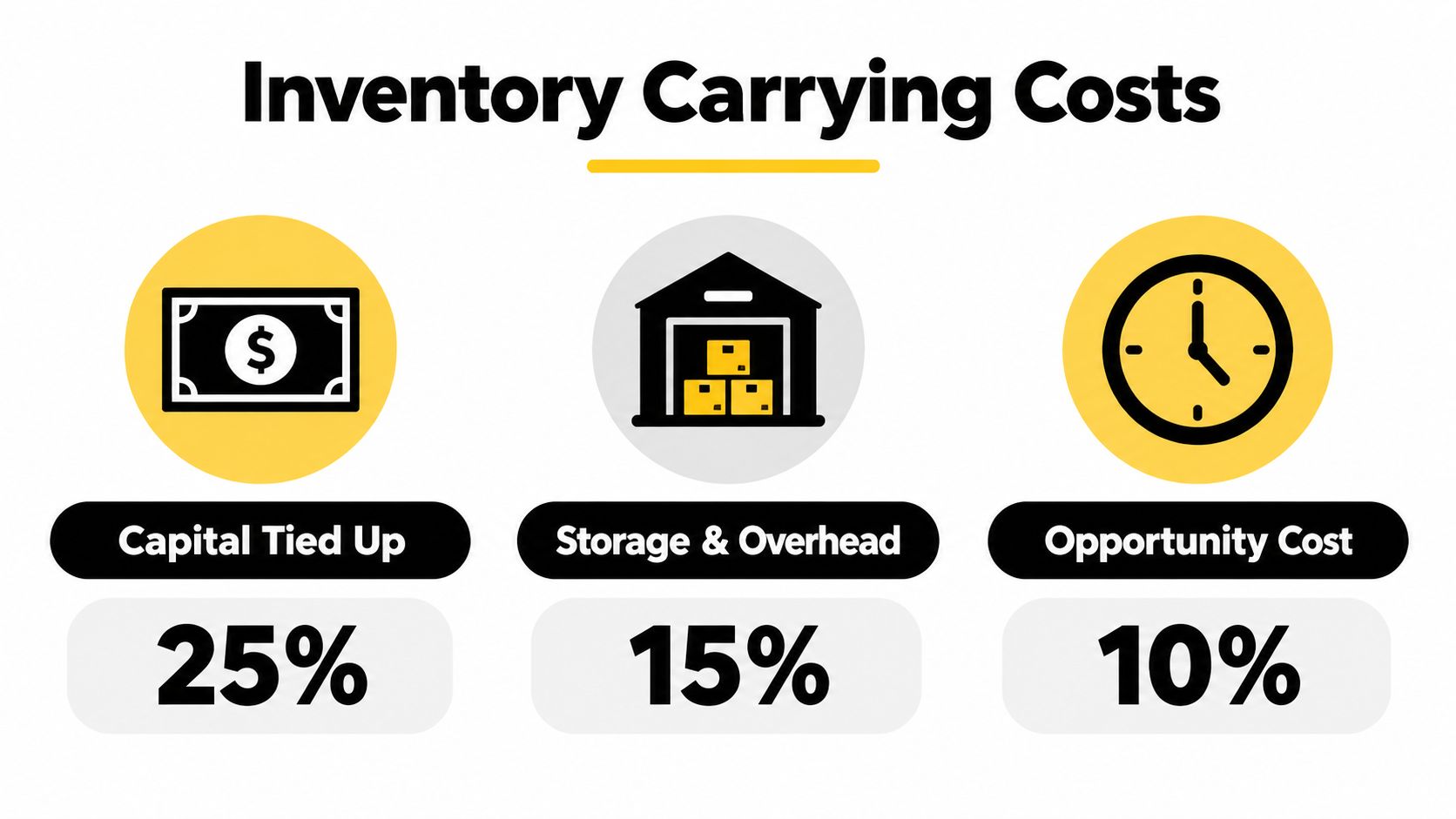
Annual carrying costs commonly run at 20% to 30% of average inventory value according to benchmark inventory data. On $1 million in inventory, that equals roughly $200,000 to $300,000 per year in holding costs. Expired products and items that never sell create a separate margin loss.
Benchmark data also reports that 46% of surveyed SMBs say at least 5% of their inventory is dead stock. In vending, dead stock may be an unpopular flavor, a seasonal product left in a machine, or a bulk purchase that local demand cannot support.
Where the carrying cost comes from
Separate the categories to see where a route loses money:
Capital tied up: Cash held in slow-moving products cannot fund equipment repairs, route expansion, marketing, or improved payment systems.
Storage and handling: Cases require space, organization, movement, and labor before reaching a machine.
Insurance and damage: Stored goods face leaks, handling damage, temperature problems, and other losses.
Obsolescence: Changing preferences, packaging updates, and dated products reduce selling value.
Shrinkage: Differences between recorded and actual stock weaken purchasing decisions.
The practical question is, “How much inventory can this route support without slowing cash conversion?” Inventory turnover, commonly calculated as cost of goods sold divided by average inventory, helps answer it. Higher turnover generally means stock becomes sales faster, with less exposure to holding costs and obsolescence. Research also connects inventory productivity with supply-chain performance, so purchasing decisions can affect supplier coordination and downstream replenishment as discussed in inventory productivity research.
Bulk purchasing may reduce ordering friction, yet it can overload a route with products that move slowly. Smaller, more frequent replenishment may increase handling work while protecting freshness and cash flow. The sound choice depends on demand velocity, supplier reliability, shelf life, and the cost of a stockout.
A structured cost comparison analysis should include product waste, route labor, storage, emergency purchases, and missed sales, rather than comparing wholesale prices alone.
The target is a right-sized inventory position. It protects availability and customer satisfaction while limiting idle capital. Better stock control also protects operating margins and gives operators clearer evidence for assortment decisions that support reliable service and local visibility. An empty machine loses a sale, while an overfilled storeroom limits the funds available to improve the vending program.
How Telemetry-Driven Replenishment Prevents Stockouts
A driver arrives at a machine expecting a routine refill, only to find that the fast-selling drinks sold out days earlier while slower snacks remain untouched. Fixed schedules conceal that mismatch. Telemetry changes replenishment from a calendar exercise into an exception-based operating process. Connected equipment reports sales activity, inventory movement, and machine conditions as data becomes available, as detailed in this telemetry data collection guide.
That visibility improves decisions without removing operator judgment. The team can focus route time on machines and products that need attention rather than checking every location with the same urgency.
Start with item-level movement
Separate fast movers from slow movers at each location. Bottled water that sells steadily during every shift needs a different reorder point from a niche snack purchased occasionally. Applying one rule to both products produces empty slots in some machines and unnecessary stock in others.
A practical workflow includes five steps:
Capture movement by machine and product. Record what sells, where it sells, and when demand rises.
Identify service-sensitive items. Prioritize products whose absence creates complaints or lost transactions.
Set location-specific reorder points. Use local sales velocity and supplier lead time instead of a route-wide average.
Use alerts for exceptions. Investigate unusual depletion, sudden inactivity, dispensing errors, or repeated variance.
Review the assortment regularly. Replace weak products with items customers request or buy more consistently.
Stockout research identifies costs that can include lost gross margin, expediting or backorder expenses, and future demand shifting to competitors in this analysis of stockouts. In vending, customers rarely place a backorder. They choose another drink, snack, or location, so the missed transaction may also weaken confidence in the service.
Tune the response, don't chase every alert
Telemetry can expose poor replenishment habits. Sending a full case whenever a low-stock notification appears may reduce empty slots while increasing overstock. Each response should account for remaining units, expected demand before the next visit, shelf life, machine capacity, and the cost of an additional route stop.
A low-stock alert is a decision prompt, not an automatic purchase order.
Demand also varies by site and operating hours. A machine near a night shift may require a different service window from one in a daytime corporate office. A school location may change with its academic calendar, while a healthcare facility may maintain steadier activity.
The strongest process combines telemetry with human review. Operators still need to validate unusual readings, consider customer feedback, inspect physical conditions, and account for delivery constraints. The system identifies where conditions changed. Experience determines the sensible response, protecting availability without turning every alert into an expensive visit.
Inventory Visibility as a Local SEO Advantage
Inventory accuracy can influence more than replenishment. It can also help a vending company become easier to find when facility managers search for local refreshment services, break room vending, or vending operators.
Google says complete and accurate business information supports local visibility, with local results mainly shaped by relevance, distance, and prominence in its local ranking guidance. For eligible retail businesses, Google also says that showing in-store products on a Business Profile can help those products appear in local search results.
That creates a practical connection between operations and marketing. If a business publishes product information that no longer matches reality, searchers may see an inaccurate assortment, lose confidence, or find a competitor offering clearer information. A reliable process starts with accurate product names, current prices where applicable, local availability, and a Business Profile that reflects the service area.
What Google needs to display local inventory
Requirement | Description | Impact |
|---|---|---|
Business Profile | A verified Google Business Profile identifies the business and its local presence. | Supports relevance and local discovery. |
Local products feed | The feed describes the products sold through eligible local inventory programs. | Helps Google understand the assortment. |
Inventory feed | Product inventory data includes available products, prices, and quantities. | Gives searchers clearer availability information. |
Accurate business details | Complete business information supports local search relevance. | Makes it easier for facility managers to evaluate the provider. |
Google's local inventory documentation explains that businesses need a Business Profile plus local product and product inventory feeds, and that eligible listings can appear on Google Search, Google Images, and certain Business Profile surfaces at no charge through its local inventory requirements.
The marketing value is not limited to product discovery. Google says local inventory features place inventory and key business information in front of hundreds of millions of people who conduct shopping-related searches each day in its local inventory advertising overview. For a vending business, that supports a broader visibility strategy, especially when paired with useful pages about break room vending, workplace refreshments, and service areas in Oklahoma.
Accurate inventory also supports customer acquisition efficiency. Businesses evaluating ways to cut customer acquisition cost with AI should still fix basic data quality first. Automation can't compensate for outdated product records, inconsistent location information, or a service page that makes vague promises.
Google's guidance says updating in-store product information can help nearby customers find a business more easily, while free local listings can increase product awareness, clicks, and browsable inventory visibility across Search, Maps, and the Business Profile through its product information guidance. The operational lesson is straightforward: accurate stock data can serve the route, the customer, and the search engine at the same time.
Manual Restocking vs. Automated Telemetry Models
Manual restocking works when the route is small, demand is stable, and the operator can inspect every machine often enough to catch changes. It starts to fail when locations multiply, product ranges expand, or demand shifts between visits.
A driver following a fixed schedule may find that one machine still has slow-moving snacks while another has sold out of its most popular drinks. The route plan treats both stops equally, even though their commercial value and service urgency differ.
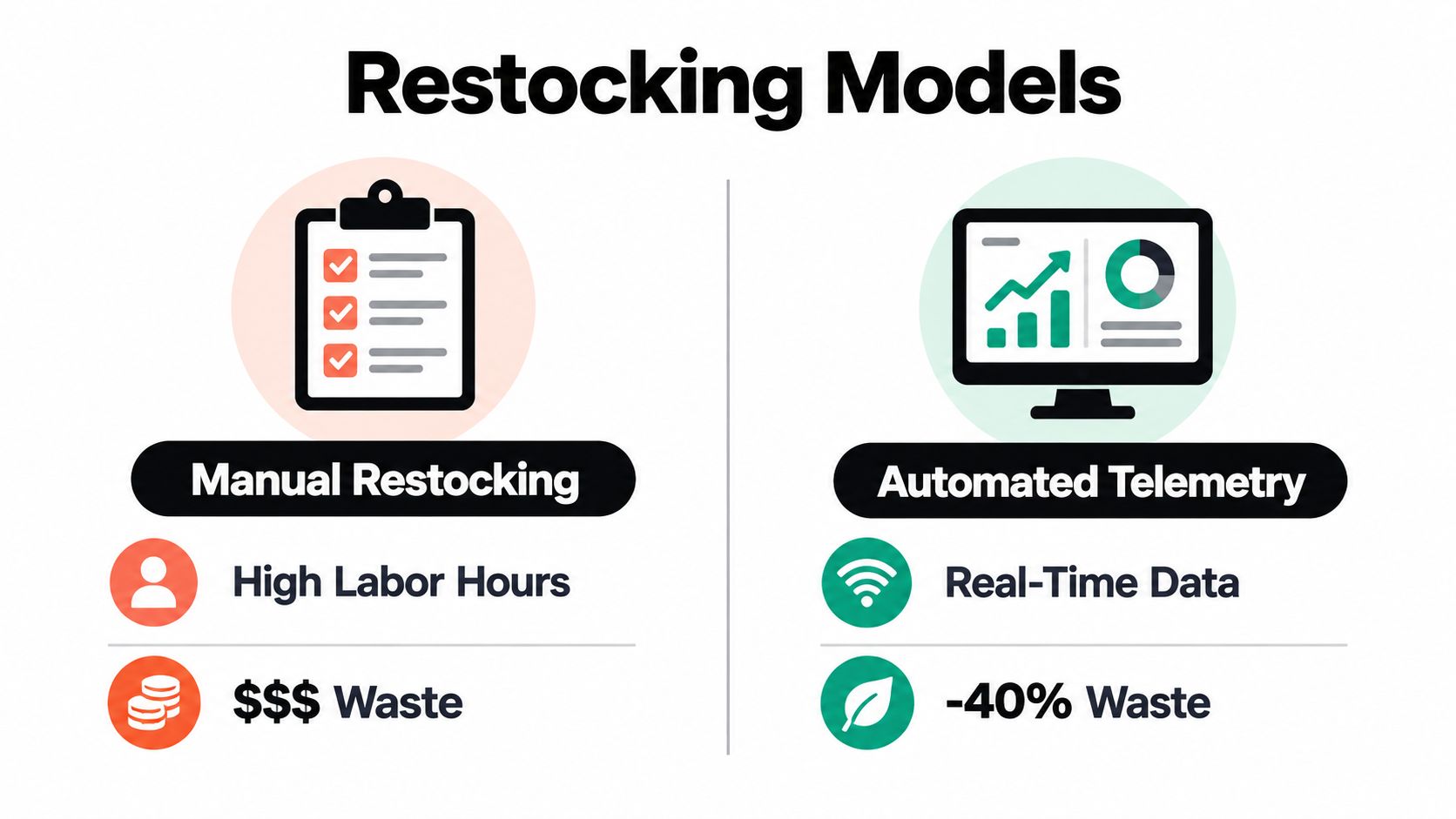
The operational trade-off
Operating factor | Manual restocking | Automated telemetry |
|---|---|---|
Visibility | The operator sees the machine during scheduled visits. | Connected data provides ongoing movement visibility. |
Route planning | Stops follow a calendar or driver judgment. | Stops can respond to demand and exceptions. |
Stockout response | The problem may be discovered after a customer reports it. | Low-stock patterns can trigger earlier review. |
Product decisions | Counts and memory often guide purchases. | Sales velocity supports location-specific decisions. |
Labor use | Drivers spend time checking machines that may not need service. | Teams can focus attention where the data shows need. |
Demand changes | The assortment may lag behind customer behavior. | Operators can review movement and adjust selections. |
The advantage of automation isn't that it removes people from the process. It puts people where their judgment matters. A driver can prepare the right load before leaving, while a route manager can investigate unusual consumption instead of relying on a stale spreadsheet.
Automated controls also deserve skepticism. A system with inaccurate item records, incorrect machine capacity, or incomplete product setup will produce confident but unreliable recommendations. The operator still needs physical counts, clean master data, and a process for reconciling differences.
Better technology can't rescue an unreliable stock record. It can only make the error travel faster.
A 2026 survey of 400 businesses found that 92% were satisfied with their current inventory approach, yet inventory accuracy remained the top improvement area. The survey also found that 81% wanted to implement AI, while only 11% were using it, and identified supplier reliability at 52%, inaccurate inventory data at 44.8%, overstock at 37.5%, and stockouts at 33.5% as major pain points in the 2026 state of inventory management survey.
That finding applies directly to vending. Start with accurate product records, disciplined receiving, consistent counts, and clear replenishment rules. Then use telemetry and automation to increase speed and scale. Operators comparing broader warehouse solutions from Material Handling USA will recognize the same principle: automation creates value when it improves control, not when it only adds another dashboard.
A practical overview of automated inventory management systems should therefore include the people and process layer, not just the hardware. The strongest model combines connected equipment, clean data, route discipline, and human follow-through.
Why Vendmoore's Managed Model Protects Your Program
A vending program succeeds when someone owns the full chain from product selection to machine performance. That ownership includes monitoring movement, adjusting assortments, checking physical conditions, responding to feedback, and replenishing before customers repeatedly encounter empty slots.
For Oklahoma businesses, the operating environment varies by location. A corporate office may need convenient drinks and snacks throughout the workday. A manufacturing site may see concentrated demand around shift changes. A hospital or clinic may require dependable access across long operating hours, while a residential property may need a broader mix that serves residents at different times.
The managed-service advantage
A managed model gives the operator responsibility for decisions that facility teams shouldn't have to make themselves:
Assortment decisions: Use location feedback and sales movement to decide which products deserve space.
Replenishment planning: Match deliveries to demand instead of relying only on fixed visit schedules.
Machine performance: Review telemetry and transaction patterns for signs of equipment or dispensing problems.
Service follow-up: Resolve issues before repeated complaints weaken customer confidence.
Program adjustment: Change selections when customer preferences, site usage, or operating conditions shift.
Vendmoore Enterprises provides connected vending machines with real-time inventory and performance visibility, cashless payments that include Apple Pay and Google Wallet, and product assortments adjusted to location feedback and sales activity. Its portfolio includes compact refreshment centers, bottle-and-can vendors, dual-zone chill centers, and frozen food machines for workplaces and public spaces across Oklahoma.
The important distinction is accountability. A machine can have modern payment hardware and still perform poorly if nobody reviews the data or acts on it. Conversely, a capable operator can create a reliable program with straightforward tools when the process is consistent. Technology supports the service model, but ownership turns information into action.
Lead-time volatility makes that discipline more important. A 2026 benchmark report identified lead-time swings at 29%, raw-material costs at 23%, freight and shipping at 22%, and demand shifts at 21% as nearly tied planning challenges. The same report found dead stock rising from 12% in 2024 to 24% in 2026, while the share of businesses holding almost none, under 5%, fell from 49% to 32% in the supply-chain planning benchmark. These figures describe a wider planning environment, but vending operators face the same basic pressure: supplier timing and customer demand can change faster than a static route plan.
A vendor-managed inventory service makes inventory responsibility part of the vending partnership rather than an extra task for a facilities coordinator. The result should be measured through practical outcomes: fewer empty selections, less obsolete product, better route focus, stronger customer satisfaction, and a program that remains useful as the location changes.
Visit Vendmoore Enterprises to discuss connected vending, managed replenishment, and product programs for Oklahoma workplaces, schools, healthcare facilities, industrial sites, and public spaces. Their team can assess your location, recommend an appropriate vending format, and build an inventory process designed to keep the products people want available.
Comments