
Contactless Payment Systems Based on RFID Technology Guide

You are standing in a break room between meetings. The person ahead of you holds a phone near the reader, a snack drops, and the line moves. Nobody hunts for coins or waits on a paper receipt. That speed is why facility managers ask about contactless payment systems based on RFID technology when they look for break room vending or a vending operator.
The tap looks simple. The machine behind it is not. A short radio link, a payment application, a one-time code, and a remote approval all have to finish before the spiral turns. Miss one layer and the customer retries, walks off, or calls the number on the glass.
Operators who run machines in offices, schools, hospitals, and factories learn this on the floor. A reader bolted to a door is not the same thing as a certified terminal that can still behave correctly when the network blinks. What follows is a plain map of each layer, where the risks sit, and how to decide whether tap-to-pay belongs on your site.
RFID, NFC and EMV Explained in One Comparison
A worker holds a phone near the reader, the coil drops a snack, and nobody thinks about the stack that just ran. Four names get mixed together in sales calls. They do different jobs.
RFID is the general radio method that identifies a tag or card and carries the wireless link between the customer's device and the machine. NFC is a short-range form of that radio, usually under 4 cm, and it is what phones and contactless cards in practice use. EMV contactless is the payment standard built on the ISO/IEC 14443 proximity protocol plus transaction cryptograms that approve a bank-card purchase. Tokenization swaps the card number for a payment token so the account number stays out of the machine.
Term | What it is | Role at a vending machine | Example |
|---|---|---|---|
RFID | Radio identification between a tag or card and a reader | Carries the wireless link but cannot approve a bank payment alone | Access badges, inventory tags |
NFC | Short-range form of RFID, usually under 4 cm | Phone and card tap interface | Apple Pay, Google Wallet |
EMV contactless | Payment standard built on ISO/IEC 14443 plus transaction cryptograms | Approves the bank-card purchase | Chip cards with tap |
Tokenization | Replaces the card number with a payment token | Keeps the real account number out of the machine | Wallet payments |
The idea traces to early fuel-pump fobs such as ExxonMobil's 1997 Speedpass, but that history is not what you operate day to day. Modern vending, transit, retail, education, and healthcare systems combine the radio link with EMV authentication and tokenized wallet credentials rather than a simple radio identifier, as the Boston Fed contactless payments review lays out.
Practical rule: a reader alone is not a payment system.
The terminal has to support EMV contactless kernels, wallet support, and tokens before it can take bank cards. A cashless payment terminal is the piece that ties those layers to the vending controller. The EMV layer is what approves the money.
How a Tap Becomes an Approved Purchase
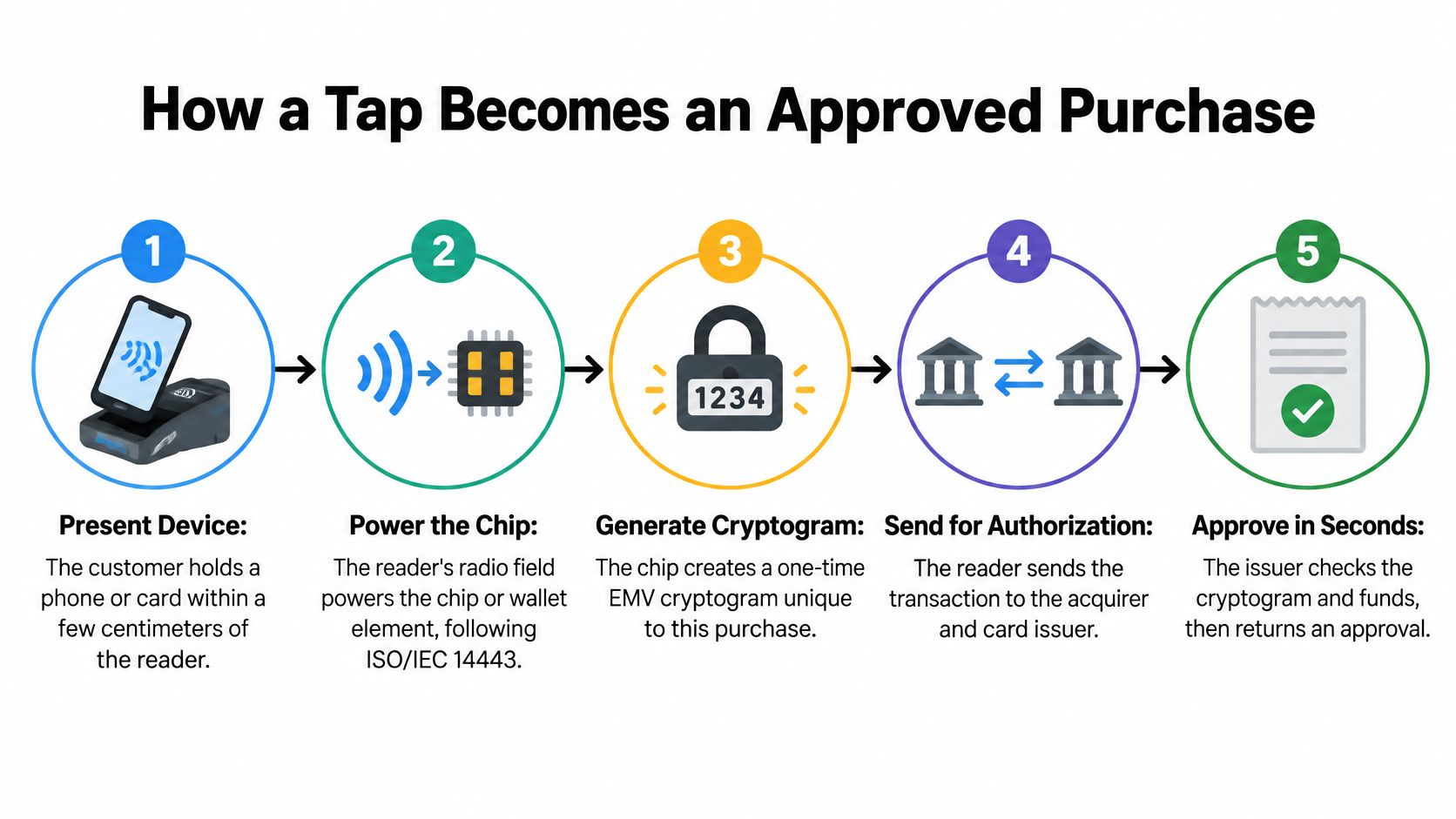
At a school vending machine, a customer taps a phone, waits for approval, then expects the snack to drop. Each part of that exchange has a job. A short reader-to-device interaction starts the payment, while the processor connection and machine controller determine whether the purchase completes and gets recorded. Contactless transactions are designed to be quick, but there is no hard half-second authorization deadline: network conditions and terminal configuration affect the wait.
Present the device. The customer holds a phone or card close to the reader. The short radio range helps prevent an access badge in a pocket from triggering a payment.
Power the chip. The reader energizes the chip or wallet element over ISO/IEC 14443 and runs anti-collision to select a device. Without that step, multiple nearby cards could interfere with the exchange.
Select the application. The terminal chooses the EMV contactless application and reads the transaction data. This is the point where the radio interaction becomes a payment request.
Build the cryptogram. The chip or wallet generates a one-time code tied to the transaction. A copied static number cannot generate that code for a different sale.
Run risk checks. The terminal may approve offline within configured limits or send the request to the processor. Offline approval is an operational setting, with risk attached, not an automatic fallback.
Get the answer. The issuer returns an approval or decline over an encrypted, authenticated path. Keep cryptographic keys in tamper-resistant certified hardware and retain only permitted data.
Release and log. The controller tells the machine to dispense and records the event. If the payment log and the product mechanism disagree, the operator may struggle to resolve a customer dispute.
A repeat tap while the first request is still processing can create duplicate presentments. The customer may assume the first attempt failed, while the terminal receives another request. Stable power, responsive software, and a reliable connection reduce this risk. For unattended machines, monitoring transaction status and dispensing events helps operators distinguish a slow approval from a failed vend.
Compare a successful tap with a failed one before judging a reader.
When a tap fails
Check the reader, device, connection, and machine response before blaming the card.
Reader distance: Hold the phone or card in the marked zone, close to the reader.
Wallet state: A locked phone or expired default card may decline without a useful message for the customer.
Authorization time: A delayed processor response can prompt a second tap. Treat roughly 500 milliseconds as an approximate speed target, not a guaranteed limit or a cutoff for approval.
Displayed result: A blank light and a red decline point to different problems. Only one necessarily involves the network.
Why a Tapped Payment Cannot Be Copied and Reused
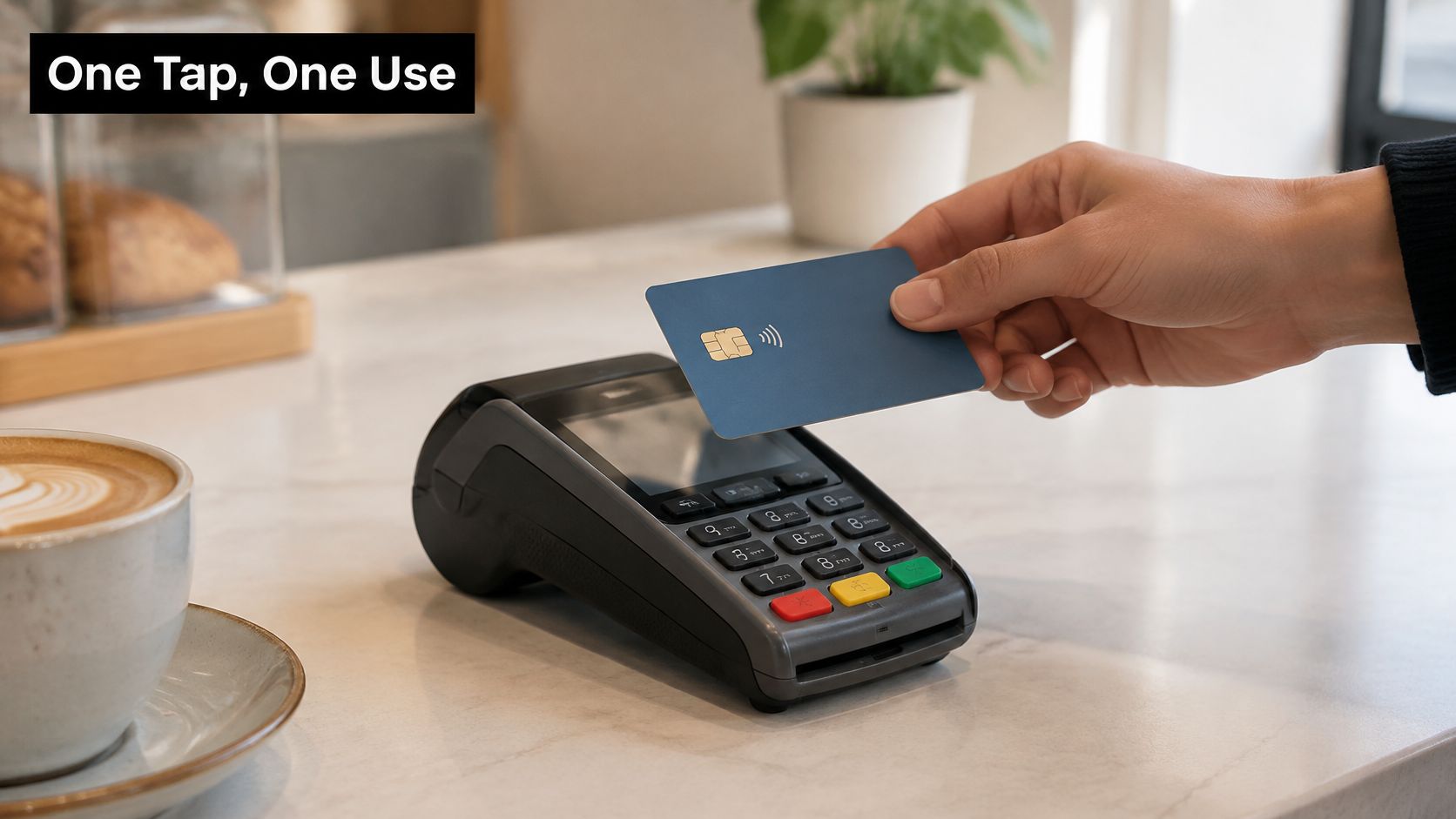
A static card number is like a photocopy of a concert ticket. Anyone holding the copy can try to walk in. An EMV cryptogram is like a ticket that is valid for one seat on one night. Each transaction produces a single-use code, so authorization data is not reused from one purchase to the next, as Visa's contactless payments overview describes. A copied number cannot create a valid approval for a new amount or a different terminal.
What the customer never sees
Tokenization replaces the primary account number with a payment token that is constrained in how it can be used and has little value if stolen. A phone holds a device-specific token for Apple Pay or Google Wallet, so the vending controller never sees the card number. That matters in offices, campuses, clinics, airports, and stadiums, where machines process small purchases and should not store live credentials.
Online, the issuer checks a dynamic cryptogram. Offline, the terminal can use mechanisms such as Dynamic Data Authentication and Combined Data Authentication together with application-cryptogram generation. Those options still depend on keys, limits, and a controller that was certified to use them.
What the operator has to protect
Security does not stop at the chip in the customer's hand.
Keys: Keep cryptographic keys inside tamper-resistant certified hardware, not in a spreadsheet or a loosely locked controller.
The path: Send authorization data over an encrypted and authenticated payment network.
The record: Retain the minimum permitted transaction information and no full card numbers.
A vending controller should never keep full primary account numbers, raw chip data, magnetic-track equivalents, private cryptographic keys, or a wallet device identifier tied to a named person.
The security of a tap depends on the payment controller and its configuration as much as on the chip in the customer's card.
Vending Machine and POS Requirements to Check
Buying an "RFID reader" is the mistake that stalls most unattended projects. ISO/IEC 14443 defines proximity communication, not the complete payment application. A compliant terminal also has to run card selection, anti-collision, data exchange, risk checks, and authorization handling, which the Dutch Payments Association note on EMVCo standards treats as separate from the radio itself. NFC wallet taps use that same radio base as contactless EMV cards, so one certified reader architecture can take both.
Requirement | Vending machine | POS terminal | Why it matters |
|---|---|---|---|
Radio standard | ISO/IEC 14443 proximity reader | Same ISO/IEC 14443 base | Defines the radio layer only, not the payment |
Read range | Under 4 cm, deliberate tap | Same range | Limits accidental reads from nearby cards |
Payment kernel | EMV contactless kernels supported and certified | Same certified kernels | Required to process bank cards |
Authorization path | Encrypted, authenticated link to processor | Acquirer host connection | Keeps approvals near 500 ms |
Wallet support | Apple Pay and Google Wallet tokens | Same wallet support | Matches the phones customers carry |
Connectivity | Cellular or Wi-Fi with defined fallback | Network with defined fallback | Outages change how approvals are handled |
How the hardware differs on site
The radio standard is shared. The box around it is not. A vending reader sits at a fixed height on a metal door, often outdoors or in a noisy electrical cabinet, and it has to survive vibration from the compressor. A countertop POS terminal gets cleaner power, a staff member nearby, and a customer who can be asked to try again. Mount the vending reader where a person can deliberately present a phone, and give the controller stable power so the field does not sag mid-tap.
Adding hardware after the fact is a controller job, not a sticker job. A practical walkthrough of how to add a card reader to a vending machine shows why the payment path and the vend motor have to agree.
Questions to put to any vendor
Ask these before you sign, and get the answers in writing.
Kernels: Which EMV contactless kernels are certified, and for which card networks?
Processor: Which processor or acquirer answers the authorization, and what is the typical round trip?
Keys: Where are cryptographic keys stored, and is the hardware tamper-resistant and certified?
Offline: What happens when the link drops, and what is the offline ceiling?
One dashboard: How do inventory events and tap events land in the same view?
Where Contactless Security Still Breaks Down
A vending reader can accept a tap during a network outage, then leave the operator with a transaction that has not been checked by the issuer in real time. That is an operating choice, not an automatic feature of RFID or an EMV chip. Recent research findings reported in the University of Surrey summary of those findings describe weaknesses in some offline point-of-sale implementations, including cases where payment limits or expected verification checks could be bypassed. The summary gives operators reason to test their own terminal settings, not to assume every contactless payment is exposed in the same way.
Set offline limits with the acquirer, restrict who can change them, and check the behavior before the machines go live. An EMV chip provides cryptographic protections during a transaction, but it does not set a terminal's offline ceiling or alert you to an unusual run of attempts.
Questions to answer before launch
At an unattended site, an outage or disputed charge may go unnoticed until a customer reports it. Decide who responds, what evidence is retained, and which controls can be changed remotely.
Outage: What happens if the reader cannot reach the issuer?
Disputes: Who handles a charge a customer says they did not make?
Limits: Who sets offline limits, and who is allowed to change them?
Remote disable: Can you disable one terminal from the dashboard?
Telemetry: Can the system distinguish a failed tap from a pattern that needs review?
Risk | What it looks like | Control to set |
|---|---|---|
Offline approval above limit | A payment is accepted without the expected PIN or biometric check | Set offline limits per terminal and test them before launch |
Network outage | Authorization cannot reach the issuer | Agree fallback behavior and limits with the acquirer in writing |
Reader tampering | Hardware has been altered or bypassed | Use tamper-resistant certified hardware in a locked enclosure |
Outdated firmware | A known flaw remains active | Schedule remote updates and maintain certified kernel versions |
Repeat or burst taps | One device makes many attempts in a short period | Set telemetry alerts for tap velocity and declines |
Disputed charge | A customer disputes a purchase | Keep a timestamped record with terminal ID and token reference, and define liability in the contract |
The EMV payment tokenisation guide explains how tokenisation supports contactless payment use cases. For vending operators, that layer does not replace outage procedures, remote shutdown, reconciliation, or monitoring. A reader can process taps correctly and still leave gaps if alerts are missed or nobody owns the response.
Treat payment security as an operations task. Set a clear fallback for outages, confirm who reviews alerts, and make sure the dashboard can show whether a transaction failed, was approved offline, or needs investigation. Pair those controls with a practical guide to mobile payment security for vending and other unattended sites, so site managers and the payment vendor can act on the same risks.
Privacy of Tap Data and Customer Records
Privacy on an unattended machine is a data-flow decision, not a slogan on the reader. Tokenization means the machine and its controller see a payment token instead of the primary account number, so the card number is not exposed at the vending point.
What a normal sale may keep
Per sale, a controller can reasonably hold a short operational record.
Timestamp: When the tap happened, down to the second.
Terminal ID: Which machine and which reader took it.
Product slot: What was vended, so stock and disputes can be matched.
Amount and approval code: Enough to reconcile with the processor.
Token reference: A pointer the acquirer understands, not the card number itself.
What it must not keep
Do not store full card numbers, raw chip or track data, cryptographic keys, or wallet device identifiers tied to a named person. Where a site uses badge or employee-linked access, tap logs must not become a personal spending diary. That line matters in hospitals, schools, and factories, where a refreshment purchase should not follow someone into an HR file.
Set a retention period in the contract, delete detailed logs after it ends, and restrict dashboard access by role. A short privacy notice on or near the machine should state what is recorded and for how long.
Ask the vendor where logs are stored, who can read them, and how long they live.
How to Roll Out Tap-to-Pay Vending at Work or in Public
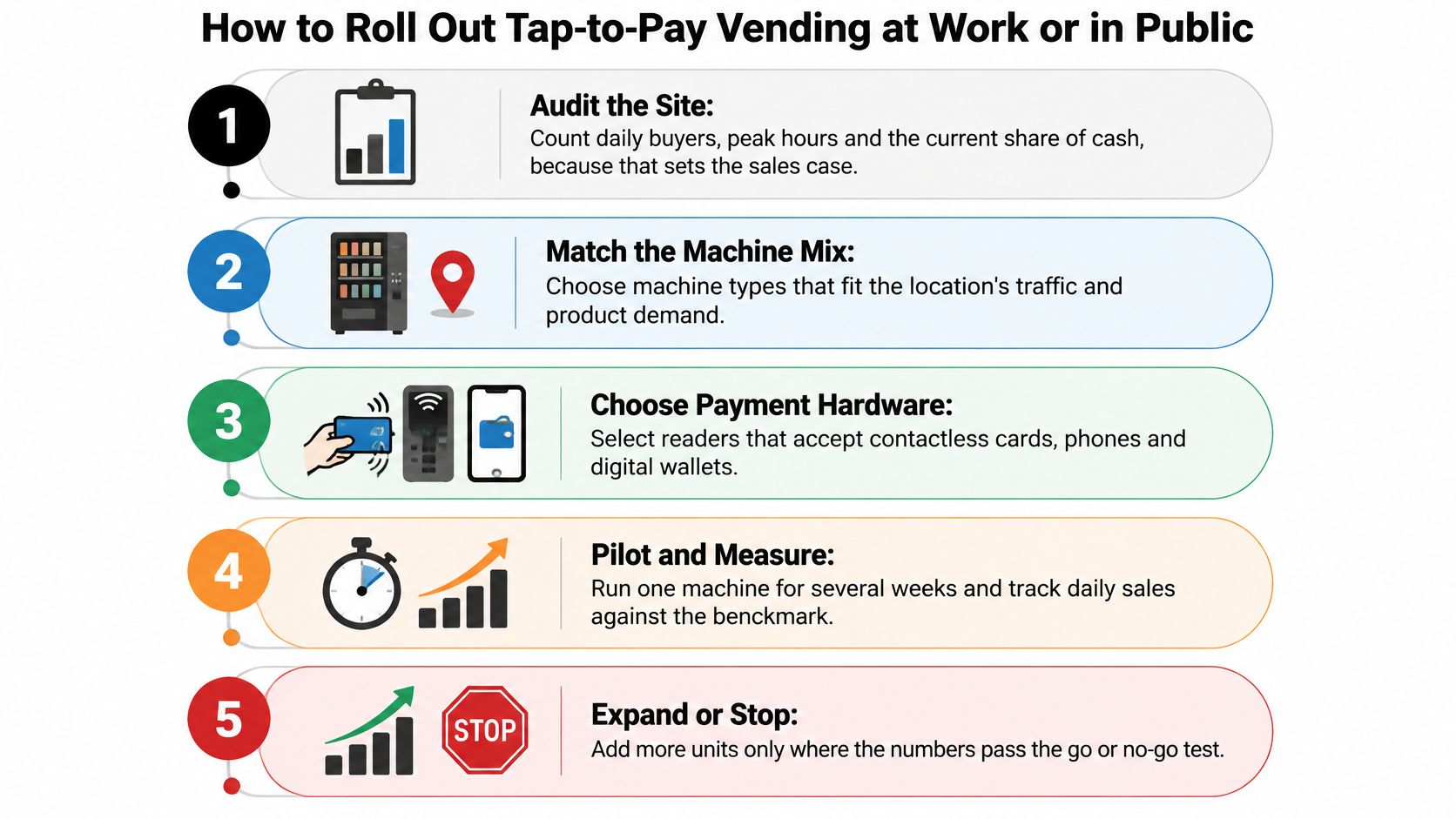
Most unattended purchases are small. The average ticket for most unattended transactions sits below $3.00, and 69% of vending transactions were cashless in 2023, up from 67% in 2022, according to William Blair's note on small-ticket contactless payments. At that price, a slow or confusing tap feels expensive. The sequence below exists so the tap stays the easy part.
Audit the site. Count daily buyers, peak hours, and the current share of cash. That mix is the sales case, not a guess about "going cashless."
Match the machine to the room. Compact refreshment centers fit break rooms. Dual-zone chill or frozen machines fit hospitals, schools, and stadiums, because demand is not the same in a clinic corridor and a factory lunch line.
Confirm kernels and wallets in writing. A reader without certified EMV contactless kernels and wallet tokens cannot take bank cards, no matter how new the bezel looks. Support for Google Wallet on a vending machine should be a named capability, not a maybe.
Set offline limits and outage fallback before launch. Agree the ceiling and the behavior with the processor while you can still test. Discovering the fallback during a real outage means you learn it from angry texts.
Test real devices. Use an iPhone, an Android phone, and physical cards at the distances people stand, and include a deliberate double tap. Retries and duplicate presentments are the complaints you will hear first.
Turn on telemetry. Alert on failed taps, declines, stockouts, and disputes so you see the pattern before the site manager does.
Put the instructions on the glass. Signage should show where to tap and what an approved light and a declined light mean. Unclear feedback is what drives abandoned purchases.
Review monthly. Read customer comments with the sales file and change the assortment. A perfect reader cannot sell a drink nobody wants.
Why the order matters
Skipping the audit and jumping to hardware is how operators end up with a certified terminal in a room that still wants coins at 6 a.m. Skipping the double-tap test is how a "successful" pilot produces duplicate charges in week one. The radio, the kernel, the fallback, and the sign have to be true at the same time.
Adoption Benchmarks and a Go or No-Go Test
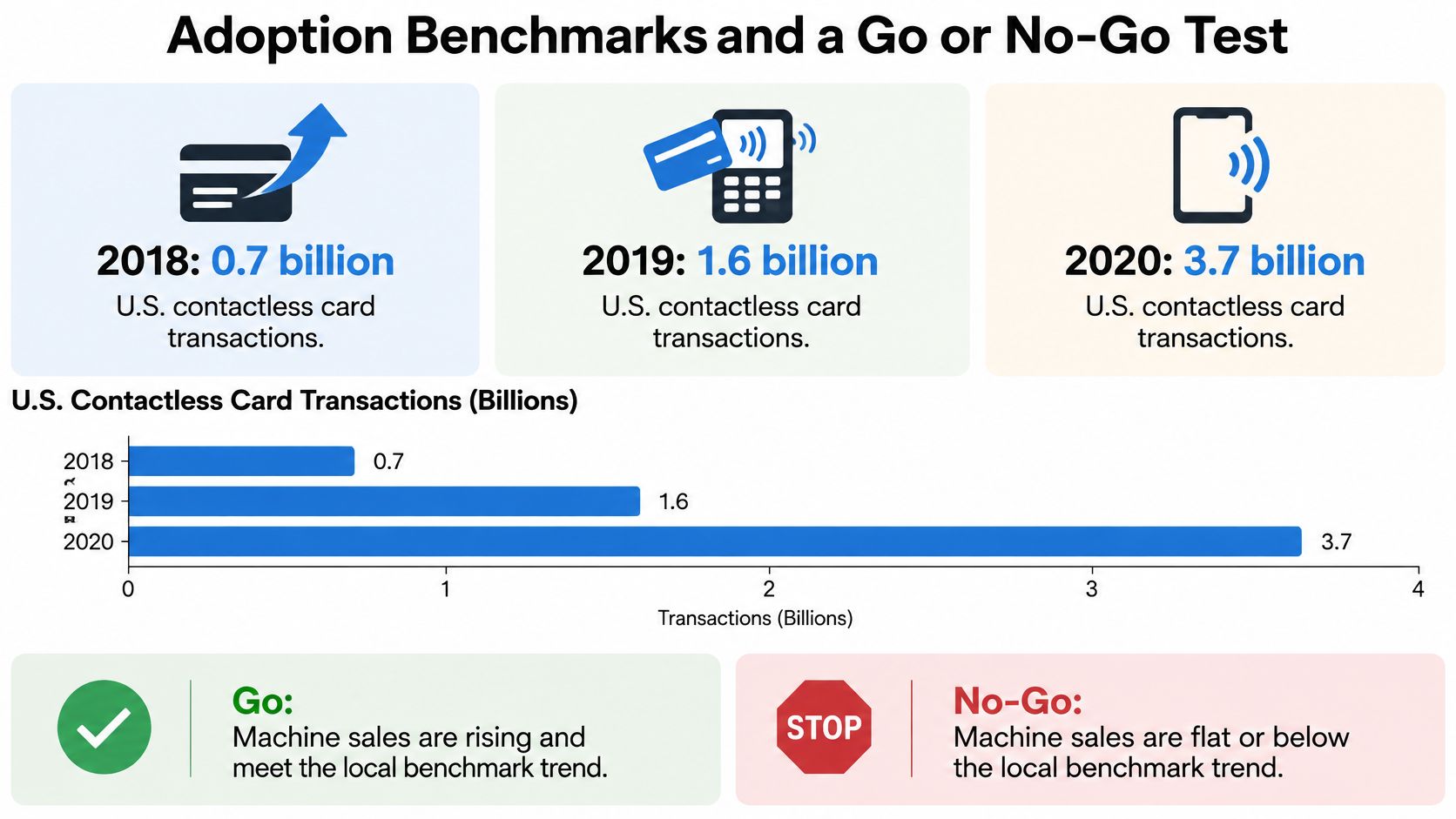
A rise in contactless payments shows that customers are using taps more often, but it does not guarantee that every vending site will benefit. Federal Reserve estimates put U.S. contactless card transactions at 0.7 billion in 2018, 1.6 billion in 2019, and 3.7 billion in 2020, according to the Federal Reserve payments study findings.
Metric | Figure | Period or source |
|---|---|---|
U.S. contactless card transactions | 0.7 billion to 1.6 billion | 2018 to 2019, Federal Reserve estimate |
U.S. contactless payments | 3.7 billion | 2020, Federal Reserve estimate |
Cashless share of unattended transactions | 51% to 62% | January 2020 to October 2021 |
Contactless share of all unattended transactions | 18% | January 2020 |
Contactless share of cashless unattended transactions | 43% | October 2021 |
Contactless share of cashless transactions | Nearly half | First half of 2022 |
Cashless share of vending transactions | 69% | 2023 |
In a study of about 160,000 unattended-payment devices, cashless purchases accounted for 51% of transactions in January 2020 and 62% in October 2021. Cash declined from 49% to 38% over the same period. The contactless figures use different denominators: taps made up 18% of all unattended transactions in January 2020, while they represented 43% of cashless transactions in October 2021. Those percentages do not show a like-for-like increase. Contactless methods were nearly half of cashless transactions in the first half of 2022. The 2023 cashless vending share is the William Blair figure noted above.
A machine that accepts only coins or magnetic stripe payments may miss customers ready to tap. Check whether each location's customers carry cards and wallets the reader supports, then compare vending machine payment systems against that mix. Adoption figures help set expectations, but machine-level results depend on the site, connectivity, and the way declines or outages are handled.
The go or no-go test
Make the call before ordering hardware.
Habits: Customers already pay by phone or card in comparable venues.
Ticket size: Purchases are small and customers expect a quick checkout.
Link: Connectivity is reliable, with a defined fallback if the network drops.
Proof: The vendor can document certified kernels, wallet tokens, and tamper-resistant hardware.
Visibility: Telemetry reports failed taps and declines, so you can spot trouble.
Outage story: Staff know what the machine does during a network outage and can explain it to customers.
If most answers are yes, arrange a site survey. Get kernel certification, offline limits, and dispute terms in writing before signing. Vendmoore Enterprises serves Oklahoma City, Norman, Edmond, and surrounding cities with managed programs and machine ownership options for workplaces that want tap acceptance without operating the payment stack alone. The tap is the visible part of the sale. The operator's controls, outage plan, and transaction records determine whether it keeps working when conditions change.
Comments