
Drink Vending Machine Near Me: Find the Best Local Fit

At 2 p.m., a production worker on an Oklahoma plant floor wants a cold drink and cannot leave for a store. A nurse ending a long stretch in a hospital corridor faces the same gap, and so does an office employee between meetings. Each one pulls out a phone and searches "drink vending machine near me." The result that helps them is a machine they can reach, pay at without guessing, and trust to have drinks in stock.
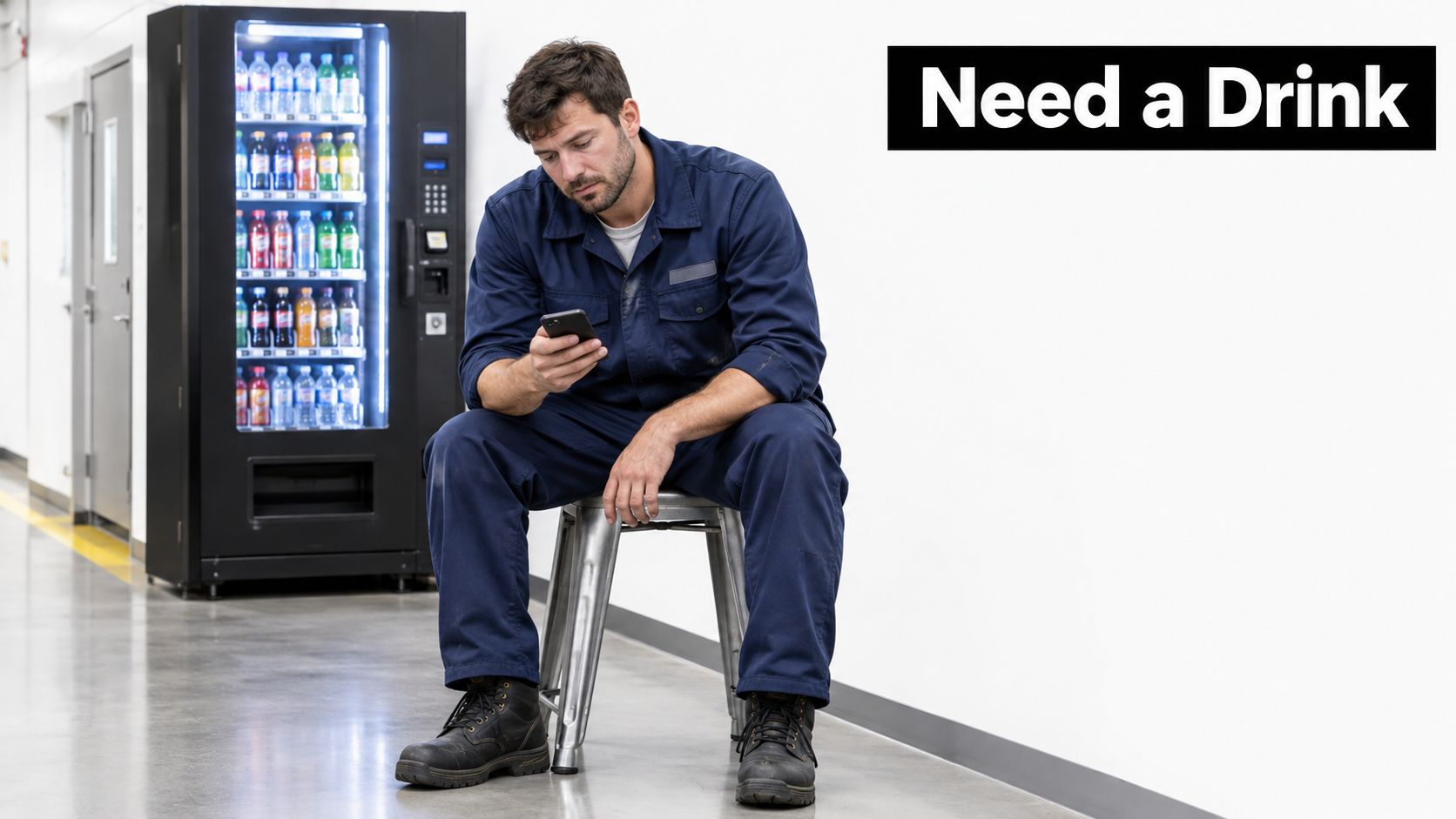
Vending is an established convenience channel in the U.S. Industry estimates put the number of active machines at approximately 2.93 million in 2025, reaching roughly 40 million consumers daily (U.S. vending market estimates). Manufacturing and factory sites hold the largest listed share of placements, so dependable on-site refreshments matter directly to Oklahoma's industrial workplaces.
I've placed machines in offices, schools, and hospitals across the state, and the search is a usability question dressed up as a distance one. Getting there matters, but so does everything after arrival: whether the price is posted where you can see it, whether the card reader works, whether the drink you want is in the machine. Operators who monitor machines remotely through telemetry can spot an empty column the day it happens and treat it as a scheduling fix instead of a complaint. For facility managers, those details decide whether vending supports the break room or turns into a recurring service call.
When a Nearby Drink Machine Actually Matters
A map pin answers where, and that is all it answers. It can't tell you whether the machine sits inside a badge-restricted building, around a locked corridor, or too far from the people who need it during a fifteen-minute break. It won't confirm the unit is powered on, stocked, or set up to accept the card in your pocket.
That gap shows up hardest where people can't easily step away. A factory employee might get a short window between tasks. A hospital visitor could be waiting on a floor far from the cafeteria, while an office worker in Norman watches the clock ahead of a meeting. I've walked all three of those sites placing machines, and the "near me" result that works is the one that removes friction at the moment of need.
Drinks are only half of what people reach for on a break. In break rooms where staff pack lunches, or in buildings with steady visitor traffic, giving the machine better-for-you company (the healthy snack ideas from Yuve work well as a starting list) widens who the amenity serves.
What a useful nearby result needs to answer
Before choosing a machine, check three things: whether it is physically accessible, whether the payment methods are posted and working, and whether the drink selection fits the location. A bottle-and-can vendor in a break room can serve a shift-based workforce well. A machine in a hospital corridor has to work for visitors and staff running on different schedules.
I check sightlines before I check anything else on a placement. A unit tucked behind a column or past a staff-only door may as well be in another zip code.
The placement mix explains why these settings matter. As the market estimate linked earlier reports, manufacturing and factory sites hold the largest listed share of U.S. vending placements at roughly 27%, with government facilities around 13%, commercial offices near 11%, hospitals close to 9%, residential locations at 8%, and public locations at 7%. Every one of those is a setting where people want a cold drink without leaving the premises.
A machine earns trust through the everyday details: the right drink, a usable payment screen, and a reliable restock.
Whether you're an employee looking for a drink or a facility manager weighing a vending service, judge the result by how it performs for the people using the space. Distance is the easy part. The machine still has to earn the walk.
Proven Ways to Find a Drink Vending Machine Close By
Search results misrepresent vending machines more often than people expect. Listings go stale, general vending companies rank above the actual operator, and machines inside secure buildings show up in results that were never open to the public. BrightLocal reports that 46% of consumers always or often add "near me" to local searches, and its research says customers are more likely to visit and consider businesses with complete Google Business Profiles (2025 local-search statistics). A complete profile confirms a business exists. It tells you nothing about whether the machine on that property is stocked, takes your card, or sits where visitors can reach it.
Use a quick search-and-check routine
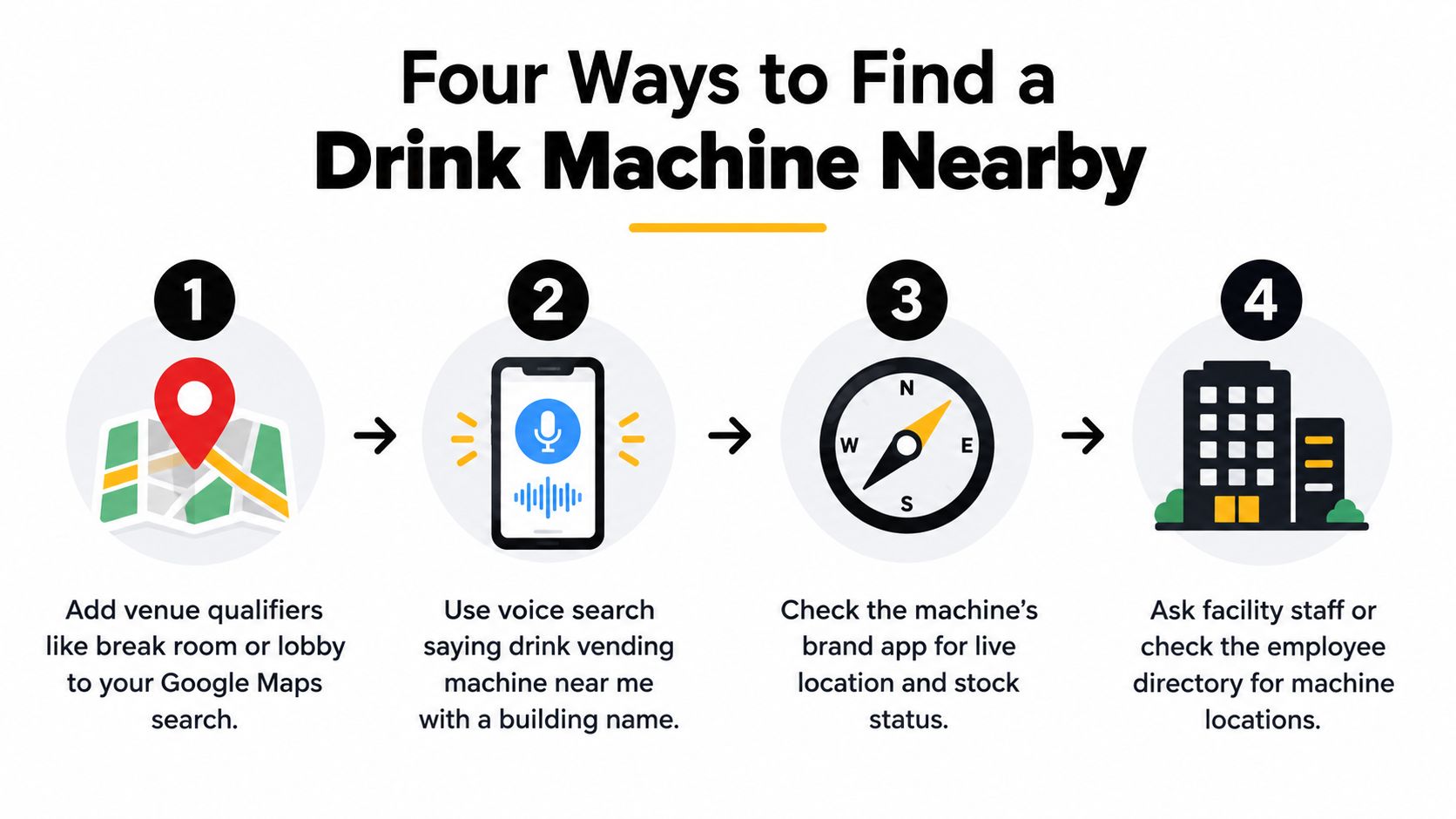
Add a venue to the map search. Try "office vending machine," "break room vending," or "lobby drink vending" with a city or building name. The qualifier filters out equipment dealers and residential-route operators that a broad vending search pulls in.
Review the Business Profile. Check the provider's listed services, service area, photos, hours, and recent reviews. A profile with current details gives you more to work with than a business name and an old phone number.
Confirm the machine on site. If you're already in the building, look for lobby directories, break-room signs, or a service number posted on the machine. Ask staff whether the machine serves visitors or only employees.
Check the operator's website. Look for named service areas, the types of locations covered, and how the company restocks. Operators who monitor machines remotely can refill a fast-moving slot before it sits empty for days. For an Oklahoma installation, review Vendmoore's Oklahoma service areas and compare the listed coverage with your location.
A map result identifies a candidate. The details establish whether it is a real option for your situation.
For building owners weighing a nearby drinking-water amenity against packaged beverage vending, these facility hydration station upgrade tips can help frame the broader break-room decision.
When inside a large campus, hospital, or office, add the building name to a voice or phone search and check with facility staff before walking across the property. You can also watch this guide:
What to Compare Before You Choose a Local Vending Provider
A vendor promising “a machine near you” may mean a machine installed somewhere in the building. That's not enough for a facility manager deciding whether to bring in a service. Compare providers on how they operate after installation, not just on equipment or a quick placement promise.
Criterion | What to Ask | Strong Answer | Red Flag |
|---|---|---|---|
Service model | Who stocks, cleans, and repairs the machine? | The provider defines responsibilities and handles routine service. | The host must troubleshoot or restock without a clear agreement. |
Telemetry | Can the operator monitor inventory and machine issues remotely? | The operator can use machine data to guide replenishment and follow-up. | Restocking depends entirely on a fixed route or customer complaints. |
Payment options | Which cards, mobile wallets, and cash options work? | Payment methods are stated clearly and match the users at the site. | “Cashless” is promised without explaining what payment types are accepted. |
Assortment flexibility | Can products change to match the location? | The provider reviews sales and requests, then adjusts the mix. | The same fixed product list is used at every location. |
Response expectations | Who responds if a machine fails or a payment doesn't dispense a drink? | The host has a service contact and a defined process for reporting problems. | No clear contact or follow-up process is offered. |
Data visibility | What information can the host see? | The provider can discuss transactions, stockouts, and service issues. | The host gets no meaningful operating updates. |
Cashless equipment can improve usability, but it won't rescue a poorly chosen site or mismatched product mix. One study covering 250,000 machines reported higher transactions after adding cashless capability, including larger changes among low-volume machines. Those results are benchmarks, not promises: the study measured equipment on one payment platform and may reflect differences in locations, operators, and existing demand (cashless vending technology analysis).
A visible machine isn't automatically a productive machine. Access, demand, assortment, and service have to line up.
For a provider conversation, score each criterion as clear, partial, or unresolved. A local overview of vending services can help facility teams think through managed service expectations before speaking with prospective operators. The point isn't to find a vendor with the flashiest machine. It's to choose a provider that can explain how the machine will be kept useful and supported.
Accessibility and the Hidden Barrier Behind ‘Near Me'
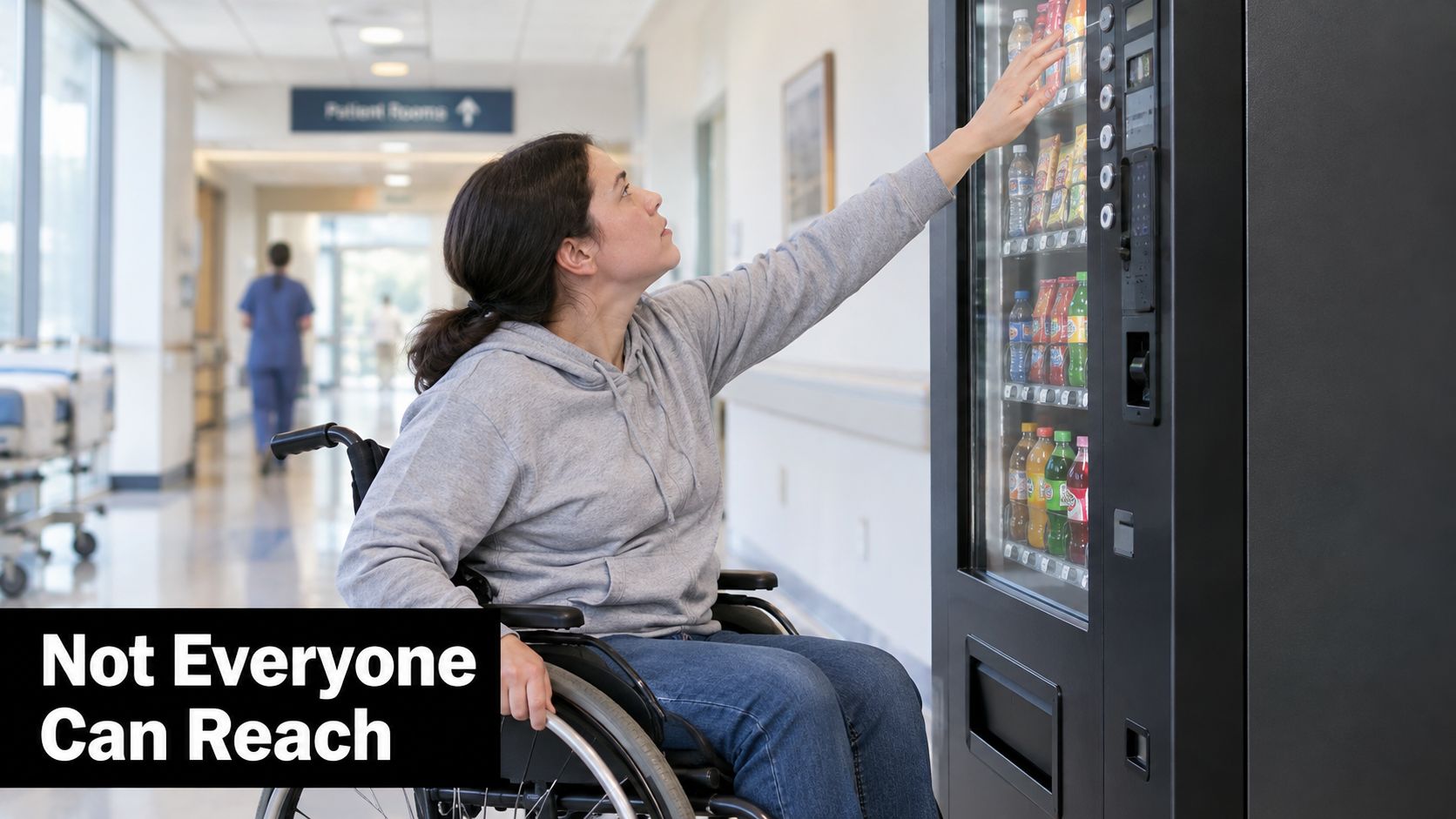
A vending machine can be nearby and still be out of reach. A narrow aisle, high controls, difficult payment screen, or blocked route can turn a convenient amenity into an inaccessible one for an employee, patient, or visitor.
U.S. accessibility guidance says vending machines must be positioned on an accessible route. Standards for self-service machines also address clear floor space, reach range, operable parts, privacy, speech output, Braille, and display screens (ADA guidance for businesses). Yet local listings rarely tell users about machine height, aisle clearance, audio cues, or accessible payment functionality.
Ask about the full purchase, not just the route
A wheelchair user may be able to reach the machine but not the selection controls. A person with low vision may see a digital payment screen but be unable to use it independently if the interface lacks usable contrast or audio support. A tap-to-pay option can help some customers while creating another barrier for someone who can't operate the screen or access a digital wallet.
These details matter in hospitals, schools, airports, offices, and residential buildings, where users have different mobility, dexterity, and vision needs. A building manager should ask whether the provider evaluates the route and controls at each placement, and whether it can share practical access information before installation.
When discussing touchscreen equipment, include usability and assistive features in the conversation. This overview of vending machine touch screens can help frame the technology questions, but a screen's presence alone doesn't establish that every customer can use it.
Ask a prospective operator to document the machine's location and access conditions. Treat a clear answer about barriers and limitations as part of service quality, not a marketing extra.
Payment Options and Price Transparency at the Machine
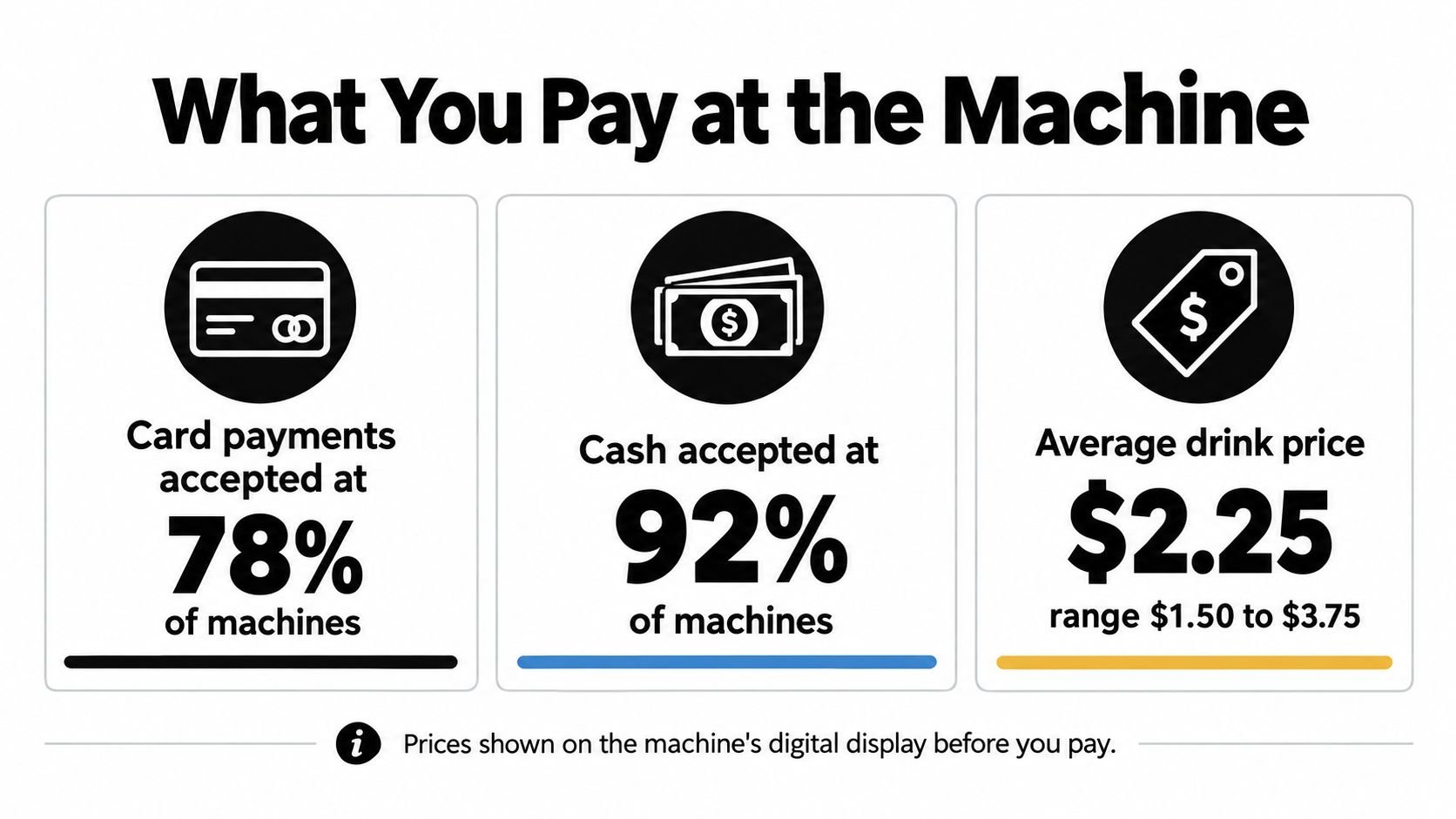
A search for a drink vending machine nearby carries two practical questions: Can I pay the way I prefer, and what will the drink cost? Cashless use is now common, but “cashless accepted” doesn't tell a customer whether the machine takes contactless cards, chip cards, Apple Pay, or Google Wallet.
A study of 160,000 U.S. vending machines found cashless sales rose from 51% in January 2020 to 62% by October 2021. More recent reporting puts cashless vending at 71% of transactions in 2024, with 77% of those cashless transactions contactless (mobile payments in modern vending). For operators, those figures underline why payment options belong in the site plan. For customers, they make clear why a machine's payment badge matters.
Price is part of the customer experience
A machine may display a price before checkout, but an old photo or stale review can't reliably tell you what an item costs today. Listings often omit item-level prices, cash support, applicable taxes, and what to do if a payment is approved but the drink doesn't dispense.
Before choosing a provider, ask which payment types the machine accepts and how customers report a failed vend. Find out whether the price appears clearly before payment, how refund requests are handled, and where users can contact the operator. The answers should be visible on the machine or easy to find from the host site.
For facility managers, price and payment policies should be part of the vendor discussion rather than a detail left until installation. This guide to cashless payment trade-offs can help clarify the balance: tap-to-pay offers convenience, while cash acceptance can remain important for people who don't have a card or usable phone. A transparent machine makes that choice clear before someone starts a transaction.
Installation and Ongoing Service Expectations
A professional installation starts with a site walk, not a delivery truck. The operator should check where people pass and pause, how the space is used across operating hours, whether the machine can be accessed, and whether the proposed location has suitable power and conditions for refrigeration.
What good setup and follow-up look like
Choose equipment for the site. A machine needs to maintain product temperature under the location's ambient conditions. The operator should consider airflow and placement, not just whether the cabinet fits.
Verify refrigeration. At installation, use an independent calibrated logger to confirm temperature. Record readings before and after restocking, then check door seals, airflow, the condenser, and vents for obstructions.
Rotate inventory properly. Use first-expiring, first-out handling so older product sells before newer stock.
Set telemetry alerts. Configure notifications for temperature excursions, low inventory, payment failures, and extended downtime, then use those alerts to guide service.
Washington's vending-machine food code offers a useful benchmark: refrigerated vending-machine ambient temperature must not exceed 41°F (5°C) for more than 30 minutes immediately after filling, servicing, or restocking. Operators should verify the applicable requirements in Oklahoma and any additional standards set by a school, hospital, airport, or other client.
A restock plan should follow actual sales rather than guesswork. The operator can start with a baseline for transactions, average ticket, stockouts, and time out of service, then adjust placement or assortment in measured trials. If a top-selling drink repeatedly disappears before the next visit, telemetry and inventory records should lead to a practical change in the replenishment schedule.
Ask how the provider will document installation checks, handle service calls, and share relevant operating information with the host. Vendmoore's machine installation process is one example of the kind of setup information a facility manager can review before discussing a placement. A clear process should cover the first restock and ongoing service, not only the day the machine arrives.
How Vendmoore Supports Oklahoma Locations
For an Oklahoma office, school, hospital, or industrial site, a local vending provider needs to fit the building's users and remain accountable after installation. Vendmoore Enterprises operates AI-powered vending programs across the Oklahoma City metro, Norman, Edmond, and surrounding communities, with beverage options and service for workplaces and public spaces.
The equipment portfolio includes compact refreshment centers, bottle-and-can vendors, dual-zone chill centers, and frozen food machines. Apple Pay, Google Wallet, and contactless cards are supported, while connected telemetry provides inventory and performance information that can guide replenishment. The aim is to respond to what sells and what the host location requests, rather than relying only on a routine visit schedule.
Match the service to the location
A busy break room may need a different beverage mix from a school, healthcare facility, apartment property, stadium, or airport. Vendmoore gathers employee and customer feedback and adjusts assortments to suit the site. The company also offers fully managed vending programs and options for clients who want to own their machines.
Customer testimonials highlight fair pricing, product variety, and monthly prize promotions. For facility managers, those details are useful starting points for a conversation, but they don't replace a site assessment. Ask about placement, product choices, payment methods, service contacts, accessibility information, and what the operator can share about stock and machine performance.
If you're searching for “drink vending machine near me” as an employee or visitor, confirm that the machine is accessible to you and that its payment options and prices are clear. If you're looking for vending services for a property, compare providers on the operational questions above and check their actual service coverage before committing.
Vendmoore Enterprises offers managed drink vending with cashless payments, customized assortments, and telemetry-guided replenishment for Oklahoma workplaces and public spaces. Visit Vendmoore Enterprises to review service options and request a site assessment for your location.
Comments