
Hospital Vendor Policy: What to Require and How to Enforce

Your phone rings at 6:40 on a Tuesday morning. Security has a technician at the loading dock with a pallet of drinks, no badge, and no appointment, and the only person who recognizes his company is the nurse manager who ordered the machine three years ago.
The contract exists somewhere. The policy says vendors need advance approval and a scheduled visit. Nobody can say whether that clause covers the man who restocks the break room, who is supposed to escort him, or what happens when he shows up again on Saturday.
That gap is why a hospital vendor policy matters more than most facilities teams expect. Vendor rules get written for clinical representatives and device salespeople, then fail without warning when a recurring nonclinical operator needs routine access to a staff area. The same access, safety and audit requirements apply to a refreshment service.
Core Elements Every Hospital Vendor Policy Includes
A badge that stays active after a contract ends is a small administrative miss with a long tail. The service agreement lapsed, the technician kept coming, and the badge roster only revealed the problem during an audit. The failure was structural: nobody owned offboarding in writing.
A hospital vendor policy closes that gap by turning a web of departmental habits into one controlled process. Security manages badges. Facilities manages physical access and escorts. Infection control sets orientation requirements. Purchasing holds contracts and spend records. Clinical leaders review anything that touches care. The policy tells each group where its job starts, where it ends, and what evidence proves the job was done.
Practical rule: if you can't name the person who owns an element, that element isn't controlled. It's only described.
Most vendor policies are written for clinical representatives and device sales. Recurring nonclinical operators, such as vending and refreshment services, often sit at the edge of those rules even though they enter staff areas on a schedule. A useful policy brings them into the same access, safety and compliance structure, while naming the places where ordinary vendor language fails to fit. The overview of what counts as a healthcare vendor helps clarify those categories before the rules are applied.
The complete checklist
Every working policy covers the same set of elements. What varies is how much control each one carries at your facility.
Policy element | What it controls | Example requirement |
|---|---|---|
Scope and definitions | Who counts as a vendor and which visit types are covered | Clinical representatives, contractors and refreshment operators all listed |
Risk tiering | Level of control based on data, physical access and patient-safety impact | High tier for EHR, billing and clinical device suppliers |
Credentialing | Identity, screening, training and licenses checked before access starts | Badge issued only after training and screening are verified |
Access and escorts | Which areas a vendor may enter and when | Restricted zones require an escort; break-room access in set hours |
Safety and infection control | Orientation and conduct in patient-facing and food-handling areas | Infection-control orientation completed before the first shift |
Compliance and audit | Evidence kept and the hospital's right to review it | Audit rights written into the contract; training records retained |
Incident reporting | Notification timelines and responsibilities after an incident | Defined notification window stated in the contract |
Offboarding | Removing credentials and retrieving hospital property | Badges deactivated and property returned on the last day of service |
Procurement reporting | Spend tracking and supplier ownership records | Annual spend recorded by supplier category |
Read that table as a chain, not a list. A vendor gets tiered, the tier sets the credentialing depth, credentialing produces the badge, the badge sets access and escort rules, access generates audit evidence, and offboarding closes the loop. Procurement reporting runs across all of it, because spend records help the hospital see which suppliers are active and which records need review.
The same discipline applies beyond healthcare. Institutional suppliers in many sectors keep ownership, insurance and compliance records because buyers need to know who is on site and what standards they follow. That makes a hospital's document request routine rather than unusual. Procurement teams may also see partners such as the manufacturers behind their in-stock lab furniture when they compare supplier categories, even though the hospital policy still has to define access and compliance duties for itself.
The weak point is usually the handoff. A vendor can be approved, trained and badged, yet still create risk if no one records the visit window, updates the supplier list, or closes the file when service ends. Each element needs a named owner, a written timeline and a review date. Without those, the policy reads well but leaves auditors and incident reviewers to reconstruct what should have happened.
Access Levels by Vendor Risk Tier
Write one access rule for every supplier and you get one of two outcomes. Set it strict and the refreshment technician can't restock a break room on a Friday afternoon. Set it loose and the contractor with access to your billing platform arrives on a visitor badge.
Risk tiering avoids that choice. Classify each vendor by operational criticality, data access, physical access and potential patient-safety impact, then set the control level to match the tier.
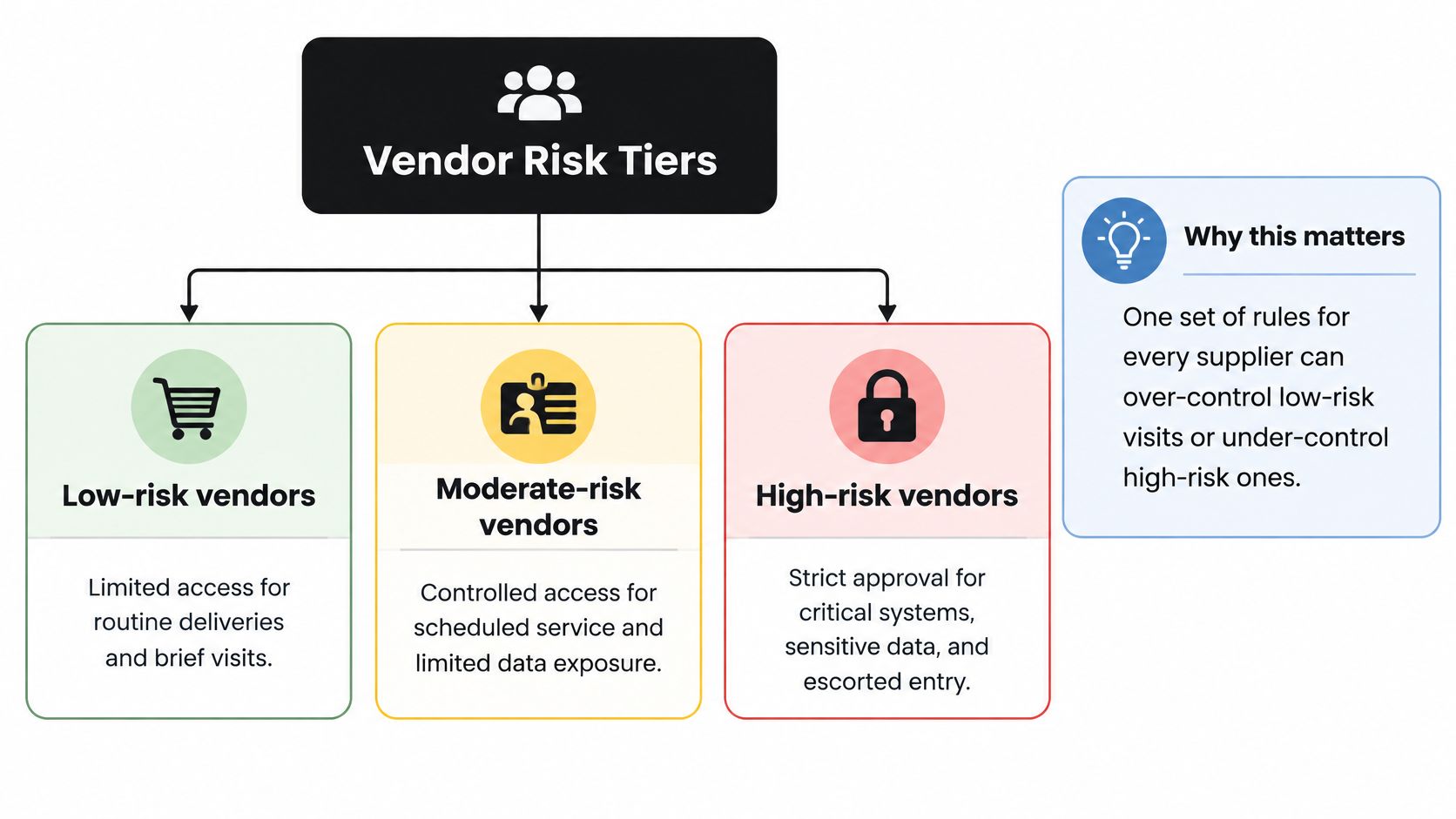
The HHS cybersecurity performance goals describe the top-tier obligation well: identify, assess and mitigate third-party risks, keep processes for discovering vendor vulnerabilities, and respond promptly to vendor-related incidents. That's a different job from checking a driver's license at the dock, and the policy should say so.
Risk tier | Typical vendors | Access granted | Required controls |
|---|---|---|---|
High | EHR, billing, claims and clinical device suppliers | System or clinical-area access under a named internal owner | Security controls, incident-notification timelines, audit rights, subcontractor oversight |
Moderate | Food, refreshment and facilities vendors working onsite | Scheduled onsite access to staff areas; escort in restricted zones | Credentialing checklist, badge rules, infection-control orientation |
Low | Vendors with no protected health information and limited onsite access | Simplified screening; lobby or break-room access in set windows | Periodic reassessment, sign-in logs, confidentiality terms |
Emergency service | Repair and product-removal technicians | Exception access under the incident process | Escort, post-visit incident report, retroactive credential check |
High tier. These suppliers can disrupt care delivery or expose patient data. Contracts should carry documented security controls, defined incident-notification timelines, business-continuity and recovery expectations, subcontractor oversight, and audit rights. A vendor that supports the EHR should never be governed by the same page of rules as the one that fills a snack machine.
Moderate tier. Food, refreshment and facilities vendors work onsite on a schedule. They need the credentialing checklist, badge rules and infection-control orientation, plus an escort whenever the route crosses a restricted zone. The control is real, but it doesn't require a security architecture review.
Low tier. Vendors with no protected health information and limited onsite access can use simplified screening and periodic reassessment. Sign-in logs and confidentiality terms usually do the job.
Emergency service. Repair technicians and product-removal crews need exception access under an incident process. They get an escort, a post-visit report, and a retroactive credential check.
Tiering isn't paperwork for its own sake. It sends review effort toward the failures with the greatest consequence and keeps routine visits from stalling.
How to Credential a Vendor Before First Visit
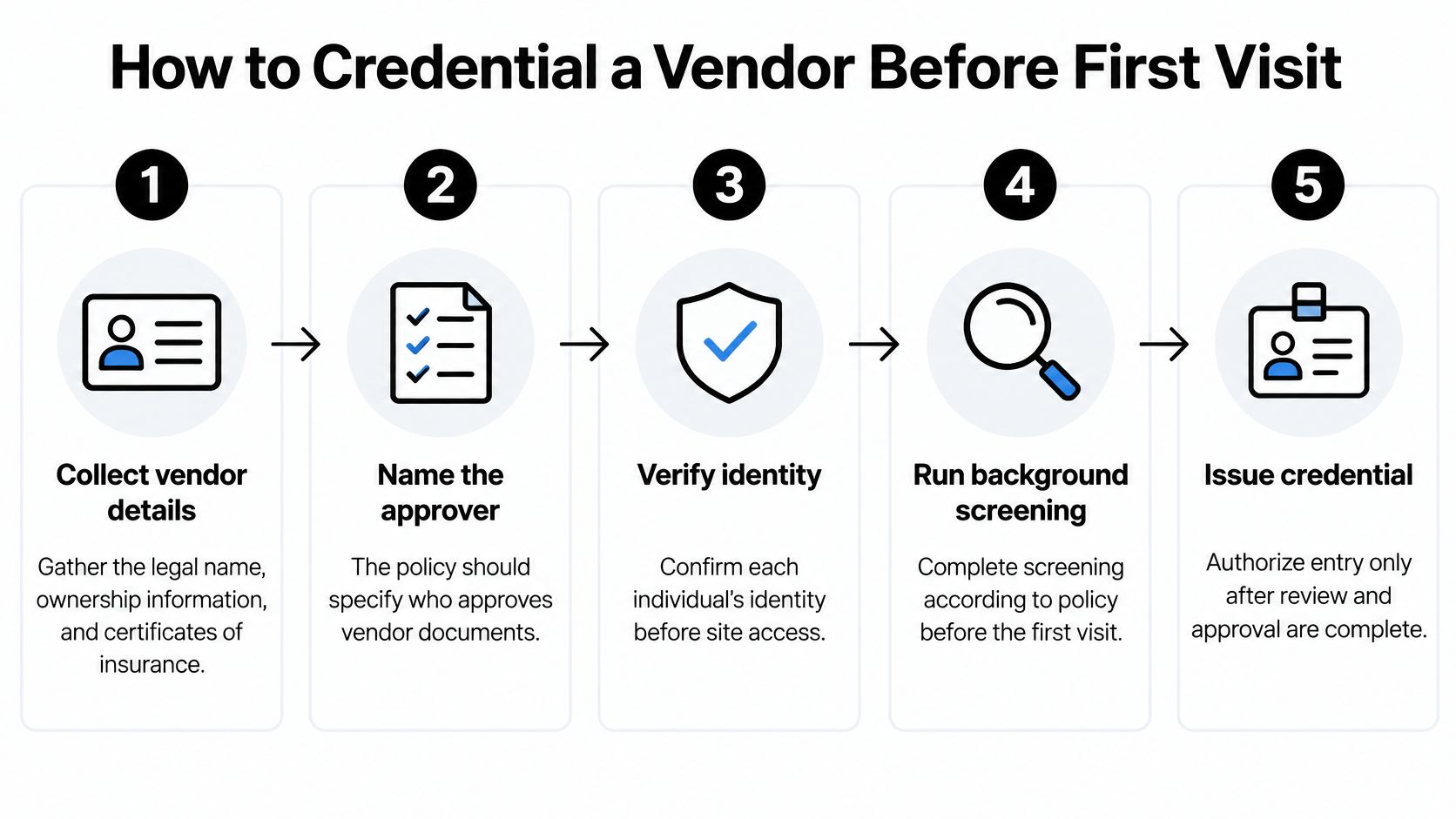
A vending route technician arrives for a first restock. The front desk knows the company name and nothing else: no idea whether the person holding the dolly has been screened, trained, or even employed by the firm on the contract. Credentialing exists to prevent exactly that gap. It turns a company into a set of named individuals with documents attached, and every skipped step weakens the whole chain.
The HHS Office of Inspector General resource guide recommends that organizations document vendor compliance obligations, require vendors to acknowledge applicable standards of conduct, verify required training and screening, check exclusion status, and preserve rights to audit vendor records. Applied to an onsite food, equipment, facilities or refreshment supplier, that produces a seven-step checklist.
Collect the legal name, ownership information and certificates of insurance. The policy should name who approves them, by role and by name. The common slip is a certificate on file for a parent company while the local operator doing the work is a separate legal entity with its own coverage. When an incident occurs, that mismatch decides whose insurance responds.
Verify each individual's identity and run background screening where local law permits. Company-level vetting doesn't cover the technician who walks your corridors every week. Screen the person, not just the entity.
Check exclusion status against federal and state exclusion lists before any individual is approved for access. Do it again at renewal, because status changes between contracts.
Confirm required licenses such as food handler certificates or equipment operator credentials, and record expiry dates in the same system that holds the badge record. A license that expires mid-contract is a live compliance exposure, and the calendar reminder belongs to the hospital, not the vendor.
Complete orientation covering infection control, confidentiality, emergency procedures and badge rules, and keep a signed acknowledgment of the hospital's standards of conduct. Orientation delivered verbally with no signature is hard to defend later. For a refreshment operator, the infection-control portion matters most on the route itself: which corridors are open, which require an escort, and what changes when a unit is under isolation precautions.
Issue a badge with a set duration and only the access zones the vendor's tier allows. Duration matters as much as scope. A badge that never expires is the same as permanent access.
Add the vendor and each named individual to the vendor inventory with a named risk owner and an onboarding approval date. This is the record audits will ask for first, and it is also the record that tells the night supervisor whether the person at the loading dock belongs there.
No access begins until all seven steps are signed off. Not six, not "the paperwork is coming." A provisional badge defeats the entire sequence.
One point the steps above don't settle: what happens when someone fails screening or repeatedly breaks policy. Contracts need termination rights that are clear enough to use without a legal negotiation, and the checklist should name who makes that call.
Service Visits, After-Hours Access and Emergency Exceptions
Picture the night shift. A refreshment machine in a staff area is empty at 2 a.m., and the operator needs a same-day restock. Most hospital vendor rules require advance appointments, so under an appointment-only reading the restock waits until the next business day and the machine stays empty through a full shift.
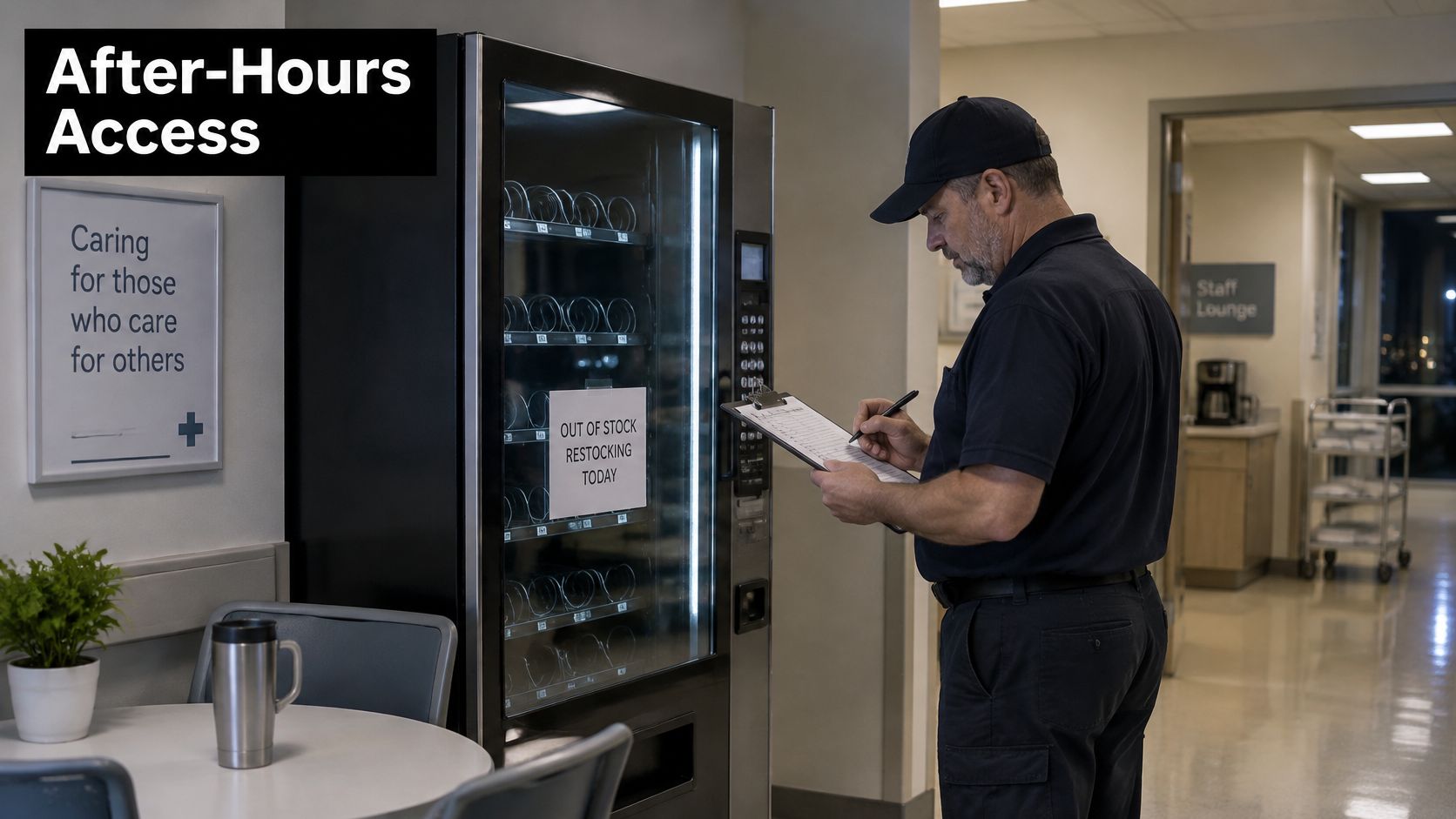
Public policies commonly require advance approval, scheduled appointments, credentialing, check-in and restrictions on patient-care areas, and some explicitly prohibit unannounced visits, as a published vendor representative policy shows. What those documents rarely explain is how a hospital should govern recurring nonclinical services: vending replenishment, telemetry maintenance, emergency repairs, food recalls, or after-hours access to a lobby or break room. A hospital may know exactly how to admit a device salesperson and have no idea how to classify a technician who needs ten minutes at a machine inside a public corridor.
An exception path that works
The operator calls the named facilities contact, who confirms the request in writing.
The technician checks in at the security desk and receives a short-duration badge limited to the break room and the corridor that serves it.
A facilities escort accompanies the technician in any patient-adjacent area and stays for the whole visit.
The technician signs a record listing time in, time out, items restocked and any food-safety issue.
The risk owner reviews the exception log within one business day.
Preapproved service windows for routine replenishment, such as Tuesday and Friday mornings, cut how often anyone needs that path. Our vendor maintenance request form is the kind of document that keeps those requests traceable instead of verbal.
The policy should also set badge duration, food-safety responsibility for product temperature and expiry, and how machine or product failures get reported.
The contrarian point is that tighter access rules can reduce operational resilience. A rigid appointment-only model delays repairs, leaves machines empty, and complicates urgent product removal after a recall. The problem is the missing exception path, not too much security. Hospitals need rules proportionate to risk, so routine service stays reliable and urgent service stays possible.
Audit Sampling and Offboarding Checks
Approval is a snapshot. Audits test whether the snapshot still holds.
The method is sampling. Pick a set of active badges and a set of vendor staff, then compare both against current rosters and training records. You're not trying to review every vendor every quarter. You're trying to find the pattern of drift before an incident does.
Check | Records compared | Pass condition |
|---|---|---|
Active badges | Badge roster versus current vendor staff list | Every active badge matches a current assignment |
Training and screening dates | Training records and screening files | All dates current under the policy's renewal rule |
Terminated personnel | Separation list versus access logs | No access recorded after the removal date |
Subcontractors | Contract subcontractor list versus onsite workers | Every onsite worker is named and credentialed |
Hospital property | Equipment issue log versus returned items | All items returned or accounted for at offboarding |
What to do when a check fails
Suspend the badge the same day. Document the finding, including who found it and what record was compared. Notify the named risk owner in writing. Then review the contract's termination rights if the failure involves screening, repeated policy violations or an unnamed subcontractor. Our guide to vendor performance reporting covers how to turn those findings into a renewal conversation rather than a one-off fix.
The most common control failure is an approved company keeping access after an individual's assignment has ended. It happens because rosters change on the vendor's side and nobody tells the hospital. Build the notification requirement into the contract and the audit will have something to test against.
Write the audit calendar into the policy with a named owner. Schedule an unscheduled review after any material change to the contract or scope, and treat a new subcontractor as a material change.
Procurement Reporting and Vending Standards
Hospital vendor policy increasingly ties supplier choice to documented reporting, ownership records and spend data. The policy should require ownership certification, subcontracting details and annual spend by category, because those three records answer most questions a regulator or board will ask.
California makes the requirement concrete. Under Health and Safety Code sections 1339.85 to 1339.87, licensed hospitals with operating expenses of at least $50 million, and hospitals with operating expenses of at least $25 million that belong to a hospital system, must file annual reports covering procurement from minority-owned, women-owned, LGBTQ-owned and disabled-veteran-owned businesses for the prior calendar year, as the California Health Care Access and Information supplier diversity program sets out. Public records show the scale at individual facilities: Scripps Green Hospital reported $3,455,552 in diverse procurement for January 1 to December 31, 2022, including $2,732,061 with women-owned businesses and $546,070 with minority-owned businesses, according to published hospital supplier diversity plans.
Where vending standards usually stop
Vendor-access policies written for clinical representatives rarely translate nutrition and sustainability goals into measurable requirements for retail food and vending, so the vending operator often signs the same paperwork as a device sales rep with none of the food-specific checks. European Commission research identifies hospitals, schools and other public institutions as procurement settings where criteria can cover food services and vending machines, including healthier and more sustainable choices, per the Joint Research Centre's work on public canteen criteria.
Close that gap in the contract itself. Set a healthier-share target for externally operated vending, and measure it against actual sales data rather than assuming the operator will hit it on goodwill alone. A quota by itself can fail for simple reasons: healthier items priced above the alternatives, empty shelves on night shifts, or a product mix badly matched to the staff working that floor. When those items don't sell, the operator reverts to the old assortment, and the policy looks satisfied on paper while the machines say otherwise.
Pair the target with supporting measures: satisfaction feedback, machine uptime, availability across departments and shifts, allergen controls, temperature records, waste and recycling metrics, and a fixed reporting cadence. Payment acceptance belongs on the list too, because an operator that can't take cards locks out most buyers. A 2023 micropayment trends report found cashless payments represented 67% of vending-machine sales, with an average cashless transaction of $2.11 against $1.36 for cash.
For a hospital already tracking supplier categories and spend, our breakdown of hospital vending machine programs shows what the reporting side looks like in practice.
Terms to Confirm Before Signing
Use this as a pre-signing review. Ask the prospective operator to answer in writing and attach the evidence, not just the commitment.
Risk tier and access zones. Which named zones, and what escort rule applies to each.
Credentialing. The list of individuals, license certificates with expiry dates, and screening confirmation where permitted.
Service windows. Standing visit days and hours, plus an after-hours contact and a stated emergency response time.
Audit rights and retention. How long evidence is kept, and the hospital's right to inspect badge and training records.
Incident notification. The hours allowed for reporting a food-safety or access incident.
Offboarding. The deadline for removing badges and returning property when a named individual leaves.
Procurement and food reporting. Annual spend by supplier category, ownership certification, and the product-category and healthier-share measures from the section above.
An operator that answers every item in writing, with dated records, is easier to audit. Operators that handle stocking, service and support in-house, and that build a menu plan around your break room or lounge instead of dropping a fixed assortment, tend to have those records already.
If you're still shaping the security side of the program, this explanation of tiering vendors by security risk is a useful reference for the classification conversation. And when the questions turn to response times and remedies, our walkthrough of the vendor management service level agreement covers what to put in the terms.
Assign a named policy owner this week, then send these seven questions to every prospective operator before access begins.
Vendmoore Enterprises runs full-service break room vending across the Oklahoma City metro, including Norman and Edmond, handling stocking, service and support so hospital facilities teams aren't chasing a restock at 2 a.m. We build each vending menu around your break room, lounge or community space, with classic favorites, healthier options or a mix of both, and our machines take cards, Apple Pay, Google Wallet and cash with remote monitoring behind them. If you're standing up a vendor program or replacing an operator who never quite fit it, visit Vendmoore Enterprises to start free vending service.
Comments