
Menu the Canteen: Smart Planning for Break Rooms

You're standing in your Oklahoma break room at mid-afternoon, watching a fully stocked machine get ignored. The chips people want are empty, the healthy bars nobody asked for are gathering dust, and someone just left to drive to a convenience store. That's not a hardware failure. That's a menu failure.
Treat the menu the canteen runs as a living retail assortment, not a fixed cafeteria list you set once and forget. When every slot has to earn its place based on real purchases, stockouts, waste, and employee requests, the same footprint starts working for offices, schools, healthcare facilities, industrial sites, and property managers who need people fed without running a full kitchen.
Why the Assortment Mix Matters More Than the Machine
Most facility managers shop for a machine first. They compare dimensions, cooling, and payment screens, then accept whatever default assortment ships with it. That order is backwards.
The machine is a refrigerated shelf. The assortment is the product people buy, ignore, or complain about. A polished unit filled with slow movers teaches employees to walk past it. A plain unit filled with the drinks, snacks, and meal items your specific crews reach for gets used on every shift.
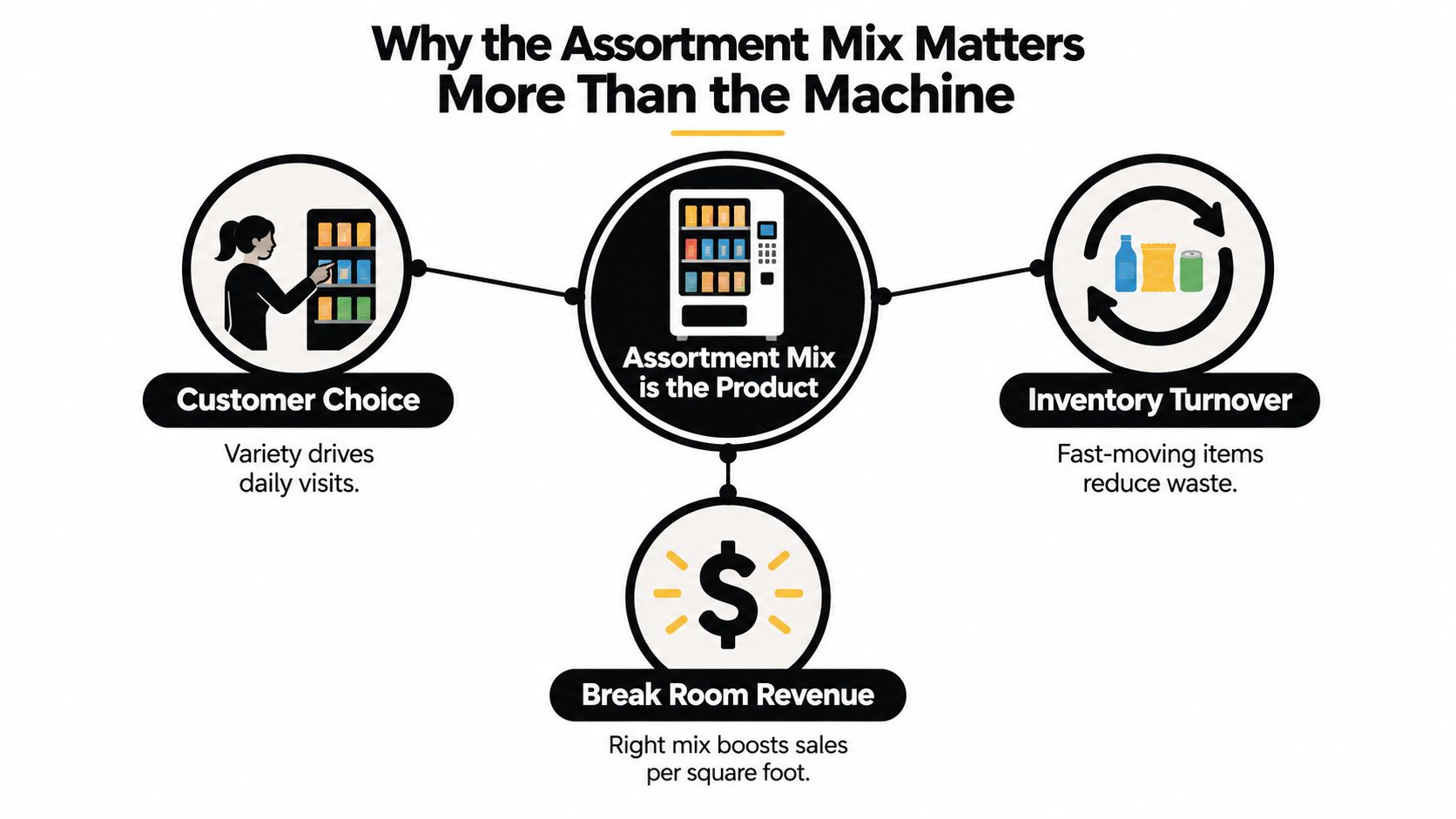
What a Flat Assortment Looks Like
You see the pattern quickly. Top sellers sell out early in the cycle and stay empty. Unpopular items occupy premium eye-level slots until they expire. Fresh items arrive in quantities nobody forecast, so you get waste on one shelf and stockouts on the next.
That's an inventory problem, not a vending problem. Fix the mix and you fix usage, waste, and revenue at the same time. Leave the mix alone and no screen or payment upgrade will save it.
The Four Levers That Decide Performance
Category balance: Fresh, frozen, and shelf-stable items each do a different job across shifts and hunger levels.
Dietary coverage: People need clear options they can trust without hunting through ingredient lists.
Pricing discipline: A clear ladder helps people decide fast and protects your margin on the right items.
Feedback loops: Purchase data and direct requests tell you what earns a slot on the next restock.
If an item hasn't earned its slot with actual purchases, it's renting space from something your people would buy.
Start with the mix. Buy the machine that fits that mix, not the other way around.
Balancing Fresh, Frozen, and Snack Categories
Fresh, frozen, and shelf-stable items aren't competitors. They're tools for different moments. A nurse coming off a night shift, a warehouse crew on a short break, and an office worker in an afternoon slump don't need the same thing.
Fresh prepared items win on perceived quality. Sandwiches, salads, and wraps feel like a real meal and suit predictable lunch traffic. They also punish bad forecasting fastest because unsold product becomes waste, which is why your replenishment model for packaged sandwiches at wholesale scale matters as much as the recipe.
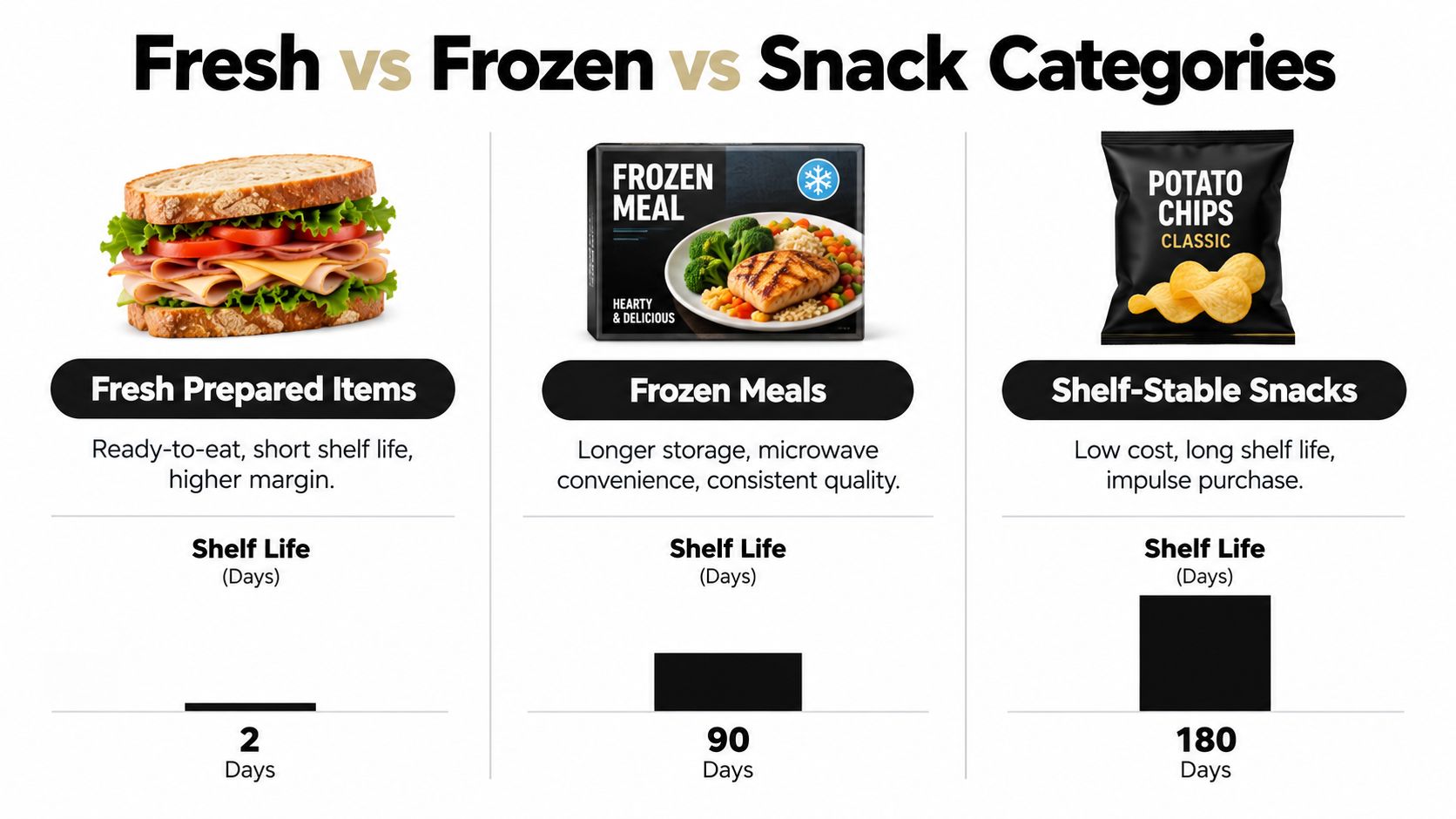
Frozen meals are the underrated shift workhorse. They wait patiently for early morning and late night demand, heat consistently, and give smaller sites a hot meal option without daily fresh delivery. Shelf-stable snacks do the volume work between meals, they're forgiving on storage, and they're the easiest category to tune by flavor and brand.
Demand for fresh access outside a traditional cafeteria is not theoretical. Healthcare facilities represented about 19.4% of the fresh-food vending market by application in 2025 and were projected to grow at 13.8% annually through 2034. Hospitals can't shut down food access when the cafeteria closes, and neither can plants or airports.
Comparing Fresh, Frozen, and Snack Tiers
Category | Best Use | Typical Restock | Common Mistake |
|---|---|---|---|
Fresh prepared | Predictable lunch and dinner peaks | Frequent, small drops | Ordering for peak day every day |
Frozen meals | Off-hours and smaller sites | Less frequent, planned fills | Treating frozen as low quality filler |
Shelf-stable snacks | Between-meal and impulse demand | Regular top-ups by velocity | Stocking variety nobody requested |
Build your protein and snack tier with the same discipline. If you're evaluating powders or ready-to-drink shakes for a wellness-leaning site, a practical roundup of the best chocolate protein powder UK options can help you compare taste and ingredients before you commit slot space.
Allocate space by your site's traffic pattern, not by a preset plan someone uses everywhere. A hospital needs more off-hours depth. An office needs lunch speed. Let sell-through, spoilage, and stockout frequency move the shares.
Building the Standardized Item Register
Good operators don't restock from memory. They run one standardized item register and they check it against the physical machine. Without that single source of truth, every service visit becomes a guess and assortment drift goes unnoticed until complaints arrive.
Put your prep and packing discipline behind the register so what's listed is what gets loaded.
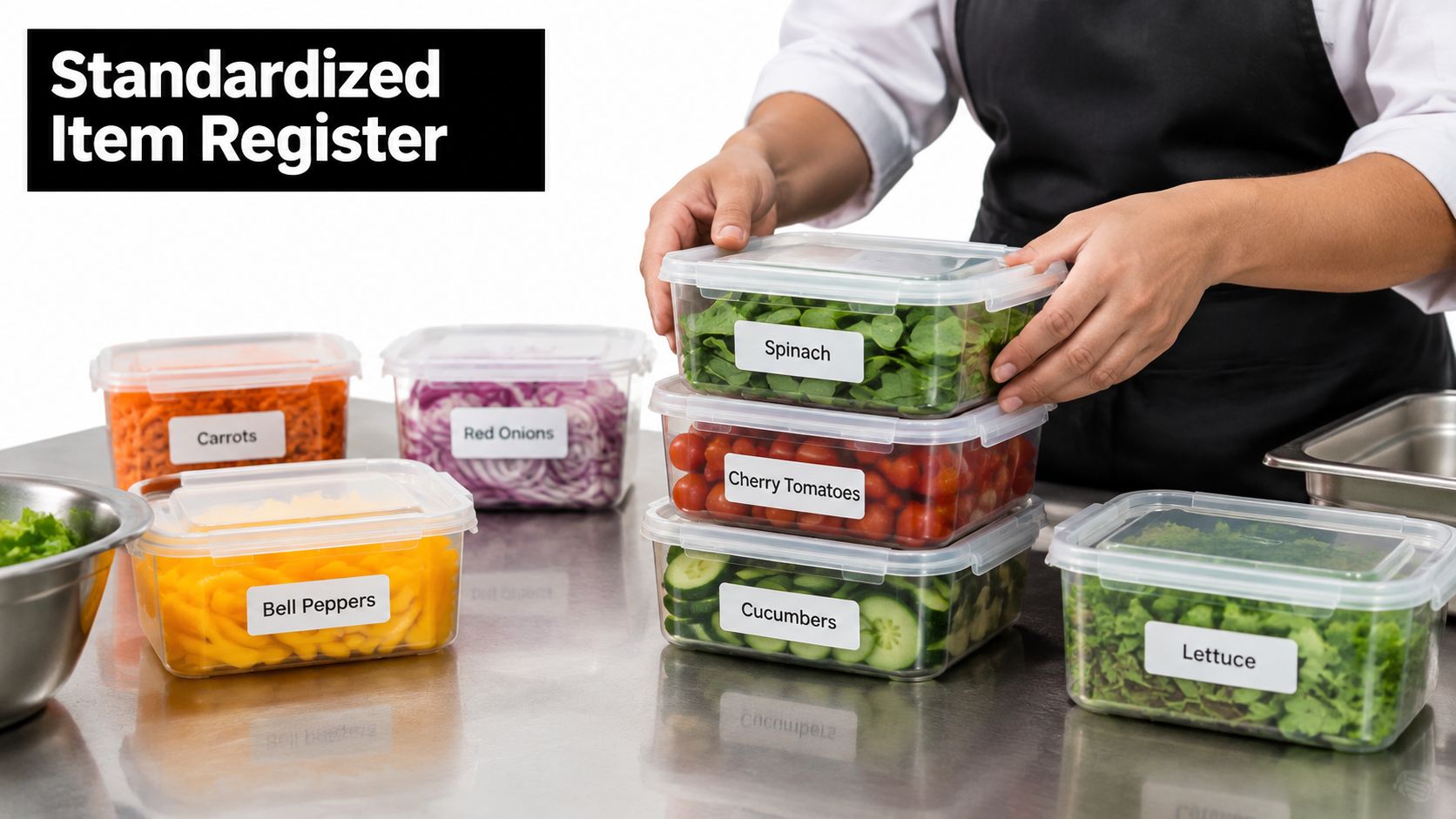
Assign one accountable menu owner. That person approves additions, removals, price changes, and substitutions. When everyone can change the menu, nobody owns the result and slow movers survive because nobody remembers who added them.
What Every Register Entry Needs
Category and slot: Fresh, frozen, snack, or beverage, plus where it sits in your vending machine planogram.
Allergens and nutrition attributes: Recorded once, reviewed when a supplier changes formulation.
Price and cost: Visible side by side so margin decisions aren't made blind.
Sales velocity, stockouts, and waste: Updated from actual service and telemetry data, not opinion.
Retail teams managing large catalogs face the same consistency problem, which is why guidance like NanoPIM on winning every channel is useful reading on keeping product data accurate across every place it appears. Your vending register deserves that same rigor at a smaller scale.
Audit the Register Against Reality
Don't trust self-reports. In a 38-school validation study, a rapid menu audit achieved substantial agreement with direct observation at Cohen's kappa = 0.68, while unaudited self-reports had poor agreement and low specificity. Sample-check slots against the register on a fixed interval and fix mismatches on the spot.
The walkthrough below shows the kind of hands-on checking that keeps a register honest in a working location.
Connected telemetry turns this from a static spreadsheet into a live tool. You see what sold, what's about to stock out, and what sat untouched, so the next restock responds to last cycle's demand instead of last quarter's gut feel.
Covering Dietary Needs Without Killing Familiar Favorites
Don't replace comfort food with a lecture. People who want a burger, burrito, or familiar snack will buy it elsewhere if you remove it. People who need vegetarian, vegan, allergen-free, or lower-sugar options will do the same if you never offer anything they can eat.
Segment the assortment instead. Keep core favorites in place, add clearly labeled alternatives beside them, and let actual purchases settle the argument. Honest on-machine labeling beats guilt-driven placement every time because people trust what they can verify quickly.
Behavior Doesn't Match Stated Preferences
Workplace-food reporting shows that 58% of consumers aged 18 to 22 and 52% of those aged 25 to 34 replace meals with snacks at home or work, even as 63% of surveyed employees supported reducing meat offerings while traditional dishes remained top sellers. Read that carefully. Employees can support lighter options in a survey and still buy the familiar item at the machine.
Your job isn't to pick a side. It's to stock both, label both clearly, and track uptake by location and shift. Rotate seasonal or themed items around a stable core so regulars keep their favorites while new options get a fair test.
Size for Snacks and Meals
That snack-as-meal behavior changes portion strategy. If a large share of younger workers are replacing meals with snacks, a menu built only around a midday meal block misses how they eat. Stock snack-meal combinations, smaller portions that pair protein with a drink or side, alongside full fresh and frozen meals for people on a proper break.
For allergen coverage, dedicated lines such as gluten free snack packs let you serve restricted diets without reformulating your entire snack tier. Flag allergens in the register, mirror those flags on the machine, and never let a substitution enter a slot without updating both.
Practical rule: Add alternatives alongside favorites, label them plainly, and cut only what repeated purchase data says nobody wants.
Coverage earns trust. Removal earns resentment. Stock for the workforce you have, across every shift they work.
Pricing the Menu for Cashless Convenience
Pricing is where most vending programs leave money sitting in the coil. Operators set prices once, round everything the same way, and never revisit the ladder even as costs and preferences change. Build a ladder with intent instead.
This is the kind of modern, cashless-ready unit your pricing needs to match.
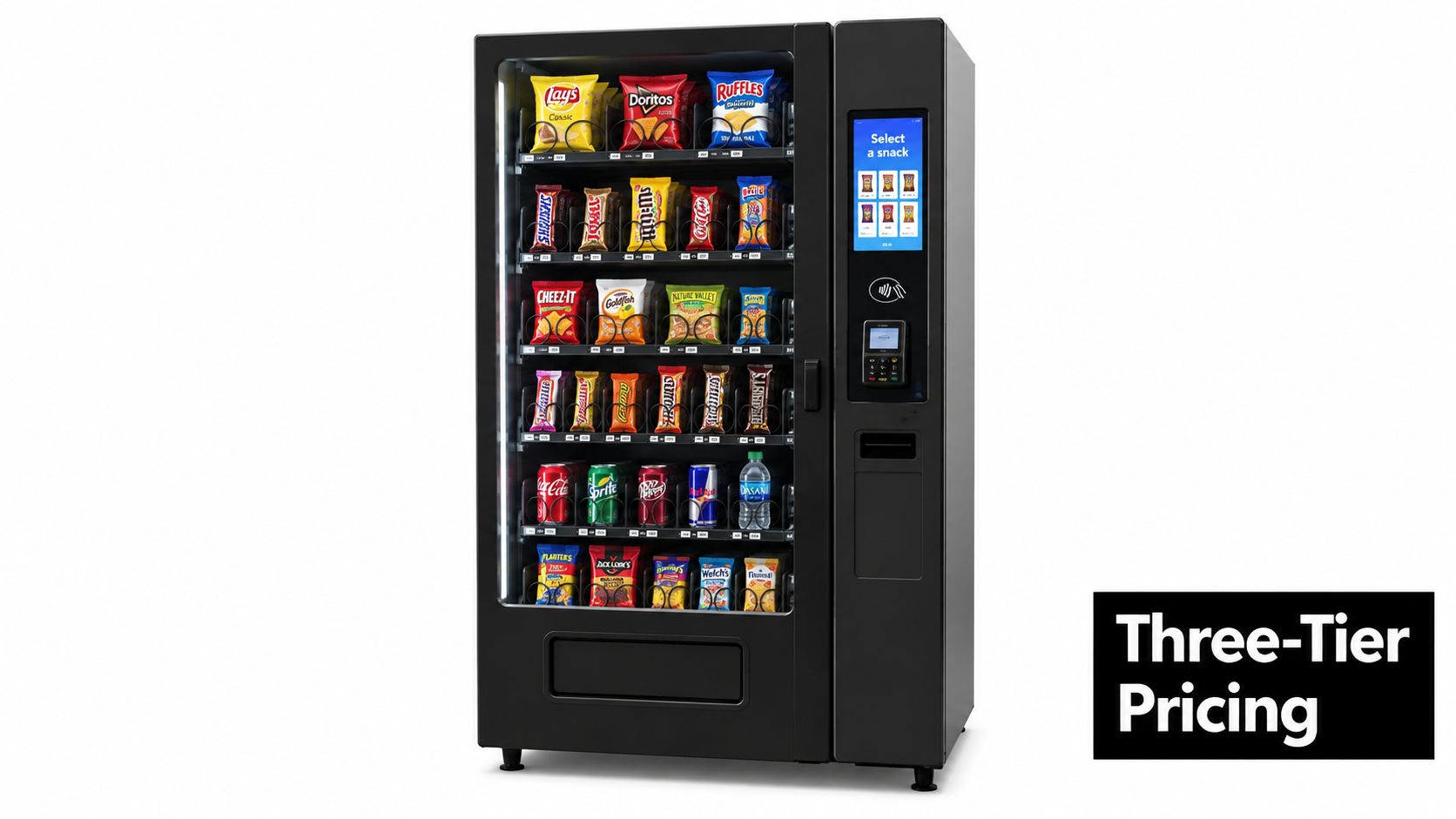
Build Three Clear Tiers
Value tier: Everyday snacks and drinks priced for easy, frequent purchases that keep traffic coming back.
Mid tier: Grab-and-go items priced as an impulse-friendly step up, where most daily volume should land.
Premium tier: Fresh and frozen meals priced for better ingredients and a fuller portion.
Use round pricing where speed matters and charm pricing where you're signaling a deal, but stay consistent within a tier. If you're benchmarking your ladder, review current vending machine snack prices before you reset a live location. Protect margin on labor-light shelf-stable items so you can afford quality where people taste the difference, in fresh and frozen meals.
Remove Friction at Payment
Apple Pay and Google Wallet aren't perks anymore. They're baseline. Add contactless cards alongside mobile wallets, because every failed or slow payment at a busy break is a lost sale and a reason not to return. When paying takes a tap, people stop doing mental math about exact change and start choosing what they actually want, including a drink or side with a main item.
Make the menu itself just as easy to scan. The LinkShip digital menu QR guide is a helpful resource if you want customers to pull up ingredients, allergens, and current availability on their phones before they reach the machine. That reduces hesitation at the glass and complaints after purchase.
Revisit the ladder whenever supplier costs move or a tier stops converting. Small, explained adjustments beat sudden jumps that make regulars feel ambushed.
Running the Feedback Loop That Keeps the Menu Fresh
A menu that never changes becomes invisible. Regulars stop looking, assume nothing new is coming, and take their spending elsewhere. Keep the assortment moving with a loop that's cheap to run and hard to skip.
Measure Weekly, Ask Monthly, Review Quarterly
Check sell-through by SKU, stockouts, waste, and payment method mix every week. Those four signals tell you what's earning space, what's running out too early, what's expiring, and whether payment friction is costing you sales.
Ask a short monthly question set. Facility managers can tell you about shift changes and headcount. End users can tell you what they'd buy tomorrow if it appeared. Keep your prompts tight using proven methods for how to gather customer feedback, and put a QR code on the machine so requests arrive at the moment of purchase, not weeks later in a forgotten inbox.
Review the full assortment quarterly. Rotate out persistent slow movers, expand proven winners into better slots, and document every change in the register so you can connect results to decisions.
Pilot Before You Roll Out
Test changes as controlled pilots, not chain-wide resets. Pick one or two comparable locations, keep a baseline period, introduce the new item or category shift with clear placement and labeling, then compare availability, purchase mix, and waste before and after.
Reinforcement is what separates a policy on paper from a menu in practice. In a randomized intervention involving 51 schools, treated sites were 5.78 times more likely than controls to have menus without red or banned items, while a broader survey found only 20% of 184 canteen managers had compliant menus without active reinforcement. Publishing a standard doesn't change execution. Ownership, training, availability targets, and weekly exception reviews do.
Try placement and replenishment fixes before you kill a slow seller. Sometimes the item isn't wrong. The slot, price tier, or refill timing is.
Make the loop visible. Tell the site what you changed because they asked. People who see their request appear in the machine become your most reliable customers.
A 90-Day Plan to Roll Out Your Break Room Menu
You don't need a perfect assortment on day one. You need a baseline, a tuning window, and the discipline to let data overrule opinions. This plan works across offices, schools, healthcare facilities, industrial sites, and multi-tenant properties because the sequence stays the same even when the items differ.
Days 1 to 7 Build the Baseline
Audit every current slot against your register. Record category, allergens, price, stockouts, waste, and what sold most in the recent cycle. Talk to the site contact about shifts, peak breaks, dietary requests, and nearby food competition. Don't add anything yet. You can't prove improvement without a starting point.
Days 8 to 30 Tune the Core
Pilot your changes. Tighten the snack tier around proven flavors, test fresh or frozen additions where off-hours demand exists, and set your three-tier price ladder. Confirm cashless options work under real break-time pressure. Check availability weekly and fix placement before you blame the product.
Days 31 to 90 Lock In the System
Name the menu owner in writing. Set the rapid audit interval, the monthly feedback ask, and the quarterly assortment review. Use telemetry to trigger restocks on velocity, not on a fixed route habit. Expand winners from pilot sites to comparable locations, and keep a short exception log for items that miss availability targets.
Operators evaluating partners should also look at how findable and credible that partner is locally. Google states that local search rankings are primarily determined by relevance, distance, and prominence, and that prominence is influenced by how many websites link to a business and how many reviews it has. Accurate business information, location-specific service pages, and consistent responses to reviews help Oklahoma facility managers find a real operator when they search for break room vending or vending machine operators.
Vendmoore Enterprises is one Oklahoma option that offers fully managed programs and machine ownership models, with smart machines that accept Apple Pay and Google Wallet and telemetry that supports data-driven replenishment.
Day-one checklist
Register complete: Every slot classified with price, allergens, and category.
Owner named: One person approves every menu change.
Payment tested: Contactless cards and mobile wallets verified at peak time.
Feedback live: QR code posted and monthly ask scheduled.
Audit booked: First rapid audit date set before launch.
Run the checklist, then let ninety days of purchases tell you what your menu should become.
If you're ready to replace a flat, guess-based assortment with a break room program built on real purchase data, cashless convenience, and restocks tuned to your shifts, talk to Vendmoore Enterprises about a vending plan built to fit your Oklahoma workplace, school, healthcare facility, or industrial site. Tell us your headcount, shifts, and dietary needs, and we'll build a starting menu, set the feedback loop, and keep every slot earning its place.
Comments