_edited.png)
Schools with Vending Machines: 7 Operator Models for 2026

A school administrator needs a reliable snack and beverage option for students staying late, teachers working after hours, and campus teams between activities. The decision quickly becomes larger than choosing a machine. A national district contract may offer scale, a school-focused vendor may simplify compliance, and a local operator may launch faster with more personal service. Each model affects Smart Snacks compliance, student payment access, assortment control, revenue arrangements, maintenance, and procurement speed.
The seven models below compare those trade-offs from an operator's perspective. They cover national foodservice integrators, education specialists, independent regional companies, and local smart-vending providers. The right choice for schools with vending machines depends less on the most impressive equipment than on whether the operator can document compliant products, maintain dependable service, support cashless payments, and adapt the program to the school's actual size and schedule.
1. Vendmoore Enterprises
A school serving students after class may need a different vending setup from a staff lounge or a smaller satellite building. Vendmoore Enterprises is a strong fit for schools that want local accountability without giving up connected vending technology. Based in the Oklahoma City metro and serving Norman, Edmond, and nearby cities, the company offers smart machines with cashless payment options such as Apple Pay and Google Wallet, along with telemetry for monitoring inventory and machine performance.
That visibility helps staff identify low-stock items without checking each machine manually. Local service can also make it easier to discuss substitutions, resolve faults, and adjust the assortment after launch.
Vendmoore's equipment range supports several campus formats. A compact refreshment center may suit a teacher lounge or smaller building. Bottle-and-can machines, dual-zone chill centers, and frozen-food machines can serve larger campuses or facilities operating beyond the school day. Vendmoore also offers managed programs and machine-ownership options, allowing schools to choose how they divide operating duties, equipment costs, and replenishment responsibility.
Practical rule: Approve the assortment before installation, then require the operator to document every substitution during replenishment.
Where Vendmoore fits best
The local model works well when product selection needs regular feedback from one school or a small group of nearby sites. Vendmoore can tailor snacks and beverages to each location, collect requests, and adjust the mix instead of relying entirely on a fixed national planogram. That flexibility can support age-appropriate student selections while keeping staff-room products separate.
Before installation, ask for a written review of every product sold through student-accessible machines. Federal standards apply when food or beverages are sold to students on campus during the school day outside reimbursable meal programs. Schools can use the USDA Smart Snacks guidance to support documented nutrition checks and product approvals.
The main constraint is geography. Vendmoore is not a nationwide provider, and its website does not publish pricing or detailed contract terms, so each school must request a custom proposal. For Oklahoma schools, direct communication, local assortment decisions, connected restocking data, and responsive service may justify that limitation. Experience serving workplace break rooms, healthcare facilities, manufacturing sites, residential properties, stadiums, and airports may also help the operator adapt procedures to different operating conditions.
2. Canteen
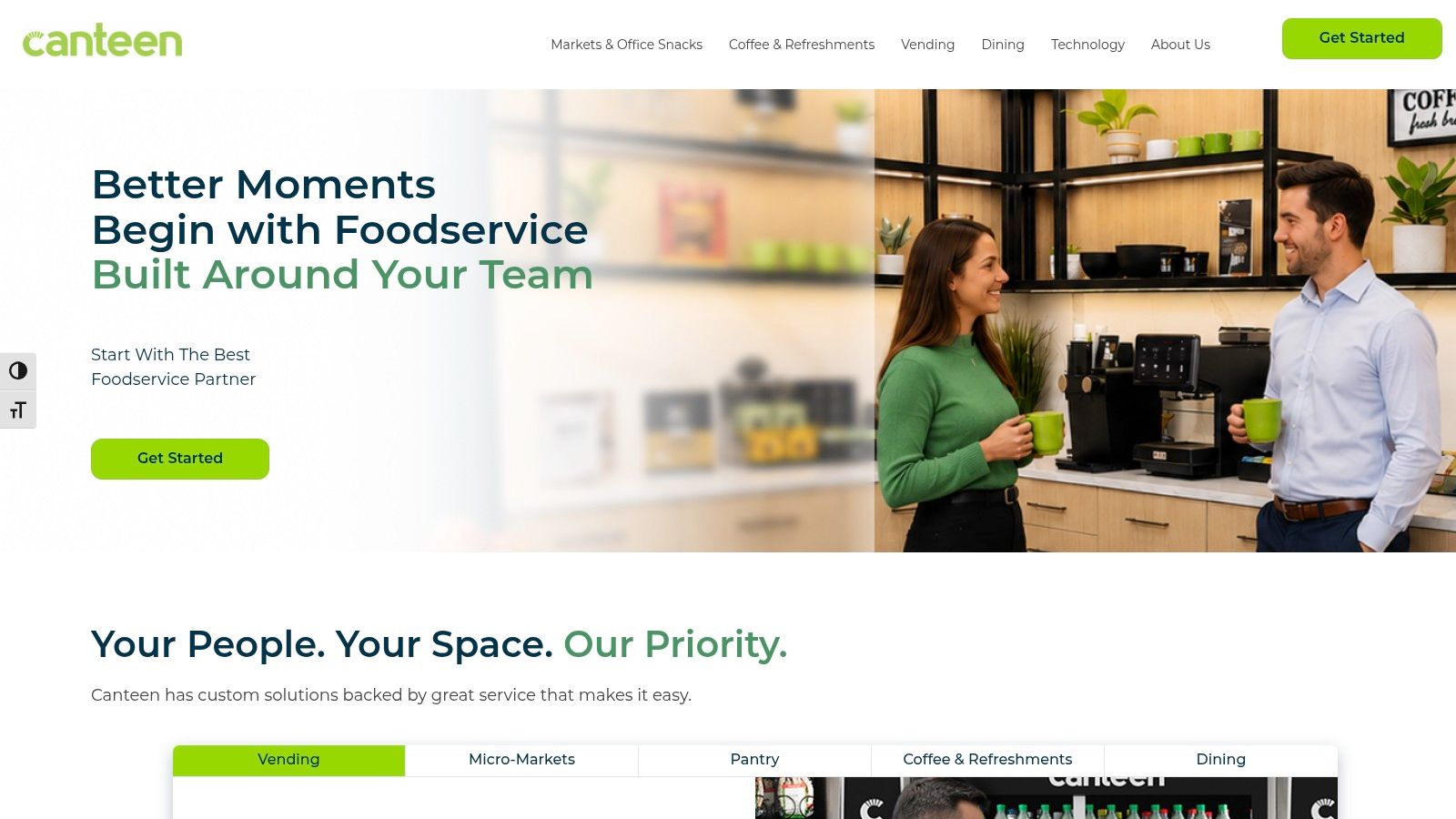
Canteen, part of Compass Group, suits organizations seeking district-level vending, micro markets, fresh-food coolers, and centralized service processes. That model fits school systems with several campuses, shared procurement requirements, and a need for consistent reporting. Cashless payment and telemetry-enabled equipment can reduce purchase friction while giving administrators visibility into product movement and service activity.
Its advantage is operational scale. Canteen can combine snack and beverage vending with broader retail formats, which may suit secondary schools and higher-education settings that need food access beyond cafeteria hours. The school program still requires a defined wellness screen. Before signing, ask Canteen to show how the proposed planogram will be checked against the applicable Smart Snacks requirements for school vending.
Small schools may encounter more friction with a national program. Minimum volume expectations, fixed planograms, and formal contracting can make one-building placement less attractive. Compare the proposed service frequency, cashless payment support, and assortment-change process with a local operator before assuming national scale will produce better service.
For district-scale service, review the operating model in writing. For a broader view of refreshment-service structures, see Canteen refreshment services before comparing national and local providers.
Request these items:
Campus coverage: List each building, machine type, route, and included service.
Assortment control: Identify who approves substitutions and how schools request product changes.
Service terms: Specify restocking, repair escalation, payment support, reporting, and response expectations.
Canteen is strongest when a buyer needs repeatable execution across multiple sites. A school seeking highly customized selections, informal approvals, or a simple launch may find a local operator easier to configure.
3. Sodexo
Sodexo suits districts and campuses that want vending connected to a broader education foodservice and convenience strategy. Its model can combine smart vending, grab-and-go retail, digital ordering, mobile payments, and automated checkout with cafeteria operations. That integrated approach is useful when the machine isn't an isolated amenity but part of a plan to extend food access outside traditional meal-service periods.
The education model also allows age and wellness considerations to shape the offer. A K-12 campus may need a tightly controlled student assortment, while a university or staff area may support a wider range of products. The operator's use of data and digital engagement tools can help administrators evaluate availability and purchasing behavior rather than relying only on anecdotal feedback.
The trade-off is procurement complexity. Sodexo is an enterprise provider, so a district or university may need a formal contracting process, internal approvals, and a longer implementation timeline. Premium technology can also create more dependencies, including account setup, payment administration, connectivity, and data governance. A school looking for one straightforward machine should avoid paying for an operating model it won't use.
The school guidance on healthy vending options is useful when building a product brief, but the contract still needs specific commitments. Confirm which products are eligible for student sale, how the operator handles substitutions, and whether the machine can be restricted by schedule or location.
Sodexo works best when the school already has a broader foodservice relationship or wants one provider to manage cafeteria service, vending, grab-and-go retail, and digital access. It's less attractive for a small site that values speed, informal communication, and a narrow equipment footprint.
4. Aramark
Aramark brings a strong education and campus-services orientation, with vending, micro markets, mobile carts, grab-and-go formats, and connected retail capabilities. That mix gives a school more choices than a traditional snack machine. A campus can place a cart near an event area, use vending for after-hours access, and add a micro market where traffic and staffing justify a larger retail format.
Cashless access and app or QR-enabled experiences may help students and staff move through purchases quickly. The more important operational question is whether those features work for the school's actual users. Before signing, test payment flows with the student population and confirm that the machine supports the payment methods families commonly use. A connected machine that students can't easily access won't solve an availability problem.
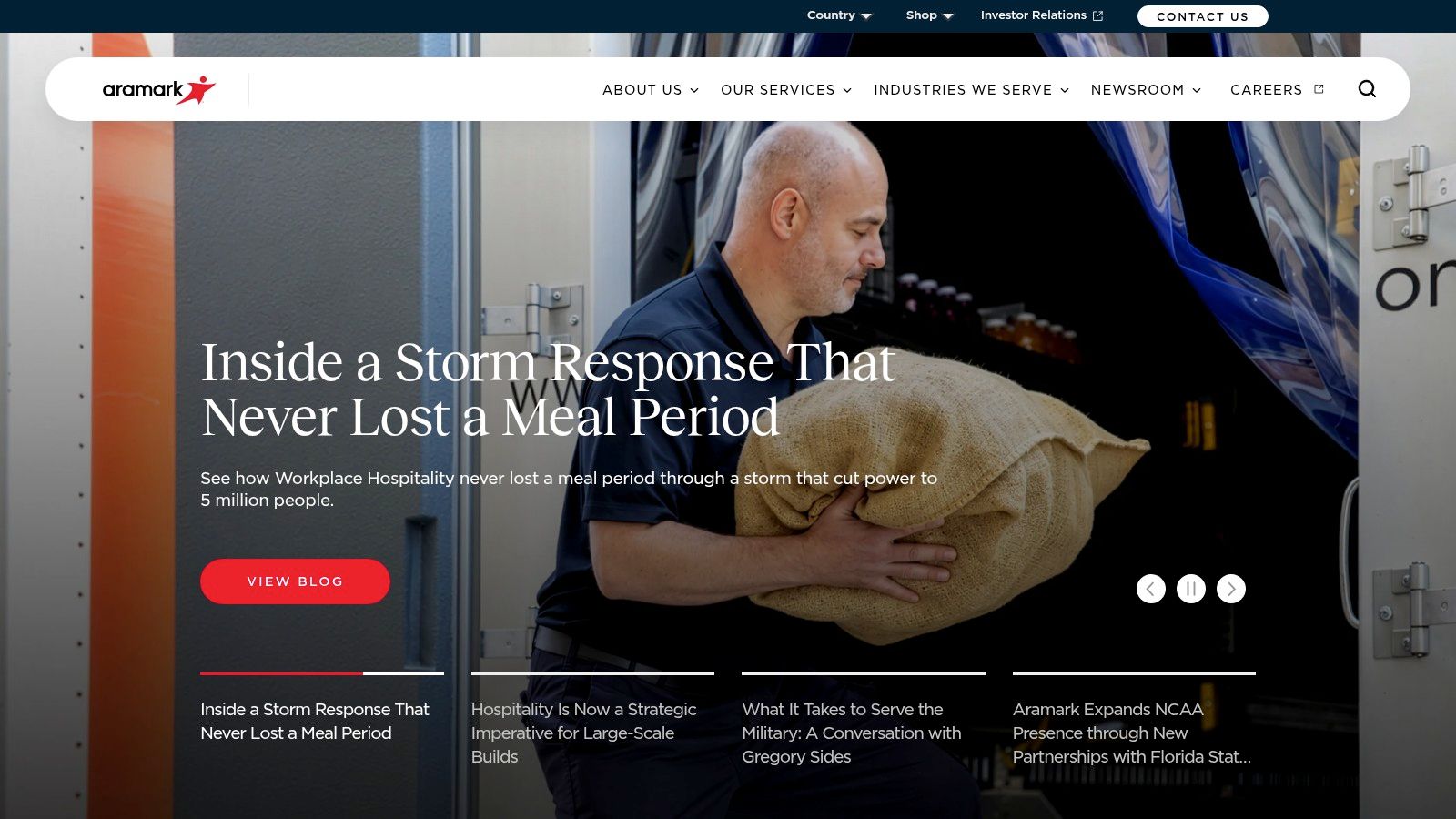
Aramark's scale can be an advantage for districts with established procurement teams and multiple locations. It can also mean a formal RFP, more stakeholders, and less flexibility for a small school seeking a quick pilot. Administrators should examine service-level agreements closely, especially around repair response, restocking, product substitutions, refund handling, and escalation contacts.
A practical proposal should answer:
Who owns the planogram: The school should know whether local staff can request changes or whether a regional team approves them.
How compliance is documented: Require a product-level review for student-accessible machines.
How performance is reported: Request unit sales by product category, stockout information, and service records.
Aramark is a sensible shortlist candidate for a campus that wants vending integrated with dining and facilities. It needs more diligence when the school is small, the procurement window is short, or the buyer wants direct control over every selection. The guide to selecting food vending machines can help administrators define equipment requirements before issuing an RFP.
5. AVI Foodsystems
AVI Foodsystems is an independent foodservice operator with education experience across dining, vending, beverages, and retail programs. Its appeal is customization. Schools that want vending to reflect broader goals around wellness, sustainability, fresh products, or local procurement may find more room for discussion than they would in a rigid national planogram.
The operator's full-service capability can also make vending part of a larger campus food strategy. A district could align machine products with cafeteria themes, staff-room service, event catering, and other retail locations. That's valuable when the school wants consistency across food channels rather than a machine stocked by a separate provider with no connection to campus dining.
AVI may prioritize multi-location or higher-volume opportunities over a single small-school placement. Smaller institutions should ask directly whether the proposed route supports their site economics, how often the machine will be visited, and which products can be changed without a full contract amendment. Public-facing Smart Snacks detail appears less prominent than it is with some larger competitors, so compliance needs to be addressed during scoping rather than assumed.
Use the overview of box vending machines to clarify whether a traditional snack machine, refrigerated unit, or another format matches the campus environment. Then ask AVI for a school-specific product list with nutrition documentation.
AVI is a strong option for districts or universities that value an independent operator and want vending connected to dining objectives. It may be less efficient for a small school seeking one machine, minimal administrative overhead, and a rapid launch.
6. American Food & Vending and American Dining Creations
American Food & Vending combines vending and micro market services with broader dining capabilities through American Dining Creations. That structure can appeal to schools that want one relationship for refreshment service, campus dining, catering, and retail access. Its national operating scale and technology partnerships provide more flexibility than a basic machine-placement model, especially for campuses considering a move from vending to a micro market.
The best use case is a school or district with enough traffic to justify a coordinated program. A micro market may provide a wider assortment and a more open retail experience, but it also requires stronger controls around access, payment, replenishment, loss prevention, and product approval. A standard vending machine is easier to supervise and may be the better starting point for a smaller site.
School-specific Smart Snacks resources are less visible publicly than those offered by some education-focused competitors. That doesn't determine operational quality, but it does mean administrators should require a written compliance workflow. The proposal should identify who reviews products, who approves substitutions, how student access is controlled, and how staff-only areas are separated from student-facing service.
A good discovery call should cover:
Technology fit: Confirm payment methods, connectivity, refunds, and reporting.
Site economics: Ask whether the company supports a single school or expects a broader campus opportunity.
Dining integration: Define which products belong in vending and which should remain part of cafeteria or meal service.
American Food & Vending is worth considering for a district seeking a flexible independent provider with dining depth. For a small school, the operator should demonstrate that the proposed service level won't depend on future expansion to remain viable.
7. America Vending
America Vending positions itself directly around schools and universities, which can make the initial buying process easier for administrators who don't want to translate a workplace vending proposal into a student environment. Its school-focused offering includes traditional vending, healthy vending, micro markets, and smart coolers, with an emphasis on USDA Smart Snacks compliance for student-facing machines.
The company also promotes no-cost placement models, which can reduce the financial barrier to installation. That doesn't make the program free in every practical sense. Schools still need to review revenue terms, product pricing, service commitments, access schedules, marketing restrictions, and the operator's responsibilities when equipment fails.
The right comparison is not “free machine versus paid machine.” It's total control and service value over the contract term. A school should confirm whether it can approve every student-facing SKU, whether healthier products remain affordable, and whether the operator provides records that demonstrate compliance. Local wellness policies can also govern food marketing and vending access schedules, as explained in the CDC school nutrition framework.
America Vending may be a practical choice for districts looking for a dedicated school-vending message and a straightforward installation model. Its national coverage and service-level details should be verified in the RFP, particularly for schools outside major operating markets.
For comparison, administrators can also review school-focused foodservice options before selecting a traditional vendor, smart cooler provider, or micro market model. The operator should provide references, route coverage, escalation contacts, and a product approval process before installation.
7-Provider Comparison: School Vending Services
Provider | 🔄 Implementation Complexity | ⚡ Resource Requirements | ⭐ Effectiveness / Quality | 📊 Expected Outcomes | 💡 Ideal Use Cases & Tips |
|---|---|---|---|---|---|
Vendmoore Enterprises | Low–Moderate, local deployments with flexible managed/ownership options | Low, local service team, site survey and custom quote required | ⭐⭐⭐⭐, strong local responsiveness and customer feedback loops | Improved assortment relevance, high uptime, rapid issue resolution | Best for OKC-area offices, schools, healthcare; request site-specific proposal |
Canteen (Compass Group) | Moderate–High, districtwide rollouts and standardized planograms | High, centralized procurement, service standards, minimum volumes possible | ⭐⭐⭐⭐, proven large-program capability | Consistent program delivery, Smart Snacks–aware design, broad product range | Large school districts and multi-site programs; expect contractual minimums |
Sodexo (Education & Campus) | High, enterprise integrations (cafeteria + vending + digital) | High, digital tools, dietitian input, procurement timelines | ⭐⭐⭐⭐, strong end-to-end service and wellness alignment | Extended access beyond cafeteria hours, data-driven engagement and speed | Large campuses seeking integrated dining + vending; plan for longer timelines |
Aramark (Student Nutrition & Refreshments) | High, formal RFPs and campus-level contracting common | High, connected retail platforms and campus operational integration | ⭐⭐⭐⭐, deep campus operational experience | Modernized vending experiences, mobile/QR access, campus-scale deployments | Colleges and universities wanting cohesive refreshment services; review SLAs closely |
AVI Foodsystems (Education Division) | Moderate, flexible, campus-tailored programs with local procurement emphasis | Moderate, fresh program support, local sourcing, integration with dining | ⭐⭐⭐⭐, flexible, campus-focused operator | Tailored fresh offerings, alignment with wellness and sustainability goals | Universities and districts wanting customization; confirm Smart Snacks details during scoping |
American Food & Vending (and ADC) | Moderate, national but independent operator with multiple platform options | Moderate, micro market platforms and in‑house tech; scalable operations | ⭐⭐⭐, flexible multi-channel capability | Blended vending + dining solutions, adaptable program design | Campuses needing blended vending/dining/catering; confirm compliance resources |
America Vending | Low–Moderate, school-focused, quick deployments and $0-placement options | Low, targeted school resources and compliance support (may have limited coverage) | ⭐⭐⭐, clear Smart Snacks focus for student-facing machines | Rapid Smart Snacks–compliant deployments, low-barrier adoption | K‑12 districts seeking compliant, low-cost installations; verify geographic coverage and SLAs |
Turning Operator Options into a School Vending Decision
The best operator isn't automatically the largest, cheapest, or most technologically advanced. Start by confirming which machine locations students can access, during which hours, and whether the products are sold during the school day. Student-facing machines must be screened against Smart Snacks requirements, while employee-only areas may follow a different policy framework. Put the distinction in the site plan and contract.
Next, match the operator's scale to the school's operating reality. A districtwide provider may offer centralized procurement and consistent service across many buildings, but a small school may receive better attention from a regional or local operator. Ask for the minimum site requirements, proposed visit frequency, replenishment triggers, and the person responsible for resolving problems.
Request the commercial terms in writing. That includes service-level agreements, repair response, refund handling, cashless payment support, telemetry access, product substitutions, assortment-change rights, marketing restrictions, and termination provisions. If the school expects to use vending for reimbursable meals, treat the machine as part of the meal-accountability system. California guidance, for example, requires accurate meal records, eligibility tracking, and controls against a student receiving more than one reimbursable meal during a service period, as described by the California Department of Education.
Test payment access before signing. Let students and staff try the proposed card, mobile-wallet, and account-based options, then record where they encounter friction. A machine that accepts cashless payments but produces failed transactions, unclear refunds, or inaccessible interfaces will create more administrative work than expected.
Use this simple scoring sheet for two or three shortlisted operators:
Compliance documentation: Does the operator provide a product-level Smart Snacks review and substitution controls?
Cashless access: Can students pay reliably with the methods they already use?
Service reliability: Are replenishment, repair, refund, and escalation terms measurable?
Assortment control: Can the school request age-appropriate and location-specific changes?
Procurement fit: Can the provider meet the school's approval timeline and contract process?
Scale fit: Does the route economics work for one building, several schools, or a district?
Reporting: Will administrators receive useful sales, stockout, and service information?
Equity and access: Are healthier products visible and affordable, with an option for students who lack convenient digital payment access?
The winning proposal should score well across operations, compliance, access, and responsiveness, not just equipment appearance. A thoughtful vending program can also help administrators redirect afternoon cravings toward a more controlled and transparent on-campus option.
Vendmoore Enterprises offers Oklahoma schools managed or client-owned smart vending programs with Apple Pay and Google Wallet acceptance, connected telemetry, location-specific assortments, and proactive replenishment. If your school needs a responsive local operator for student areas, teacher lounges, or after-hours service, visit Vendmoore Enterprises to request a site-specific proposal.
Comments