
Smart Machines Examples: 8 Upgrades Your Break Room Needs

Does a machine have to think like a person to count as smart?
The vending unit in the hallway probably doesn't, and the one that does is nothing like the humming coin box people picture. The break room machine worth paying for today is connected, cashless, and reporting back to somebody who acts on the numbers. The label has a real history behind it. IBM's Deep Blue became the first computer to beat a reigning world chess champion in a match played under standard tournament controls, winning 3.5–2.5 against Garry Kasparov in 1997, as IBM's Deep Blue history records. Deep Blue didn't reason like a person. It combined fast hardware, chess-specific rules, and a large body of encoded chess knowledge, which is the same recipe sitting inside the machines below.
That's the working definition worth carrying into a facility decision: a smart machine senses something, applies rules or a model, and either acts or reports data a human can use. The eight examples that follow all fit, from telemetry-equipped snack vendors to frozen food units. Each entry ends with the checks that matter before you sign, so a facility manager can compare options instead of browsing brochures.
1. Connected Telemetry Snack and Drink Vending Machines
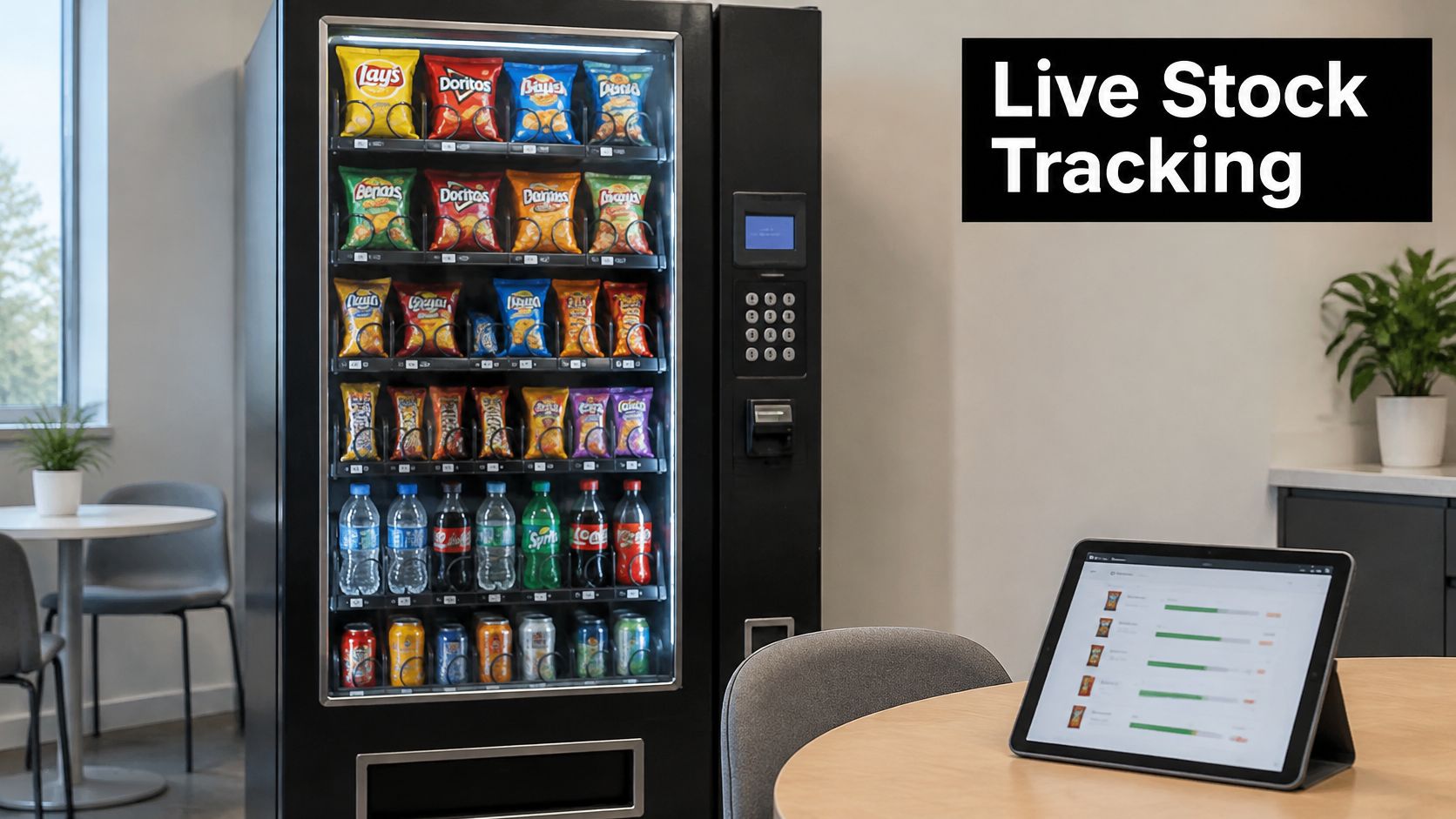
A telemetry machine carries a modem and sensors that push stock levels, sales by slot, cabinet temperature, and fault codes to a dashboard. The route stops being a fixed weekly loop and becomes a response to what the machine sold. In a large office, that difference shows up fast: the unit that empties the same two drinks every Thursday is the one nobody was watching. This is the same remote-monitoring layer Vendmoore builds into its machines alongside tap-to-pay.
Why timing beats prediction
The factory-floor version is prescriptive AI, which recommends or triggers corrective action instead of only forecasting a failure. A longitudinal factory-floor study reported a 38% reduction in unplanned downtime, a 22% gain in overall equipment effectiveness, and 15% lower energy consumption per unit against a predictive-maintenance baseline, with inference latency of 50 milliseconds or less and control loops of at least 10 Hz, according to the published factory-floor study. A snack vendor needs the low-stock alert to fire before the Friday shift finds an empty coil; millisecond control is factory-floor overhead.
What breaks
Cellular dead spots: test signal strength at the wall where the machine will sit, away from the easy signal at the front door.
Stale dashboards: a portal that refreshes once a day is a report, and route decisions made from it arrive late.
Alarm fatigue: if every temperature blip pings someone, the fault that matters gets ignored.
Ask for the screen, not the brochure. A sample dashboard showing stock by slot, sales velocity, and fault history tells you more than any feature list.
Pull monthly sales data, cut the slow movers, and reload with what people buy. Vendmoore's telemetry data collection guide covers what a healthy feed should report. When the dashboard shows a repeatable morning spike, the adjacent shelf can justify better morning brews with Peak Performance pods beside the snack machine; the same sales data tells you whether that add-on earns its space.
2. Cashless Tap-to-Pay Vending with Apple Pay and Google Wallet
NFC readers change the smallest transaction in the building. Visa's in-person contactless share climbed from under 1% in 2018 to nearly 50% in 2025, with acceptance at more than 80% of U.S. merchant locations, and a 2023 Forbes Advisor survey found 53% of Americans use digital wallets more often than traditional payment methods while 51% would stop shopping with a merchant that doesn't accept them, per William Blair's contactless payments report. A break room is a small-ticket environment. If the reader won't take a phone, some of your people won't buy.
The honest trade-off
Cashless volume is real. In 2025, 78% of monitored vending sales were cashless and the average cashless ticket was $2.45 against $1.57 for cash, according to Ken Research's North America vending machine market summary. The same summary reports that 14.6% of surveyed respondents rated vending-machine shopping "much worse" than traditional retail and 25.5% "somewhat worse," with complaints including malfunctions and inadequate refunds. A failed vend on a card tap becomes a support ticket, and handled badly it costs more trust than a jammed coin return ever did.
Practical rule: no reader goes in until you can describe the refund path out loud. Automatic reversal, app credit, or a phone number answered during shift hours.
What to verify
Wallet support, not just cards: confirm Apple Pay and Google Wallet specifically, then sign the front of the machine so people know.
Offline behavior: ask what happens to a payment when the network drops, and whether the machine holds or refuses the transaction.
Cash as a fallback: visitors and older staff without a wallet still buy. A unit that also takes bills keeps them as customers.
The cashless payment walkthrough explains what a tap does behind the screen.
3. Unattended Micro Markets
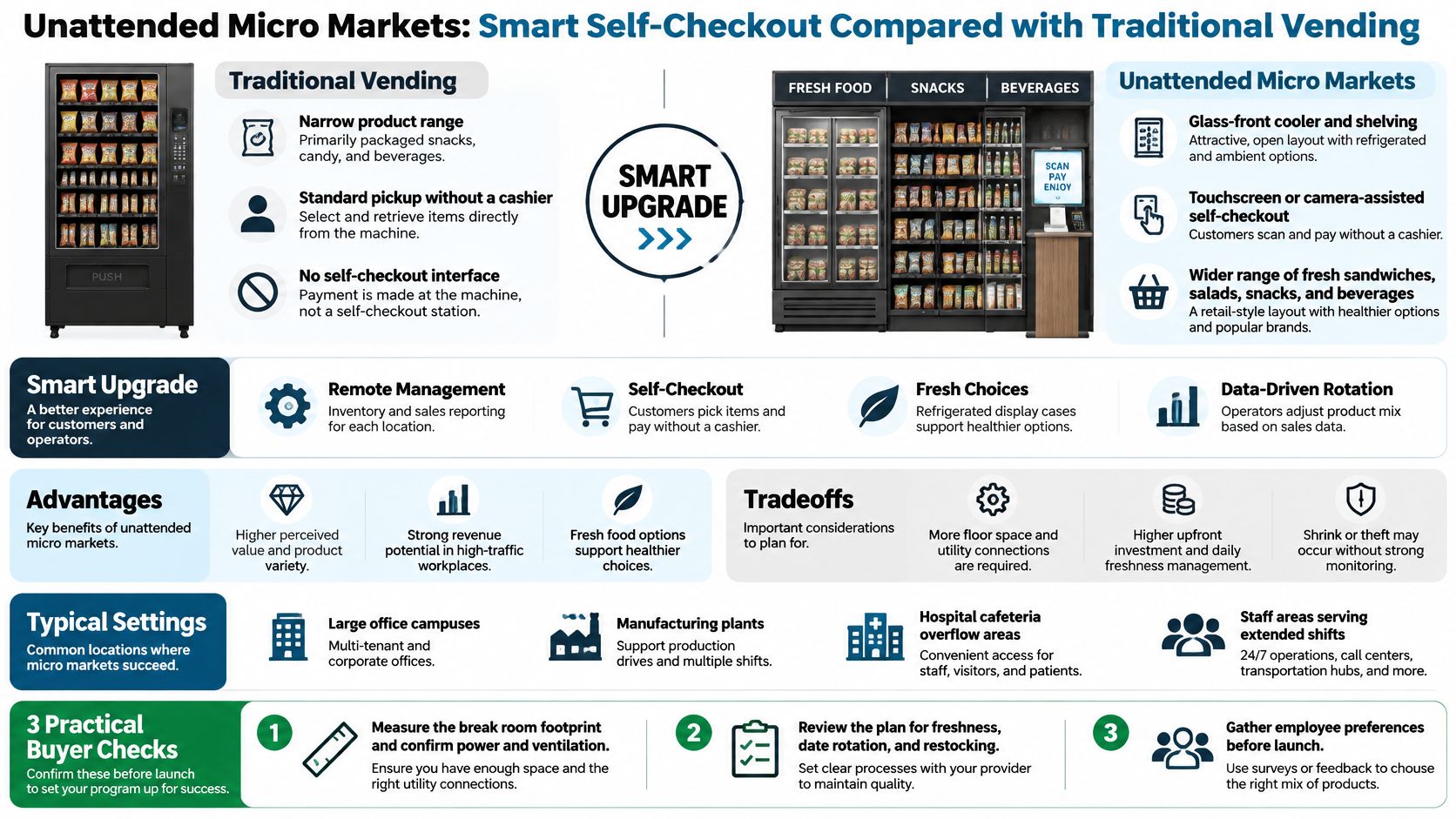
A micro market asks more of a room than any vending machine: open shelving, a glass-front cooler, and a kiosk where people scan and pay for themselves. It is the biggest step up from coil vending and the fastest-growing corner of the category. Vending and micro-market sales rose 30% in 2024, from $26.04 billion to $33.85 billion, according to Vending Market Watch's State of the Vending and Micro Market Industry report. Cashless payments dominate the format: 96% of micro-market transactions and 100% of smart-store transactions were cashless in 2024, based on millions of transactions analyzed by the IoT M2M Council.
Where it wins and where it fails
Micro markets beat vending on variety, freshness, and average ticket. They lose on shrink, spoilage, and floor space, because open shelves put product in reach without a coil between the customer and the item. A market with weak date rotation turns a $9 sandwich into a write-off, and a market in a 40-person office rarely justifies the footprint.
Space and services: measure the footprint, power, and ventilation before choosing a format. A cooler needs airflow, not a closet.
Freshness plan: ask for the rotation schedule, who pulls short-dated items, and how markdowns are handled.
Shrink controls: ask what covers the shelves. Cameras near the kiosk and a closed door policy for non-employees matter more once product sits in the open.
Launch assortment: survey staff before opening day. Early adoption decides whether the market survives its first quarter.
Give the market three months of data before you judge it. Day-one assortment is a guess. The sales report is what tells you the truth.
A full-service provider takes the operational weight off your team by handling stocking, service and support, and building the menu to fit your space. The unattended retail operations guide goes further on shrink control and checkout flow, and this breakdown shows how the format compares with traditional vending in practice:
4. Compact Refreshment Centers
Not every room has twenty feet of wall. A compact refreshment center packs snacks and bottled drinks, sometimes cans too, into one narrow cabinet with a card reader and a telemetry board inside. Reception areas, clinic corridors, and small professional offices are where these units earn their keep.
Match the mix to the people
A survey of 100 employees and office managers found 65% rated access to healthy office snacks as very or extremely important, and 53% said office snacks help them stay healthy, according to Canteen's healthy breakroom snacks survey. That isn't an argument for stripping candy out of the machine. It's an argument for a deliberate mix: better-for-you rows beside the conventional sellers, with the sales data to show which rows move.
Checks before you order
Clearances: measure the door swing, cabinet height, and the electrical drop before ordering anything.
Sixty-day review: read sales by slot after two months and swap the dead rows out.
Feedback loop: a short survey or a QR code on the machine beats guessing from the break room rumor mill.
Say a 30-person insurance office in Edmond has a four-foot alcove beside reception. A full-size vendor won't fit, but a compact unit will, and two better-for-you rows plus water will outsell the third energy drink row within a quarter. The trap is treating a small machine as a miniature version of a big one. It isn't. Limited facings mean every slot has to earn its space from day one.
5. Dual-Zone Chill Centers
Two independently controlled temperature zones in one cabinet, usually cold beverages on one side and chilled snacks or ready meals on the other, is the format that solves the yogurt problem. A single-zone machine chills everything to the same setpoint, which is too warm for a salad and too cold for a chocolate bar. Separate zones let you hold each category where it belongs, and the compressor logic reports on both.
Why early detection pays
Catching a problem before a customer does has a measurable payoff. Intel's tire-manufacturing deployment combined industrial cameras and AI-based visual inspection to catch defects automatically, lifting detection accuracy to 99.9% from roughly 90% for manual inspection, cutting labor costs by about $49,000 per production line, and reducing customer complaints by more than 10,000 a year, according to Intel's tire inspection case study. Swap cameras for thermistors and the logic holds. A zone drifting to 45°F overnight is a service event you can catch before someone buys a warm yogurt.
What to ask for
Temperature logs and alarm settings for each zone, with the threshold written down.
A rotation plan that uses telemetry to flag short-dated product before it expires.
Preventive maintenance on compressors and condenser coils, scheduled quarterly rather than after a failure.
I'd also baseline the site before install: current stockout frequency, service calls, and spoiled product. Without that number, nobody can prove the new cabinet changed anything.
6. Frozen Food Vending Machines
Freezer compartments with controls that hold ice cream, frozen meals, and frozen snacks at safe temperatures, plus connected models that report temperature and stock. They matter most where people can't leave the building for a meal. Manufacturing sites, hospital night shifts, and event venue staff areas are the classic fit.
Why plants buy these first
Plant floors already run on automated equipment at scale. The International Federation of Robotics reported 541,302 industrial robots installed worldwide in 2023, the second-highest total on record, with an operational stock of approximately 4.28 million units in factories, up 10% from the prior year, per the IFR's robot installation report. Instrumenting a freezer cabinet is a much smaller project, and in a 2025 Deloitte survey of manufacturers, 29% reported using AI or machine learning at the facility or network level, with 24% deploying generative AI at that scale, according to the Deloitte Smart Manufacturing and Operations Survey. The people working beside that equipment are the ones buying a frozen meal at 2 a.m.
Set temperature alarms to notify the operator the moment a freezer drifts out of range, not the next morning.
Plan restocking around delivery schedules so product spends minimum time outside the freezer.
Check energy ratings and placement, since a freezer in a hot loading dock costs more to run.
Moving frozen product into a machine without a cold chain plan is how you get thaw-and-refreeze complaints. The frozen food transport guide covers the handling side.
7. Connected Water and Beverage Dispensers
Filtered, chilled, sometimes carbonated water on demand is a break room upgrade that removes pallets of bottled water from the supply closet. The connected part is the maintenance layer: many units report usage, filter life, and product levels to a cloud dashboard, so a filter change is triggered by gallons dispensed instead of a calendar reminder nobody reads.
Plumbed or bottled
This is the decision that shapes everything after it. A plumbed unit needs a water line, a shutoff valve, and a drain within reach, plus a landlord conversation in a leased space. A bottled unit needs someone to haul and change bottles and a place to store spares. Carbonated models add a CO2 tank that needs a swap schedule. Filter spec matters too: sediment and carbon block, changed on volume, and the tap and drip tray sanitized on a schedule the operator owns.
Details worth pinning down
Filter change responsibility: who orders, who installs, and what happens when a light stays red for a week.
Water quality: ask for the filter spec against your building's water, especially in older Oklahoma City properties.
Program fit: pair the dispenser with a snack or beverage vendor so the room has one service contact, not three.
If you're specifying a freestanding unit instead of a plumbed one, gallon dispenser features and materials helps you compare build quality. Office water services explains how filtering, delivery, and service calls usually get bundled.
8. Fresh Food Vending Kiosks
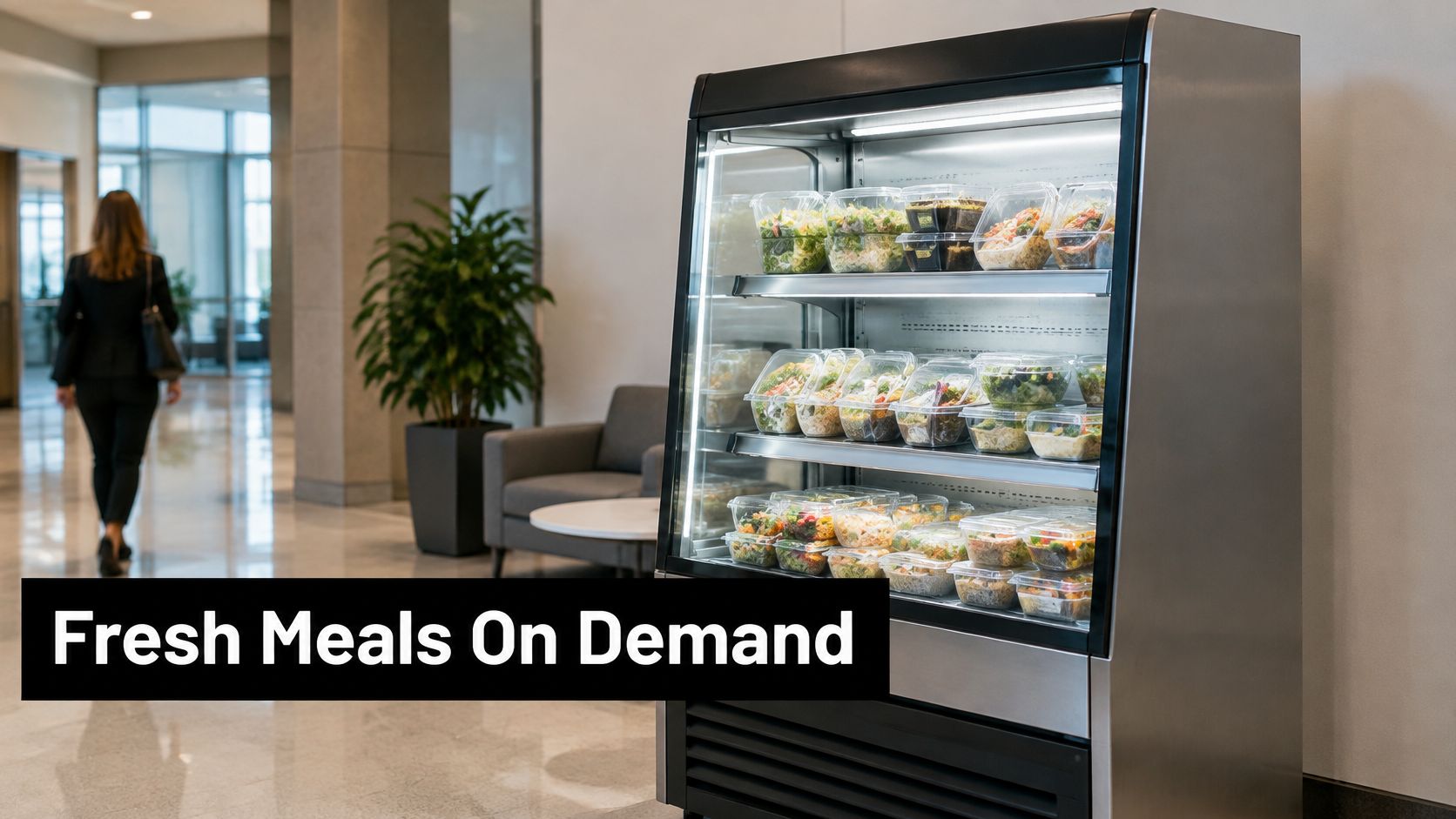
Fresh food kiosks are refrigerated, often app-linked cabinets stocked with prepared meals, salads, and grab-and-go items. The customer pays at a touchscreen or through a phone and collects from a temperature-controlled compartment. These units earn their place in offices and healthcare facilities with no nearby restaurant, where the alternative is a 20-minute drive.
The waste math
Fresh food is a perishable inventory problem dressed up as a machine. Every item has a sell-by window, and unsold product at the end of that window is a straight loss. The operators who make fresh food work do three things well: they hold cabinets at proper refrigerated temperatures with logged readings, they date-code every item on load, and they use demand data to shade the next order down for slow days. A kiosk loaded with the same 30 sandwiches daily in a 60-person office will throw away money every Friday.
The menu should follow the badge data, not the distributor's catalog. Track what sells by daypart for eight weeks before you lock an assortment.
What to settle before launch
Food safety controls: ask who monitors temperature, how often, and what triggers a pull-and-discard.
Menu rotation: get the weekly rotation in writing, and confirm it changes with demand rather than staying fixed.
Demand tracking: review item-level sales for the first three months and adjust portions and variety.
8 Smart Machine Examples Compared
Item | Best For | Space Requirement | Key Smart Feature | Main Drawback |
|---|---|---|---|---|
Connected Telemetry Snack and Drink Vending Machines | Offices and break rooms needing data-driven restocking | Standard vending machine footprint; requires network coverage | Real-time stock, sales, and fault monitoring | Higher hardware and subscription costs |
Cashless Tap-to-Pay Vending with Apple Pay and Google Wallet | Busy workplaces and public spaces where quick payment matters | Standard vending machine footprint | Contactless mobile wallet payments | Processing fees and possible payment outages |
Unattended Micro Markets | High-traffic workplaces seeking fresh food and variety | More floor space; needs power and utility connections | Self-checkout with remote inventory and sales reporting | Higher investment and ongoing freshness management |
Compact Refreshment Centers | Small offices, lobbies, and reception areas | Compact footprint for limited spaces | Telemetry-enabled stock and sales monitoring | Limited capacity and product selection |
Dual-Zone Chill Centers | Workplaces offering drinks and chilled foods in one unit | Single vending unit with room for refrigeration | Independent temperature controls and alerts for two zones | Higher energy use and careful expiration management |
Frozen Food Vending Machines | Workplaces with limited food access or long shifts | Vending machine footprint with freezer capacity | Temperature alerts and connected stock reporting | High energy use and risk of product loss if the freezer fails |
Connected Water and Beverage Dispensers | Offices and schools seeking filtered drinks and less bottled water | Requires a water line or space for bottled supply | Cloud-based usage and filter-life tracking | Does not provide snacks or food |
Fresh Food Vending Kiosks | Offices, hospitals, and lounges needing ready-to-eat meals | Space for a refrigerated kiosk | Demand forecasting and automated temperature monitoring | Short shelf life requires careful stock rotation |
Choosing the Right Smart Machines for Your Space
Start with the room, not the technology. Measure the footprint, confirm power and network coverage, and count the people who will walk to the machine between 7 a.m. and 3 p.m. Then match format to traffic: a compact refreshment center for a reception alcove, a telemetry snack vendor for a busy floor, a micro market or fresh food kiosk where dozens of people need a real meal, a dual-zone or frozen unit where the nearest alternative is a drive.
The harder question is whether to connect anything at all. Non-smart machines still represented 60.94% of installed units in North America and Europe in 2025, while smart or IoT-enabled machines were forecast to grow at 15.26% annually, and retrofit costs run roughly $1,500 to $2,500, according to Mordor Intelligence's vending machine market analysis. Connectivity earns its keep where a failure is expensive or invisible: hospitals, airports, campuses, and distributed workplaces with several small sites. In a low-traffic site with a narrow assortment, a conventional machine or a modest retrofit often beats a flagship install.
High traffic, high downtime cost: prioritize telemetry, tap-to-pay, and automatic refunds.
Moderate traffic: retrofit the existing cabinet with a card reader and monitoring before replacing it.
Low traffic, simple assortment: keep it conventional and put the money into product mix.
Vendmoore Enterprises installs and operates AI-powered vending across the Oklahoma City metro, with tap-to-pay through credit and debit cards, Apple Pay, and Google Wallet plus remote monitoring, and the lineup runs from compact refreshment centers and bottle-and-can vendors to dual-zone chill centers and frozen food machines. Whatever operator you talk to, audit your break room first, ask employees what they'd buy, and request real telemetry from a comparable site. A vendor who can't show you a live dashboard is selling you a coin machine with a card reader bolted on.
Vendmoore Enterprises handles the whole program for workplaces across Oklahoma City, Norman, Edmond, and the surrounding cities: machine selection, tap-to-pay setup, stocking, and the telemetry behind it, so your break room stops running out of what people want. If you're weighing a compact unit against a micro market or a frozen machine, they'll match the format to your space and traffic instead of selling you the biggest box. Visit Vendmoore Enterprises to start with a break room audit and a product mix built around your team.
Comments