
Snack Drink Vending Machine Combo: Is It Worth It?

Your break room has an empty wall, employees keep asking for cold drinks, and someone wants better snacks than the leftovers beside the coffee maker. A snack drink vending machine combo sounds like the obvious answer, until you start comparing cabinets, cooling systems and service arrangements.
The important question isn't how many features fit on the sales sheet. It's whether shared floor space, shared uptime and a shared assortment work for your building. A good choice starts with the people using the machine, then works backward to the equipment and operating agreement.
How a Combo Machine Splits One Cabinet Between Snacks and Drinks
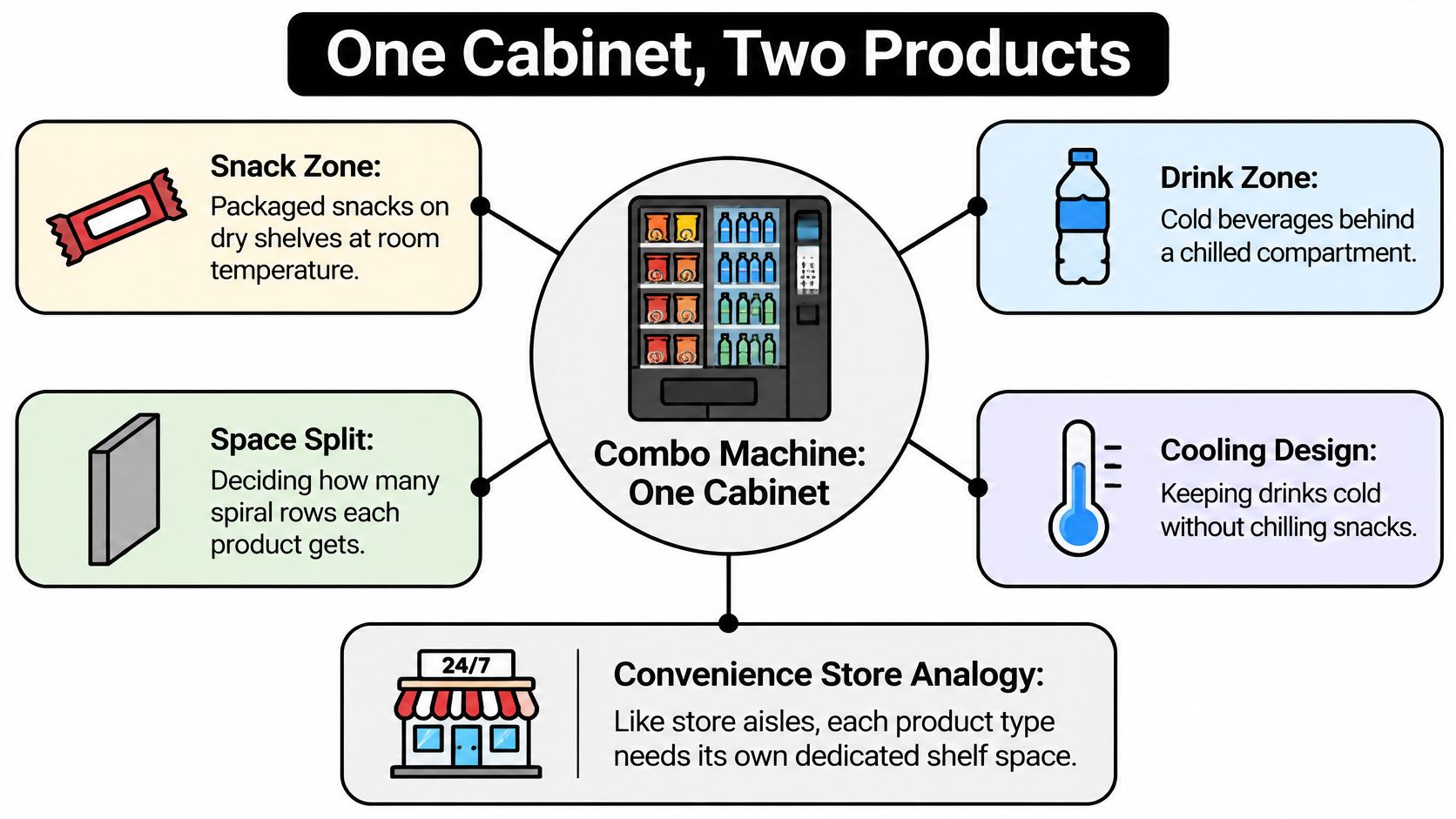
A combo vending machine sells packaged snacks and cold drinks from one cabinet. Think of a convenience store with separate aisles under one roof, or a kitchen drawer with dividers. The available space matters, but so do the partitions that determine what fits where.
A wide snack bag needs clearance to move through its spiral without catching. A bottle needs a compatible delivery mechanism and enough chilled storage behind its selection. Giving either category more room leaves less room for the other.
The illustration shows the basic division between dry shelves and refrigerated storage.
Separate Compartments Versus a Shared Interior
A dual-compartment design separates the vending zones, with dedicated shelving, temperature arrangements and often separate dispensing mechanisms. A jammed drink column may leave the snack mechanism usable, provided the fault doesn't affect shared controls or payment hardware.
A hybrid design shares the cabinet and payment front while dividing the interior into an ambient snack section and a refrigerated bay. Manufacturers don't always use these labels consistently, so inspect the layout rather than trusting the product category.
Practical rule: Count the temperature zones and dispensing mechanisms, then identify which controls they share.
Temperature zoning determines what you can stock. Dry packaged snacks generally belong on ambient shelves, beverages may need chilled storage, and frozen products require equipment designed specifically for frozen holding. A chilled compartment isn't interchangeable with a freezer, and cooling capability alone doesn't establish suitability for fresh food.
Selections Aren't the Same as Capacity
A selection is a product choice. Capacity is how many packages the machine holds behind those choices. Our explanation of vending machine capacity helps distinguish variety from refill depth.
Before choosing products, compare package dimensions with the proposed shelf configuration. For assortment inspiration beyond the usual candy-and-chips list, the snack ideas from IFM Gourmet Food Store offer a useful starting point, but every candidate still needs a fit test.
Ask to see the actual internal layout. That reveals whether you're considering a genuinely integrated combo, a refrigerated cabinet with snack shelves, or separate machines marketed together.
Combo, Snack-Only and Drink-Only Machines Side by Side
A combo wins when space is tight and users want both categories; separate machines win when demand is uneven or independent operation matters more. Neither format is automatically the better investment.
The comparison should cover the complete installation, not just the cabinet price. A snack machine may look inexpensive until you add the drink machine needed to finish the service.
Combo, snack-only and drink-only machines compared
Criterion | Combo machine | Snack-only machine | Drink-only machine |
|---|---|---|---|
Footprint for both categories | One cabinet; confirm actual dimensions and service clearance | Requires a separate drink cabinet to cover both categories | Requires a separate snack cabinet to cover both categories |
Selections per unit | Snack and drink choices share the available layout | Available selections dedicated to snacks | Available selections dedicated to beverages |
Temperature zones | Ambient plus chilled; frozen only in an appropriate configuration | Ambient; frozen products require a freezer configuration | Chilled in a standard refrigerated beverage unit |
Typical sale value | Can increase when the customer buys both categories | Usually a snack-only purchase | Usually a drink-only purchase |
Service visits | Both zones can be handled during the same stop | Separate cabinet to inspect and replenish, potentially during the same site visit | Separate cabinet to inspect and replenish, potentially during the same site visit |
Upfront or lease cost | Generally above a comparable single-category unit, below purchasing both formats | Lower equipment cost when only snacks are needed | Lower equipment cost when only beverages are needed |
Best-fit site | Break rooms, lounges, schools and clinics with limited space | Hallways and lobbies with snack-led demand | Gyms, warehouses and sites with heavy drink demand |
Read the Rows as Trade-Offs
More categories doesn't necessarily mean more capacity. A combo can provide broader choice within a limited installation area while holding fewer units of the category that sells fastest.
Avoid relying on generic selection-count ranges. Compare the proposed machines' specification sheets, then ask how many slots remain after accommodating your actual bottle sizes, snack bags and specialty items. An adjustable shelf isn't useful if its proposed configuration can't vend reliably.
Likewise, buying a snack and drink doesn't automatically mean completing a single payment. Some machines support a multi-vend session; others authorize separate purchases. Confirm the customer flow with a demonstration rather than assuming that shared payment hardware provides a shopping basket.
Compare the installed service, not the equipment silhouette.
Service visits also need careful interpretation. Separate cabinets don't necessarily require separate trips to the building. An operator can replenish both during the same stop, although each cabinet still needs inspection, cleaning and inventory work.
Which Constraint Changes the Answer?
For an office or clinic, the deciding row is often usable floor space. Include the door swing, ventilation clearance, delivery route and the space a customer occupies while retrieving a purchase.
For an airport or stadium, peak throughput matters more. Separate machines can let customers buy simultaneously, but only if their placement leaves enough room for separate queues. More equipment won't solve congestion if everyone still stands in the same narrow passage.
Where Combo Machines Earn Their Place and Where They Fall Short
A clinic break room with one open wall asks a harder question than a lobby with room for three cabinets: if the only available footprint has to hold snacks and drinks together, which demand are you willing to disappoint during a fault, a refill lag or a lunch rush?
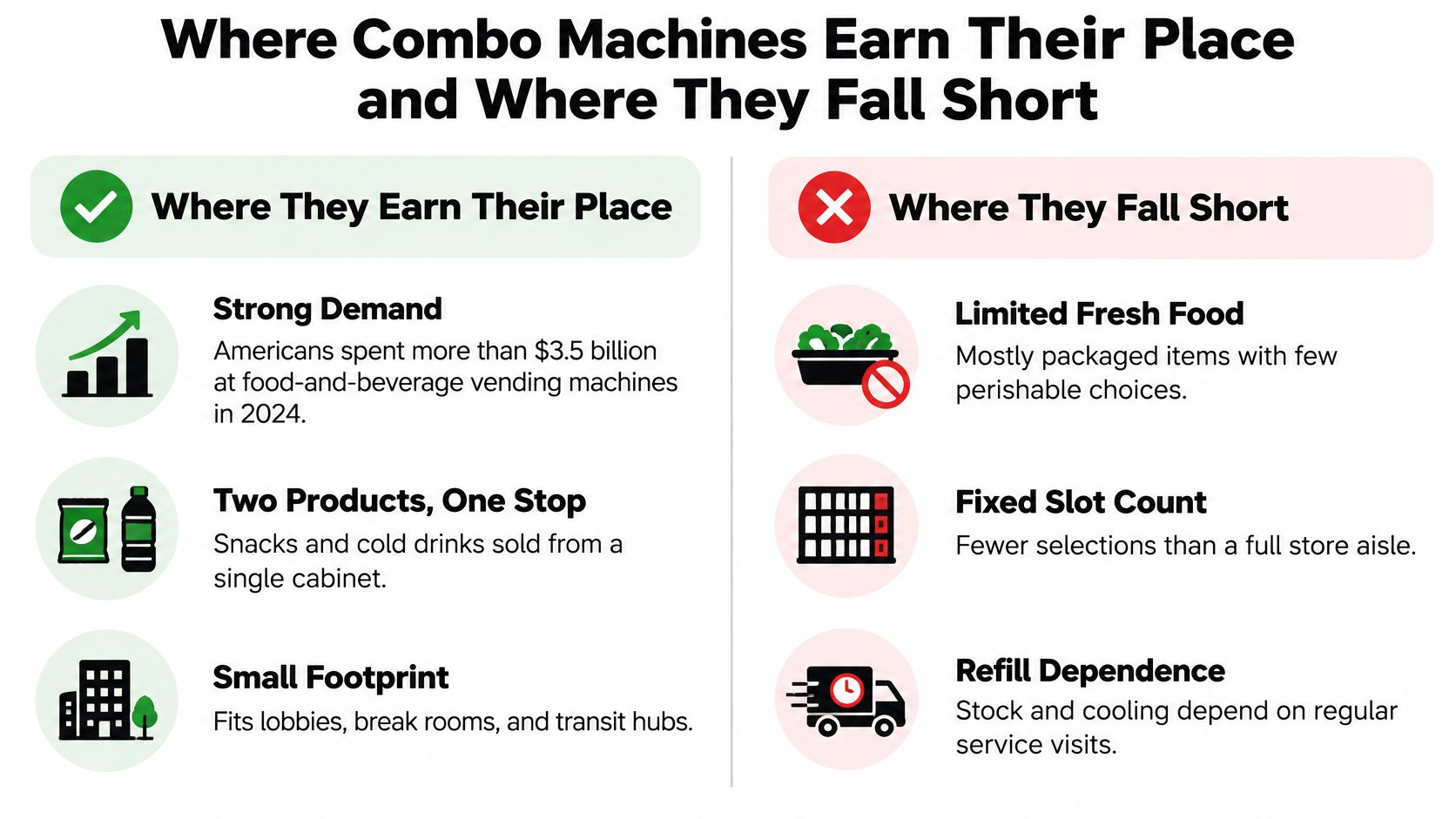
Vending is a substantial purchasing channel, but national demand does not prove demand at your address. Your placement still needs repeat customers, a mix that matches their routines and an operating arrangement that keeps the cabinet available when people expect it.
The trade-off is easier to judge as three shared budgets: floor space, uptime and assortment. A combo spends all three from one cabinet.
Where the Shared Cabinet Helps
A combo can simplify the placement agreement and give the operator one replenishment route inside the building. Sales records from the same cabinet can also show whether drinks carry snacks during breaks or whether the two categories peak at different times.
Mixed-category availability creates a chance for an added purchase. Someone buying an afternoon drink can also choose a snack without walking elsewhere, although availability isn't proof of a larger basket. The useful evidence is repeated same-visit demand, not a single busy week.
A well-planned refill restores both categories together and uses the visit to correct slow selections, inspect delivery mechanisms and remove damaged or expired packages. If the visit only fills visible gaps, the shared cabinet is sharing neglect.
Checks That Catch the Drawbacks
The weaknesses deserve the same attention as the benefits.
Shared downtime: A failed reader, controller or power supply can interrupt both categories. Identify common components and confirm what remains usable after a fault.
Restricted depth: A broad menu can leave popular products with too little stock behind each selection. Ask which columns get depth after your real bottle sizes, snack bags and specialty items are placed.
Cooling failure: A failed chilled bay can warm beverages and compromise temperature-sensitive food. Confirm temperature monitoring, sales lockout behavior and the procedure for assessing affected stock.
Customer queues: Shared controls can become a bottleneck during synchronized breaks. Observe the busiest buying period and watch how many people can complete a purchase while others wait.
Category imbalance: If beverages outsell snacks consistently, the snack side can become display space. Give the faster category more columns and reduce slow facings before adding variety.
Don't assume that all warm drinks must be discarded. Shelf-stable soda and temperature-sensitive dairy drinks present different handling questions; the operator needs a product-specific procedure.
Before signing, review the vending machine installation cost considerations, including delivery access, electrical readiness and any site preparation.
Choose a combo for steady mixed demand in constrained space. Choose independent machines when category imbalance or the consequences of an interruption outweigh the convenience of a shared cabinet.
Cashless Payments and Telemetry Under the Hood
Cashless acceptance has become central to modern vending. In an analysis covering approximately 160,000 cashless devices, cashless transactions increased from 51% in January 2020 to 62% in October 2021, according to Vending Times.
More recently, Cantaloupe reported that cashless payments represented 78% of vending-machine sales in 2025, up from 73% in 2024. These are payment-market benchmarks, not forecasts for an individual Oklahoma break room.
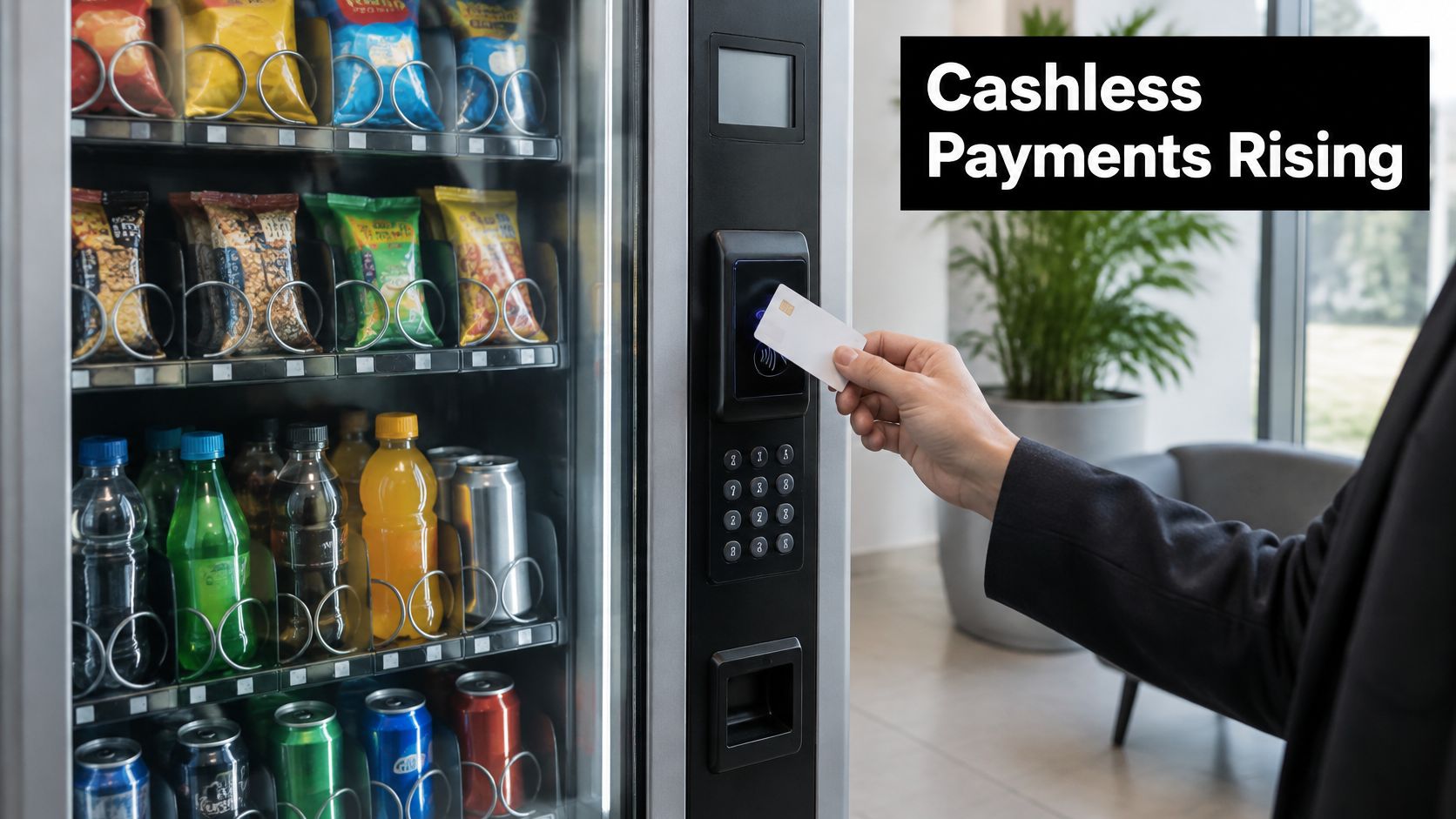
A visible, easy-to-use reader helps customers understand how to begin.
What Customers Experience
Tap-to-pay removes the need to find exact change. Customers may use a compatible card, phone wallet or watch, but the machine's software determines whether they can continue selecting products within the same payment session.
Test that sequence before installation. Check whether the screen explains authorizations clearly, how the machine handles an unsuccessful vend, and how customers request help without sharing sensitive payment details.
Cashless and telemetry aren't the same feature. A reader processes payment; telemetry sends operational information to the operator. They may use related hardware, but a connected payment terminal doesn't guarantee detailed stock or temperature reporting.
For a visual look at vending technology in practice, use the video below.
What the Operator Receives
Telemetry combines machine counters, controller records and supported sensors. Our guide to telemetry data collection explains how those readings support replenishment and service decisions.
Telemetry signals and the actions they trigger
Telemetry signal | What the machine reports | Action it triggers |
|---|---|---|
Stock level per selection | Units left in each slot, based on supported tracking | Restock route priority |
Cabinet temperature | Reading for each monitored chilled or frozen zone | Service call when a zone drifts from its set range |
Vend or payment fault | Error code from the mechanism or reader | Technician assessment and dispatch |
Sales by selection | Units sold per hour and per day | Reorder quantities and assortment changes |
Payment mix | Share of card, phone and cash sales | Decision on how much cash float to keep |
Treat inventory readings as operational estimates unless the equipment verifies physical stock. Incorrect loading records, unrecorded removals and delivery faults can create discrepancies.
Before committing, identify which signals arrive live and which arrive in summaries. Name the person who receives a temperature alert, establish the response procedure, and determine what happens when connectivity fails. Cash float should reflect actual cash usage and the machine's change-making requirements, not a general assumption that everyone pays digitally.
Tailoring the Assortment Without Guessing
Start with what the location already buys, then earn additional shelf space through measured tests. Employees requesting a product is useful evidence, but repeat purchases determine whether it deserves a permanent slot.
A 2025 peer-reviewed study in Frontiers in Nutrition examining 30 vending machines at Slovenian universities found that 26.38% of products met its sustainable-packaging criteria, alongside gaps in availability, labeling, accessibility and affordability. The finding concerns those university machines, but it highlights a practical question for any facility: can customers identify, afford and purchase the alternatives being offered?
Give Each Tier a Clear Test
Assortment tiers, waste risk and how to test them
Tier | Example products | Shelf-life and waste risk | How to test it |
|---|---|---|---|
Classic favorites | Chips, candy bars, regular soda, energy drinks | Generally shelf-stable; slow sellers can still expire | Track sell-through against the established baseline |
Lower-sugar drinks | Zero-sugar sodas, unsweetened iced tea, sparkling water | Flavor acceptance can leave stock sitting | Introduce a small trial group and compare repeat purchases |
Higher-protein snacks | Roasted nuts, protein bars, jerky | Often shelf-stable; check heat sensitivity and package dates | Compare with classic snacks at a similar price |
Refrigerated or fresh items | Yogurt cups, wraps, cut fruit | Shorter usable life and greater waste exposure | Use a narrowly limited trial and inspect waste at every refill |
Lower-impact packaging | Aluminum cans and packaging with verified local recycling options | Product shelf life and packaging performance need separate checks | Request packaging details and record customer feedback separately |
For ingredient screening, the guide to protein bar additives to avoid from Maximum Health Products can help generate questions. It doesn't replace reading the actual product label, reviewing allergens or checking whether customers like the product.
A healthier menu isn't automatically a lower-waste menu. Products have to sell before their usable life ends.
Split the Shelf Budget Deliberately
For a hypothetical starting allocation, give most slots to proven sellers, a smaller group to healthier alternatives and a limited group to trials. Record the allocation before loading so you can distinguish a deliberate experiment from a product added casually during a refill.
Judge performance using units sold relative to stock offered, time available, stockouts and discarded products. A drink that sells out early may deserve deeper capacity rather than an additional flavor. A fresh item with respectable sales may still be unsuitable if too much stock is discarded.
Our approach to assortment planning connects those decisions to the space available. We customize each menu with classic favorites, healthier choices or a blend, and build the plan around the customer's breakroom, lounge or community space.
Keep prices and labels readable, including allergen information where applicable. A product isn't meaningfully available if users can't identify it, reach the controls or understand its price.
Choosing a Combo Setup for Each Type of Site
Choose the site type first, traffic pattern next and most damaging failure last. A facility's label helps narrow the options, but the daily rhythm determines what the equipment must handle.
An office with staggered breaks behaves differently from a production floor where employees leave their stations together. Likewise, a clinic waiting room doesn't necessarily share the purchasing habits of a hospital staff lounge.
Recommended machine format by site type
Site type | Usage pattern | What matters most | Likely format |
|---|---|---|---|
Corporate office break room | Steady daytime use with lunch peaks | Cashless payment, timely restocking, lunch-friendly items | Combo with a chilled bay |
School, college or teacher lounge | Short bursts between classes, tight budgets | Clear labels, healthier tiers, affordable pricing | Combo with a healthier mix |
Hospital or clinic | Extended hours or round-the-clock shifts | Reliable cold storage and alerts reaching the responsible person at night | Combo with an alarmed chilled bay, or a separate drink unit |
Manufacturing or industrial site | Shift changes and heavy drink demand | Durability, drink capacity, quick restocking | Separate drink unit paired with a snack combo |
Apartment or property complex | Low, spread-out traffic | Simple payment and manageable maintenance | Compact combo with tap-to-pay |
Stadium or airport | Surges around events or boarding | Throughput, queue length and uptime | Separate snack and drink units where demand supports them |
Test the Recommendation Against the Building
For an office, look beyond total headcount. Hybrid attendance, nearby food options and the distance between departments can change where employees will actually buy refreshments. Place the machine where intended users already pass, without obstructing circulation.
Educational facilities need a menu appropriate to the people with access. A teacher lounge and a student-accessible corridor shouldn't automatically receive identical products or pricing arrangements.
Healthcare locations need clear ownership of after-hours problems. An alert that reaches an unattended office inbox won't help night-shift staff. Determine who can isolate affected stock and contact service when the main administrative team is absent.
Industrial sites: Check whether drink demand is concentrated at shift changes and whether delivery access remains available during operating hours.
Residential common areas: Match the assortment to residents' purchases rather than copying an office lunch menu.
Transport and event sites: Observe customer arrival patterns and leave room for people carrying luggage or moving in groups.
Match Inventory to the Actual Space
We provide break room vending for teacher lounges, apartment community areas and office breakrooms, and customize each machine's inventory to the space where it's placed. The placement considerations in our guide to vending machines in different locations help connect the building's use to the equipment choice.
Before settling on a format, watch the busiest purchasing period. Determine whether customers can complete purchases within the break time available, rather than judging capacity from quiet-hour use.
Finally, establish whether the site needs round-the-clock access. That decision affects physical access, lighting, reporting instructions and after-hours service procedures, not merely whether the machine remains plugged in.
Confirm Your Combo Setup Before You Sign
Use this checklist to turn a promising cabinet into a workable service agreement.
Measure peak demand. Observe the busiest buying period and confirm that the proposed setup won't create an unacceptable queue.
Verify payments. Test accepted methods and identify users who still need cash.
Assign alerts. Confirm stock, temperature and fault reporting, including who receives each notification.
Document the assortment. Agree on proven, healthier and trial tiers, with a scheduled review of sales and waste.
Clarify ownership and costs. Establish whether the operator stocks and services the machine or the site owns it. Document any placement fee, commission, electricity responsibility and liability for refrigeration failure.
Put service terms in writing. Confirm visit cadence, response arrangements and escalation contacts.
Check accessibility. Review labels, prices, payment screens, controls and product retrieval for users with disabilities or limited digital access.
We offer fully stocked vending and customer-owned options across the Oklahoma City metro, Norman, Edmond and surrounding cities. Our lineup includes the HAHA Ai Vending, Trimline II Refreshment Center and 40-Select Dual Zone Chill Center. Call 405-294-2373 to work through the checklist for your site.
Vendmoore Enterprises offers managed break-room vending and customer-owned machines, with assortments matched to the people using each space. Visit Vendmoore Enterprises to explore a snack-and-drink combo setup that fits your location, purchasing patterns and service needs.
Comments