
Where to Place Vending Machines in 7 High-Traffic Locations

The break room has a vending machine, but employees still leave the building for a drink. In the lobby, visitors walk past another machine without stopping. Before replacing either one, check the basics: can people find it when they need it, does it carry what they want, and can they pay?
Putting vending machines in busy buildings isn't enough. A dependable vending service starts with understanding the building's routines, then choosing equipment and service arrangements that fit them.
Why Vending Machine Placement Matters
Think of a vending location as a small marketplace, not an empty corner waiting for equipment. The audience, available time, nearby alternatives, and reason for buying all matter. A crowded entrance can be less useful than a quieter break room where employees have time to choose something.
Consider an office employee heading into a meeting. A machine beside the entrance might be visible, but it's inconvenient if buying something means retracing their steps. A machine near the shared kitchen may fit naturally into the trip they're already making.
The basic logic isn't new. Modern vending machines emerged in England during the early 1880s, and Percival Everitt developed a coin-operated machine dispensing envelopes, postcards, and notepaper in 1883, establishing a self-service model built around compact goods, automated payment, high-traffic placement, and minimal staffing, as described in the history of vending machines.
Look for a reason to stop
For today's facilities, the useful question isn't how many people pass a spot. Ask whether those people have an unmet need and enough time to act on it. Offices, schools, healthcare facilities, manufacturing sites, multi-tenant buildings, stadiums, and airports each require a different answer.
A suitable location should pass these tests:
Repeatable demand: People return regularly, or the operator can anticipate event-driven demand.
A natural pause: Users can browse without obstructing a doorway, elevator, or circulation route.
A useful alternative: The machine fills a gap rather than duplicating an equally convenient food option.
Practical servicing: Staff can deliver inventory, remove waste, and maintain equipment without disrupting the building.
Practical rule: Choose the place where someone would reasonably stop to buy, not merely the place where they happen to walk.
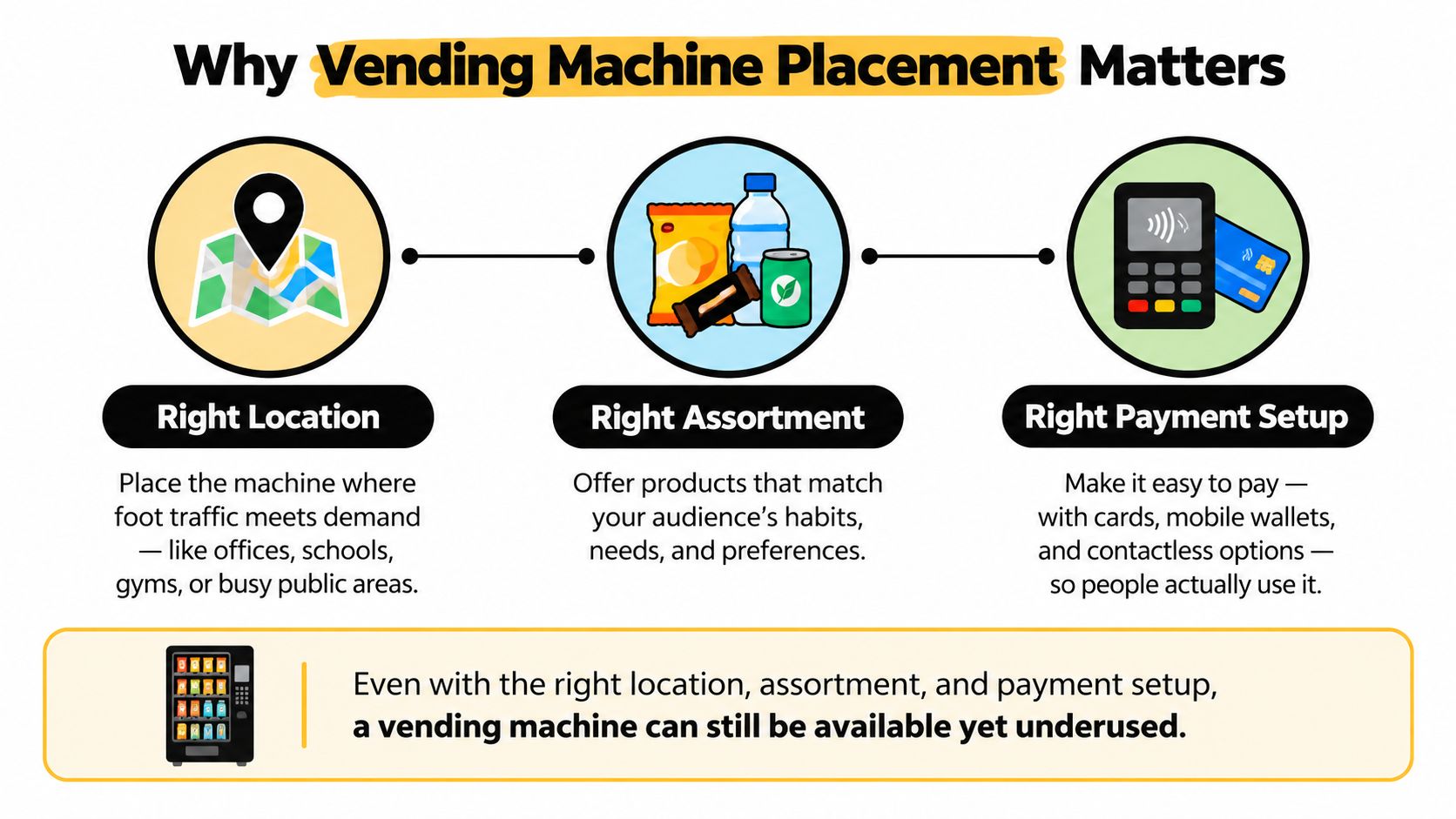
The relationship between location, assortment, and payment is straightforward, but all of them need attention.
Check the work behind the machine
Before approving a footprint, walk the delivery route. Check doors, loading access, service-cart space, electrical suitability, network reception, and the clearance required by the proposed equipment. Refrigerated and frozen formats also need an operating environment that supports their temperature requirements.
Accessibility belongs in the placement decision, not on a post-installation punch list. Evaluate approach space, reach, controls, lighting, and the collection opening with the expected users in mind. A machine isn't convenient if someone can see the selection but can't comfortably operate it.
Ask who will remove empty packaging nearby and who will pull expired or unsuitable stock. Those responsibilities are easy to overlook when everyone is focused on installation.
A promising site should have clear answers to three questions: Who needs this service? When will they use it? Can the operator keep it dependable? If those answers are vague, don't commit to equipment yet.
Compare the Best Vending Machine Locations
The United States has been estimated to have approximately 5 million to 7 million vending machines across at least 1.5 million locations, illustrating the breadth of the market, although those estimates shouldn't be treated as a current machine census, according to this vending-market statistics overview.
For a facility manager, national scale matters less than identifying the demand pattern inside the proposed building. Use this matrix as a planning tool, not a promise of sales.
Vending Location Decision Matrix
Location | Primary Audience | Demand Pattern | Best Placement Focus | Product and Service Consideration |
|---|---|---|---|---|
Offices and business centers | Employees and meeting attendees | Workday breaks and meeting schedules | Shared kitchen or break room | Compact combination format; coordinate with existing food service |
Schools and colleges | Students, faculty, and staff | Class schedules and campus activities | Approved student commons | Suitable snacks and beverages; align service with campus access |
Healthcare facilities | Staff, visitors, and caregivers | Waiting periods and clinical shifts | Separate public and staff pause points | Chilled choices where appropriate; dependable exception response |
Manufacturing sites | Production and support teams | Shift breaks and handovers | Approved break area | Beverage capacity and meal-oriented options; safe restocking route |
Multi-tenant buildings | Residents or employees across tenants | Shared-space routines | Accessible common amenity area | Compact format; clear property-wide service responsibility |
Stadiums | Spectators and venue workers | Event-driven surges | Pause point outside moving queues | Fast selection and sufficient capacity; event-based servicing |
Airports | Passengers and airport workers | Flight activity and extended waits | Authorized waiting or staff area | Portable products; workable security and replenishment access |
Separate background demand from surge demand. An office may support a familiar daily rhythm, while a stadium needs an event-specific stocking plan. An overnight office operation may resemble a shift-based industrial site more than a conventional business center.
Choose the operating pattern first. The building label alone won't tell you which machine to install.
Workplace Placement Across Three Settings
A CDC presentation citing a national workplace study reported that 50% of employees had workplace food or beverage vending, 33% had a cafeteria or snack bar, and 75% had a break room with a refrigerator and microwave. Evaluate vending alongside those existing amenities, not in isolation.
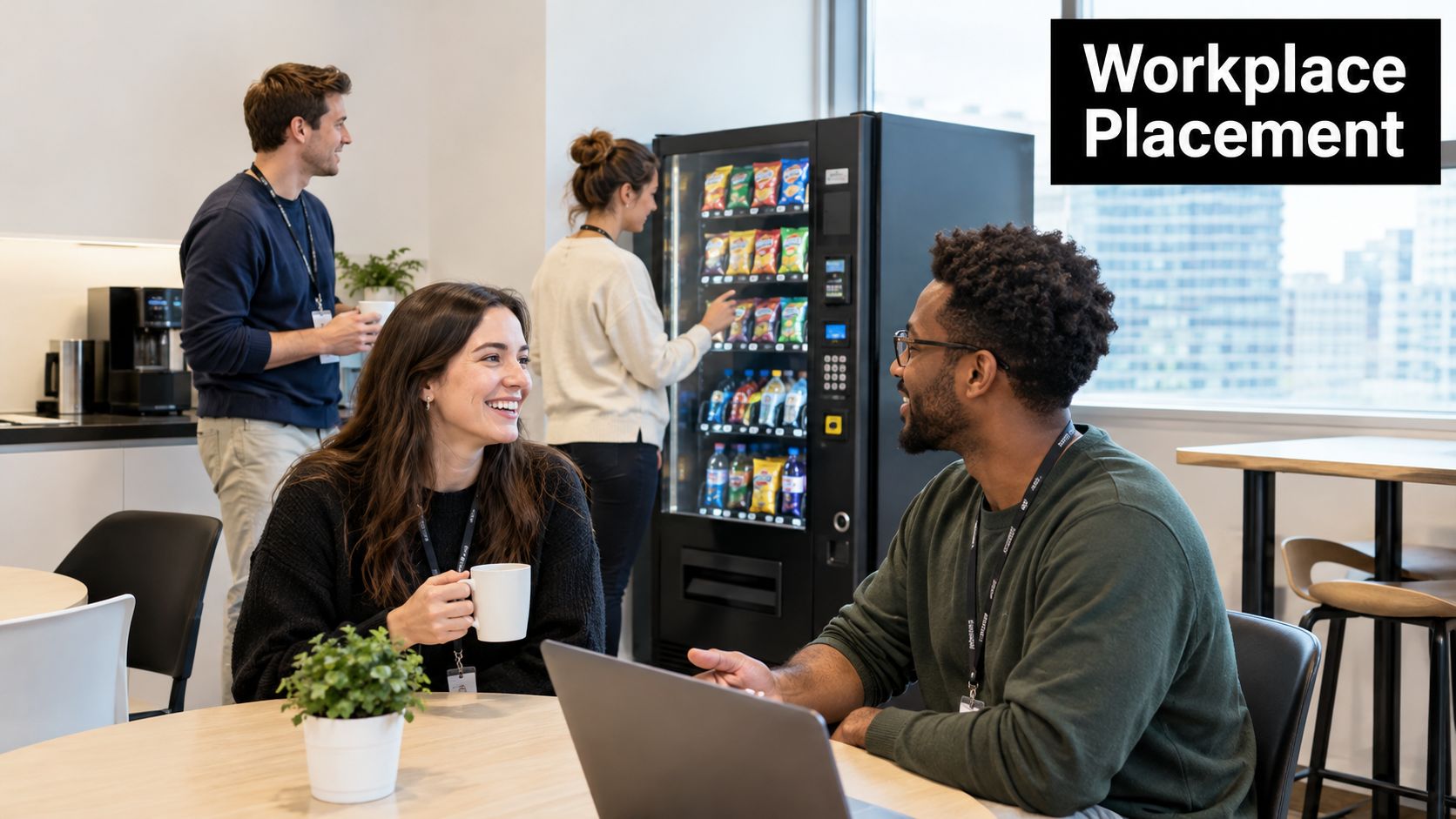
A shared break room is a useful starting point when employees already gather there.
Match the workplace routine
Offices and business centers should compare shared kitchens, meeting-area approaches, and lobby-adjacent common spaces. Don't assume the lobby wins because visitors see it. Check whether employees can reach the machine during an ordinary break and whether cafeteria hours leave a service gap.
Multi-tenant buildings need a property-wide arrangement. Confirm which tenants or residents can enter the space, how they receive service updates, and who handles complaints. Shared access isn't useful if responsibility is split among people who assume someone else is managing the machine.
Manufacturing and industrial sites need a shift-aware plan. Evaluate approved break areas, locker-room approaches, safety restrictions, and restocking routes that don't cross active production unnecessarily. Ask the overnight team what they need rather than letting daytime preferences stand in for everyone.
Use the following video alongside an on-site discussion of the proposed setup.
A workplace machine should support the break employees actually have, not the break someone assumes they have.
Choose snacks, beverages, frozen items, or meal-oriented options around that routine. Don't order the same package for every workplace.
Schools and Healthcare Sites
Schools and healthcare facilities require more than a convenient corner. Define the intended audience before choosing equipment: a student commons, a hospital waiting area, and a staff-only clinical break room serve different people under different conditions.
Schools and colleges
For schools, establish age-appropriate assortment criteria, approved operating hours, payment access, and alignment with campus food service. Don't assume students can use the same payment methods as faculty or that a machine should operate whenever the building is open.
Nutrition presentation deserves testing, not promises. A 2025 campus study found that traffic-light nutrition labeling combined with a colorful machine wrap reduced unhealthy purchases, but the reduction was small, according to the campus healthy-vending study. Don't treat labels or a healthy-product refresh as a complete wellness strategy.
Compare student commons, residence-related common areas, and staff spaces separately. For more campus-specific planning considerations, consult this guide to vending machines on campus.
Hospitals, clinics, and medical offices
Separate public waiting demand from staff break demand. A caregiver waiting for an appointment may want a portable drink and snack. A staff member working overnight may need something closer to a meal.
Before commissioning chilled or frozen equipment, require temperature verification and a documented response to an alarm. Agree on how the operator will replenish stock without blocking patient circulation or interrupting sensitive work.
Waiting areas: Keep sightlines clear and provide room to choose without crowding reception.
Staff spaces: Confirm access across relevant shifts and proximity to appropriate eating facilities.
Restricted areas: Establish permissions, delivery procedures, and an accountable facility contact.
Stadiums and airports
These venues deserve the same audience-first discipline, but with greater attention to changing demand. Congestion isn't evidence of a good vending position. People moving toward a gate or joining a concession queue may have no practical opportunity to stop.
For stadiums, evaluate event duration, competing concessions, queue boundaries, and the route spectators take after the event. Ask whether customers can complete a purchase without stepping into moving crowds. Plan inventory around the event and establish who can respond while it's underway.
For airports, distinguish passengers from workers and public areas from security-controlled spaces. Extended waiting time may create a useful opportunity, but only if the operator can obtain service access and replenish the machine under the site's procedures.
Before approving either venue, ask:
Capacity: Can the proposed format handle the expected surge without constant intervention?
Connectivity: Can the payment terminal and monitoring system operate at the exact position?
Response: Who handles a failed machine during an event or busy travel period?
Complementarity: Does vending fill a genuine food-service gap, or add another queue?
Decline a prominent position if the operator can't support it. Visibility won't compensate for empty shelves or inaccessible service routes.
How to Choose the Right Placement
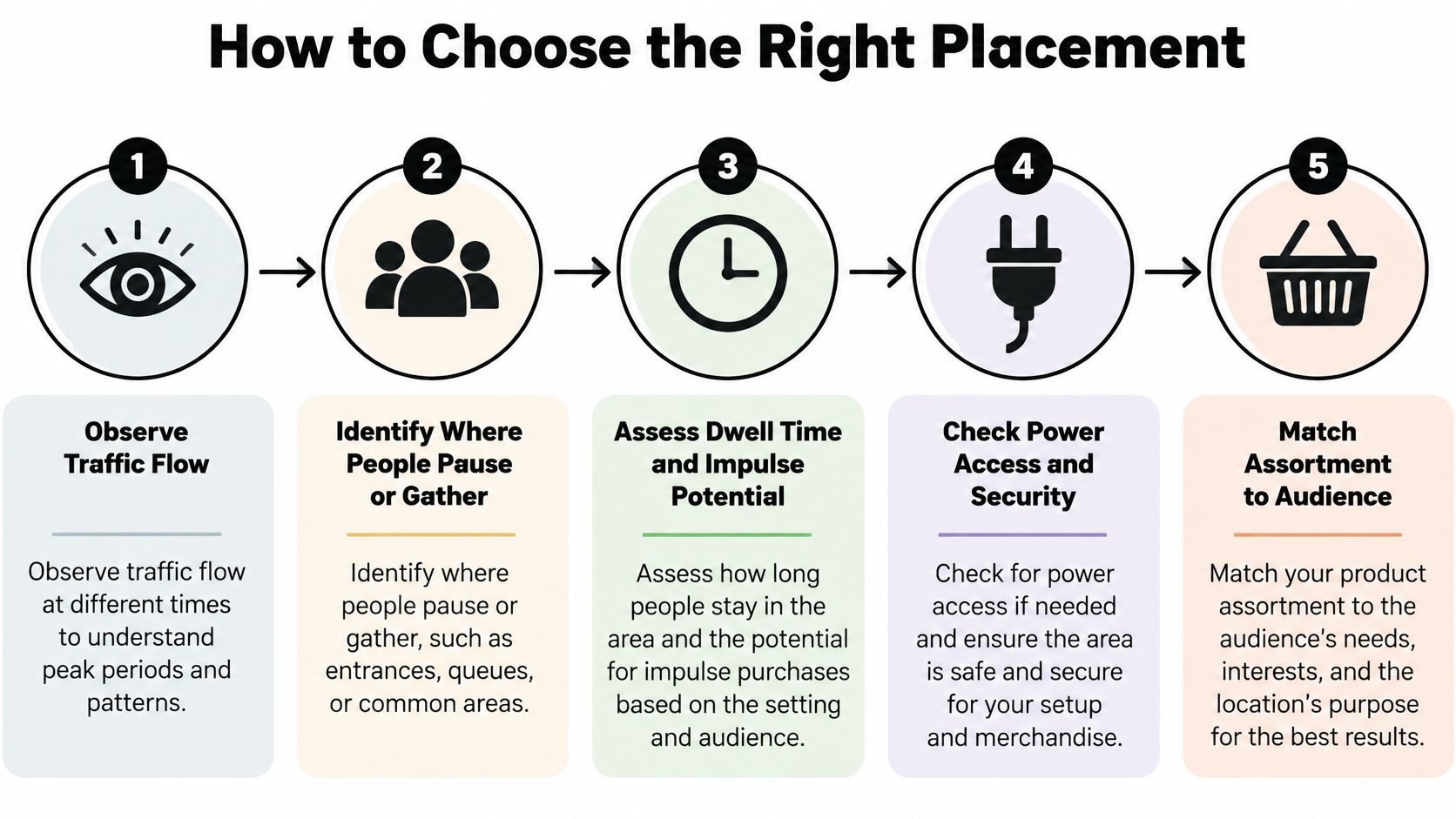
Start with observation, not an equipment catalog. Walk candidate spaces during ordinary activity, busy periods, and quieter operating hours. Record where people stop, what refreshments they already have, and what would make using a machine worthwhile.
Use this sequence to turn those observations into a placement decision.
Move from observation to approval
Define the service gap. Write down the intended audience and unmet need. “Refreshments after the cafeteria closes” is more useful than “a busy building.”
Check the exact footprint. Have the operator confirm electrical suitability, connectivity, ventilation, equipment clearance, and delivery access for the proposed model.
Match the format. Consider a compact combination machine where space is constrained, separate beverage capacity where drink demand warrants it, or chilled and frozen formats where the food-service plan supports them.
Assign ownership of tasks. Document installation, stocking, cleaning boundaries, maintenance, refunds, and the facility's service contact.
Validate after installation. Compare actual use with the original assumptions before expanding or changing equipment.
Agree on success before signing
Choose measures that reveal whether the service works: availability during intended hours, unresolved faults, product sell-through, waste, and user feedback. Agree on when the facility manager and operator will review those measures.
Discuss commercial terms alongside the service obligations. This overview of vending-machine placement fees can help frame the conversation without assuming every property needs the same arrangement.
Don't accept “we'll see how it goes” as the entire operating plan. A trial still needs clear responsibilities and a decision process for retaining, adjusting, or relocating the machine.
Build a Product Mix for Each Location
An assortment should answer a local need, not display the operator's entire wholesale catalog. Begin with familiar snack and beverage choices, then reserve room for products the site's users specifically request.
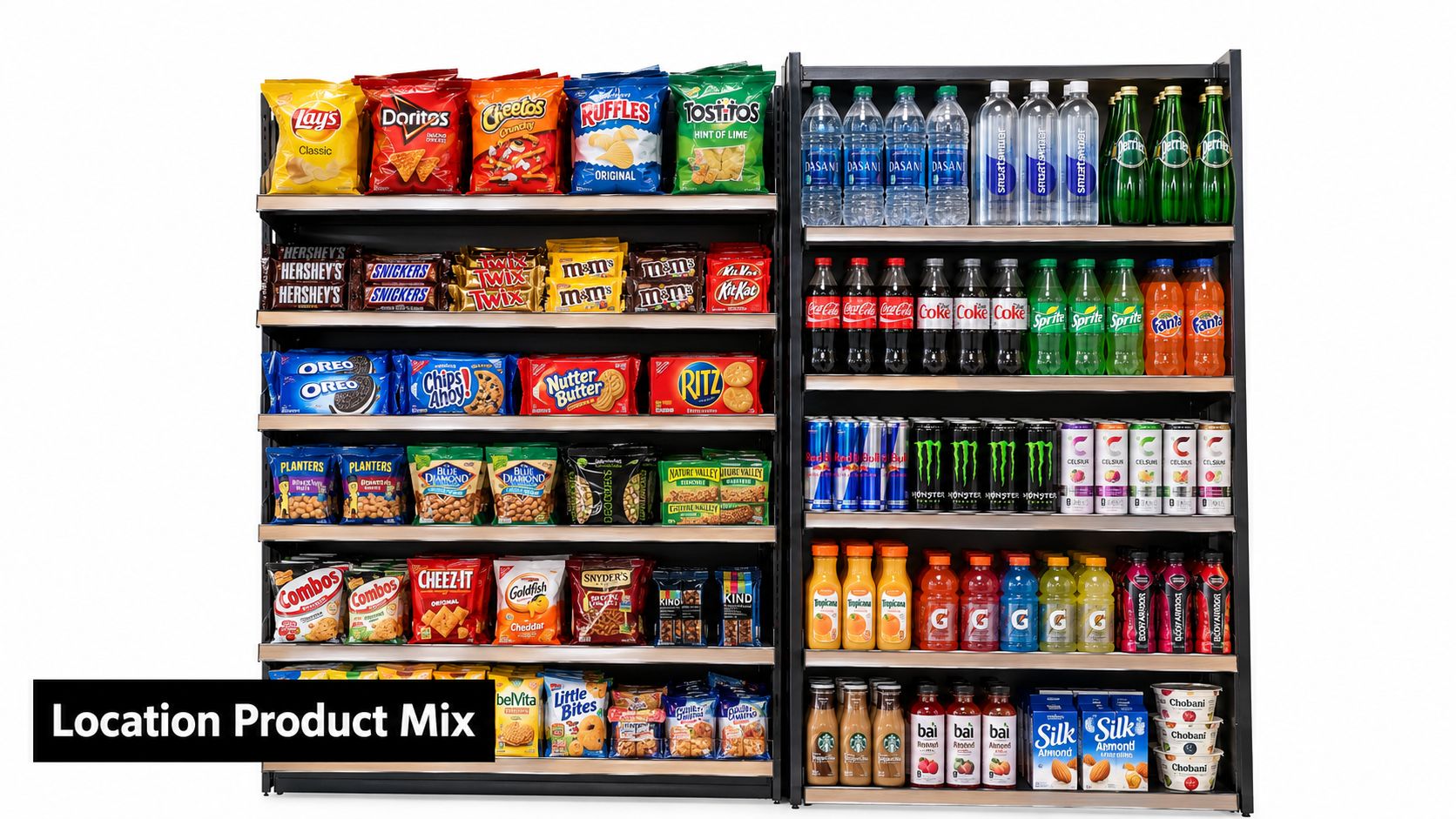
This display illustrates a conventional snack-and-drink selection, but your own mix should follow the audience.
Give each product a job
Decide whether an item serves a quick treat, hydration, a more substantial break, or a dietary preference. Meal-oriented and frozen products belong only where the equipment, handling process, and customer routine support them.
For an informal employee tasting, Gym Snack's resource on how to build a variety pack snack box can provide a starting point for organizing sample choices. Treat feedback as a candidate list, not proof that every requested item deserves permanent space.
Use a consistent method:
Establish a baseline: Record sales by slot, unavailable items, and discarded stock.
Test a focused change: Adjust a product, its position, its nutrition cue, or its price presentation without changing everything together.
Check continued interest: Look beyond launch curiosity to repeat demand and ongoing feedback.
Keep or revise: Retain useful changes and remove items that repeatedly expire or displace stronger choices.
The principles behind assortment planning help make those decisions deliberate.
Don't confuse variety with usefulness. A smaller selection that stays relevant and available is a better operating target than a crowded display full of products nobody repurchases.
Use Telemetry for Smarter Replenishment
A dashboard isn't a replenishment plan. The operator has to convert machine events into decisions about what to pack, where to go, and which faults require attention.
A peer-reviewed analysis of wireless telemetry in vending operations found that reliable real-time data can support demand-based provisioning, troubleshooting, supply optimization, and improved profitability, provided machine selection and data quality support effective use. Reliable is the important qualification.
Turn signals into action
Machine signal | Operational question | Recommended action |
|---|---|---|
Slot-level sales velocity | Will this item last until the next delivery? | Adjust its target stock |
Repeated stockouts | Is demand being underestimated? | Increase capacity or revise service timing |
Temperature alarm | Is the product still suitable for sale? | Follow the food-safety response procedure |
Payment failures | Is inventory available but purchasing blocked? | Investigate the terminal and connection |
Door or service alert | Was an expected service action completed? | Verify the event and resolve exceptions |
Set target stock around expected demand during the delivery interval plus a safety buffer. Adjust that buffer using observed shortages and spoilage rather than applying a universal stock level.
Keep a human verification loop
A predictable weekday pattern needs different handling from an event surge or a campus schedule change. Prioritize machines facing a projected shortage, but retain periodic physical counts and equipment checks.
Wireless outages, failed vend signals, payment reversals, and product substitutions can distort estimated inventory. Compare physical stock with recorded stock, investigate discrepancies, and correct the underlying process rather than merely resetting the count.
Operating discipline: An alert is useful only when someone owns the next action.
When comparing operators, ask how their telemetry data collection becomes a service queue. Request an example of the response process, not just a dashboard demonstration.
Balance Cashless Convenience and Access
Offer convenient digital payment, but don't assume digital-only is automatically appropriate. Apple Pay, Google Wallet, and contactless cards can simplify purchasing for equipped customers. They don't solve access for someone without a usable card, a charged phone, or a working connection.
The case for cashless acceptance is substantial. Cantaloupe's 2025 Micropayment Trends Report stated that cashless payments represented 71% of vending-machine sales in 2024, up 17% from the previous year, while contactless or mobile payments accounted for 77% of cashless vending sales.
Those figures support accepting digital payments. They don't establish that every customer at your property can use them.
Choose a payment policy for the audience
A school should examine access for minors. A hospital should consider visitors arriving unexpectedly. An airport should account for travelers whose available payment method may not work with the installed terminal.
Cash brings collection, reconciliation, and security work. Digital-only operation avoids some of that work but can leave willing customers unable to buy. Consider the benefits of contactless payments alongside the access requirements of the particular site.
Ask users directly: Find out which payment methods people can realistically use.
Investigate failed purchases: Review declines by location and gather reports of abandoned attempts. Don't assume terminal data captures every person who gave up.
Check operating conditions: Test the reader and connectivity at the installed position.
Set an alternative-access policy: Decide whether cash acceptance or another practical arrangement is needed, and explain it clearly.
Don't infer a customer's circumstances from a declined transaction. Use voluntary feedback and appropriate privacy safeguards when investigating access barriers.
Compare operators by their operating plan
Before choosing vending services, ask competing operators to put these commitments in writing:
Decision | What the operator should explain |
|---|---|
Placement and machine | Why the footprint and format fit the intended users |
Product selection | How feedback and purchasing patterns influence changes |
Payment access | Supported methods and the process for failed purchases |
Replenishment | How service timing responds to actual demand |
Verification | Physical counts, temperature checks, and data-quality review |
Support | Fault reporting, escalation, refunds, and responsibility |
Service model | What managed service or ownership leaves you responsible for |
Buy a workable service arrangement, not a list of features. An advanced machine still needs an operator who understands the site's access restrictions, food needs, and service windows.
The right choice is the machine whose location, products, payment access, and replenishment plan match a clearly understood site.
Vendmoore Enterprises offers Oklahoma facilities smart vending with Apple Pay and Google Wallet, custom assortments, connected telemetry, and managed-service or machine-ownership options across compact, chilled, dual-zone, and frozen formats. Visit Vendmoore Enterprises with your proposed location, operating hours, audience, and current refreshment gaps to discuss a machine and service plan that fit your building's routines.
Comments