_edited.png)
Vending Machines on Campus: A Practical Implementation Guide

A campus vending program often starts with a simple complaint: the dining hall closed, the nearest store is too far away, and the machine in the student center has nothing worth buying. Students want convenience, campus leaders want better food access, and facilities teams want equipment that doesn't create another maintenance problem. Operators who treat vending machines on campus as a small retail network, rather than isolated boxes, can satisfy all three groups.
The winning model combines location-specific assortments, reliable payment options, telemetry, student feedback, and clear operating agreements. It also creates a commercial opportunity beyond campus. A well-run program can support demand for break room vending and vending services among nearby offices, healthcare sites, apartments, and other Oklahoma organizations searching for a dependable local operator.
Planning a Campus Vending Program That Earns Its Space
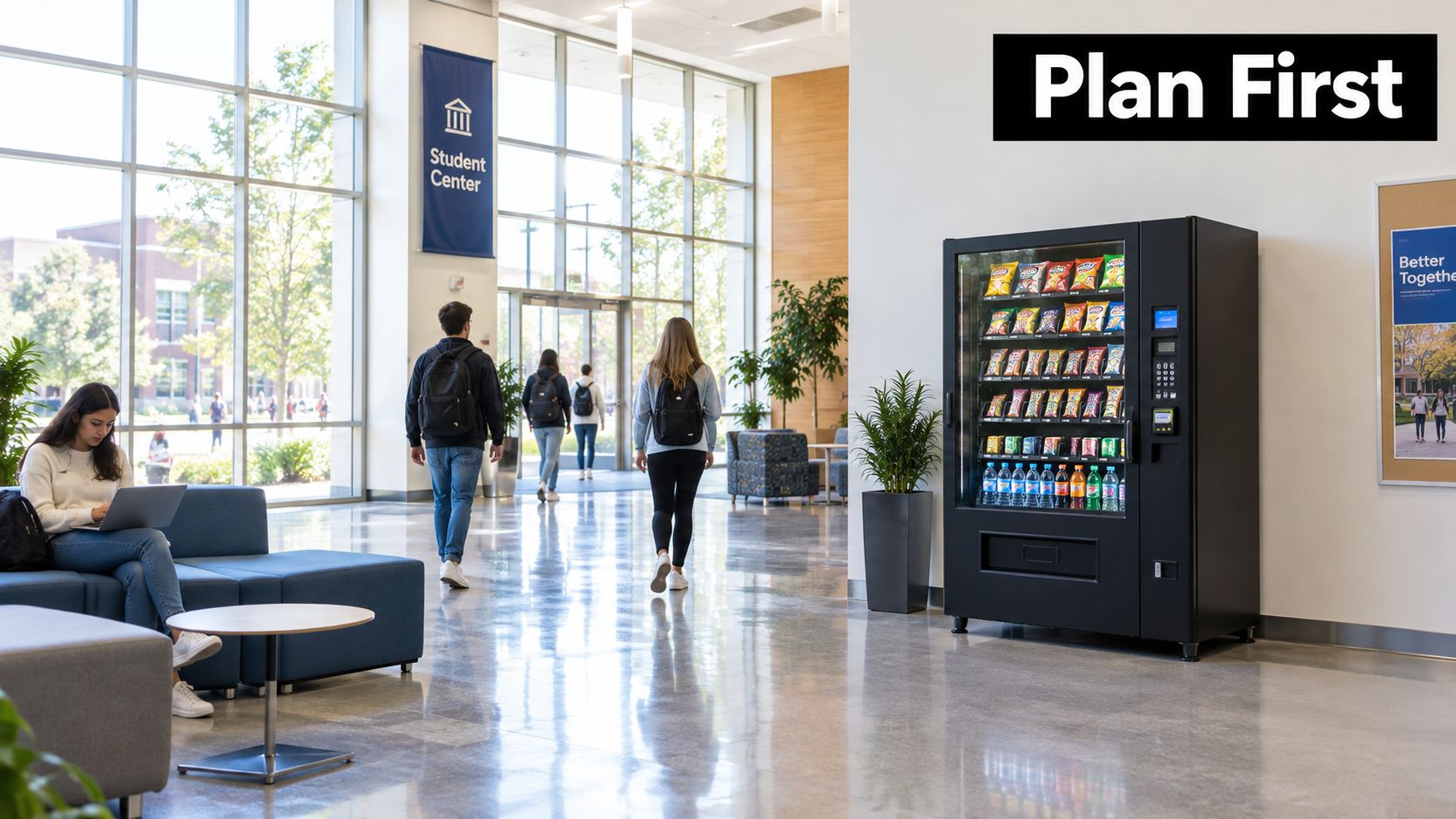
Buying equipment first is the fastest way to create an expensive placement problem. Start with a one-page program brief that states what the campus wants vending to accomplish, who will use it, where demand exists, and how the operator will prove performance.
Set the operating objectives
Separate the goals before anyone discusses machine models. A campus may want added convenience after dining hours, healthier choices, new revenue, better access for students with limited schedules, or a managed service for faculty and staff break rooms. Those goals can coexist, but they require different assortments, locations, reporting, and contract terms.
Program Goal | Primary Lever | Secondary Lever |
|---|---|---|
Convenience after dining hours | Residence hall and library placement | Late-night meal and snack assortment |
Revenue generation | High-velocity products and reliable uptime | Targeted promotions |
Wellness support | Clearly labeled healthier choices | Refrigerated and fresh-food testing |
Equity and access | Fair pricing and multiple payment methods | Accessible placement and feedback |
Operational reliability | Telemetry and defined service levels | Monthly performance reviews |
Build the campus case before placement talks
Map the decision-makers early. Dining services may control food policy, facilities may control power and space, student affairs may manage residence halls, information technology may approve network access, and student government may provide useful demand feedback. Include procurement, risk management, accessibility staff, and any auxiliary services that already manage campus retail.
The operator's brief should answer five questions:
Who buys: Separate residents, commuters, athletes, faculty, staff, visitors, and overnight workers.
Where demand occurs: List residence halls, academic buildings, libraries, recreation centers, student unions, and staff areas.
What success means: Define service uptime, product availability, customer feedback, and financial reporting.
Who pays and who benefits: Clarify commissions, fees, subsidies, and ownership of equipment.
What happens if assumptions fail: Include review dates, assortment changes, relocation rights, and exit terms.
A shared-space arrangement needs especially clear boundaries. If dining services already sells drinks or snacks, position vending as an extension of access rather than an attempt to replace the existing operation. The campus vending guidance for schools can help frame the discussion around service coverage, stocking, and support.
Practical rule: Never promise a campus-wide rollout before testing the specific buildings, audiences, and hours that will determine demand.
Matching Machine Formats to Campus Demand
The correct machine depends more on the building's behavior than on its available floor space. A residence hall needs different equipment from a gym, and a faculty break room shouldn't inherit the same planogram as a student union.
Compare formats by use case
Machine format | Best campus setting | Operating advantage | Main limitation |
|---|---|---|---|
Compact refreshment center | Small offices, study lounges, teacher areas | Small footprint for modest demand | Limited selection and capacity |
Bottle-and-can vendor | Recreation centers, outdoor walkways, athletic facilities | Fast access to chilled hydration | Less suitable for meals or mixed snacks |
Dual-zone chill center | Student unions, dining-adjacent spaces, busy lobbies | Combines drinks and snacks in one footprint | Requires careful temperature and assortment management |
Frozen food machine | Residence halls and round-the-clock study spaces | Supports meals and late-night demand | Needs stronger power planning and frozen inventory control |
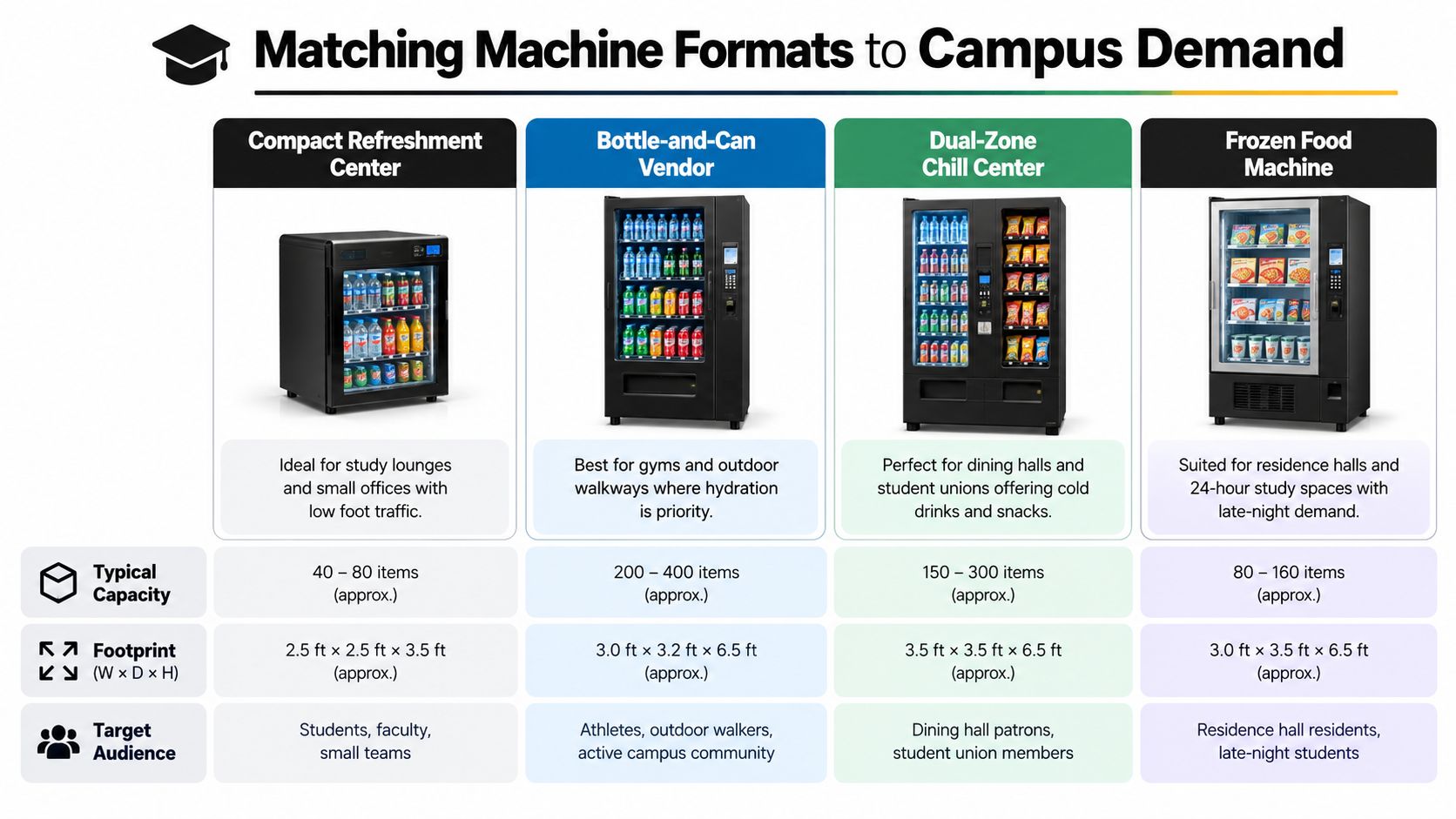
A compact refreshment center works when convenience matters but demand is modest. It fits a study lounge or faculty area where users want water, coffee, packaged snacks, and quick replenishment without dedicating a large corridor footprint.
A bottle-and-can machine earns its space in places where people arrive thirsty. Recreation centers, athletic facilities, and outdoor paths favor cold water, sports drinks, and other beverages. Keep the selection focused and make product visibility a priority.
A dual-zone chill center is the strongest choice for tight, busy locations that need both snacks and drinks. Its split-temperature design lets an operator serve chilled beverages alongside products requiring a different storage environment, making it useful in student unions and dining-adjacent spaces.
Frozen equipment belongs where students need something more substantial outside regular food-service hours. Residence halls and study spaces can support frozen meals, breakfast items, and culturally familiar foods, but only if the operator has dependable power, temperature monitoring, and a replenishment plan. The smart food vending machine overview offers additional context for choosing technology around the use case rather than treating every machine as interchangeable.
Building an Assortment Students Actually Buy
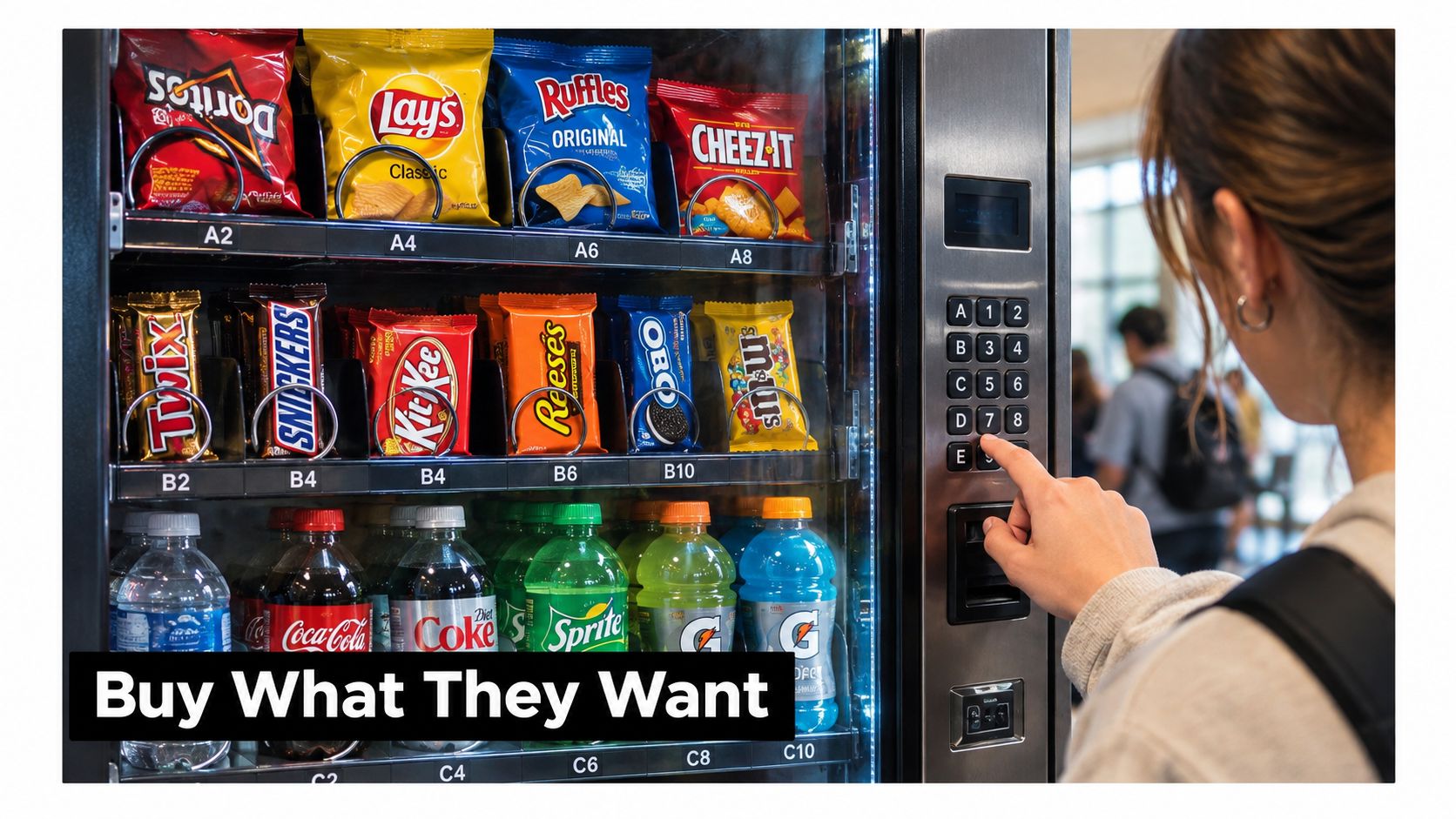
Assortment is where campus vending programs either become useful retail channels or turn into stale snack storage. Identical planograms across every building usually fail because students use a residence hall differently from a library, gym, or faculty break room.
A peer-reviewed campus study evaluated 12 machines across classrooms, residences, and offices over two weeks. It recorded 99 purchases, with residential machines averaging 15 purchases per machine, and purchasing peaked between 1:00 and 2:00 p.m., representing 40% of observed transactions. Those findings support a simple operating rule: use location and daypart data to decide what belongs in each machine, rather than copying one campus-wide assortment. The campus vending study provides the underlying research.
Keep convenience and choice in the same planogram
The same study found that only 6.3% of available vending items met its definition of healthy, while hunger was the most frequently reported purchase reason, cited by 61.3% of respondents. Students weren't necessarily shopping for a nutrition lecture. They were solving an immediate problem, often between classes or during a long study session.
That means healthier vending shouldn't mean removing every familiar high-velocity product. Build a layered assortment:
Core hydration: Water and other dependable beverages should anchor busy locations.
Fast energy: Include salty snacks, breakfast items, and convenient products students already recognize.
Better-choice options: Add nuts, whole-grain items, lower-sugar drinks, yogurt, fruit where refrigeration allows, and clearly labeled alternatives.
Substantial food: Use refrigerated or frozen meals in residence halls and late-night study sites.
Dietary coverage: Label allergens clearly and include vegetarian, vegan, gluten-aware, and culturally familiar choices where demand supports them.
Price needs equal attention. In the study, 60.4% of students said they would change their usual purchases if healthier options were available, and the same percentage said they would change purchases if prices changed. That makes pricing a merchandising decision, not an administrative detail. Test accessible options beside premium products, review complaints by building, and avoid making the healthier choice visibly unaffordable.
Rotate around the academic calendar. Welcome periods, examination weeks, athletic seasons, and holiday closures change demand. Use the product assortment optimization resource to structure tests, but let each machine's sales and feedback determine what stays.
Placing Machines Where Foot Traffic Already Lives
Placement is the cheapest performance lever in campus vending. A mediocre machine in a busy, comfortable location can outperform a better machine hidden near an unused corridor.
Score each candidate site
Walk every location at the same times students use it. Record visible traffic, dwell time, nearby food alternatives, power access, delivery access, lighting, security-camera sightlines, and whether the machine creates a corridor obstruction. Check accessibility with facilities staff before approval, not after installation.
Use a practical scorecard:
Criterion | Strong candidate |
|---|---|
Foot traffic | People naturally pass the machine |
Dwell time | Users wait, study, exercise, or gather nearby |
Need gap | Dining options are closed, distant, or limited |
Visibility | Students can see the machine without searching |
Power and service | Technicians can reach it without disrupting operations |
Accessibility | Clear approach, usable controls, and no blocked route |
Security | Placement supports visibility and safe transactions |
Residence halls are strong for late-night snacks, frozen meals, and personal care products because students already live nearby. Libraries benefit from quiet, compact formats with water, coffee, packaged snacks, and study-friendly meals. Recreation centers need hydration first, followed by products aligned with workouts. Academic buildings and faculty areas often perform better with compact refreshment centers than with oversized machines built for residential demand.
A placement meeting should end with a service path, an electrical confirmation, an accessibility check, and a named campus contact.
Facilities teams also care about sightlines and clutter. Keep machines away from fire equipment, narrow egress routes, camera blind spots, and doors that need full clearance. For a broader framework on matching messages and offers to physical locations, the Splash Access location marketing guide is a useful complementary resource.
Document the approved footprint, delivery window, contact process, and relocation rules in the venue agreement. The venue setup guidance can support that conversation and reduce the chance that placement details remain informal.
Designing a Payments Mix That Never Excludes a Student
Cashless payments make vending faster, but cashless-only vending creates avoidable access problems. A campus serves students with phones, student accounts, bank cards, cash, and occasionally no working payment device at all.
Compare the payment rails
Payment method | Speed | Strength | Friction to manage |
|---|---|---|---|
Apple Pay and Google Wallet | Fast tap-to-pay | Convenient for phone users | Dead batteries, device settings, wallet issues |
Student ID integration | Fast account-based purchase | Connects with campus accounts | Requires campus-system integration and reconciliation |
Credit and debit cards | Familiar and broadly accepted | Works for visitors and staff | Terminal fees, declines, and refund handling |
Cash | Direct and independent of accounts | Includes users without cards or phones | Cash handling, change, security, and service burden |
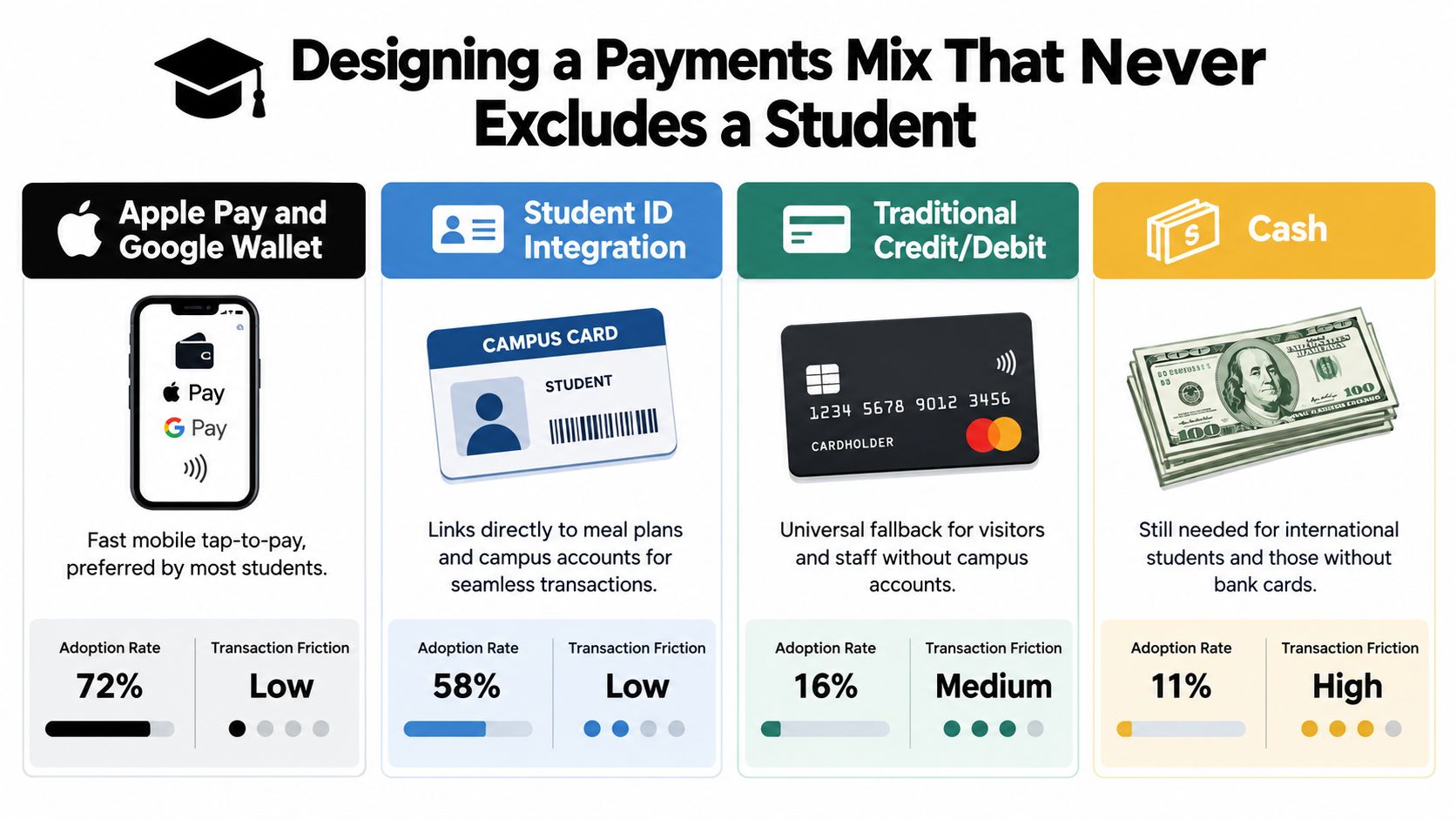
Mobile wallets should be standard where connectivity and terminals support them. They reduce friction for students who already use Apple Pay or Google Wallet, but they shouldn't be the only route. A phone can be dead, a wallet can be locked, or a user may not have a compatible bank account.
Student ID integration is valuable when the campus wants purchases connected to meal plans or auxiliary accounts. It also introduces administrative work. Define who owns refunds, how failed transactions are investigated, how funds are reconciled, and which department receives reports.
Traditional credit and debit terminals cover visitors, staff, commuters, and students who don't use campus accounts. Keep the refund process visible and train the service team to distinguish a declined transaction from a failed vend.
Cash still deserves an explicit decision. A campus can choose a cash-capable machine, a cash alternative elsewhere, or a documented reason for going cashless. Don't treat exclusion as a technology feature. Ask student affairs and accessibility staff to review the payment mix before launch, then monitor complaints and failed transactions by location.
Turning Telemetry Into a Restock Rhythm
A smart machine is only useful when its data changes an operating decision. Door sensors, vend counts, cashless reports, temperature alerts, and stockout notifications should tell the route team what to refill, when to refill it, and why the planogram needs adjustment.
Capture the right signals
Start with item-level sales and stock data. A total revenue number won't tell you whether water sold through, a frozen meal expired, or a popular snack disappeared because the spiral failed. Connect each SKU to its machine, location, product class, and replenishment history.
The operating protocol is straightforward:
Segment demand: Review building type, daypart, semester period, and product category.
Calculate velocity: Use observed daily movement for each item and machine.
Set reorder points: Combine velocity with supplier lead time and safety stock.
Investigate exceptions: Review repeated stockouts, failed vends, temperature warnings, and expirations.
Adjust the planogram: Replace weak items, expand proven categories, and test one change at a time.
Review monthly: Combine dashboard trends with student comments and facilities feedback.
A reorder point isn't a universal number. A residence hall with late-night demand may need a different threshold from an academic building that peaks during office hours. Likewise, a slow-selling refrigerated product may deserve a smaller test rather than automatic removal if it serves a dietary need or fills an access gap.
Operator discipline: Every repeated stockout should produce a decision. Increase the par level, change the delivery rhythm, move the product, or replace it.
Use fill rate, stockout frequency, spoilage, transaction success, repeat purchasing, and user feedback alongside revenue. For health-oriented machines, track access and time-to-replenishment as well. The telemetry data collection guide helps connect the technology layer to route and assortment decisions.
Monthly reviews should include students and campus facilities, not just the operator. A short feedback form can identify products missing from the machine, payment failures, confusing labels, and locations that feel inconvenient or unsafe. That feedback becomes the next planogram input.
Contracts, Engagement, and Local SEO That Keep the Program Growing
A campus vending contract should protect service quality without locking either party into a bad site or stale assortment. The commercial model needs to match the campus's tolerance for ownership, oversight, and financial variability.
Choose the contract structure deliberately
Contract Type | Operator Risk | Campus Risk | Best Fit |
|---|---|---|---|
Commission | Higher demand and inventory exposure | Lower operational burden | Campuses wanting managed service tied to performance |
Flat fee | Predictable operator economics | Less direct financial upside | Stable locations with clear space value |
Hybrid | Shared exposure | Shared financial structure | Campuses wanting predictable support plus performance alignment |
Include defined stocking expectations, response procedures, equipment ownership, insurance, data access, product standards, accessibility responsibilities, and termination terms. Limit exclusivity to the actual service need. A campus shouldn't give up flexibility across every food category just because one operator manages a particular building.
For teams reviewing language, a practical guide to AI contract drafting for law can help organize clauses and questions before counsel completes the agreement. It isn't a substitute for legal review, especially where campus procurement, public funds, privacy, or student accounts are involved.
Turn students into useful participants
Promotion works best when it supports operations. Use digital signage to highlight new products, run prize promotions tied to feedback, host sampling during welcome activities, and ask students to vote between carefully selected test items. Keep the promotion simple enough to execute and measure.
The operator should publish service details for both campus decision-makers and nearby commercial buyers. Create dedicated pages for campus vending, break-room vending, smart vending machines, office snack delivery, and vending services in Oklahoma City, Norman, Edmond, and surrounding communities. Each page should explain the service, machine formats, payment options, stocking model, and the types of facilities served.
Google says local visibility depends primarily on relevance, distance, and prominence, with prominence influenced by information across the web, including links, articles, directories, review count, and review score. That supports specific service and location pages instead of relying on one generic homepage. A campus operator that also wants break room vending leads should make those pages useful to office managers, property managers, healthcare administrators, and facilities directors.
Reviews are another operating channel. BrightLocal's 2025 Local Consumer Review Survey, based on a representative panel of 1,026 U.S. adults, found that 96% were open to writing a business review. It also reported that 89% would use a business that responds to all reviews, compared with 44% who would use a business that doesn't respond to reviews at all. Request feedback after installations, service recoveries, assortment reviews, and successful campus launches, then respond to every review with specific language about reliability, product variety, and service areas. Google's local ranking guidance and the BrightLocal review survey provide the relevant local-search context.
Vendmoore Enterprises offers managed vending programs and machine-ownership options, with cashless payments including Apple Pay and Google Wallet, connected inventory insights, location-specific assortments, and service across Oklahoma City, Norman, Edmond, and surrounding communities.
Vendmoore Enterprises can help you plan, install, stock, and monitor vending machines on campus, in break rooms, and across other shared facilities. Visit Vendmoore Enterprises to discuss a location-specific assortment, payment mix, telemetry plan, and service model for your organization.
Comments