_edited.png)
Tea Vending Machines for Modern Break Rooms

The break room is busy, but the beverage options haven't changed in years. An aging coffee pot sits beside a snack machine with limited choices, employees bring drinks from home, and visitors leave the building to find something better. For facility managers, tea vending machines offer a practical way to improve that experience without building a cafeteria or adding another daily task to the facilities team.
Modern vending is no longer just a coin-operated box. Connected telemetry, cashless payments, recipe controls, and managed replenishment turn a hot or chilled tea station into a measurable workplace amenity. The right program can fit an office, clinic, school, factory, airport, or public venue while giving operators visibility into stock, sales, faults, and customer preferences.
The Evolution of the Workplace Break Room
A break room often reveals how an organization treats everyday employee needs. In one office, the refrigerator may be clean and well stocked, but the only hot beverage option is a shared kettle and a jar of tea bags. In another, a snack machine is available, yet it doesn't offer a satisfying drink for someone who wants green tea, black tea, or a chilled ready-to-drink option. Employees solve the problem themselves by bringing drinks from home or walking off-site.
That gap matters because breaks happen where people work. A 2024 peer-reviewed study of workplace food environments found that 61.0% of surveyed employees spent lunch in a common break room, while 66.0% brought lunch from home (peer-reviewed workplace food environment study). The same study reported that most small and medium-sized enterprises lacked a worksite cafeteria, vending machines, or other food provisions. A managed tea vending program can serve that existing break-room habit without requiring a full food-service buildout.
From basic refreshment to workplace amenity
A dedicated hot beverage station changes the room's function. Employees can select a drink, pay quickly, and return to work without leaving the property. In healthcare facilities, the machine can serve staff and visitors in designated areas. In schools and colleges, the product mix can be adjusted for the audience and site rules. In manufacturing environments, a dependable machine near the break area can serve shift workers who can't easily leave the premises.
The equipment doesn't need to be extravagant. What matters is reliable availability, suitable drink selection, clean surroundings, and responsive service. A compact machine may suit a small office, while a larger facility may need separate hot and chilled options. Facility managers should also consider the condition of the surrounding break room. A clean machine placed in a neglected area won't create trust, so a practical Gmaids office cleaning service resource can help teams think about the broader relationship between equipment hygiene and room maintenance.
Practical rule: Treat the break room as an employee service point, not merely a place to park a vending machine.
The Japanese market shows why packaged tea became suitable for this model. Vending machines expanded from approximately 240,000 in 1964 to 1 million in 1970, exceeded 2 million in 1973, and passed 5 million in 1984 (history of Japan's vending-machine revolution). Kirin introduced bottled black tea through Gogo no Kocha in 1986, while ITO EN first marketed bottled green tea in 1989. That shift moved tea from a beverage prepared with hot water into a portable product suited to workplaces, transport hubs, schools, hospitals, and public spaces.
For managers planning an upgrade, the practical question isn't whether tea belongs in a break room. It's whether the current setup supports the way employees already take breaks. A useful framework for improving that environment is available in this guide to the break room experience.
How Smart Tea Vending Machines Actually Work
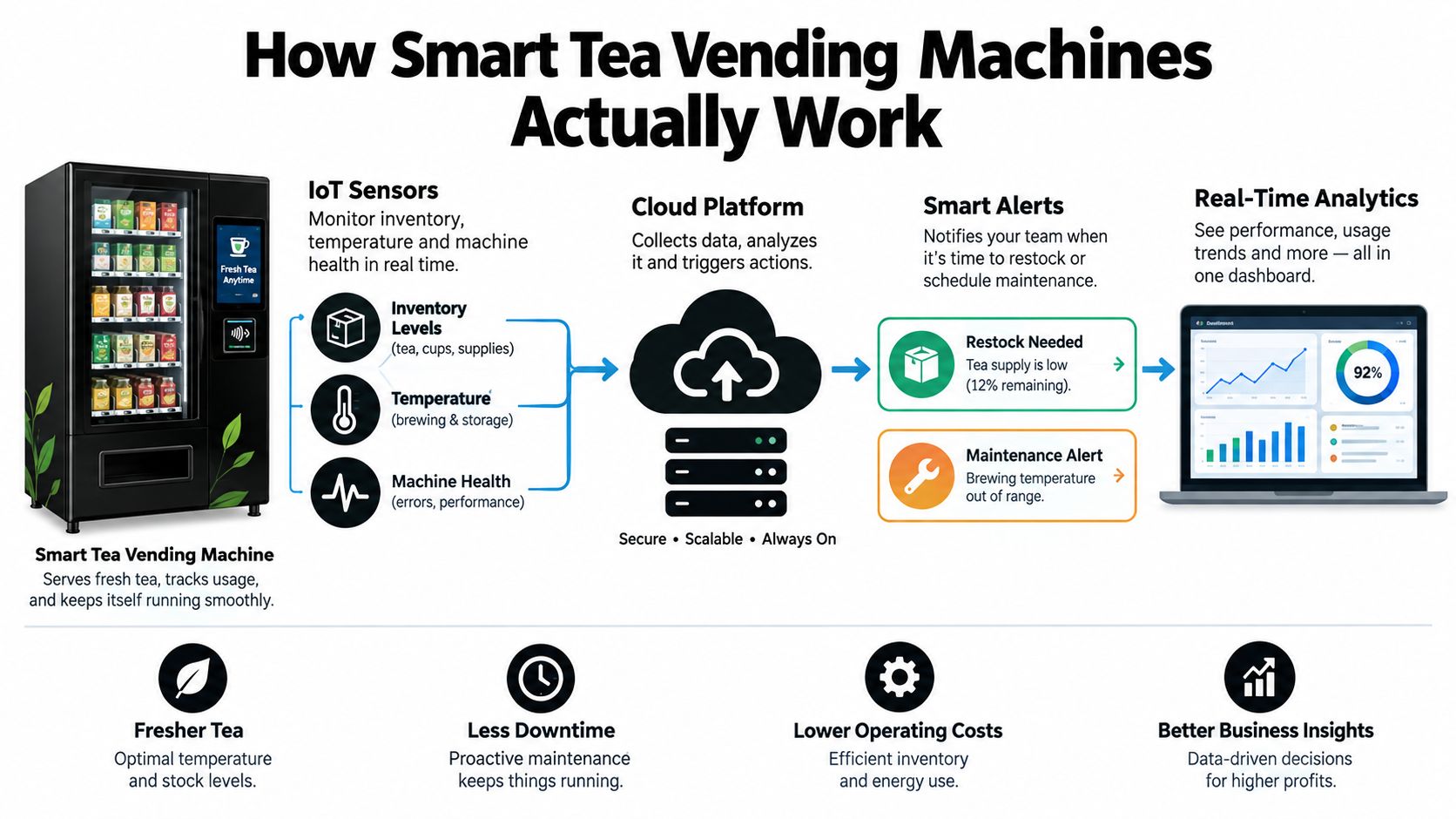
A smart tea vending machine combines four operating layers: the beverage system, payment hardware, connected sensors, and a service platform. The customer sees a touchscreen or selection panel, but the operator sees inventory levels, sales activity, temperature readings, fault alerts, and service history.
The machine may track ingredient hoppers, cup supplies, water conditions, refrigeration, door access, and dispensing events. That information travels through a connected platform, where the operator can identify a low ingredient level or repeated fault before a facility manager reports an empty selection. The result isn't a completely self-managing appliance. It is a machine that gives a service team better information so people can manage it more accurately.
What telemetry changes for operators
An offline machine forces a route driver or facility employee to inspect it manually. That approach can miss a fast-selling item, a payment fault, or a machine that has stopped dispensing. Telemetry supports more targeted decisions:
Inventory visibility: Operators can see which ingredients, bottles, cans, cups, or lids need attention.
Fault detection: Temperature, payment, door, and dispensing alerts can support earlier intervention.
Assortment decisions: Sales patterns and employee feedback help operators remove unpopular options and add products people request.
Route planning: Service teams can group replenishment and maintenance work more efficiently instead of relying only on fixed inspection schedules.
A good operator still reviews the data instead of blindly following alerts. A low ingredient reading might reflect a sensor issue, while a sudden sales spike may justify a temporary assortment change. The platform improves judgment, but it doesn't replace it.
Payments are part of the experience
Cashless readers support contactless cards and mobile wallets such as Apple Pay and Google Wallet. That matters in a break room, where employees may not carry coins and may want to complete a purchase during a short pause. Payment reliability also affects trust. A machine that displays a preferred drink but rejects the transaction creates more frustration than an older machine with fewer options.
The operating model is explained clearly in this guide to how smart vending machines work. Facility managers should ask whether the proposed system provides access to transaction reporting, outage alerts, inventory data, and service records, rather than accepting “smart” as a vague product label.
The connected machine should also support feedback. If employees consistently select chilled iced tea over a slower-moving hot option, the operator can adjust the assortment. That is the difference between installing equipment and running a managed refreshment program.
A short demonstration can make the workflow easier to understand:
Comparing Machine Types and Venue Applications
The correct machine depends on traffic, space, beverage expectations, and who will handle servicing. A compact countertop unit may work well in a small office with moderate demand, but it won't suit a stadium concourse or a manufacturing site with concentrated shift breaks. Conversely, a high-capacity system can create unnecessary cost and maintenance work in a quiet administrative suite.
Fresh-brew systems prepare tea from water and ingredients inside the machine. They can offer a more prepared-to-order experience, but they require careful cleaning, ingredient control, recipe management, and water-heating verification. Concentrate systems simplify some preparation steps and can support consistent recipes, though operators must manage concentrate storage, dosing, and product rotation.
Ready-to-drink bottled tea uses a chilled vending format rather than an in-machine brewing process. That reduces hot-water and brew-path maintenance, but it shifts attention to refrigeration, stock rotation, bottle presentation, and replenishment. For a facility that wants quick service with minimal beverage preparation, a chilled tea cooler may be the more practical choice.
Match the format to the site
A corporate office may benefit from a compact hot beverage unit near the main break room, supplemented by chilled bottled tea. A university or hospital may need multiple points of service, clear product labeling, and strong replenishment routines. Manufacturing sites often need durable equipment, simple selection flows, and service coverage that accounts for shift patterns. Airports and stadiums usually prioritize throughput, payment speed, and bottle-and-can capacity.
Machine Format | Ideal Venue | Primary Maintenance Focus |
|---|---|---|
Fresh-brew hot tea machine | Offices, clinics, schools, and staff break rooms | Water quality, brew paths, temperature verification, cleaning, and ingredient dating |
Concentrate dispenser | Facilities seeking recipe consistency and broad drink choices | Concentrate rotation, dosing accuracy, tubing, and sanitation |
Ready-to-drink tea cooler | Offices, apartments, public spaces, and reception areas | Refrigeration, stock rotation, shelf presentation, and payment hardware |
Bottle-and-can vendor | Airports, stadiums, campuses, and high-traffic corridors | Cooling performance, product loading, payment uptime, and fast replenishment |
Compact countertop refreshment center | Smaller offices and controlled-access workplaces | Counter cleanliness, supply levels, cup and lid availability, and routine servicing |
Dual-zone chill center | Larger facilities with varied chilled product needs | Temperature separation, stock organization, door seals, and telemetry alerts |
The machine's footprint is only one part of the decision. Look at the shape of demand. A location with light traffic throughout the day may need less capacity than a factory where most purchases occur during short, predictable breaks. A machine with lower theoretical capacity can outperform a larger unit if the operator stocks it correctly and responds quickly to demand changes.
A practical comparison of temperature-controlled formats appears in this guide to hot and cold vending machines. Use it alongside a site walk, not as a substitute for one. Measure available power, floor space, access routes, cleaning access, customer flow, and the distance between the machine and the nearest service point.
Hygiene Engineering and Temperature Safety Controls
A modern interface, contactless reader, and remote dashboard don't make a tea vending machine safe by themselves. Hot beverage equipment combines water, heat, food-contact components, ingredients, cups, lids, and frequent public handling. Schools, hospitals, and workplaces need documented controls that staff can verify.
For water-based tea preparation, EN 16889 specifies that water used for hot-beverage preparation should reach at least 65 °C during production (EN 16889 requirements for hot-beverage preparation). This threshold supports hygienic preparation, but it doesn't mean every tea should use the same brewing temperature. Green tea generally calls for a lower brew temperature than black tea, so commercial equipment should use programmable profiles or recipe-specific settings.
The outlet is the point that matters to the customer. Heat can fall through tubing, valves, and idle sections between the boiler and the cup. Operators should verify the dispensing temperature, maintain calibration records, and perform periodic flow-rate checks rather than relying only on the boiler display.
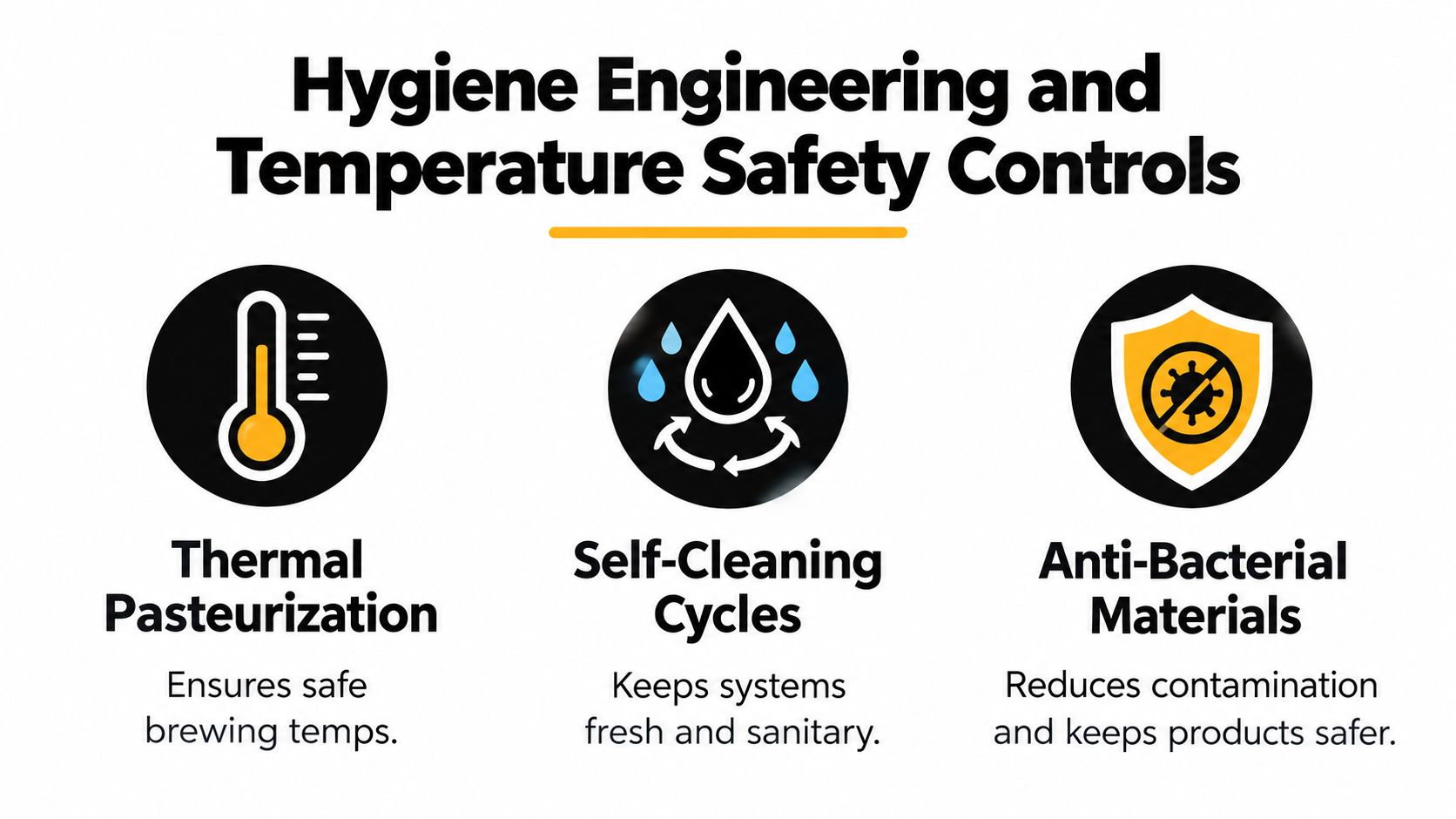
Controls buyers should require
Commercial vending equipment should be specified as a regulated dispensing appliance, not as an ordinary countertop kettle. IEC 60335-2-75:2024 covers commercial dispensing appliances and vending machines that prepare or deliver food and drinks, including equipment rated up to 250 V for single-phase systems and up to 480 V for other systems (IEC 60335-2-75:2024 commercial dispensing appliance standard).
A buyer's checklist should include:
Electrical protection: Require documented conformity to the applicable standard, heater protection, insulation controls, and independent over-temperature cutoffs.
Food-contact materials: Ask for declarations covering water- and beverage-contact parts, with assurance that components won't transfer harmful constituents into food.
Water management: Establish who tests the water, how filters are changed, and how water-quality records are retained.
Cleaning records: Define cleaning frequency, sanitation checks, failed-cycle procedures, and staff accountability.
Scale control: Set a preventive descaling schedule because mineral buildup can change heating time, flow, dose, and energy use.
Ingredient control: Date ingredients, separate allergen-containing products where relevant, and make selections and labels clear.
Cup and lid safety: Check that dispensing protects the user's hands and that cups and lids remain covered and protected from contamination.
The machine can report a fault, but only a documented procedure proves that someone responded to it.
Telemetry should flag abnormal heating time or dispensing volume before customers complain. It can't verify every sanitation task, inspect every food-contact surface, or replace trained service staff. That distinction separates a professional vending service from a technically impressive machine with weak operating discipline.
The Financial Impact of Cashless and Connected Systems
Cashless technology changes more than the payment screen. It affects whether customers complete a purchase, how operators collect transaction information, and how service teams decide where to spend time.
Cantaloupe data cited by Vending Times reported that 71% of vending transactions were cashless in 2024, and 77% of those cashless transactions were contactless (Vending Times analysis of mobile payments in vending). The same report stated that phone- or smartwatch-based transactions increased 300% year over year, while the average cashless vending purchase was $2.24, compared with $1.78 for a cash purchase, a 37% difference. For tea vending, contactless cards and mobile wallets remove a practical barrier for employees who don't carry cash.
A separate 2025 William Blair analysis citing Berg Insight estimated that 44% of vending machines, approximately 6.5 million units, were connected in 2023, and projected connected-machine penetration to reach 71%, or about 11.4 million units, by 2028 (William Blair unattended-retail analysis). That projection is not a guarantee for any individual location, but it shows the direction of unattended retail infrastructure.
Where the operating return comes from
The clearest financial benefit often comes from preventing avoidable work. If an operator knows that bottled tea is nearly depleted, a replenishment visit can be planned around other service tasks. If a machine reports a payment fault, the technician can arrive with the right replacement part instead of discovering the issue during an unrelated inspection.
Connected data can support:
Fewer stockouts: Replenishment follows observed demand rather than a fixed assumption.
Better route density: Technicians can combine product loading, cleaning, and repairs on purposeful visits.
Lower cash handling exposure: Cashless systems reduce collection and reconciliation work.
More defensible subsidies: Employers can review usage when they fund or partially subsidize drinks.
Smarter promotions: Operators can test a seasonal tea selection or a monthly prize promotion and review participation.
The financial case still depends on local demand, pricing, service costs, equipment terms, and product margins. Managers shouldn't accept generic promises about return on investment. They should request transaction reporting, service-level commitments, and a clear explanation of which labor the operator will perform.
A balanced review of payment options, including their limitations, is available in this guide to cashless payment pros and cons. The strongest proposal connects payment convenience to measurable operating improvements rather than treating a cashless reader as a decorative upgrade.
Choosing Between Managed Services and Equipment Ownership
The procurement decision starts with a simple question: who will own the daily work after installation?
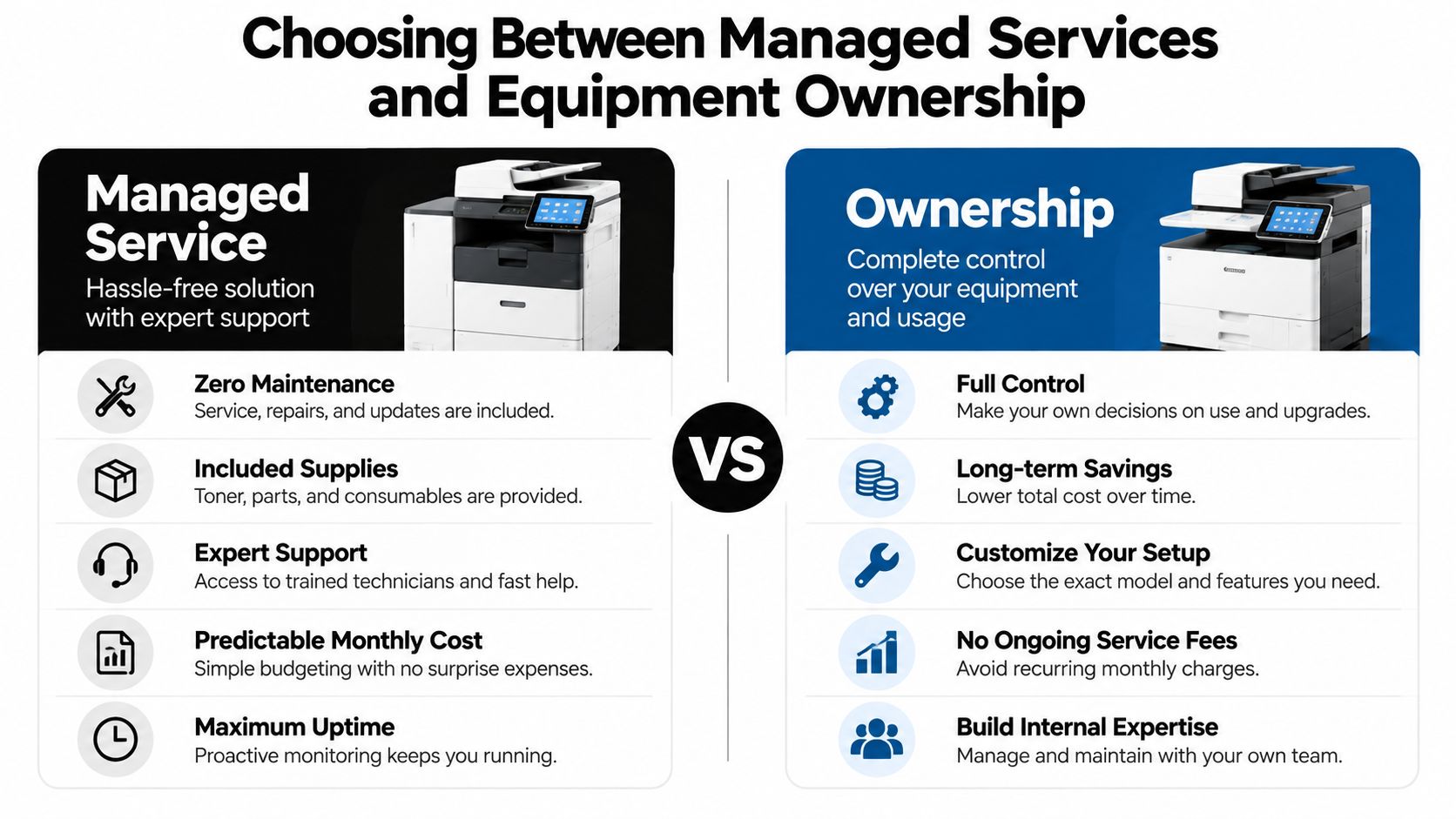
With equipment ownership, the facility usually controls the machine, product selection, pricing, and schedule. That control can suit an organization with maintenance staff, procurement capacity, and a clear plan for ingredients and service. It also means the facility carries responsibility for capital expenditure, repairs, sanitation, consumables, payment hardware, software updates, and downtime.
A managed vending service transfers much of that operational burden to an operator. The provider may install the equipment, stock products, monitor telemetry, process service requests, clean the machine, and adjust the assortment. The facility still needs to approve placement, access, policies, and escalation contacts, but it doesn't have to build a vending operation internally.
Use the decision matrix
Choose ownership when the facility has a capable technical team, wants full control over product sourcing, and can document cleaning, replenishment, and repair work. Ownership can make sense when the site has stable demand and the buyer accepts the responsibility for keeping the machine productive.
Choose a managed model when the facility wants a turnkey amenity, lacks vending-specific maintenance capacity, or operates across multiple sites. A local operator can also respond more effectively when the machine needs attention between planned visits. The hidden cost of ownership isn't only the repair invoice. It's the employee time spent checking stock, the lost confidence after repeated outages, and the opportunity cost of sending facilities staff to solve beverage problems.
Ask each provider to state clearly:
Who supplies ingredients and packaged drinks?
Who performs routine cleaning and descaling?
Who owns the payment account and handles transaction disputes?
What telemetry does the facility receive?
What happens after a stockout or service alert?
Which repairs are included, and which create additional charges?
How are product choices changed when employee preferences shift?
What service-level agreement covers response times and uptime expectations?
For broader workplace planning, a practical Freeform House office guide can help facilities teams think about amenities as part of the overall managed environment, rather than as isolated equipment purchases.
The best model depends on operational bandwidth, not just purchase price. A machine that costs less to acquire can become expensive if nobody owns the replenishment schedule, sanitation records, payment faults, or technician response.
Building a Better Vending Experience for Your Facility
A successful tea vending program combines three things that buyers often evaluate separately: equipment capability, operating discipline, and service responsiveness. The machine needs suitable capacity and beverage options, but it also needs reliable payments, documented hygiene controls, accurate replenishment, and a clear path for resolving faults.
Start with the site rather than a catalog. Identify who uses the space, when demand peaks, whether customers want hot tea, chilled bottled tea, or both, and where the machine can sit without blocking access. Include power, water, drainage, ventilation, cleaning access, lighting, accessibility, and visibility in the site review. An accessibility resource such as this guidance on ADA compliance for your Jenks business can help teams remember that convenient placement must also support users with different mobility needs.
Evaluate the proposal, not just the machine
A credible vending proposal should answer practical questions:
Payment flexibility: Does the reader accept contactless cards and mobile wallets?
Product fit: Can the assortment include hot tea, iced tea, bottled tea, and alternatives suited to the site?
Service ownership: Who stocks, cleans, repairs, and verifies temperatures?
Data access: Can the operator provide inventory, sales, and fault reporting?
Safety documentation: Are materials, electrical conformity, sanitation checks, and maintenance procedures documented?
Response expectations: Does the agreement explain what happens during a stockout, outage, or failed cleaning cycle?
Feedback process: Can employees or visitors request changes to the selection?
The machine should become more useful over time. Sales data can identify slow products, while direct feedback can reveal why a selection underperforms. A facility manager may learn that employees want more chilled tea during summer, smaller servings during late shifts, or a different balance between familiar black tea and green tea. The operator's job is to turn those observations into controlled assortment changes, not random substitutions.
The feature set described in this overview of vending machine features should be evaluated against the actual needs of the location. A dual-zone chill center may be unnecessary for a small office, while a compact machine may underperform in a hospital lobby or airport corridor.
Vendmoore Enterprises provides customizable vending programs with cashless payments, connected inventory monitoring, replenishment, and beverage assortments that can include iced tea and ready-to-drink options. The company serves workplaces and public spaces in the Oklahoma City metro, Norman, Edmond, and surrounding areas, with both managed programs and equipment options for clients who prefer ownership.
A tea vending machine is only the visible part of the service. The core value comes from keeping the selection available, the equipment clean, the payments simple, and the response process accountable.
If your Oklahoma workplace, school, healthcare facility, factory, or public venue needs a better break-room refreshment program, Vendmoore Enterprises can help match tea vending, cashless payment, telemetry, and replenishment to the way your site operates. Visit the team to discuss a managed service or equipment option built around your space, users, and service requirements.
Comments