
Vendor Managed Inventory Meaning: A Plain-English Guide

Walk into almost any office break room on a Friday afternoon and the older system fails in real time. The machine is down to two warm bottles and a flavor nobody wants. Somebody has to notice the gap, find a phone number, and hope a delivery lands before Monday.
Vendor managed inventory removes that noticing and deciding step. The delivery still has to arrive, the machine still has to work, and payment still has to clear. The change is who watches the numbers and who is responsible for acting before the shelf goes empty. The arrangement works like a building thermostat run by a service company: the site sets the comfort range, the contractor watches the readings and responds.
That is the core of vendor managed inventory meaning: replenishment responsibility moves to the supplier, within limits both sides accept. It is often confused with consignment. The difference is risk: consignment can leave ownership with the supplier until an item sells, while VMI describes who controls restocking. A well-run program makes that boundary explicit, because availability improves only when the supplier has usable stock data and the site knows which gaps remain its own.
Vendor Managed Inventory Explained in Plain English
Vendor managed inventory is a supply arrangement in which the supplier watches the customer's stock data and decides when and how much to replenish, inside performance targets both sides agreed to. A peer-reviewed review of the vendor managed inventory model defines it as a planning and control approach where the vendor gets access to the customer's inventory information and takes responsibility for maintaining agreed stock levels, with replenishment typically handled through regularly scheduled reviews of what's on site.
The approach became prominent in the late 1980s through retailer and supplier collaboration, most visibly between Walmart and Procter & Gamble. What changed was who did the work. Under the old arrangement the customer forecast demand, placed orders and waited for delivery. Under VMI the supplier reads near-real-time sales or stock data and coordinates the restocking itself. A documented comparison of the Walmart and Procter & Gamble diaper supply chain shows the effect: the share of brand categories running a 10% out-of-stock rate fell from 20% to 7%, while the share holding out-of-stocks below 5% climbed from 43% to 60%.
Now shrink that down to one building. The break room machine empties, nobody reorders, and the room goes without until someone complains loudly enough. Under VMI the machine reports its own condition and the operator acts on it, whether or not anyone at the site notices.
Think of a serviced office building where a controls company runs the heating. The tenant doesn't check the temperature every hour and phone in an adjustment. A service company watches the readings and tunes the system within a range both parties agreed, and the tenant gets a comfortable room. Vendor managed inventory does the same for stock, with one important difference covered later: comfort has no scrap value, and a stale sandwich does.
The same review notes that VMI commonly shifts replenishment from monthly deliveries to weekly or even daily cycles, with smaller quantities and more frequent decisions. Smaller, more frequent drops are what make freshness and availability possible at the same time.
Task | Traditional reordering | Vendor managed inventory |
|---|---|---|
Watching stock levels | Customer checks shelves or counts | Vendor reads shared usage or machine data |
Deciding what to reorder | Customer forecasts demand and places orders | Vendor sets quantities within agreed targets |
Replenishment cycle | Often monthly, triggered by customer orders | Scheduled reviews, commonly weekly or daily |
Responsibility for shortages | Customer | Vendor, measured against agreed service levels |
Information shared | Mostly order records | Sales, stock and usage data |
Here is the same pivot in one picture, from empty shelf to automatic refill.
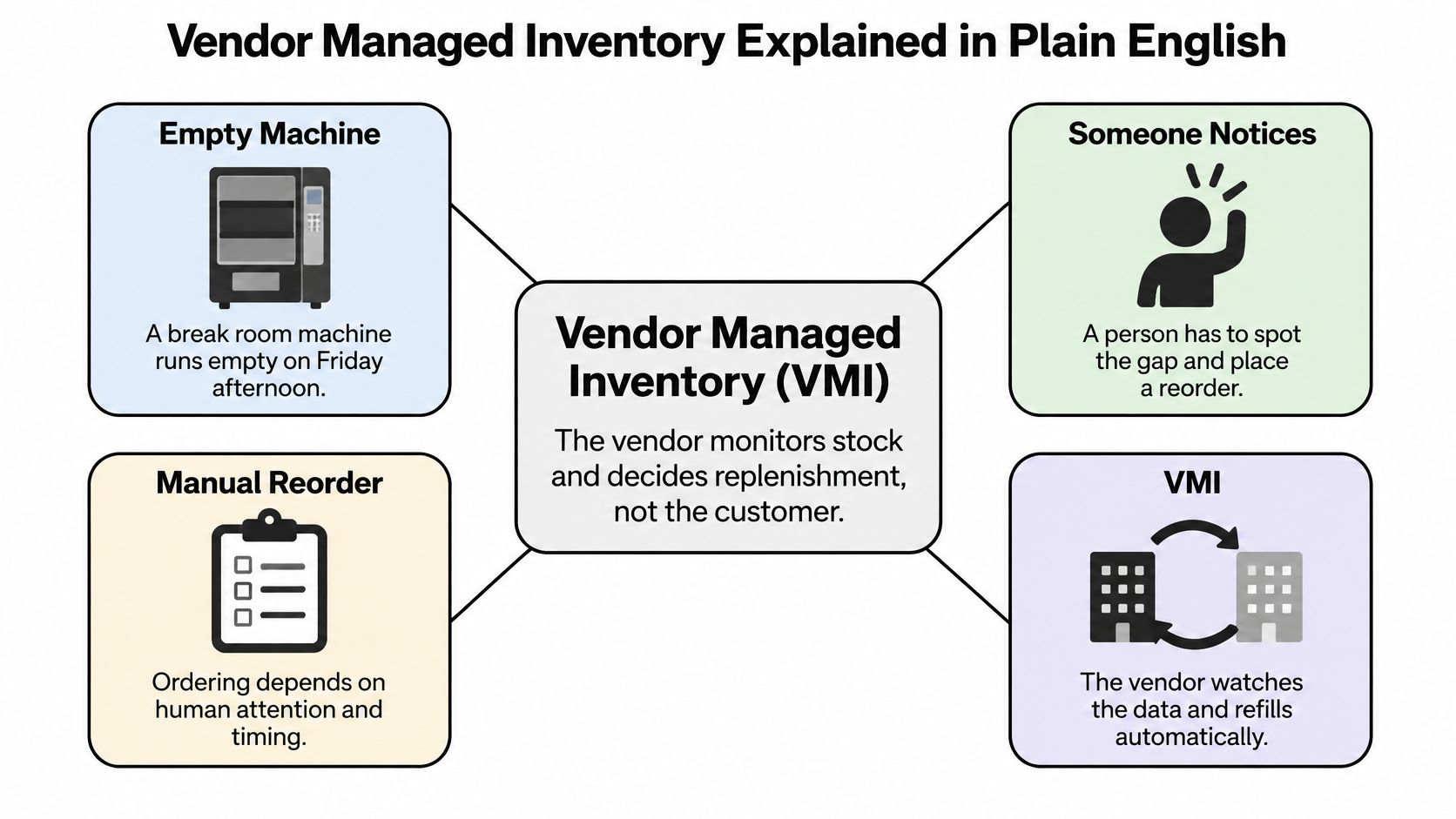
Say it in one sentence and you've got the concept: the vendor owns the decision about when stock moves, and the site owns the outcome it agreed to expect.
How the Replenishment Loop Works Step by Step
Par level is the target quantity of each product in a machine, the number a restock aims at. Telemetry is the machine's own reporting, sending sales and remaining stock automatically instead of waiting for a person to count.
Put those two together and you get a loop. A systematic review of vendor managed inventory practice frames the operating model as the buyer supplying demand and inventory information while the vendor determines replenishment timing and quantities within pre-agreed limits. The loop then runs like this.
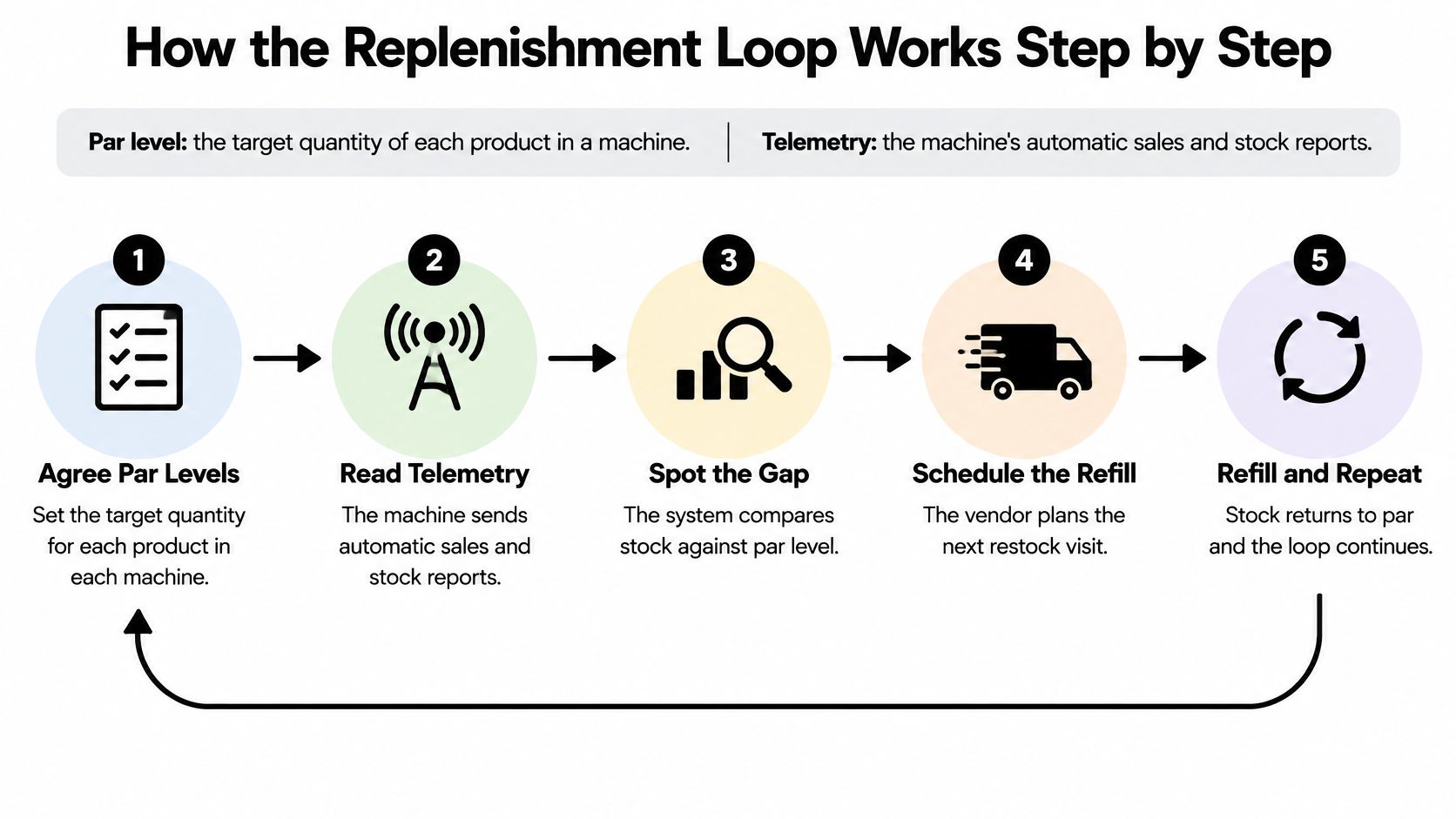
Set par levels machine by machine. Targets are set product by product: a cola row, an iced tea row, a better-for-you snack row, a frozen slot. A 40-select machine in a hospital staff room doesn't carry the same par as a compact refreshment center in a property management office, because the rooms and the shifts differ.
Let the machine do the counting. Sales and stock data arrive through telemetry, and telemetry data collection is what turns a fixed visit schedule into a concrete decision. Cashless transaction records add a second signal, showing which items turn fast and which have stalled.
Compare stock against par and against days of supply. A row holding ten units against a par of twelve is fine if it turns over twice a week and a problem if it turns over twice a day. Days of supply does that arithmetic before the shelf goes bare.
Rank the visits. The vendor decides which machines get restocked, in what quantity and in what order, moving high-velocity sellers and machines near stockout to the front of the route.
Restock and record. The visit brings stock back to par and logs what went in, so the next data point is accurate rather than a guess. Where a machine is topped up by on-site staff instead of a route driver, a low-stock reminder sticker on the shelf edge does the work of a par flag on a warehouse bin.
Review the results and reset the targets. Fill rate, meaning the share of requested products available, plus stockout counts and waste, tells both sides whether the par levels were right. Then the numbers get adjusted for the next pass.
A loop that works looks quiet. Stock sits near par rather than piled high or empty, visits follow demand instead of a calendar, and nobody at the site places an order.
Practical rule: if a machine's par levels haven't changed in a year, the loop has stalled. Break room demand shifts with headcount, seasons, holidays and whatever product launched last month.
Ownership is a different question from all of this, and it's where most programs get into trouble.
Agreement Terms That Decide Who Carries the Risk
Operational control and ownership are separate questions, and vendor managed inventory only settles the first one. Adobe's guide to vendor managed inventory benefits and risks makes the distinction plainly: VMI is about who decides when and how much to reorder, while ownership, payment timing, obsolete-stock liability and shrinkage need their own contractual terms. The same guide names the recurring failure points, which are unclear ownership, obsolete stock, inaccurate counts and service cost.
Here's the scenario that catches people out. The dashboard says the snack row is available: four units, all shown in stock. Three of them passed their date last month and the fourth sits behind a jammed spiral. The data is technically right, the shelf is practically wrong, and the contract decides who pays for the gap and who clears it.
Terms worth seeing in writing, item by item:
Approved stock levels for each machine, with minimum thresholds that trigger a visit.
Service targets, such as a fill rate or a cap on consecutive days without a product.
Data access rights: which readings the site can see, how often, and in what form. A service target is only enforceable if it's written into a vendor management service level agreement.
Title transfer, the moment ownership passes: at delivery, at machine loading, or at the point of sale.
Returns and credit for unsold or unusable stock.
Expiration rules, including who pulls short-dated product and who absorbs the cost.
Damaged goods, covering product ruined by a failed cooler or a power interruption.
Shrinkage and theft, meaning missing stock the machine count cannot explain.
Excess and obsolete liability when a menu change strands inventory nobody wants.
VMI can sit inside a consignment arrangement, where the vendor owns the goods until a customer takes them, or run without it, where the site owns the stock and the vendor only controls timing. How consignment stores document vendor terms shows the clauses those agreements typically carry, and the language transfers well to a break room contract.
Before you sign, ask four questions. Who owns the stock on the shelf right now? Who pays for expired or damaged product? Which reports do I get, and how often? What happens if a machine is down for a week?
What Vendor Managed Inventory Delivers for Workplace Sites
A refreshment program run this way shows up in three places: fuller machines, fewer staff hours spent chasing stock, and assortments that follow what people buy instead of what somebody guessed last quarter.
The strongest published evidence comes from healthcare. A hospital simulation comparing traditional inventory management with three VMI designs, collected in this library of vendor managed inventory research, found the first design raised inventory turnover from 6.31 to 7.76, cut average inventory by 36% and reduced inventory-management costs by 40%. A second design, using frequent replenishment with a one-month supply, cut inventory by 44% and management costs by 47%. A third eliminated safety stock and modeled a 70% inventory reduction with a 69% management-cost reduction. Treat those as study results and modeled potential rather than a promise about a vending route.
The mechanism behind them matters more than the percentages. A study of 101 manufacturing companies found demand visibility and control limits were the principal predictors of service performance, while inventory location was the factor tied to cost performance, as reported in research on inventory management practices and VMI performance. Telemetry alone delivers nothing. The signal has to meet a replenishment policy with defined limits and a named owner.
Cashless payment has become a demand signal in its own right. A 2023 report found cashless transactions made up 67% of sales at the machines it studied in 2022, up 11% from 2021, according to this study of vendor managed inventory and information sharing. Payment records tell an operator which products move and when, which is exactly the input a restock decision needs.
Judge a program on a short list of measures, and watch the direction rather than the absolute number at first:
Fill rate: share of requested products available. It should climb in the first months and then hold steady.
Stockout frequency: empty rows per machine per week. It should fall and stay down.
Waste percentage: stock pulled unsold. It should drop as par levels tighten.
Replenishment response time: hours between a low-stock signal and the visit. It should shorten.
Sales per machine-day: revenue per machine per day. It should hold or rise as availability improves.
These are the readings that connect a data pipeline to something a site cares about, and they sit alongside the wider set of inventory management KPIs a managed program should report at review time.
Where Vendor Managed Inventory Fits Break Rooms and Public Spaces
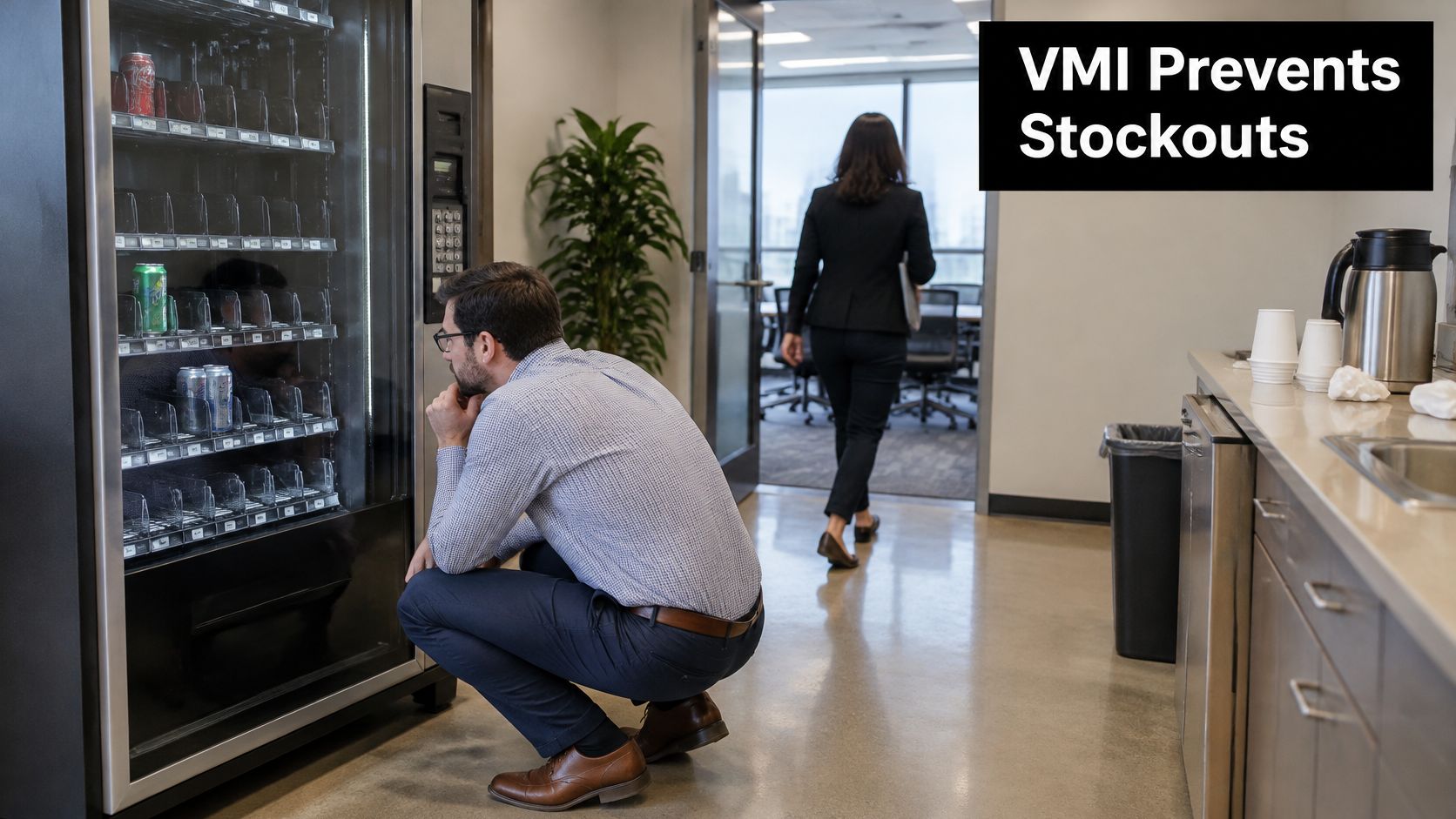
An office in the Oklahoma City metro runs on a steady weekday rhythm: coffee and snacks through the morning, a real spike at lunch, cold drinks all afternoon. Then a Friday all-hands gets scheduled, thirty extra people pass through the break room, and by 1:40pm the cold drinks machine is down to iced tea and water.
Nobody at the office places an order. The machine's data flags the drawdown against par, and the operator adds a visit or shifts the next one earlier. Responsibility for that call sits with the vendor, which is the whole point of the model.
Different rooms produce different rhythms, and the model has to bend to each. Teacher lounges follow the school calendar, busy in the days before a break and quiet through summer, so a par list set in October looks wrong in July. Vendmoore Enterprises provides break room vending for teacher lounges, apartment community areas and office breakrooms, and each location's menu is built around who walks past it, whether that means classic favorites, healthier options or a mix.
Apartment common areas swing with residents instead: quiet midweek mornings, heavy Saturday traffic, a burst during move-in weeks. Drinks in a common area tend to sell on convenience, since a resident is choosing between the machine downstairs and a trip to a store, which makes the beverage rows the ones worth watching closest. Some residential communities layer perks on top of vending, such as the member coffee delivery described in this Freeform House member coffee guide.
Stadiums and airports break the pattern entirely. A single event can drain a machine in ninety minutes, and normal reorder thresholds never see it coming. Clinics and hospital staff rooms need the opposite quality, dependable availability across night shifts and weekends when a nurse can't leave the floor for a snack. In every one of these settings the site hands the restocking decision to an outside operator, which is the same arrangement behind unattended retail.
The practical lesson is to match the model to the site's pattern. Steady sites gain the most from automated replenishment, because their demand is predictable enough to forecast from data. Event-driven sites still benefit, but they need extra safety stock on the fast movers and a manual override the site can trigger when a meeting, a game or a shift change is about to overwhelm the machine.
When Vendor Managed Inventory Fits and When It Does Not
Two assumptions deserve challenging before anyone signs. Vendor managed inventory doesn't automatically mean consignment, which is a separate term in the contract rather than a feature of the model. And it doesn't automatically cut costs or free up working capital for everyone involved, because it can shift inventory risk onto the supplier and leave the site more dependent on a single operator.
A Springer chapter on barriers to vendor managed inventory adoption lists insufficient knowledge, resources, skills, initiative and coordination as the reasons programs stall. Those are organizational conditions, not technical ones, and no telemetry platform fixes them.
Condition | Good fit for VMI | Weak fit for VMI |
|---|---|---|
Demand pattern | Steady, repeatable use | Irregular, event-driven spikes |
Data quality | Machines report sales and stock reliably | Low-traffic or offline machines send little data |
Product range | Focused, repeatable assortment | Constantly changing or very wide range |
Supplier capability | Can serve many locations reliably | Cannot cover several sites consistently |
Data sharing | Site accepts sharing usage data | Consumption data is confidential |
Site volume | Enough sales for reliable forecasts | Too little volume for automated forecasting |
Volume cuts both ways. A small satellite office with a dozen people may sell too little for a forecast to mean anything, so the algorithm ends up guessing and the machine drifts between overstocked and empty. A stadium concourse has the opposite problem: plenty of volume, but concentrated into bursts that defeat a threshold calibrated on an ordinary Tuesday.
Decision rule: adopt VMI where demand repeats, machine data flows reliably and the agreement names who carries the risk. Keep manual control everywhere else, at least for now.
Phasing beats a blanket rollout. Turn the model on for the locations with steady traffic and a settled menu, keep the irregular sites on manual oversight, and expand once the reports show the loop holding.
Every program also needs a fallback. Write down what happens when telemetry goes dark for three days, who reconciles a machine that reports stock it doesn't have, and which person owns the correction. A break room that depends entirely on a data feed with no manual path back is one outage away from empty shelves.
Decide Whether Vendor Managed Inventory Fits Your Site
Choosing VMI means choosing who holds responsibility: who watches stock, who places each order, and who pays when product expires on the shelf. A good setup works like a thermostat run by a service company, where your site sets the target and the vendor does the adjusting, but only if the agreement names who pays when the system drifts.
Bring three questions to any provider. What par levels and service targets will be set for this location, and who adjusts them when traffic shifts? Who owns the stock on the shelf, and who absorbs expiry or shrinkage losses? Which telemetry and reports will the site receive, and how often? A provider running genuine VMI can answer all three before signing, because the replenishment job transfers to them rather than getting automated in place.
The ownership question separates the two models sites confuse most. Under consignment the supplier keeps title until a sale, while under VMI the site can own the stock the vendor reorders. A proposal labeled VMI that reads like consignment puts the risk somewhere else entirely.
For workplaces and public spaces across the Oklahoma City metro, Vendmoore Enterprises runs managed break room and common-area programs suited to each location, serving Oklahoma City, Norman, Moore, Del City and the surrounding metro. Call 405-294-2373 to ask how par levels and product mix would be set for your space, and use this cost comparison analysis to weigh a managed program against owning your own machine.
Vendmoore Enterprises installs and operates smart vending machines across the Oklahoma City metro, with cashless payment, remote monitoring and replenishment driven by each machine's sales and stock data. If your break room still depends on someone noticing an empty shelf, a managed program takes that task off your plate. Visit Vendmoore Enterprises to start a conversation about a managed program for your site.
Comments