
Warehouse Vending Machines: Types, Costs and Setup

Your night crew has finished the available snacks, the nearest store is a drive away, and someone has left a note asking for better drink options. Meanwhile, supervisors are checking glove supplies by hand. You're considering warehouse vending machines, but choosing equipment is only part of the decision.
The useful starting point is what employees need, where they need it, and who will keep it available. Treat vending as both break infrastructure and point-of-use inventory control, then judge it on availability, stock visibility, safe access, and sales.
Warehouse Vending Machine Types and Where Each Fits
A warehouse vending machine is an automated dispenser placed on or near the work area that controls who can take what and records each withdrawal. The level of control differs: a snack machine may record an anonymous purchase, while an industrial dispenser can associate an issued item with an employee.
Don't confuse the cabinet with the service it provides. A refrigerated machine, for example, only becomes a useful meal option when its assortment, temperature controls, replenishment schedule, and nearby eating facilities work together.
Warehouse vending machine types and fit
Type | Typical products | Best warehouse use |
|---|---|---|
Snack | Chips, bars, nuts and crackers | Shift-long snack access in break rooms and near packing lines |
Drink | Bottled water, cans and sports drinks | Hydration on hot floors, docks and long shifts, with the machine outside active loading areas |
Frozen | Frozen meals and ice cream | Hot-meal option where a microwave is available |
Dual-zone chill | Snacks plus chilled drinks and meals | One footprint for mixed needs on larger sites |
Compact | Small snacks and drinks | Small satellite break rooms and supervisor offices |
PPE and MRO | Gloves, eye protection, hearing protection and spare parts | Controlled access to safety supplies at the point of use |
Snack and drink machines solve different stocking problems. A crew buying water throughout a shift can empty beverage capacity while snack selections remain untouched. Separate cabinets let the operator allocate space to each demand pattern.
A frozen machine needs more supporting infrastructure. Employees need somewhere to heat and eat meals, and the replenishment team needs a reliable cold-handling routine. A dual-zone chill machine offers mixed storage in a single footprint, but confirm the actual temperature capabilities before assigning products to each compartment.
Compact equipment suits a smaller satellite space, not automatically an entire small warehouse. Check product capacity against how often someone can realistically replenish it.
The diagram separates refreshment access from controlled industrial dispensing.
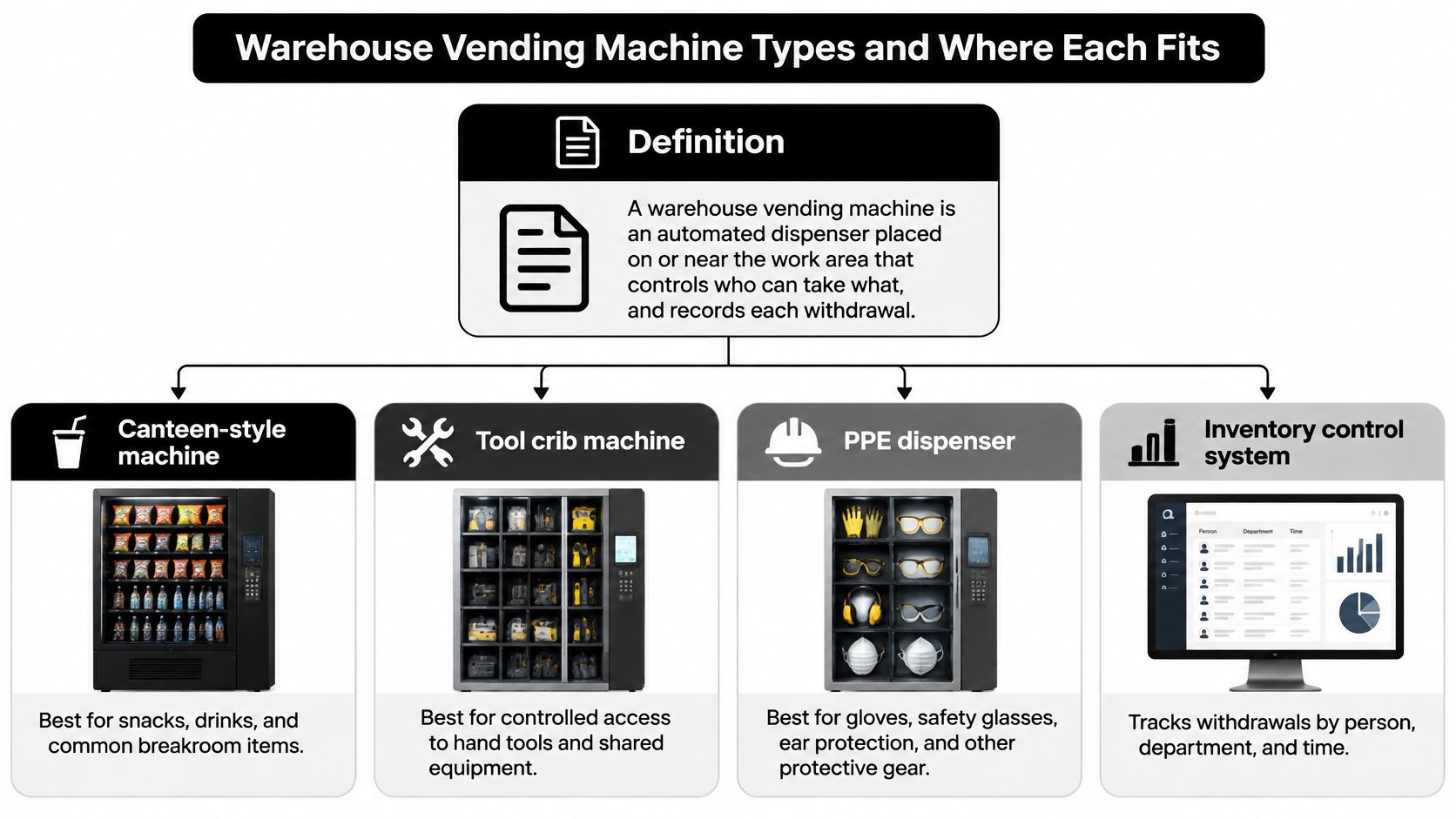
A mature inventory-control approach
Industrial vending isn't a recent novelty: Retail Systems' account of industrial vending describes the April 27, 1993 grant of U.S. Patent No. 5,205,436 for a “Machine Tool Dispensing Device and System,” developed for a Ford Motor Company plant. Its controller already restricted access, recorded usage, monitored inventory, and supported replenishment.
That distinction matters when comparing industrial vending solutions. PPE and maintenance, repair, and operations supplies, commonly called MRO, require a different access model from employee refreshments.
Practical rule: Start with the item workers need within walking distance on every shift. Add another machine type when shift length or floor size justifies it, and consider dual-zone equipment when mixed needs must share a footprint.
Why Warehouses Add Vending to the Floor
Consider a hypothetical night-shift worker on a 10-hour shift who spends twenty minutes walking to a distant storeroom for gloves and then finding water. The problem is not just an inconvenient purchase. The worker has combined a supply trip with a refreshment trip because neither need is served nearby.
A conveniently located dispenser can change that routine, but managers should distinguish plausible operational benefits from measured results. Shorter travel is something you can observe. Better retention is a much larger claim.
What break research actually tells you
In a 2023 global workplace survey published by Compass Group, 78% of workers said taking a lunch break makes them more productive, 85% said regular breaks improve overall productivity, and more than seven in ten said they use breaks to eat and drink. In workplaces with an advanced food offering, the same survey reported that 70% chose to eat lunch with colleagues, compared with 23% who ate alone.
Those are general workplace findings, not warehouse-specific studies. They describe employees' reported experiences and break behavior, not a measured productivity increase caused by installing vending machines.
For a warehouse manager, the practical implication is to support useful breaks rather than treat every minute away from a workstation as waste. Accessible food and drinks can help employees spend their break eating or resting instead of searching for supplies.
Benefits to test on your floor
Fewer unnecessary trips: Observe whether workers can obtain common items without crossing the building or leaving the property.
Access across operating hours: Check availability for night and weekend crews, not just the day shift.
Visible safety-supply stock: Give supervisors a reliable way to identify shortages before employees need an item.
Less manual counting: Compare the work required to maintain the machine with the previous counting and issuing routine.
Ask employees whether the location helps. A well-stocked cabinet behind a locked office door does little for an overnight crew, and a meal selection doesn't help if the microwave area is inaccessible.
Vending alone doesn't prove better retention or fewer injuries. Record the changes your site can demonstrate, and leave broader conclusions open until you have appropriate evidence.
Cashless Payments and Telemetry That Track Stock
A machine that accepts money isn't necessarily an inventory-control system. Payment answers how a purchase is settled; authentication answers who is authorized to withdraw an item. You may need one, the other, or both.
For refreshments, cards, mobile wallets, and cash-free accounts remove the need to carry change. When evaluating reader compatibility and payment workflows, Sambapay's guide to cashless payments offers useful background, although local processing terms and equipment compatibility still need checking.
From badge tap to reorder alert
For industrial supplies, start with identification. As Grainger's explanation of industrial PPE vending describes, a badge, PIN, or employee code can associate a withdrawal with a person, department, timestamp, and item. That record helps supervisors investigate unusual consumption rather than guessing whether a shortage came from ordinary use, stockpiling, or loss.
Badge authentication is the starting point for a traceable issue record.
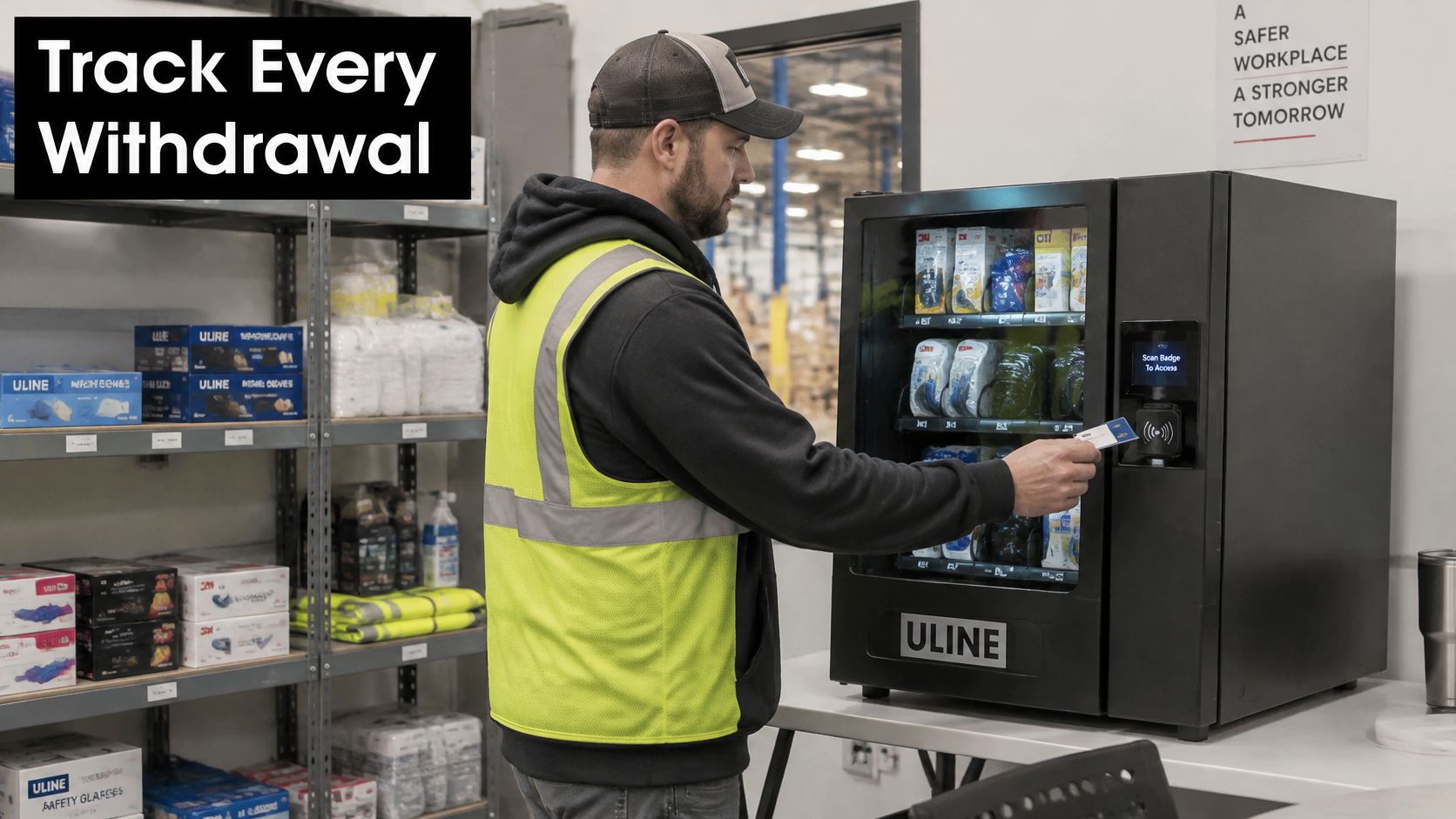
Next, telemetry sends machine activity and available inventory information to a reporting system. A stock-keeping unit, or SKU, represents a particular product, such as a specific glove size or drink package.
Set a reorder threshold early enough to cover consumption while replenishment is arranged. Use observed withdrawals to adjust minimum and maximum quantities, rather than copying the same settings across every location.
GlobalSpec's overview of industrial vending explains the operational chain: recorded withdrawals support demand-based replenishment and inventory planning. Better settings can reduce emergency shortages, excess secondary stock, and counting work, but only if someone responds to the information.
Configuration choices that matter
Item-level sensing or RFID: Choose a method suited to the package, cabinet, and accuracy requirements. Test awkward items before approving the layout.
Segmented cloud reports: Separate results by SKU, employee group, shift, and location so a busy area doesn't hide another area's shortage.
Exception alerts: Assign a named recipient and backup for low stock, failed dispensing, connectivity problems, and relevant temperature alarms.
Use a telemetry data-collection checklist to define what the dashboard must report before installation. Also distinguish an estimated inventory balance from a physically verified count.
A dashboard is useful only when an assigned person knows what action to take.
Required PPE must never be blocked by an arbitrary consumption limit. Configure a safe exception route for replacement items and unusual tasks.
Costs, Ownership Models and Payback Math
Model | Machine owner | Stocking and service | What to track |
|---|---|---|---|
Fully managed | Provider | Provider | Sales per SKU, uptime and stockouts |
Customer-owned | Host site | Host site or contracted service | Unit cost, restocking labour and repair cost |
Hybrid | Shared by agreement | Provider with host review | Split of sales and service fees |
Ownership models and who carries the costs should be settled before comparing cabinet prices. A fully managed agreement transfers much of the operating work to the provider; ownership gives the host more responsibility for purchasing, stock, repairs, and performance.
The stocking work belongs in the financial comparison, even when it doesn't appear on an equipment quote.
Calculate the return to the right party
For whoever earns the sales margin and pays the operating expenses, use this framework:
Net monthly gain = gross margin on sales + avoided stockout and shrink losses + restocking labour saved − service fees or commission − utilities − prize or promotion costs − spoilage and repairs.
Gross margin means sales less product cost, not total receipts. Count labor savings only where work disappears or staff can use that time elsewhere, and avoid counting the same benefit under both productivity and labor.
For a host in a fully managed arrangement, the calculation may instead center on commission received, host-paid costs, and documented operational benefits. Don't credit the host with sales income that belongs to the provider.
Hypothetical example, not a price quote or benchmark: A customer-owned unit grossing $1,800 a month at a 45% gross margin produces $810 before operating expenses. Subtract assumed utilities of $150 and service of $200, leaving $460 per month before losses and labor savings.
Divide the upfront investment by that monthly net to estimate simple payback. If the net is negative, higher sales alone won't necessarily fix the arrangement; inspect margin, spoilage, service costs, and product mix.
Use the video alongside a written quote, not as a substitute for a line-by-line cost comparison.
Keep industrial savings in context
A 2013 ISHN report on workplace vending reported average consumption reductions of roughly 20% to 30% through automated dispensing and accountability, with some dispense-limit programs exceeding 50% in usage and spending savings. Those industrial-supply results aren't a forecast for snack sales or a reason to restrict necessary protective equipment.
Build your budget around a written vending-machine installation cost assessment, including payment processing, connectivity, delivery, and any site work. Counting sales alone overstates the return.
Placement, Safety and Oklahoma Compliance Checks
Keep machines off forklift routes, loading zones, and pedestrian bottlenecks. An empty patch of floor isn't automatically a suitable vending location, especially if customers, queues, or an open service door would extend into a travel path.
Measure the cabinet footprint, door swing, service access, and clear aisle width before choosing equipment. Include the space employees occupy while browsing and collecting products, not just the machine's dimensions.
Placement by location and traffic pattern
Location | Traffic pattern | Placement rule |
|---|---|---|
Break room off the production floor | Low forklift traffic | Preferred location; keep the door and aisle clear |
Dock or loading zone | Trucks, carts and pedestrians | Avoid |
Office or supervisor area | Moderate and steady | Good for badge-controlled PPE and supplies |
Shift entry or locker area | Peaks at shift change | Only where it sits outside walkways |
The injury context warrants care: CUNY's warehouse-automation reporting cites a 2024 U.S. warehousing injury rate of 4.8 cases per 100 workers, compared with 2.6 across all occupations. That comparison doesn't establish a vending-related risk or benefit.
A vending machine cannot replace ergonomic controls, a hydration policy, meal breaks, or safety training. Its location and assortment should support those measures rather than introduce another reason for workers to cross active traffic areas.
For managers considering outside support with a site risk review, Opus Safety's explanation of outsourced health and safety describes that service model. Oklahoma requirements still need confirmation with the relevant local authority and qualified site professionals.
Confirm the site requirements before installation
Treat this as a pre-installation verification checklist, not a statement that every item is a universal Oklahoma legal requirement.
Electrical capacity: Have a licensed electrician confirm the supply, grounding, circuit capacity, and whether a dedicated circuit is required for the selected equipment. Don't plan around extension cords.
Accessible operation: Check the approach space, reach range, payment controls, product-selection panel, and collection opening against applicable accessibility guidance. A reachable screen doesn't guarantee a reachable product tray.
Cold-food controls: Specify temperature monitoring, an alarm response, and a documented restocking routine for refrigerated and frozen units. Plan for Oklahoma summer heat and follow the equipment's permitted ambient conditions.
Product information: Make allergen and nutrition information available for every stocked item, and update it when products change. Keep labels legible and avoid obscuring important package details.
Employee-data handling: Set retention periods, access permissions, and a defined purpose for badge and transaction records. Explain the monitoring to employees and limit reports to people with a business need.
Access and break policies: Align permissions with working arrangements and safety responsibilities. Provide an escalation route when the normal dispensing rule doesn't fit a legitimate need.
Property and food-sale approval: Obtain landlord approval where applicable. Confirm food-sale requirements with the Oklahoma State Department of Health and the relevant city or county health department before operation.
Use a documented venue setup plan to record approvals and unresolved work. Assign an owner to each outstanding item rather than leaving a general note that the location is ready.
Stock for the task, then check the traffic
Prioritize gloves, eye protection, and water, followed by lower-sugar snacks and useful meal items, then discretionary selections. Set minimum and maximum quantities per SKU and schedule restocking outside shift-change peaks.
Pair transaction timing with floor observations and employee feedback. Transactions alone don't reveal walking distance or unsafe clustering; if observation confirms either problem, relocate the machine or assess another location before expanding the menu.
Avoid this installation mistake: Don't put a frozen unit in a hot ambient location simply because an electrical outlet is available.
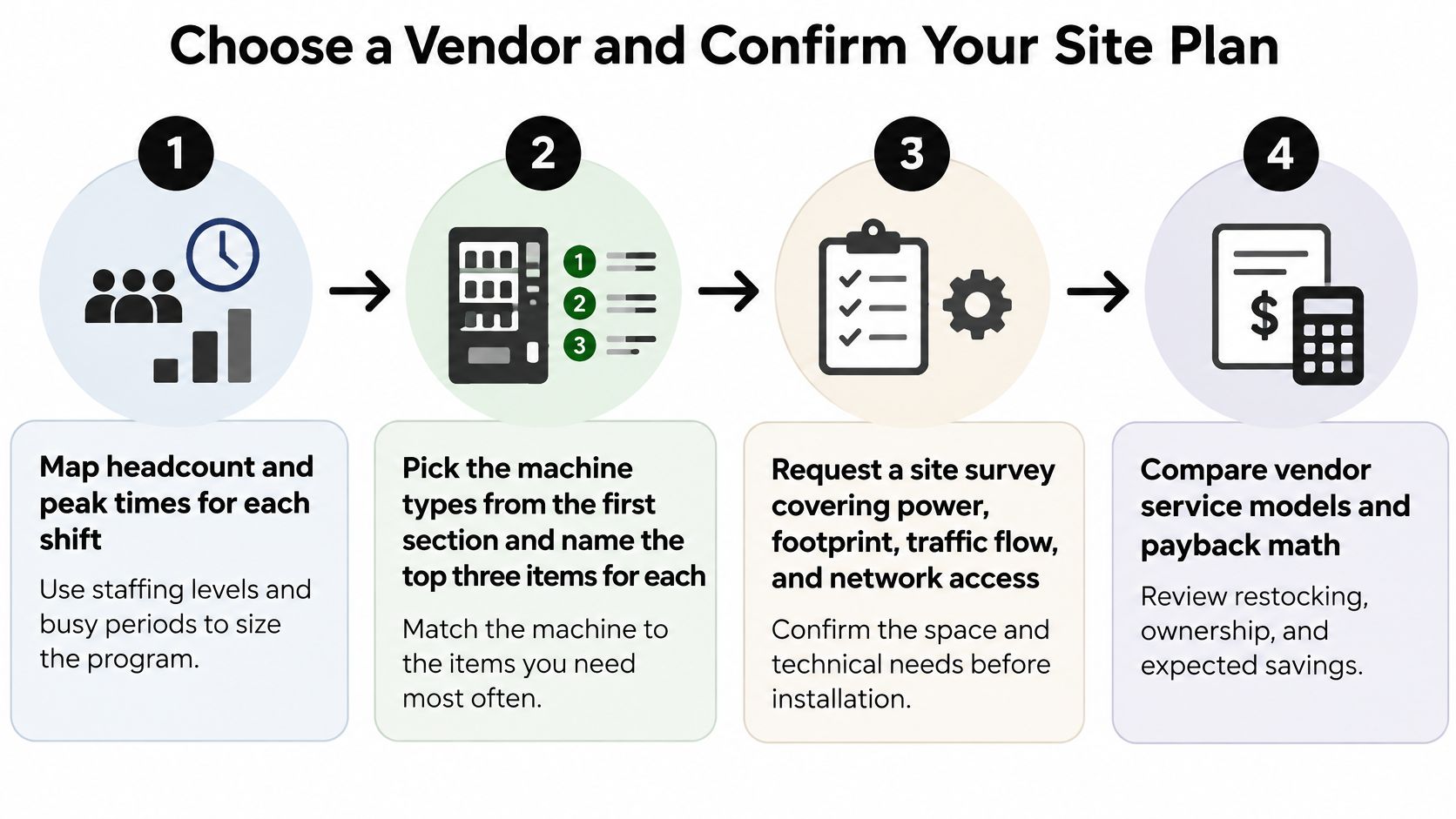
Choose a Vendor and Confirm Your Site Plan
Map headcount and peak times for each shift. Include temporary staff and weekend crews so the program reflects actual attendance rather than payroll totals.
Pick the machine types and name the top three items for each. Specific products make capacity and replenishment discussions more useful than a request for more variety.
Request a site survey covering power, floor space, pedestrian routes, loading zones, and network access. Identify how service staff will enter without interrupting warehouse work.
Compare ownership models against your budget and net monthly gain. The distinction between a vendor and a service provider helps clarify whether you're buying equipment or ongoing operating support.
Review a sample telemetry dashboard and restock log. Confirm who receives exception alerts, who acts on them, and how an unresolved problem gets escalated.
Agree service levels for response time, replenishment, and product changes in writing. At gated sites, Nimbio's guide to what to look for in a gate access system provides useful questions for coordinating authorized service access.
Run a proposed 60-day trial, not an assumed provider commitment. Judge stockouts, transaction volume by shift, repeat purchases where appropriately measurable, and employee feedback, then agree what should change.
Use the planning sequence to keep equipment selection tied to the site rather than a catalog.
At Vendmoore Enterprises, we're a free vending service partner and Oklahoma vending operator offering vending machines and break room vending, with a lineup including HAHA Ai Vending, BC10 Bottle & Can Vendor, Trimline II Refreshment Center, Compact 23/10 Refreshment Center, MPZ Frozen Food, and 40-Select Dual Zone Chill Center; call 405-294-2373 to request a site survey.
Vendmoore Enterprises offers warehouse refreshment and break room vending with customized assortments, stocking, service, and support, along with options for customers who want to own their machines. Visit Vendmoore Enterprises to discuss your shift patterns, available space, and food and drink needs, and arrange a site survey for your Oklahoma workplace.
Comments