
Airport Vending Machines: A Guide for Facility Managers

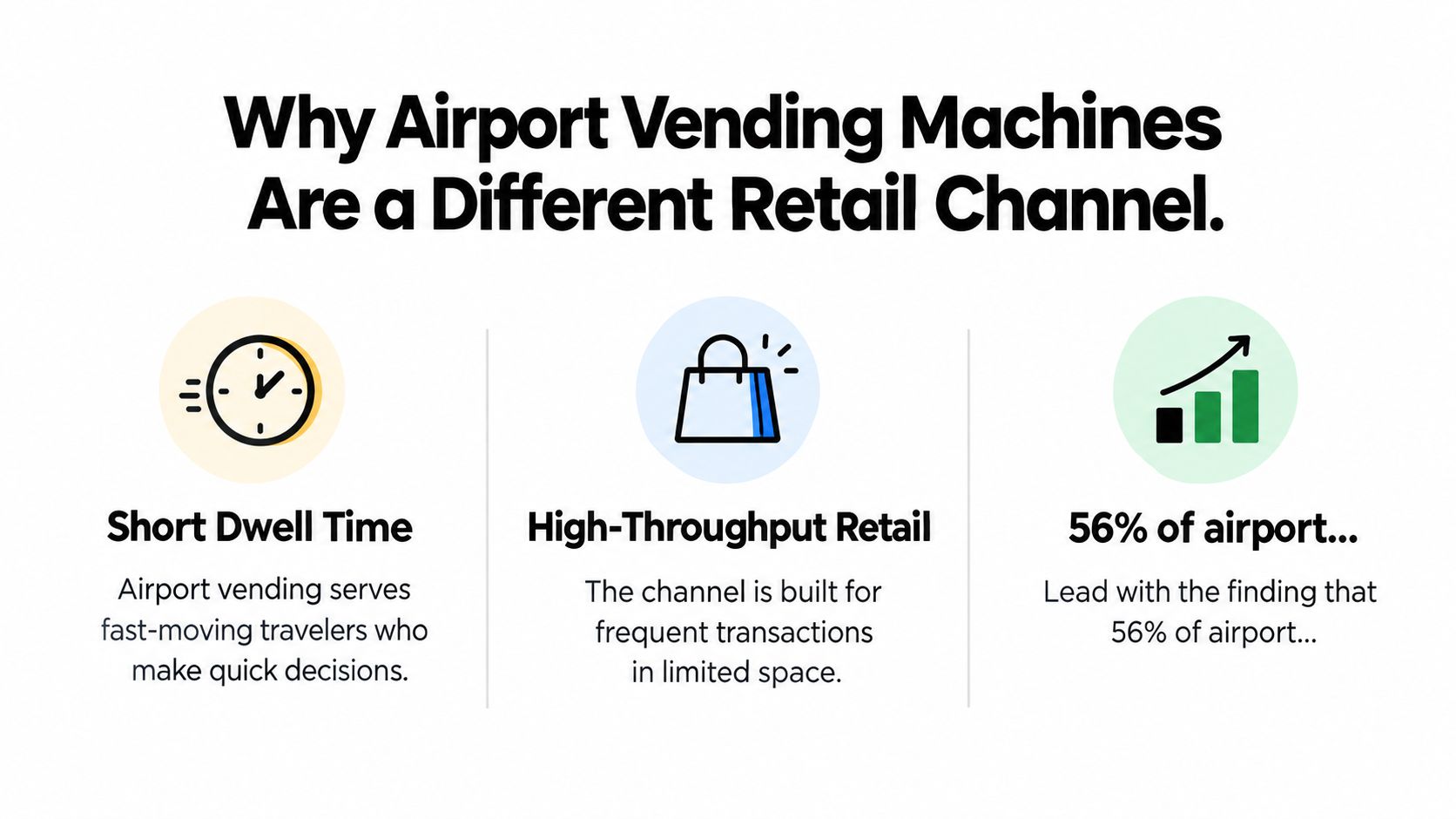
56% of airport vending purchases occur within 30 minutes of a boarding announcement, according to a market analysis of airport smart vending. That analysis also reports contactless payment shares of 62% in North America and 78% in Europe. For a facility manager, those findings point to a clear operating priority: help passengers find, pay for, and retrieve the right product before they have to leave.
Airport vending machines aren't just break-room machines placed in a terminal. They're a retail service that must work under boarding pressure, restricted service access, and uneven demand. Equipment selection matters, but the more consequential decisions concern who responds when payment fails, refrigeration goes out, or the machine beside a departure gate sells out.
Why Airport Vending Machines Are a Different Retail Channel
A passenger approaching a machine near boarding isn't necessarily browsing. They may need a drink, a meal substitute, or a replacement for something forgotten at home. The boarding-window finding makes transaction speed and gate-area placement operating decisions, not cosmetic details.
Workplace vending serves a relatively familiar population. Employees can learn the assortment, return later, or report a problem to someone nearby. A departing traveler may never use that machine again and may have no time to resolve an unclear charge.
Evaluate the complete purchase
Facility managers should evaluate the purchase from approach to retrieval. Can a traveler read prices without opening several menus? Is the selected item clearly identified? Does the machine confirm whether the product dropped?
Those details belong in equipment demonstrations and acceptance testing. A polished touchscreen isn't evidence that the transaction works well under pressure.
Equipment fit: Match the dispensing mechanism to the actual package, including fragile food and irregularly shaped travel products.
Service access: Confirm how an operator reaches the machine with stock, tools, and replacement parts.
Operating visibility: Require reporting that distinguishes unavailable products, unsuccessful payments, and dispensing faults.
Passenger outcomes: Track whether a customer can complete a purchase, not merely whether the machine has power.
Practical rule: A powered-on machine isn't necessarily an available retail service.
Set expectations before installation. Define uptime, payment success, and product availability separately, including what counts as an outage and when the service clock starts. Otherwise, the operator and airport can report different versions of the same performance.
The useful comparison isn't airport vending versus a staffed shop in every circumstance. It's whether the proposed machine can reliably fill a specific service gap without creating an unresolved maintenance or customer-support burden.
How Airport Vending Machines Evolved Into Specialized Retail
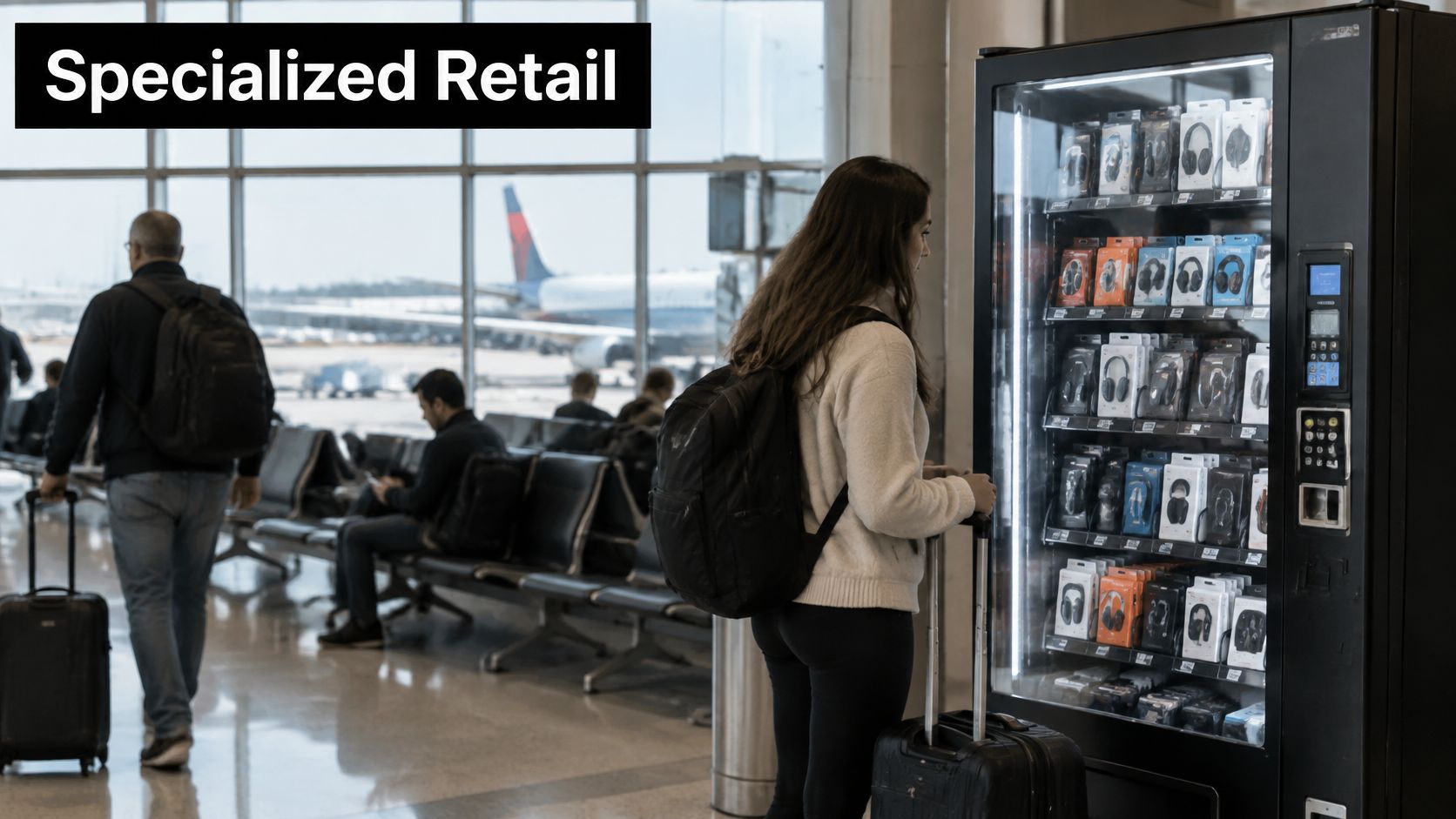
Airport vending expanded beyond basic snacks and beverages during the 2000s and 2010s. At Las Vegas McCarran International Airport, machines selling iPods and other Apple products reportedly generated approximately $60,000 to $70,000 in monthly revenue by 2009, serving demand for electronics unavailable in conventional airport shops; by May 2019, McCarran had added more than two dozen machines, including four Sprinkles cupcake machines, while Dallas/Fort Worth International Airport had 15 machines, including two CVS health and personal-care units, with socks and apparel machines planned, according to USA Today's account of specialized airport vending.
The same report found that ibuprofen sales through CVS airport vending machines reached roughly 12 times the volume sold at a typical CVS store. That's evidence of an urgent purchase occasion, not a reason to assume every pharmacy product will perform equally well.
Specialization beats indiscriminate expansion
The electronics example matters because the machines addressed a retail gap. Their value wasn't just that they offered more products. They offered something travelers couldn't otherwise obtain in that location.
Apply that distinction when evaluating an assortment proposal. A machine filled with unrelated categories can be harder to shop, replenish, and troubleshoot than a focused unit with a clear purpose. More selection also ties up space that could hold additional stock of products passengers need.
Purchase occasion | Assortment question |
|---|---|
Forgotten essential | Does the machine carry a practical replacement? |
Immediate discomfort | Can the traveler identify the appropriate packaged product clearly? |
Food between services | Is the item substantial enough for the intended need? |
Gift or treat | Can the dispenser protect presentation and packaging? |
Don't use the historical revenue example as a forecast for another airport. Product availability elsewhere in the terminal, location, pricing, and service requirements all need separate evaluation.
The stronger lesson is methodological: identify the unmet need before selecting the machine. Then test whether the proposed product can be stocked economically, displayed clearly, and delivered intact. Specialized retail works as an operating proposition only when the equipment and service plan support the category.
Choosing Machine Formats and Placement by Terminal Zone
Start with a site walk, not a machine catalog. Record where passengers pause, where queues form, and how service staff would open and replenish the cabinet without obstructing movement. A location can look attractive on a floor plan and still be awkward to operate.
Use a vending-machine placement assessment to organize that discussion around the space and its users. Passenger-facing machines and staff break-room vending should have separate assumptions about demand, access, and assortment.
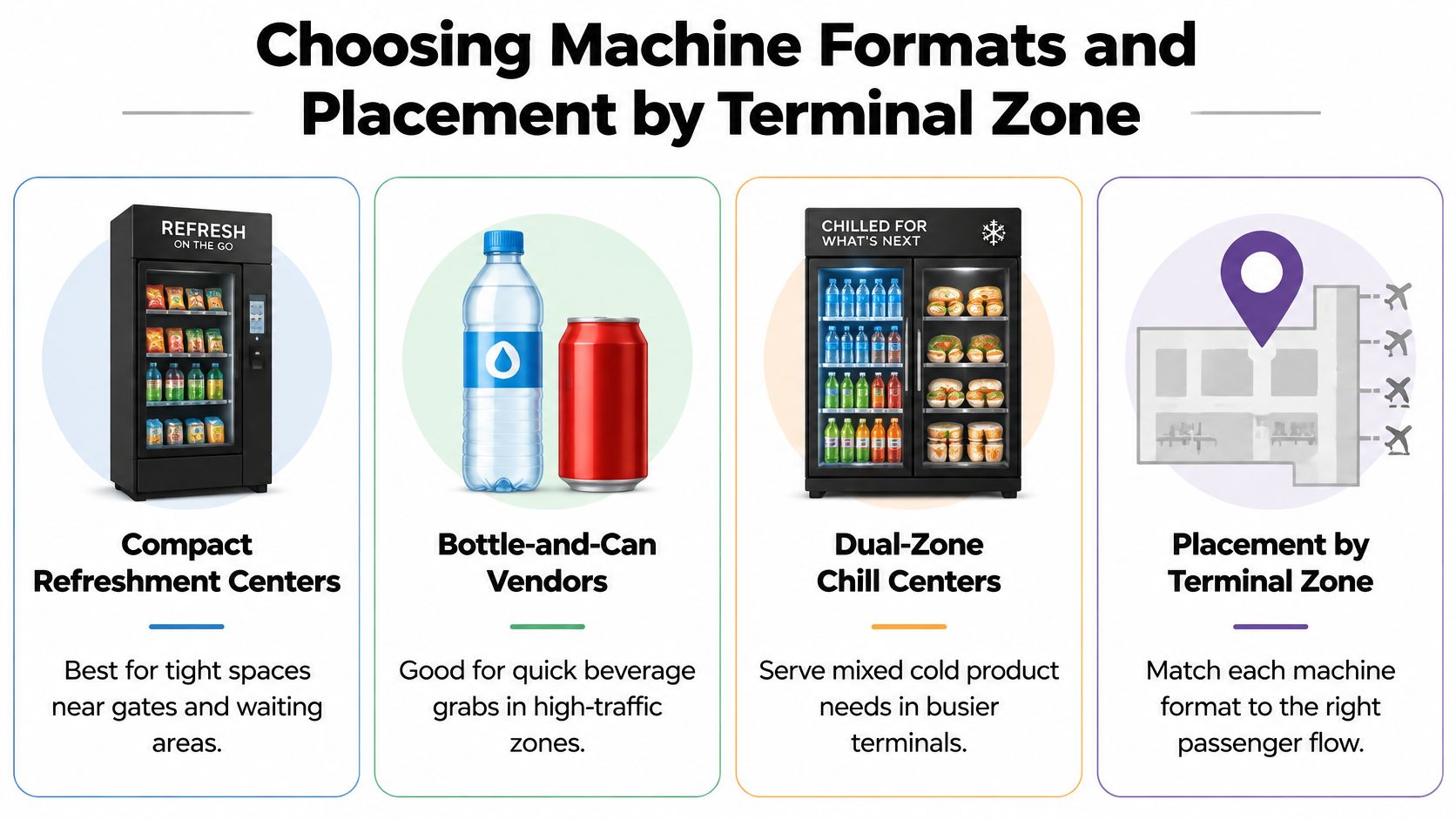
Match the cabinet to the job
Terminal zone | Format to evaluate | Main trade-off |
|---|---|---|
Gate-adjacent waiting area | Compact refreshment center | Smaller footprint versus replenishment capacity |
Busy concourse midpoint | Bottle-and-can vendor | Beverage capacity versus category breadth |
Mixed-demand terminal area | Dual-zone chill center | Assortment flexibility versus servicing complexity |
Baggage claim | Refreshment or travel-essential machine | Arrival needs versus departure assumptions |
Staff-only break area | Frozen food machine or meal-focused unit | Meal access versus preparation facilities |
These are starting points, not universal placement rules. A frozen meal offer, for example, needs a practical way for the intended customer to prepare and eat it. A dual-zone machine needs an explicit explanation of which products belong in each compartment and how those zones are monitored.
Check electrical supply, ventilation clearance, door swing, network reception, and product-delivery access before approving the position. Include the space required for the customer retrieving a purchase, not just the cabinet footprint.
Ask the operator these questions before requesting a final proposal:
Who uses this zone? Separate departing passengers, arriving passengers, waiting visitors, and employees.
What is the purchase occasion? Identify refreshment, a meal, or an urgent travel need.
When can service happen? Verify permitted access and a workable delivery route.
What changes at peak demand? Consider whether customers or restocking carts would obstruct adjacent circulation.
Size the machine to the service plan. Extra capacity is useful only if the operator can keep the right products in it.
Cashless Payments and What Happens When They Fail
The regional contactless shares noted earlier support treating NFC cards and mobile wallets as primary payment methods. But acceptance logos don't establish reliability. Facility managers need to see what happens when authorization, dispensing, or connectivity fails.
A failed transaction needs clear customer instructions, especially when boarding is imminent.
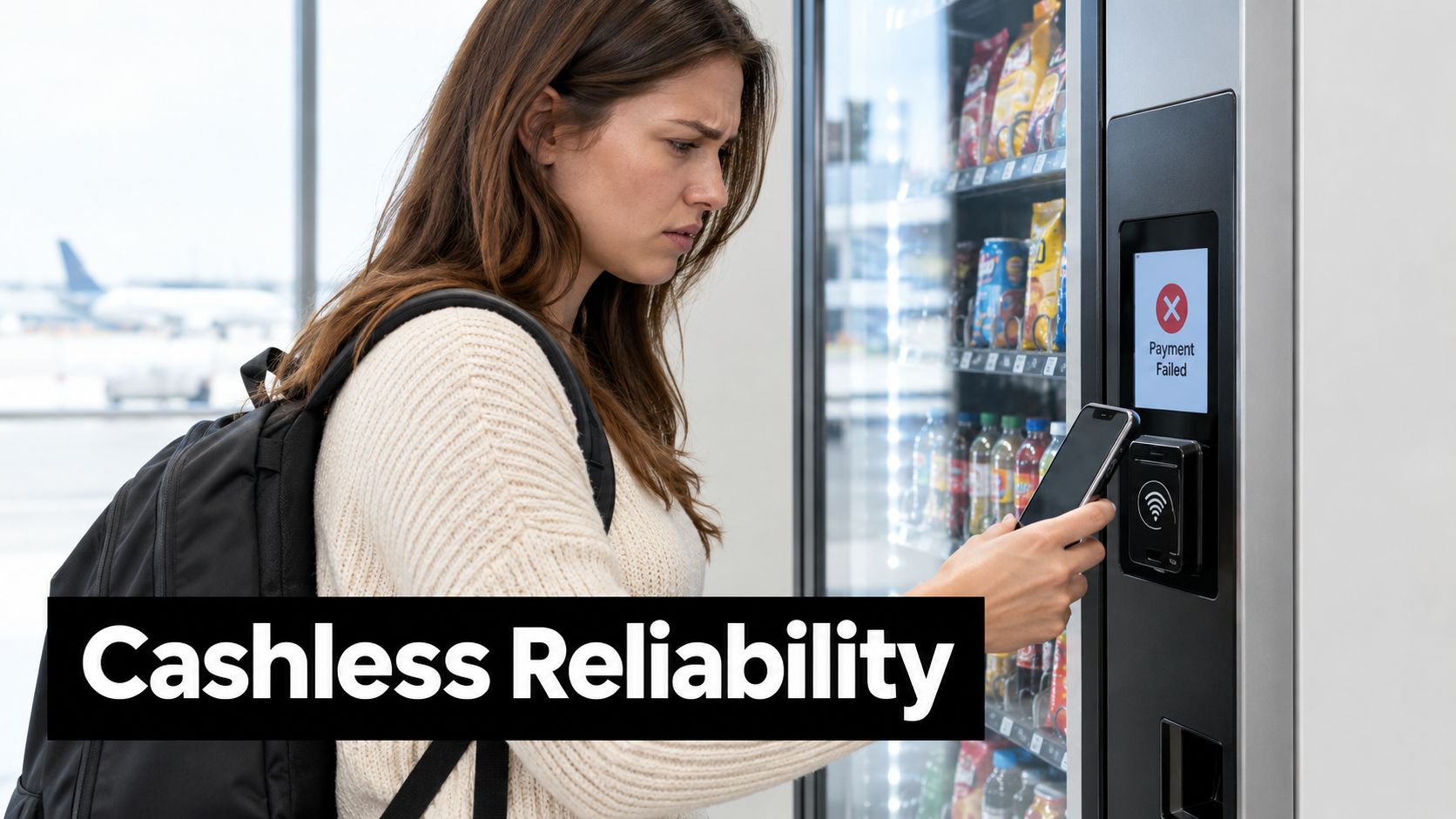
A Worldline airport-payments report found that 59% of travelers would be more likely to purchase an ancillary service when their preferred payment method was accepted, while identifying gaps in options such as Apple Pay and QR-based payments. That finding concerns airport ancillary purchasing, not a guaranteed vending sales increase.
Specify recovery as well as acceptance
Require EMV/NFC certification, demonstrated Apple Pay and Google Wallet compatibility, and a documented connectivity-loss procedure. Ask the provider to explain whether offline authorization is supported, what limits apply, and how transactions reconcile after recovery. Don't accept an undefined promise that the reader works offline.
A vending payment-system evaluation should also examine customer recovery:
Dead phone or unsupported wallet: Provide an alternative that doesn't depend on the same device or wallet.
Payment without delivery: Match the authorization record to the dispensing result.
Apparent duplicate charge: Explain pending authorizations and the refund escalation route.
Receipt request: Offer a usable process before the passenger leaves.
Connection failure: Display a clear status rather than inviting repeated taps.
Use the demonstration below as a discussion aid, then require testing on the proposed equipment.
Include travelers with different capabilities
Test screen height, wheelchair approach space, tactile controls, readable pricing, and audio or visual instructions. Review multilingual flows and timeout behavior with users who take longer to use the interface.
Refund support must be accessible too. A QR code alone won't help someone whose phone is unavailable. Require a readable machine identifier and a support route that staff can explain.
Payment convenience depends on a recoverable transaction, not just a successful tap.
Temperature Control and Telemetry for Perishable Vending
Perishable vending requires a temperature-control loop, not merely a refrigeration setting. The operator must detect unsafe conditions, stop dispensing, arrange corrective service, and document a safe return to operation.
Under the U.S. food-code requirements summarized in Trust20's vending food-safety guidance, refrigerated units must keep internal air at or below 41°F (5°C), and that limit must not be exceeded for more than 30 minutes after filling, servicing, or restocking. A safety controller must inhibit sales following a power failure, mechanical fault, or temperature excursion until servicing and replacement of affected food.
Put the control sequence in the specification
Ask the operator to demonstrate the complete sequence rather than show a normal-temperature dashboard. Place the temperature-measuring device away from the door opening, where ambient air can distort readings.
Continuous temperature telemetry: Record cabinet conditions and show when readings were last received.
Door-open and power-loss alarms: Distinguish a servicing event from an unattended fault.
Local data logging: Preserve evidence during a communications outage.
Automatic vend inhibition: Stop affected sales without waiting for someone to read an alert.
Controlled remote configuration: Allow authorized adjustments without letting a remote reset bypass safety requirements.
Documented recovery: Record corrective work, food disposition, restocking, and release back into service.
A disconnected machine must still protect food locally. Remote monitoring helps staff respond; it shouldn't be the only mechanism preventing an unsafe sale.
For frozen food vending machines, request the applicable storage specification separately. Don't assume the refrigerated-air requirement defines the correct operating conditions for every frozen product.
Treat telemetry as a staffed workflow
An Atlanta airport vending program expanded to 54 machines across six of seven terminals after an operator secured an eight-year contract in 2004; during the following four years, it progressed from DEX handheld inventory technology to remote monitoring and credit-card readers, as described in Vending Market Watch's Atlanta operations account.
The practical lesson is that a network needs coordinated oversight. Assign an alarm recipient, an escalation contact, and someone authorized to remove affected stock. Review unresolved alarms at handover so responsibility doesn't disappear between shifts.
Acceptance test: Demonstrate the fault, the lockout, the notification, and the authorized recovery before approving perishable sales.
Comparing Managed Vending Programs and Client-Owned Machines
Machine ownership and operating responsibility are different decisions. A facility can own equipment while contracting out stocking and service, or use an operator-owned program with negotiated assortment requirements. Evaluate the actual agreement rather than relying on the model's label.
The central question is who performs the work when something goes wrong. Ownership alone doesn't establish who pays for spoiled stock, investigates a charge, maintains telemetry subscriptions, or replaces a failed refrigeration component.
Managed Vending Program vs Client-Owned Machines
Factor | Managed Program | Client-Owned Machines |
|---|---|---|
Equipment | Operator generally supplies it under the agreement | Facility purchases or leases it |
Cost structure | Service and commercial terms negotiated together | Equipment and operating expenses require separate planning |
Stocking | Operator manages replenishment | Facility stocks or contracts for the work |
Assortment control | Agreed with the operator | More direct control, with purchasing responsibility |
Spoilage and downtime | Allocation must be written into the contract | Facility retains exposure unless transferred by agreement |
Payments | Operator may administer processing and support | Facility must assign accounts, fees, and reconciliation |
Telemetry | Operator manages monitoring and response | Facility needs subscriptions, access, and accountable staff |
Maintenance | Service scope should define exclusions | Facility arranges repairs and parts coverage |
For a useful way to think about supplier-managed replenishment, consult the inventory management insights from Procright. Use that resource to frame questions about stock visibility and responsibility, then specify the airport-specific obligations in the contract.
Compare the work, not just the purchase price
Vendmoore Enterprises is an Oklahoma option offering modern, AI-powered vending services for workplaces and public spaces, including cashless acceptance through Apple Pay and Google Wallet, connected inventory and performance telemetry, and assortments adjusted through employee and customer feedback. Its offering includes fully managed programs and flexible options for clients who want to own equipment.
Facilities considering ownership can review the company's client-owned machine options. Ask which services remain included and which require a separate arrangement.
Client ownership can suit a facility that wants purchasing control and has staff to manage operations. Managed vending can suit a facility that wants an accountable outside operator. Neither model removes the need for written responsibilities, service access, and performance review.
Before signing, request a responsibility matrix covering installation, cleaning, food handling, refunds, connectivity, software access, repair approval, and removal at contract end. A low equipment price won't compensate for an operating task nobody agreed to perform.
Building an Assortment That Serves Real Passenger Needs
A 2024 U.S. survey of 2,203 adults found that more than half had difficulty finding healthy food at airport restaurants and kiosks; among frequent travelers, 71% said they'd try healthy plant-based options if available, according to the Physicians Committee's airport food survey. That identifies a reported access gap, not a forecast of purchases at a particular machine.
Availability and nutritional adequacy also deserve separate evaluation. Torino Airport's 2025 service charter reported 99.3% satisfaction with drinks-and-snacks vending availability. That service measure doesn't establish whether passengers with dietary, medical, or lifestyle requirements could find a suitable meal.
Build meaningful choice
Adding an isolated wellness-branded snack doesn't create a useful food offer. Evaluate whether passengers can assemble something suitable for the occasion.
Plant-based meals: Offer substantive food rather than treating every plant-based snack as a meal replacement.
High-protein snacks: Check portions and package information instead of relying only on front-label positioning.
Low-sugar drinks: Make alternatives easy to identify.
Allergen-transparent products: Keep ingredient information available before purchase and avoid unsupported safety assurances.
Culturally varied foods: Test selections against local passenger feedback rather than assuming preferences.
Connect purchasing to replenishment
Use product assortment optimization as a recurring operating process. Review sales alongside time spent out of stock, remaining shelf life, and customer requests. An item with limited recorded sales may have been unavailable during the period when passengers wanted it.
For perishables, distinguish replenishment quantity from display variety. Filling every available position can create unnecessary waste when demand shifts. Short-date markdowns may help where the system and pricing agreement permit them, but they don't extend safe shelf life.
Build demand forecasts around terminal location, flight schedules, season, and disruption patterns, then compare the forecast with actual withdrawals. Adjust purchases and refill timing together.
A stocked machine can still offer the wrong food. Measure whether passengers find suitable choices, not simply whether shelves contain products.
Keep feedback specific. Ask what passengers couldn't find and whether they needed a meal, a snack, or a dietary alternative. Those answers are more actionable than a general request for healthier options.
Your Next Step Toward an Airport Vending Program
Scope a limited pilot in selected terminal zones. Define the assortment hypothesis, agree on uptime and payment-success targets, and decide who reviews telemetry and authorizes changes.
Before selecting an operator, ask:
Safety: Who responds to temperature excursions?
Recovery: How does a departing passenger obtain a refund?
Assortment: What triggers a product change?
Access: What accessibility testing has been completed?
For operators, discoverability should support this evaluation process. Google identifies relevance, distance, and prominence as local-ranking factors, with links, articles, directories, review count, and review scores contributing to prominence. Accurate business profiles and useful location-specific service pages can help facility managers find airport vending, break-room vending, and office vending services in Oklahoma City, Norman, Edmond, and surrounding markets. They don't guarantee rankings.
For an Oklahoma airport or facility deployment, visit Vendmoore Enterprises to discuss managed vending or client-owned equipment supported by cashless payments, connected telemetry, and thoughtfully selected assortments. Bring your proposed locations, service-access constraints, and passenger or employee needs so the team can help scope a practical pilot.
Comments