
Healthy Hot Teas: Which to Serve and How to Brew Them

Global tea output rose nearly 54% in a decade, from roughly 3.48 million tonnes in 2004 to 5.35 million tonnes in 2013, and worldwide consumption reached about 4.8 million tonnes that year, according to UNCTAD's tea market report. In a break room, tea is already the default hot drink.
A hot-tea program often stalls after the leaf has been debated for weeks while the water stays on one setting. That setting is the lever you control. The same green tea bag works like a pour-over brewed a few degrees too hot: at 80 °C it comes out clean and faintly sweet, and at a rolling boil it turns harsh and bitter. A cup handed over at 95 °C is uncomfortable to hold and carries risks the evidence is fairly settled on.
A label that only says "green tea" still tells a caffeine-sensitive visitor nothing about caffeine or dose. Tea type sets the job the drink is meant to do. Brewing temperature, how long you hold it, the words on the label, and the dose decide whether that job arrives intact.
Healthy Hot Teas by Purpose at a Glance
Each tea on a program has a job, the way a name on a shift roster has a shift. Brew temperature, hold time, and the words on the label decide whether that job lands in the cup.
Healthy hot tea types by purpose and service fit
Tea type | Best use | Service fit | Label note |
|---|---|---|---|
Green tea | Daytime refreshment and lower-sugar swap | Needs a dedicated lower-temperature setting | Lists caffeine content |
Black tea | Strong flavor, milk-friendly, sugar-free swap | Brews near boiling, holds flavor well | Offer regular and decaffeinated versions |
Peppermint or chamomile herbal | Caffeine-free option for late hours | Brews near boiling, forgiving on timing | Check blend for allergen sources |
Rooibos or hibiscus herbal | Caffeine-free, fruity flavor | Brews near boiling, longer steep | Check for allergen and interaction notes |
Decaffeinated black or green | Caffeine-sensitive staff and visitors | Same settings as regular version | Show residual caffeine on the label |
Functional blends (ginger-lemon, turmeric, spiced) | Specialty option for variety | Test each blend at the standard near-boiling setting, and move it to its own line if added sugar or spice changes the cup | Check added sugar, spices and allergens |
How to Read the Table
The first column is a job description, not a tasting note. Green tea covers mid-morning, when someone wants a lift that is not a soda. It stays pleasant only if you give it a dedicated lower-temperature setting. Black tea is for the person who wants a cup strong enough for milk and still sugar-free. It brews near boiling and keeps its flavor while it sits. Those are service reasons. They are not claims that the drink prevents disease.
Herbal rows cover the other end of the day. Peppermint and chamomile belong with the evening shift and with anyone who stops caffeine after lunch. Near-boiling water is fine, and a bag left in an extra minute rarely ruins the cup. Rooibos and hibiscus take the same heat, but they need a longer steep before color and flavor show up. Pull them early and you serve hot tinted water, not the drink you stocked.
Functional blends are the row that trips operators. Ginger-lemon, turmeric, and spiced chai-style mixes can carry added sugar, dairy, tree nuts, and botanicals that interact with medication. They sell, especially in January. Brew each one first at your standard near-boiling setting. If sugar or spice makes that cup taste like a different product, put it on its own line so the dose and the label stay honest. Stock one or two, and read the full ingredient statement before you commit to a case.
Rule of thumb: if two teas on your list do the same job for the same person at the same hour, one of them is costing you shelf space.
The Five Item Shortlist
From an empty station, five products cover the jobs: one green, one black, one peppermint, one decaffeinated black, and one functional blend. Five roles, and no wall of near-duplicates that sit until they stale. That is the same logic behind any product assortment built around roles rather than volume. It matters more for hot tea than for snacks, because hot tea moves slowly.
Demand is already there. In 2024, the U.S. Census Bureau reported that tea was present in almost 80% of U.S. households and that more than 159 million Americans drank tea on any given day (U.S. Census Bureau). Match brew temperature, hold time, and the label to the person standing at the machine.
Serving Temperature Decides Whether Hot Tea Is Healthy
Hot tea works like a bowl of soup. The leaf decides whether the cup is worth drinking. The temperature decides whether that cup burns on the way down. A break-room program can argue all day about green versus black and still hand someone a scalding drink.
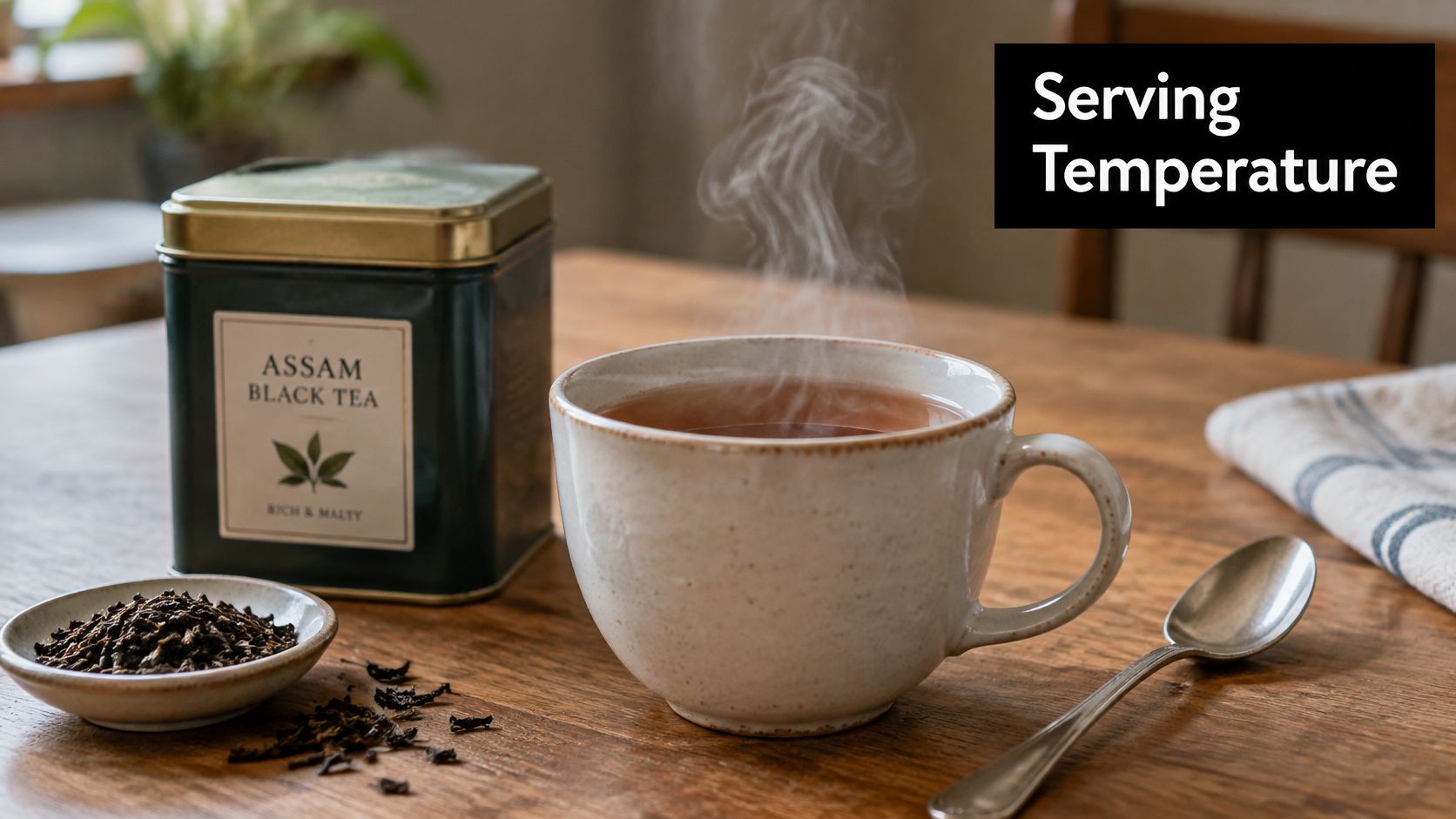
Black tea is the workhorse of most break-room programs, and it is the cup many drinkers picture when they hear the words hot tea.
What the Evidence Supports and What It Doesn't
The clearest summary of the field is an umbrella review published in 2019 that assessed 96 meta-analyses covering 40 distinct health outcomes (Molecular Nutrition and Food Research). Its dose-response findings linked an increase of about two to three cups a day with lower risks of total mortality, cardiovascular death, coronary artery disease, stroke and type 2 diabetes. Favorable associations also appeared for some cancers, plus bone, cognitive and maternal outcomes. The review did not show that tea alone prevents disease, and the strength of evidence shifted from one outcome to the next.
Two other findings keep the claim honest. A meta-analysis of 11 randomized controlled trials with 378 participants found that at least a week of black tea intake was associated with an average systolic blood-pressure reduction of about 1.8 to 2.0 mmHg and a diastolic reduction of about 1.3 mmHg (National Library of Medicine). That drop is real and measurable. It is nowhere near a replacement for anyone's medication. The National Center for Complementary and Integrative Health calls the evidence limited and mixed, with inconclusive human studies on cancer prevention and on green tea for weight loss (NCCIH).
Where Temperature Turns a Healthy Drink Harmful
Brew temperature and serving temperature are not the same setting. Leaves often need near-boiling water to release flavor. The cup the guest drinks should land much cooler.
That same umbrella review flagged harmful associations for esophageal and gastric cancer when tea was consumed above roughly 55 to 60 °C (131 to 140 °F). Prospective research points the same direction in plain language: people who drank tea they described as very hot had a higher esophageal-cancer risk than people who drank it cold or lukewarm. The International Agency for Research on Cancer drew a similar line slightly higher, classing beverages consumed above 65 °C (149 °F) as probably carcinogenic, as summarized in the Wiley-published analysis of tea and temperature.
Green tea adds a second temperature problem, this one about chemistry rather than safety. Experimental brewing research found that catechins, including EGCG, can degrade, epimerize or form oligomers above about 90 °C and during prolonged steeping, and that at 95 °C major epi-form catechins began to decline substantially after about 60 minutes while they stayed comparatively stable at 60 °C (PubMed Central). Hold green tea hot all afternoon and you lose the compounds you are paying a premium for, while the tannins that make it harsh keep building.
Operators often mix those two jobs up. Extraction wants heat. The hand-off wants a pause, the way soup sits a minute before the first spoonful. Technique is easier to copy from a demonstration than a description, so here is the brewing side of the same idea in motion.
Brew temperature, steep time and hold guidance by tea type
Tea type | Brew temperature | Steep time | Hold guidance |
|---|---|---|---|
Green tea | 70-85 °C | 2-3 minutes | Dispense immediately; avoid long hot-holding |
Black tea | 95-100 °C | 3-5 minutes | Dispense promptly after brewing |
Peppermint or chamomile | 95-100 °C | 5-7 minutes | Dispense promptly after brewing |
Rooibos or hibiscus | 95-100 °C | 5-7 minutes | Dispense promptly after brewing |
All teas at hand-off | Comfortably warm, below 55-60 °C (131-140 °F) | Not applicable | Check with a probe or thermostat setting |
A healthy hot tea is unsweetened and served warm, not a drink that promises to prevent disease.
Three settings to confirm before launch: a green-tea program that sits below boiling and stays off the black tea line; a standard setting near boiling for black and herbal; and a probe reading at the cup that lands the drink comfortably warm. If the machine pours straight from a boiler, add a cooling beat between dispense and pickup, or post a clear caution at the panel. The tea vending machine setup guide covers which machine types hold two temperatures, since many single-boiler units cannot.
Caffeine Levels and Hydration Facts to Display
Caffeine is the number guests ask for at the machine, and it is the number tea menus most often get wrong. It is not a fixed property of "tea." Leaf, dose, steep, and cup size all change the yield, the way a recipe changes when you change the scoop and the timer. Data from 400 tea samples collected in homes, workplaces, and retail outlets across 10 areas of the United Kingdom found an average of about 40 mg of caffeine per 235 ml cup, with reported values ranging from 1 to 90 mg per 100 ml (published analysis of UK tea samples). Same leaf, same nominal cup, a very different dose.
That spread is why the panel has to match the brew you run. A longer steep or a heavier leaf charge pulls more caffeine into the cup. A short steep and a smaller pour pull less. Holding a finished pot hot does not rewrite the chemistry, but it does invite a second, stronger brew if staff top up the leaves. Label the serving you dispense, not a generic tea line.
Typical caffeine per 235 ml cup by tea type
Tea type | Caffeine per 235 ml cup | Display note |
|---|---|---|
Green tea | About 25-50 mg | Show caffeine per serving |
Black tea | About 40-70 mg | Show caffeine per serving |
Decaffeinated black or green | About 2-5 mg | Label as decaffeinated |
Herbal teas (peppermint, chamomile, hibiscus, rooibos) | 0 mg | Label as caffeine-free |
Ordinary daily intake in the hydration trials | Up to about six servings | Tea counted like water, not as a diuretic |
Read the last row as servings, not as a printed milligram cap. A systematic review of six intervention trials found that tea supported hydration similarly to plain water at intakes of up to six servings per day (Primary Health Care review). The UK sampling did not show a diuretic effect at ordinary tea drinking. A three-cup office habit is hydration, not fluid loss. Adult caffeine advice in public health guidance is moderate daily intake, with extra care in pregnancy and for people who are caffeine-sensitive. Post the milligrams in the cup. Let guests apply their own limit.
Unsweetened tea also carries a clean label story. It provides zero calories and zero grams of added sugar per serving and is about 99.5% water. A U.S. Department of Health and Human Services evidence submission identifies tea as one of the major dietary sources of flavonoids and notes that caffeinated beverages contribute to total water intake similarly to non-caffeinated ones (HHS evidence submission). In a break room full of sweetened drinks, that swap is the practical health claim: fluid, flavor, and flavonoids, without added sugar.
Show caffeine per serving on the menu board or machine panel. Keep decaffeinated options on their own button so nobody avoiding caffeine has to guess. Sites that also want plain water beside the tea machine can look at home delivery from Oxy Plus Water for the cooler. Caffeine-free blends carry the same unsweetened, nearly all-water cup into the evening, and the guide to herbal tea and hydration covers which ones suit late service.
Allergen and Ingredient Checks Before You Stock a Tea
The tea family isn't where a hot-tea program gets into trouble. The ingredient list is. Chamomile sounds harmless and belongs to the same plant family as ragweed, so a customer with a ragweed or related pollen allergy may react to it. That isn't a reason to pull chamomile off the menu. It's a reason to print the word where people can see it before they drink.
Common tea ingredients and the label line each one needs
Ingredient or item | Concern | Label line |
|---|---|---|
Chamomile | Ragweed-family cross-reactivity | Contains chamomile (ragweed family) |
Licorice root | Blood-pressure effects in large amounts | Contains licorice root |
Ginseng or added herbs | Possible medication interactions | Contains ginseng; consult a clinician if on medication |
Chai or flavored blends | Milk, nut or spice flavorings | Check and list milk, tree nut and spice flavorings |
Caffeine | Sensitivity and daily limits | Caffeine per serving; caffeine-free if applicable |
Tea bag material | Possible microplastic release from plastic mesh | Paper, cellulose or loose-leaf option available |
The rows that catch people out sit in the middle. Licorice root turns up in a lot of blends marketed for throat comfort and can affect blood pressure in large amounts. Ginseng and other added herbs carry medication interactions. Chai-style and flavored blends may include milk, nut or spice flavorings that someone with a dairy or tree-nut allergy needs to know about before the first sip rather than after.
Packaging deserves a mention that stays calm. A 2025 review reported that micro- and nanoplastics may come from packaging, production water and the leaves, and summarized findings of more than 109 particles released from some plastic tea bags when steeped in boiling water (2025 review of tea contaminants). The same literature stresses that the human-health risks remain unclear, so treating an ordinary tea bag as proven harmful would overstate it. The balanced answer is variety plus options: paper or cellulose bags and loose-leaf alongside standard bags, and don't pour boiling water straight onto plastic mesh when the product gives you a choice.
The rule that covers all of it: name every botanical and every flavoring, not just the tea family. That's the discipline behind vegan snack box labeling applied to the food side, where the ingredient line carries far more weight than the front of the pack. A tea blend deserves the same treatment.
How to Set Up a Healthy Hot Tea Program Step by Step
In a 120-person office, the break-room machine gains green, black, two herbal teas and one functional blend. Within the first week, three people ask for a lower-sugar option and one asks whether the chai contains dairy. Both questions were predictable. Setup answers them: how each tea is brewed, held, labeled and dosed, not a later switch of suppliers.
Serving temperature is the lever the program controls. Leaf type matters, but a green tea poured from the same near-boiling boiler as black tea is a different drink, and often a worse one. A shared boiler works like one stove burner asked to simmer herbs and boil a stew at the same time. Something scorches.
The sequence below is seven steps, not a short version you finish and then refine. Work them in order.
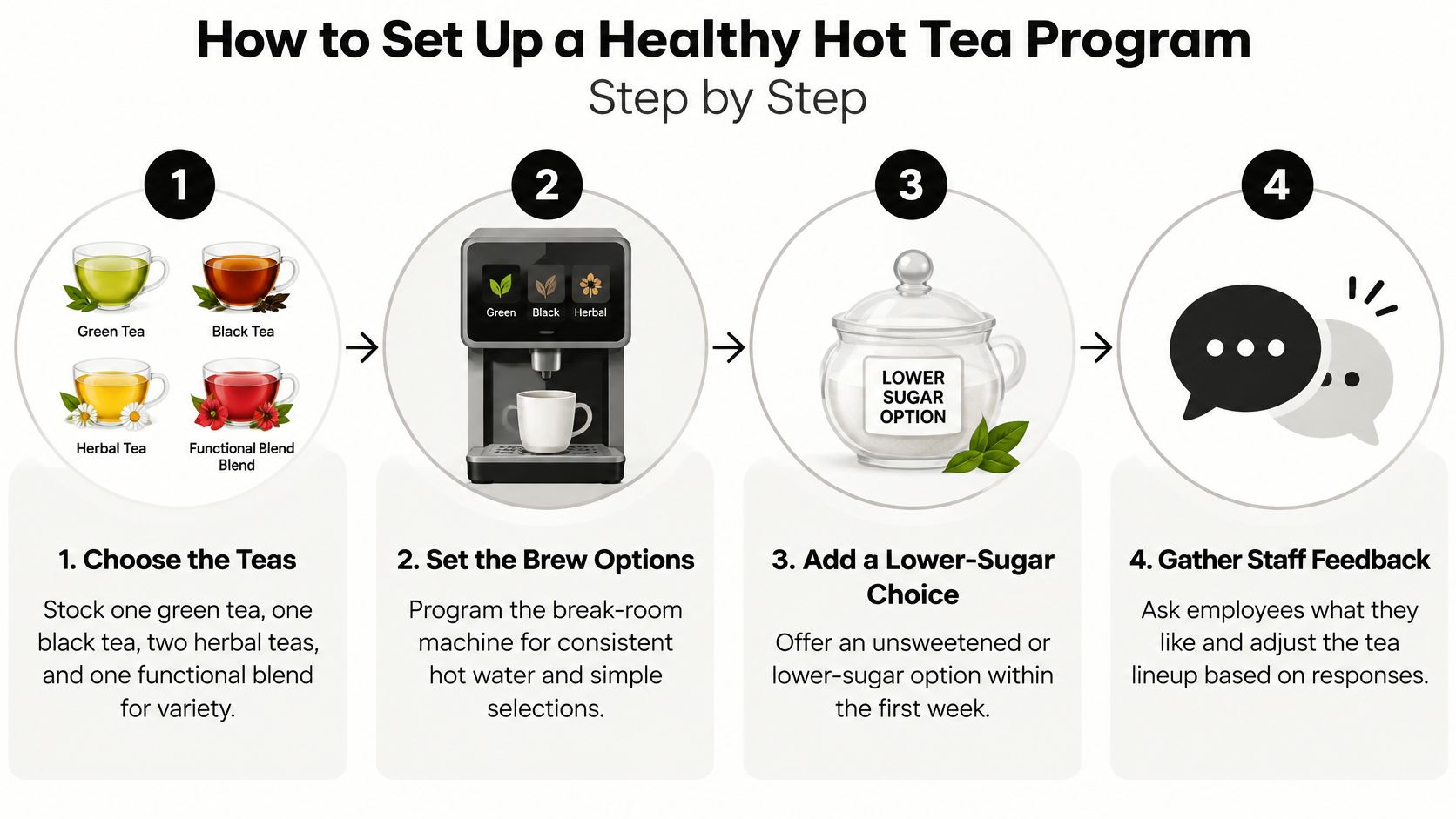
Give green tea its own temperature setting. Program the green line below boiling, in the 70 to 85 °C band. A shared boiler scorches green leaf, and the flavor that comes back is the reason people say they don't like green tea.
Set black and herbal teas near boiling. 95 to 100 °C. Those leaves and botanicals need the heat to open up, and they hold their flavor far better through a busy morning than delicate leaf does.
Check the cup, not just the boiler. Probe the dispensed drink rather than trusting the setting on the screen. A machine pouring straight from a boiler needs a cooling beat or a visible caution at the panel.
Load unsweetened first. Every tea on the menu should be drinkable with nothing added. Ship sweetener separately in sachets so the default cup is the lower-sugar one and the choice belongs to the customer.
Post the numbers. Caffeine per serving on the panel, plus a label line naming every botanical and flavoring in each blend. The vending machine nutrition labeling guide covers how to lay that out so people read it instead of walking past it.
Offer a paper-bag or loose-leaf route. At least one line that isn't plastic mesh, for the customers who ask and the facilities managers who request it.
Review at month one. Pull sales by item, keep the top performers, retire the two slowest and replace them with a different job category rather than a near-identical flavor.
Steps 1 through 3 belong to whoever programs and maintains the machine. Temperature settings, hold time and the temperature of the cup in the hand are their job. Steps 4 through 6 sit partly with the supplier, since what goes in the case, what's printed on the carton and what the label says are their decisions. Dose (unsweetened by default, sweetener only if the customer adds it) is decided before the first cup is sold. Step 7 is yours either way, because sales by item are the signal that a lineup is working.
One more check before you blame the tea. If cups come out tasting metallic or flat, water is usually the cause, and the same troubleshooting that explains bad-tasting coffee from a water problem applies to a tea boiler in the next room.
Confirm Your Tea Lineup Before You Stock
A buyer who signs the hardware first often finds the green tea boiling and the herbal carton silent on caffeine. Those misses are cheaper to catch on paper than after a week of complaints. Run three checks in order, and treat serving temperature as the control you cannot fix by swapping a box of bags.
The mix comes first. Cover a green, a black, at least one caffeine-free herbal, and at least one decaffeinated option. Leave a category out and someone in the building drinks plain water, or skips the break. Locking the mix first also puts three suppliers on the same comparison, leaf against leaf, before anyone quotes a machine.
The temperatures come second. Can the machine hold a separate green-tea setting and a standard near-boiling setting, and does the cup in the hand land below 55 to 60 °C (131 to 140 °F)? One water temperature fails the green tea requirement, whichever leaf you buy. That question rules out unsuitable hardware before a price talk starts. Once the blend is chosen, how hot the water is held and poured is the health lever the program controls.
The labels come third. Every blend should name its botanicals, its flavorings, and its caffeine per serving. A supplier who cannot produce a label sheet has already shown how thin the rest of the paperwork will be.
Before you sign: ask for the label sheet as a document, not a verbal assurance. If it doesn't exist yet, it isn't going to exist after installation either.
Vendmoore Enterprises stocks Coca-Cola, Pepsi, iced coffees and teas, and offers snacks, beverages, and breakfast, lunch and dinner items. The company installs and operates smart vending machines for workplaces and public spaces across Oklahoma, including the Oklahoma City metro, Norman, and Edmond, with cashless payment and telemetry that shows when a line is running low. If you want those drinks and meal items in the same break room as a hot-tea lineup you have already checked for mix, temperature, and labels, contact Vendmoore Enterprises about stocking that range in Oklahoma City, Norman, or Edmond.
Comments