
Lunch Vending Machine Guide: Types, Safety and Setup

Japan's beverage vending fleet saw average sales volume per machine drop nearly 40%, according to The Straits Times. That isn't a forecast for Oklahoma lunch vending. It's a warning against assuming that installing a machine guarantees demand.
A lunch vending machine needs more than a convenient location and a card reader. Buy it as a food-safety system with a data trail, then judge it by whether people can reliably buy meals they want. Temperature records, accountable service and assortment testing matter more than a long feature list.
Lunch Vending Machine Types and Where Each Fits
A lunch vending machine is a refrigerated or chilled cabinet designed to hold ready-to-eat meals, including sandwiches, salads, rice-based dishes and wraps, rather than only packaged snacks. Frozen machines serve a related need, but buyers need somewhere suitable to heat their meals.
Lunch vending machine types and where they fit
Machine type | Typical contents | Temperature control | Best placement |
|---|---|---|---|
Meal-capable refrigerated machine | Sandwiches, salads, rice balls, bento-style meals | Refrigerated with continuous monitoring | Offices, hospitals, transit hubs |
Dual-zone chill center | Chilled meals plus ambient snacks and drinks | Separate chilled and ambient zones | Break rooms and mixed-use lounges |
Frozen food machine | Frozen entrees and dumpling-style meals | Freezer temperature control | Manufacturing sites and apartment common areas |
Compact refreshment center | Snacks, drinks and light grab-and-go meals | Ambient or chilled, per spec sheet | Small offices and schools |
Bottle and can vendor | Beverages only | Chilled or ambient | Supplement to a meal machine |
Apply the operating tests
Start with what must stay cold. A cabinet that chills beverages isn't automatically suitable for perishable meals. Check the manufacturer's intended food applications, operating temperature range and monitoring capabilities, not just whether the brochure says refrigerated.
Next, work out how often someone can restock it. Fresh meals require close coordination between deliveries, expiration dates and actual purchases. Frozen meals may suit a location with less frequent replenishment, provided the site has appropriate heating facilities and freezer monitoring.
Finally, estimate how many people will buy meals each day, not just how many people occupy the building. Employees who bring lunch, work remotely or leave the premises don't create the same demand as staff who depend on on-site food. Observe the break room during actual meal periods before sizing the cabinet.
The comparison of hot and cold vending machines can help clarify equipment choices, but the specification sheet should decide the purchase. Model names and zone counts differ between manufacturers, so compare temperature ranges, independently controlled zones and access for loading and cleaning.
Starting rule: Name the site's biggest unmet meal need first. Choose the machine that serves that need, not the machine with the most selections.
A bottle-and-can vendor can complete a break room, but it can't replace meal access. Likewise, a compact refreshment center is a poor substitute for a meal-capable cabinet when staff need substantial lunches rather than snacks.
Features That Make Lunch Vending Work Unattended
Meals spoil, purchases concentrate around breaks, and equipment sits unattended between visits. That makes operational features more important than a polished touchscreen.
Use this visual checklist when reviewing equipment demonstrations.
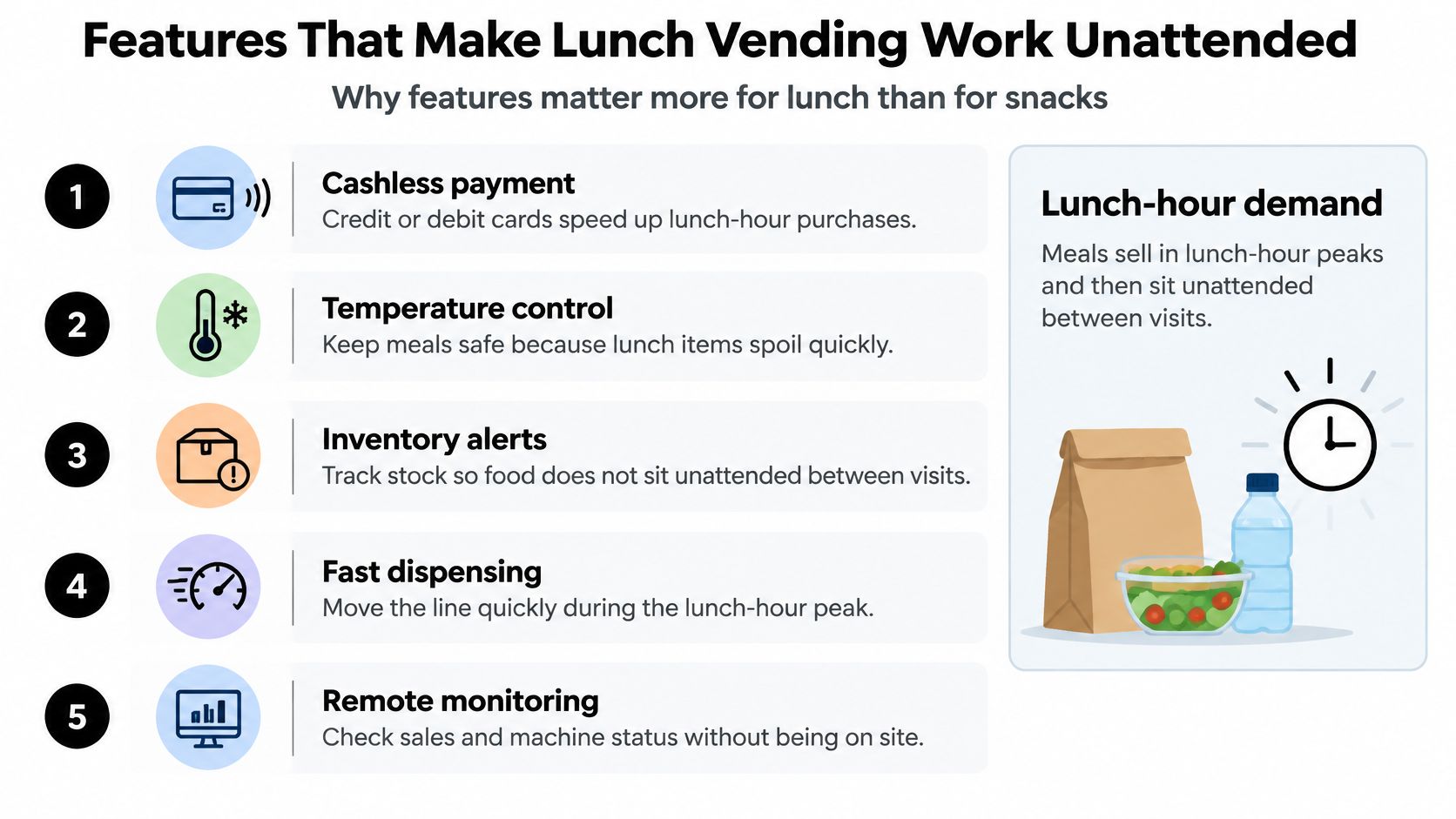
Cashless payment comes first for usability. Specify credit and debit cards, Apple Pay and Google Wallet, with cash fallback where appropriate. Ask how failed transactions, connectivity interruptions and refunds are handled during a busy lunch period.
Telemetry should support replenishment. Request inventory by slot, sales by day and a pick list showing what the next service visit needs. Ask how long transaction and inventory records remain available and whether they can be exported.
Remote monitoring needs a human owner. Temperature excursions, door faults and vend lockouts should reach a named contact, not an unattended inbox. Ask who receives alerts after hours, who backs them up and how quickly each fault category receives service.
Configurable slots protect menu flexibility. Test actual sandwich packs, salad containers and frozen trays before accepting the layout. Ask whether menu descriptions and prices can change remotely, and which physical adjustments require a visit.
Efficient cooling deserves scrutiny. Compare documented energy consumption under comparable operating conditions, along with ventilation clearance and maintenance access. Ask what cleaning and servicing the cooling system needs to retain its rated performance.
Put requirements in the quote
Required: Food-appropriate temperature control, automatic safety lockout, accessible records, accountable alerts, suitable payment methods and reliable dispensing.
Useful but optional: Remote merchandising changes, advanced dashboards and promotional screens. Don't buy these instead of dependable refrigeration or service.
Have the operator demonstrate a purchase, a failed vend and an alert acknowledgment. A feature checkbox doesn't tell you whether the workflow is usable.
This video offers another reference for evaluating vending equipment and operation.
Food Safety Rules Behind Every Fresh Lunch
The FDA Food Code sets 41°F (5°C) or below for cold holding of time/temperature-control-for-safety foods and requires automatic vending controls when equipment can't maintain required temperatures. It also provides a limited servicing allowance: refrigerated vending-machine air may exceed that threshold for no more than 30 minutes after filling, servicing or restocking before shutoff must engage.
Treat those provisions as equipment acceptance criteria, not background reading. The operator needs to demonstrate that a failure prevents sales and that staff can recover the machine safely.
Food-safety checkpoints for lunch vending
Checkpoint | Requirement | What to verify |
|---|---|---|
Cold holding | Maintain the FDA cold-holding limit stated above | Temperature is logged continuously and reported remotely |
Power or mechanical failure | Automatic vend lockout until serviced | Lockout activates during a controlled test and alerts a named contact |
After restocking | Stay within the FDA servicing allowance stated above | Door-open time is kept short during service |
Date marking | Perishable items are date-stamped | Expired items are removed at each service visit |
Corrective action | Excursions are documented with the action taken | A service log is kept and available for inspection |
The House food-safety and sanitation guidelines also emphasize time-and-temperature controls, monitoring documentation and date-stamping perishables. Use those practices in the operating specification while confirming the requirements that apply to your own location.
Handle an overnight outage deliberately
Don't resume selling because the cabinet feels cold again. Cooling after power returns doesn't establish what happened to the meals during the outage. Keep affected products unavailable while an authorized, trained person reviews the temperature history and follows the applicable disposition procedure.
That person should record the fault, affected stock, disposal or other authorized action, repair and release decision. Remove expired or temperature-abused meals from sale and segregate them so another employee can't accidentally reload them.
The facility manager should know who can authorize reopening. Require a written procedure identifying the service technician or food-safety lead, the verification steps and the record retained after the machine returns to operation.
A remote alert is only useful when someone acknowledges it, acts on it and records the outcome.
For operators coordinating mobile service crews, Routelink's resource on dispatch software for fleet-based wholesalers provides useful context for assigning field work. Dispatch supports the response; it doesn't replace food-safety judgment.
Include those responsibilities in your product quality standards, alongside receiving checks and stock rotation. The FDA Food Code is a model code, so confirm Oklahoma state and applicable local requirements before opening the machine for sales.
Matching Lunch Vending to Each Site Type
A 2025 global workplace study of 3,593 employees, summarized alongside the Employer Well-being Strategy Survey, reported that 61% considered vending services essential or important, rising to 66% among Gen Z and 65% among millennials; reported employer adoption was 59% overall and 79% in Gen Z workplaces. Those preferences don't establish demand at your building. Use the actual meal-access gap to decide whether lunch vending belongs there.
Lunch vending needs by site type
Site type | Main lunch need | Assortment focus | Main constraint |
|---|---|---|---|
Corporate office | Quick desk-free lunches | Sandwiches, salads and familiar favorites | Peak lunch-hour restocking |
School or campus | Affordable, quick options | Balanced mix with clear labeling | Access rules and scheduling limits |
Hospital or clinic | Food for staff on any shift | Balanced meals with dietary labeling | Temperature compliance on night shifts |
Manufacturing site | Hearty, filling meals | Protein-forward and frozen meals | Restocking around shift changes |
Airport or transit hub | Fast grab-and-go meals | Ready-to-eat items with cashless payment | High traffic and rapid turnover |
Apartment community | Evening and weekend meals | Frozen meals and familiar snacks | Less frequent staff presence |
Ask who depends on the machine
Corporate offices: Who stays on site for lunch? Position the machine where employees can take a proper break without creating a queue across a corridor.
Schools and campuses: Who can buy, and during which periods? Confirm access restrictions, labeling expectations and affordable choices before selecting the menu.
Hospitals and clinics: What can night-shift staff eat when other outlets close? Plan hospital vending machine access around staff routes and restricted areas, not just visitor traffic.
Manufacturing sites: When do shifts break, and what happens if meals run out before the next crew arrives? Test hearty, protein-forward choices rather than assuming snack demand predicts meal demand.
Airports and transit hubs: Can a traveler complete a purchase without delaying others? Favor straightforward packaging, clear pricing and dependable dispensing.
Apartment communities: Who responds when the leasing office is closed? Evening and weekend convenience requires a service arrangement that doesn't depend on staff being present.
Score readiness before committing
Give each candidate location a pass or fail for meal-period traffic, reliable power, secure and accessible placement, and a named service-alert contact. Resolve failures before installation.
The practical benefits should be clear: lunch without leaving the building, food during off-hours and less pressure to make an off-site trip during a short break. If those benefits don't solve a real problem, don't install a meal machine merely because there's empty floor space.
Stocking Lunch Items and Testing Assortments
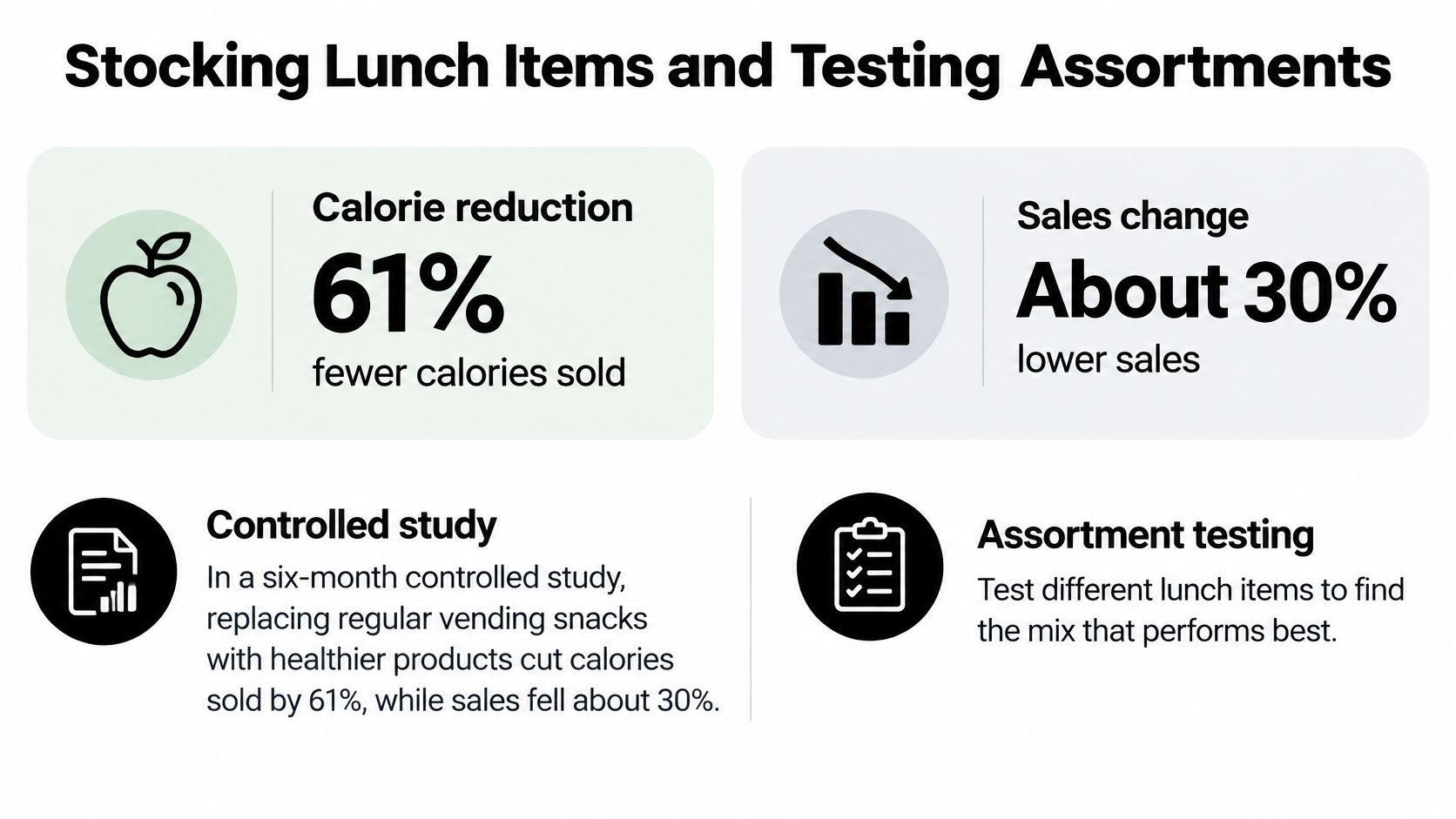
A six-month controlled study described in this vending intervention paper found 61% fewer calories sold after healthier snacks replaced regular products, alongside about 30% lower sales; it also discusses a separate randomized trial across 56 campus machines in which healthier-product guidelines with promotional signage increased snack-machine revenue, while price reductions alone didn't produce the same effect. These are snack-vending findings, not guaranteed lunch-machine results.
The trade-off is visible in this summary.
Test the menu rather than the label
The Employer Well-being Strategy Survey identifies nutritious-assortment requirements and price differentials as policy options. Treat them as testable choices, not promises of better sales.
For a hypothetical 90-day pilot across three different site types, use this sequence:
Keep familiar meals. Add healthier alternatives in visible slots with concise nutritional or promotional cues.
Adapt handling and selection. Schools, hospitals and factories need different mixes. For produce-based options, Shopifarm's tips for storing fresh produce can supplement ingredient-handling planning, not replace finished-meal safety procedures.
Track commercial outcomes. Record units sold, revenue per slot, daily sell-through, spoilage, markdowns and repeat purchases using privacy-appropriate methods.
Reallocate deliberately. Give early sellouts more space and reduce allocations that repeatedly expire.
Use product assortment optimization to make controlled adjustments. Change product mix, signage or price separately so you can better distinguish their effects, while accounting for attendance and seasonal changes.
What Lunch Vending Costs and Who Pays
Compare complete operating proposals, not attractive machine prices. A cabinet can be inexpensive to acquire and expensive to keep stocked, safe and working.
Cost line | What belongs in the quote |
|---|---|
Machine | Purchase price or lease payments for the specified refrigerated, dual-zone or frozen equipment |
Product | Wholesale meal costs, delivery charges where applicable and unsold stock removed from sale |
Power | Refrigeration or freezer electricity under the proposed operating conditions |
Service | Restocking labor, repairs, callouts and after-hours fault response |
Telemetry and monitoring | Subscriptions, connectivity, temperature alerts, record storage and sales reporting |
Revenue terms | Site fees, revenue sharing or sales retained under an owned program |
Compare the same operating assumptions
Have competing providers quote the same site, meal mix and service scope. Identify who pays for spoiled inventory after equipment failure and whether payment-processing charges sit outside the headline fee.
Confirm that temperature records, lockout verification and corrective-action documentation are included. A low service charge means little if essential checks become extras.
Buying advice: Compare total operating cost per meal sold, not cost per machine.
Calculate that measure using meals sold, not stocked capacity. Keep site subsidies and revenue-sharing payments visible so finance staff can distinguish the cost of meal access from the operator's commercial return.
Choose Managed or Owned Lunch Vending
The decision isn't whether to buy a machine. It's whether your organization wants to operate a small unattended food business.
Resolve who restocks and repairs it, who owns food-safety decisions and alert response, and how much menu control the site needs. Assign those responsibilities before discussing cabinet finishes or promotional screens.
Compare responsibility, not just ownership
In a fully managed program, the provider handles replenishment, service and support under the agreement. The site supplies a suitable location, access arrangements and a contact who can report building problems or changing attendance.
In an owned program, the site controls purchasing, assortment and pricing. It also needs people or contractors to manage deliveries, rotate stock, arrange repairs and retain operating records.
Managed vending suits a facility that wants meal access without adding a retail operation to its staff workload. Ownership suits an organization that has the capability and motivation to run that operation, not merely a desire to retain sales revenue.
Ownership doesn't require staff to perform every repair themselves. It does require someone to commission the repair, decide what happens to affected food and verify that the machine can return to service.
A managed agreement also needs clear boundaries. Don't assume a service provider takes responsibility for a disconnected power supply, inaccessible building or ignored site-side alarm unless the contract says so.
The distinction between a vendor and a service provider matters here. Supplying equipment is a transaction; maintaining dependable meal access requires continuing operational accountability.
Take the next steps in order
List candidate sites and their main lunch need. Record who uses each space, when meals are needed and what alternatives exist. Separate a genuine meal-access problem from a request for more snack variety.
Set the required features. Specify food-compatible equipment, payment access, usable operating records and the service workflow. Keep optional merchandising features separate so they don't obscure essential controls.
Request operating evidence in writing. Obtain sample temperature logs, the lockout procedure and named alert contacts. Establish who can authorize stock disposal and reopening, including when the usual contact is unavailable.
Pilot before expanding. Track the assortment, availability, discarded stock and user feedback. Agree on the conditions for continuing, changing or removing the program before anyone commits to a wider rollout.
Make the local service arrangement explicit
At Vendmoore Enterprises, we offer fully stocked vending, and customers can also choose to own their own machine. Our full-service vending covers stocking, service and support, allowing the operating model to match the site's resources.
We customize each machine's inventory to the space and serve Oklahoma. That means the conversation should begin with your break room, teacher lounge or community area and the people who use it, rather than a fixed menu.
Call 405-294-2373 with your candidate site list, meal periods and main access gaps. Use that conversation to establish the right equipment, service responsibilities and pilot scope before committing.
Vendmoore Enterprises offers fully managed vending and machine-ownership options for Oklahoma locations that need dependable lunch access. Visit Vendmoore Enterprises to discuss your site list, customized inventory and the operating arrangement that fits your break room or common area.
Comments