
Property Management Vendor Application: How to Get Approved

An office building manager needs a reliable break room vending operator before a new floor of tenants moves in next month. Two vendors send over packets on the same afternoon. The first attaches a glossy product brochure and a signed W-9, while the second includes a complete property management vendor application with verified insurance endorsements, replenishment schedules, and measurable outage commitments.
Only one of those files moves past the operations desk. Across the roughly 340,000 businesses operating in the U.S. property-management industry tracked by IBISWorld, formal vendor vetting has replaced handshake deals. Property teams overseeing residential communities, corporate offices, hospitals, and industrial parks need more than a valid business license. They need evidence that the vendor can enter the site safely, operate predictably, and keep the amenity working after approval.
A sound review evaluates every incoming vendor packet on two separate tracks. Compliance documents prove a company is legally eligible to step onto the property, while operating evidence proves it will perform after installation day. Pairing both tracks upfront saves operations teams from approving a compliant vendor that lets break room machines sit half-empty. It also shows serious vending services and trade operators how to get approved without watching their paperwork stall in a queue.
Classify the Service and Required Documents
Start every review by sorting the requested work into a risk exposure class, because that single label determines every document, insurance limit, and screening rule that follows. Property teams handle a heavy administrative load already, and a 2025 Building Engines survey on commercial property-management technology found that vendor management and procurement rank alongside tenant issue management and preventive maintenance as the most time-consuming work areas. Treating a vendor application as a structured intake gate rather than an open-ended contact form keeps your team from chasing missing forms after a contractor has already arrived on site.
Modern vendor platforms tie centralized databases and automated approvals directly to accounting workflows, yet the same survey points out that getting suppliers to adopt digital work-order systems remains a major obstacle. Requiring vendors to declare their service class, maintenance schedule, payment handling, and digital work-order compatibility at intake filters out operational friction early. If you want a broader look at structuring initial intake stages, Procright offers a step-by-step guide to onboarding suppliers that aligns cleanly with property-level procurement rules.
Application Requirements by Service Type
Match the applicant's scope against the table below before issuing a document request. Treat about $1 million per occurrence and $2 million aggregate in general liability coverage as a standard starting point, then raise limits when site risk or contract terms call for tighter protection.
Service type | Risk exposure | Documents to collect | Insurance to verify | Screening |
|---|---|---|---|---|
Routine refreshment restocking | Low, recurring visits to break rooms | W-9, references, emergency contacts | General liability, commercial auto if vehicles enter the site | None unless restricted areas are entered |
Equipment installation | Medium, heavy machines and utility connections | W-9, subcontractor list, scope-specific licenses | General liability at about $1M per occurrence and $2M aggregate, workers' compensation | Background screening if occupied units or schools are involved |
Electrical work | High, licensed trade with fire and shock risk | State electrical license, W-9, ownership details | General liability, workers' compensation, additional-insured endorsement | Background screening for all personnel on site |
Food handling | High, direct consumer health exposure | Food-safety documentation, sanitation procedures | General liability, certificate reconciled to contract | Required where healthcare or restricted areas apply |
Recurring on-site access | High, unattended access to units or sensitive areas | Personnel roster, ID verification, access procedures | General liability, commercial auto if applicable | Background screening for every person with access |
Enforcing Mixed-Scope Classifications
Many workplace service providers cross more than one row in that table. A break room vending operator might handle routine snack and drink replenishment every Tuesday, yet also wheel in heavy dual-zone coolers during launch week and restock fresh or frozen items that trigger food-safety rules. When an engagement spans multiple rows, apply the highest-risk row to the entire file.
Classification rule: Never schedule a site walk, delivery window, or installation date until every document tied to the highest-risk row sits verified in the folder.
Record the assigned risk class directly on the cover sheet of the vendor file so any future reviewer understands why stricter limits or background checks were enforced. That record matters even more in regulated environments like hospitals and clinics, where understanding what defines a healthcare vendor prevents a routine break room delivery from violating facility access rules.
Verify the Application in Five Steps
Once the service class is locked in, move the file through a gated verification sequence instead of checking papers in whatever order they hit your inbox. Assigning each step to a named staff member with a hard completion deadline prevents applications from sitting half-reviewed in a shared drive.
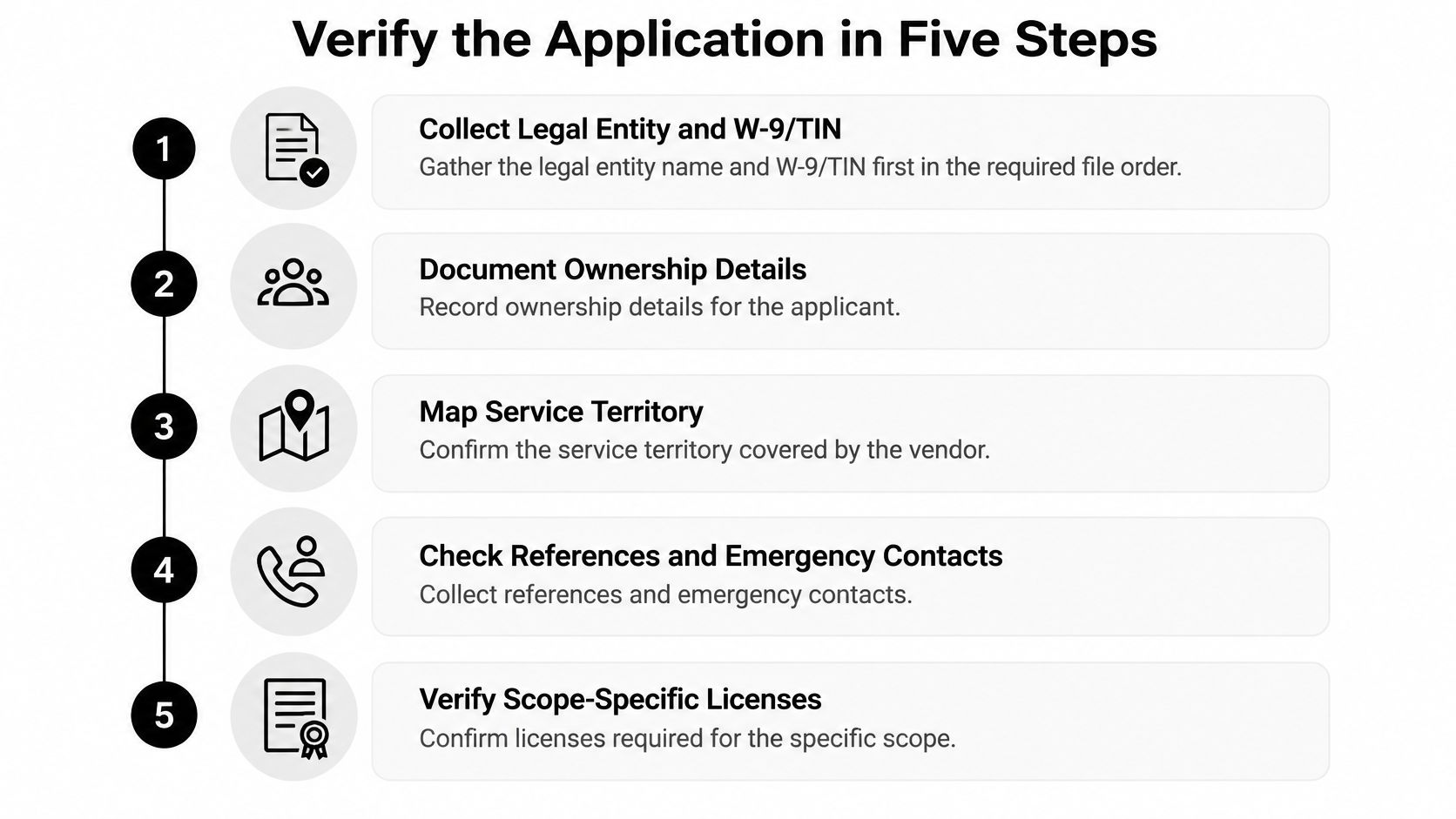
A gated workflow outlined in the VendorAccess property-management compliance checklist stops risky gaps before a supplier gets badge access or a purchase order. Follow these five steps in exact sequence:
Collect the complete entity and scope file first. Request the legal entity name, W-9/TIN, ownership details, service territory, comparable references, emergency contacts, and scope-specific trade licenses in one pass. Pull subcontractor disclosures right here too, because any subcontractor stepping onto your property must carry the exact same credentials as the prime applicant. If a licensed trade is involved, check the state database directly rather than trusting a scanned PDF, much like property teams in coastal portfolios verify a Florida pest control license through official registries before awarding recurring routes.
Reconcile every insurance policy against the contract. Confirm commercial general liability, workers' compensation where applicable, commercial auto for any vehicles entering parking decks or loading docks, and required additional-insured endorsements. A common property-management baseline sits around $1 million per occurrence and $2 million aggregate for general liability, adjusted upward for heavy installation or specialized trades. Never stop at glancing at a certificate of insurance; reconcile policy limits, effective dates, named insured entities, and actual endorsement wording directly against your contract terms.
Complete background screening prior to granting access. Whenever technicians or route drivers will enter occupied apartment units, K-12 schools, healthcare wings, or restricted back-of-house corridors, verify screening results before issuing keys, fobs, or gate codes. Log the clearance date and individual names in the file rather than accepting a verbal assurance from a branch manager.
Gate conditional approvals with written deadlines. Sometimes an urgent break room installation or seasonal repair needs to move forward while a minor endorsement wording update is in transit from an insurance broker. Approve conditionally only after logging each open deficiency, its exact expiration date, and the named reviewer responsible for closing it, paired with a strict no-work rule if active coverage lapses.
Maintain a timestamped audit trail with automated renewals. Record every approval stamp, reviewer name, and expiration date inside your management platform, and trigger renewal notices ahead of policy cutoffs. When an auditor or building owner asks why a vendor was allowed on site six months ago, that timestamped log answers the question in thirty seconds.
Why Certificates Alone Fail Audits
Step two catches more compliance disasters than any other check in the workflow. A certificate of insurance is merely a snapshot showing coverage existed on the day the broker printed the page, not legal proof that your ownership entity holds additional-insured protection under the underlying policy.
Conditional approval without a logged expiration date and a named owner quietly turns into permanent approval the moment your team gets busy.
The same discipline applies when distinguishing an ongoing operational partner from a one-off contractor. Reviewing the difference between a vendor and a service provider clarifies which agreements require continuous certificate monitoring and which only need single-job verification before payment release.
Scoring Criteria and Service Levels That Win Approval
Passing compliance checks only tells you a supplier won't blow up your insurance audit. It doesn't tell you whether their vending machines stay stocked during a Friday rush or whether a technician answers the phone when a card reader freezes. To separate reliable operators from bare-minimum applicants, score every finalist against pre-set weights before reading a single sales pitch.

Structured qualification programs detailed in the NetVendor compliance guide for property management teams show that inadequate insurance, expired licenses, weak safety practices, and vague contracts cause the vast majority of vendor failures. Defining a weighted scorecard upfront removes gut feelings from the selection room and forces every applicant to back up marketing claims with verifiable proof.
Scoring Weights and the Evidence to Request
Use this five-part weighting model to evaluate break room vending services and recurring building contractors on equal footing.
Criterion | Weight | Evidence to request |
|---|---|---|
Compliance and safety | 30% | Current insurance, licenses, screening records and safety procedures |
Operating reliability | 25% | Replenishment frequency, equipment uptime method, product rotation procedures |
Service responsiveness | 20% | Escalation response times, dispatch ownership, maximum response time |
Total cost | 15% | Fee structure and product pricing compared on the same basis |
Technology and reporting | 10% | Payment-security controls, alert-to-action workflow, sample reports |
Comparing total cost on a true apples-to-apples basis is where many operations leads catch hidden trade-offs. Ask every vending or amenity applicant to lay out its fee structure, item-level product pricing, and any commission or revenue share paid back to the property side by side. A zero-cost installation fee looks attractive until you notice inflated drink prices that frustrate tenants or a tiny commission percentage buried in fine print.
Turning Scorecard Proof into Enforceable Contract Terms
Reject unsupported slogans before you assign points. A vendor claiming "24/7 service" gets zero credit in the responsiveness category unless it puts exact coverage hours, named dispatch ownership, maximum response times, and outage protocols in writing. The same skepticism applies across every building trade, which is why practical buyers vetting recurring contractors use clear operational benchmarks like those in this guide to choosing a reliable Miami-Dade cleaner rather than taking broad reliability promises at face value.
The walkthrough below breaks down how structured vendor scorecards keep recurring service commitments measurable from day one.
Once a vendor wins the scorecard, translate its proof directly into your vendor management service level agreement. Spell out exact reporting cadences, service windows, corrective-action deadlines, termination rights, and data ownership. For connected vending operators, treat telemetry dashboards and cashless payment terminals as measurable operational controls, requiring written uptime definitions, alert-to-action workflows, inventory reconciliation, and cybersecurity ownership.
Don't file the contract away after onboarding. Run formal performance reviews every quarter to audit stockout rates and ticket closure times, while continuously re-validating insurance policies, trade licenses, site-access rosters, and subcontractors in the background.
Tenant-Facing Technology and Amenity Questions to Ask
Approving a roof repair contractor rarely affects a tenant's daily routine, yet installing smart vending machines or cashless refreshment centers puts your vendor directly in front of every employee, resident, or visitor walking through the lobby. Tenant expectations are high: the 2025 VTS Global Workplace Report, cited in Atlas Global Advisors' vendor onboarding checklist for property managers, found that 85% of tenants believed access to additional amenity space, even offsite, would benefit them.
Even with strong demand, "more amenities" isn't automatically better for a building. A poorly placed machine blocks corridor traffic, an unresponsive refund process sparks tenant complaints at the front desk, and an unmonitored network connection introduces unnecessary privacy risk. Standard onboarding checklists often toss around acronyms like SOC 2 or ISO 27001 without giving property managers practical questions suited for low-risk, on-site equipment.
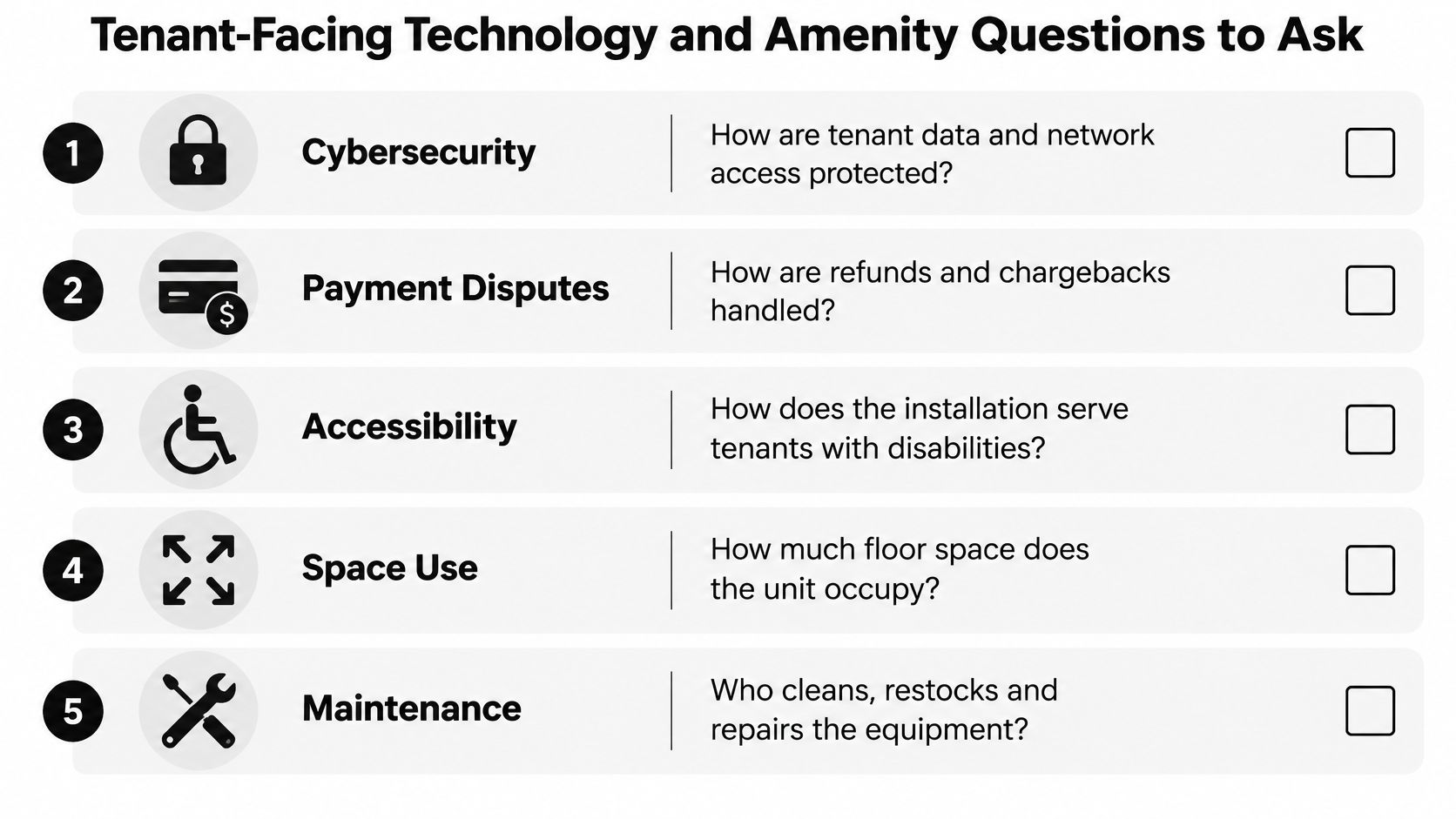
Questions to Ask a Vendor Before a Pilot
Put all seven questions below to any amenity or smart vending applicant in writing before authorizing a trial installation. Any supplier that dodges a question or answers with vague assurances hasn't earned floor space in your building.
Question | What a good answer shows |
|---|---|
What data is retained, and who can access it? | Named data categories, retention period, access roles and a written breach-notice commitment |
How is tenant feedback collected and acted on? | Feedback channel, response time and a documented process for changing assortments |
How are payment disputes resolved? | Refund path, dispute timeline and the named contact who owns resolution |
How is equipment placed for accessibility and traffic flow? | Clearance dimensions, accessible-reach rules and a site plan the property approves |
Which certifications apply? | A SOC 2 or ISO 27001 report covering stored data, or a stated reason none applies |
How will success be measured without overstating causation? | Baseline utilization and stockout rate before install, compared with the same period after |
What triggers removal or relocation? | Written thresholds for stockouts, complaint volume and low utilization at 30, 60 and 90 days |
Assortment flexibility deserves extra attention during that review, especially when you're comparing practical apartment amenity ideas or upgrading an office break room. A warehouse shift crew, a teacher lounge, and a medical clinic waiting area don't buy the same snacks or beverages. At Vendmoore, we customize each machine's inventory to fit the needs of the space where it is placed, building a thoughtful mix of classic favorites, healthier options, or both and documenting why each selection belongs in that location.
Running a Structured 30, 60, and 90-Day Pilot
Never sign a multi-year exclusivity agreement on a new amenity without testing performance against written checkpoints first. Break the trial into three clear milestones:
At 30 days: Confirm clean installation, verify initial stock levels and product rotation, and audit the first full monthly telemetry or sales report for accuracy.
At 60 days: Compare machine utilization and stockout frequency against your baseline expectations, review tenant product requests, and verify how fast the vendor closed any refund or maintenance tickets.
At 90 days: Hold a formal keep, relocate, or remove review using the exact performance thresholds agreed to before delivery, without claiming the machine alone drove broader lease renewals or retention.
If a smart vending operator won't commit to written relocation or removal triggers at 90 days, they're asking your property to absorb the entire risk of a bad placement.
Diagnose Stalled Files and Submit a Pilot-Ready Packet
Compliance folders prove eligibility, yet location-specific operating evidence is what convinces a busy property operations lead to sign off. Most vending operators treat a property management vendor application like a tax form: attach a W-9, drop in a generic certificate of insurance, paste three anonymous quotes from happy customers, and wait. Meanwhile, public-sector procurement standards such as the Chicago Housing Authority vendor submission checklist show what serious reviewers expect: a structured work plan, past performance, relevant references, organizational structure, clear fee proposals, and full compliance disclosures.
If you've submitted an application that hasn't moved in two weeks, stop sending "just checking in" emails. Diagnose the exact stall point using the table below and send the missing proof before resubmitting.
Common Stall Points and Fixes
Problem | Why it stalls | Fix before resubmitting |
|---|---|---|
Certificate of insurance has expired | Coverage lapsed after the application was logged | Send renewed dated proof and hold scheduling until it arrives |
Only generic testimonials provided | Reviewers cannot tie praise to their own building | Add location-specific references and a one-page operating plan |
Vague 24/7 service claim | Coverage hours and dispatch owner are not stated | Specify hours, dispatch owner, maximum response time and outage procedure |
Subcontractor paperwork missing | Prime vendor documents do not cover subcontractors | Collect the same insurance and screening from each subcontractor |
Pilot has no removal criteria | Reviewers cannot approve a trial with no exit | Define the thresholds for relocation or removal in writing |
Assemble the Pilot-Ready Packet
Whether you're a property manager setting a clear submission standard or a break room vending operator trying to cut approval time in half, bundle four crisp components into a single PDF packet:
Verified compliance folder: Include the legal entity details, W-9, trade licenses, reconciled insurance endorsements, background-screening attestations, and matching subcontractor files.
Completed weighted scorecard evidence: Supply documented replenishment schedules, payment-security controls, comparable references from offices, schools, hospitals, or residential properties, and transparent pricing side by side.
One-page operating plan: Lay out exact service frequency, response-time commitments, named escalation contacts, inventory replenishment logic, ADA accessibility placement notes, and a sample monthly performance report. Pair that plan with a clean vendor maintenance form so building engineers know exactly how to log and track repair requests.
Written 30-, 60-, and 90-day pilot plan: Specify baseline utilization tracking, stockout caps, feedback collection loops, and clear relocation or removal criteria.
Compliance gets your company on the eligible list; a one-page operating plan gets your machines onto the property floor.
Confirm Oklahoma Coverage and Make the First Call
Geographic service territory is the very first filter for any regional portfolio. Before assembling custom site plans for Oklahoma buildings, confirm the operator actively routes technicians to your specific zip codes. At Vendmoore, our listed service areas cover Oklahoma City (all OKC metro locations), Moore, Choctaw, Del City, Jones, Norman, Mustang, Edmond, Newcastle, Shawnee, and Tuttle.
Once you've verified service coverage, pick up the phone during regular office hours to confirm open packet items and lock down operational expectations before a site walk. You can reach our team in Moore, Oklahoma at 405-294-2373 Monday through Friday from 9:00 AM to 5:00 PM or Saturday from 9:00 AM to 3:00 PM, or submit your property details through our online contact form with your first name, last name, email, phone number, and message.
Bring four sharp questions to that first call so nothing gets glossed over:
Which exact service classes is the vendor currently insured and approved to perform on site?
Who personally owns dispatch when a machine jams, loses cooling, or drops a card transaction?
How are installation fees, retail item prices, and any property commissions structured in writing?
What is the exact timeline for compliance review, site placement approval, and delivery?
Close the review with a written decision rather than an informal verbal nod. If minor paperwork items remain open while a placement date approaches, issue a documented conditional approval with hard calendar deadlines so your team protects the property and gets a reliable break room amenity up and running without unnecessary delays.
Vendmoore Enterprises installs and manages modern, AI-powered break room vending programs across the Oklahoma City metro and surrounding communities, featuring tap-to-pay cashless checkout, real-time remote monitoring, and customized snack, drink, and frozen food assortments built for each site. Whether you're evaluating a new vending partner for an office building, apartment community, school, hospital, or industrial facility, our team delivers the clear operating plans and responsive local service property managers require to approve a pilot with confidence. Visit Vendmoore Enterprises to review our full-service and machine-ownership options and start your property's refreshment plan.
Comments