
Real Time Stock Data for Vending Machines Explained

The iced coffee slot empties at 10 a.m. on a Tuesday. The break room still looks fine from the hallway, so nobody calls. The driver finds the empty coil on Thursday, along with a sticky note asking why the machine never has anything cold after midmorning. That two-day blind spot is the whole problem real-time stock data is meant to fix on a vending route.
A count taken at the last visit is already stale by the next lunch rush. A live feed is a continuous, timestamped record of what the machine itself reports as people buy, doors open, and faults trip. Used well, it tells you which slots will stock out before the next stop. Used blindly, a sensor glitch or an estimated count will send a truck to a machine that still has product, or leave a fast seller empty because the number on the screen never moved.
Real-Time Vending Stock Data at a Glance
Say that iced coffee coil holds eight bottles on Monday morning. By 10:15 the last one is gone. If the machine only gets counted on the weekly route, Thursday is the first time anyone knows. Real-time stock data, in this article, means machine-level inventory, not market quotes. It is the stream of events each cabinet sends while sales are happening, so a reorder decision can land before the next empty window, not after it.
Not every cabinet sends the same set of events. A slot count may come from a drop sensor or a spiral counter, or it may be an estimate built by subtracting sales from the last physical fill. Cash sales, card taps, and a door that opened for a service call are different facts. Treat them as separate signals.
Signal | Trigger | What It Shows | Restocking Use |
|---|---|---|---|
Vend event | Each completed purchase | Which slot sold and when | Sales speed per product |
Slot stock count | After each vend or restock, if sensed | Units left in each slot | Live reorder trigger |
Door-open event | Each time the door opens | Restock or service visits | Confirms a route actually happened |
Cabinet temperature | Periodic reading | Whether chilled and frozen stock is held at temperature | Early warning of spoilage |
Fault code | Slot, coin or payment fault | Jammed or dead slot | Dispatch a repair before stock sits unsold |
Payment record | Each tap-to-pay transaction | Cash versus cashless mix | Product mix decisions |
A vend event is the cleanest speed signal, because it names the slot and the minute. A slot stock count is what you compare with a reorder point, but only if that machine can sense units. A door-open event proves someone was there. It does not prove the right products went in. Temperature and fault codes stop you from restocking a cabinet that will spoil food or a coil that cannot vend.
Three checks before you trust a machine
Run this on any cabinet before you build a route around it.
When it last sent an update. If the timestamp is from yesterday, the screen is a photograph, not a live count.
Which signals it reports. Vend events without slot counts, or counts without door events, leave a hole in the decision.
Whether slot counts are sensed or estimated. Sensed counts drop with each successful vend. Estimated counts only stay honest if every sale and every fill was logged.
A slot that looks full on an estimated count can be empty in the building. Confirm the sensing method before you skip a stop.
How Live Counts Reach the Operator Dashboard
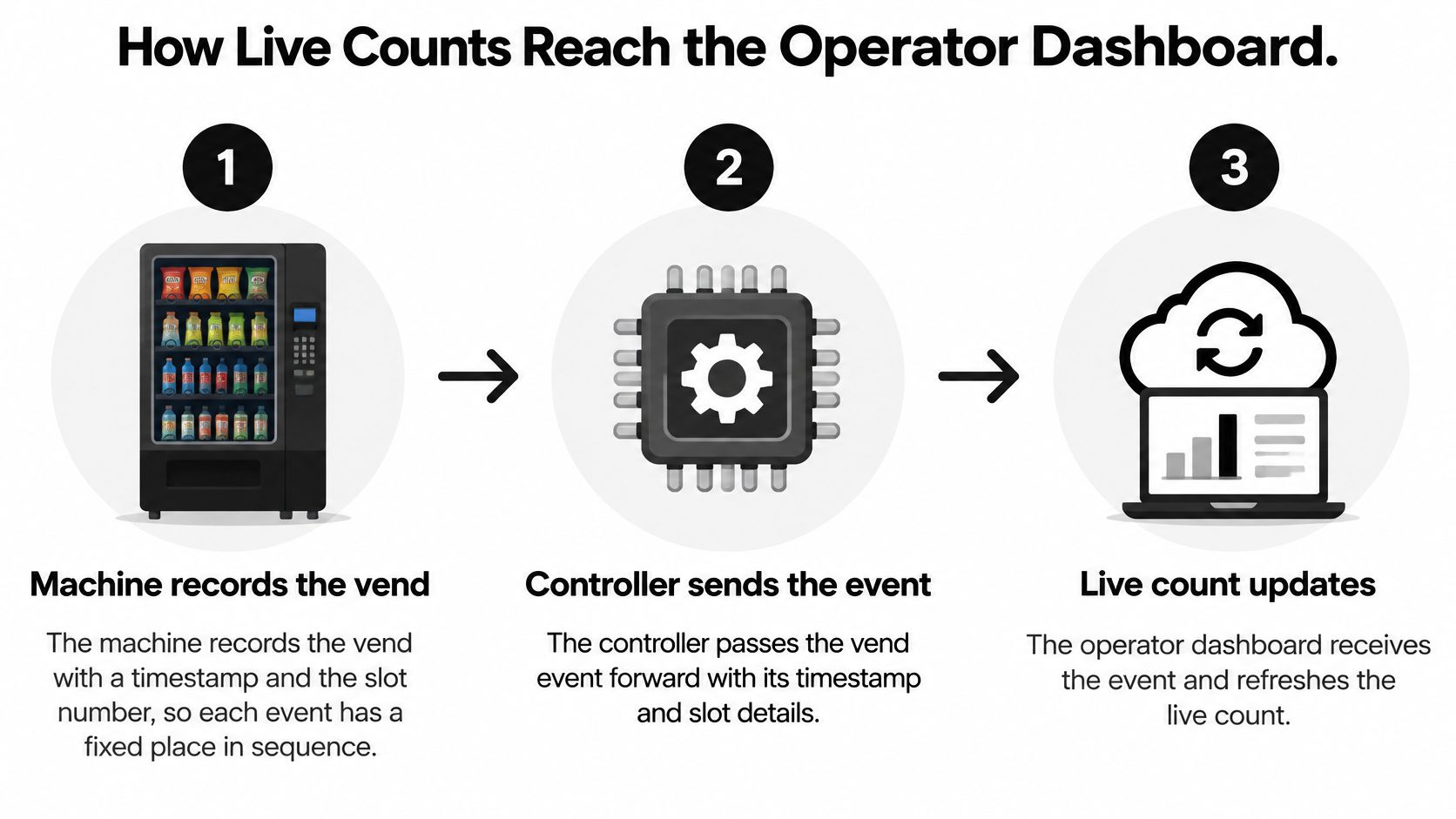
A bottled-water sale can affect the next restock only after its record reaches the dashboard and triggers a useful decision. A break in the chain can leave an apparently active screen showing a slot that is already empty.
The machine records the vend. Its controller logs the time and slot number. That detail separates a coffee sold at 9:40 from one sold at 12:10, rather than combining both into a daily total.
The controller stores the event locally. If the cellular connection drops, the cabinet can retain the sale until it reconnects. A brief outage need not create a permanent hole in the record.
A cellular or Wi-Fi link sends the event. The machine transmits stored sales to the cloud platform. The connection carries the record; local storage preserves it while the link is unavailable.
The dashboard updates the slot count. A machine with unit sensing can report units remaining. If it cannot sense stock, the platform subtracts each recorded sale from the last logged fill and displays an estimate. Keep that estimate clearly identified, since it is not a physical count.
A threshold rule flags low slots. The platform compares the count with the product's reorder point. At that stage individual events become a restocking signal. Without a threshold, the dashboard is only a sales ticker.
The operator plans the route. Review the flags, group nearby stops, and assign a driver. A low-slot alert helps prioritize a visit, but the operator still weighs the stock signal against the cost of adding another stop.
Why tap-to-pay belongs in the sales record
Cashless payments need to appear in the same record as other vends. The Diary of Consumer Payment Choice from Federal Reserve Financial Services reports that mobile phones were used for 23% of all consumer payments in 2024, 11% of in-person non-bill payments, and 45% of remote payments. It also reports an average of 11 mobile-phone payments per consumer in 2024, up from 10 in 2023. When a phone tap is missing from the vend log, recorded sales speed for drinks and snacks falls short, and a low-stock alert may arrive late.
A payment record also helps operators track whether a location's purchases are shifting toward cards and digital wallets. Keeping payment, vend, and stock-threshold information together makes the alert easier to act on. Teams that build dashboards that drive decisions can see the sale and its stock impact in one place, rather than checking separate reports.
A live feed can still contain gaps or misleading counts. How vending telemetry works explains the path from cabinet to cloud. Check periodically that events are arriving, that sales made during offline periods appear after reconnection, and that estimated counts still align with logged fills and vends. A connected status confirms a link, not a complete sales record.
Setting Reorder Points From Sales Speed
Sales speed is units sold per day, taken from the last two to four weeks of vend events. One busy Monday will overstate a slow office. Lead time is the number of days between the moment you decide to restock and the moment the driver is at the machine. The reorder point is daily sales multiplied by lead time, plus a 20% buffer, rounded up to a whole unit.
Bottled water that sells 18 a day, with a 2-day lead time, needs 36 units to cover the wait. Add 20 percent and you get 43.2, which rounds up to 44 units. When the live count hits 44, that slot is ready for the next route, not when it hits zero.
Product | Daily Sales (units) | Lead Time (days) | Reorder Point With 20% Buffer |
|---|---|---|---|
Bottled water | 18 | 2 | 44 units |
Salty snacks | 10 | 3 | 36 units |
Iced coffee | 6 | 1 | 8 units |
Frozen meal | 4 | 4 | 20 units |
Energy drink | 3 | 7 | 26 units |
The same rule produces the rest of the table. Salty snacks at 10 a day and a 3-day lead land at 36. Iced coffee at 6 a day with a 1-day lead lands at 8, which is why a short lead time still needs a buffer on a small coil. A frozen meal at 4 a day and a 4-day lead lands at 20. An energy drink at 3 a day and a 7-day lead lands at 26, because the wait, not the daily pace, is what fills the truck.
Three adjustments that keep the math honest
Weekday shape. Offices often sell harder on Mondays and Fridays. Raise the buffer before those days rather than rewriting the whole par level for a quiet Wednesday.
New products. A flavor that has been in the cabinet for four days does not have a speed yet. Give it two weeks of vend events before you trust the daily average. Until then, fill to a modest par and watch sell-through.
Sold out before the visit. If a slot hits zero while the route is still a day away, the reorder point is too low. Raise it. Adding extra visit days to a long route list usually costs more than carrying a few more units of a proven seller.
You can track whether those points are doing their job with the inventory KPIs that show fill rate and stockouts. The practical test is simple. The slot should reach its reorder point the day before the route, not the day after the driver has already passed the building.
If the flag appears after the truck has left the area, the lead time in the formula is shorter than the real route.
Balancing Stockouts Against Overstock
A stockout costs the sale and makes the break room feel unreliable. People remember the empty coffee coil longer than they remember a full one. Overstock ties up cash in coils that turn slowly. For chilled and frozen food, extra units past one sales cycle become waste you pay to throw away.
Three ways of deciding when to visit sit on that tradeoff. None of them is free.
Approach | How It Decides | Stockout Risk | Waste Risk | Best Fit |
|---|---|---|---|---|
Fixed weekly route | Same visit every week | High for fast sellers | Moderate | Stable, low-volume offices |
Threshold-triggered visit | Visit when a slot reaches its reorder point | Low | Low | Mixed-traffic break rooms and common areas |
Demand-forecast route | Plan visits from weekday, event and seasonal patterns | Lowest when data is clean | Low | Stadiums, airports and campuses with event spikes |
A fixed weekly route is easy to staff and easy to explain to a site contact. It fails when a water slot sells out on Wednesday and the truck is not due until Monday. Waste stays moderate because you are not chasing every dip, but fast sellers still go empty.
A threshold-triggered visit sends the driver when a slot hits its reorder point. Stockout risk and waste both stay low if the counts are real. It is the practical default when you have telemetry and mixed traffic, and you do not yet have a month of clean history.
A demand-forecast route plans ahead from weekday, event, and seasonal patterns. It fits stadiums, airports, and campuses where Tuesday is quiet and Friday night is not. It only beats a threshold when the history is clean. Dirty counts produce a confident plan for the wrong day.
Retail teams often compare inventory software for retail and eCommerce when they want par levels and reorder rules in one system. The same discipline applies in a cabinet. The software does not pick up the waste. The rules do.
Working rules I would actually run
Rank slots by the cost of running out. A frozen meal or a bottled-water column outranks a slow candy slot. Protect the items people came to the machine to find.
Cap par levels for fresh items at what sells through in one cycle. A second case of sandwiches "just in case" is usually the case you discard.
Move product inside the machine first. If one coil is empty and the neighbor is full of a slow twin, shift units before you order more. That transfer shows up as a door-open plus a count change, not as a new purchase order.
Forecasting needs at least a month of clean vend events before it should override a threshold. Until that month exists, book the visit when the reorder point hits, and keep the weekly route only for sites whose sales barely move.
Four Sites and the Restocking Patterns They Create
The reorder rule can stay the same across a route. The clock and the product mix cannot. We customize each machine's inventory to fit the needs of the space where it is placed, because the sales record at one address is a poor template for the next.
A corporate office spikes at 10 a.m. and again after lunch. Coffee and snack slots need to be topped up before those windows, not after the second wave has already walked away. A Thursday-only fill misses both peaks twice.
A clinic turns over at 7 a.m. and 7 p.m. Breakfast items and drinks empty early. Evening slots stay quieter unless the night shift is large. A midday restock looks efficient on a map and still leaves the morning crew with empty rows.
A manufacturing floor breaks at 10 a.m. and 2 p.m., and only on shift days. Telemetry shows frozen meals and chilled drinks jumping on those days and sitting still when the line is down. Treat a holiday Monday as a different site from a normal Monday.
A stadium or airport is nearly flat most of the week, then steep on event nights. The live feed is what justifies a same-day visit. A fixed weekly par will either waste a quiet Tuesday or run out before halftime.
What the sales record should change
Product mix follows the same evidence. The vend log shows what that location buys, which is the point of product assortment optimization. An office that lives on iced coffee does not need the same facing as a plant that lives on frozen meals.
Keeping those patterns straight across buildings is a multi-location stock accuracy problem. One shared par level copied to every serial number will overfill the clinic and underfill the plant. The reorder math stays put. Timing and assortment move with the site.
Checking Your Data for Gaps and Errors
Live data is not the same thing as a correct count. That assumption is how routes get booked against fiction. Cash can log as money in the box without a clean slot match. A cabinet can sit offline across a busy weekend. An estimated count drifts by one unit every time a vend or a fill is missed, and the screen still refreshes on a schedule so it looks healthy.
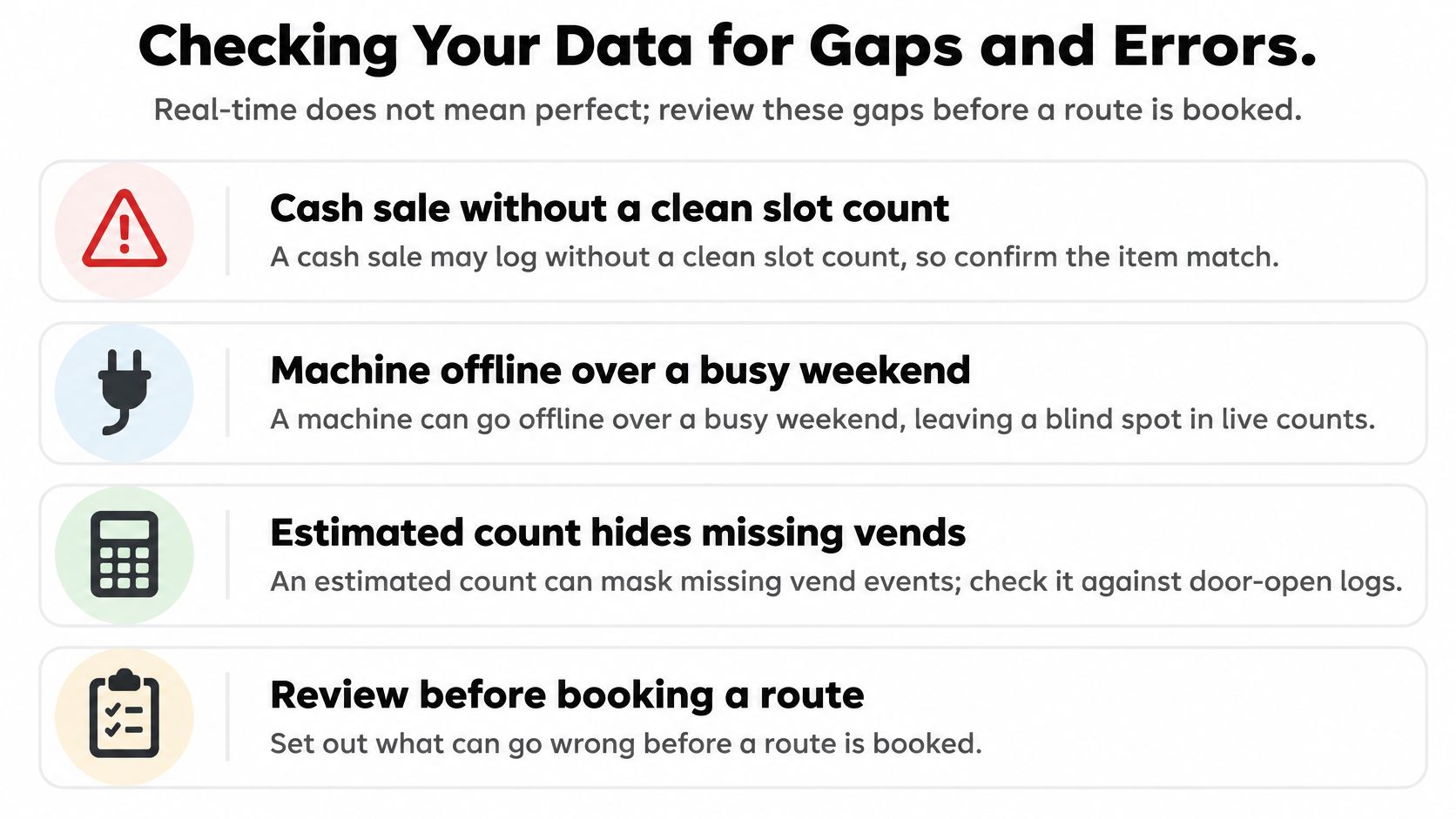
Monthly checklist
Last update window: Confirm the newest event falls inside the interval you expect for that cabinet. A machine that should report within minutes and last spoke on Friday is offline for planning purposes.
Sensed versus estimated: Mark which slots have a sensor and which are math. Do not average them into one confidence level.
Three-slot physical count: On each machine, count three slots by hand and compare them with the dashboard. Pick one fast seller, one slow seller, and one estimated slot.
Payments versus vends: Payment totals should match vend totals for the same window. A gap means sales that never hit a slot, or vends that never hit a tender.
Fault codes after service: A jam code that is still open after the driver left means the repair did not clear, and the product behind it is not really for sale.
Time order: Events should arrive in the order they happened. A restock timestamp that lands before the sales it was meant to cover will inflate the count.
What to do when a check fails
If the dashboard count runs high, recount that slot and reset the estimate to the physical number. Do not "adjust it down a bit" and hope the next week corrects itself. If a machine has been offline, treat its count as unknown and visit it before you trust the figures for a skip-stop.
The fuller set of mismatches, and how they show up in a fill report, sits in how inventory discrepancies get found. A count that has not been checked against the shelf is an estimate, however live the icon looks.
A healthy sensed feed has a boring signature. The slot count drops by exactly one per vend, and the update shows up within minutes of the sale. Anything lumpier than that needs a look before you cancel a stop.
Vending Service Coverage in Oklahoma City, Norman and Edmond
People looking for break room vending in Oklahoma City, office vending in Norman, or vending machine service in Edmond are usually trying to match a building to a route, not to read a technology brochure. We cover workplaces, schools, clinics, industrial sites, and venues across the Oklahoma City metro, Norman, Edmond, and surrounding cities, and the visit pattern changes with the building.
Oklahoma City
Offices and business centers in Oklahoma City typically need snack and drink combinations on a cadence tied to weekday peaks. Clinics and manufacturing sites in the same metro more often need cold and frozen cabinets, because shifts do not pause for a cafeteria. High-traffic common areas need machines that can take a midweek top-up when a slot hits its reorder point, rather than waiting on a single weekly pass. Cashless acceptance is set up on site so a sale still records when nobody has bills.
Norman
Norman service covers campuses, offices, and clinics where the crowd changes by the hour. Snack-and-drink machines fit staff lounges. Cold and frozen cabinets fit healthcare and any site that wants a meal between classes or shifts. Visit cadence follows the sales speed of that building. A steady office can sit on a fixed day. A mixed lobby should trigger a stop from the live count. Cashless checkout is part of the install, so the payment record and the vend record stay paired.
Edmond and nearby cities
Edmond offices usually want a compact snack and beverage setup with a predictable refill. Industrial sites farther out need the cold and frozen capacity, plus a route that respects shift breaks. Venues and busier public spaces need higher-volume cabinets that can be restocked on event days, not only on a standing weekday. The same cashless setup applies, so a busy night does not depend on a bill validator.
What to confirm before you book service
Service area. Your city or ZIP code needs to sit on the route, including Oklahoma City, Norman, Edmond, and the surrounding cities we already run.
Machine fit. Offices usually take snack and drink machines. Clinics and plants usually need cold and frozen cabinets. Venues need higher-volume units.
Data and cadence. You should know how far back slot history goes for your machine, and whether stops are fixed or triggered when a slot reaches its reorder point.
How people pay. Employees and visitors should be able to pay without cash, including phone wallets, so every sale lands on the slot record.
Set Up Live Restock Tracking for Your Site
An empty top-selling slot can turn a live count into a useful route decision, but only if the count is checked against actual sales. Start with two or three machines in the busiest spot. Set par levels for top sellers using daily sales times lead time, plus 20 percent, rounded up. Confirm that each machine records vend events and door-open events. Agree in writing whether a visit is triggered when a slot reaches its reorder point or follows a fixed day where sales barely change from week to week.
Vendmoore Enterprises is one option for workplaces and public spaces across the Oklahoma City metro, Norman, Edmond, and surrounding cities. Its machines feature tap-to-pay and remote monitoring. Remote counts can help guide replenishment, but estimated inventory is only useful when checked against vend and door activity. For a managed replenishment program, vendor managed inventory for vending pairs inventory tracking with scheduled service.
"Vendmoore has been absolutely amazing at our workplace. Every time we've asked for something new, they at least give it a shot and stock it for a bit to see how it goes.", Brandi P.
Before scheduling service, ask how far back slot data goes and how the team checks reported counts against machine activity. Vendmoore's office is open Monday to Friday, 9:00AM to 5:00PM. Current contact details are on the company website.
Visit Vendmoore Enterprises to check service in your city and discuss whether remote monitoring and a managed restocking schedule fit your building.
Comments