
Soda Pop Machines for Break Room Programs
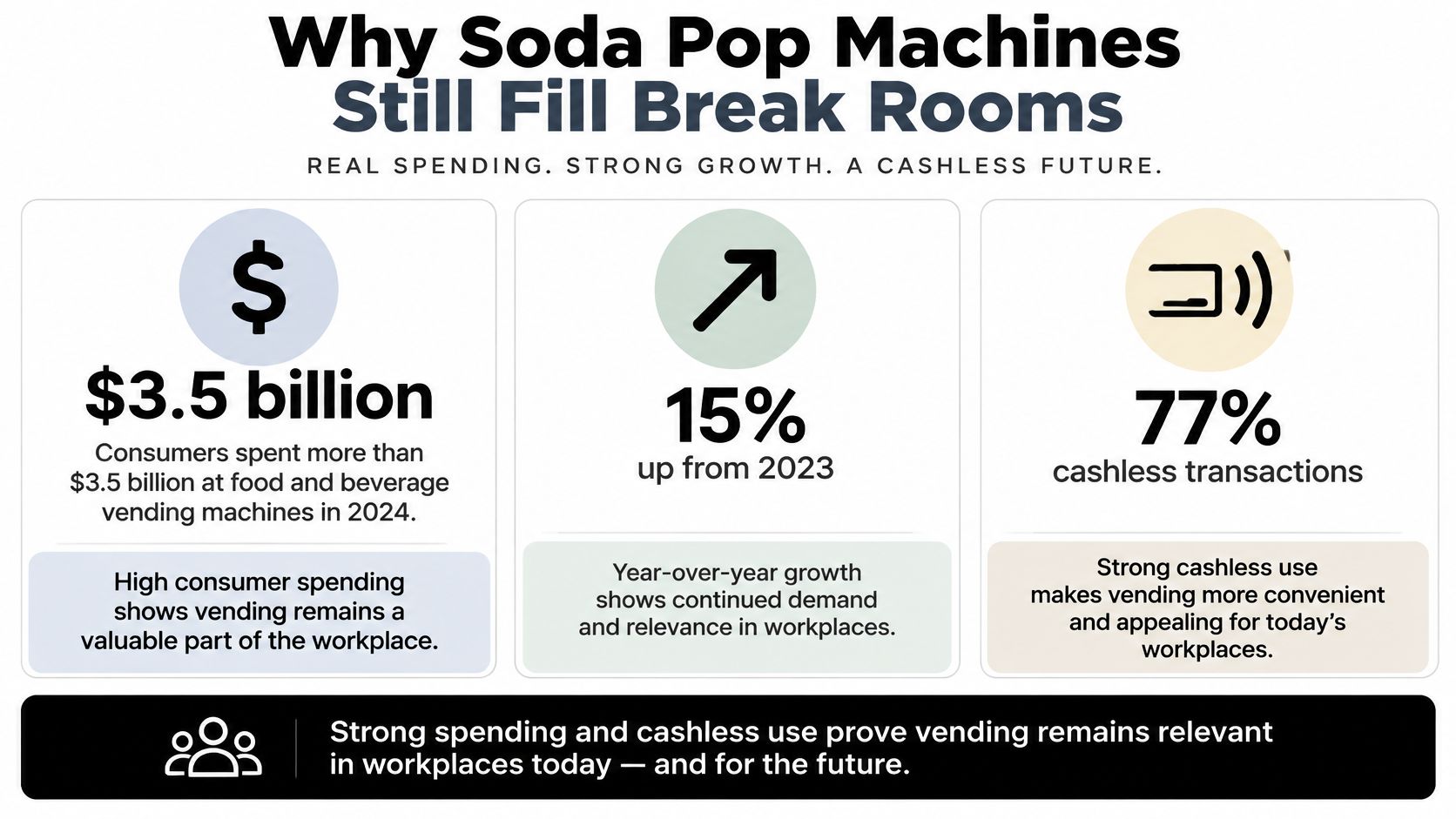
Consumers spent more than $3.5 billion at food and beverage vending machines in 2024, up 15% from 2023, and 77% of vending transactions were cashless, according to PaymentsJournal. That makes soda pop machines more than spare refrigerators with coin slots. They're small retail operations, and facilities managers need to judge them by who can buy, what stays available, and who handles the work.
Why Soda Pop Machines Still Fill Break Rooms
Say a manufacturing plant has an attended cafeteria during the day, but its evening crew brings meals from home. A cold-drink machine near the break room fills a specific gap: employees can buy something without leaving the building or depending on cafeteria hours. The cabinet's usefulness comes from that fit, not from the plant's total headcount.
Think of vending as a corner soda fountain that lost its attendant but kept the cold drink, the measured portion, and the payment, including at 2 a.m. and between shifts. The transaction is unattended. The responsibility for keeping it working isn't.
Bottled-soda vendors appeared in the 1930s and moved from ice cooling toward electric refrigeration, as described in Coca-Cola's equipment history.
Match the machine to the people who stay
Offices, schools, hospitals, factories, airports, stadiums, and apartment community rooms all bring people together for extended periods. But they don't create the same purchasing situation. An employee taking lunch has a different opportunity to browse than a visitor moving toward a stadium entrance.
In a clinic, the audience includes staff and visitors whose schedules don't align. In an apartment community room, access may depend on building hours and whether residents use the space. At an airport, a machine must serve travelers without complicating the concession or service arrangements.
Reliable availability matters more than an impressive-looking selection. A familiar drink that's consistently stocked can be more useful than a broad menu with empty columns.
Practical rule: Treat the machine as a service point with an owner, not an appliance someone will remember to refill.
Put the decisions in a useful order
A facilities manager can narrow the project without learning vending jargon first:
Cabinet type: Match the dispensing mechanism and temperature zones to the products.
Payment mix: Decide how people will pay, including those without a usable digital wallet.
Placement: Choose a visible, accessible stop on an existing route.
Stocking and price: Establish what belongs in the machine and how customers see the cost.
Ownership and service: Assign purchasing, filling, repairs, cash handling, and refunds.
The useful question isn't whether soda pop machines still have a role. It's whether a particular setup serves one room well enough to justify the space and work.
Bottle Can and Multi Temperature Cabinets
Soda pop machine types and where they fit
Cabinet | Best products | Temperature setup | Typical site | How it is loaded |
|---|---|---|---|---|
Bottle and can vendor | Sealed sodas, water, energy drinks | One cold zone | Offices, clinics, lobbies | Columns or trays by flavor |
Can stack vendor | 12-ounce cans | Uniform cold, high capacity | Factories, stadiums | Gravity stacks, fewer SKUs |
Glass-front merchandiser | Bottles, cans, juices | Single refrigerated cabinet | Break rooms where people browse | Shelf planogram |
Dual-zone chill center | Cold drinks plus a second drink or snack zone | Two temperature zones | Compact break rooms | Split inventory |
Combo refreshment center | Drinks and snacks in one footprint | Cold drink side, ambient snack side | Small offices, teacher lounges | Two compartments |
Read the cabinet from the product outward
A bottle and can vendor suits a short, dependable drink list. Staff load each flavor into its assigned column or tray, using packages approved for that mechanism. Don't assume two bottles with similar volumes will dispense identically. Their shape and rigidity can affect delivery.
A can stack vendor favors repeated purchases of fewer products. Cans sit in gravity-fed stacks rather than occupying a wide browsing display. That makes it a sensible format for a factory break or stadium rush where customers already know what they want.
A glass-front merchandiser lets customers compare bottles, cans, and juices before choosing. Its shelf planogram, the map showing which product belongs in each position, must stay accurate. If someone moves tea into the water position without updating the selection and price, the customer may receive something different from what they expected.
A dual-zone chill center separates products that need different temperature settings. Confirm the operating range of each zone before planning the menu. Two zones don't automatically mean every combination of drinks and snacks is suitable.
A combo refreshment center pairs refrigerated drinks with ambient snacks. It can make sense in a small office or teacher lounge that can't accommodate separate cabinets, provided each compartment has enough room for the products people buy.
Check the installation limits
Cabinet names aren't a substitute for a specification sheet. Before accepting equipment, confirm:
Package compatibility: Test the intended bottle or can through the delivery mechanism.
Ambient rating: Use equipment rated for the heat, cold, or exposure at the proposed location.
Usable capacity: Count space for the planned assortment, not just the cabinet's maximum advertised load.
Service access: Leave room to open doors, remove trays, and reach components.
A sun-heated lobby can challenge equipment intended for a controlled indoor room. An outdoor installation needs a cabinet explicitly rated for that environment, not an indoor machine placed under an overhang.
Likewise, a tiny lounge shouldn't inherit a stadium-style stack just because the equipment is available. Pick the row that matches dwell time and product mix before comparing payment options.
Cash Cards and Phone Payments Side by Side
The average cashless vending ticket was $2.24 versus $1.78 for cash, according to Market Data Forecast, which also reports that cashless transactions represented 71% of vending-machine sales in 2024, contactless or mobile payments accounted for 77% of cashless sales, and mobile sales grew more than 300% during the year. The ticket gap suggests that payment method may accompany a different quantity or price tier, not merely a different checkout motion. It doesn't establish that tapping a phone causes someone to spend more.
Keep different payment paths usable
Cash serves workers, students, patients, and visitors who don't have a wallet configured or whose card has been declined. It also creates work: bills can jam, and staff must count collections and maintain the change float, the coins reserved for change.
Credit and debit cards give customers a cashless option without requiring a phone. Put the selling price on the glass or selection label before checkout. Any fee, larger-size offer, or other prompt must be visible before authorization, not discovered afterward.
Apple Pay and Google Wallet offer contactless checkout, but a working phone doesn't guarantee a successful sale. Reader connectivity and authorization still matter. The benefits of cashless payment are best evaluated alongside these operating limits.
Set an inclusion standard
A hybrid cash-plus-tap setup is a practical default where retaining cash is feasible:
Preserve an alternative: Don't make a mobile wallet the only route to a drink without examining who it excludes.
Show the full price: Disclose charges before the customer commits.
Track failures: Record failed authorizations, refund requests, and the time refunds take.
Review payment types: Split sales by tender each month to see whether one group encounters more trouble.
If the reader can't authorize, the display should explain the problem and offer a cash or retry path rather than leave the customer guessing.
A payment upgrade isn't inclusive if a customer can see the drink but has no usable way to buy it.
Check the effect on lower-income workers and other cash-dependent customers rather than assuming contactless access benefits everyone equally.
Telemetry and Connected Machine Features
Telemetry means the machine sends operating information to someone who can act on it. The underlying self-service dataset covered more than 625,000 connected vending card readers, according to Cantaloupe's micropayment trends release. That scale makes connected payment infrastructure a serious operating consideration, but a reader alone doesn't guarantee inventory, fault, or temperature reporting.
Ask what reaches the route team
Request a demonstration of the actual dashboard and alert settings:
Transaction reporting: Sales and failed authorizations should be distinguishable, with payment types available for review.
Sales by selection: Product-level history helps the stocker pack the right drinks instead of bringing an assortment based on memory.
Vend and column faults: Delivery failures should trigger investigation, not merely appear in a report nobody opens.
Reader-online status: Connectivity problems need an alert before customers become the outage-detection system.
Temperature readings: Cabinet drift should reach the person responsible for refrigeration before more product is loaded.
The telemetry data collection guide provides context for connecting machine information to replenishment decisions. Confirm which capabilities are included on the proposed cabinet and which require additional sensors or subscriptions.
Separate useful records from unnecessary customer tracking
A facilities team usually needs to know that water is selling and a reader is offline, not who bought each bottle. If a wider hospitality program involves customer profiles or messaging, Purple Engage's restaurant CRM software guide offers a separate framework for evaluating those customer-management tools. Don't confuse that function with machine monitoring.
For a non-connected location, assign a named person a weekly manual check of transactions, selection counts, delivery faults, reader operation, and temperature. The buying question is simple: Which alerts reach a named person, and which conditions still require a site walk?
Where Foot Traffic Actually Turns Into Sales
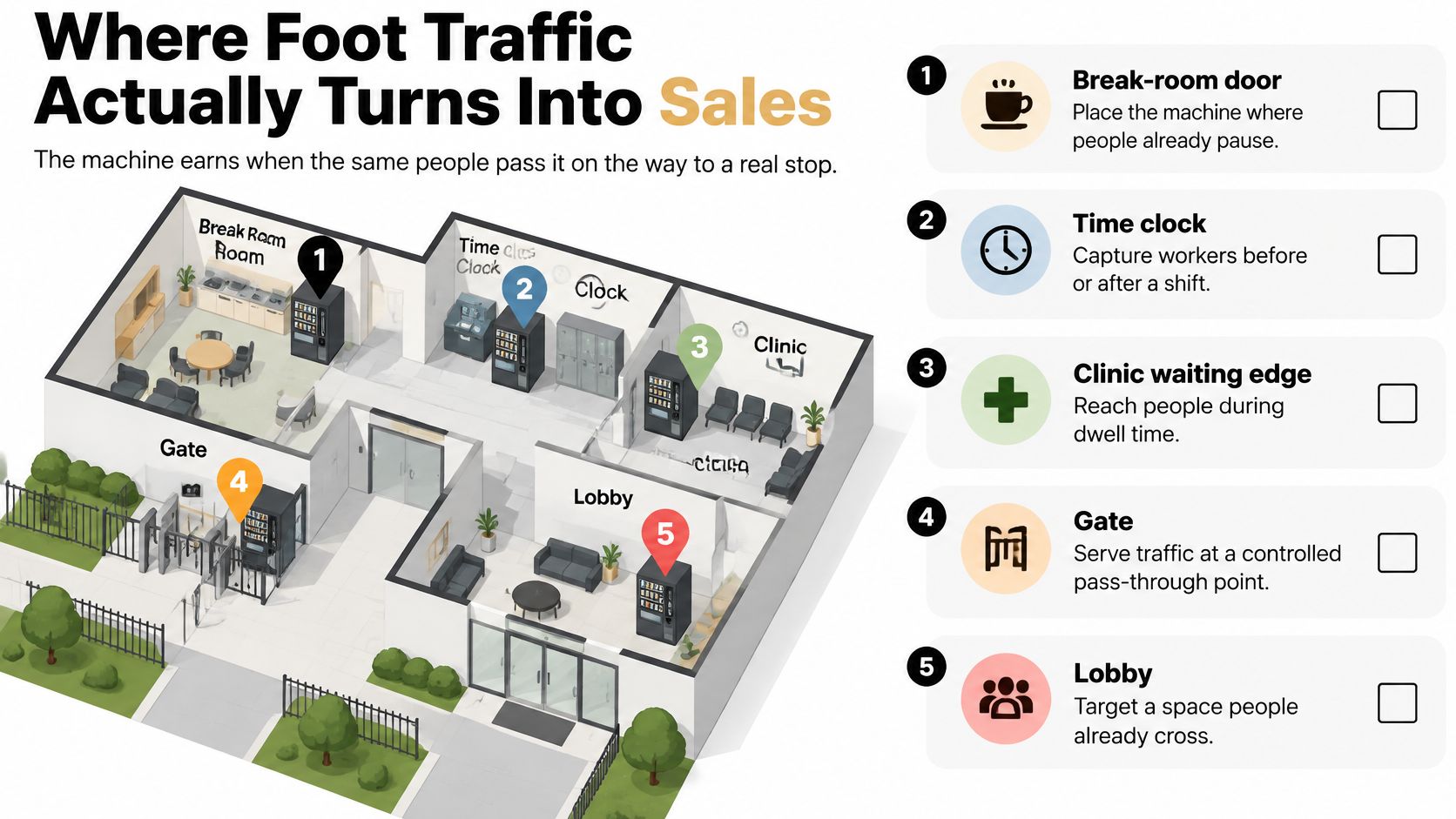
Placement is a dwell-time problem, not just a pedestrian-count problem. A machine has a useful opportunity when people pass it on the way to a real stop: a break-room door, time clock, clinic waiting edge, gate, or lobby they already use.
A beautiful lobby can disappoint if everyone crosses it without stopping. A busy break room can fail just as badly when a copier blocks the display or a queue prevents anyone from reaching the reader.
Walk the customer path and the service path
Count people who pause. Watch where employees wait, eat, or gather rather than counting everyone who passes through a distant entrance. Observe shift changes at plants, class breaks on campuses, and visitor peaks at clinics. Those concentrated periods reveal when access matters.
Put the display on the existing path. Customers shouldn't need to discover a side corridor or cross a work area. Position the reader for comfortable adult use while confirming accessible reach and clear approach space. Leave enough room for the service door to open without blocking circulation.
Confirm power and the physical setting. Identify a dedicated outlet suitable for the equipment, keep the cabinet clear of heat and direct sun, and have the building team confirm that the floor can support it fully loaded. Don't plan an installation around an extension cord stretched across a walkway.
Clear the site's rules before delivery. Review school wellness policies, hospital infection-control zones, airport or stadium concession agreements, and landlord approval in multi-tenant buildings. Record who approves the location so a delivery crew isn't left negotiating at the door.
Test the restocking route. Walk from the delivery entrance with the hand-truck route in mind. A location that requires crossing a secure line or moving cases through a patient corridor may be impractical even when customers can reach it easily.
Make the location easy to keep usable
Ask the room's regular users what occupies the space during the busiest break. Chairs move, delivery boxes accumulate, and temporary displays can become permanent obstacles. Put the machine footprint and service-clearance area on the room layout so future changes don't unintentionally remove access.
The guide to vending machine locations can help a facilities team compare different building settings without treating every busy entrance as equal.
Placement test: If employees naturally walk past the display between their desks and the microwave, the location has a useful starting advantage.
That's a stronger reason to stock a location than an attractive wall with no reason for anyone to stop.
How to Stock Flavors and Set Prices
A workable assortment starts with a short list and a repeatable review. The restocker needs to know what belongs in each position, what quantity to bring, and which complaints indicate a missing product rather than a missing flavor.
Stocking is also a chance to inspect the mechanism and rotate products, not just fill visible gaps.
Use a selection-level routine
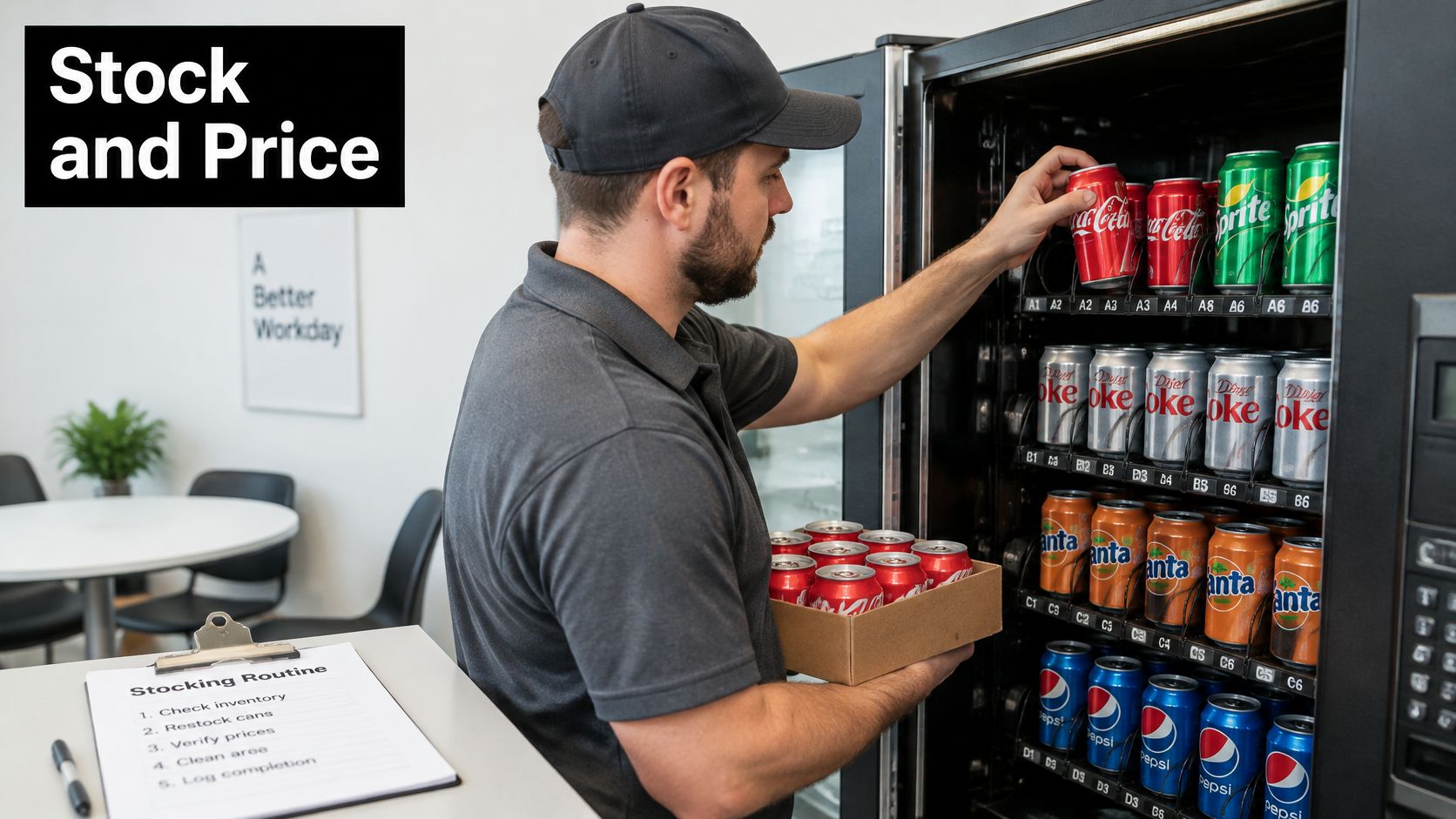
Review two to four weeks of sales. Pull sales by selection, or compare manual opening and closing counts. Record deliveries and removals so a stock adjustment doesn't look like a sale.
Set a par for each position. Here, par means the target quantity after filling. Base it on demand through the next visit, including the busiest daypart. Morning iced-coffee demand and afternoon soda demand may require different allocations. Leave empty spirals only deliberately, not because nobody ordered the product.
Start with a focused brand set. Include a cola, lemon-lime soda, water, an energy drink or tea, and a lower-sugar option. Add a second brand only when its position earns the space. Check package fit before buying a case for a trial.
Display price tiers before payment. Label the shelf or selection, not only the reader. Keep cash and cashless prices the same under this inclusion standard, so choosing a premium drink explains the larger purchase rather than an unexpected payment surcharge.
Review unsuccessful trials after two weeks. Pull a selection that hasn't sold and test a requested flavor instead of automatically adding another cola. Adjust the review if closures or unusual attendance made the trial unrepresentative.
Log availability voids. Here, a void means a wanted drink was unavailable, not an accounting cancellation. Record the product and time. Repeated stockouts can teach customers not to check the machine at all.
Make requests specific
Office and school requests for a healthier mix usually call for a menu edit, not another machine. Ask whether customers want less sugar, unsweetened drinks, different portions, or caffeine-free choices. The drinks for vending machines guide can help organize those categories.
For employees asking about drinks they mix themselves, they can browse Vital Cola drops from Wallaby Wellness as a separate format. Don't confuse a mix-at-use product with a sealed, ready-to-vend beverage or assume package compatibility.
Use the video as an additional visual reference alongside the cabinet's loading instructions.
Configure connected inventory warnings to identify likely shortages before the route leaves. Without those warnings, assign someone a weekday availability check and a clear reporting contact. Variety follows velocity, not the distributor's full catalog.
Service Routes Versus a Managed Program
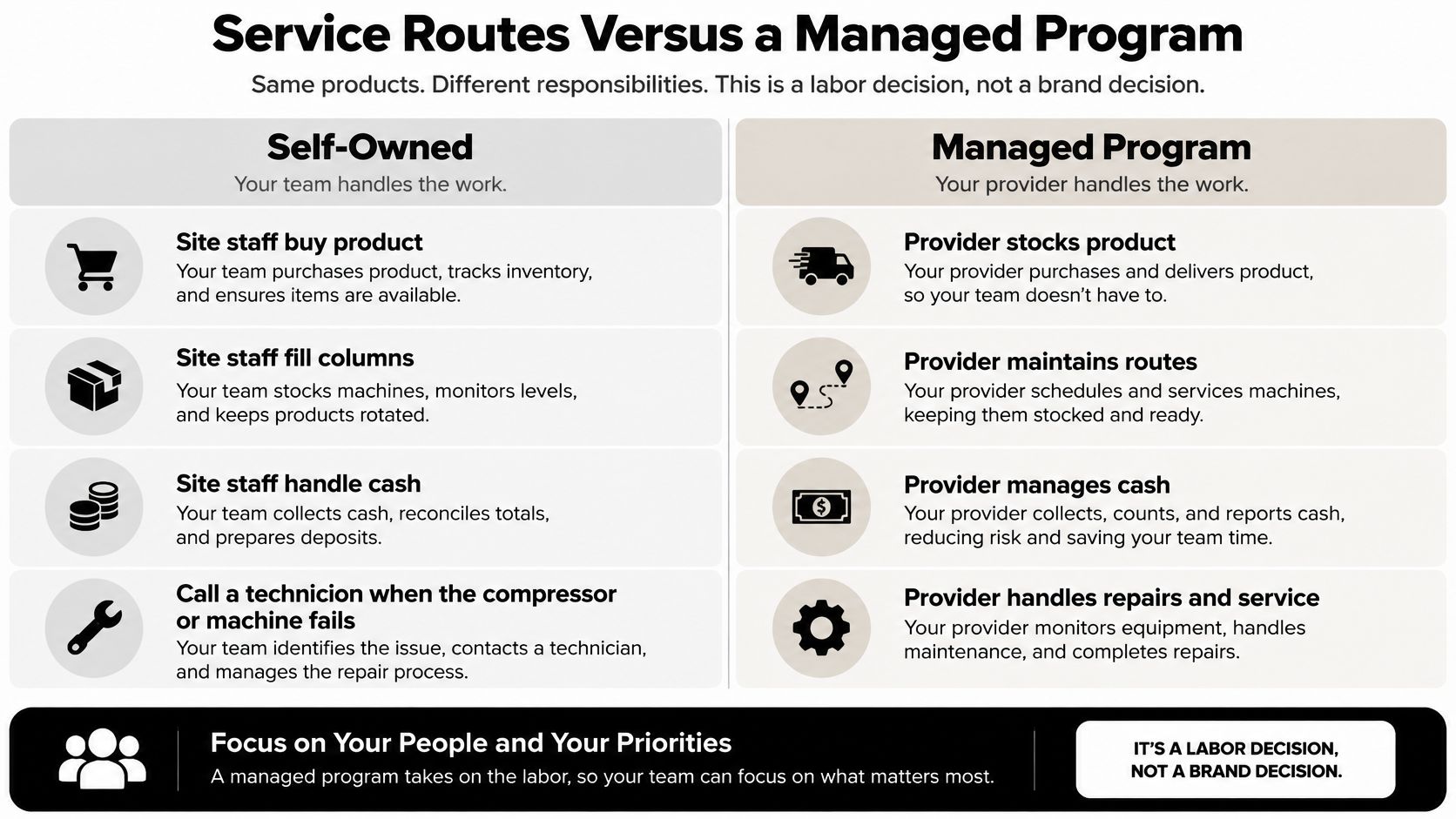
Choosing who owns a soda pop machine also determines who handles routine work. A self-owned cabinet can suit a site with staff available to order products, fill selections, reconcile cash, and arrange repairs. If that person is absent, the machine may sit empty until someone else takes responsibility.
Model | Who stocks | Who repairs | Cash and refunds | Best when |
|---|---|---|---|---|
Self-owned | Site staff | Owner or a called technician | Site | The site wants margin and has someone to cover fills |
Full-service operator | Operator | Operator | Operator | The break room should stay off the office manager's list |
Hybrid | Operator | Shared or contracted | Agreed in the contract | A campus owns equipment but not the daily route |
A full-service program assigns stocking, service, and support to the operator. Vendmoore offers full-service vending, as well as the option for customers to own their own machine. A hybrid arrangement can suit a campus that owns equipment but does not want to manage a daily replenishment route. Set out who handles the reader, refrigeration repairs, and refunds before service begins. These responsibilities work like a handoff checklist: each task needs a named owner.
Define a complete service visit
A service visit should restore availability and check that the cabinet works, not just add cases to the shelves:
Inspect operation: Check temperatures, investigate delivery failures, and clear jams safely.
Clean contact surfaces: Wipe the reader, selection controls, and exterior with suitable products.
Restore the assortment: Fill to par, rotate stock, and remove expired or persistently slow items.
Confirm checkout: Verify that the reader is online and the machine can complete a sale.
Use the vendor-managed inventory services guide to help define who monitors stock and replenishes products. Keep the service contact and escalation process where building staff can find them.
Count the packaging after the sale
Energy-efficient refrigeration can reduce environmental impact, but it does not ensure that cans and bottles get recycled. Aluminum can recycling rates are generally much higher where deposit systems apply. That pattern is a reason to assess packaging recovery alongside energy claims, rather than treating an efficient cabinet as the whole environmental plan.
At airports, stadiums, campuses, hospitals, and multi-tenant buildings, place clearly labeled collection bins beside the machine. Confirm accepted containers with the building's waste contractor and align pickup with use. Compare beverage units sold with containers recovered to get a site-level indicator, keeping in mind that customers may carry packaging elsewhere.
A recovery habit can matter more than a generic environmental label. Results depend on local conditions and whether customers can reach the right bin without a detour.
Request a Break-Room Walkthrough
Bring a room layout, headcount, outlet location, the drinks people already request, and the dwell point you observed. Include the building's access restrictions and the person authorized to approve installation. Those details let a walkthrough address the room as it operates.
We serve workplaces and public spaces across the Oklahoma City metro, including Norman and Edmond. State the payment mix you want during the walkthrough, along with your expectation that prices appear on the glass.
Match the proposal to the room
At Vendmoore Enterprises, we offer full-service vending covering stocking, service, and support, and our machines accept credit/debit cards, Apple Pay, Google Wallet, and cash. Our lineup includes HAHA Ai Vending, BC10 Bottle & Can Vendor, Trimline II Refreshment Center, Compact 23/10 Refreshment Center, MPZ Frozen Food, and 40-Select Dual Zone Chill Center. The frozen-food model serves a different purpose from a soda pop machine and shouldn't determine the beverage installation.
Have the proposed cabinet shown against the actual room dimensions. A small lounge and a room needing separate temperature zones require different installation decisions.
Before agreeing to placement, request written responsibilities:
Filling: Name who purchases products, replenishes selections, and covers absences.
Availability problems: Identify who responds to empty selections, failed deliveries, and refund requests.
Packaging collection: Confirm who supplies bins, empties them, and coordinates with the building hauler.
Leave the walkthrough with named responsibilities, not an assumption that someone else handles the work.
Vendmoore Enterprises offers full-service soda pop machines and break-room vending, with stocking, service, and support for Oklahoma workplaces and public spaces. Visit Vendmoore Enterprises to request a walkthrough and bring your room layout, preferred drinks, and payment requirements so we can discuss the cabinet, filling responsibilities, and packaging collection that fit your site.
Comments