
Vending Machine Electrical Requirements: Circuits and GFCI

You've picked a spot for a vending machine in the break room, and there's an outlet on the wall. Before you schedule delivery, someone needs to answer a less obvious question: does that outlet connect to the right circuit, with the right protection, for the actual machine you're ordering?
Vending machine electrical requirements involve more than finding a plug that fits. The equipment's connection type, manufacture or rebuild date, nameplate ratings, and the building's electrical protection all matter. For a site manager, the practical job is to get the machine specifications to the facility electrician early enough to correct a mismatch before the delivery crew arrives.
Find Your Connection Type and Electrical Rule
Electrical protection requirements by connection type
Connection type | Electrical limit or trigger | Protection required | Supply detail to check |
|---|---|---|---|
Cord-and-plug, made or rebuilt on or after January 1, 2005 | NEC GFCI rule applies at 150 V or less to ground and 60 A or less, single-phase or three-phase | GFCI in attachment plug or within 12 inches of plug | Manufacture or rebuild date on nameplate or supporting records |
Cord-and-plug, made or rebuilt before January 1, 2005 | NEC GFCI rule applies at 150 V or less to ground and 60 A or less, single-phase or three-phase | GFCI-protected outlet | Outlet confirmed as GFCI-protected |
Hard-wired machine | NEC GFCI rule applies at 150 V or less to ground and 60 A or less, single-phase or three-phase | GFCI-protected branch circuit | Electrician confirms circuit and breaker type |
The date-based cord-and-plug requirements summarized by Electrical License Renewal distinguish machines manufactured or rebuilt on or after January 1, 2005, which need a GFCI in the attachment plug or within 12 inches of it, from older machines that generally need a GFCI-protected outlet; hard-wired machines require a GFCI-protected circuit.
Treat those equipment-side rules and the building's supply-side requirements as separate checks. A machine's cord protection doesn't automatically settle whether the proposed outlet is acceptable under the locally adopted code.
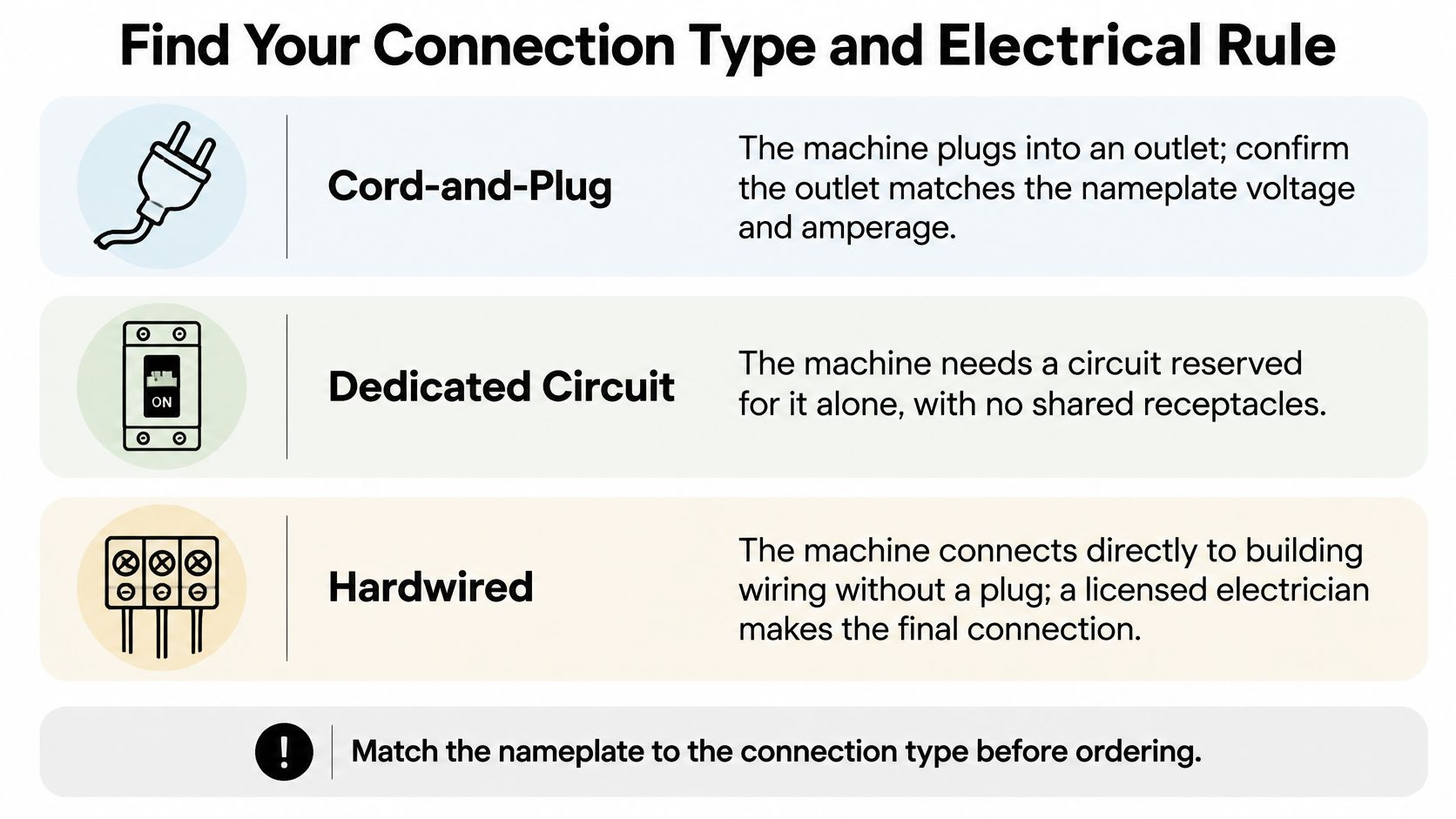
Classify the machine before choosing its outlet
A dedicated circuit isn't a connection type in the same sense as cord-and-plug or hard-wired. It describes a circuit reserved for the machine, and either connection method can use one.
Use this routine before assigning an installation location:
Find the nameplate. Photograph it clearly, then record the manufacture date. For refurbished equipment, obtain the rebuild date and supporting documentation if it isn't shown on the cabinet.
Identify the connection. Determine whether the machine uses a cord and attachment plug or requires a permanent wiring connection.
Apply the matching table row. Don't classify the equipment from cabinet appearance or a seller's description alone.
Assign hard-wiring to the electrician. Have the facility electrician confirm the protected supply and approved connection arrangement.
Create an installation record. Enter the connection type, protection method, voltage, rated current, and phase on the installation sheet.
A rebuilt machine can look old while falling under a newer date-based requirement. Conversely, replacing cosmetic panels doesn't establish that a machine was electrically rebuilt. Ask for records rather than guessing.
Turn the classification into a site decision
A standard-looking receptacle may be acceptable in one installation and unacceptable in another because its upstream protection, the equipment's history, and the applicable code differ. Appearance alone won't establish compliance.
For permanent wiring changes, Engle Services' information on commercial electrical work provides context for involving an electrical contractor rather than treating installation as a delivery task. Coordinate that work with the practical location details in our venue setup guidance.
The table is a starting point, not final electrical approval. The nameplate, installation instructions, locally adopted code, and authority having jurisdiction determine the acceptable installation.
GFCI Protection Rules Under the NEC
Under the 2023 National Electrical Code, NEC 210.8(D) specifically requires GFCI protection for the branch circuit or outlet supplying a vending machine rated 150 volts or less to ground and 60 amperes or less, whether single-phase or three-phase, as explained by IAEI Magazine's electrical appliance safety guidance.
The important distinction is where the protection applies. This is a requirement for the supplying branch circuit or outlet, not merely a statement that the machine should contain a protective device somewhere inside it.
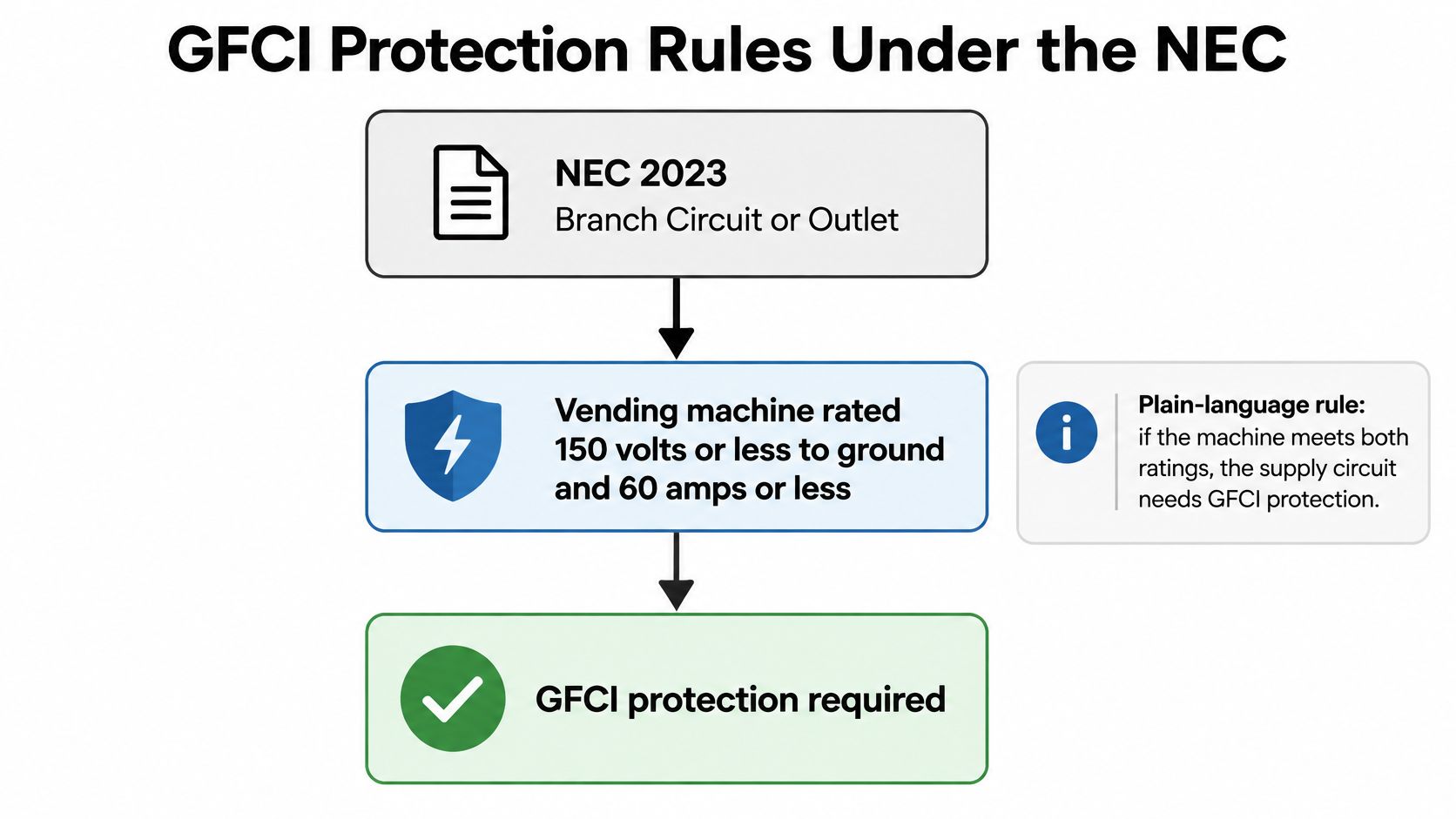
Confirm the supply, not just the machine
A GFCI detects an imbalance between outgoing and returning current and interrupts power when that imbalance indicates leakage. It serves a different purpose from ordinary overcurrent protection, so a conventional breaker isn't proof of GFCI protection.
In an office, school, healthcare facility, or shared break room, the site team needs to establish what protects the actual connection point. That can require tracing an ordinary-looking receptacle to an upstream GFCI device or a GFCI breaker.
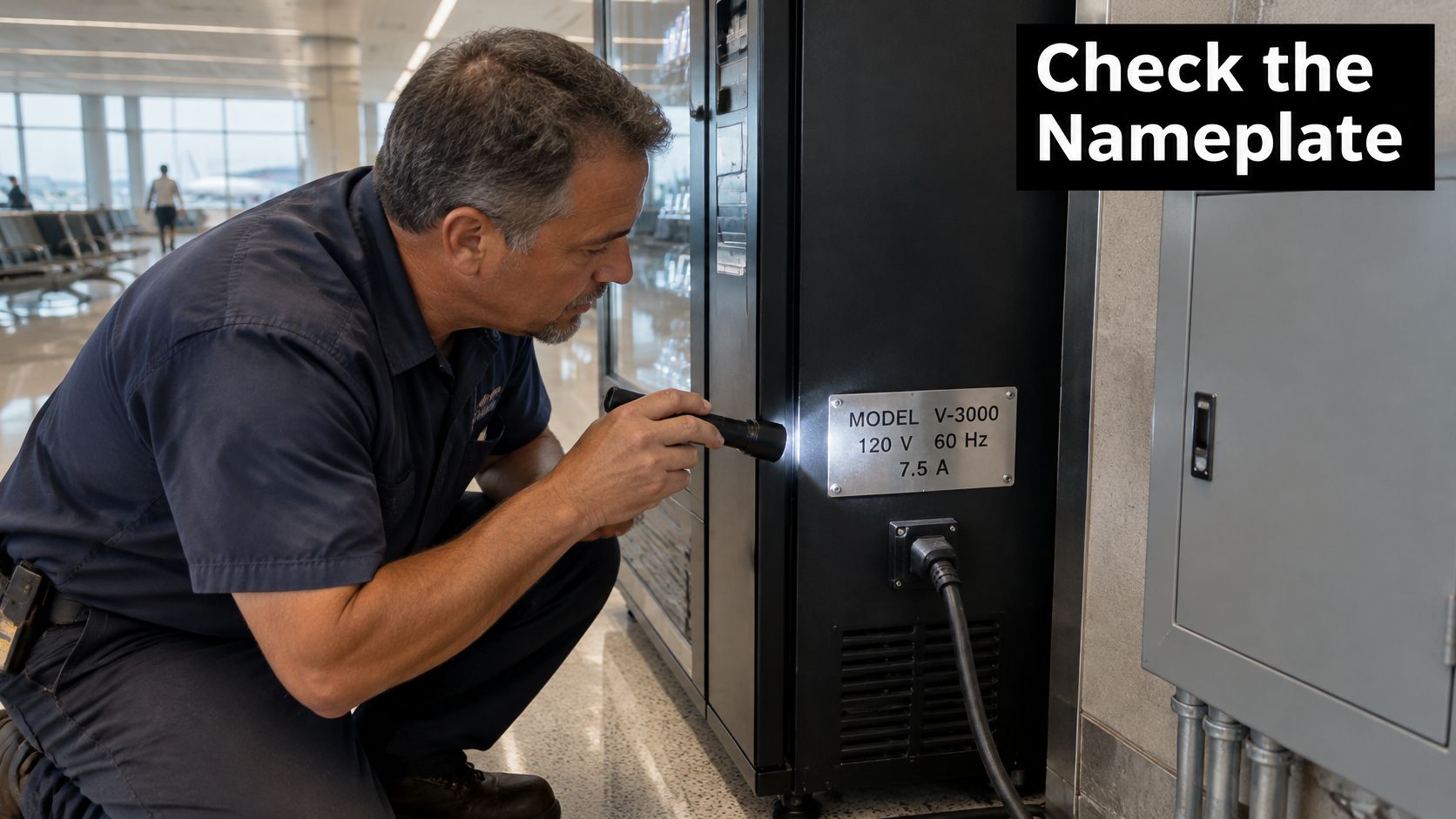
Verify the equipment rating. Read the nameplate rather than assuming every vending machine has the same electrical characteristics.
Identify the protective device. Record whether protection is provided at the receptacle, upstream, or at the breaker.
Test after installation. Operate the device's test and reset controls according to its instructions. Have the electrician use a compatible plug-in tester at the outlet where appropriate.
A plug-in tester is a useful screening tool, but it doesn't replace an electrician's assessment of wiring, grounding, and protective-device compatibility.
A machine that powers on has demonstrated that it receives power, not that its electrical installation is safe or compliant.
Avoid the built-in protection assumption
A built-in GFCI can satisfy an equipment-specific requirement without resolving every obligation on the building side. Don't approve a supply solely because the machine's cord has test and reset buttons.
Likewise, a receptacle without visible buttons may still have upstream protection. The electrician should verify it rather than reject or accept it on appearance.
Use the connection-type table and manufacture-date routine in the opening section to classify the equipment, then have the electrician confirm the applicable supply-side requirement under the code adopted locally.
Voltage, Amperage and Dedicated Circuits
The nameplate tells the electrician what supply the machine expects. Voltage identifies the required electrical potential, rated amperage describes the stated current requirement, and phase identifies the supply configuration.
Don't confuse the machine's rated current with the circuit breaker rating. The electrician selects the circuit arrangement using the equipment instructions, conductor requirements, applicable code, and load characteristics, rather than matching every printed number.
A useful commercial benchmark appears in Denver International Airport's electrical design standard, which specifies a dedicated 120-volt, 20-amp, GFCI-protected branch circuit for each vending machine and recommends GFCI circuit breakers to keep protection accessible.
Why shared break-room circuits cause trouble
Say a refrigerated vending machine shares a circuit with a microwave and coffee maker. The vending compressor starts while the other appliances are operating, and the combined demand can trip the breaker.
The problem isn't necessarily a defective vending machine. The site may have assigned too many loads to the circuit.
A dedicated circuit offers practical advantages:
Fewer load-related interruptions. Unrelated appliances don't compete with the machine for circuit capacity.
Clearer identification. Staff can locate the machine's breaker without experimenting with other equipment.
Simpler troubleshooting. The electrician can investigate the vending load without first separating unrelated appliances.
A dedicated circuit doesn't eliminate genuine ground faults or equipment defects. It removes one avoidable source of confusion.
Compare the nameplate with the proposed circuit
For a worked comparison, suppose the nameplate lists a voltage matching the proposed receptacle and a rated current below the proposed breaker rating. That still isn't automatic approval: the electrician must check conductor sizing, receptacle configuration, starting characteristics, and the manufacturer's instructions.
The airport specification is a facility benchmark, not a universal circuit rule. A different machine or jurisdiction may require a different arrangement.
GFCI breakers can be useful where a receptacle would become difficult to reach behind a cabinet, provided authorized staff can access the panel. Include any circuit changes in the installation scope rather than discovering them during delivery; our vending machine installation cost guide can help organize that discussion.
Before calling the electrician, record voltage, rated amperage, phase, and planned location. Send a nameplate photo as well as your transcription.
Three-Phase and Higher-Voltage Machine Supply
Phase is a supply requirement, not an exemption from GFCI protection. A three-phase vending machine still needs the protection applicable to its ratings and installation.
Read the phase marking on the nameplate alongside the voltage. If the machine requires three-phase power, the electrician must confirm a matching supply before delivery, including the appropriate circuit and connection equipment.
Match the supply configuration
Consider a machine labeled for a standard single-phase supply. The electrician checks the intended outlet with an appropriately rated meter and compares the measured voltage with the equipment's permitted supply range.
A higher-voltage or three-phase machine needs a different evaluation. Don't connect it to a general break-room outlet through an improvised adapter, and don't assume the building has suitable power just because an industrial panel is nearby.
For context, IEC 60335-2-75:2024 covers vending machines rated up to 250 V for single-phase equipment and 480 V for other equipment, including certain DC- and battery-supplied appliances. Those are the standard's scope limits, not permission to connect a particular appliance to any supply within them.
Confirm panel suitability before ordering
A panel's overall capacity doesn't establish that a particular breaker or branch circuit is suitable. Panel compatibility, available capacity, conductor arrangement, and equipment instructions all need review by the electrician.
For background terminology during that discussion, ATEK Distribution's bus ratings and breaker selection guide can help site managers distinguish panel-level questions from machine-level requirements. It shouldn't substitute for a site-specific electrical design.
Stop rule: If the nameplate voltage or phase doesn't match an available supply, pause the order until the equipment provider and electrician agree on a supply plan.
That decision belongs before shipping, not after the machine has been moved into its final position.
Planning the Location Before Electrical Work
Settle the machine's location before walls are finished or circuits are roughed in. Moving a cabinet on a drawing is easier than relocating a receptacle after wiring and finishes are complete.
The location plan should show more than the machine footprint. Include the electrical connection, door swing, customer access, service space, and the airflow clearance specified for the equipment.
Approve the placement checklist
Choose a direct cord path. Position the machine so its supplied cord reaches the approved receptacle without an extension cord, doorway crossing, or pinch point.
Reserve the circuit where practical. Keep the planned vending supply separate from microwaves, coffee makers, refrigerators, and water coolers.
Keep protection reachable. Don't bury a reset device behind the cabinet. If protection is at a secured panel, ensure authorized facilities staff have dependable access.
Allow equipment-specific clearance. Obtain the required space for door opening, the vending bin, ventilation, cleaning, and service.
Send a marked location plan. Give the electrician the proposed position, nameplate voltage, rated amperage, phase, and connection information.
For indoor placement considerations, use our guide to placing a vending machine inside alongside the electrical drawing.
Put the facilities team in the approval chain
Offices, schools, and healthcare sites often control electrical changes through a facilities department. Route the location request through that team before anyone promises a delivery date.
For projects involving new branch circuits or outlet relocation, estimators can evaluate tools such as Exayard for electrical estimating while preparing the electrical scope. The contractor still needs actual site conditions and confirmed machine specifications.
Skipping placement coordination can leave the installer choosing between a shared circuit and an extension cord. Neither should become an improvised substitute for the approved supply arrangement.
Standards Behind Vending Machine Electrical Ratings
Standards that shape vending machine electrical ratings
Standard | Scope | What it tells an installer |
|---|---|---|
UL 751 | Self-contained, payment-accepting vending machines for circuits rated up to 600 V under ANSI/NFPA 70 | Product safety certification; field wiring still follows the nameplate and local code |
IEC 60335-2-75:2024 | Vending machines up to 250 V single-phase and 480 V other equipment, including some DC- and battery-supplied units | Electrical safety for dispensing appliances; confirm the voltage class matches the site |
NEC 210.8(D) | Vending machines; GFCI on the supplying branch circuit or outlet at 150 V or less to ground and 60 A or less | Field wiring requirement the site must meet, not only a device inside the machine |
UL 751 covers self-contained, payment-accepting vending machines intended for alternating- or direct-current circuits rated up to 600 volts under ANSI/NFPA 70. Its product-safety framework addresses electrical, mechanical, and fire-safety concerns rather than prescribing a universal field circuit size.
Product safety and installation serve different purposes
A product certification evaluates equipment against a defined standard. It doesn't establish that the building's outlet, grounding path, overcurrent protection, or circuit arrangement is suitable for that equipment.
The IEC publication for commercial dispensing appliances and vending machines, IEC 60335-2-75:2024, sets electrical safety requirements for appliances dispensing food, drinks, and consumer products. Its publication year identifies the edition, not the age or approval status of an individual machine.
The distinction matters when comparing equipment. A standard's maximum voltage scope isn't the machine's operating voltage, and a reference to a standard isn't itself proof that the particular machine bears a valid certification mark.
Check the actual equipment documentation
Ask for the machine's certification mark, applicable standard edition, nameplate photograph, and installation instructions. Match the documentation to the actual model and configuration being delivered.
Machine identity. Confirm the documents describe the delivered model, not a similar cabinet.
Supply instructions. Check the stated voltage, phase, connection method, and grounding requirements.
Installation conditions. Identify restrictions affecting location, receptacle arrangement, or required protective devices.
Approval principle: Certification describes the product. The electrician must still verify the building connection.
The final field installation follows the machine's instructions, locally adopted electrical code, facility specifications, and the authority having jurisdiction. Don't treat a certification label as a substitute for that review.
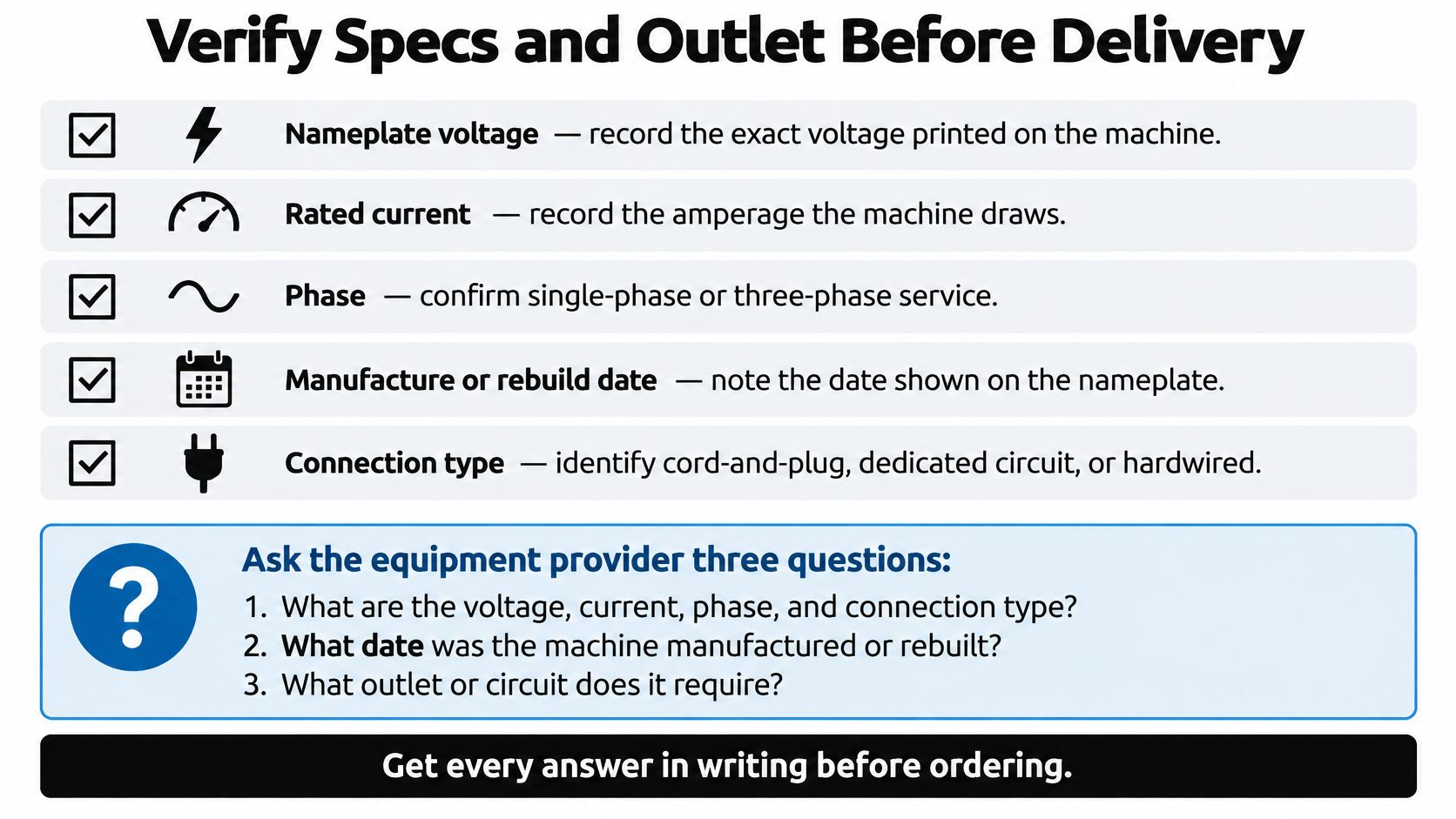
Verify Specs and Outlet Before Delivery
Before ordering, get the specifications in writing: nameplate voltage, rated current, phase, manufacture or rebuild date, and connection type. A sales photo of the front of the cabinet won't answer those questions.
Our lineup includes the HAHA Ai Vending, BC10 Bottle & Can Vendor, Trimline II Refreshment Center, Compact 23/10 Refreshment Center, MPZ Frozen Food, and 40-Select Dual Zone Chill Center. Record specifications for the actual selected machine rather than treating different models as electrically interchangeable.
Resolve the equipment questions
Ask these questions during equipment coordination:
Connection method. Is the machine cord-and-plug connected or hard-wired?
Protection arrangement. What GFCI arrangement is recommended for this equipment, and has the electrician confirmed it meets the site's adopted code?
Documentation. Are installation instructions and certification details available for the machine being delivered?
Our machine installation process guide can help coordinate delivery tasks with the site's electrical preparation.
Have the electrician verify the site
Complete the checks before delivery wherever possible. Metering, panel work, and wiring assessment belong with qualified electrical personnel, not an untrained site manager.
Measure outlet voltage. Compare it with the nameplate and instructions. The common slip is assuming the receptacle's appearance proves its voltage.
Identify the supplying circuit. Trace it to the panel and label it accurately. Don't call an outlet dedicated just because nothing else is plugged into its face.
Check for shared loads. Confirm whether other receptacles or break-room appliances use the circuit. Hidden downstream loads can be missed during a visual inspection.
Operate GFCI test and reset controls. Follow the device instructions and investigate a failed test. A visible GFCI label isn't proof that protection works.
Check grounding and condition. Inspect for damage, loose plug retention, and wiring concerns. An intact cover plate can conceal a worn receptacle.
Verify cord reach. Use the final cabinet position, not an approximate floor mark. Don't solve a shortfall with an extension cord.
Confirm access. Make sure authorized personnel can reach the breaker and protective device. A reset button hidden behind the installed cabinet won't be convenient during a fault.
Record a single sign-off
The facility electrician should document the electrical verification, and the site manager should retain the circuit identification, protection method, and test date. Before energizing the delivered machine, confirm it matches the reviewed specifications and that its cord and plug weren't damaged in transit.
For specification questions before installation, call Vendmoore Enterprises at 405-294-2373. Resolve open electrical items before connecting power.
Common Electrical Problems and Fixes
Electrical symptoms, likely causes and fixes
Symptom | Likely electrical cause | Safe fix |
|---|---|---|
GFCI trips repeatedly | Ground fault, moisture, or faulty GFCI device | Unplug if safe; address moisture and have an electrician test wiring and device. Never bypass protection |
Breaker trips at startup | Shared circuit or compressor start surge | Have an electrician evaluate the load and provide a dedicated circuit sized to the nameplate |
Lights dim or machine resets when compressor starts | Extension cord or weak, undersized circuit | Remove the extension cord and have the supply checked before using a suitable outlet |
Plug or outlet runs warm or shows discoloration | Loose connection or undersized or damaged receptacle | Stop use; electrician checks connections and replaces defective components |
Machine dead with no power | Tripped upstream GFCI, switched outlet, or failed cord | Check upstream protection and outlet power; inspect the cord and plug without opening live equipment |
Treat symptoms as clues, not diagnoses
Repeated GFCI trips need investigation. Moisture, damaged insulation, or a faulty protective device can produce similar symptoms, so don't assume drying the exterior has corrected the problem. Leave wet or suspect equipment disconnected until it has been assessed.
Startup breaker trips call for a load and equipment review. A shared circuit may be responsible, but a compressor defect can also cause trouble; installing a larger breaker without checking the wiring and equipment isn't a safe fix.
Dimming lights or control resets suggest the electrician should investigate voltage drop and supply quality. Remove any extension-cord arrangement, but don't assume that alone resolves an underlying circuit problem.
Know when to stop
A warm plug, burning odor, or discolored receptacle warrants prompt attention. If the connection appears overheated, don't handle it; have qualified personnel isolate the supply safely.
For a dead machine, check upstream before assuming an internal failure. An upstream GFCI or switched outlet can interrupt power even when the machine's own controls appear normal. Don't repeatedly reset a device that trips again.
Heat or odor. Stop operation and call the electrician.
Repeat trips. Leave the equipment disconnected pending diagnosis.
Equipment faults. Coordinate electrical findings with the vending service technician.
The GFCI and dedicated-circuit requirements provide the basis for evaluating the supply, while our vending machine troubleshooting guide can help organize non-electrical checks. Never bypass protection to keep a machine selling.
Vendmoore Enterprises offers break room vending with stocking, service, and support for Oklahoma workplaces and community spaces. Visit Vendmoore Enterprises to discuss your location and equipment options, and coordinate the machine specifications with your facility electrician before delivery.
Comments