
Factory Vending Machine Options and How to Choose One

The night crew is asking why the drinks are gone again. Your maintenance supervisor wants better control over gloves and cutting tools, while the break room machine still takes payment without reliably delivering a snack. Buying a newer factory vending machine might help, but only if you fix the placement, capacity and service arrangements behind it.
A useful vending program serves the people who are on site, when they're on site. Judge it by availability across shifts, successful purchases and timely replenishment, not just the touchscreen or payment logos on the door.
Factory Vending Machine Types Compared
Say a plant has 300 people, a production hall without a canteen and a separate maintenance bay. A single snack machine won't cover meal access, cold drinks and controlled tooling withdrawals.
Factory vending machine types and where they fit
Machine type | Best location | Typical products | Payment options |
|---|---|---|---|
Snack and cold drink combo | Main break room | Snacks, bottled water, sodas | Coins, cards, mobile wallets |
Bottle and can vendor | Corridors, locker rooms | Bottles and cans only | Cards, cash |
Refreshment center | Larger break rooms | Shelf snacks plus beverages in separate zones | Cards, cash, mobile wallets |
Dual-zone chill center | Long shift break areas | Chilled drinks and ready-to-eat items | Cards, mobile wallets |
Frozen food machine | Sites without a canteen | Frozen meals and ice cream | Cards |
Industrial MRO cabinet | Production floors, maintenance bays | PPE, cutting tools, fasteners, batteries | Badge or PIN access |
Treat the payment column as a specification to confirm on the proposed equipment, not a guarantee attached to the category. A refurbished bottle vendor, for example, needs the appropriate reader and integration before it can accept cards.
Most plants need a combination. A canteen-less site might pair a chill center with a bottle vendor, keeping meal selections separate from the busiest drink purchases. Frozen meals make sense only when workers can also reach a microwave, utensils and a suitable eating area.
Match the category to the job
A machining site can place an MRO cabinet beside the tool crib while keeping food vending in a clean break room. Don't put a refreshment machine beside a dusty process because there's an unused socket there.
The same layout questions apply to warehouse vending machine placement, especially where employees share break areas across departments.
Practical rule: Record headcount per break area and the shift pattern before selecting a machine category.
Those numbers determine the capacity and assortment you need. Total payroll headcount alone doesn't tell you how many people will queue at a particular machine during a shared break.
Matching Machines to Mixed Shifts and Crews
Consider a three-shift plant where the day's stock runs out at 2 p.m., leaving the night crew with empty selections. At the weekend, the card reader loses its connection, so the remaining products can't be bought.
Neither problem appears on a feature list. Office staff, production workers, drivers, overnight crews and temporary employees need different products at different times.
Machine requirements by crew and shift
Crew or case | Product mix | Payment need | Restock timing |
|---|---|---|---|
Day office and admin staff | Classic snacks, healthier options, coffee | Cards, mobile wallets | Before midday |
Production crew, day shift | Hearty snacks, cold drinks, quick items | Cards, cash for visitors | Full load before first break |
Overnight crew | Ready-to-eat items, caffeine, water | Mobile and card with offline fallback | Before the shift starts |
Weekend and overtime staff | Core range only | Card with clear fault reporting | Friday before the weekend |
Temporary and contract staff | Mixed range, visitor-friendly | Cash and card | Before scheduled crew arrivals |
Measure usability by shift
Industry reporting on telemetry and cashless vending describes using transaction and machine-usage information to manage vending operations. For a factory, turn that visibility into checks the facilities team can act on:
Shift-level availability: Could each crew buy the products allocated to it?
Failed transactions: Separate reader failures from dispensing failures.
Stockout duration: Record how long a selection stayed unavailable, not just whether it sold out.
Fault response: Measure the interval between reporting a problem and restoring service.
Use a vending machine capacity assessment to distinguish insufficient storage from poor visit timing. More slots won't fix a route that consistently arrives after the night crew's break.
For a broader way to organize operational improvements, browse factory process optimization use cases from AI for Manufacturing. Apply that process mindset to vending: identify the failure, assign an owner and check whether the change worked.
Require a clear explanation of offline payment handling and failed-purchase refunds. For the hypothetical plant above, schedule a second restock before the night shift starts, then review failed-transaction reports weekly during the first month.
Payment Options Workers Actually Use
U.S. consumers made an average of 47 payments per month in October 2025, with 32 payments, or 67%, made by debit, credit or prepaid card, according to the Federal Reserve's 2025 Survey and Diary of Consumer Payment Choice. The same survey found that 81% used cash in the prior 30 days, down from 83% in 2024, while check use fell from 35% to 33%.
That's a strong reason to prioritize cashless acceptance without automatically removing cash. These are national consumer figures, not a measurement of your plant's purchasing habits, so verify what employees can use.
Cards with tap-to-pay should be the starting point. Specify debit and credit acceptance and test the installed reader with an actual purchase. The trade-off is dependence on reader uptime and the payment system's connection or approved offline capability.
Mobile wallets add a familiar checkout option. Apple Pay and Google Wallet let employees use compatible phones rather than retrieve a physical card. Younger adults used mobile phones for 45% of their payments in 2024, according to Federal Reserve Financial Services, but wallet acceptance still relies on a working, correctly configured reader.
Cash keeps access open to people without a usable card. Visitors, temporary staff and employees who prefer notes or coins shouldn't discover the limitation after walking to the break room. Cash acceptance adds collection, counting, change replenishment and jam-clearing duties.
Account or badge billing needs an agreed administrative process. It can support employer-funded allowances or employee accounts, but payroll deductions require a payroll agreement. Establish who reconciles charges and handles disputed withdrawals before enabling it.
Don't confuse a payment logo with a completed purchase. Test selection, authorization, dispensing and the receipt or confirmation together.
A practical guide to paying cashless at vending machines can help employees understand the checkout sequence. Put equally clear instructions on the machine for reporting a charge without a delivered item.
Use the payment-handling questions in the final checklist to pin down offline storage and refunds. Those details determine who does the work when checkout fails.
Controlled Cabinets for PPE and Tooling
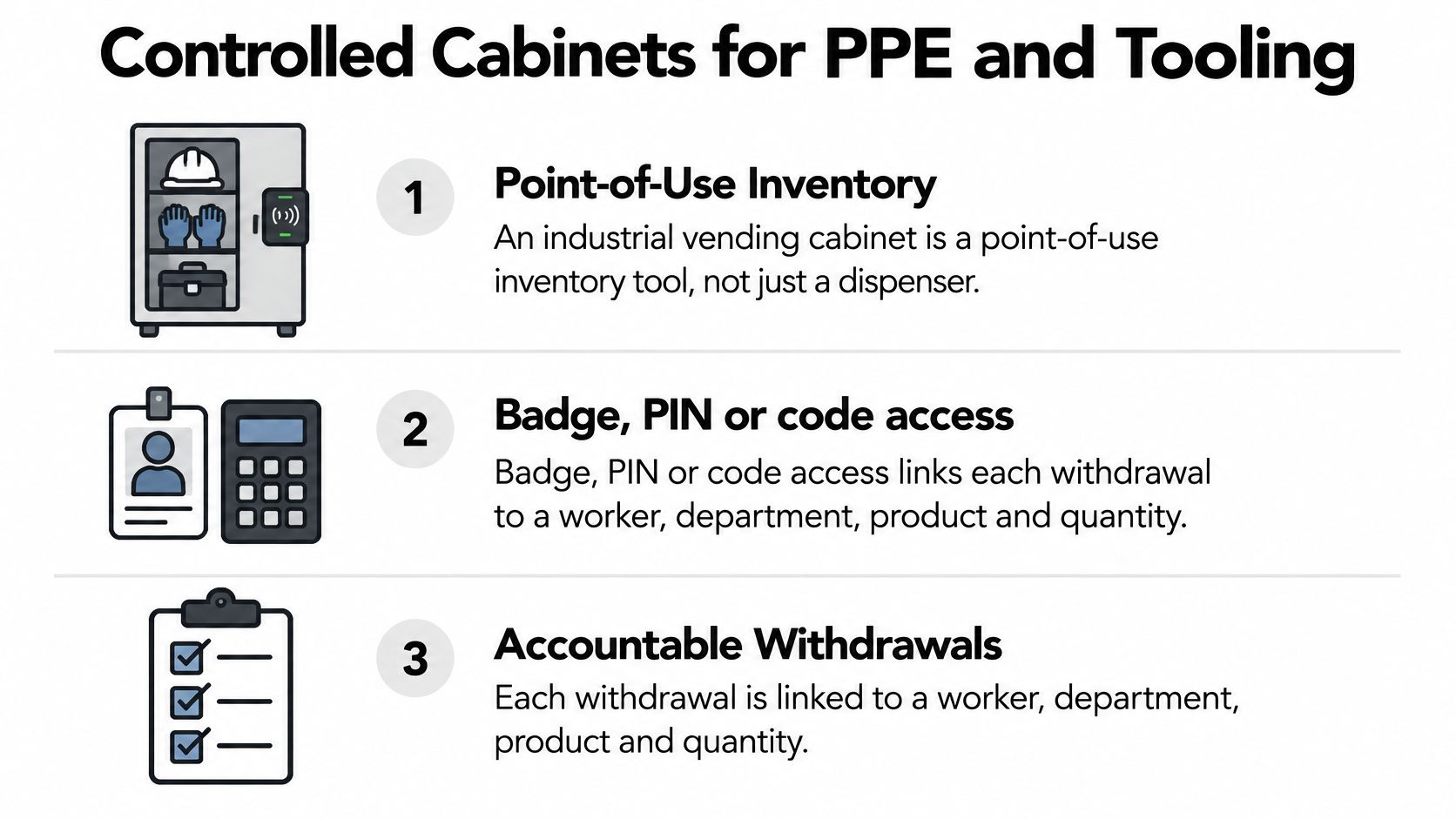
An industrial vending cabinet is a point-of-use inventory tool, not just a dispenser. Badge, PIN or code access associates a withdrawal with a worker, department, product and quantity, creating a digital chain of custody for PPE, cutting tools, batteries and fasteners.
A Peerless Research Group MRO study reported by Modern Materials Handling found that approximately 24% of companies were using industrial vending machines. The useful capability isn't the locked door alone, it's the supervisor-accessible transaction record.
These are the controls to build into the setup.
Set permissions before loading stock
Define access by SKU and job role. Match the item to the task rather than giving every badge identical permissions.
Link every withdrawal to an employee ID. Shared credentials undermine accountability and make investigation harder.
Restrict safety-critical items to authorized personnel. Pair access controls with a documented way for workers to obtain required PPE when a badge fails.
Review exception reports. Look for unusual quantities, repeated withdrawals and unexpected department usage, not just total dispenses.
Confirm off-shift records remain available. Test the reporting process when storeroom staff aren't present.
Say gloves keep disappearing from a welding bay. A report showing unusually heavy withdrawals by one department gives the supervisor a specific issue to investigate: incorrect glove selection, poor training, stock transfers or possible theft. It isn't proof of misconduct.
For reusable tools, pair transaction records with durable identification. The Evright Industrial tool tagging guide is a useful reference when planning how to identify tools outside the cabinet.
Use a PPE vending machine purchasing checklist to check access controls alongside dispensing compatibility. A cabinet must release the actual packaged gloves or tooling you intend to stock.
This video provides additional context for evaluating industrial vending.
The controls matter most on multi-shift floors where the storeroom closes but production continues. Keep an authorized backup access procedure so an inventory safeguard doesn't become a barrier to necessary supplies.
Placement and Managed Service Models
Check the proposed location before discussing the finish or touchscreen.
Foot traffic: Place refreshment machines near the break area employees already use.
Power and network access: Verify the equipment's electrical requirements and test connectivity at the installation point.
Heat exposure: Keep refrigeration equipment away from direct sun and process heat.
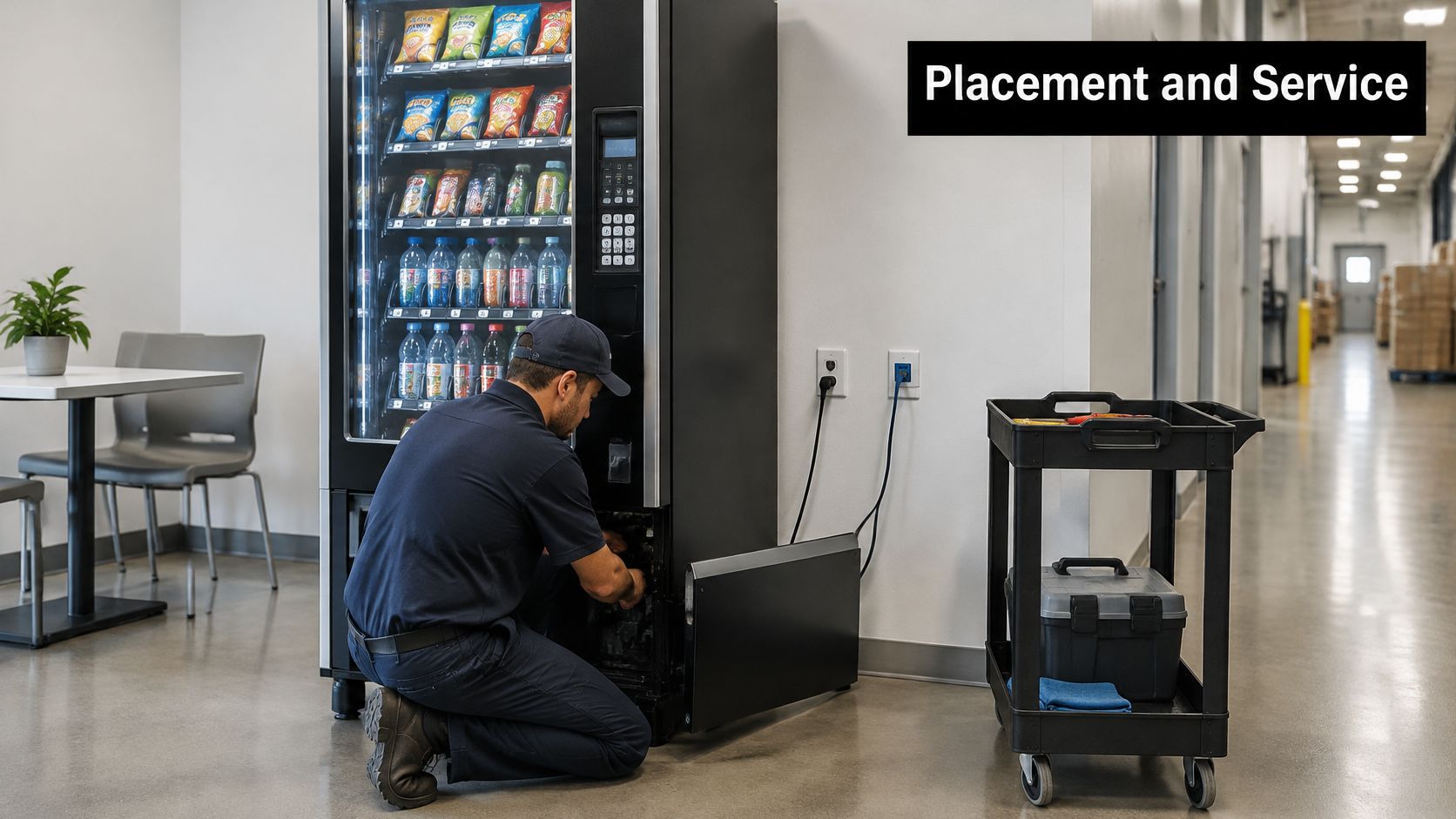
Delivery access: Confirm the route accommodates the machine, stock trolley and service technician.
Cleaning clearance: Leave access for floor cleaning, ventilation and maintenance.
Shift access: Choose a location every intended crew can reach without entering a restricted zone.
A central location isn't useful if employees need an escort to reach it. Likewise, an easy installation can become an expensive service problem when technicians can't open the cabinet fully or remove a failed component.
Managed service versus customer-owned machines
Factor | Fully managed service | Customer-owned machine |
|---|---|---|
Who stocks and restocks | Operator | Site staff or contracted restocker |
Who handles faults and repairs | Operator, within agreed response time | Site owner |
Upfront equipment cost for the site | Usually none, confirm in writing | Machine purchase cost |
Menu control | Shared, adjusted to site feedback | Site controls fully |
Telemetry and reporting | Operator dashboard | Requires compatible machine and software |
Fully managed service suits a facility that doesn't want employees buying stock, rotating products and arranging repairs. Ownership gives the site more direct control, but someone must still handle purchasing, expiry checks, reconciliation and service calls.
Maintenance access deserves the same attention as customer access.
Build replenishment around demand
A paper on optimal replenishment policies for industrial vending machines describes the physical upper limit of slot capacity as a constraint for inventory planning. Use that limit to set minimum stock, maximum quantities and reorder triggers by SKU.
Connected inventory software can compare recorded withdrawals with a reorder threshold and alert the responsible operator or storeroom. The alert is useful only if someone owns the replenishment task and can reach the site before stock runs out.
Give critical selections more protection than slow sellers. In a hot-shift plant, cold-drink slots may need a higher replenishment threshold; in maintenance, a production-critical consumable may need extra safety stock.
Service test: A low-stock notification isn't a restock commitment.
Size slots against demand variability and supplier lead time, then confirm who changes thresholds when staffing or production schedules change. Put the resulting replenishment obligations into the service agreement rather than leaving them as dashboard settings only the operator understands.
Compare Factory Vending Service Terms Before You Sign
Put these questions into every proposal comparison. Require concrete answers rather than assurances that service is responsive.
Fault response: What's the committed response time in hours, and does it mean acknowledgement, attendance or restored operation?
Restock timing: Which shifts does each visit support? Name the visit window and the process for overtime or weekend changes.
Payment handling: Which methods will the installed machine accept, and what happens when connectivity fails? Confirm whether offline transactions are supported and how they're stored and submitted.
Refunds: How does an employee report a failed purchase, who resolves it and how is repayment delivered?
Menu changes: Who approves substitutions, and how often can the site request new items?
Reporting access: Can the plant team review stockouts, faults and failed payment attempts, rather than sales totals alone?
Use a vending service-level agreement checklist to turn those answers into responsibilities both parties can verify.
At Vendmoore Enterprises in Oklahoma, we offer fully stocked, full-service vending and handle stocking, service and support. Customers can also choose to own their machine. Call us at 405-294-2373 to request a site visit, and bring your shift pattern and headcount per break area so we can propose a menu and placement.
Request a written breakdown of upfront equipment cost, any revenue share or commission, and any per-visit or restock fees. Compare managed and customer-owned options on total cost, including the staff work ownership leaves with your facility.
Sign only when response time, restock timing and the refund process are written into the agreement. A machine specification can tell you what the equipment supports; the contract must tell you who keeps it usable.
Vendmoore Enterprises offers full-service factory and break room vending, with stocking, service and support, plus options for customers who want to own their machines. Visit Vendmoore Enterprises to discuss your break areas, crew schedules and product needs, and arrange a site visit for a placement plan that fits your facility.
Comments