
Smart Fridge Vending Machine Guide: How It Works in 2026

The lunch rush is approaching, the break room has drinks but nothing substantial to eat, and someone has reported that the cooler feels warm. If you manage an Oklahoma workplace, school, or residential property, you don't just need another way to collect payments. You need to know what's available, whether it's safe to sell, and who will fix a problem.
A smart fridge vending machine connects those decisions. Its value comes from treating refrigeration, inventory, and checkout as parts of the same operating system, rather than adding a card reader to a cold cabinet.
What a Smart Fridge Vending Machine Is and How It Differs
A smart fridge vending machine is a refrigerated vending cabinet with a network connection, cashless payment hardware, and reporting that shows stock, sales, internal temperature, and faults on an operator's dashboard. Some use locked, open shelves where customers remove products after authorizing payment. Others retain a more familiar vending layout.
Think of a standard machine as a mailbox you walk to and check. A smart fridge is more like a connected home thermostat that reports a problem before anyone notices it. The distinction isn't the screen or the appearance of the cabinet. It's whether the operator can see what's happening without standing in front of it.
The layers behind the cabinet
The essential layers are refrigeration with temperature sensing, connectivity that sends data off-site, and payment hardware. Payment configurations can include cards, Apple Pay, Google Wallet, and cash, but buyers should confirm the exact configuration rather than assume every smart cooler has a cash acceptor.
Many standard snack machines aren't refrigerated, so they can't safely sell chilled ready-to-eat foods. Frozen products also require equipment designed for frozen storage. A refrigerated cabinet doesn't become a freezer because its dashboard is advanced.
The comparison below shows the practical differences a site manager should examine.
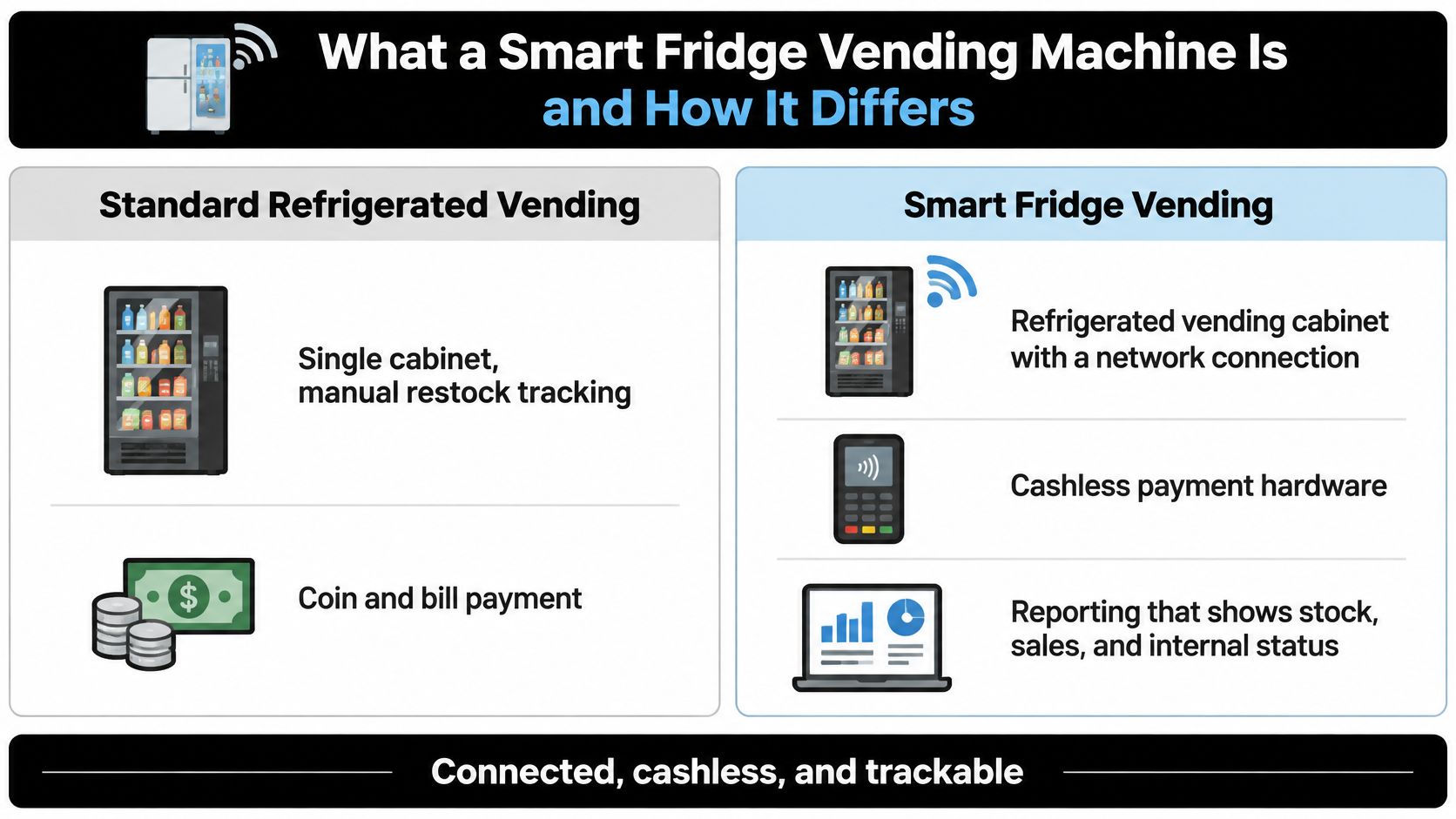
Smart fridge vending compared with standard vending
Feature | Smart fridge vending machine | Standard vending machine |
|---|---|---|
Cooling | Refrigerated cabinet with temperature sensing | Often ambient, or basic cooling without sensing |
Payment | Cards, Apple Pay, Google Wallet and cash, when configured | Mostly coins or cash, with card readers on equipped machines |
Stock tracking | Remote, based on sales and restock events | Manual check on each visit |
Fault alerts | Automatic alerts for temperature and equipment faults | Often found when a customer reports a problem |
Suitable products | Ready-to-eat, dairy and chilled items, plus frozen items in freezer-rated equipment | Shelf-stable snacks and drinks in ambient equipment |
These are buying distinctions, not universal labels. A conventional refrigerated vending machine can have modern payment and monitoring upgrades. Conversely, an attractive touchscreen doesn't prove that a cooler records expiry dates or stops unsafe sales.
Start with the food you want to offer, then evaluate the controls needed to support it. Use the fit checklist at the end to separate useful capabilities from features your location won't need.
How Telemetry Turns a Cabinet Into a Connected Machine
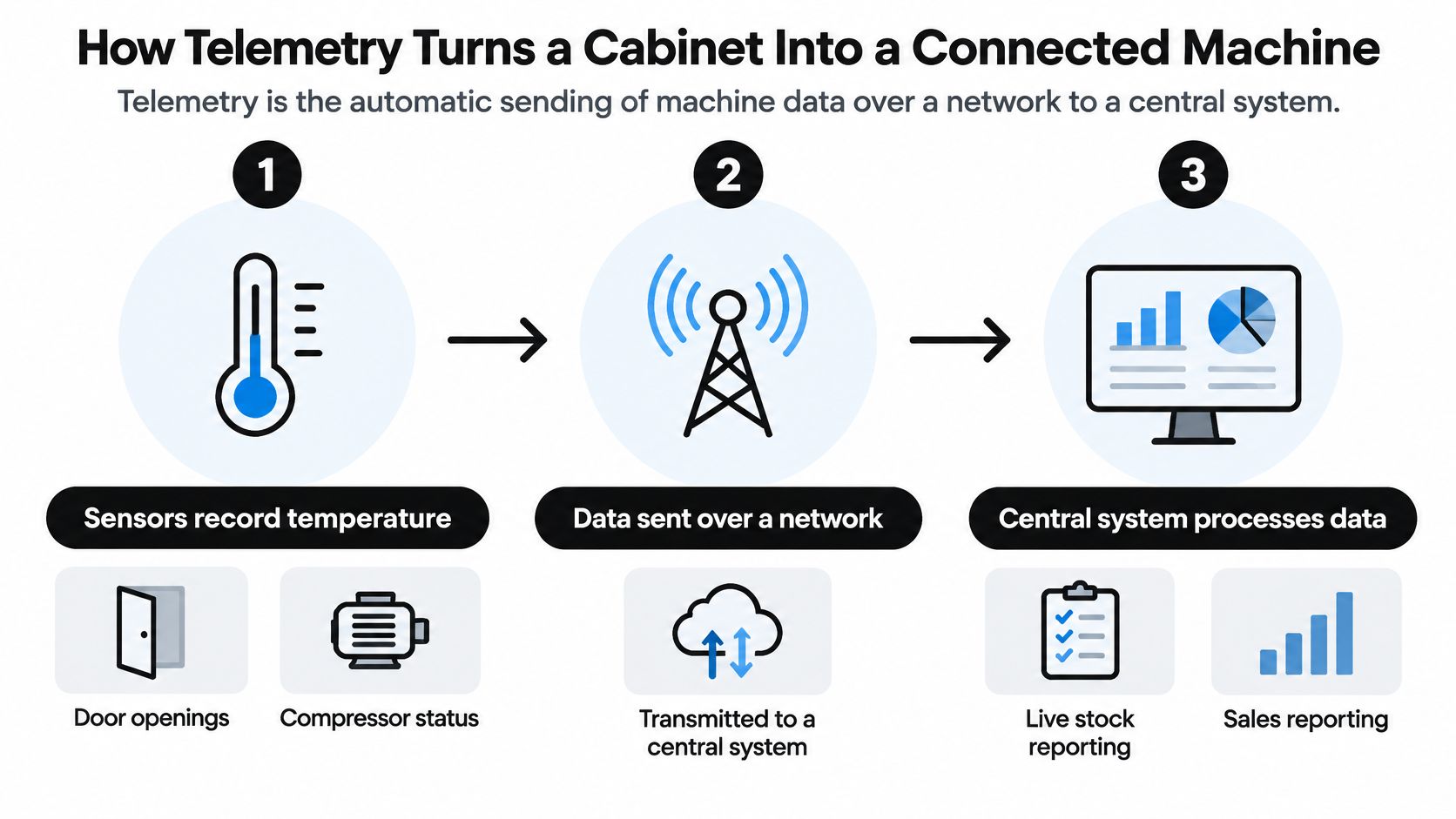
Telemetry is the automatic sending of machine data over a network to a central system. It gives the operator a working view of the cabinet, not merely a record of yesterday's revenue.
This diagram shows how readings move from the machine to the operator's platform.
The operating loop
Sensors record conditions, including temperature, door openings, and compressor status where supported.
The controller timestamps readings and sales so events can be compared.
The connection transmits data to the operator's platform.
The platform flags low stock, temperature excursions, or equipment faults.
Operations schedules the appropriate restock visit or technician.
The service event is logged, giving the next cycle an updated starting point.
According to Berg Insight estimates cited by William Blair's unattended-retail analysis, about 44% of the world's vending machines, approximately 6.5 million units, were connected in 2023; the analysis projected 71%, roughly 11.4 million units, by 2028, an increase of about 4.9 million machines and 27 percentage points over five years, and cited potential operating-cost reductions of at least 20% from telemetry combined with software.
Those savings aren't automatic. Operators have to act on the information: replace blind inspection visits with informed routes, replenish popular products before shelves empty, and dispatch the right technician when equipment fails. An ignored alert doesn't improve service.
For more detail on what operators collect, our guide to telemetry data collection explains the connection between machine reporting and service decisions.
The following video offers additional context for connected vending.
Distributed workplaces, schools, hospitals, airports, and residential properties make this loop particularly useful. Driving between locations to discover what each machine needs is slow and expensive. Remote reporting lets the operator prepare before leaving the warehouse.
Food Safety Limits Built Into Refrigerated Vending
Temperature is a food-safety control, not just an equipment-performance metric. A cabinet can look clean and accept payments while holding perishable food under unsuitable conditions.
The FDA Food Code equipment provisions establish the 5°C (41°F) refrigerated vending threshold, the permitted 30-minute excursion immediately after filling, servicing, or restocking, and applicable automatic-shutoff and discard requirements. The FDA's complete Food Code also specifies a maximum seven-day holding period for applicable refrigerated ready-to-eat food maintained at 5°C (41°F) or below; this isn't permission to extend a shorter product shelf life.
Food-safety limits and the control that enforces each
Control point | Limit (FDA Food Code) | How the machine enforces it |
|---|---|---|
Ambient air temperature | 5°C (41°F) or below | Continuous sensing with an independent high-temperature cutoff |
Time above limit after filling, servicing or restocking | No more than 30 minutes | Timer started by a door-open or service event |
Refrigerated ready-to-eat food held before consumption or discard | No more than 7 days at 5°C (41°F) or below, where the provision applies | Expiration timestamp on each batch |
Excursion beyond the permitted window | Discard refrigerated ready-to-eat food where applicable | Automatic shutoff, disabled selections and a product-inspection task |
Controls must reflect product conditions
Place the monitoring sensor in the product-storage airflow path, not directly beside the evaporator where readings can give an overly reassuring picture. Pair it with an independent high-temperature cutoff and a timer linked to door openings or service activity.
Continuous or short-interval readings should carry timestamps. Escalating alerts should warn operations as conditions approach the limit, rather than waiting until a shutdown is unavoidable. A door left ajar after restocking and a compressor failure need different repairs, even if both produce a warm cabinet.
For staff who handle loading and product removal, BacteriaFAQ.com's kitchen temperature rules for food handlers provide useful background on why time and temperature belong together. For equipment context, our guide to what's inside a vending machine helps distinguish the refrigeration components from payment and dispensing hardware.
Practical rule: A warning on a dashboard isn't a substitute for a control that prevents an unsafe sale.
Preserve an auditable history connecting each excursion to restocking, door openings, compressor faults, and product disposition. The response should disable affected refrigerated selections, notify operations, document inspection and discard decisions, and record the corrective action.
The operator should verify the applicable requirements with the local food authority. A reset button must never substitute for deciding whether the food is still suitable for sale.
How Inventory Software Decides What to Restock
A refrigerated machine can be well stocked and still need urgent attention. Its shelves might contain slow-selling products approaching expiry while the item everyone wants is nearly gone.
That's why replenishment can't rely on quantity alone. Each batch needs an expiration timestamp, and the operator needs accurate records of sales and restock events. Where practical, shelf placement should follow first-expire-first-out, putting the earliest-expiring suitable products where customers will select them first.
A break room example
Say chicken wraps sell out by mid-morning in an office break room, while the yogurt still has four days of usable shelf life. This is a hypothetical operating scenario, not a forecast for every workplace.
The operator should prioritize wraps on the restock route and leave adequately stocked yogurt for the next planned visit. But if the cabinet reports an unresolved temperature excursion, the task changes from ordinary replenishment to inspection and corrective action.
A fixed par-level rule misses that distinction. Topping every shelf back up on the same schedule can add more yogurt while failing to provide enough wraps for the next lunch rush.
A useful ranking combines:
Projected stockout time, estimated from sales velocity and remaining sellable inventory.
Remaining shelf life, evaluated by batch rather than just product name.
Current temperature status, so a food-safety exception overrides normal replenishment.
Our explanation of a vendor-managed inventory system describes how replenishment responsibility can sit with the operator instead of the site manager.
Good replenishment means delivering the right food while it can still be sold safely, not simply filling every empty space.
What the dashboard should show
When comparing vending operators, request a demonstration using a product and location you recognize. The dashboard should show a stockout forecast, batch expiry dates, cabinet temperature status, and a restock queue ranked by priority.
Also examine how the operator records damaged goods, removals, and substitutions. Sales-based stock estimates become unreliable if someone removes expired food without logging it. Accurate inventory helps prevent lost purchases from stockouts and avoidable spoilage from poor cold-chain control.
Cashless Payments and Their Trade-offs
Cards, Apple Pay, and Google Wallet let customers pay without carrying coins, while cash can preserve an alternative purchasing path. Connected payment systems also let operators review transactions in near real time. That's convenient, but cashless doesn't always mean frictionless.
In a survey of 2,325 U.S. consumers, debit cards accounted for 29.6% and credit cards for 27.3% of respondents' most recent unattended purchases, while separate industry analysis placed global cashless acceptance at only 20%–25% of unattended machines, as discussed in the Cantaloupe and PYMNTS unattended-retail report.
Payment failure cases and the required response
Failure case | What a well-run machine should do |
|---|---|
Dead phone battery | Offer a card or cash fallback at the same selection |
No compatible wallet | Show card and cash options on the payment screen |
Card declined | Show a clear reason message when available and allow a retry |
Connection dropped | Show a clear message, allow a retry and log the attempt |
Temporary authorization confuses buyer | Explain the hold in plain language and state when funds release |
These are acceptance criteria for the installation, not capabilities to assume every cabinet includes. If the selected smart fridge can't accept cash, the site needs an explicit decision about an alternative, rather than a vague promise that everyone can use a phone.
Checkout responsibilities extend beyond payment
A customer should be able to find a receipt, identify the machine, and report a disputed charge without searching through unrelated website pages. Explain the difference between a pending authorization and a completed purchase, and publish the refund process and expected timing without promising a release date the operator can't control.
Accessibility also belongs in the evaluation. Check screen readability, control reach, payment-terminal placement, and whether someone can complete a purchase without relying solely on a smartphone. Schools and healthcare sites may need purchasing controls that match their audience and policies.
Removing cash can speed checkout and improve operational visibility, but it can also exclude customers and increase dependence on network uptime.
Transaction records and operational telemetry shouldn't be treated as interchangeable data. Establish who can access each, how long records are retained, and what gets shared with the property manager. Our guide to cashless payment advantages and disadvantages explores these practical trade-offs.
Before deployment, answer a direct question: does the site retain a non-digital payment path?
Where Smart Fridge Vending Fits in a Refreshment Program
The refrigerated vending-machine market was valued at USD 6,504.66 million in 2024, according to Credence Research. That establishes cooled self-service retail as a sizeable category, but market size alone doesn't tell you which cabinet belongs in your break room.
This overview places refrigerated vending within the wider refreshment program.
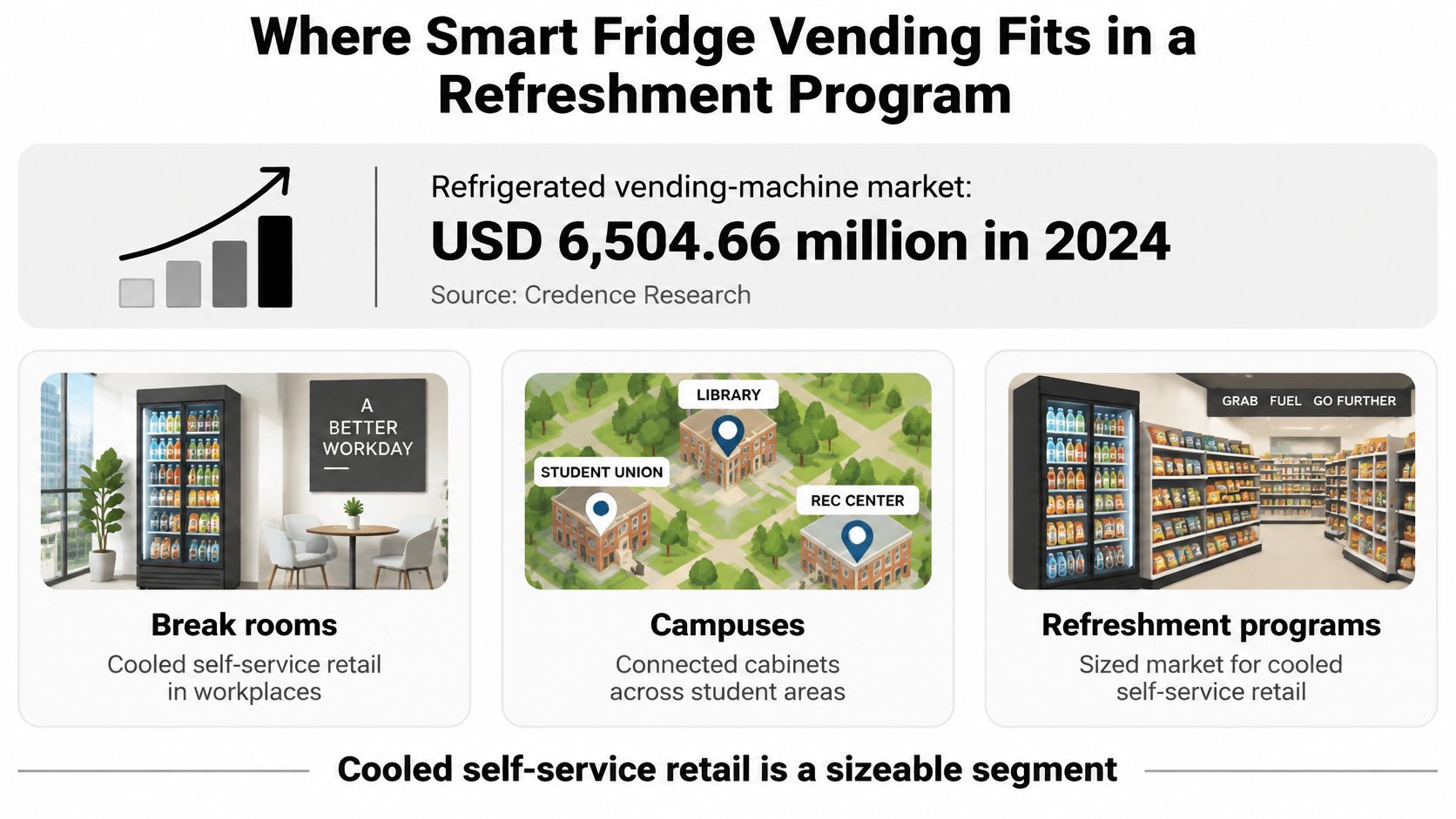
Match the location to the operating need
Corporate offices and business centers: Combine chilled lunch items with suitable snacks and drinks. Remote inventory visibility helps the operator prepare for changing attendance without asking office staff to count shelves.
Schools, colleges, and universities: Prioritize clear product information and appropriate purchasing controls. Position the machine where students or staff can use it within the institution's access rules.
Hospitals and clinics: Plan for shift workers who need ready-to-eat food outside cafeteria hours. Maintain records that support the facility's food-safety review.
Manufacturing and industrial sites: Build the assortment and replenishment schedule around shift changes. Loading products during a production break may obstruct the people the machine is supposed to serve.
Airports and stadiums: Use accurate stock information to prepare for concentrated demand. Confirm that replenishment staff can reach the cabinet when access restrictions apply.
Multi-tenant residential complexes: Place the service in an accessible community area with a named property contact. Unattended doesn't mean the cabinet can operate without cleaning, loading, and maintenance.
Choose the format before choosing the features
A shelf-stable snack program may be better served by conventional vending. A chilled-food program needs refrigeration controls, while an open micro market also requires space and a suitable checkout arrangement. A freezer menu needs freezer-rated equipment, not just a cooler with additional software.
For properties in Oklahoma City, Norman, Edmond, and nearby communities, route access and service coverage deserve as much attention as cabinet capacity. A suitable machine still needs an operator who can reach it.
The more distributed the locations and the more perishable the menu, the stronger the case for connected refrigerated vending. Apply that rule to the actual food program, rather than choosing equipment because its checkout looks modern.
Confirm the Fit Before You Install a Smart Fridge
A smart fridge should solve a defined refreshment problem. Before committing floor space or signing an agreement, turn the proposed service into answers you can compare and document.
Run the fit checklist
Menu and limits: Does the menu need refrigeration, and who establishes the applicable storage limit?
Safety records: Can the operator show temperature history and corrective-action logs, not just a current reading?
Inventory visibility: Can stock and expiry information be reviewed without sending someone to the site?
Payment fallback: What happens when a card fails or a customer's phone dies?
Fault ownership: Who receives an alert, who responds, and what response window is agreed?
Data handling: How are transaction and telemetry records stored, accessed, and shared?
Service access: What schedule fits the site's opening hours, security requirements, and busiest breaks?
A vague answer on any of the opening checks is a reason to pause. Refrigeration requirements, safety records, inventory visibility, and payment access determine whether the installation can deliver the service people expect.
Our venue setup guide can help you prepare the space and discuss access before installation. Bring the proposed menu, available placement area, and building access requirements to that conversation.
Compare responsibilities as well as cost
Ask what the total cost of a fully managed arrangement would be compared with owning the machine. Then establish which party pays for repairs and emergency restocks. Put those responsibilities in the agreement instead of assuming that machine ownership includes ongoing operational support.
We install and operate smart vending machines across Oklahoma. Vendmoore Enterprises offers fully stocked, full-service vending, where we handle stocking, service, and support, as well as an option for customers who want to own their machine. Compare the checklist with our proposed arrangement and call 405-294-2373, Monday through Friday, 9:00AM to 5:00PM, to discuss your location.
Vendmoore Enterprises offers break room vending with customized assortments, connected monitoring, and fully managed service or machine-ownership options. Visit Vendmoore Enterprises to discuss your menu, payment needs, and service access so we can help identify an appropriate smart fridge vending setup for your Oklahoma workplace or community space.
Comments