
Middle School Vending Machines: Rules and Setup Guide

National figures cited in the USDA Smart Snacks guidance show that 44% of middle schools had vending machines on campus, compared with 71% of high schools. That gap exists for a reason. Middle school vending machines operate inside a tighter policy, developmental, and access environment than high school units or office break rooms, and programs that copy a high school setup usually run into compliance trouble within their first semester.
Most school teams start the conversation by asking which snacks sell best. Starting with products puts the process backward. A dependable campus vending program begins with policy, physical access controls, fair payment rules, and a scheduled verification routine, then fills the slots to match. Whether a district is evaluating student-facing machines or pairing them with separate break room vending for teachers and staff, getting the order of decisions right prevents rejected deliveries, student complaints, and stalled approvals.
Why Middle School Vending Needs Its Own Rules
Walk past a snack machine in a seventh-grade hallway and it looks identical to the unit in an office lobby or a high school commons. The glass front, spiral coils, and card reader are the same hardware. What changes is everything around the glass. Inside a middle school, every item on display sits within a regulated school day, serves children aged roughly eleven to fourteen, and intersects with federal nutrition rules, district wellness policies, and bell schedules that never apply to an adult workplace.
This operational boundary covers two connected environments on campus. The first is student-facing equipment in hallways, cafeterias, and gyms. The second is staff-only break room vending in faculty lounges and administrative workrooms, which often relies on the same vending services partner and delivery route even though it serves a different audience. Treating both zones as one undifferentiated contract is where most friction begins.
A vending machine in a middle school is a policy decision that happens to dispense snacks.
Think of a campus machine less like a corner store and more like a classroom. Every slot, operating window, and payment option communicates a deliberate standard set by school leadership. Before contacting any vending operator or reviewing questions vendors ask about bid tools from State and Local Bid Reviews, a school team needs to lock down four decisions on a single page:
Approved products: Which snacks and beverages pass federal, state, and district limits for middle schoolers.
Location and access hours: Where each machine sits, who can physically reach it, and which bell windows stay locked out.
Fair payment and pricing: How students pay without excluding families who lack cards or smartphones, and how prices compare with cafeteria items.
Verification and restocking: Who checks every load against the approved list and how quickly noncompliant substitutions get pulled.
Putting those four decisions on one page gives administrators, food service directors, and prospective vending operators a shared blueprint before anyone signs an agreement.
Smart Snacks Limits Every Middle School Product Must Meet
Every food and beverage sold to students during the school day falls under the USDA's Smart Snacks in School standards, whether the item sits in a hallway machine, a school store, or a snack bar. Congress directed the USDA to create these nationwide rules through the Healthy, Hunger-Free Kids Act of 2010, and the framework took effect on July 1, 2014, replacing a patchwork of local policies for schools participating in the National School Lunch and School Breakfast Programs, as detailed in a PLOS ONE policy analysis. For a vending program, the practical meaning is direct: the standards follow the student, not the machine. A product that passes in a high school can still fail a middle school rule, so every stocking decision starts with the federal chart below.
Product type | Middle school limit | Example items | Common mistake |
|---|---|---|---|
Snack food, single serving | 200 kcal or less per package; sodium 200 mg or less | Baked chips, granola bars, pretzels | Multipack bags that exceed the per-package limit |
Plain water | Allowed with no added sugar | Bottled still or sparkling water | Flavored waters with added sugar |
Low-fat or nonfat milk | Up to 12 fl oz | Skim or 1% milk | Whole milk or higher-fat flavored milk |
100% fruit juice | Up to 12 fl oz | Orange or apple juice | Juice drinks or punches sold as juice |
Other beverages | Low-calorie only, within the grade-band cap | Diet or zero-calorie drinks that meet the cap | Regular soda or sugared sports drinks |
Reading the Nutrition Label on the Exact Package
A brand name never guarantees compliance. Manufacturers routinely sell retail versions and school-compliant versions under nearly identical wrappers, and package weights shift without warning. A vending operator loading baked chips or pretzels must check the Nutrition Facts panel on the exact single-serve bag going into the coil, not an old spec sheet from last fall. Multipack bags frequently look small enough at a glance yet carry two servings inside one wrapper, pushing the package over the 200 kcal or 200 mg sodium ceiling.
Beverage slots trip up teams just as easily. Plain bottled or sparkling water passes cleanly, while lightly sweetened flavored waters fail because of added sugar. Milk slots must hold skim or 1% milk in containers up to 12 fl oz, leaving out whole milk and higher-fat flavored bottles. Fruit juice must be 100% juice capped at 12 fl oz, never fruit punches or juice blends that carry added sweeteners. Any other beverage must stay low-calorie and within the middle school grade-band limit, which rules out regular sodas and sugared sports drinks. For product-level menu ideas that fit these boundaries, review our breakdown of healthy vending machine snacks in schools.
The reliable habit is a receiving check, not a memory check. When each delivery arrives, one designated person reads the Nutrition Facts on every incoming package against the table above before a single item reaches a coil. Programs rarely fail because a team chose the wrong product on purpose; they fail because a distributor substituted a lookalike package and nobody opened the case.
Local Overrides Always Win
Federal limits set the floor, not the ceiling. State legislation and district wellness policies frequently tighten those rules by banning artificial food dyes, capping added sugars lower, or restricting caffeine and artificial sweeteners. Whenever a district rule is stricter than the federal chart, the local standard governs every student-facing slot. Pull the physical wrapper of every item currently stocked in any campus machine today and check each Nutrition Facts label against the table row by row.
Building an Assortment Students Will Actually Buy
Meeting nutrition rules keeps a program legal, yet a compliant snack that sits untouched behind the glass creates expired inventory, frustrated operators, and zero benefit for hungry students. Closing the gap between eligible items and items students choose takes deliberate menu design rather than a generic list of virtuous foods.
Below is a practical three-tier framework for organizing slots so compliance and student demand pull in the same direction.
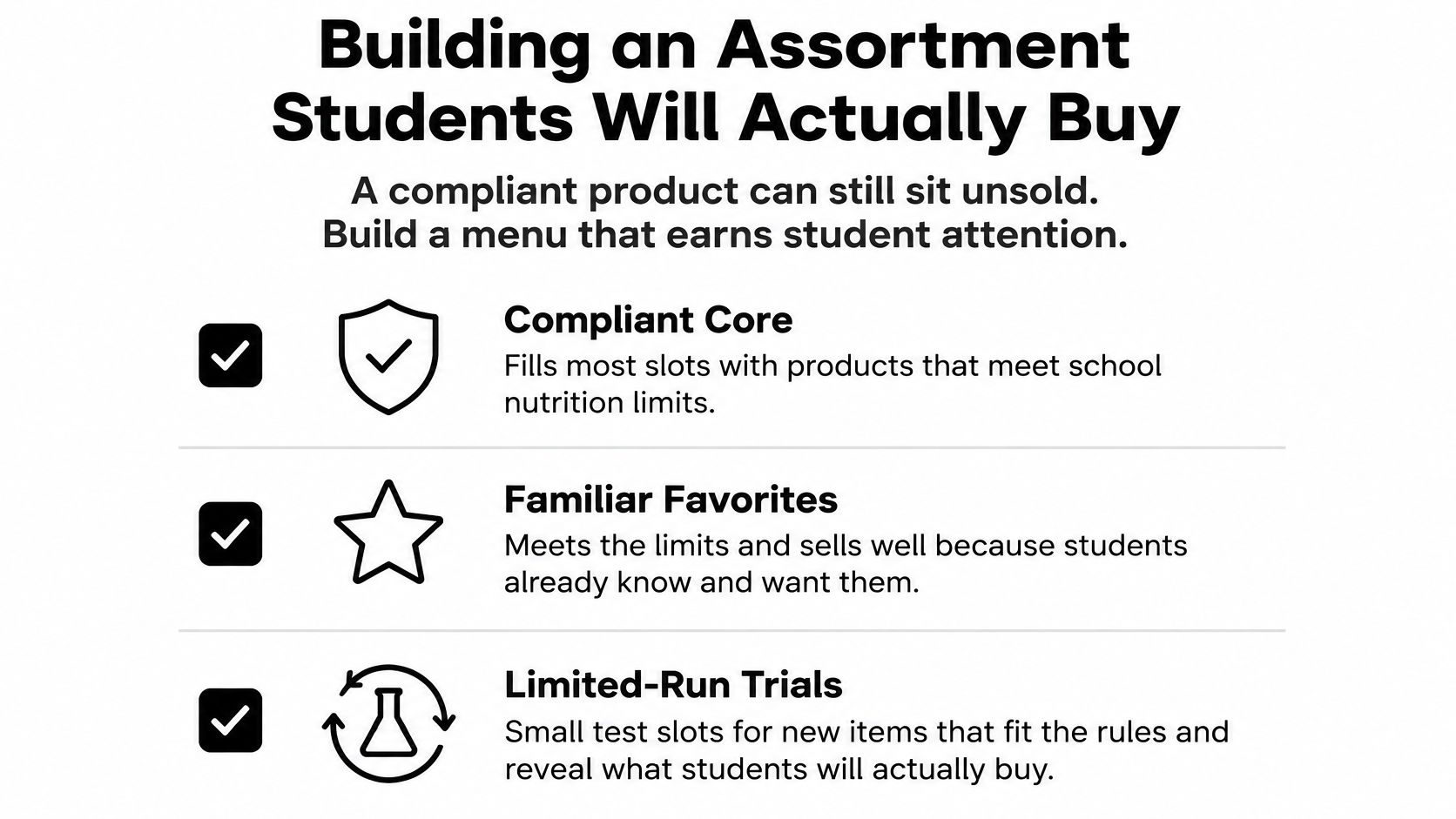
A working middle school assortment splits its slots into three clear roles. The Compliant Core anchors the machine with dependable staples that pass every nutrition threshold and hold a steady shelf life. Familiar Favorites fill the high-visibility eye-level rows with recognizable snacks students already eat outside school in their compliant single-serve formulations, such as baked tortilla chips, whole-grain crackers, or reduced-fat cheddar popcorn. Limited-Run Trials occupy just one or two rotating slots per term to test unfamiliar items before committing full case quantities. Loading half a machine with trendy health bars students have never tasted almost always produces stale stock and wasted budget; testing one new item per term lets purchase patterns decide what earns a permanent coil.
Designing Around Middle School Realities
Twelve-year-olds interact with vending machines differently than adults in an office break room. Every item should arrive in a single-serve package that opens cleanly without scissors or adult help and requires no microwave or hot water. Clear allergen labeling matters just as much, especially on campuses with nut-free zones or classrooms managing severe food allergies. When selecting classroom-friendly options, checking lists of allergen-safe snacks for school lunches from Gym Snack helps food service leads screen out hidden peanut or tree-nut cross-contact risks before approving a vendor's proposed menu.
Turning Rules Into an Auditable SKU Matrix
Vague instructions like "stock healthier choices" break down on the first busy delivery week. A three-year randomized middle-school intervention published in PMC showed how schools can encode nutrition standards into strict equipment controls: participating machines were restricted to single-serving snack packages with no more than 200 kilocalories, while 100% fruit juice and all beverages with added sugar were removed altogether. Translating that kind of protocol into daily operations requires an item-level SKU matrix rather than verbal guidance.
Build the matrix as a simple spreadsheet with one row per machine slot and four mandatory fields for each approved product:
Package calories: Recorded for the full package as sold, not a single partial serving.
Added-sugar status: Marked clearly so route drivers never confuse unsweetened items with flavored variants.
Serving size and container volume: Documented in ounces or grams so package-size changes trigger an automatic review.
Beverage or snack category: Assigned to its exact eligibility tier, paired with a written substitution rule stating that any recipe or package change requires fresh approval before loading.
The video below illustrates how structured school nutrition and vending choices look in practice when teams align equipment with student habits.
For deeper strategies on balancing slot velocity with menu variety across any site, explore our guide on product assortment optimization. Before your first delivery, draft a working sheet of 12 to 15 approved items as a starting baseline and assign every single SKU to a numbered coil.
Placement and Access Rules for Each Location
Putting a machine in the wrong corridor can trigger compliance violations even when every snack inside is eligible. Who can physically walk up to the machine, and at what hour of the day, determines which regulations apply.
Placement | Who can use it | Usual access window | Rules that usually apply |
|---|---|---|---|
Hallway, commons or cafeteria | Students | School day | Smart Snacks applies in full |
Gym concession during school events | Students and families | Before, during or after school events | Check whether event exemptions apply |
Teacher lounge or staff workroom | Staff only, with badge or key access | Any hours when students are excluded | Smart Snacks generally does not apply when students cannot reach the machine |
Community or residential common room | Adults and residents | Any hours | No school food rules; building and lease terms govern |
Having equipment inside a school building is very different from letting students buy snacks during class time. In a 2014 CDC national study of 631 schools, vending machines were accessible during the school day in 33.0% of middle schools, compared with 66.4% of high schools, 10.1% of elementary schools, and 28.1% of all participating schools overall. District policies increasingly rely on locked access windows, timer switches, and physical zoning rather than banning machines outright.
Separating Student Zones From Staff Break Room Vending
Each placement row carries distinct operational rules:
Hallways, commons, and cafeterias: Any machine reachable by students during instructional hours or passing periods must meet Smart Snacks rules in full, with electronic timers or lockouts configured if district policy shuts machines down during lunch service.
Gym concessions at school events: Evening basketball games, track meets, and weekend tournaments often fall under state or district fundraiser and event exemptions, so athletic directors should verify written exemption boundaries before stocking non-school-day items.
Teacher lounges and staff workrooms: Federal guidance makes a sharp distinction based on physical access. As noted in USDA vending guidance referencing Kansas Smart Snacks policy, a vending machine inside a faculty workroom doesn't have to follow Smart Snacks standards when students can't enter that room. That makes dedicated break room vending for educators and administrators a separate service track, allowing broader coffee, cold drink, and classic snack menus as long as badge or key access keeps students out and local wellness policy agrees.
Community and residential common rooms: Adjacent adult spaces operate under property lease agreements and local health codes rather than school nutrition rules.
Access check: If a student can walk up to a machine without passing a locked door or staff barrier during the school day, treat that machine as student-facing regardless of who the machine was intended to serve.
Physical Placement Standards Inside the Building
Once policy zones are defined, walk the floor with a tape measure and a facilities manager. Position student-accessible machines within clear staff sightlines to discourage vandalism and loitering, and keep them well away from classroom doors where foot traffic and compressor noise disrupt lessons. Verify accessible reach heights and clear floor space so students using mobility aids can select and retrieve items independently. Confirm a dedicated electrical outlet capable of supporting refrigerated or dual-zone cold units, and post a laminated sign showing exact operating hours directly on the side panel. For practical indoor site-planning tips covering foot traffic and utilities, see our overview on placing a vending machine inside a facility.
Write down every proposed machine spot on campus today, listing exactly who can reach it and the exact hours it stays powered on.
Payment and Pricing Choices That Keep Access Fair
Many modern vending services default to cashless-only terminals because removing bill validators cuts coin-jam service calls and simplifies accounting. Inside a middle school, however, a cashless-only machine creates an immediate equity problem. Unlike high schoolers with part-time jobs or adults in an office break room, a large share of sixth-, seventh-, and eighth-grade students don't carry debit cards, smartphones, or active digital wallets. Removing cash turns a hallway snack machine into a two-tier amenity that serves only the students with family bank cards or phones.
Payment method | Who it reaches | Main risk | Recommended role |
|---|---|---|---|
Cash or coins | Students without cards, phones or wallets | Cash handling and theft | Keep as a standard option |
Card or tap-to-pay | Students with bank cards | Excludes students without cards | Add alongside cash, never alone |
Digital wallet | Students with smartphones and reliable plans | Excludes students without phones or data | Optional extra method |
School meal account link | Students with meal accounts | Can reveal free or reduced-meal status | Avoid unless payment privacy is protected |
Keeping cash active alongside modern readers gives families flexibility without locking anyone out. Adding tap-to-pay speeds up passing-period lines for students who do carry cards, and you can weigh those speed gains against setup considerations in our look at contactless payment benefits. Whatever hardware you choose, protect payment privacy strictly: no screen prompt, receipt tone, or account lookup should signal to nearby peers whether a student qualifies for free or reduced-price school meals.
Price Parity and Tighter Local Models
Pricing matters just as much as payment hardware. Compare every vending slot price directly against the cafeteria's à la carte price for the same snack or drink category. A fifty-cent markup looks minor on a vendor spreadsheet, yet for a middle schooler stretching a small weekly allowance, that gap determines whether they can buy water or a snack after practice.
District timing and product rules vary sharply across the country. Federal implementation research compiled in the USDA Healthy, Hunger-Free Kids Act Smart Snacks evaluation documented local policies restricting vending access from 45 minutes before school until 30 minutes after school, and noted that Chicago permits beverage vending in middle schools while prohibiting snack vending machines in student-accessible areas during school hours.
When a Refreshment Station Beats an Open Snack Machine
Sometimes the fairest answer isn't an unattended snack machine at all. If a school struggles with food insecurity, lunchroom competition, or cashless exclusion, a limited, supervised refreshment station with a short fixed menu of water and approved snacks can serve students more equitably than a hallway coil machine. Choosing a supervised station or beverage-only machine isn't a failed vending rollout; it's an accurate fit for the building's community.
Before signing any operator agreement, answer a five-question equity audit in writing:
Cash access: Can a student with only dollar bills and quarters buy every item in the machine?
Price parity: Do slot prices match or stay within a few cents of comparable cafeteria items?
Payment privacy: Does the payment flow conceal free or reduced-meal eligibility completely?
Meal timing: Do operating hours prevent the machine from pulling students away from balanced school breakfasts and lunches?
Stigma-free hydration: Can every student reach free drinking water nearby without feeling pressured to buy bottled drinks?
Restocking and Audit Schedule That Keeps Machines Compliant
Most compliance failures in middle school vending machines don't stem from willful rule-breaking. They happen on a rushed Tuesday afternoon when a route driver runs low on baked pretzels and fills the empty coil with regular pretzels from the truck. Pre-policy audits conducted across eight rural Appalachian middle schools, reported in a CDC Stacks evaluation, found that only 36.6% of foods and beverages sold through vending machines and à la carte channels met the forthcoming USDA Smart Snacks standards. Without a scheduled verification routine, drift happens fast.
Cadence | Task | Who checks | Record to keep |
|---|---|---|---|
Every delivery | Reconcile invoice quantities against machine inventory and the approved SKU list | Site coordinator | Signed delivery log |
Weekly | Check expiry dates, empty slots and price labels | Operator route staff | Replenishment sheet |
Monthly | Spot-check machine contents against the approved SKU list | School food service or program lead | Audit form with substitutions noted |
Each new product | Complete a nutrition review before loading | Food service director | Updated approved SKU database |
Quarterly | Review sales by item, stockouts and complaints | Program lead with operator | Performance report |
Four Controls That Prevent Silent Substitutions
The schedule above works because four operational controls sit behind it. First, maintain one central approved SKU database shared between the school food service lead and the vending operator. Second, require a documented nutrition sign-off before any new item or reformulated package enters the building. Third, reconcile every delivery invoice against what went into the coils so unauthorized stand-ins get caught at the loading dock rather than weeks later. Fourth, run unannounced monthly spot checks paired with short exception reports whenever a noncompliant item turns up.
Audit habit: Treat an unauthorized snack substitution like a mislabeled shipment, not a minor favor. Logging the exception and fixing the root cause protects the district during state administrative reviews.
Measurable Service Levels for Managed Vending Operators
When working with a full-service vending provider, write compliance verification directly into the service-level agreement rather than relying on verbal promises. Specify four measurable standards:
Approved SKU compliance rate: Set the target at 100% of stocked slots matching the approved database.
Audit cadence: Confirm how often the operator self-audits coils alongside the school's monthly spot check.
Removal turnaround: Define the exact response window for pulling any noncompliant or expired item once flagged.
Documented corrective action: Require a brief written note explaining how the operator will prevent the same substitution on future routes.
Modern connected telemetry strengthens every row of this schedule. Remote inventory tracking flags unusual coil changes, monitors sell-through by slot, and alerts route staff before top sellers go empty, turning the quarterly review into an objective data check. Teams tracking these metrics across multiple machines can benchmark their process using core inventory management KPIs. Attach the cadence table directly to your operator agreement as the required restocking schedule.
How to Judge a Middle School Pilot
Evaluating a new campus vending program by gross commission checks alone hides almost everything that matters to a principal or food service director. A landmark three-year trial shows why reporting infrastructure has to be settled before the truck delivers the machine.
In the three-year HEALTHY study archived by the National Library of Medicine, researchers tracked vending offerings across 30 middle schools, split evenly between 15 intervention schools and 15 control schools. By the end of the trial, every intervention school with beverage vending machines met the study's beverage goal, compared with only one of nine control schools with beverage machines. The intervention also cut students' access to less-healthy foods outside the federally reimbursable school meals program.
Here was the operational catch. Despite running a rigorous multi-year trial, researchers couldn't report item-level sales volume or itemized revenue. The machines lacked detailed telemetry, vendors didn't log sales by individual product and time period, and districts received lump-sum revenue checks with no breakdown of what moved. Without itemized reporting, a school can't tell whether water outsold juice, which slots sat dead for a month, or whether afternoon sales spiked right after lunch.
Metrics Every Middle School Pilot Should Track
Before plugging in a single unit, agree on a pilot scorecard powered by connected telemetry and school feedback:
Approved-list accuracy: Track the percentage of stocked slots that match the food service director's signed database during monthly checks.
Stockout rate by slot: Measure how often top-selling compliant items run empty, since frequent stockouts push students toward off-campus alternatives or leave staff frustrated.
Utilization by payment type: Break down cash, card, and mobile-wallet transactions to verify that cash-dependent students are being served.
Price and product feedback: Log complaints or requests from students and parents rather than guessing why a coil slowed down.
Cafeteria meal participation: Watch breakfast and lunch counts alongside vending volume to ensure hallway snacks supplement meals instead of replacing them.
Beverage goal compliance: Verify that drink coils stay strictly within middle school limits across every audit period.
Item-level sales per time window: Pull connected machine reports showing unit volume by SKU and time of day so low performers rotate out smoothly.
Because every campus operates under different bell schedules, local rules, and neighborhood habits, a menu or timer window that thrives at one middle school won't automatically transfer to another. Set a concrete review date before launch, such as a 90-day pilot check-in, and lock down the exact reporting format with your operator in advance.
Confirm Your Program Plan Before You Order
Signing an equipment contract before the internal rules are settled forces your school team to negotiate compliance retroactively. Walk through this five-step pre-order checklist in sequence:
Written locations and hours: Document every student-facing and staff-only machine site along with exact access windows.
Signed SKU database: Secure formal approval from your food service director for every snack and drink coil.
Fair payment and pricing: Confirm cash plus card acceptance, verify price parity with cafeteria items, and complete your equity audit.
Restocking and audit cadence: Incorporate delivery logs, weekly checks, monthly spot audits, and SLA removal rules into the contract.
Item-level reporting access: Confirm that connected telemetry exports SKU-by-SKU sales and stockout data on a set schedule.
Choosing Full-Service Vending Versus Owned Equipment
Once the plan is on paper, decide who will operate the machines. Under a full-service vending arrangement, a dedicated operator installs the machines, handles weekly stocking, repairs hardware, and manages telemetry while following your school's approved SKU list. Under an owned-machine arrangement, the school or parent group buys the equipment outright, sources inventory directly, and handles all maintenance and restocking internally. Compare both paths on four practical points: who holds final SKU approval, who absorbs the cost of a noncompliant or expired load, how fast repairs happen when a bill validator jams, and what itemized sales reporting comes standard.
For schools and workplaces in Oklahoma evaluating a partner for teacher lounges, staff break rooms, or customized campus programs, Vendmoore Enterprises offers full-service vending where our team handles stocking, service, and support, alongside options for organizations that prefer to own their machines. We customize each vending menu with classic favorites, healthier options, or a mix of both to fit breakrooms, lounges, or community spaces, and our team can be reached at 405-294-2373 to talk through a pilot layout.
Hold off on placing any machine order until every box on your pre-order checklist is signed off and one named staff member owns the monthly approved-list check.
Planning a compliant campus program or upgrading break room vending for your faculty lounge and workplace starts with an operator who respects your rules and customizes every slot. Vendmoore Enterprises delivers full-service smart vending with customized product menus, cash and contactless payment options, and remote inventory monitoring across the Oklahoma City metro area. Reach out to discuss your space, review menu possibilities, and map out a dependable vending pilot for your school or facility.
Comments